542 résultats
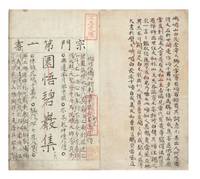
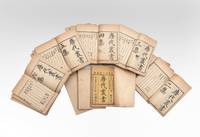
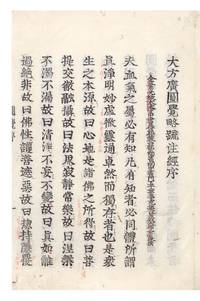
6775Eight columns per page 17 characters per column. Three sizes of type. 42; 41; 38; 40 folding leaves. Four vols. Large 8vo 280 x 195 mm. orig. dark wrappers dyed with persimmon juice shibubiki new stitching. Enryakuji Temple Mount Hiei: mid-Kan'ei ca. 1626-30. An unrecorded moveable type edition of the commentary and subcommentary of Zongmi 780-841 on the Sutra of Perfect Enlightenment. This is a rare example of an Eizan-ban a book printed with moveable type at the temples on Mount Hiei outside of Kyoto where Enryakuji Temple one of the most important monasteries of Japan and the headquarters of the Tendai sect of Japanese Buddhism is located. Printing began there in the 13th century. "There were few of these printed books in the medieval period perhaps due to the dominance of Kyoto itself as a printing centre.Eizan printing came into its own on a large scale only from the end of the sixteenth century with the introduction of movable-type printing. Typographic printing flourished at various temples on Hieizan from the Keicho to Kan'ei periods 1596-1644 and with the publication of Chinese works as well as Tendai scriptures publication and distribution at Hieizan began to develop into the beginnings of a commercial enterprise."-K.B. Gardner "Centres of Printing in Medieval Japan: Late Heian to Early Edo Period" reprinted in Brokaw & Kornicki eds. The History of the Book in East Asia 2013 p. 450. The writings of Dushun 557-640 Zhiyan 602-68 Fazang 643-712 and Zongmi are considered by many as the "crowning glory of Chinese thought. marking the maturation of a process by which the Chinese made Buddhism their own."-Bowring The Religious Traditions of Japan 500-1600 p. 104. Zongmi was a Tang dynasty Buddhist scholar monk; he was the fifth patriarch of the Huayan school as well as a patriarch of the Heze lineage of Southern Chan. The Sutra of Perfect Enlightenment was the scripture that led Zongmi to enlightenment in 808; he resolved to prepare a commentary and subcommentary on the text which he accomplished fifteen years later. As stated above this moveable type edition is unrecorded. Kawase in his bibliography of Japanese moveable type editions records another printing of this text dated 1626 but with ten columns per page and 20 characters per column Vol. I p. 304. Sorimachi in his amazing 40th anniversary catalogue of moveable type books issued in 1972 describes what appears to be yet another moveable type printing of this text with the same number of columns and characters as the Kawase example but using three different sizes of type they might be the same printing. It is described as four parts in two volumes in their original bindings printed in mid-Kan'ei ca. 1630 and with a slightly different title. The NIJL records no moveable type editions and only the woodblock-printed Seihan edition of 1644. On the printed title-labels of the second and fourth volume covers the title is given as Engaku ryakusho chu. The labels on Vols. I and III are no longer present. As mentioned above the wrappers have been dyed with persimmon juice which serves a dual purpose: to strengthen the paper and act as an insect repellent. Nevertheless the wrappers are somewhat wormed. Each volume has some worming but this set is in rather fresh and appealing condition. unknown books
718743 parts in 16 vols. 8vo orig. wrappers new stitching. China: Zhan yi tang Prefaces dated 1790 & 1791. First edition. Zhao 1727-1814 "was an important poet and historian from Yanghu. He was born poor and supported himself at first as a private tutor. In 1761 he passed the imperial examination and in a long career served in many official capacities. Upon being appointed the prefect of Zhenan Guanzi province in 1766 he showed himself to be a reformer dedicated to helping the common people. From 1784 to 1786 he became the director of the Anting Academy in Yangzhou. In addition to writing a collection of 'poetry talk' critical notes on poetry he wrote a dynastic history histories of military campaigns and other important works. He was a friend of Yuan Mei 1716-1798 and was considered along with Yuan Mei and the poet and playwright Jiang Shiquan 1725-1785 one of the three greatest poets of Southern China."-Barnstone & Chou eds. The Anchor Book of Chinese Poetry p. 339. The present work is a collection of Zhao's miscellaneous poetry and writings on classical Chinese literature especially poetry history and historiography one volume is devoted to a discussion of the Tongjian Gangmu of 1172 politics dynastic history philosophy and various other subjects. One of the foremost historians of his day he was among the first to turn his attention to the larger more fundamental problems of historiographical method and social and institutional history. Fine set. ❧ Nienhauser ed. The Indiana Companion to Traditional Chinese Literature Vol. 1 pp. 229-30-"Chao's literary talents were manifold encompassing those of poet essayist calligrapher and critic. He mastered many poetic forms including both old- and new-style verse.Chao was a prolific writer producing many works on a great variety of subjects including history politics and philosophy.". unknown books
1958132836Köln Berlin: Kiepenheuer & Witsch 1958. Octavo pp. 1-6 7-253 254 255: ad 256: blank original green cloth front and spine panels printed in red top edge stained light gray. First German edition first printing. A translation of WE 1924 a famous Russian dystopian novel. A scarce edition of this novel. A fine copy. #132834 Kiepenheuer & Witsch unknown books
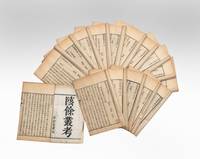
7036Printed in Chinese with Japanese reading marks. 11 columns per page 21 characters per column. 79; 59; 51; 49; 67 folding leaves. Ten parts in five vols. 8vo 240 x 149 mm. orig. brown wrappers new stitching. Japan: mid-Muromachi ca. 1440-50. An extremely rare and important "mid-Muromachi" Gozan-ban edition of The Blue Cliff Record in Chinese: Pi yen lu a collection of Chan Buddhist koan. These were verbal tests used to practice or test a student's progress in Zen compiled in the Song Dynasty and expanded by the great Northern Song Chan master Yuanwu Keqin 1063-1135 abbot of Tianning Wanshou Chan Monastery in Beijing. The text was first printed in China in 1125 or 1128 and has long been celebrated for both its startling beauty and profound complexity. Around 1140 one of Yuan Wu's successors Ta Hui destroyed the printing blocks and copies of the Pi yen lu because the work's rapid and widespread popularity made him fear that its beauty of expression would distract its readers from seeking enlightenment directly within themselves. The text was brought back from China by Dogen 1200-53 the Japanese Buddhist priest who was a founder of the Soto school of Zen in Japan. He had studied in China for four or five years and returned to stay at the Kenninji temple where he introduced many texts. This text was first printed in Japan about 1336-50 early-Nanbokucho by Gyokuho Shorin at the Kenninji; there is a copy at the National Diet Library. Our edition is a reprint of that first Japanese edition using the same woodblocks with minor changes. A later edition appeared in the Donald and Mary Hyde sale lot 65. "For some time Chan monks had been in the habit of extracting snippets from the 'records' yulu of past masters isolated them as 'ancient precedents' and commenting on them sometimes in verse sometimes in prose. By the mid-eleventh century the core situation was known as a 'case to be investigated' or a gong'an. The process was incremental and difficult to stop. Yuanwu's Emerald Cliff Record for example took a previous eleventh-century collection entitled Master Xuetou's verses on a hundred old cases and added an introduction and extensive commentary to each 'case' sometimes also dropping in comments on the appositeness or more usually inappositeness of the relevant verse so becoming in his turn 'magistrate.' A gong'an collection therefore reveals many layers all of them dedicated to undercutting the stability of language while at the same time playing a complex game of competing authorities. Herein lies their fascination."-Richard Bowring The Religious Traditions of Japan Cambridge U.P. p. 301. "Gozan-ban is a general term embracing all those books published by monks of the Zen sect chiefly at the five Zen monasteries at Kamakura and the five at Kyoto over a period of more than 200 years between mid-Kamakura and late Muromachi. The appearance of the printed page in most Gozan editions follows a distinctly Chinese style. The effect is somewhat dense and crowded caused by packing the Chinese characters tightly together with more regard for economy of space than for aesthetic effect. In this the Gozan editions differ markedly from all other early Japanese printed books which are more generously spaced. The reasons for this are twofold: the books tend to be chiefly reprints of Chinese song and Yuan editions and during the fourteenth century many Chinese blockcutters came over from the continent and practised their craft of a semi-commercial basis and on a fairly large scale."-K.B. Gardner "Centres of Printing in Medieval Japan: late Heian to early Edo period" in British Library Occasional Papers 11. Japanese Studies ed. by Yu-Ying Brown London: 1990 p. 164. PROVENANCE: This copy has the seals of Hirokata Yashiro 1758-1841 "Shinobazu Bunko"; Awa no Kuni Bunko; and Goroza Uchino b. 1873 "Kyotei Bunko". It later belonged to the great collector and bibliographer of early Japanese books Kazuma Kawase 1906-99 and has his seal. The chitsu has Kawase's manuscript title label stating in trans.: "Gozan-ban. Hekiganroku. Mid-Muromachi edition. Shinobazu Bunko provenance. Kazuma put the title on this label" also with his seal. There are four Prefaces: the first is undated the second dated 1300 the third dated 1305 and the fourth is dated 1304. Two leaves of manuscript probably written by Yashiro have been inserted at the beginning of Vol. I. They provide a commentary and a sort of title-page the work was issued without a title. Following Part I there are another two leaves of manuscript relating to this text. Following the tenth part are five Afterwards dated 1125 undated 1302 1317 and 1317. In fine condition all contained in a modern wooden box. The top of the box has been covered in a most attractive silk brocade. A few natural paper flaws and minor staining. Berkeley has an edition of this text but because of the very vague WorldCat cataloguing it is impossible to tell which exact edition it is. ❧ Kornicki Language Scripts and Chinese Texts in East Asia p. 245. unknown books
711427 folding leaves. 8vo 234 x 158 mm. orig. wrappers manuscript title label on upper cover new stitching. Japan: on final page in trans.: "Copied 1854 by Wakabayashi in today's Tottori Prefecture a member of the Shinshoken." Manipulative therapy has a long history in Japan. "Healing of the sick through rubbing of the body was known to the earliest Japanese physicians who brought the art to a high state of development. Massage was early pre-Nara period linked with the treatment of fractures and bandaging and remained one of the chief factors in the care of the body sharing with mineral baths acupuncture gymnastics and 'deep breathing' in the preliminary development of physical therapy in Japan.The achievements and learning in the practice of massage also contributed to the establishment in the latter part of the 17th century of the 'Seikotsu-Jutsu' which was a system of treatment for fractures and dislocations."-Mestler A Galaxy of Old Japanese Medical Books II pp. 484-85. Gento Yoshiwara d. 1800 was one of the three most important orthopedic specialists in Japan during the final years of the 18th century along with Bunken Kagami and Genka Ninomiya. Yoshiwara whose trade name or mark was "Kyoinsai" studied both Dutch medicine in Nagasaki and Chinese medicine and was greatly influenced by the Chinese Dao yin treatment of massage and exercise. Unlike the works of Kagami and Ninomiya Yoshiwara's most important work - "Seikotsu yoketsu" - remained in manuscript as it was restricted to students of Yoshiwara's school; the present manuscript contains a reworking of that text. The beginning of the main part of the text on the fifth leaf provides the name of Yoshiwara and the location of his school in Hizen province today's Nagasaki Prefecture and the name of two disciples Wada and Abe. The text describes 13 types of treatment in detail including treatments of dislocated shoulders fingers and jaws; spinal stretching dealing with hip problems etc. Many of these treatments have rather fanciful names: "Windmill" "Bear Hug" "Bird's Wing" "Control the Wind" "Crane Feather" "Playing with a Fish" "Worm" "Playing with a Jewel" "Tail of the Bird" "The Snail Method" "Riding on the Dragon" "Swallow's Tail" etc. Some relatively minor worming at the beginning and light marginal dampstaining. ❧ Mestler A Galaxy of Old Japanese Medical Books III p. 152. unknown books
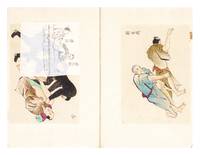
691531 finely hand-colored mounted drawings with eight fine black & white brush drawings on slips also pasted on. 36 folding leaves of which 20 are text. 8vo 253 x 180 mm. orig. patterned wrappers manuscript title label on upper cover new stitching. Japan: late Edo. Gento Yoshiwara d. 1800 was one of the three most important orthopedic specialists in Japan during the final years of the 18th century along with Bunken Kagami and Genka Ninomiya. Yoshiwara studied both Dutch medicine in Nagasaki and Chinese medicine being greatly influenced by the Chinese Dao yin treatment of massage and exercise. Unlike the works of Kagami and Ninomiya Yoshiwara's most important work - "Seikotsu yoketsu" - remained in manuscript as it was restricted to students of Yoshiwara's school Ninomiya was a student. Yoshiwara's trade name or mark was "Kyoinsai." Following the 20 leaves of manuscript text which describe 13 types of treatment in detail is a series of 31 finely drawn and hand-colored illustrations of treatments and manipulations including fixing dislocated shoulders fingers and jaws; spinal stretching dealing with hip problems etc. Many of these treatments have rather fanciful names: "Windmill" "Bear Hug" "Bird's Wing" "Control the Wind" "Crane Feather" "Playing with a Fish" "Worm" "Play with a Jewel" "Tail of the Bird" "The Snail Method" "Riding on the Dragon" "Swallow's Tail" etc. An additional eight smaller pasted-on black & white drawings show further treatments. A number of pharmaceutical ointments and plasters are described. In fine and fresh condition although the outer upper corner of all the leaves has been a little nibbled by a mouse. The scribe of this manuscript has used one incorrect character when spelling Yoshiwara's name on the first leaf giving his name as "Yoshio." ❧ Mestler A Galaxy of Old Japanese Medical Books III p. 152. unknown books
18941399253D Cong. 2d Sess.: SED27. 1894. 101pp Disbound some pages loosened else Very Good. SED27. unknown books
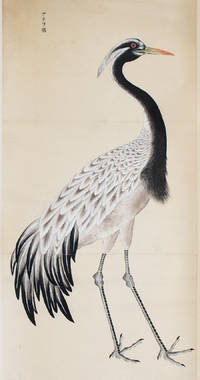
6952Scroll 420 x 12000 mm. with elaborate silk brocade endpaper at beginning. Japan: 1880-86. This beautifully rendered scroll of natural history paintings was executed with one exception by Akio or Keigu Yamamoto 1827-1903 Confucian scholar doctor botanist and highly gifted artist. He was born in Kyoto the son of the prominent doctor and botanist Boyo Yamamoto 1778-1859 the direct disciple of Ono Ranzan 1729-1810 the famous professor of botany who wrote a series of classic botanical books. Keigu "continued his father's work in his private school in Osaka and spent his time organizing meetings that were regularly attended by both honzogaku amateurs and Japanese biologists."-Federico Marcon The Knowledge of Nature and the Nature of Knowledge in Early Modern Japan p. 301. Keigu travelled widely throughout Japan drawing plants and animals. He gave botanical instruction to the Meiji emperor and other members of the royal family. Keigu also wrote several standard works on materia medica and left many sketch books and scrolls which entered the Kyoto rare book trade in 1932; some of these were published only in the 1980s. All of his sketch books and scrolls offered valuable and unique information regarding native plants and animals as well as those that had been introduced into Japan. Our scroll contains 14 very finely executed color paintings of plants birds and animals. The paintings are quite unique in their remarkable spaciousness. For instance the image of the octopus is 1410 mm. long. The images include a most unusual morning glory three joined sheets and 1190 mm. long; an edible yellow lily two joined sheets 800 mm.; an ungei flower two joined sheets 795 mm.; a magnificent red toki a now-endangered crane species three joined sheets 765 mm.; a large akowa tsuru another species of crane three joined sheets 815 mm.; a young white crane three joined sheets 935 mm.; a sea lion umiuso painted in many shades of delicate black two joined sheets 545 mm.; a carp two joined sheets 597 mm.; an octopus four joined sheets; a chameleon three joined sheets 844 mm. dated "1880"; a deer antler two sheets 545 mm.; a "Dutch" dog two sheets 545 mm.; a lion seen at exhibitions in Tokyo and Kyoto two sheets 640 mm. with a seal and note stating this was the work of "Ariyoshi" dated "1886"; and two camels two sheets 545 mm. long. Four of the paintings have the signature and seal of Yamamoto and another painting - the final - has the seal only. Three of the paintings have additional text by Yamamoto regarding where seen and painted alternative regional names date etc. Very fine condition preserved in a new wooden box. All but the penultimate painting are the work of Yamamoto. unknown books
192821819NY: Schimer 1928. First Edition. Glory Road only. Dedicated to Paul Robeson. 4to self wraps pp. 16. Illustrated cover by Bobri. Moderate wear to the covers and partially disbound good. Wolfe was a Roumanian who found a reminder in American Blacks of the roving gypsies of his native country. He wrote a number of songs on Black subjects. Schimer unknown books
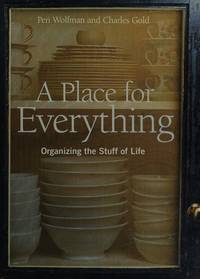
1999UWOLPLA00fpClarkson N. Potter 1999. Very Good. Wolfman Peri. A Place for Everything: Organizing the Stuff of Life. Gold Charles. New York NY: Clarkson N. Potter 1999. 192pp. Illustrated. 4to. Hardcover. Book condition: Very good. Top front corner lightly bumped. Dust Jacket Condition: Very good. Edges lightly rubbed. Clarkson N. Potter hardcover books
199455792NY:: Clarkson Potter. Fine in Fine dust jacket. 1994. Hardcover. 0517588285 . Color photographs by Charles Gold throughout. First printing. Fine in a fine dust jacket. . Clarkson Potter, hardcover books
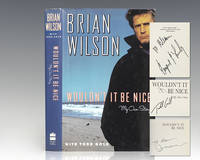
199166405New York: HarperCollins 1991. First Edition. Hardcover. Near fine/Fine. This autobiography by the creative force of the Beach Boys follows Wilson's quick rise to worldwide fame his descent into drug-assisted psychosis and his subsequent yet shaky recovery. Signed by Wilson on the half-title. Octavo. Light bump to the bottom corner of the rear board; else near fine in a clean and bright dust jacket. HarperCollins hardcover books
1991119333New York: HarperCollins Publishers 1991. First edition of Brian Wilson's candid autobiography. Octavo original half cloth. Presentation copy inscribed by Brian Wilson on the half-title page "To Glen Brian Wilson" signed by Todd Gold on the title page and inscribed by Dr. Eugene Landy on the dedication page "To Glenn Eugene E. Landy." The recipient Glenn Goldman founded Book Soup in 1975 an independently owned bookstore on Sunset Strip in West Hollywood specializing in art music film photography design and fiction. American psychotherapist Dr. Eugene E. Landy was best known for his unconventional psychological treatments especially for his treatment of Wilson in the 1970s and 80s in which he essentially took control of his life monitoring him 24 hours a day with a team of assistants to keep him sober. The treatment was later deemed unethical by Californian courts and was later dramatized in the 2014 biographical film Love & Mercy in which Landy is portrayed by Paul Giamatti. Wilson dedicated the present volume to Landy. Fine in a fine dust jacket. Jacket design by Suzanne Noli. Jacket photograph by Mark Hanauer. A unique example. Wilson's first memoir Wouldn't It Be Nice not only documents the Beach Boys' rise to fame but their founder's twenty year struggle with drug addiction alcoholism obesity and mental illness. Filled with shocking revelations the book reveals the inspiring story of one of the greatest musical geniuses of the 20th century. HarperCollins Publishers hardcover books
1972145005Burbank CA: Warner Brothers 1972. Original maquette demonstrating an early poster design for the 1973 film featuring a vintage silver gelatin photograph of the legendary streetlit scene of Father Merrin's first arrival to Georgetown in the film mounted to the poster.<br/><br/>A minimal design without the credits information seen in the completed original "purple style" poster variant and with a proposed but ultimately unrealized release date of Christmas Day shown at the bottom margin. This maquette compares both to the "purple style" poster in its use of said purple text but also to the original black and white "special poster" design both in size and compositional austerity. The "special poster" measured 25 x 19 inches as opposed to the standard 27 x 41 inches for the one sheet and stated nothing but the film's title and the stark photo of Father Merrin. <br/><br/>Based on the 1971 novel by William Peter Blatty and written for the screen by Blatty. One of the great genre films of the 1970s that accomplished the uncommon feat of being an over-the-top sensation upon its release and gaining subsequent status as a classic with a strangeness and depth supplied by Ellen Burstyn and Max von Sydow that only increases with repeated viewings. Another distinction was that it walked away with two Oscars including Best Screenplay for Blatty along with eight nominations including Best Picture a feat nearly unheard for a horror film. <br/><br/>Set in Washington DC and shot on location in Washington DC notably Georgetown University New York City and Mosul Iraq. <br/><br/>18 x 12.5 inches mounted on a 30 x 20 inch mat. Black with the vintage black and white photo of Father Merrin affixed at the center and a hand painted release date. Title letters are hand cut from purple paper and affixed in place. Good condition with water damage to the bottom three inches of the mat and with soil and loss of glue adhesion to the white mat. Archivally matted and framed in a museum-quality frame with UV glass.<br/><br/>National Film Registry. Clover "Men Women and Chainsaws. Warner Brothers unknown books
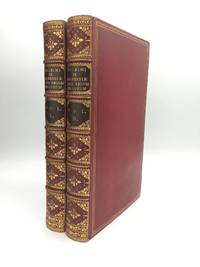
184071584London: Sumptibus Societatis 1840. First Edition. Hardcover. Very good. William of Malmesbury's Deeds of the English Kings is one of the great histories of England and one of the most important historical works of the European Middle Ages. Although its focus is national its scope encompasses most of Western Europe and beyond providing a full-scale account of the First Crusade. Apart from its formidable learning it is characterized by narrative skill and entertainment value with topics including unpowered flight and Henry I's zoo. This edition is edited by English archivist and antiquary Thomas Duffus Hardy 1804-78 from the early 12th century manuscript. The text is in Latin with Hardy's preface footnates shoulder notes and an index in English. From the library of John Patrick Crichton-Stuart 3rd Marquess of Bute 1847-1900 the industrial magnate antiquarian and philanthropist whose vast inheritance reportedly made him the richest man in the world with his armorial bookplate to each front pastedown. Tall octavo two volumes. Sumptuously bound in full red morocco with decorative gilt stamping five raised bands black leather onlays ornamental dentelles and marbled endpapers. The spines are darkened just a touch with some light rubbing to the corners and tips. A striking set. Sumptibus Societatis hardcover books
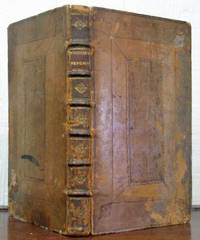
17091897London: Printed for E. Sanger at the Post-House at the Middle Temple-Gate E. Curll at the Peacock without Temple-Bar and J. Pemberton at the Golden-Buck against St. Dunstan's-Church Fleet-Street 1709. 1st edition. Period full panelled calf binding. Red speckled edges. Wear to base of binding's boards. Joint leather starting. Bookplate to front paste-down and period inscription to ffep. Unobtrusive worming to gutter of last 8 gatherings. An About VG - VG copy. 6 vii 1 blank 101 101 - 112 112 105 - 162 161 - 164 167 - 212 213 - 226 213 - 310 32 pp. Initial imprimatur leaf. Text continuous despite paginatiron irregularities. 31 page Index at rear with Publisher advert last page. Head- tailpieces. Decorative initial captial letters. Folio. 13-3/4" x 8-3/8" <br/><br/> Printed for E. Sanger at the Post-House at the Middle Temple-Gate, E. Curll at the Peacock without Temple-Bar, and J. Pemberton hardcover books
166023678London: Printed by John Redmayne for Philip Chetwin 1660. 1st edition Abbott W. Bib. of O. Cromwell #1060; Halkett and Lang IV 107 attributing the work's publication to Fiennes; Wing W-1988. Period full calf. A Gd copy minor worming to spine/A2 partially detached lower portion/lower corner lacking from leaf E3 does not affect text. Occasional period marginal annotation. 6 112 pp 8vo: A4 -A1 presumed a blank B - 4U4 4X - 4Z2. <br/><br/>Whitelocke's account of the Committee deliberations in which Cromwell ultimately declined to assume the mantle of 'king'. Printed by John Redmayne for Philip Chetwin unknown books
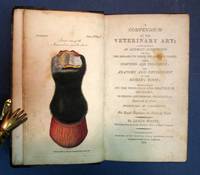
180229918Canterbury: Printed by W. Bristow for J. Badcock 1802. 1st edition Canterbury issue. Period brown half-sheep binding with marbled paper boards. Some rubs & general wear to binding. Period pos to ffep. A VG copy. vi 7 - 20 232 pp. Illustrated with 15 copperplate engravings 4 color and the 6th Fig 1 serving as frontis. 12mo signed in 6s. 6-3/4' x 3-7/8" <br/><br/> Printed by W. Bristow, for J. Badcock hardcover books
1973S9238Ottawa:: Royal Society of Canada 1973. 1973. Tall 8vo. xiii 403 pp. Figs. refs. index. Blue cloth gilt-stamped spine title; sine sun-faded corners bumped. Ink stamps of Stanley L. Miller on all three edges. Scarce. Very good. Royal Society of Canada, 1973. hardcover books
7194164 stories in six series bound in 18 vols. Small 8vo orig. wrappers new stitching. China: Bian shan lou cang ban 1806. An early edition of Tang Dynasty 618-907 fiction containing 164 stories some of which are concerned with gastronomy medicine calligraphy and tea. Others concern extraordinary events and strange spirits. Nice set. Scarce. unknown books
19476055131947. 8 3/4" x 11 5/8"; 1 page recto and verso; very good fresh; 1947. Rare and unique! Signed on the front by: Agnes Moorehead; Brian Donlevy; Robert Walker; Tom Drake; Beverly Tyler; Audrey Totter; Hume Cronyn; Hurd Hatfield; Joseph Calleia; Godfrey Tearle; Jonathan Hale; Henry O'Neill; Warner Andersen; Art Baker; Ludwig Stossel; Arno Frey; William Wright; Erville Alderson; Nella Walker; Barry Nelson; Moroni Olsen; Trevor Bardette; Robert Considine - story; Frank Wead - writer; Ray June - Cinematographer; Stanley Goldsmith - assistant director; Joe Edmondson - sound technician; Samuel Marx - producer; Signed on the back by: George Boemler - film editor; H.T. Wensel Harry - technical advisor; Tessa Primock - script; Gertrude Kupwood Ward; Hans Peters - art direction; Dick Campbell - sound; Frank Myers - assitant director; and many others! Although contemporary sources indicate that Leon Ames and Agnes Moorehead were cast they did not appear in the released film. The film marked the motion picture debut of Guy Williams who played the title character in the Walt Disney television series "Zorro" 1957-1959. According to HR news items in June 1946 a controversy erupted when former First Lady Eleanor Roosevelt objected to the casting of Lionel Barrymore as Franklin D. Roosevelt alleging that the actor had made desparaging remarks about the late president. Production on the film had already begun when the studio decided to replace Barrymore's scenes with actor Godrey Tearle. "The Beginning or the End" was released February 19 1947 directed by Norman Taurog. Signed by Authors. No Binding. Very Good. paperback books
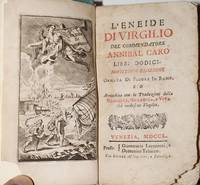
1750002388Venezia: Giammaria Lazaroni e Domenico Tabacco 1750. Pebbled Half Cloth Faux Leather over Paper Pastedown on Boards. Good Minus. 8vo. 20 568 pp. With fifteen woodcut plates with frontis one for each canto of the Aenied and one for the Bucolica and Georgica respectively. Some soiling throughout. All leaves of the Bucolica and a few of the Georgica have severe wormholing in the lower corner with only trivial touching of text. A few other leaves have corners overtrimmed or with loss. Still an uncommon edition with only three copies located on OCLC. <br /><br /> Giammaria Lazaroni, e Domenico Tabacco hardcover books
17253447London: Np 1725. Second English language edition. Very good. Second English edition see below. Sm. 8vo. 680pp. Modern 1/2 black morocco gilt over marbled boards. Title lightly soiled. A few leaves closely trimmed at top margin. Foxon R264 noting "all copies seen were issued in Rooke's "Select Translations" 1726. It may never have been separately published." The pagination of the 1723 first printing is 12431pp. Np hardcover books
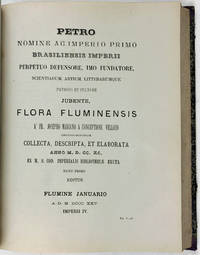
188145183Flumine Januario / Rio de Janeiro: Typ. Economica 1881. First complete edition. Half black morocco over marbled boards gilt spine title. A very good copy boards rubbed repaired tear and closed tear on Volume V half title and title page. xii vii 467 1 pp. 4to. Published in and taking up the entire volume of Archivos do Museu Nacional do Rio De Janeiro. Volume V. 1880 1881. Added title page: Petro nomine ac imperio primo Brasiliensis imperii perpetuo defensore . jubente Flora fluminensis a' fr. Josepho Mariano a Conceptione Vellozo Ordinis monorum collecta descripta et elaborata anno M.D. CC. XC. Ex M.S. cod. Imperialis bibliothecæ eruta nunc primo etitur. Flumine Januario A.D.M. DCCC. XXV imperii IV. José Xavier Veloso 1742-1811 born in what is now Minas Gerais Brazil was ordained in 1766 in the convent of St. Anthony in Rio de Janeiro where he studied philosophy and theology later geometry in San Paulo and finally natural history. He collected plants animals and minerals in the Rio de Janeiro area from 1783 to 1790 at which time he moved to Lisbon where he worked at the Royal Academy of Sciences while preparing Florae Fluminensis his greatest work for publication. Using the Linnaeus' system of sexual classification of plants he prepared very highly detailed texts and 1700 prints many of them of new species. But the publication of the work was beset by problems. First sent to Venice the plates were never completed. Later the French invasion of the Iberian peninsular sent the Portuguese government then Veloso and his manuscripts into exile in Brazil where he died in 1811. In 1825 an abbreviated version of the text was published followed by the eleven volumes of the Icones in 1827 of which few copies survive. The complete text was not published until this edition in 1881. Bound with and proceeded by Archivos do Museu Nacional do Rio De Janeiro. Volume IV. 1879. Rio 1881. viii 151 1 pp vii plates. Folded color plate split at fold. Volume subtitle: Insectologia. Includes Müller Fritz: A metamorphose de um insecto diptero among other works. Rodrigues 2473. Sabin 98833n. For the shorter version of 1825 see: Barba de Moraes II p. 343. Pritzel 468. Jackson 377. Innocencio V.5 4258; V.13 p.122. Also see Nissen BBI 2046. Typ. Economica hardcover books
1719LV2044Lugduni Batavorum Leiden Netherlands:: Apud Samuelem Luchtmans 1719. 1719. 8vo. xl 748 118 pp. Engraved half title plate by F. Bleyswyk Bleyswyck red and black title with printer’s device woodcut decorative initials and tailpieces index; occasional light foxing. Original gilt and blind-stamped full calf five raised bands with gilt-stamped maroon spine piece; worn joints cracked but reinforced with painted Kozo paper. Ownership blind emboss stamps on first and last few leaves including title. Binding worn internally very good. This Compendium of Roman History by Velleius is an early edition of Dutch classical scholar Pieter Burman the elder. His history written in a rhetorical style covered the period from the end of the Trojan War to the death of Livia in 29 A.D. and most useful for the period from the death of Julius Caesar in 44 B.C. to the death of Augustus in 14 A.D. Bryan Michael. Bryan’s Dictionary of Painters and Engravers Volume 1. G. Bell 1903. p. 145. "Velleius Paterculus’ short work is the earliest surviving attempt on the part of a post-Augustan historian to survey the history of the res publica from its origins to his own times. In a period from which no other contemporary historical narrative survives in more than meagre fragments Velleius’ work is uniquely important. It is a critical counter to the later accounts of Tacitus Suetonius and Cassius Dio not simply because it offers a different view of Tiberius but because Velleius saw continuity where later authors saw only radical change which destroyed the Republic and put monarchy in its place. For other reasons too Velleius occupies a unique position in Roman historiography." – See: Eleanor Cowan ed. Velleius Paterculus: Making History Classical Press of Wales 2011. Apud Samuelem Luchtmans, 1719. hardcover books