TORRE Y FRANCO - ROMERO, Lucas de.MareMagnum

15 963 résultats
Madrid, 1924 [Separata del "Boletín de la Real Academia Española"]. 4to. mayor; 46 pp. Cubiertas originales.
Córdoba, Caja Provincial de Ahorros y Asociación de Amigos de Córdoba, 1984. 4to.; VII + 181 pp. con XX reproducciones de documentos en negro. Cubiertas originales.
Valladolid, Instituto "Isabel la Católica" de Historia Eclesiástica, 1968. 4to. mayor; VIII pp., 502 pp. y una lámina retrato Cubiertas originales.
Madrid, 1955. 4to; 4 hojas, 6 hojas, 257 folios numerados, 2 hojas. Edición limitada y numerada de 300 ejemplares., Cubiertas originales.
Madrid, Anejos del Boletín de la Real Academia Española, 1970. 4to. mayor; 267 pp. y 5 láminas. Cubiertas originales.
1959stela1012<p>Toronto: c1959. 1959. 12mo. pp. 52. profusely illus. in b/w. wrs. edges worn a couple short tears & stains to wrs. Soft cover. Good.</p> [Toronto: c1959]. paperback
Madrid, 1941 [Biblioteca Clásica de la Medicina Española]. 4to.menor; XV-342 pp. Encuadernación original en tela.
Madrid, Manuel Aguilar, 1941 ["Biblioteca de Cultura Española"]. 4to. menor; 252 pp., 2 hs. y una lámina Encuadernación original en tela estampada.
1992100135119FLAMMARION 1992 384 pages 14 8x2 2x22 8cm. 1992. Broché. 384 pages.
A clean, unmarked book with a tight binding. 144 pages.
Milano, 1951, stralcio con copertina posticcia muta, pp. 663/672 con una cartina e 10 fotografie. - !! ATTENZIONE !!: Con il termine estratto (o stralcio) intendiamo riferirci ad un fascicolo contenente un articolo di rivista, sia che esso sia stato stampato a parte utilizzando la stessa composizione sia che provenga direttamente da una rivista. Le pagine sono indicate come "da/a", ad esempio: 229/231 significa che il testo è composto da tre pagine. Quando la rivista di provenienza non viene indicata é perchè ci è sconosciuta. - !! ATTENTION !!: : NOT A BOOK : “estratto” or “stralcio” means simply a few pages, original nonetheless, printed in a magazine. Pages are indicated as in "from” “to", for example: 229/231 means the text comprises three pages (229, 230 and 231). If the magazine that contained the pages is not mentioned, it is because it is unknown to us.
1939W66073Bruxelles, Hayez 1939 94pp.avec ills., 29cm., extrait des "Mémoires publiés par l'Institut Royal Colonial Belge (section des sciences techniques), collection in-4o", tome II, br.orig., bel état
94pp.avec ills., 29cm., extrait des "Mémoires publiés par l'Institut Royal Colonial Belge (section des sciences techniques), collection in-4o", tome II, br.orig., bel état
relie, 215pp. in -folio (25 cm x 29 cm) toile sous jaquette d'editeur,cassette, tirage numerote limite, . ISBN 9020913255. illustrations photographique en noir et couleurs in et hors texte, bon etat !!
Teruel, Editorial "Lucha", 1976. 4to.; III-330 pp. Cubiertas originales.
Teruel, Editorial "Lucha", 1977. 4to.; V-273 pp. Cubiertas originales.
444 pages. Bibliography. Index. Black and white illustrations. "Explores what innovative farmers and scientists are doing now - as well as during the past fifty years - so strengthen and purify the soil on which we - and the plants and animals we live on - depend; how new, healthier, and more productive ways have been found to raise food crops, thus eliminating reliance on petrochemical fertilizers and pesticides with their serious side effects." - from dust jacket. Book clean, bright and unmarked with light wear. Moderate wear and no tears to dust jacket preserved in a clear protective cover. Nice copy of the increasingly scarce hard cover version of this classic work on healthy soil enrichment. Book
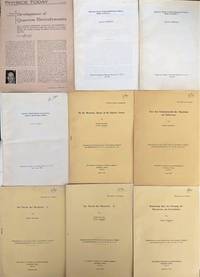
1940ST13395Tokyo:: Scientific Papers of the Institute of Physical and Chemical Research 1940. 1940. 8 offprints 1 extract. Original wrappers. From the collection of Abraham Pais. Very good. INVENTORY: 1. TOMONAGA Sin-itiro. Uber den Zusammenstoß des Mesotrons mit Elektronen. Offprint from: Scientific Papers of the Institute of Physical and Chemical Research no. 976 vol. 37 pp. 399-413 June 1940. Original yellow printed wrappers. Signed by Pais. "In 1940 Dr. Tomonaga directed his attention to the meson theory and developed the intermediate coupling theory in order to clarify the structure of the meson cloud around the nucleon." :: Nobel Lectures 1972. 2. TOMONAGA Sin-itiro. Zur Theorie des Mesotrons. I. Offprint from: Scientific Papers of the Institute of Physical and Chemical Research no. 1071 vol. 39 pp. 247-266 Dezember 1941. Original yellow printed wrappers. Signed by Pais. 3. TOMONAGA Sin-itiro. Bemerkung uber die Streuung der Mesotronen am Kernteilchen. Offprint from: Scientific Papers of the Institute of Physical and Chemical Research no. 1105 vol. 40 pp. 73-86 September 1942. Original yellow printed wrappers. Signed by Pais. 4. TOMONAGA Sin-itiro; Miyazima Tatuoki. Zur Theorie des Mesotrons. II. Offprint from: Scientific Papers of the Institute of Physical and Chemical Research no. 1103 vol. 40 pp. 21-67 August 1942. Original yellow printed wrappers. Signed by Pais. 5. TOMONAGA Sin-itiro; Miyazima Tatuoki. On the Mesotron Theory of the Nuclear Forces. Offprint from: Scientific Papers of the Institute of Physical and Chemical Research no. 1124 vol. 40 pp. 274-310 March 1943. Original yellow printed wrappers. Signed by Pais. 6. TOMONAGA Sin-itiro. Remarks on Bloch's Method of Sound Waves applied to Many-Fermion Problems. Offprint from: Progress of Theoretical Physics vol. 5 no. 4 pp.544-569 July-August 1950. Signed by Pais. 7. TOMONAGA Shin-ichiro. Elementary Theory of Quantum-Mechanical Collective Motion of Particles I. Offprint from: Progress of Theoretical Physics vol. 13 no. 5 pp.467-481 May 1955. 8. TOMONAGA Shin-ichiro. Elementary Theory of Quantum-Mechanical Collective Motion of Particles II. Offprint from: Progress of Theoretical Physics vol. 13 no. 5 pp. 482-496 May 1955. 9. TOMONAGA Sin-itiro. Development of Quantum Electrodynamics. Extracted from: Physics Today vol. 19 no. 9 pp. 25-32 September 1966. Signed by Pais. . / BIOGRAPHY: Tomonaga was a prominent Japanese physicist influential in the development of quantum electrodynamics work for which he was jointly awarded the 1965 Nobel Prize in Physics :: along with Richard Feynman and Julian Schwinger :: for the study of QED specifically for the discovery of the renormalization method. Nobel biography: Tomonaga completed work for Rigakushi bachelor's degree in physics at Kyoto Imperial University in 1929 with one of his intimate friends. Dr. Hideki Yukawa Nobel laureate. He was engaged in graduate work for three years at the same university and was then appointed a research associate by Dr. Yoshio Nishina at the Institute of Physical and Chemical Research Tokyo where he started to work in a newly developed frontier of theoretical physics quantum electrodynamics - under the guidance of Dr. Nishina. His paper on the photoelectric pair creation is well-known. Tomonaga stayed in Leipzig Germany from 1937 to 1939 to study nuclear physics and the quantum field theory in collaboration with the theoretical group of Dr. W. Heisenberg where he published a paper "Innere Reibung und Warmeleitfahigkeit der Kernmaterie" which was chosen as the thesis for Rigakuhakushi Doctor of Science at Tokyo Imperial University in December1939. In 1940 Dr. Tomonaga directed his attention to the meson theory and developed the intermediate coupling theory in order to clarify the structure of the meson cloud around the nucleon. He joined the faculty of Tokyo Bunrika University which was absorbed into the Tokyo University of Education in 1949 as Professor of Physics in 1941. It was in 1942 when he first proposed the covariant formulation of the quantum field theory in which the concept of the quantum state was generalized so as to be relativistically covariant. During the Second World War Dr. Tomonaga was interested in developing a theory of microwave systems. He solved the motion of electrons in the magnetron and also developed a unified theory of the systems consisting of wave guides and cavity resonators. As soon as the War was over Tomonaga came back to academic research again with a programme in which he was first to summarize and extend the intermediate coupling theory and secondly to apply the covariant field theory to actual physical systems. His aim was to investigate the nature of field reaction in the meson theory as well as in quantum electrodynamics. He was confident prior to the Lamb-Retherford experiment by means of a model calculation that divergence difficulty in quantumelectrodynamics could be overcome simply by handling the infinite mass and charge due to field reactions in some way or another. It was only a step further for him to develop the renormalization theory with covariant formalism in his right hand and experimental support in his left. Dr. Tomonaga was invited to the Institute for Advanced Study Princeton in 1949 where he was engaged in the investigation of a one-dimensional fermion system. Thus he first succeeded in clarifying the nature of collective oscillations of a quantum-mechanical many-body system and opened a new frontier of theoretical physics modern many-body problem. In 1955 he published an elementary theory of quantum mechanical collective motions. Dr. Tomonaga took the leadership in establishing the Institute for Nuclear Study University of Tokyo in 1955. From 1956 to 1962 he was appointed President of the Tokyo University of Education and since 1963 he has been President of the Science Council of Japan and Director of the Institute for Optical Research Tokyo University of Education. He occupies an important position in various governmental committees for scientific research and policymaking. Tomonaga's honours and awards include the Japan Academy Prize 1948; the Order of Culture 1952; the Lomonosov Medal U.S.S.R. 1964. Dr. Tomonaga is a member of the Japan Academy the Deutsche Akademie der Naturforscher "Leopoldina" and a foreign member of the Royal Swedish Academy of Science. He is a corresponding member of the Bayerische Akademie der Wissenschaften and a foreign associate of the National Academy of Science of U.S.A. Tomonaga has published widely in scientific journals on such subjects as quantum electrodynamics the meson theory nuclear physics cosmic rays and the many-body problem. His book "Quantum Mechanics" was published in 1949 and translated into English in 1963. Scientific Papers of the Institute of Physical and Chemical Research, 1940. unknown
1940S13395Tokyo:: Scientific Papers of the Institute of Physical and Chemical Research 1940. 1940. 8 offprints 1 extract. Original wrappers. From the collection of Abraham Pais. Very good. INVENTORY: 1. TOMONAGA Sin-itiro. Uber den Zusammenstoß des Mesotrons mit Elektronen. Offprint from: Scientific Papers of the Institute of Physical and Chemical Research no. 976 vol. 37 pp. 399-413 June 1940. Original yellow printed wrappers. Signed by Pais. "In 1940 Dr. Tomonaga directed his attention to the meson theory and developed the intermediate coupling theory in order to clarify the structure of the meson cloud around the nucleon." :: Nobel Lectures 1972. 2. TOMONAGA Sin-itiro. Zur Theorie des Mesotrons. I. Offprint from: Scientific Papers of the Institute of Physical and Chemical Research no. 1071 vol. 39 pp. 247-266 Dezember 1941. Original yellow printed wrappers. Signed by Pais. 3. TOMONAGA Sin-itiro. Bemerkung uber die Streuung der Mesotronen am Kernteilchen. Offprint from: Scientific Papers of the Institute of Physical and Chemical Research no. 1105 vol. 40 pp. 73-86 September 1942. Original yellow printed wrappers. Signed by Pais. 4. TOMONAGA Sin-itiro; Miyazima Tatuoki. Zur Theorie des Mesotrons. II. Offprint from: Scientific Papers of the Institute of Physical and Chemical Research no. 1103 vol. 40 pp. 21-67 August 1942. Original yellow printed wrappers. Signed by Pais. 5. TOMONAGA Sin-itiro; Miyazima Tatuoki. On the Mesotron Theory of the Nuclear Forces. Offprint from: Scientific Papers of the Institute of Physical and Chemical Research no. 1124 vol. 40 pp. 274-310 March 1943. Original yellow printed wrappers. Signed by Pais. 6. TOMONAGA Sin-itiro. Remarks on Bloch's Method of Sound Waves applied to Many-Fermion Problems. Offprint from: Progress of Theoretical Physics vol. 5 no. 4 pp.544-569 July-August 1950. Signed by Pais. 7. TOMONAGA Shin-ichiro. Elementary Theory of Quantum-Mechanical Collective Motion of Particles I. Offprint from: Progress of Theoretical Physics vol. 13 no. 5 pp.467-481 May 1955. 8. TOMONAGA Shin-ichiro. Elementary Theory of Quantum-Mechanical Collective Motion of Particles II. Offprint from: Progress of Theoretical Physics vol. 13 no. 5 pp. 482-496 May 1955. 9. TOMONAGA Sin-itiro. Development of Quantum Electrodynamics. Extracted from: Physics Today vol. 19 no. 9 pp. 25-32 September 1966. Signed by Pais. . / BIOGRAPHY: Tomonaga was a prominent Japanese physicist influential in the development of quantum electrodynamics work for which he was jointly awarded the 1965 Nobel Prize in Physics :: along with Richard Feynman and Julian Schwinger :: for the study of QED specifically for the discovery of the renormalization method. Nobel biography: Tomonaga completed work for Rigakushi bachelor's degree in physics at Kyoto Imperial University in 1929 with one of his intimate friends. Dr. Hideki Yukawa Nobel laureate. He was engaged in graduate work for three years at the same university and was then appointed a research associate by Dr. Yoshio Nishina at the Institute of Physical and Chemical Research Tokyo where he started to work in a newly developed frontier of theoretical physics quantum electrodynamics - under the guidance of Dr. Nishina. His paper on the photoelectric pair creation is well-known. Tomonaga stayed in Leipzig Germany from 1937 to 1939 to study nuclear physics and the quantum field theory in collaboration with the theoretical group of Dr. W. Heisenberg where he published a paper "Innere Reibung und Warmeleitfahigkeit der Kernmaterie" which was chosen as the thesis for Rigakuhakushi Doctor of Science at Tokyo Imperial University in December1939. In 1940 Dr. Tomonaga directed his attention to the meson theory and developed the intermediate coupling theory in order to clarify the structure of the meson cloud around the nucleon. He joined the faculty of Tokyo Bunrika University which was absorbed into the Tokyo University of Education in 1949 as Professor of Physics in 1941. It was in 1942 when he first proposed the covariant formulation of the quantum field theory in which the concept of the quantum state was generalized so as to be relativistically covariant. During the Second World War Dr. Tomonaga was interested in developing a theory of microwave systems. He solved the motion of electrons in the magnetron and also developed a unified theory of the systems consisting of wave guides and cavity resonators. As soon as the War was over Tomonaga came back to academic research again with a programme in which he was first to summarize and extend the intermediate coupling theory and secondly to apply the covariant field theory to actual physical systems. His aim was to investigate the nature of field reaction in the meson theory as well as in quantum electrodynamics. He was confident prior to the Lamb-Retherford experiment by means of a model calculation that divergence difficulty in quantumelectrodynamics could be overcome simply by handling the infinite mass and charge due to field reactions in some way or another. It was only a step further for him to develop the renormalization theory with covariant formalism in his right hand and experimental support in his left. Dr. Tomonaga was invited to the Institute for Advanced Study Princeton in 1949 where he was engaged in the investigation of a one-dimensional fermion system. Thus he first succeeded in clarifying the nature of collective oscillations of a quantum-mechanical many-body system and opened a new frontier of theoretical physics modern many-body problem. In 1955 he published an elementary theory of quantum mechanical collective motions. Dr. Tomonaga took the leadership in establishing the Institute for Nuclear Study University of Tokyo in 1955. From 1956 to 1962 he was appointed President of the Tokyo University of Education and since 1963 he has been President of the Science Council of Japan and Director of the Institute for Optical Research Tokyo University of Education. He occupies an important position in various governmental committees for scientific research and policymaking. Tomonaga's honours and awards include the Japan Academy Prize 1948; the Order of Culture 1952; the Lomonosov Medal U.S.S.R. 1964. Dr. Tomonaga is a member of the Japan Academy the Deutsche Akademie der Naturforscher "Leopoldina" and a foreign member of the Royal Swedish Academy of Science. He is a corresponding member of the Bayerische Akademie der Wissenschaften and a foreign associate of the National Academy of Science of U.S.A. Tomonaga has published widely in scientific journals on such subjects as quantum electrodynamics the meson theory nuclear physics cosmic rays and the many-body problem. His book "Quantum Mechanics" was published in 1949 and translated into English in 1963. Scientific Papers of the Institute of Physical and Chemical Research, 1940. unknown books
448 pages. Undated. Possibly circa 1850s. A fascinating detailed and superbly illustrated survey of contemporary technology. Title page is followed by page one, thus book may be missing one or more leaves. Boards and spine well worn. Much foxing and staining. Text block tight. Book
1245460536.Gpaperback. Good. Access codes and supplements are not guaranteed with used items. May be an ex-library book. paperback
3098BBZürich, Büchergilde Gutenberg, o.J. Gr.-8°. 47 S. Mit zahlreichen Textillustrationen von Hans Fischer. Goldgeprägter Orig.-Pappband (Rücken gebräunt, leicht fingerfleckig).
3098BBZürich, Büchergilde Gutenberg, o.J. Gr.-8°. 47 S. Mit zahlreichen Textillustrationen von Hans Fischer. Goldgeprägter Orig.-Pappband (Rücken gebräunt, leicht fingerfleckig). + Wichtig: Für unsere Kunden in der EU erfolgt der Versand alle 14 Tage verzollt ab Deutschland / Postbank-Konto in Deutschland vorhanden +
19585883BBZürich, Käser Presse, 1958. 4°. 36 S., 2 Bl. Mit 4 Holzschnitten von Fred Bauer. Orig.-Broschur.
19585883BBZürich, Käser Presse, 1958. 4°. 36 S., 2 Bl. Mit 4 Holzschnitten von Fred Bauer. Orig.-Broschur. + Wichtig: Für unsere Kunden in der EU erfolgt der Versand alle 14 Tage verzollt ab Deutschland / Postbank-Konto in Deutschland vorhanden +, A