7 654 résultats
19852090502113717880Not Available 1985. Soft Cover. Fine. The book is in fine condition. Not Available paperback
1986Persia psg<p><strong>Persia psg</strong> Āṣaf Muḥammad HÄshim 1765 or 1766-1841; and Birgitt Hoffmann translator. <strong>Persische Geschichte 1694-1835 erlebt erinnert und erfunden = <em>Das Rustam at-tawÄrīḫ</em>: in deutscher Bearbeitung. </strong>Series: <em>Islamwissenschaftliche Quellen und Texte aus deutschen Bibliotheken; Bd. 4</em>. Two volumes bound in one. Bamberg: Verlag Aku 1986 909 pages pagination continuous bib indexes. Very heavy volume. Originally issued in paperback but they have been bound in red library buckram cloth with gilt lettering on spine. Original wrappers bound into the hardcovers. Both volumes like new the text and the binding. <strong>The set: $100.00 Box B4 May need extra postage</strong></p><p>Notes: Translation of: <em>Rustam al-tavÄrÄ«kh</em> of Muḥammad HÄshim Āṣaf by Birgitt Hoffmann.</p> Aku, hardcover
187334559Edinburgh and London: William Blackwood and Sons 1873. True First Edition Very Scarce. 8vo publisher's original red cloth lettered in gilt on the spine. 2 ads. x 130 folding map at rear. A fine copy very well preserved with minimal mellowing to the red of the spine panel the binding tight and the text-block clean. RARELY SEEN FIRST EDITION. The three papers consider: I. The Relations Between Great Britain the Protected Tribes and Ashanti with the Causes of the Ashanti War. II. The Relations and Causes Continued. III. The Topography of Ashanti and the Protectorate of the Gold Coast. A folding map of the Gold Coast and Coomassie is tipped in at the end of the book. William Blackwood and Sons hardcover
1053143 folding leaves. 8vo 240 x 170 mm. orig. patterned semi-stiff wrappers with orig. title-slip old stitching. Japan: 1791 date of Preface.<br /> <br> <br> <br /> <br /> A rare manuscript of Japanese natural studies or the “learning of roots and herbs†honzÅgaku 本è‰å¸ by ZÅ doctor and botanist 1758-1834. It was one of the major intellectual trends of the Tokugawa period with a large portion of the educated classes taking an interest in the topic. Initially inspired by the Chinese encyclopedic work Bencao gangmu 本è‰ç¶±ç›® Systematic Materia Medica Japanese natural studies came with time to focus on the natural environment of Japan in contradistinction to China. Our manuscript explicitly concerned with the mushrooms of “Our August Japan†is a case in point.<br /> <br> <br> It contains descriptions of 129 mushrooms divided into categories: wood mushrooms ground mushrooms bamboo mushrooms wood-ear mushrooms and poisonous mushrooms. Our author lists alternative names for a mushroom in question notes where it grows and describes its appearance. Literary references are given in many of the entries. Curiously despite the manuscript’s title ZÅ Han quotes from Chinese local gazetteers which often contained lists of local products.<br /> <br> <br> There is an appendix which contains four essays. discusses in turn different names of the mushroom in various parts of Japan; the etymology of the character kinoko 蕈 meaning mushroom; the method of ascertaining the poisonous character of a mushroom; and a prescription for breaking down the poison.<br /> <br> <br> ZÅ was the author of Seikei zusetsu An Illustrated Book of Agricultural Things the great agricultural and botanical work issued in the early years of the 19th century. It is an encyclopedic survey of all the agricultural products and practices of Japan. He served the Satsuma fiefdom under the lord Shimazu Shigehide<br /> <br> <br> Our text was never printed circulating only in manuscript form.<br /> <br> <br> â§ Ueno MasuzŠ上野益三 Nihon hakubutsugakushi 日本åšç‰©å¦å² Tokyo: Heibonsha 1973 p. 416. unknown
2011Q-0061725498Harper 2011-11-22. Hardcover. New. In shrink wrap. Looks like an interesting title! Harper hardcover
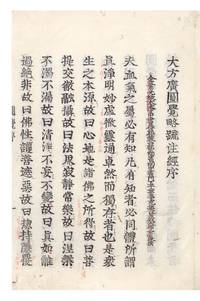
6775Eight columns per page 17 characters per column. Three sizes of type. 42; 41; 38; 40 folding leaves. Four vols. Large 8vo 280 x 195 mm. orig. dark wrappers dyed with persimmon juice shibubiki new stitching. Enryakuji Temple Mount Hiei: mid-Kan’ei ca. 1626-30.<br/> <br/> An unrecorded moveable type edition of the commentary and subcommentary of Zongmi 780-841 on the Sutra of Perfect Enlightenment. This is a rare example of an Eizan-ban a book printed with moveable type at the temples on Mount Hiei outside of Kyoto where Enryakuji Temple one of the most important monasteries of Japan and the headquarters of the Tendai sect of Japanese Buddhism is located. Printing began there in the 13th century. “There were few of these printed books in the medieval period perhaps due to the dominance of Kyoto itself as a printing centre…Eizan printing came into its own on a large scale only from the end of the sixteenth century with the introduction of movable-type printing. Typographic printing flourished at various temples on Hieizan from the Keicho to Kan’ei periods 1596-1644 and with the publication of Chinese works as well as Tendai scriptures publication and distribution at Hieizan began to develop into the beginnings of a commercial enterprise.â€â€“K.B. Gardner “Centres of Printing in Medieval Japan: Late Heian to Early Edo Period†reprinted in Brokaw & Kornicki eds. The History of the Book in East Asia 2013 p. 450.<br/> <br/> The writings of Dushun 557-640 Zhiyan 602-68 Fazang 643-712 and Zongmi are considered by many as the “crowning glory of Chinese thought… marking the maturation of a process by which the Chinese made Buddhism their own.â€â€“Bowring The Religious Traditions of Japan 500-1600 p. 104.<br/> <br/> Zongmi was a Tang dynasty Buddhist scholar monk; he was the fifth patriarch of the Huayan school as well as a patriarch of the Heze lineage of Southern Chan. The Sutra of Perfect Enlightenment was the scripture that led Zongmi to enlightenment in 808; he resolved to prepare a commentary and subcommentary on the text which he accomplished fifteen years later.<br/> <br/> As stated above this moveable type edition is unrecorded. Kawase in his bibliography of Japanese moveable type editions records another printing of this text dated 1626 but with ten columns per page and 20 characters per column Vol. I p. 304. Sorimachi in his amazing 40th anniversary catalogue of moveable type books issued in 1972 describes what appears to be yet another moveable type printing of this text with the same number of columns and characters as the Kawase example but using three different sizes of type they might be the same printing. It is described as four parts in two volumes in their original bindings printed in mid-Kan’ei ca. 1630 and with a slightly different title. The NIJL records no moveable type editions and only the woodblock-printed Seihan edition of 1644.<br/> <br/> On the printed title-labels of the second and fourth volume covers the title is given as Engaku ryakusho chu. The labels on Vols. I and III are no longer present.<br/> <br/> As mentioned above the wrappers have been dyed with persimmon juice which serves a dual purpose: to strengthen the paper and act as an insect repellent. Nevertheless the wrappers are somewhat wormed.<br/> <br/> Each volume has some worming but this set is in rather fresh and appealing condition. unknown
2044578-nnew. unknown
2044578like new. unknown
7555Ten columns per page 20 characters per column. 71 folding leaves. Two parts in one vol. 8vo 270 x 180 mm. orig. wrappers stained dark brown with fermented persimmon juice to prevent worming nevertheless wrappers a little wormed new stitching. Japan: ca. 1600-40.<br/> <br/> A rare movable type edition unrecorded by Kawase or Sorimachi and not in WorldCat. The copies at the National Diet Library and Bukkyo University Library are different movable type editions. We learn from the final paragraph on the last leaf that this edition is an exact copy of the Chinese printed edition<br/> <br/> Zhili 960-1028 was a Chinese monk of the Tiantai tradition. “In 991 he became the abbot of Ganfusi and four years later he began his residence at the monastery Bao’enyuan on Mt. Siming whence his toponym…Zhili later found himself at the center of the Shanjia Shanwai or ‘Home-Mountain/Off-Mountain’ debate that racked the Song-dynasty Tiantai school.â€â€“Buswell & Lopez The Princeton Dictionary of Buddhism p. 825.<br/> <br/> This is his commentary written in 1004 on The Essentials of the Ten Gates of Non-Duality by Jingxi Zhanran 711-82 the putative ninth patriarch of the Tiantai zong and one of the great revitalizers of the Tiantai tradition. “From the Song forward orthodox Tiantai doctrine has been based upon Zhili’s doctrinal elaborations on Tiantai teachings. Zhili was best known for his interpretation of the thought of Zhanran…who commanded great respect and imperial patronage in the Tang Dynasty…<br/> <br/> “Zhili’s doctorial elaboration on Zhanran’s teachings was generated during debates with other Tiantai monk-scholars over Zhanran’s works. The victorious faction led by Zhili was retrospectively known as the Home Mountain shanjia Teaching in contrast to their opponents labeled the Off Mountain shanwai Teaching. In the present work Zhili criticized his opponents’ interpolation of Huayan and Chan thought in Tiantai doctrine…<br/> <br/> “Zhili’s interpretation was canonized other interpretations were left in oblivion. Tiantai orthodoxy for the following centuries was defined during the Song Dynasty.â€â€“Shin-yi Chao “Chinese Religion in the Song and Alien Dynasties†in Nadeau ed. The Wiley-Blackwell Companion to Chinese Religions pp. 106-07.<br/> <br/> Zhili’s text is preceded by a Preface by his friend and fellow priest Zunshi 964-1032 who was the other pivotal figure in the Tiantai revival.<br/> <br/> A very good and crisp copy preserved in a most attractive chitsu. With some worming mostly confined to the gutter or lower margins occasionally touching a few characters. A few of the final leaves have some worming. unknown
1952192842Beijing 1952. Hardbound. Good- portfolios highly scuffed scratched; edge-worn w/ loose threads; masking tape repair & pencil notations to labels; interior linings peeling & chipped. print mats will have instances of chips tears smudgingrubbing & foxing. prints will have instances of tanning foxing smudging & occasional dampstaining; chips & tears to corners & edges. some tissue-guards present & will be of similar conditions. plates remain loose beneath the mats. two oversized navy blue textured portfolios w/ white title labels. vol1: 23 color & black woodblack prints. vol2: 39 color & black woodblack prints. 62 prints total. Interior portfolio flaps have original print listings intact. Both Parts one and two are incomplete. Part two has an incomplete set of supplements. There are also 6 random color prints with no identifaction; a few unmatted. A few prints appear to have been placed in unnumbered mats with handwritten pencil numbers so it's difficult to authentic if that is the acutal assigned print. Contents as follows with indentififers of hand-written numbering color or black printing whether a second copy of slight variation is present and other notable conditions; Part I: Print Number 5 Hand-Written Number HW Color; 11 C 12 C 15 Black with chipping 22 C 25 C with dense foxing 32 HW C 40 HW C 41 C and severely torn 45 C 49 HW C 57 two copies present with slight variations in design/printing HW C 60 C 71 HW C 73 HW C 78 HW C 88 Black and torn at lower corner/edge 89 B 92 B two copies present with slight variations in design/printing 93B two copies present with slight variations in design/printing. Part Two Contents: 114 B 123 two copies present with slight variations in design/printing C and B 124 C 129 two copies present with slight variations in design/printing C and B 135 C two copies of variations 141 C 142 C two copies of variations 144 C 146 C two copies of variations 148 C 155 C two copies of variations 159 C. Part Two Supplemental all prints Black printing: S1 S2 S10 two copies of variations S11 S12 S12 S14 S15 two copies of variations S16 with heavy tanning/foxing or dampstaining S19 S20 with creased chipped edges and dampstaining/foxing S21 HW S22 S23 and S24. Approximately 22lbs of shipping. hardcover
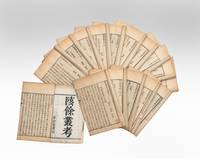
950843 parts in 16 vols. 8vo orig. wrappers new stitching. China: Zhan yi tang Prefaces dated 1790 & 1791.<br /> <br> <br> <br /> <br /> First edition. Zhao 1727-1814 "was an important poet and historian from Yanghu. He was born poor and supported himself at first as a private tutor. In 1761 he passed the imperial examination and in a long career served in many official capacities. Upon being appointed the prefect of Zhenan Guangxi province in 1766 he showed himself to be a reformer dedicated to helping the common people. From 1784 to 1786 he became the director of the Anting Academy in Yangzhou. In addition to writing a collection of ‘poetry talk’ critical notes on poetry he wrote a dynastic history histories of military campaigns and other important works. He was a friend of Yuan Mei 1716-1798 and was considered along with Yuan Mei and the poet and playwright Jiang Shiquan 1725-1785 one of the three greatest poets of Southern China."–Barnstone & Chou eds. The Anchor Book of Chinese Poetry p. 339.<br /> <br> <br> The present work is a collection of Zhao’s miscellaneous poetry and writings on classical Chinese literature especially poetry history and historiography one volume is devoted to a discussion of the Tongjian Gangmu of 1172 politics dynastic history philosophy and various other subjects. One of the foremost historians of his day he was among the first to turn his attention to the larger more fundamental problems of historiographical method and social and institutional history.<br /> <br> <br> Fine set.<br /> <br> <br> â§ Nienhauser ed. The Indiana Companion to Traditional Chinese Literature Vol. 1 pp. 229-30–â€Chao’s literary talents were manifold encompassing those of poet essayist calligrapher and critic. He mastered many poetic forms including both old- and new-style verse…Chao was a prolific writer producing many works on a great variety of subjects including history politics and philosophy.â€. unknown
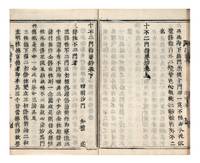
755413 columns per page 18 characters per column. 43; 49; 55 folding leaves. Three vols. 8vo 279 x 195 mm. orig. wrappers stained dark brown with fermented persimmon juice to prevent worming nevertheless wrappers a little wormed with careful repairs cont. manuscript title labels with “Kongen†written on each cover new stitching. Japan: ca. 1630-40.<br/> <br/> A rare movable type edition unrecorded by Kawase or WorldCat. Sorimachi in his wonderful Catalogue 42 1972 of movable type books describes a copy item 419 and gives a date of “mid-Kan’ei†ca. 1630-40. In his description Sorimachi states that the full title of this work is Jippunimon Kongensho or Jufunimon Kongensho. He also suggests that it might well be an “Eizan-ban†printed at the Enryakuji monastery complex on Mount Hiei which specialized in Chinese works as well as Tendai scriptures.<br/> <br/> This work contains the text in Vols. II and III of The Essentials of the Ten Gates of Non-Duality Ch.: Shibu’er men by Jingxi Zhanran 711-82 the putative ninth patriarch of the Tiantai zong and one of the great revitalizers of the Tiantai tradition. Interspersed with Zhanran’s text is later commentary by other Tiantai monk-scholars.<br/> <br/> Vol. I contains further commentaries including those of Siming Zhili 960-1028 a Chinese monk of the Tiantai tradition. “In 991 Zhili became the abbot of Ganfusi and four years later he began his residence at the monastery Bao’enyuan on Mt. Siming whence his toponym…Zhili later found himself at the center of the Shanjia Shanwai or ‘Home-Mountain/Off-Mountain’ debate that racked the Song-dynasty Tiantai school.â€â€“Buswell & Lopez The Princeton Dictionary of Buddhism p. 825.<br/> <br/> Zhili’s commentary written in 1004 was important. “From the Song forward orthodox Tiantai doctrine has been based upon Zhili’s doctrinal elaborations on Tiantai teachings. Zhili was best known for his interpretation of the thought of Zhanran…who commanded great respect and imperial patronage in the Tang Dynasty…<br/> <br/> “Zhili’s doctorial elaboration on Zhanran’s teachings was generated during debates with other Tiantai monk-scholars over Zhanran’s works. The victorious faction led by Zhili was retrospectively known as the Home Mountain shanjia Teaching in contrast to their opponents labeled the Off Mountain shanwai Teaching. In the present work Zhili criticized his opponents’ interpolation of Huayan and Chan thought in Tiantai doctrine…<br/> <br/> “Zhili’s interpretation was canonized other interpretations were left in oblivion. Tiantai orthodoxy for the following centuries was defined during the Song Dynasty.â€â€“Shin-yi Chao “Chinese Religion in the Song and Alien Dynasties†in Nadeau ed. The Wiley-Blackwell Companion to Chinese Religions pp. 106-07.<br/> <br/> A very good set preserved in a chitsu. With some carefully repaired worming throughout touching characters. In Vol. III the final 18 leaves have worming that obscures several characters per leaf. unknown
ria9798504496290_inpPaperback. New. New Book; Fast Shipping from UK; Not signed; Not First Edition; Breve estudio sobre la historia de la democracia parlamentaria y sus variables. paperback
20182-1720252262Independently published 2018. Paperback. New. 268 pages. 10.00x8.00x0.61 inches. Independently published paperback
1774ZB259278Roma: Per Giovanni Bartolomicchi 1774. Part 1 only; 12mo xi 1 327 pp later plain paper wrappers soiled and chipped previous owner's name on title text very good and an untrimmed copy. - If you are reading this this item is actually physically in our stock and ready for shipment once ordered. We are not bookjackers. Buyer is responsible for any additional duties taxes or fees required by recipient's country. Photos available upon request. Roma: Per Giovanni Bartolomicchi, unknown
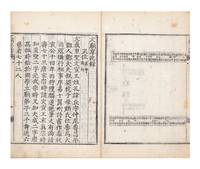
9430Four leaves of illus. 30 folding leaves. Large 8vo 305 x 208 mm. orig. yellow semi-stiff wrappers upper wrappers somewhat soiled both wrappers with some worming new stitching. Korea: 1765.<br /> <br> <br> <br /> First edition of this book published on royal command by King YÅngjo of ChosÅn. The book was compiled by Kim Kwi-ju 金龜柱 1740-86 the older brother of Queen Consort ChÅngsun 1745-1805. The royal Preface is furthermore written in Kim’s standard script calligraphy. Years after the compilation of this book factional intrigue under YÅngjo’s successor ChÅngjo led to Kim being exiled after which he soon died.<br /> <br> <br> Our book outlines sacrifices at the Confucian temple in Seoul including the KyesÅng å•“è–ç¥ and SongjÅl å´‡ç¯€ç¥ shrines. The KyesÅng shrine built in 1669 was the site of sacrifices to the fathers of several Confucian sages including Confucius and Mencius. At the temple as a whole a number of Chinese and Korean Confucian sages and worthies were worshipped. The book contains illustrations outlining the layout of the shrines with the placement of the tablets for the various Confucian scholars marked with their names.<br /> <br> <br> The royal Preface is dated 1765. Ordering the compilation of a record of past exemplars apparently made the king reflect on his own character and actions. He wrote “when I with my shallow learning recite the writings of the sages and worthies but remain unable to learn the Way of the sages and worthies and when I admire the deeds of the sages and worthies but cannot act in their manner it is like knowing what something tastes like but not get to eat it or like knowing the road but being unable to follow it. Even though I might laugh at people of the past why would people of the future not laugh at me tooâ€<br /> <br> <br> Minor worming mostly marginal towards end. See WorldCat 855527023 for a digital copy. unknown
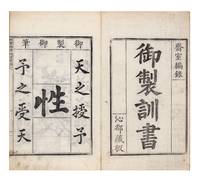
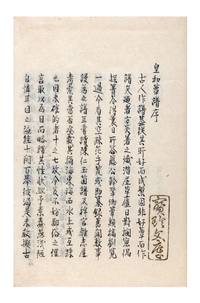
942941 folding leaves. Large 8vo 337 x 206 mm. orig. semi-stiff wrappers new stitching. Korea: Simdo æ²éƒ½ 1756.<br /> <br> <br> <br /> First edition and rare; WorldCat lists only one printed copy at Berkeley. This book of exhortations on good government with striking royal calligraphy was written by King YÅngjo or Yeongjo of ChosÅn 1694-1776 in 1756. At this time YÅngjo was commemorating the death of his father the previous king. According to Fang Chaoying 1908-85 YÅngjo then in his 65th year “could not foresee that he was to live twenty more years and so it appears that he was trying to justify himself in his own mind with regard to posterity as well as to the ancestors whom he expected to face any day†The Asami Library 115. YÅngjo offered three main principles for a king to follow: “to venerate Heaven to love the people and to treat the officials with respect†ibid.<br /> <br> <br> Large standard script characters written by the king himself are reproduced in the beginning of the book. The king’s brush records Confucian assertions such as “the following of human nature is called the Way / the cultivation of the Way is called instruction.†Accepting the Mencian dictum that human nature is inherently good the king continues: “I possess the good human nature / to realize the bright mandate of Heaven.â€<br /> <br> <br> The main text of the book is reproduced in the handwriting of the important scholar-official SÅ MyÅng-Ång or Seo Myeong-eung å¾å‘½è†º 1716-87. SÅ wrote in many genres and had a cosmopolitan outlook. For example he wrote a Preface to one of the major multilingual lexicographical works produced in ChosÅn in the 18th century see Söderblom Saarela “Mandarin over Manchu†379-80.<br /> <br> <br> Very fine and fresh copy beautifully printed.<br /> <br /> <br> <br> References<br /> <br> <br> Fang Chaoying. The Asami Library: A Descriptive Catalog. Edited by Elizabeth Huff. Berkeley: University of California Press 1969.<br /> <br> <br> Söderblom Saarela MÃ¥rten. “Mandarin over Manchu: Court-Sponsored Qing Lexicography and Its Subversion in Korea and Japan.†Harvard Journal of Asiatic Studies 77.2 2017. unknown
ria9780750701587_inpHardcover. New. New Book; Fast Shipping from UK; Not signed; Not First Edition; First published in 1993. The purpose of this book is to help those who help others. Research has consistently demonstrated that those in the professions particularly helping professions have significantly higher levels of stress and b hardcover
1993Q-0750701587The Falmer Press 1993-02-01. Hardcover. New. In shrink wrap. Looks like an interesting title! The Falmer Press hardcover
A9780750701587Hardback. New. "Burnout" and "stress" are recognizable words to individuals in the teaching profession. Based on analysis of the psychological needs of teachers this book aims to provide insights into the nature of stress and burnout outlining a programme for dealing with these issues. hardcover
1993DADAX0750701587Routledge 1993-02-16. 1. hardcover. New. 6.29x0.89x9.46. Buy with confidence. Excellent Customer Service & Return policy. Routledge hardcover
6506396Pearson Education pp. 304 1st Edition . Hardback. Used. Pearson Education hardcover
19592090202120403424Kisetsufu shoten 1959. Soft Cover. Fine. Number of books: 1 Kisetsufu shoten paperback
1980KOS01207212Bunshu shunshu NEW 1980. Soft Cover. Fine. KOS01207212 Bunshu shunshu NEW paperback
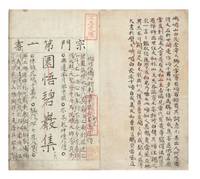
7036Printed in Chinese with Japanese reading marks. 11 columns per page 21 characters per column. 79; 59; 51; 49; 67 folding leaves. Ten parts in five vols. 8vo 240 x 149 mm. orig. brown wrappers new stitching. Japan: mid-Muromachi ca. 1440-50.<br/> <br/> An extremely rare and important “mid-Muromachi†Gozan-ban edition of The Blue Cliff Record in Chinese: Pi yen lu a collection of Chan Buddhist koan. These were verbal tests used to practice or test a student’s progress in Zen compiled in the Song Dynasty and expanded by the great Northern Song Chan master Yuanwu Keqin 1063-1135 abbot of Tianning Wanshou Chan Monastery in Beijing. The text was first printed in China in 1125 or 1128 and has long been celebrated for both its startling beauty and profound complexity. Around 1140 one of Yuan Wu’s successors Ta Hui destroyed the printing blocks and copies of the Pi yen lu because the work’s rapid and widespread popularity made him fear that its beauty of expression would distract its readers from seeking enlightenment directly within themselves.<br/> <br/> The text was brought back from China by Dogen 1200-53 the Japanese Buddhist priest who was a founder of the Soto school of Zen in Japan. He had studied in China for four or five years and returned to stay at the Kenninji temple where he introduced many texts.<br/> <br/> This text was first printed in Japan about 1336-50 early-Nanbokucho by Gyokuho Shorin at the Kenninji; there is a copy at the National Diet Library. Our edition is a reprint of that first Japanese edition using the same woodblocks with minor changes. A later edition appeared in the Donald and Mary Hyde sale lot 65.<br/> <br/> “For some time Chan monks had been in the habit of extracting snippets from the ‘records’ yulu of past masters isolated them as ‘ancient precedents’ and commenting on them sometimes in verse sometimes in prose. By the mid-eleventh century the core situation was known as a ‘case to be investigated’ or a gong’an. The process was incremental and difficult to stop. Yuanwu’s Emerald Cliff Record for example took a previous eleventh-century collection entitled Master Xuetou’s verses on a hundred old cases and added an introduction and extensive commentary to each ‘case’ sometimes also dropping in comments on the appositeness or more usually inappositeness of the relevant verse so becoming in his turn ‘magistrate.’ A gong’an collection therefore reveals many layers all of them dedicated to undercutting the stability of language while at the same time playing a complex game of competing authorities. Herein lies their fascination.â€â€“Richard Bowring The Religious Traditions of Japan Cambridge U.P. p. 301.<br/> <br/> “Gozan-ban is a general term embracing all those books published by monks of the Zen sect chiefly at the five Zen monasteries at Kamakura and the five at Kyoto over a period of more than 200 years between mid-Kamakura and late Muromachi. The appearance of the printed page in most Gozan editions follows a distinctly Chinese style. The effect is somewhat dense and crowded caused by packing the Chinese characters tightly together with more regard for economy of space than for aesthetic effect. In this the Gozan editions differ markedly from all other early Japanese printed books which are more generously spaced. The reasons for this are twofold: the books tend to be chiefly reprints of Chinese song and Yuan editions and during the fourteenth century many Chinese blockcutters came over from the continent and practised their craft of a semi-commercial basis and on a fairly large scale.â€â€“K.B. Gardner “Centres of Printing in Medieval Japan: late Heian to early Edo period†in British Library Occasional Papers 11. Japanese Studies ed. by Yu-Ying Brown London: 1990 p. 164.<br/> <br/> PROVENANCE: This copy has the seals of Hirokata Yashiro 1758-1841 “Shinobazu Bunkoâ€; Awa no Kuni Bunko; and Goroza Uchino b. 1873 “Kyotei Bunkoâ€. It later belonged to the great collector and bibliographer of early Japanese books Kazuma Kawase 1906-99 and has his seal. The chitsu has Kawase’s manuscript title label stating in trans.: “Gozan-ban. Hekiganroku. Mid-Muromachi edition. Shinobazu Bunko provenance. Kazuma put the title on this label†also with his seal.<br/> <br/> There are four Prefaces: the first is undated the second dated 1300 the third dated 1305 and the fourth is dated 1304.<br/> <br/> Two leaves of manuscript probably written by Yashiro have been inserted at the beginning of Vol. I. They provide a commentary and a sort of title-page the work was issued without a title. Following Part I there are another two leaves of manuscript relating to this text. Following the tenth part are five Afterwards dated 1125 undated 1302 1317 and 1317.<br/> <br/> In fine condition all contained in a modern wooden box. The top of the box has been covered in a most attractive silk brocade. A few natural paper flaws and minor staining. Berkeley has an edition of this text but because of the very vague WorldCat cataloguing it is impossible to tell which exact edition it is.<br/> <br/> â§ Kornicki Language Scripts and Chinese Texts in East Asia p. 245. unknown