7 654 résultats
18480008767circa 1848-9. Fine. 8.5 x 14.5 cm / 11 x 17.5 cm; <br/><br/>Having already accepted Texas as its 29th state in 1845 the U.S.A. in The Treaty of Guadalupe Hidalgo 2 February 1848 acquired 6 additional territories including Californa which eventually acquired statehood. This map was the recto of leaf 378/379 in probably a then-new history textbook. It is the same map with the identifier DLMW148 on the ImageBase of Virginia Tech University. This hand-colored in outline map shows the old boundaries and the new boundaries of Texas Upper California and Mexico and eastward to the Mississippi River and the Gulf of Mexico. unknown
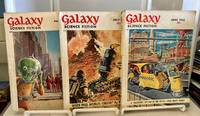
1952A48861New York NY: Galaxy Publishing Corp. . 1952. True First Edition. Magazine. Very Good-. This is a True First Edition - published in Galaxy Magazine prior to the hardback First Edition. These are three smaller than trade sized magazines. The magazines are in Very Good- condition and were ssued without dust jackets. The covers have edge wear bumping rubbing and several edge tears and nicks especially to the spine ends. The text pages are generally clean and bright though there is noticeable generalized toning. Other noteable stories include: Shipshape Home by Richard Matheson Orphans of the Void by Michael Shaara Yesterday House by Fritz Leiber and Proof of the Pudding by Robert Sheckley. "The Space Merchants is a 1952 science fiction novel by American writers Frederik Pohl and Cyril M. Kornbluth. Originally published in Galaxy Science Fiction magazine as a serial entitled Gravy Planet the novel was first published as a single volume in 1953 and has sold heavily since. It deals satirically with a hyper-developed consumerism seen through the eyes of an advertising executive. In 1984 Pohl published a sequel The Merchants' War. In 2012 it was included in the Library of America omnibus American Science Fiction: Four Classic Novels 1953–1956. Pohl revised the original novel in 2011 with added material and more contemporary references. " from Wikipedia; Galaxy Magazine; Cover Art; Pictured 7/3/24 . Galaxy Publishing Corp. unknown
1975264336Herb Gold 1975. Ephemera. Zigler served as Press Secretary to President Richard Nixon and at 29 was the youngest White House Press Secretary in history. He called the Watergate break-in a 'third-rate burglary attempt' and repeatedly dismissed reports by Bernstein and Woodward. He remained a stauch defender of Nixon until the bitter end even urging him not to resign. Six typed pages with extensive holograph corrections in black ink. Signed by Gold in pen on first page. The pages are the last portion of the article 'The Western White House Did Not Fall' which appeared in Esquire April 1975. In the Esquire article the sub-title for this section is 'Postlude: At Motel with Ron Zigler.'.<br> Herb Gold unknown
Maija Kärkkäinen, edIn Pristine Condition. unknown
Gunnar Brusewitz and AnneIn Pristine Condition. unknown
0922T558218Leather Bound. Fair. Fair on the outside 1/4 leather and boards. Boards detached. Leather spine cover missing. Pps 209-216 loose. Else VG inside complete with no reader's marks/. Vignettes illus. Privately printed London 1875. hardcover
19662092902140316971Tokyosogensha 1966. Soft Cover. Fine. Number of books: 1 Tokyosogensha paperback
20121-1584234881Gingko Pr Inc 2012. Hardcover. New. 260 pages. 11.75x9.75x1.00 inches. Gingko Pr Inc hardcover
1584234881.Ghardcover. Good. Access codes and supplements are not guaranteed with used items. May be an ex-library book. hardcover
2012DADAX1584234881Brand: Gingko Press Inc 2012-12-06. First Edition. hardcover. New. 9.70x1.10x11.60. Buy with confidence. Excellent Customer Service & Return policy. Brand: Gingko Press Inc hardcover
2012103394Gingko Press. New. 2012. Hardcover. 1584234881 . FREE UPGRADE to Courier/Priority Shipping Upon Request - IN STOCK AND IMMEDIATELY AVAILABLE FOR SHIPMENT - Flawless copy brand new pristine never opened -- 260 pages; over 300 illustrations most in color. -- with a bonus offer-- . Gingko Press hardcover
19982111902153101754Mainichishinbunsha 1998. Soft Cover. Fine. Volume: 1 Mainichishinbunsha paperback
Claus Hagedorn-OlsenIn Pristine Condition. unknown
19291161981929. First Edition. Signed. GOLD Mike. 120 Million. New York: International 1929. Octavo original black cloth. $1650.First edition of the first book by controversial radical Mike Gold published at the cusp of the Great Depression an outstanding presentation/association copy inscribed by him to influential New York publisher and editor Albert ""Pete"" Gross inscribed by Gold along an entire page ""To Pete GrossLion Tamer Father Author's Friend New Yorker Book Maker Philosopher Gin Drinker and Puritan from a fellow bum Mike Gold"" featuring 20 early passionate writings by Gold on Black Americans the I.W.W. immigrants miners strikers and more.Born Itzok Isaac Granich Jewish American Mike Gold was a ""radical's radical. born to poverty reared in poverty and educated by poverty"" Folsom Education of Mike Gold 224. A founding co-editor of New Masses in 1926 before becoming its sole editor Gold made a major impact that was early and unusually noted by Time magazine which declared: ""40 times he has been chased by cops for taking part in street demonstrations; 20 strikes have had his help."" Confrontational and controversial Gold was at the forefront of an emerging literary tradition that launched works by Richard Wright Tillie Olsen Henry Roth John Fante H.T. Tsiang Claude McKay and many more. His own writings were pivotal in arguing for art as a ""class weapon"" Rideout Radical Novel 165works that helped launch a movement ""nurtured by the cultural politics of the left"" the impact of racism poverty and the rise of fascism and fiction that was also often propelled by the ""heroes plots and language of pulp fiction."" To Lionel Trilling ""the importance of the radical movement cannot be overestimated. It may be said to have created the American intellectual class as we now know it"" Denning Cultural Front 240 3. The 20 works in 120 Million his first book includes Gold's writings on Black Americans immigrants the I.W.W. and strikers and miners along with short fiction dramatic prose and select poems. First edition first printing: with ""Copyright 1929 by International Publishers Co. Inc/""; no statement of edition or printings. Without very elusive dust jacket. Hanna 1443. The recipient Albert ""Pete"" Gross was a highly influential publisher and editor who co-founded International Publishers in 1924 before becoming am editor at Boni & Liverright in 1924. Text very fresh faint edge-wear to spine ends of original cloth. An impressive about-fine inscribed copy. hardcover
192928801New York: International Publishers. Very Good. c.1929. Unstated edition. Hardcover. no dust jacket light shelfwear age-toning to edges of text block small indentation in top of text block with minor damage to the top edges of a few pages non-authorial gift inscription dated 1934 on front endpaper. Short fiction and non-fiction pieces drama and verse by this New York-born Jewish writer 1894-1967 who during the 1930s and 1940s was one of the most prominent and outspoken Communist writers on the American literary landscape. The first section of the book consists of a dozen "Proletarian Sketches" a mix of short stories essays and reportage with evocative titles like "The Damned Agitator" "Death of a Negro" "On a Section Gang" "Love on a Garbage Dump" etc. The second section is entitled "Proletarian Chants and Recitations and contains ten pieces of varying types; most are in a blank verse format although one entitled "Strike!" subtitled "A Mass Recitation" is more or less a one-act play. One of the other recitations is entitled "Vanzetti in the Death House." . International Publishers hardcover
2023__1927338832RuveneCo Inc 2023. Paperback. New. 384 pages. 10.83x8.39x1.26 inches. RuveneCo Inc paperback
1995Q-094374847XAlfred Music 1995-01-01. Paperback. New. In shrink wrap. Looks like an interesting title! Alfred Music paperback
19952490190629035Alfred Music 1995-01-01. Paperback. Like New. Nice looking book has minor edge wear. Alfred Music paperback
036569150X.Gpaperback. Good. Access codes and supplements are not guaranteed with used items. May be an ex-library book. paperback
0365691534.Ghardcover. Good. Access codes and supplements are not guaranteed with used items. May be an ex-library book. hardcover
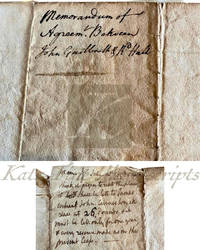
17630001650<p>On offer is a pre-Revolutionary plantation rental agreement between a Philadelphia shopkeeper and a Springfield millwright featuring notes that connect multiple family and business ties in late 18th-century Philadelphia and Chester counties.</p><p>The rental memorandum is the work of Philadelphia-based lawyer Paul Isaac Voto whose office was located at <em>"the corner of Black Horse Alley in Second Street." </em></p><p>The agreement was drafted between Mr. John Gailbreath often spelled Galbreath or Gilbreath in other historical documentation c. 1717–1766 a shopkeeper whose store was located <em>"in Second Street between Market and Chestnut streets" </em>and the prospective renter millwright Richard Hall of Springfield Chester County. Historical documents show that Hall also owned property in the region.</p><p>Dated May 1763 the rental memorandum indicates that John Gailbreath <em>".letts his house and plantation in Springfield… for one year from the date hereof to… Richard Hall paying the rent of twenty seven pounds…"</em></p><p>The agreement lays out several rules of tenancy including the following examples:</p><ul><li><p><em>"The Tenant is to have Liberty to reap his Corn and Thrash it in the Barn after the time is over leaving the Thaw and Chatt…"</em></p></li><li><p><em>".the Tenant agrees not to take any Hay Straw or Dung off the Premises…"</em></p></li><li><p><em>".the Tenant agrees to… keep the House… and Premises in repair as good as now… shall not keep more fires in the House but only one in the kitchen and one in another room and… not to cut any timber or wood But in the Back Field joining to Crosiers Croziers Plantation…"</em></p></li></ul><p>A caveat on the verso of the lease agreement states that <em>".If John McCoy do not think it proper to rent the place it shall be lett to James Cochran John Cairnes son in law at 26 pounds…" </em>According to historical news documents Galbreath was traveling in 1763 and appears to have entrusted a Chester County contact with the final decision on the rental in his absence.</p><p>The document is signed by Hall but not Galbreath. Its delivery was witnessed by Paul Isaac Voto and Elyha Taylor and the original seal is present.</p><p>This document provides not only insight into property rights legal agreements and plantation rentals in pre-Revolutionary Pennsylvania but it also offers genealogical data to support research on the still-incomplete history of early Pennsylvania families. These include the Cairnes Voto Hall Cochran and Crozier or Crosier families among others.</p><p>While some 18th-century newspaper data exists digitally to assist with ongoing research these being the sources used to find the location of the subjects' businesses this document remains an invaluable primary source for those interested in 18th-century life movement and genealogical links.</p><p><strong>Condition:</strong> Significant age toning folding and micro-tears with significant tearing in one corner. The document is written in ink with a clear legible hand and remains in good condition for its age. Overall: Fair to Good.</p>
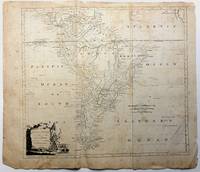
H9044Sheet measures 17x15 inches light wear and a few short tears have been neatly mended on the verso a few small stains some lengthwise creases but a handsome map. unknown
18020009162BETHEL TOWNSHIP LEBANON COUNTY PENNSYLVANIA. Good. 1802. On offer is an interesting document of early 19th century education an original handwritten note book covering a myriad of subjects related to mathematics. The owner and creator of this book was a man named Henry Snevely also written as Snavely and the book dates from 1802 - 1803. It seems Snevely was born in the United States and lived his whole life in Southeastern Pennsylvania. At the time of the creation of the book Snevely was almost 50 years old an established land owner in Bethel Township Lebanon County. Why he had a book of mathematics is unknown however I have found records of a Henry Snavely who taught at a school in Bethel Township from 1797 onwards. It may be likely that this book is actual not for Henry himself but for the instruction of his students. Either way the book presents a fantastic overview of early 18th century knowledge. The book covers a very large range of topics however Math pertaining to financial matters is dominant throughout. As well there are conversions of Irish and British currency. The primary immigrants to the area at the time of the book were indeed Scotch-Irish so teaching Irish and British currency conversions wouldnt be too far off. Currency exchange in particular is a primary focus owing to the large amount of immigrants to the area. Individual page headings in the book include Exchange many pages Exchange of Arbitrations Barter Profit and Loss Fellowship Fellowship with Time Allegation Media Alternate Partial and Total Square Root Cube Root Arithmetical and Geometric Progression Compound Interest Single and Double Position Reduction Addition Subtraction Multiplication and Division of Fractions and Vulgar Fractions Rule of Three in Fractions and Questions for Exercise. There is a later manuscript memorandum on rear endpaper dated 1829 bearing the names of additional members of the Pennsylvania Snavely clan Molly George and John. The name Martin Rupp also appears in memorandum and our research confirms various Martin Rupps residing in southeastern Pennsylvania during this time. The book is in fair to good condition. The volume is bound in the original stiff paper wraps. The cover is very worn and the spine is torn and partially detached. There is mild age-toning and occasional staining but the internal pages are generally clean. The black ink is still bold and easily legible throughout. The book contains about 85 pages of manuscript entries and the book itself is approximately 90 pages. It measures 12.5 x 8 inches. Biography: Henry Snavely was born on August 2 1755 in Bethel Township Lebanon County Pennsylvania. .Henry Snavely was a Lutheran. At that time he was considered a good scholar and is said to have been a hard student obtaining his knowledge principally by his own exertion. He taught the school from 1797 to 1807.; A report from 1773 shows his farm had 150 acres 5 horses 4 cattle and no servants. OVERALL: G; Manuscript; Folio - over 12" - 15" tall; KEYWORDS: HISTORY OF HENRY SNEVELY HENRY SNAVELY EARLY 19TH CENTURY KNOWLEDGE SCIENTIFIC REVOLUTION MATHEMATICS GEOMETRY TRIGONOMETRY FINANCIAL CALCULATIONS BARTERING INTEREST TEACHER'S BOOK BETHEL TOWNSHIP LEBANON COUNTY SOUTHEASTERN PENNSYLVANIA COMPLEX MATHEMATICS ALGEBRA MARTIN RUPP PRACTICAL MATH FOR FARMERS 19TH CENTURY AMERICA EARLY 1800S IN THE MID-ATLANTIC STATES CYPHER BOOK AMERICANA HANDWRITTEN MANUSCRIPT DOCUMENT LETTER AUTOGRAPH WRITER HAND WRITTEN DOCUMENTS SIGNED LETTERS MANUSCRIPTS HISTORICAL HOLOGRAPH KEEPSAKE WRITERS AUTOGRAPHS PERSONAL MEMOIR MEMORIAL ARCHIVE DIARY DIARIES JOURNAL LOG ANTIQUITÉ CONTRAT VÉLIN DOCUMENT MANUSCRIT PAPIER ANTIKE BRIEF PERGAMENT DOKUMENT MANUSKRIPT PAPIER OGGETTO D'ANTIQUARIATO ATTO VELINA DOCUMENTO MANUSCRITTO CARTA ANTIGÜEDAD HECHO VITELA DOCUMENTO MANUSCRITO PAPEL . paperback
184974700Boston 1849. Original stampless ms. letter from agent E. P. Pratt to Company Secretary Guy. R. Phelps. The letter on typical blue paper is dated March 13 1849 and concerns policies on two very well known California '49ers; Augustus Elliott and John Webber Jr. Red circular date stamp on verso of March 14. Some age blurring but still extremely legible.Much of the letter concerns a plea for multiple copies of the company's Annual Report but at the top we read - Augustus Elliot ins'd by Policy No. 2660 goes to Calif in Barque Sangrange. At the end of the letter just prior to the salutations we read - John Webber Jr. ins'd by Pol. No. 1401 is going to California overland and wants a Permit; he is in a hurry for it as he starts shortly."A year after Elliott reached California he organized his Atlantic and Pacific Express Company to carry mail and packages between the east and west coasts of America personally accompanying each shipment by steamer across the Isthmus from San Francisco to New York and back again a “superior advantage†especially for those who wished to send gold dust to eastern banks. Offering such illustrious references as the US Senators from Massachusetts and the first federal official in San Francisco he soon added the service of assisting emigrant families to make the trip “on most favorable termsâ€. This was more than a year before Henry Wells organized the Wells Fargo Company to extend his eastern Express service to California.Unlike Elliott who soon sailed for the Isthmus of Panama Captain John Webber Jr. a heroic veteran of the Mexican-American War was selected to lead the 50 men of the “California Mutual Protection Association†overland to the Gold Fields. Well-equipped with a dozen other military veterans in uniform four musicians “two black servants and six dogs†they left Boston on March 19 a week after this letter was written their six month journey on the Oregon Trail recorded in a diary now held by the Bancroft Library. By the time Webber – portrayed as a U.S.Grant-type soldier in the Discovery Channel dramatization “Gold Fever†– reached Utah on July 31 only four of his group remained. They did not reach Sacramento until September"B. McMakin. unknown
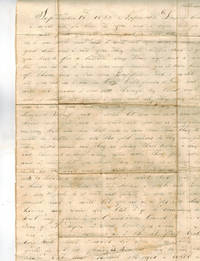
1855007164Sacramento California 1855. Manuscript. Very Good. No Binding. HOLOGRAPH LETTER SIGNED. Two manuscript letters in ink both on ruled paper with folding creases the 1855 letter 8" x 12 1/2" with single spaced writing both sides approx. 500 words. The 1856 letter 15" x 10" folded in half to make 4 pp. approx. 300 words with small blindstamp top left corner depicting an eagle. The earlier letter is headed "September 18th 1855 Naperville Dupage County Illinois" and ends "Michael direct your letters Nevada County Nevada post office California". George writes to his brother Michael in Naperville that he has "seen a good dele sins i rote you they last letter" including a hundred "inshins" and some "Buffellow". He adds that "we had good luck all they way of may we left Council Bluff" and that he is not home sick yet. He then talks of the gold mines river mining what they are paying and the cost of things such as board "from five to ten dollars a week" "Beaf" "wors 15 to 20 cents" and "potato" "4 cent per pound". He adds that he intends to have some gold before he comes home and that "girls are not so plenty here as they are in state". He closes by asking his brother to write him and to remain at home in Illinois to care for their parents. The 1856 letter headed Sacramento august 3th 1856 informs his brother that he is well and "down to Sacramento now" working on a farm feeding a "schrasing" thrashing machine and that "they times is verry hard in California now". He adds that he had some money "stole" while he was in the mountains but since coming down into the valley he was making money and will send some home soon. The letter ends with George wishing to see them all soon and that he is not home sick. The third page of the letter bears a drawing of a wing or leaf eleven smaller versions of the same image interspersed on page 2. A fascinating testimonial on California during the gold rush written in a strong hand and in a wonderful vernacular style by a good observer. unknown