VERZOSA, Juan de.MareMagnum

15 963 résultats
Alcañiz - Madrid, 2004. 4to. mayor; CCXXX pp., 280 pp. Cubiertas originales.
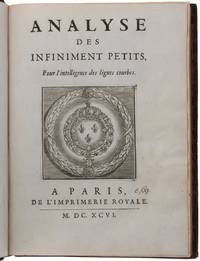
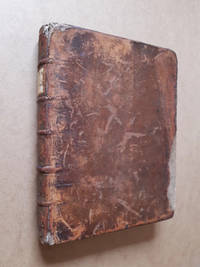
17002848Paris: L'imprimerie Royale; Jean Boudot 1700. First edition. First editions. L'Hôpital's treatise on differential calculus was based on lessons he received from Johann Bernoulli and it was under the influence of Malebranche that some years later appeared the first work on the integral calculus by Louis Carré. Hardcover. THE FIRST BOOKS ON DIFFERENTIAL AND INTEGRAL CALCULUS. <p>A fine sammelband comprising the first editions of the first books on the differential and integral calculus respectively. "In France it was through the Oratorian circle of Nicolas Malebranche that Johann Bernoulli introduced in 1691 the Leibnizian calculus. His lessons to the Marquis de l'Hôpital led to the draft of the first treatise of differential calculus 1696 and it was under the influence of Malebranche that some years later appeared the first works on the integral calculus by Louis Carré in 1700 and Charles René Reyneau in 1708. The spread and acceptance of the Leibnizian calculus was transferred in this way to the wide public" Landmark Writings p. 56. "The importance of L'Hospital's work lay in its dissemination throughout Europe of the concepts and early development of the calculus whose cause L'Hospital advanced as well through his many contacts; these included Christiaan Huygens who is reputed to have learned the calculus from L'Hospital" DSB. Bernoulli's lectures also covered integral calculus but L'Hospital dropped plans to write a continuation to his Analyse des infiniment petits dealing with this subject "in deference to Leibniz who had let him know that he had similar intentions" ibid. Leibniz never wrote such a text however and Bernoulli's lectures on integral calculus remained unpublished until they appeared in his Opera 1742. The task of completing L'Hospital's book was instead taken up by Carré a pupil of Malebranche and assistant to Pierre Varignon from whom he probably learnt calculus. "Following the classical custom his Analyse des infiniment petits starts with a set of definitions and axioms . The difference differential is defined as the infinitely small portion by which a variable quantity increases or decreases continuously. Of the two axioms the first postulates that quantities which differ only by infinitely small amounts may be substituted for one another while the second states that a curve may be thought of as a polygonal line with an infinite number of infinitely small sides such that the angle between adjacent lines determines the curvature of the curve. Following the axioms the basic rules of the differential calculus are given and exemplified. The second chapter applies these rules to the determination of the tangent to a curve in a given point . The third chapter deals with maximum-minimum problems and includes examples drawn from mechanics and geography. Next comes a treatment of points of inflection and cusps. This involves the introduction of higher-order differentials each supposed infinitely small compared to its predecessor. Later chapters deal with evolutes and with caustics. L'Hospital's rule is given in chapter 9" ibid. The tenth and final chapter of the Analyse discusses the methods of Descartes and Johann Hudde. The companion work by Carré is "the first treatise on the integral calculus in any language which is here applied to the determination of the area of superficies surfaces and solids and their centres of gravity problems of percussion oscillation etc." Sotheran. On this last topic the determination of the centres of oscillation of solids Carré made a significant error. This was known to Bernoulli but not publicized at the time and so was propagated into several later calculus texts such as Charles Hayes' Treatise on Fluxions 1704 and Edmund Stone's The Method of Fluxions both Direct and Inverse 1730. Both works are rare on the market: ABPC/RBH list four copies of L'Hospital's book since the Norman copy which realised $6325 in 1998; and only two copies of Carré's work in the last half century. </p> <br /> <p>"Differential and integral calculus are generally considered to have their origins in the works of Newton and Leibniz in the late 17th century although the roots of the subject reach far back into that century and arguably even into antiquity. Leibniz first described his new calculus in a cryptic article more than a decade before the publication of the Analyse. For all practical purposes Leibniz' early papers were not understood until Jakob Bernoulli and his younger brother Johann began studying them in about 1687 and making discoveries of their own using his techniques.</p> <br /> <p>"Bernard de Fontenelle became the secretary of the Académie des Sciences in Paris in 1697 and wrote the eulogy of l'Hôpital for the academy's journal. He said that in 1696 'the Geometry of the Infinitely small was still nothing but a kind of Mystery and so to speak a Cabalistic Science shared among five or six people. They often gave their Solutions in the Journals without revealing the Method that produced them and even when one could discover it it was only a few feeble rays of this Science that had escaped and the clouds immediately closed again.' Later on Montucla went one step further and listed the only people that he believed understood Leibniz' calculus before 1696: Leibniz himself Jakob and Johann Bernoulli Pierre Varignon and l'Hôpital. L'Hôpital's Analyse changed all of this and for much of the 18th century his book served aspiring French mathematicians as their first introduction to the new calculus.</p> <br /> <p>"For all that the Analyse was a popular and successful introduction to the differential calculus it's remarkable that there is no account of the integral calculus in the book. In his Preface l'Hôpital explained why: 'In all of this there is only the first part of Mr. Leibniz' calculus . The other part which we call integral calculus consists in going back from these infinitely small quantities to the magnitudes or the wholes of which they are the differences that is to say in finding their sums. I had also intended to present this. However Mr. Leibniz having written me that he is working on a Treatise titled De Scientiâ infiniti I took care not to deprive the public of such a beautiful Work' p. iii. Unfortunately Leibniz never completed this book On the Science of the Infinite.</p> <br /> <p>"The Analyse consists of ten chapters which l'Hôpital called 'sections.' We consider it to have three parts. The first part an introduction to the differential calculus consists of the first four chapters:</p> <br /> <br /> In which we give the Rules of this calculus. <br /> <br /> Use of the differential calculus for finding the Tangents of all kinds of curved <br /> lines. <br /> <br /> Use of the differential calculus for finding the greatest and the least ordinates to which are reduced questions De maximis & minimis. <br /> <br /> Use of the differential calculus for finding inflection points and cusps.<br /> <br /> <p>"Taken together these chapters provide a thorough introduction to the differential calculus in about 70 pages. The next five chapters are devoted to what can only be described as an advanced text on differential geometry motivated in part by what were then cutting-edge research problems in optics and other fields" Bradley et al. pp. v-vi.</p> <br /> <p>These subsequent chapters no longer mirror the structure of Bernoulli's lectures. Chapter 5 the longest in the Analyse deals with evolutes and involutes including the cycloid and various spirals. Chapters 6-8 are on envelopes of lines and curves i.e. curves that are tangent to every member of a family of lines or curves - this includes the study of caustics in geometrical optics. Chapter 9 contains "the solution of various problems that depend upon the previous Methods;" the first of these is the celebrated rule that we now call L'Hôpital's Rule which was first discovered by Bernoulli. In his final chapter of the Analyse l'Hôpital demonstrates how all of the methods of Descartes and Hudde may be easily derived and justified using Leibniz's differential calculus.</p> <br /> <p>Born into a noble family L'Hospital 1661-1704 abandoned a military career due to poor eyesight to pursue his interest in mathematics. "Some time around 1690 L'Hôpital joined Nicolas Malebranche's circle which was engaged among other things in the study of higher mathematics. It was there in November 1691 that he met the 24-year-old Johann Bernoulli who was visiting Paris and had been invited by Malebranche to present his construction of the catenary at the salon . Bernoulli told Pierre Rémond de Montmort that upon meeting the Marquis he soon found him to be a good enough mathematician with regard to ordinary mathematics but that he knew nothing of the differential calculus other than its name and had not even heard of the integral calculus. L'Hôpital had apparently mastered Fermat's method of finding maxima and minima and told Bernoulli that he had used it to invent a rule for determining the radius of curvature for arbitrary curves. The method was unwieldy and actually could only be used at local extrema of algebraic curves. Bernoulli showed him the formula for the radius of curvature that he had developed with his brother Jakob which employed second-order differentials. Apparently this so impressed the Marquis that he visited Bernoulli the very next day and engaged him as his tutor in the differential and integral calculus.</p> <br /> <p>"Bernoulli tutored the Marquis in his Paris apartment four times a week from late 1691 through the end of July 1692 . In the summer of 1692 Bernoulli accompanied the Marquis to his estate in Oucques near the French city of Blois where he continued giving him tutorials until some time in October . Bernoulli kept copies of his lessons to the Marquis throughout his long and productive career. The first part on the differential calculus was incorporated by l'Hôpital into the first four chapters of the Analyse. Bernoulli himself published the much larger second part concerning the integral calculus in his collected works. Titled Lectiones mathematicae de methodo integralium this treatise bears the subtitle 'written for the use of the Illustrious Marquis de l'Hôpital while the author spent time in Paris in the years 1691 & 1692' . Because Bernoulli chose not to publish this part it was impossible in the 18th century to say how closely l'Hôpital's textbook coincided with Bernoulli's lessons. A comparison finally became possible when Paul Schafheitlin discovered a manuscript copy of the full set of lessons on both the differential and integral calculus in the library of the University of Basel in 1921 . Because the latter part was a near-perfect match to what Bernoulli had published in 1741 he could be quite certain that the first part was essentially the same set of lessons l'Hôpital had used when composing the Analyse .</p> <br /> <p>"Since the appearance of the Lectiones various authors have characterized the Analyse as having essentially been written by Bernoulli. Indeed Bernoulli himself in an angry letter to Varignon of February 26 1707 said that 'to speak frankly Mr. de l'Hôpital had no other part in the production of this book than to have translated into French the material that I gave him for the most part in Latin.' The truth is much more nuanced. The superstructure of l'Hôpital's first four chapters is certainly due to Bernoulli and many of the details are essentially the same in both texts. However l'Hôpital added much in both quantity and quality. For one thing Bernoulli's Lectiones occupied 37 manuscript pages compared to 70 typeset pages for the first four chapters of the Analyse but the Marquis added much more than mere verbiage to Bernoulli's lesson. He was a very talented pedagogue. He organized his material very well extracting general propositions where Bernoulli gave examples and explained matters clearly and in some detail. Furthermore he frequently included many illustrative examples gradually increasing in difficulty generally providing an appropriate level of detail but always leaving some things for readers to work out for themselves" Bradley pp. vii-xi. The last six chapters were not taken directly from Bernoulli's lectures although l'Hôpital has drawn on material provided to him in Bernoulli's letters or in his lessons on the integral calculus.</p> <br /> <p>Louis Carré's 1663-1711 father a prosperous farmer wanted him to become a priest but after having spent three years studying theology in Paris he refused to take holy orders and his father cut off all financial support for his son. Carré managed to avoid poverty by becoming an amanuensis to Malebranche. The group Malebranche had assembled at the Oratory in Paris included Varignon and l'Hôpital among others. Carré spent seven years with Malebranche after which he became a private tutor in Paris specializing in the teaching of women then barred from a university education many of whom were nuns.At this stage Carré seems to have been interested mainly in philosophy and did not take much interest in current mathematical research. However on 4 February 1699 Varignon admitted him as one of his élèves in the Academy of Sciences. This stimulated Carré's interest in mathematics and he began working on his Methode pour Ia mesure des surfaces .</p> <br /> <p>The work is divided into four Sections:</p> <br /> <br /> On the measure i.e. area of surfaces.<br /> On the dimension i.e. volume of solids.3<br /> On centres of gravity.<br /> On centres of percussion and oscillation.<br /> <br /> <p>The centre of percussion is the point on a solid body attached to a pivot where a perpendicular impact will produce no reactive shock at the pivot. The same point is called the centre of oscillation for the body suspended from the pivot as a pendulum meaning that a simple pendulum with all its mass concentrated at that point will have the same period of oscillation. The formula for the centre of oscillation originally derived by Huygens in his Horologium oscillatorium 1673 requires certain integrations to be performed. Carré made an error in calculating the integral for the moment of inertia of a cone suspended from its vertex a mistake that led to an incorrect expression for the centre of oscillation of the cone. Lenore Feigenbaum explains that the story of Carré's mistake and the subsequent propagation of his error in eighteenth-century calculus textbooks "is instructive in several regards: first in showing how some of the methods of the calculus were interpreted and absorbed during the early 18th century; second in shedding light on the nature of the textbook industry of the time; and finally in providing us with a modicum of historical sympathy when we find our own students making the same kind of mistakes."</p> <br /> <p>Between 1701 and 1705 Carré published over a dozen papers on a variety of mathematical and physical subjects which led to him being admitted to the Academy of Sciences as an Associate Mechanician on 15 February 1702 and being promoted to Pensioner on 18 August 1706. This provided him with an income which allowed him to devote himself entirely to his academic studies during the final five years of his life. At age 46 he suffered an attack of dyspepsia from which he died in 1711. </p> <br /> <p>I. Babson Supplement p.30; Honeyman 2006 & 2007; Norman 1345; Sotheran First Supplement 1411; not in Macclesfield. II. Macclesfield 481; Poggendorff I 383-384; Sotheran I 704. Bradley Petrilli & Sandifer. L'Hôpital's Analyse des infiniments petits. An Annotated Translation with Source Material by Johann Bernoulli 2015. Grattan-Guinness ed. Landmark writings in Western mathematics 1640-1940 2005.</p> <br/> <br/> Two works bound in one volume 4to 251 x 186 mm pp. xviii 181 3 with 11 folding engraved plates; pp. xii 115 1 blank and 4 folding engraved plates. Old signature cut from first title and expertly repaired. Contemporary French calf spine gilt with red lettering-piece. Fine copies. / Hardcover. L'imprimerie Royale; Jean Boudot unknown
1708#BIBLIO-1153Analyse démontrée ou la méthode de resoudre les problêmes de mathématiques et d'apprendre facilement ces sciences; Expliquée & démontrée dans le premier Volume & appliquée dans le second à découvrir les proprietés des figures de la Geometrie simple & composée ; à resoudre les Problêmes de ces sciences & les Problêmes des sciences Physico-mathématiques en employant le calcul ordinaire de l'Algebre le calcul differentiel & le calcul integral ; Ces derniers calculs y sont aussi expliqués & démentrés. Dediée a Monseigneur le Du de Bourgogne Charles-René Reynaud or Reyneau. Tome I. Demonstrated analysis or the method of solving mathematical problems and of easily learning these sciences; Explained and demonstrated in the first Volume and applied in the second to discover the properties of the figures of simple and composite Geometry; to solve the Problems of these sciences and the Problems of the Physico-mathematical sciences by using the ordinary calculation of Algebra the differential calculus and the integral calculus; These last calculations are also explained and disproved. Dedicated to Monseigneur the Duke of Burgundy Charles-René Reynaud or Reyneau. Volume I Paris: Jacque Quillau 1708. Hardback full speckled calf raised bands with gilt-blocked title and decoration to spine. Quarto/4to measures around 7 7/8" x 10" x 1 5/8" xxiv 486 pp and two-page list of corrigenda. Extensive scuffing and wear to binding with some loss to leather at head and tail of spine a little to top of hinge corners of boards and more so to lower fore-edge of front board. Title label also missing although gilt title lettering itself can still partially be seen. Rubbing at edges and on hinges. Some cracking to outer hinges and extensively to inner hinges whereby daylight can be seen through them but boards are still attached. Otherwise reasonably firm. Bumped and torn corners. Speckled page edges which are browned scuffed and otherwise marked especially to upper and lower edges. A little puckering tearing and staining to pastedowns and endpapers with marking. Heavy marking to title page and previous owner inscription to top in ink with name of author written in pencil towards bottom. The odd dog-eared page corner. A little marking to page surfaces throughout but generally reasonably clean no underlining marginalia etc. A scarce first edition copy of one of the earliest calculus textbooks and a work of some significance in the field. See pictures for further information.<em>Charles-René Reynaud or Reyneau 1656 Brissac – 24 February 1728 Paris was a French mathematician. A priest of the Oratory of Saint Philip Neri father Reyneau was successively professor of philosophy at Toulon and Pézenas and then of mathematics at the college of Angers. He was a member of the Académie des sciences belles-lettres et arts d'Angers and free associate of the French Academy of Sciences. </em><em>Source: Wiki</em><em>Reyneau was a priest who served as a professor of philosophy at Toulon and Pezenas and then as professor of mathematics at the College of Angers. While he made no significant discoveries in the field of mathematics Reyneau had a talent for explicating new discoveries in mathematics. His most important work the Analyse demontree was a popular textbook in the early 18th century and was the book used by Jean le Rond d'Alembert to learn the fundamentals of the subject. In it Reyneau describes explains and demonstrates the main theories found in the works of Leibniz Newton Descartes Bernoulli and other pioneering mathematicians of the day. </em><em>Source: Jeff Weber Rare Books</em> Jacque Quillau hardcover
19971301190PN. New. 1997. Soft Cover. Date is original print. This is a reprint edition . PN paperback
1997299542PN. New. 1997. . Soft Cover. Date is original print. This is a reprint edition . PN paperback
1974748499PN. New. 1974. Soft Cover. Date is original print. This is a reprint edition. . PN paperback
2016x-1359673016Palala Press 2016. Hardcover. New. 364 pages. 6.14x0.81x9.21 inches. Palala Press hardcover
1359673016.Ghardcover. Good. Access codes and supplements are not guaranteed with used items. May be an ex-library book. hardcover
1359678301.Ghardcover. Good. Access codes and supplements are not guaranteed with used items. May be an ex-library book. hardcover
Madrid, José Porrúa Turanzas, 1980 ("Studis Humanitatis"). 4to.; XIX pp., 426 pp. Ilustraciones. Cubiertas originales.
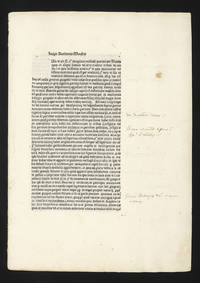
338122 leaves Gothic type 43 lines. Folio 301 x 213 mm. disbound some worming towards end. Padua not Pavia: Pierre Maufer about 1475. First edition a remarkable discovery of the third known copy of the true first edition of the first modern book devoted solely to anatomy. The other two surviving copies are in the Biblioteca Corsiniana Rome and the Biblioteca Comunale Viterbo. The rarity of this book is well-known: it is revealing that Castiglioni Choulant and Garrison all cite the 1478 edition as the first printing. Its influence was great: "The first outstanding anatomist worthy of the name.the Anathomia of Mondino was the most used anatomical text up to the end of the sixteenth century probably because it contained the most important technical indications in brief and concise form."-Castiglioni A History of Medicine pp. 341-43. Mondino ca. 1275-1326 a native of Bologna was the son of an apothecary and the nephew of a professor of medicine. He attended the University of Bologna where he studied under Alderotti Thaddeus of Florence an early dissector and took his medical degree in 1300. Mondino soon became a professor of medicine at the university. "Mondino's chief work is his compendium of anatomy Anatomia Mundini completed in 1316 which made him in Castiglione's sic words 'the first outstanding anatomist worthy of the name.' Mondino's book dominated anatomy for over two hundred years. The major reason for Mondino's great popularity was the simplicity conciseness and systematic arrangement of his book which is divided into six parts: 1 an introduction to the whole body and a discussion of authorities; 2 the natural members including the liver spleen and other organs in the abdominal cavity; 3 the generative members; 4 the spiritual members the heart lungs trachea esophagus and other organs of the thoracic cavity up to the mouth; 5 the animal members of the skull brain eyes ears; and 6 the peripheral parts bones spinal column extremities. This organization was not the result of any philosophical approach to the subject but rather derived from the necessity of dissecting the most perishable organs first. "Mondino should be regarded as the restorer of anatomy if only because his popular textbook and his experimental teaching were instrumental in preparing the revival of the subject. His text was the first book written on anatomy during the Middle Ages that was based on the dissection of the human cadaver; his efforts consolidated anatomy as a part of the medical program at Bologna and encouraged further study. His book also dominated the teaching of anatomy and no real improvements were made upon it until 1521 when Berengario da Carpi wrote his famous commentary on Mondino."-D.S.B. IX pp. 468-69. "Mondino's book soon became a classic text; he was venerated soon after his death as a divine master and anyone who was found differing from his book was regarded as monstrous. For three centuries the lecturers on anatomy were required to use his book in their teaching as may be seen in the statutes of many medical schools."-Castiglioni op. cit. pp. 344-45-& see the detailed account of the contents of this book and methods of dissection which it reveals on pp. 341-45. A very fine copy with all edges uncut and preserved in a slipcase. Two contemporary annotators have made a number of neat comments in the wide margins. This copy was clearly removed from a sammelband. The final four leaves have some worming becoming increasingly more pronounced but not at all offensive touching the text of the final three leaves. ❧ Choulant-Frank pp. 88-96. Garrison-Morton 361-describing the 2nd edition of 1478-"The first modern book devoted solely to anatomy written for his students in 1316. Mundinus re-introduced human dissection which had been neglected for 1500 years before him; he was the most noted dissector of his period." Garrison History of Medicine pp. 160-61. GKW M25666-citing Pavia in error. ISTC im00871200. Klebs 688.1. Sarton III Pt. I p. 843-"In spite of his personal observations Mondino was almost entirely dependent upon Galen and Theophilos and upon Arabic authorities.". unknown books
SLIVCN-9781529953138Ebury Press (10/2025)
20070008765Anchorage AK: Yes Alaska Press 2007. First Limited edition. Hardcover. Fine/issued without. 4to 128 pages blue cloth in matching publisher's clamshell box with ribbon <br/><br/>Copy 294 of only 300 limited and signed copies each with a matching numbered giclee print of the city of Anchorage: signed by Mishler and Carey and Roderick. An evocative book of Mishler's love affair with Anchorage. " .its about the people who live here those crazy individuals who for what ever reason have decided to make Anchorage their home." With essays by Michael Carey and historian Jack Roderick. Note: these are photos of Anchorage at that period. Anchorage is subject to daily earthquakes: the bigger ones continually change the appearance of the city. Yes Alaska Press hardcover
In nur 200 numerierten Exemplaren erschienen.
1020777621.Ghardcover. Good. Access codes and supplements are not guaranteed with used items. May be an ex-library book. hardcover
1022206389.Gpaperback. Good. Access codes and supplements are not guaranteed with used items. May be an ex-library book. paperback
1346688109.Ghardcover. Good. Access codes and supplements are not guaranteed with used items. May be an ex-library book. hardcover
1998160223Abrams, New York, 1998. 256 S., mit vielen teils ganzseitigen und farbigen Illustrationen, 4° OLeinen, mit goldgeprägten Deckel- und Rückentitel, SU
Q-053104453XFranklin Watts. Library Binding. New. New. In shrink wrap. Looks like an interesting title! Franklin Watts unknown
49780733-nnew. unknown
1994197048Bonechi 1994 130 pages in4. 1994. Broché. 130 pages.
1977mon0000176751Columbia Pictures Publications / 1977T. paperback. Very Good. in x in x in. very clean softcover. no marks. clean text. tight binding. light age and edge wear. ISBN matches listing Columbia Pictures Publications / paperback
Mondadori, Urania n. 682, ottobre 1975. Traduzione di Beata della Frattina. Spedizioni tracciabili con raccomandata entro 24 ore dall'ordine. Soft cover in fine conditions, no inscriptions or markings inside. Worldwide delivery.
Valladolid, 2000. 4to. mayor; 318 pp. Encuadernación original en tela.
1985007053Georgia : Georgia Council for the Arts 1985 1985. 1st Edition 1st Printing. Soft cover. Fine/No Jacket. 1st edition1st printing ; 32 p. booklet : chiefly illustrations some in color ; 16 x 23 cm. ; LC: NK4210.N27 ; OCLC: 811052274 ; textured decorative wrappers glassine protective sheet on title page ; Published on the occasion of exhibitions held at the Lamar Dodd Art Center Apr. 6-Apr. 30 Fay Gold Gallery May 19-June 14 and the Madison Morgan Culture Center Oct. 6-Nov. 17. ; "Nasisse's style is intuitive and fictional. The South is particularly susceptible to confusions of fact and fiction and Nasisse makes personalized myths of 'haints' and 'boogey men'. His creations invoke images from various primitive cultures such as Haitian Voodoo Mexican and Italian votives and Mayan ritual figures. The eccentricity of some of his creations evokes the religious fervor of work by some of Nasisse's untrained artist friends like Dilmus Hall and Reverend Howard Finster or the grotesque humor of the late Nellie Mae Rowe."--Peter Morrin ; "I just take up a pencil and trace out the future of a thing."--Andy Nasisse ; scarce ; spot on inside front cover ; else FINE <br/> <br/> [Georgia] : Georgia Council for the Arts, 1985 paperback