740 résultats
195061496Chicago IL: Hart Schaffner & Marx ca. 1950. Two large colour lithograph advertising posters sized 38.25 x 51 in. and 28.75 x 38.5 in. respectively both bearing the Golden Trumpeter logo as rendered by noted artist Robert Reinhardt von Liski minor dustsoiling creasing faint dampstain to very lower right fore-edge of larger poster minor closed tears neatly repaired light age toning still both bright VG- copies now mounted and shrink wrapped on archival foam core. The Hart Schaffner & Marx logo for men’s fashion was first created by Edward Penfield in 1914 with the trumpeter bearing an upright lance but the next year had turned into a trumpet and would continue on HSM suits until the late 1980’s. Hart Schaffner & Marx was founded in 1887 by Harry and Max Hart Marcus Marx and Joseph Schaffner. By the early 20th century they owned dozens of small garment factories around Chicago and was one of the first tailoring/garment manufacturing firms to become unionized. They continued to grow through the 20th century and by the end of the 1960s had 38 factories and 250 retail stores around the country. The Company continues to operate under the Hartmarx label and is one of the leading men’s clothing wholesalers to this day. Von Liski 1908-1991 was a noted self-taught artist and commercial artist who worked for various studios and was a partner in a Chicago advertising agency. No copies located in Worldcat; See: Leif Peng & Nan Hall Tom Hall Today’s Inspiration Celebrating Illustrations Design Cartoon and Comic Art of the Mid-20th century 2016; Hart Schaffner & Marx Encyclopedia of Chicago 2005. Hart Schaffner & Marx, hardcover
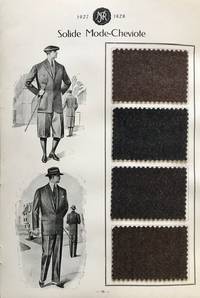
192757311Graz Austria: Richard Neurath Kaiserfeldgasse 19 und 21 1927. Two vols. 1st - Folio. 11 x 13.75 in. 45 1 pp. on thick boards. With 246 tipped-in fabric samples of wools wool blends 27 fashion plate illustrations 2 for women’s coats w/ price list and letter to salesmen dated August 1927. Original quarter-black cloth over embossed & decorated boards flaps at fore-edges w/ handle and clasp raised gilt lettering on front cover minor shelfwear rubbing clasp guard repaired & reinforced still VG complete exemplar retaining the original button clasp; together with 4to. 8.25 x 11.25 in. 4 pp unpaginated. w/ 16 additional wool and wool-blend samples tipped-in self-printed covers rounded corners. First edition of this unusually rare fashion salesman sample catalogue for men’s suits and sporting wear during the Roaring 20’s with many of the suits sporting vests while also featured are shooting & hiking suits sportswear and a rich array of fabrics drawing upon English fashion designs. Following World War I there was a concerted move away from starched collars and formal three-piece suits towards soft collars one- or two-button suit jackets and even often worn without a waistcoat. Also featured in this catalogue are many examples of the plus-fours developed out of ordinary knickers these short-legged pants were a baggier version of their predecessors and proved popular for hikers golfers and other outdoors activities. Also featured are winter coat fabrics and designs for women in velour and thick felt twill. The laid-in additional catalogue promoted the latest Loden Merino wool fabrics and thick camel hair woolens. Neurath 1882-1948 operated a successful mail-order tailoring business until the 1938 Anschluss when the Nazi’s annexed Austria and forced the April 10 plebiscite. He survived the War and later died in Tel Aviv Israel in 1948. The building which housed his offices and tailoring facilities in Graz is now the home of the popular Cafe Kaiserfeld. No copies in Worldcat. Richard Neurath, Kaiserfeldgasse 19 und 21, hardcover
188848840Paris: Grande Maison de Blanc ca. 1888. 12mo. 42 pp unpaginated. Colour chromolithograph illustrated title 18 colour chromolith plates. Dark green silk gilt lettering on front cover very minor soiling edgewear front cover rear inner hinge starting still a VG bright copy stapled textblock as issued. First edition of this delightfully produced and illustrated history of gloves through the ages. These include descriptions of mesh gloves used by the Egyptians metal gauntlets used by Roman gladiators gloves to keep warm by monks during the Middle Ages leather gloves to protect the hands and arms of the falconer fencing gloves beautiful silk & lace gloves for noblewomen at the courts of Louis XV and Louis XVI and riding gloves for women during the Second Empire of Napoleon III and finally the Belle Epoque. Grande Maison de Blanc was a renowned firm in Paris during the Belle Epoque who were especially proud of selling French-manufactured gloves linens cravats and other household goods at a discount compared to many other stores at the time. They were pioneers in not only producing their own products in house by maintaining factories in Tarare Lille Fives and other areas around France but pushing other suppliers to offer steep wholesale discounts. Worldcat locates 2 copies NYU Princeton. Grande Maison de Blanc, hardcover
194061376Laguna Beach CA: Walter T. Foster Foreman & Clark 1940. Folio. 8 x 14 in. 40 pp unpaginated. Illustrated throughout self-printed softcovers cover art illustration of Foreman & Clark men’s tweed suit minor shelfwear slight rubbing still VG copy. First edition thus of this scarce installment in the Foster “How to Draw Library†series instructing aspiring commercial artists step-by-step in creating ads for men’s “Noir†period double-breasted suits and drawing primarily from the 1940 ad campaigns of the famed Foreman & Clark men’s stores based out of Southern California. Of particular interest is the inclusion by Foster of gray scale and tints from the Craftint Co. of Cleveland OH which instructs the artist on how their colours will appear when reproduced in black & white tones for commercial advertisements. The ad at rear for “Female Fashion†includes woman saluting. Worldcat locates 1 copy Ohio State. Walter T. Foster, [Foreman & Clark], paperback
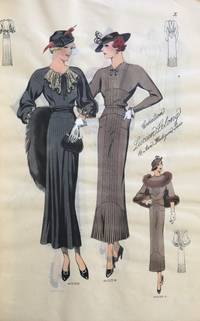
193058140Paris Vienna New York et al: Societe Graphique S.A. Editions de Mode Classique Modes Co. Importers of Fashions 303 Fifth Ave. ca. 1930. Folio. 9 x 13 in. IV pp. leaves as V-XX hand-coloured pochoir plates 2 pp. pattern cutting plates. Quarter-embossed gold foil over pink printed softcovers gilt & black decorative lettering minor shelfwear slight bumping to corners rubbing still a VG copy. First edition of this beautifully coloured collection of haute couture Parisian fashion dress designs by Lucien LeLong 1889-1958. Lelong was a contemporary designer alongside Chanel Vionnet Molyneux Lanvin & Patou focusing on designing for cafe society during the 1920’s and 1930’s. These designs emphasize Lelong Schiaparelli and Vionnet’s move towards a more sophisticated and elegant feminine silhouette during the 1930’s with hemlines dropped to mid-calf or close to the ankle soft slim-fitting dresses and backless evening gowns. Classique Modes also distributed other similar pochoir-illustrated fashion design periodicals such as Paris Chic Elite Robes elegantes Iris and others. The final 2 plates No copies in Worldcat. Societe Graphique S.A., Editions de Mode, Classique Modes Co., Importers of Fashions, 303 Fifth Ave., paperback
193956900Chicago IL: Jackman Sportswear Co. Inc. 14 E. Jackson Blvd. 1939. 8vo. 5.5 x 8.5 in. which opens up into 8 pp. Oblong 4to. 11 x 8.5 in. printed in brown on cream-coloured paper w/ numerous illustrations 4 fabric sample swatches tipped-in self-printed softcovers together w/ 3 leaves of price-lists and order forms preserved w/ mailing envelope to Henry Mayer Mahoning Valley Country Club Lehighton PA very slight shelfwear creasing NF. First edition of this scarce sample catalogue for men’s sporting clothes on the eve of World War II. This catalogue offers Raglander Raglan Sport Shirts Tommy Armour Gaucho Raglan golf shirts Jerry Glynn jackets in single-ply gabardine or wool tweed water proof silk shirts for golfers bowling shirts golf gloves Camel cloth caps and more. The famed golfer’s Jerry Glynn reversible golf jackets were taken over and produced by Whitewater following World War II and with elastic back and wind and rain resistance proved popular for decades. Tommy Armour Gaucho Raglan shirts first made their appearance in the 1930s after he had largely retired to Boca Raton FL and golf equipment is still marketed with his name. No copies located in Worldcat. Jackman Sportswear Co., Inc., 14 E. Jackson Blvd., paperback
193656297Vienna Austria & Paris: Les Editions Leon Claude 4 Rue mayran 1936. Folio. 10.75 x 14.6 in. 4 pp. With 25 colour fashion plates text printed in French English & German. Textured beige softcovers raised & embossed gilt lettering front cover black lettering for Leon Claude minor chipping head & foot of spine edgewear some scuffing still a VG copy w/ the fashion plates in bright condition. First edition of this very scarce and beautifully printed fashion design magazine from the mid 1930s produced by the publishing house which also published fashion publications such as Paris Chic La Coquette and Le Gout Parisien. These designs show the dominant influence of Elsa Schiaparelli’s fashions in the 1930s as she continued Chanel’s idea of comfortable jackets but with the emphasis on beautiful tailoring. The designs here include most in 3/4 length with some sporting shapes and belted jackets as well as fancy wraps made from leopard panther kid-astrakhan Buenos broadtail lamb beaver otter Persian lamb musk mink fox and others. The collars are voluminous and flaring all the way around and the linings are often chosen to complement and match the dresses worn by the models. These 1930s fashions show a dramatic drop in hem lengths the new French beret style hats worn at an angle and designs which inspired the Hollywood glamor look of the era popularized by Joan Crawford Carole Lombard and others. The designs are glamorous and chic with many having geometric patterns and reflecting the Art Deco influence. These fashion designs were issued only to subscribing specialty shops boutiques and fashion enthusiasts at the time with eight different issues on assorted subjects appearing annually. No copies of this issue located in Worldcat. Les Editions Leon Claude, 4, Rue mayran, paperback
194056298Vienna Germany & Paris: La Mode Artistique S.A. 4 Rue mayran 1940. Folio. 10.75 x 14.6 in. 4 pp. With 28 colour fashion plates text printed in French English & German. Textured beige softcovers raised & embossed gilt lettering front cover black lettering for La Mode Artistique minor chipping head & foot of spine edgewear some scuffing still a VG copy w/ the fashion plates in bright condition. First edition of this very scarce and beautifully printed fashion design magazine issued in the opening years of World War II following the occupation of Paris in the summer of 1940 originally owned by Leon Claude. The firm had also published fashion publications such as Paris Chic La Coquette and Le Gout Parisien. These fashion designs show the growing restraint and conservatism of Nazi Germany and reflecting the desire by Adolf Hitler to extinguish French influence in European fashion. The designs here include most in 3/4 length with some sporting shapes and belted jackets as well as fancy wraps made from seal kid-astrakhan Buenos broadtail lamb beaver otter nutria ocelot Persian lamb musk mink fox and others. The collars are trimmer and the linings are often chosen to complement and match the dresses worn by the models. These 1940s fashions still show the dramatic drop in hem lengths feathered hats worn by Germans & Austrians and designs which inspired the Hollywood glamor look of the era popularized by Greta Garbo Joan Crawford Carole Lombard and others. These fashion designs were issued only to subscribing specialty shops boutiques and fashion enthusiasts at the time with eight different issues on assorted subjects appearing annually. No copies of this issue located in Worldcat. La Mode Artistique, S.A., 4, Rue mayran, paperback
194456300Nice Paris & Maresille: A La Francaise May 1944. 4to. 78 14 pp. With numerous colour plates colour ads over 100 black & white text illustrations & photos. Colour-illustrated softcovers colour cover art on rear minor shelfwear slight rubbing light spotting to front cover and first couple leaves still VG- bright copy. First edition of this very scarce French fashion and luxury goods magazine published in occupied France a few months before the “liberation of Paris†and the Battle of Marseille. The lavish ads and articles tout the achievements of Parisian fashion designers French artists the cosmetics & perfume industry of Paris theatre productions Nazi-controlled French cinema and more. There are few of these occupied France publications surviving and Worldcat does locate a complete run at the Bibliotheque National. A La Francaise], paperback
190556908Chicago IL: American Woolen Mills Co. 1905. Thick elephant folio 17.5 x 21.5 x 3.25 in. 58 pp. printed on thick card stock each mounted on linen hinge. With 6 black & white fashion plates illustrating suit styles of the period with 380 of 400 -- many marked in pencil “O.S.†or Out-of-Stock mounted textile samples in wool wool-silk blends -- all samples clearly marked with prices and availability numerous text illustrations decorative borders printed in colour many showing bucolic scenes of sheep pastures and winter frolics. Black & blue cloth Arts & Crafts gilt lettering & ornament on front cover expertly rebacked and back cover renewed dustsoiling and occasional soiling to some leaves some samples w/ predation and minor loss dampstaining to gutter margin of last few leaves minor loss & damage to last couple leaves still a good copy. First edition of this scarce Progressive-era salesman sample catalogue for Winter season men’s suits overcoats and evening wear. The American Woolen Mills Company also known as the “Progressive Tailorsâ€maintained a huge tailoring operation in Chicago at Union & Washington until the Great Depression employing hundreds of tailors and seamstresses to fill orders. Unlike J.L. Taylor Royal Tailors and many of the other tailoring houses of the period the American Woolen Mills targeted the average white collar clerk or American immigrant salesman and merchant trying to look professional and offered $ 15.00 high class made to measure suits. These catalogues were very expensive to produce and were often issued with minimal company brand names allowing their sales force to target small shops mercantiles and general stores which would have these catalogues on the sales floor for several years. Sales people were directed to simply clip the corners of samples for out-of-stock and discontinued fabrics but they often chose to remove the entire sample in order to not distract potential customers. The catalogue offers invaluable illustrated historical reference for the colours styles and fabrics during the era of Teddy Roosevelt and the Anti-Trust policies even referring to these in their sales pitch by claiming that unlike Trusts which “by combining saves numerous expenses and sticks ALL the savings in its own pocket. . . there is no Trust in the tailoring trade.†They further claim that they remove all middlemen procure woolens directly from the weavers and by avoiding wastes of all kinds that AWM CO. lowers their prices and “it is a public benefit.†The textiles here focus on darker shades and very muted colours along with durable thick fabrics while marketing their double-breasted sacks 3-button frock coats 2-button single breasted suits assorted overcoats and more. No copies in Worldcat; See: Swell Nifty Suit Free! The Household Journal Vols. V No. 8 August 1912 p. 6; Machinists’ Monthly Journal Vol. XVII No. 3 March 1905 p. 282. American Woolen Mills Co., hardcover
193953215New York: Singer Sewing Machine Manufacturing Co. Departamento de Educacion January 1941; 1939. Two vols. 1st - Tall 8vo. 225 1 pp. Over 150 colour and black & white photo illustrations diagrams. Black textured softcovers gilt lettering & decoration printed on front cover edgewear bumping to corners minor soiling old tape repairs to front cover still G- copy; 2nd -- Oblong 4to. 12 x 7.75 in. 54 pp. on pink-tinted paper with 57 tipped-in fabric embroidered sewing samples including over on linen silk lace satin and wool textiles each w/ school stamp approving sample. Half-blue cloth post-binder over blue goards gilt lettering stamped on front cover sewn at gutter margin w/ white silk ribbon soiling minor dampstain curving to covers from the bulk of the tipped-in samples on the leaves still a VG exemplar. Both preserved in blue textured cardboard box & lid minor edgewear faint tidemark to lower fore-edge 1 corner. Fourth revised edition of this well-illustrated embroidery guide on stitches to be learned and executed on Singer Sewing Machines together with a beautifully done sample book showing Ms. Alos’ skills in learning the necessary skills in her Singer school in Villa Canas Argentina. The Singer Sewing Machine company developed special Singer Sewing Academia in Argentina Mexico and many other South American countries as well as Spain between the World Wars. These special private schools for professional dressmakers using the Singer manuals allowed female-owned dressmaking businesses to grow and create professional spaces separte from men. In addition these academias allowed women to pay by the class and embroidery was one of the advanced skills which commanded higher wages for women at the time. Singer actively encouraged this movement in order to develop home-based businesses and academias which in turn increased their sales of sewing machines. The sample book begins with a number of decorative types of embroidery stitches monograms and then displays floral patterns spider-web patterns laces a beautifully embroidered red roses and carnations on purple silks and satins. Worldcat locates 2 copies of the Libro Singer Bibliotecas del Tecnologico de Monterrey Mexico; British Library 3rd editions; See: Ketteler Sewing through the years in art women and society; Paula de la Cruz-Fernandez Atlantic Threads: Singer in Spain and Mexico 1860-1940 pp. 198-210. Singer Sewing Machine Manufacturing Co., Departamento de Educacion, paperback
197254492Chicago & New York: Montgomery Ward Steinthal Sample Co. Inc. 1972. Folio. 13 x 11.5 in. 50 pp unpaginated. printed on Harvest Gold Avocado Green and blue tinted textured papers. Numerous fashion plates and fashion sketches throughout w/ 89 fabric samples tipped-in Carol Brent label mounted. Black vinyl metal spiral wire binding as issued gilt lettering and logo stamped on front cover rounded corners minor foxing to pastedowns otherwise an excellent copy. First edition of this scarce and fascinating salesman’s sample catalogue for men and women’s suits leisure wear and formal tuxedos offered by Montogmery Ward at the beginning of the 1970s. This line of clothing featured English fabrics from Herbert Gladson Inc. tailored portions by Imperial in New York some Jacquard fabrics from David H. Small Co. in New York assembled for tailored clothing bearing Carol Brent Lady Brummell and the Designer’s Showcase labels. The men’s suits feature the slim fit with early bell bottoms wide lapels loud and vivid colour linings reverse welt hip pockets cardigans and even matching belts. Women’s clothing featured flared skirts double-breasted suit coats belted coats five-button pantsuits and fly front topcoats. No copies located in Worldcat. Montgomery Ward, Steinthal Sample Co., Inc., hardcover
195346794New York: McGregor Doniger ca. 1953. Elephant folio. 19 x 28 in colour poster expertly mounted on linen backing with 1.5 in. border around the entire poster NF copy. A wonderfully rendered advertisement which was intended for men’s sportswear and jackets sold by the McGregor-Doniger company as part of their Color of the Hebrides campaign in 1953. The image shows the model dressed in the Hebrides Mustard-coloured corduroy suit with blue & gray tartan vest & lining against the backdrop of Lewis Island with the bold McGregor company name in tartan colours at the lower fore-edge. The McGregor company was founded in 1921 by David D. Doniger a hat-maker and tailor from Scotland who left the family clothing business to establish himself in the United States. He focused on sportswear clothing that was both comfortable but also with fabrics colours and styles which were chosen to compliment one another. The McGregor line became the epitome of Preppy fashion during the 1940s and are perhaps best remembered for the red Anti-Freeze jacket worn by James Dean in the 1955 Rebel without a cause. McGregor Doniger, hardcover
195346793New York: McGregor Doniger ca. 1953. Elephant folio. 19 x 28 in colour poster expertly mounted on linen backing with 1.5 in. border around the entire poster NF copy. A wonderfully rendered advertisement which was intended for men’s sportswear and jackets sold by the McGregor-Doniger company as part of their Color of the Hebrides campaign in 1953. The image shows the model dressed in the coat against the backdrop of the Isle of Skye with the bold McGregor company name in tartan colours at the lower fore-edge. The McGregor company was founded in 1921 by David D. Doniger a hat-maker and tailor from Scotland who left the family clothing business to establish himself in the United States. He focused on sportswear clothing that was both comfortable but also with fabrics colours and styles which were chosen to compliment one another. The McGregor line became the epitome of Preppy fashion during the 1940s and are perhaps best remembered for the red Anti-Freeze jacket worn by James Dean in the 1955 Rebel without a cause. McGregor Doniger, hardcover
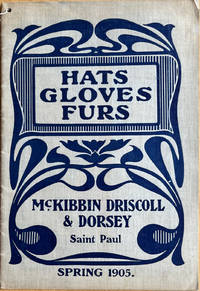
190562191St. Paul MN: McKibbin Driscoll & Dorsey Broadway and Fifth Streets St. Paul Printing Co. 1905. Tall 8vo. 27 1 pp. With text illustrations photo illustrations throughout. Gray decorated softcovers Arts & Crafts cover art & lettering in blue factory & warehouse & offices depicted on back cover small hole punch at upper left corner w/ gray silk braid as issued minor chipping to couple corners minor age-toning to fore-edges still a VG- copy. First edition of this surprisingly scarce Progressive-Era catalogue for the storied company founded originally in 1888 by McKibbin 1856-1941. This catalogue offers McKibbin Stiff Hats bowlers soft-brimmed Western hats such as the Columbia Dakota Manitoba & Railroad along with several Fedora hats. Advertised as well is an interesting novelty called the “Pin Wheel Hat†which were marketed in a round box rolled up and sold by the dozen for $ 4.50. Ladies and young women’s hats are included gloves sheep-lined coats and more. McKibbin was an orphaned self-made business man who managed to attend Princeton and Western University before moving to St. Paul where he eventually launched the business in 1888 which he sold in 1926 to T.W. Stevenson Manufacturing. No copies in Worldcat; See: David Pierce Joseph McKibbin Sept. 27 2014 & Men of Minnesota 1902 p. 372. McKibbin, Driscoll & Dorsey, Broadway and Fifth Streets, [St. Paul Printing Co.], paperback
187454872Boston: C.F. Hovey & Co. 1874. Folio. 13.5 x 11 in. 36 pp. 1 59 1 leaves. first 36 pp. incorporating title Memorandum pages several ALS letters and invoices on letterhead 8 pp. on graph paper w/ samples incorporated into the text 2 additional leaves of tissue thin manuscript copies from blotter 925 original fabric samples pinned-in glued-in and laid in sized from .5 x .5 in. up to 6 x 13 in. including a myriad of colours tartans plaids flannels silk blends cottons poplin cottons woolens etc. Original plum-coloured factory sample book purchased by Hovey from stationer P.L. Morin Paris who specialized in producing blank scrapbooks for factory sample cards printing & stationery registers w/ label mounted on front pastedown worn rubbing spine perished hinges loosed somewhat shaken still a remarkable unsophisticated exemplar preserved in folding case. This exceptional Victorian fabric sample order book assembled by a buyer for C.F Hovey & Co.’s fall fashion season furnishes an invaluable time capsule of colours textures and preferences in the 1870s. This era in women’s fashion driven by Parisian and other European design houses demanded extraordinary amounts of fabrics with an emphasis on the back of the skirt long trains and fabric draped up into bustles with an abundance of flounces and ruching. More significantly there was a tremendous growth in patterned poplin fabrics bright cotton & silk fabric blends as well as brilliant jewel colours. This order book with hundreds of different samples also offers a fantastic peek into the Victorian obsession with tartans and plaids driven by the mystique and example of Queen Victoria the ever-growing popularity with the historical romances of Sir Walter Scott celebrating the Highlanders and the poetry of Robert Burns. Tartan and plaid patterns were used in gowns dresses shawls veils hats purses and many fashion houses would often choose a particular clan pattern to celebrate and promote in their sales literature. Men’s suits coats and jackets were buttoned high on the chest the woolens became lighter weight and more durable as well of better quality and fashion designers for Hovey & Co. also incorporated rough finish woolens twills and tweeds into their clothing offered for sale. Many of the fabrics were also sold in Hovey & Co. fabric department in assorted lengths as well as ends for uses by Victorian women in home craft projects. Johnson focused on buying in the major wholesale textile dealers and markets of Europe during the 1870s including Stavert Tigomala & Co. one of the largest textile commission houses in Bradford UK; Firth Booth & Co. who specialized in bright cotton poplin plaids tartans wool blends and moire; Chamberlin Donner & Co. of Manchester one of the largest wholesale merchant houses shippers & traders in the British Empire; A. Van Bergen & Co. in Paris France whose beautifully patterned cotton and silk blends and woolens were enhanced by the award-winning dyes of Blanche at Puteaux; Les Fils de Th. Le Grand with wool blends twills and rough finish woolens. The sizes of the orders were remarkable and show the strength of Hovey’s customer base with one pair of invoices showing orders from Firth Booth & Co. totaling £ 7785 or over £ 855000 in present day value. However as evidenced by letter from Charles Kretschmann in Berlin who notes that Johnson in his June 24 1874 visit was “not pleased with the Berlin style of garments for this season and ordered only a very small lotâ€C.F. Hovey & Co. was founded by Charles Fox Hovey in 1833 as a dry goods merchant and with in a few years became a large department store located on Summer St. Through the years up to his death in 1859 he brought on many partners and was an ardent abolitionist and supporter of women’s rights establishing the Hovey Fund. After his death in 1859 Thomas Mack and Augustus De Puyster took over the running of the company and expansion through the Civil War. Johnson 1839-1927 was a Harvard grad clerk for Hovey & Co. and Civil War Veteran who rose from 1st Lieutenant in Co. H. Massachusetts 44th Infantry to Full Adjutant before mustering out right before Gettysburg. Hovey & Co. survived the massive fire of 1872 by employees soaking all the woolen blankets on the sales counters in water and placing over the roof and windows to protect the building from the flowing cinders expanded into store fronts on Chauncy and Avon Streets and was the first retailer to adopt the policy of requiring monthly payments on credit accounts. See: The History of the House of Hovey 1919; Charles Boston Looking Back at C.F. Hovey’s of Boston Shopping Days in Retro Boston May 6 2011; History of Fashion 1840-1900 Victoria and Albert Museum 2016. C.F. Hovey & Co., hardcover
196961745Portland & Pendleton OR: Pendleton Woolen Mills Feb. 1969. 4to. 9 x 11.25 in. 176 pp sections all separately paginated. on tinted paper illustrations throughout tan coloured printed section dividers thumb tabs at fore-edges. Colour-illustrated softcover post-binder screw at gutter margin 3-ring hole punched as issued minor creasing edgewear minor edgewear to thumb-tabs still a VG copy. First edition thus of this exceedingly scarce wholesaler jobber price list illustrating and presenting Pendleton Woolen Mills Mid-20th-Century fashions for men’s Shirts Light Jackets Robes Accessories Slacks Jackets Outerwear Outdoor Wear Boyswear Sweaters and Knit Shirts. In the 1960’s Pendleton was well-known for their Sir Pendleton shirt line-up of flannels for men including the Board Shirt used at the time by California surfers over a layer of petroleum jelly as an improvised wetsuit in the early days of the surf scene. The Pendletones rock band actually adopted their name in honor of the surf uniform of Pendleton shirts worn over t-shirts with khakis and later changed their name to the Beach Boys featuring Brian Dennis & Carl Wilson Mike Love and Al Jardine. The Worsted Yarns used in Pendleton men’s fashions at the time were tightly twisted and gave them a resilient luster. The company has even recently revived in 2024 the classic Board Shirt first seen in the plaids of the late 1960’s. No copies in Worldcat; See: Iconic Styles Pendleton Woven Issue No. 7 2024. Pendleton Woolen Mills, paperback
192758104New York: B. Altman & Co. Fifth Avenue July-August 1927. Tall 8vo. 7 x 11 in. 46 pp. Illustrated throughout. Colour-illustrated sofcovers stylish Art Deco cover art of flapper woman in stylish hat with cocktail on ocean liner beach fashions on back cover minor dustsoiling shelfwear minor bumping at couple corners still VG copy. First edition of this nicely printed and quintessential Flapper Era in-house fashion magazine and catalogue for B. Altman. Filled with novelties accessories and designs targeting the young flapper along with encouraging the Negligee for every mood marketing summer vacation items such as cameras photo albums even a portable sun dial. Worldcat locates 3 incomplete and broken run holdings of the Altman Magazine Mint Museum U of RI UVA. B. Altman & Co., Fifth Avenue, unknown
190048322Troy NY: Cluett Peabody & Co. Makers ca. 1900. Painted tin sign w/ black lettering 19 x 14 in. mounted in original quarter-sawn oak frame 24 x 18 in. with the advertising logo painted in black lettering minor scuffing to lettering very minor rust spotting and blue-tinted patina to sign still a VG- example. A wonderful advertising display for Monarch Shirts which originally came out of a Carlton Oregon general store which at the end of the 19th and beginning of the 20th century also sold men’s clothing accessories and shoes. George Bywater Cluett 1838-1912 and Frederick Forrest Peabody 1858-1927 were pioneers in the shirt & replaceable collar industry in Troy NY who created the iconic Arrow brand detachable Collars and shirts. They formed their company from Cluett & Sons to Cluett Peabody & Co. in 1899 and rapidly grew their business by providing women with an easier way to clean their husbands’ stained shirt collars without having to wash the entire shirt. In addition the collars wore out a much faster rate than the rest of the shirts so these replaceable collars would extend the life of the garments. Monarch shirts were famed for their durability and patented their Patent Bound Bosom Shirt which became known to consumers across the country as the Monarch Shirt. In 1905 the company launched the iconic campaign for Arrow Shirts with the famed illustrations by Joseph Leyendecker which ran for over 25 years. Various Cluett divisions maintained offices and showrooms in New York through 2002 and then in 2004 the Arrow Shirt brand was acquired by Phillips-Van Heusen Corp. Cluett, Peabody & Co., Makers, hardcover
191056015New York & Tacoma: Alfred Benjamin & Co.; Dege & Milner 1910. 8vo. 16 pp unpaginated. Black & white plates throughout including double-page centerfold pen & ink reminiscent of work of Charles Dana Gibson. Colour-illustrated softcovers cover art of horse-drawn sleigh in the snow slight dustsoiling minor shelfwear still an excellent copy. First edition of this scarce and nicely illustrated catalogue for Alfred Benjamin & Co. fashions for men before World War I. Benjamin Clothes were famed during the opening two decades of the 20th Century for emphasizing their cosmopolitan styling and that they were wholly manufactured and tailored in New York of the highest quality. The plates show well-dressed Benjamin men on the steps of The Met next to the Franz Sigel Statue on Riverside Drive in front of their Brass Era automobile at The Abbey on Lafayette and more. This copy was printed for the Dege & Milner department store in downtown Tacoma which was operated from 1901-1915 by James H. Dege and his partner William Milner before Dege opened the James H. Dege Co. store. No copies located in Worldcat. Alfred Benjamin & Co.; Dege & Milner, paperback
195052053Amsterdam: International Textiles 1950. Folio. 212 pp. With 100s of text illustrations plates diagrams photos many in colour 1 w/ tipped-in fabric sample of red velvet. Colour-illustrated softcovers cover art by Jean Colin showing the European dove of peace dangling a tailoring manikin below while flying over the Americas plexiglass spiral binding as issued minor shelfwear light soiling to fore-edges still VG copy. First edition of this very rare installment of this post-World War II fashion textiles trade magazine filled with advertising and articles detailing how Europe intended to wean itself off the Marshall Plan aid in order to rebuild. The article on Parisian fashion includes dress designs by Jean Desses Jacques Fath Pierre Balmain and others. There is a remarkable article on seersucker patterns offered for the 1951 season by Cloques which includes photos of the actual factory sample catalogue leaves showing patterns and tipped-in fabric swatches. In addition there are lavish advertisements and beautifully illustrated articles filled with fashion window displays from the Swiss Industries Fair in 1950 revealing the tremendous explosion of Mid-Century Modern designs out of European fashion design houses. International Textiles, paperback
190046147Paris: B. Henry 60 Rue de Turbigo ca. 1900. 8vo. 16 pp. Over 75 text illusts. 1 photo illust. of B. Henry. Self-printed wrappers illust. on front cover some minor dustsoiling wear slight creasing still VG- copy stapled as issued. First edition of this fascinating and very scarce catalogue of the elaborate hair-pieces and wigs for the fashions of mostly women and some men at the end of the 19th century. The pieces include full wigs hair extensions hair braided into the styles to be pinned to existing hair decorative pieces for special occasions and more. In addition there is a very good section on how to accurately measure yourself for your hair-piece. No copies located in Worldcat. B. Henry, 60, Rue de Turbigo, unknown
194657486New York: Lord & Taylor 1946. Tall 8vo. 3 101 4 pp. Double-page frontispiece white crepe-paper Christmas Tree pop-up by The Beistle Co. Illustrated throughout most in black & white 10 colour plates some photographic others a mixed-media effect. Colour-illustrated softcovers wraparound cover art minor shelfwear edgewear at corners light rippling to gutter margin of first couple leaves still a VG copy. First edition of this fashionable post-World War II catalogue celebrating 101 stylish gifts for men women & children following the easing of Wartime restrictions. The impressionistic illustrations were created by the in-house Lord & Taylor artists who were some of the most influential designers during the 1940’s and 1950’s including Dorothy Hood Helen Hall Arnold Hall Jean Karnoff Susan Abbott Betty Offt and Carl Wilson. Many of the 101 items drip with a glamour desired and reflected in post-War film and popular culture and a distinct emphasis on femininity with such items as the “Ermine hug-me-tight†stole Hand-made silk lingerie with French Alencon lace Koret dinner bag the Harem lounging costume by Joseph Whitehead Gloves that go up and up and more. Worldcat locates 1 copy Penn State; See: Keren Ben-Horin July Treasure of the Month: Frances Neady Collection On Pins and Needles July 25 2012. Lord & Taylor, paperback
193045898Troy NY: Arrow Shirt Co./ Cluett Peabody & Co. Inc. ca. 1930; 1955. Quarter-sawn oak salesman sample counter display case 18.75 x 6 x 6 ins. with glass top & front door in back with catch w/ original label at bottom of the display indicating that this case was only to be used for the display of the Company collars preserving two Arrow Shirt Co. Collars some scuffing and wear to label at bottom of case affecting lettering minor wear to sides of case together with original Leyendecker advertisement printed on canvas w/ oak frame 28.5 x 21.5 ins. the piece has been professionally cleaned and mounted on archival foam core and removed from the original bars which were damaging the image and placed back in the oak frame some sunning faint discoloration to upper left margin still remarkable pieces. A wonderful advertising display for Arrow shirts and collars including pre-World War II counter sample case and 1950s promotional ad reproducing one of the famed Leyendecker images. These pieces originally came out of a small men’s clothing shop in Bend Oregon. The Arrow collars grew from the marketing idea by Cluett Peabody & Co. in Troy NY that it gave women an easier way to clean their husbands’ stained shirt collars without having to wash the entire shirt. In addition the collars wore out a much faster rate than the rest of the shirts so these replaceable collars would extend the life of the garments. This style of detachable collars remained popular up until the mid-1930s and largely declined out of use by the end of World War II.Leyendecker 1874-1951 created the Arrow Collar Man which was an advertising campaign that ran from 1905 - 1931 and was perhaps one of the most successful product brands in history. He created 100s of images and many of them are still synonymous with men’s fashion and styles. This advertisement was part of a revived campaign by Arrow Shirt Co. in the 1950s through early 1960s as they revived the nostalgia of the Leyendecker ads and pushed their shirts with soft collars. Arrow Shirt Co./ Cluett, Peabody & Co., Inc., hardcover
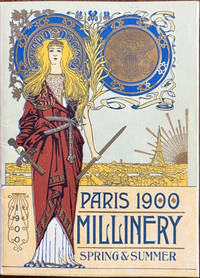
190060928Porland OR: Lipman Wolfe & Co. 1900. 16mo. 32 pp unpaginated. w/ photo illustrations throughout. Colour-illustrated softcovers view of the goddess Minerva holding broken sword city of Paris stretching into the background and medals which originally honored Czar Nicholas for the disarmament conference of 1898 now changed to the United States Seal w/ original mailing envelope post-marked 1¢ Franklin stamp NF/NF copy from the library of Caroline Augusta Gray Kamm 1840-1932 noted socialite and philanthropist in Portland built home for poor women & girls with the YWCA and was daughter of PNW pioneer William H. Gray 1810-1889 who traveled to the Lapwai Mission in Lewiston ID in 1836 where he was the Nez Perce secular agent and subsequently later married Jacob Kamm 1823-1912 pioneering Oregon industrialist and entrepreneur. First edition of this beautiful belle epoque 19th-Century fashion catalogue issued by the historic Lipman Wolfe & Co. department store in Portland OR featuring elaborate large-rimmed hats with extensive trimmings featuring fashions created by such women designers as Madam Michniwicz-Tuvee Esther Meyer Camille Roger perhaps best remembered later for her Art Deco Suffrage hats the Guillard sisters and others. The famed Lipman Wolfe & Co. department store was founded in 1880 by Adolphe Wolfe who teamed up with his uncle Solomon Lipman and at the time still maintained their original Dekum Building at 3rd Street and were the first to introduce customer elevators to their many floors. No copies in Worldcat. Lipman, Wolfe & Co., paperback