834 résultats
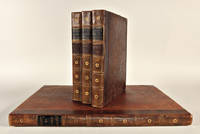
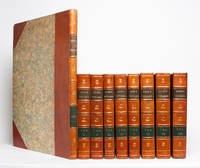
178421446London: W. & A. Strahan for G. Nicol and T. Cadell 1784. 4 volumes. Text: 3 vols. quarto 11 3/16 x 9 inches; Atlas: 1 vol. large folio 23 1/2 x 17 inches. Text: 1p. publisher's advertisements at end of vol.III. 1 folding letterpress table 24 engraved maps coastal profiles and charts 14 folding extra-illustrated with a duplicate folding engraved "Chart of the NW Coast of America and NE Coast of Asia" which is also present in the atlas. Atlas vol.: 63 engraved plates plans and maps one double-page one folding uncut. Text: contemporary tree calf expertly rebacked to style the flat spines divided into six compartments by double fillets enclosing a neo-classical roll red/brown morocco lettering-piece in the second compartment green morocco label with onlaid disc of red/brown morocco with volume number the remaining compartments elaborately tooled in gilt with stylised foliage cornerpieces around various large centrally-place tools; Atlas: expertly bound to style in half calf over marbled paper-covered boards the flat spine elaborately tooled in gilt uniform to the text.<br/> <br/>A fine set of the first edition of the official account of Cook's third and last voyage: a cornerstone among travel and voyage literature on the exploration of Hawaii and the northwest coast of America Canada and Alaska. This copy particularly desirable with the plates in the atlas uncut.<br/> <br/>"The famous accounts of Captain Cook's three voyages form the basis for any collection of Pacific books. In three great voyages Cook did more to clarify the geographical knowledge of the southern hemisphere than all his predecessors had done together. He was really the first scientific navigator and his voyages made great contributions to many fields of knowledge" Hill. "Cook's third voyage was organized to seek the Northwest Passage and to return the islander Omai to Tahiti. Officers of the crew included William Bligh James Burney James Colnett and George Vancouver. John Webber was appointed artist to the expedition. After calling at Kerguelen Island Tasmania New Zealand and the Cook Tonga and Society Islands the expedition sailed north and discovered Christmas Island and the Hawaiian Islands which Cook named the Sandwich Islands. Cook charted the American west coast from Northern California through the Bering Strait as far north as latitude 70 degrees 44 minutes before he was stopped by pack ice. He returned to Hawaii for the winter and was killed in an unhappy skirmish with the natives over a boat. Charles Clarke took command and after he died six months later the ships returned to England under John Gore. Despite hostilities with the United States and France the scientific nature of this expedition caused the various governments to exempt these vessels from capture. The voyage resulted in what Cook judged his most valuable discovery - the Hawaiian Islands" Hill.<br/> <br/>Beddie 1543; Forbes Hawaiian National Bibliography 85; Hill 2004 361; Lada-Mocarski 37; cf.Printing and the Mind of Man 223; Sabin 16250. W. & A. Strahan for G. Nicol and T. Cadell unknown books
1784WRCAM54194London: Printed by W. and A. Strahan for G. Nichol and T. Cadell 1784. Three quarto text volumes plus large folio atlas. Text: Twenty-four engraved maps coastal profiles and charts thirteen folding; folding letterpress table. Atlas: Sixty-three engraved plates charts and maps including one folding map and one double- page map. Text: Contemporary speckled calf gilt ruled expertly rebacked in matching gilt calf with gilt leather labels all edges painted red. 20th-century bookplates on front pastedowns. Light offsetting from plates light tanning and scattered faint foxing. Atlas: Expertly bound to style in half calf and marbled boards spines gilt black morocco label. Contemporary ink inscription on verso of final plate. Marginal light foxing and dust soiling. A very good set. A lovely set of the first edition of Cook's Third Voyage with a note of presentation in the atlas volume by Captain James King: "Thomas Venables The gift of Captain King." King was the author of the third text volume in the set and the preparer of Cook's journals that comprise the first two text volumes. Venables was probably a member of an ancient Cheshire landowning family later involved in early Australian settlement. King began Cook's final expedition as the expedition's astronomer and as a lieutenant on the Resolution but by the end of the expedition had been promoted to command of the Discovery and second-in-command. "At the time of Cook's death at Hawaii 14 February 1779 King was on shore in charge of the observatory. He had with him only a few men but was reinforced by some of a boat's crew who had been rowing off the mouth of the bay before the disturbance with the Hawaiians began. This brought the number of the party up to twenty-four and fortifying themselves in a neighbouring heiau or open-air temple they succeeded in repelling the attack of the Hawaiians until they were relieved two hours later by the ships' boats" - DNB. 6/10/2019 <br> <br> "Cook's third voyage was organized to seek the Northwest Passage and to return the islander Omai to Tahiti. Officers of the crew included William Bligh James Burney James Colnett and George Vancouver. John Webber was appointed artist to the expedition. After calling at Kerguelen Island Tasmania New Zealand and the Cook Tonga and Society Islands the expedition sailed north and discovered Christmas Island and the Hawaiian Islands which Cook named the Sandwich Islands. Cook charted the American west coast from Northern California through the Bering Strait as far north as latitude 70 degrees 44 minutes before he was stopped by pack ice. He returned to Hawaii for the winter and was killed in an unhappy skirmish with the natives. Charles Clarke took command and after he died six months later the ships returned to England under John Gore. Despite hostilities with the United States and France the scientific nature of this expedition caused the various governments to exempt these vessels from capture. The voyage resulted in what Cook judged his most valuable discovery - the Hawaiian Islands" - Hill. <br> <br> An excellent set of one the great Pacific voyages inscribed by one of its ultimate commanders and the partial author of the present published account Capt. James King. BEDDIE 1543. FORBES 62. HILL 361. HOWES C729a "aa." LADA-MOCARSKI 37 later issue. PRINTING AND THE MIND OF MAN 223. SABIN 16250. STREETER SALE 3478. REESE BEST OF THE WEST 14. DNB online. Printed by W. and A. Strahan for G. Nichol and T. Cadell hardcover books
178535359London: H. Hughs for G. Nicol and T. Cadell 1785. 4 volumes text: 3 volumes 4to 12 5/8 x 9 5/8 inches;atlas: 1 volume folio 23 1/2 x 17 inches. Text: engraved medallion vignettes on titles 1 folding letterpress table. Atlas: 87 engraved plates plans maps and charts 1 folding 1 double-page and including the 24 small format plates usually found in the text here on unfolded full sheets. Extra-illustrated with very rare and possibly unique impressions of the 24 engraved plates on wove paper watermarked 1801 bound into the text. Original paper-covered boards expertly rebacked to style with contemporary brown paper. All contained within dark blue morocco-backed boxes.<br/> <br/>A fine unsophisticated set of the third edition of the third voyage with the plates in their most desirable form: all the plates usually found in the text volumes are here bound unfolded and uncut in the atlas volume. In addition this set extra-illustrated with a duplicate set of those plates being unrecorded 1801 impressions on wove paper.<br/> <br/>"The famous accounts of Captain Cook's three voyages form the basis for any collection of Pacific books. In three great voyages Cook did more to clarify the geographical knowledge of the southern hemisphere than all his predecessors had done together. He was really the first scientific navigator and his voyages made great contributions to many fields of knowledge . Cook's third voyage was organized to seek the Northwest Passage and to return the islander Omai to Tahiti. Officers of the crew included William Bligh James Burney James Colnett and George Vancouver. John Webber was appointed artist to the expedition. After calling at Kerguelen Island Tasmania New Zealand and the Cook Tonga and Society Islands the expedition sailed north and discovered Christmas Island and the Hawaiian Islands which Cook named the Sandwich Islands. Cook charted the American west coast from Northern California through the Bering Strait as far north as latitude 70 degrees 44 minutes before he was stopped by pack ice. He returned to Hawaii for the winter and was killed in an unhappy skirmish with the natives over a boat. Charles Clarke took command and after he died six months later the ships returned to England under John Gore. Despite hostilities with the United States and France the scientific nature of this expedition caused the various governments to exempt these vessels from capture. The voyage resulted in what Cook judged his most valuable discovery - the Hawaiian Islands" Hill. The typography of the third edition is similar to the second edition which is generally considered superior to the first: Hughs took over the printing from Strahan and re-set all the text. In addition the third edition includes the first appearance of William Wales's "A Defence of the Arguments advanced in the introduction to Captain Cook's last Voyage against the existence of Cape Circumcision" vol.III pp.557-564. This fine set in boards comprises the rarest and most desirable form of the third voyage with the 24 plates intended for the text volumes to be bound uncut and unfolded into the atlas. Thus plates which are generally severely trimmed close or into the image to fit into the text are here on full sheets with wide margins. An early owner of this set however has extra-illustrated his text with early 19th century impressions of those plates. This issue of the duplicate set of plates appears unrecorded being on wove paper watermarked 1801. That the plates were added is confirmed by the fact that the plates are tipped-in rather than sewn or guarded into the text.<br/> <br/>Cf. Beddie 1543; cf. Forbes Hawaiian National Bibliography 62; cf. Lada-Mocarski 37; cf. Printing and the Mind of Man 223; cf. Sabin 16250. H. Hughs for G. Nicol and T. Cadell unknown books
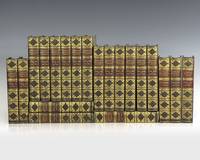
1818109061London: John & Arthur Arch; Hackney: Conrad Loddiges & Sons et al 1818-1833. Rare first edition large paper issue set of Loddiges' renowned Botanical Cabinet with 2000 numbered hand-colored plates by George Cooke. Octavos 20 volumes bound in three quarters morocco over marbled boards with elaborate gilt tooling to the spine in six compartments within raised gilt bands red morocco spine labels lettered in gilt all edges marbled. Illustrated with 2000 numbered hand-colored botanical plates by George Cooke. In near fine condition. Armorial bookplates. An exceptional collection most rare and desirable in a complete set. Founded by Joachim Conrad Loddiges in Hackey north of London the renowned Loddiges plant nursery rose to great prominence during the early nineteenth century under George Loddiges who published in serial numbers the present Botanical Cabinet produced in connection with George Cooke one of the more highly sought after engravers of the era. The 2000 hand-colored plates catalogued the broad array of exotic plants trees shrubs ferns palms and orchids introduced into the famed nursery's hothouses and gardens from around the world. John & Arthur Arch; Hackney: Conrad Loddiges & Sons, et al hardcover books
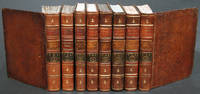
1773WRCAM18891London 1773. with: Cook James: A VOYAGE TOWARDS THE SOUTH POLE AND ROUND THE WORLD.IN THE YEARS 1772 1773 1774 AND 1775. London. 1784. with: Cook James: A VOYAGE TO THE PACIFIC OCEAN. London. 1784-85. with: Kippis Andrew: THE LIFE OF CAPTAIN JAMES COOK. London. 1788. Ten volumes all together including atlas volume. Text volumes: Large quarto. Contemporary calf expertly rebacked. Atlas: Large folio. Modern three-quarter calf and contemporary boards expertly rebacked in a complementary manner. Boards slightly worn particularly at edges. Upper right corner of upper board of second volume of third voyage chipped. Light foxing and dampstaining in some volumes particularly in margins. Some paper restoration on some plates in the atlas particularly in corners. Armorial bookplates. Overall very good. A complete set of Cook's three voyages being the second and best edition of the first voyage the first edition of the second voyage and a mixed set of the third voyage volumes one and two are from the second edition volume three from the first edition with the plates of the third voyage bound in an atlas lacks the rare "Death of Cook" plate as usual and with Kippis' biography of Cook. The first voyage describes Cook's explorations of New Zealand Australia Tahiti and other islands. The second voyage describes his southern voyages in search of a southern continent. The third is his north Pacific explorations of Alaska the Northwest Coast and Hawaii where the great navigator met his death. Of equal importance as a text of exploration a cartographic source for the numerous maps and charts included in the work and a visual source of the engravings of fauna flora and inhabitants of the Pacific. In all the entire set contains more than 200 maps and plates. HILL 782 783. HOWES C729a 3rd voyage. HOLMES 5 24 47. BEDDIE 650 1216 1552. LADA-MOCARSKI 37 3rd voyage. MITCHELL LIBRARY COOK BIBLIOGRAPHY passim. FORBES 62 3rd voyage. ROSOVE ANTARCTIC 77 2nd voyage. hardcover books
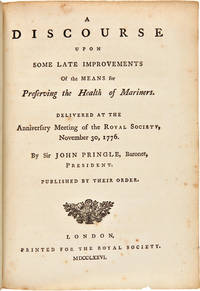
1776WRCAM36096London: Printed for the Royal Society 1776. 444pp. Half title. Small quarto. 20th-century three- quarter calf and marbled boards gilt label. Leaf C4 signed C3 a cancel as usual. Occasional minor foxing ink stain on p.2. Very good bound with five other works by Pringle see below. One of the most significant of all the printed works relating to Cook's voyages and their importance. This is the extremely rare first appearance in print of Cook's epoch- making account of the successful measures taken against scurvy on his first two voyages. There were several later versions and translations but the original edition of this milestone publication has long been acknowledged as a major rarity. The paper on scurvy was read to the Royal Society by its president Sir John Pringle in the absence of Cook himself then just beginning his final voyage as the year's Copley medal award winner and immediately published in this form. Pringle's long presentation address quoting directly from Cook and other sources is followed by Cook's paper and an extract from a letter by Cook to Pringle written from Plymouth Sound in July 1776. The paper subsequently appeared in the official account of the second voyage and in the PHILOSOPHICAL TRANSACTIONS of the Royal Society. In 1783 a series of six of Pringle's discourses at the annual presentations of the Copley medal was published in one volume. <br> <br> "In Pringle's discourse on preserving the health of mariners he includes the first printing of Captain Cook's important paper entitled: 'The Method taken for preserving the Health of the Crew of His Majesty's Ship the Resolution during her late Voyage round the World.' In this paper which Cook communicated to Pringle President of the Royal Society Cook describes the supplies carried on the voyage and his maintenance of the cleanliness of his ship and crew. It was included by Pringle in his discourse commemorating Cook's receipt of the Copley medal" - Norman sale. The winning of the battle against scurvy was one of the most important achievements in the general field of exploration. It made possible the major voyages that followed. As Robert Hughes so aptly put it in THE FATAL SHORE "malt juice and pickled cabbage put Europeans in Australia as microchip circuitry would put Americans on the moon." <br> <br> This copy is very appropriately accompanied by five other Royal Society discourses of the period. A DISCOURSE. is here bound chronologically with five other Pringle first editions: <br> <br> 1 A DISCOURSE ON THE DIFFERENT KINDS OF AIR. 1774. <br> <br> 2 A DISCOURSE ON THE TORPEDO. 1775. <br> <br> 3 A DISCOURSE ON THE ATTRACTION OF MOUNTAINS. 1775. <br> <br> 4 A DISCOURSE ON THE INVENTION AND IMPROVEMENTS OF THE REFLECTING TELESCOPE. 1778. <br> <br> 5 A DISCOURSE ON THE THEORY OF GUNNERY. 1778. <br> <br> The Streeter-Norman copy of the DISCOURSE.FOR PRESERVING THE HEALTH OF MARINERS was also bound with these five additional works by Pringle. STREETER SALE 2410. NORMAN SALE 378. GARRISON-MORTON 2156 3714. BEDDIE 1290. HOLMES 20. KROEPELIEN 1065. Printed for the Royal Society hardcover books
17853329London: W. Strahan and T. Cadell 1785. Second edition First edition Second edition. Second edition of the 1773 Hawkesworth edition complete with the "directions for placing the cuts" and The Chart of the Strait of Magellan which are sometimes lacking. This edition includes the Preface to the Second edition with Hawkesworth's famous rebuttal to Alexander Dalrymple. Three quarto volumes 284 x 227 mm bound in uniform contemporary calf expertly rebacked; collating: xx xxxvi iv directions for cuts 456; xiv 410; 395. Complete with 21 plates and charts in volume 1 22 in volume 2 and 9 in volume 3 most of which are folding. A Very Good set. Internal contents are generally in excellent shape; a few repairs the folding plates minor foxing but on the whole an attractive set.<br/><br/>First edition of A Voyage Towards the South Pole. Two quarto volumes 291 x 230 mm bound in contemporary calf expertly rebacked; collating: xl 378; viii 396. Complete with 37 plates and charts in volume 1 including the frontis portrait of Cook and 27 in volume 2 including frontis plus the folding table at p. 364. Internal contents are generally in excellent condition although with some minor browning to plates or adjacent leaves. <br/><br/>Second edition of A Voyage to the Pacific Ocean with the medallion on the title page of each volume. Three quarto volumes 296 x 234 bound in contemporary calf expertly rebacked; collating: x xcvi 421; xiv 548; xiv 556. Complete with 11 plates and charts in volume 1 including frontis 10 in volume 2 and 6 in volume 3 plus a folding table at p. 528. Volume one has two plates not called for apparently proof plates of "A Man of Van Diemen's Land" and "A Woman of Van Diemen's Land." Internal contents generally in excellent shape. On the whole a lovely set. With the Atlas volume 527 x 400 mm: containing 63 plates complete but for the "Death of Cook" plate which is only bound into some sets. Atlas volume uniformly bound to style with leather spine over marbled paper boards. Internally the plates are generally clean with only a bit of marginal foxing much nicer than typically found. <br/><br/>"In his three voyages to the Pacific Cook disproved the existence of a great southern continent completed the outlines of Australia and New Zealand charted the Society Islands the New Hebrides New Caledonia and the Hawaiian Islands and depicted accurately for the first time the north-west coast of America leaving no major discoveries for his successors. In addition the scientific discoveries in the fields of natural history and ethnology were considerable and the drawings made by the artists were of great significance" ODNB. On the heels of exploration came imperial exploitation. The Cook expeditions' mapping efforts enabled the British Empire to move safely and efficiently through the oceans in order to establish a world-wide system of economic and cultural control. <br/><br/>Beddie 648 1216 1553. PMM 223. W. Strahan and T. Cadell unknown books
1773112342London: W. Strahan and T. Cadell 1773 1777 1784. Rare first edition set of the official accounts of Captain James Cook's voyages "the foundation of modern knowledge of the Pacific and a cornerstone of the literature of travel and exploration" Beddie 648 1216 1543; Hill 782 358 361. Nine volumes altogether. Quarto bound in full calf with morocco spine labels elaborate gilt titles to the spine front and rear panels raised bands. Large folio atlas bound in the same manner. The First Voyage is comprised of three volumes edited by John Hawkesworth. "An Account of the Voyages. for making Discoveries in the Southern Hemisphere. In the Dolphin the Swallow and the Endeavour." The Second Voyage includes two volumes published in 1777: "A Voyage Towards the South Pole and Round the World. Performed in His Majesty's Ships Resolution and Adventure In the Years 1772 1773 1774 and 1775". First edition. Portrait frontispiece and 63 plates and charts several folding or double-page. The Third Voyage was published in 1784: "A Voyage to the Pacific Ocean. Undertaken by the command of His Majesty for making Discoveries in the Northern Hemisphere. To determine The Position and Extent of the West Side of North America; its Distance from Asia; and the Practicability of a Northern Passage to Europe." Four volumes first edition. The text with 24 plates and charts as called for with two large folding maps and 61 plates. An exceptional set. Captain Cooks Voyages are an iconic symbol of discovery and served not only to contribute to many diverse fields of knowledge but also to inspire many who followed after him. "He was really the first scientific navigator" Hill and the only explorer during this time to lead three circumnavigations. The knowledge accumulated during these explorations greatly expanded the awareness of the worlds geography and his writings maps and drawings significantly aided in future navigations making sea travel much more certain and educating the general public. Cooks first voyage sailed from England in 1768 rounded Cape Horn and continued westward to arrive in Tahiiti in April of 1769 where the Royal Society had engaged Cook to observe the transit of Venus across the Sun. He then sailed to New Zealand mapping the complete coastline and then travelling to Australia where his expedition became the first recorded Europeans to encounter the eastern coastline. The voyage was fraught with many perils including being nearly ship-wrecked on the Great Barrier Reef and losing many of the crew to malaria in modern day Indonesia but they were able to finally sail past the Cape of Good Hope and return to England in 1771. Cooks second voyage took place between 1772-1775 with a mission to search for the hypothetical Terra Australis. Cook crossed the Antarctic Circle for the first time in history and thought he disproved the existence of the "Great Southern Continent." He actually almost reached Antarctica on one occasion but then turned towards Tahiti for supplies. In Cooks third voyage 1776-79 his aim was to search for the North-West Passage through the American continent. He charted the American west coast from Northern California through the Bering Straight. "Cook was the first navigator to accurately map the coast and by carrying away a collection of furs he introduced the fur trade to the English and American traders whose subsequent expeditions were based upon his discoveries no other contemporaneously printed source narrative is of comparable importance" Eberstadt. On this voyage he also discovered the Hawaiian Islands which he named the Sandwich Islands. Cook died during this third voyage on the Hawaiian islands. With the publication of the first two voyages and his dramatic death in Hawaii James Cook became a national hero. So eagerly awaited was his account of the third voyage that it was sold out a few days after publication. Among his accomplishments Cook discovered New Caledonia Norfolk Island the Isle of Pines Sandwich Land Hawaii and rediscovered and charted numerous other lands. He was the first to survey New Zealand where he spent six months. He was also a pioneer in regard to the health of his men. On his second voyage Cook lost only one man out of 118 in a voyage of more than 1000 days one of the first to conquer scurvy. As a commander an observer and a practical physician his merits were equally great. He won the affection of those who served under him by sympathy kindness and unselfish care of others which were as noteworthy as his gifts of discovery and intellect. W. Strahan and T. Cadell hardcover books
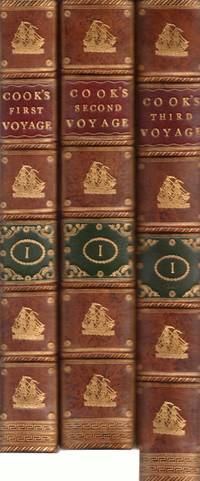
021328London England W. Strahan and T. Cadell 1st and 2nd Voyage G. Nicol and T. Cadell 3rd Voyage 1773 1777 1785. Very Good. Hardcover. Ten volumes nine quarto volumes plus one folio atlas volume all bound uniformly in contemporary tree calf with elaborately gilt-decorated spines with raised bands and red and green morocco spine labels interspersed with gilt stamped image of Cook's ship the Endeavour or Resolution. Volumes have been expertly re-backed. Light rubbing to leather on board edges with some abraded areas. Overall text plates and maps are quite clean with occasional foxing and a rare small chip or tear to edges of pages. Plate XLII in volume II has a minor closed tear. One plate in atlas volume shows an archival repair expertly rendered. One leaf in volume 1 missing 3/4" piece from edge. Three volumes from the 3rd Voyage have extra-wide margins. Trimming to several plates is a little tight to plate margins but no content loss was observed. Within several of the folding maps are very small blemishes at folds not affecting content. Set includes the scarce first edition of the first voyage by Hawkesworth the second edition of Cook's official report of the second voyage and finally the second edition of the third voyage by Cook and James King. Superbly illustrated with more than 200 engraved charts maps and plates many of which are folding. All in all this is an outstanding set with exceptional and handsome bindings and clean interiors. A high point for any book collection on world exploration. James Cook embarked on three circumnavigations between 1768 and 1776 leaving a legacy of reliable maps of most of the Pacific Ocean and the western coast of North America. The official accounts of the three voyages were eagerly sought by a curious public with early editions selling quickly and leading to an amazing array of sets consisting of various editions and collations. The 1773 first edition Hawkesworth volume is accompanied by 52 charts and plates. According to Sabin 30934 the first edition is preferred for its plates. This set includes the directions for placing plates not that binders always followed these directions and the often missing "Chart of the Streight of Magellan". Our 1777 second edition of the 2nd voyage contains 64 plates maps and charts. The binders added an additional volume to our set which includes twenty-nine plates from the first voyage and sixteen plates from the second voyage forming a separate quarto volume bound uniformly with the text volumes. The 1785 second edition of the third voyage contains 24 plates with the aforementioned extra-wide margins. The beautiful atlas folio contains two large folding maps and 61 stunning finely engraved plates. Cook's reports were perhaps more holistic than previous reports including observations of astronomy botany ethnology and languages. Cook was commissioned in 1766 as commander of HM Bark Endeavour and proceeded to sail and explore thousands of miles across largely uncharted areas of the globe. He mapped lands of the Pacific Ocean from New Zealand and Australia to Hawaii in greater detail and scale not previously charted. His mapping and surveying led to the naming of thousands of features islands and coastlines which resulted in an evolution of mapping especially in Europe. Cook's third voyage after a visit to the Hawaiian Islands headed west in search of the fabled Northwest Passage. The party sailed northward along the California and Oregon coastline completely missing the Strait of Juan de Fuca in present day Washington. After exploring British Columbian and Alaskan waters Cook headed back to the Pacific Islands where he ran into trouble. A broken mast led to a month long layover at Kealakekua Bay. During this stay tensions rose and native islanders stole a cutter from the expedition. In an effort to bargain Cook's party kidnapped the Hawaiian King Kalaniopuu as ransom for the cutter. Negotiations turned out poorly resulting in the death of Cook and four of his men. The third voyage concluded under the leadership of James King. Howes C-729a Sabin 30934 16245 and 16250. hardcover books