323 résultats
1677ZB666713Moguntiae: Sumpt. Ludovici Bourgeat Academiae Bibliopolae 1677. Rariores proprietates historias et sententias memorabiles non paucas breviter exponit. Ultima editio leaves slightly taller than 13.5 cm. 4 parts in one as issued 8 201 3 204 204 201 1 pp. each part has a special half title and each contains 100 circular engravings by Hans Sibmacher; contemporary vellum very worn with only a fragment of the spine covering remaining and the front cover bowed and almost detached armorial book plate of Wm. Strong and his name written in block letters on the now detached front free endpaper general light age toning with occasional age spotting the first twenty emblems hand colored good; edited by the author's son Ludwig Camerarius. - If you are reading this this item is actually physically in our stock and ready for shipment once ordered. We are not bookjackers. Buyer is responsible for any additional duties taxes or fees required by recipient's country. Photos available upon request. Moguntiae: Sumpt. Ludovici Bourgeat, Academiae Bibliopolae, hardcover
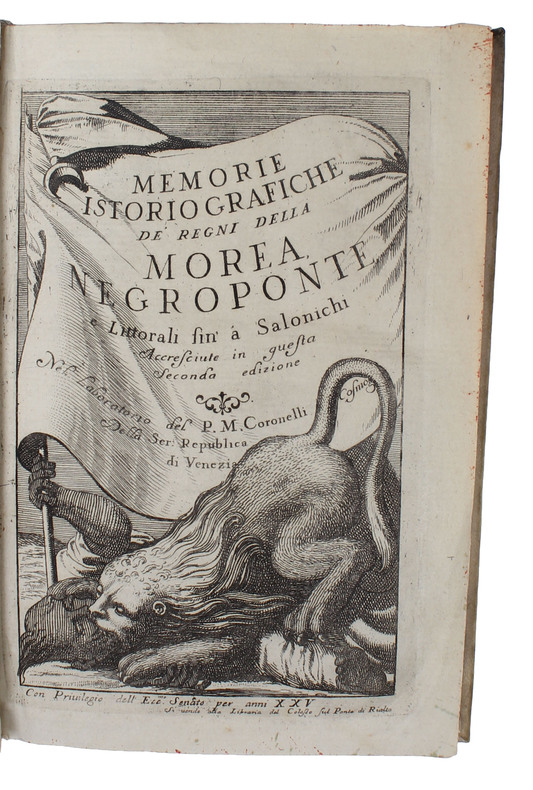
168649367Venezia, (1686). 8vo. (16,5x11 cm.). Contemp. full vellum. Halftitle-page. Engraved Title-page (the Lion of St. Mark). (8),237,1 blank,(2- Indice) pp. and 41 (of 42 ?) double-page folded engraved maps and plans (bird's-eye views or plans of fortified towns and places etc.). Internally fine and clean. Printed on good paper. A fine copy.
168649367Venezia 1686. 8vo. 165x11 cm. Contemp. full vellum. Halftitle-page. Engraved Title-page the Lion of St. Mark. 82371 blank2- Indice pp. and 41 of 42 double-page folded engraved maps and plans bird's-eye views or plans of fortified towns and places etc. Internally fine and clean. Printed on good paper. A fine copy. <br/><br/><em>Second edition the first 8vo-edition issued the same year as the first in folio describing the Venetian campaign for the reconquest of the Peloponnese or Morea from which Venice had been almost completely excluded since the Turkish conquest of the Greek island in 1458."As is often the case with Coronelli's work the contents may vary with each example as plates were added subtracted or changed as the editor saw fit" Rodney Shirley "Maps in the Atlases of the british Library" T.Coro-1a - listing only 39 maps and views for this copy.Coronelli Vincenzo Maria an Italian geographer and draughtsman was born at Venice about 1650. From 1681-1683 he worked in Paris on a pair of 3.85 meter diameter globes for Louis XIV which are now in the National Library in Paris. On his return to Venice he was made cosmographer of the Republic and founded the Academy of Argonauts the first Geographical Society. In 1702 he became general of his order. </em> hardcover
1651CA1001<p>1651 Mexico City Imprenta de Juan Ruyz. From the library of Luis Garcia Pimentel<br /><br />2 of 7136 leaves of 141. Octavo 8 1/2" x 6" bound in original period vellum with title hand written to spine. Last 36 leaves are headed "Lib. II" Libros 3 and 4 were issued separately the following year. From the library of Luis Garcia Pimentel. Medina Mexico 724; Palau 72254 First edition.<br /><br />Juan DÃaz de Arce born in Mexico towards the end of the 16th century he graduated as a bachelor from the Royal and Pontifical University on October 23 1603 he entered the College of Santa MarÃa de Todos Santos where he obtained the chair of theology which he taught for 30 years. Among other positions he was an archdeacon in charge of administering a diocese or part of it under the orders of the bishop he was appointed vicar general; He was also appointed as the schoolmaster which means that he was in charge of teaching the ecclesiastical scenes as well as archbishop of Santo Domingo but whether or not he took office is unknown. the pope appointed him delegate of the Augustinian cause over the alternative he died on June 1 1653.<br /><br />Bernardino Alvarez 1514–1584 promoted the formation of a congregation to take care of the ill founding the hospital in 1569. This congregation was given all the privileges of which the Brothers Hospitallers of St. John of God enjoyed. The Brothers remained as a congregation until 1700 when the petition of Hipolitos and Pope Innocence XII gave them the possibility of making chastity votes poorness obedience and hospitality under the rule of San AgustÃn. The San Hipólito Brothers' order was important for New Spain because seven hospitals were under their charge six of which were founded by money obtained from alms. One of those was San Hipólito hospital also founded by Bernardino Ãvarez. He was a priest born on Rosales León Spain. He studied humanities and Latin on a preceptorship located on Vegarienza León. He did his training prior making his vows before being a member of the religious institute on El Escorial Monastery where he finalized his novitiate in September 22 1531. He worked in Rome in the Real Monastery in the Ucles Monastery and in Santiago Monastery. He became a priest in 1538. He went back to Spain where he worked as a teacher in El Escorial Monastery. Bernardino Ãlvarez was imprisoned on August 6 1547. When he was released he went to Mexico after the fall of Tenochtitlan. When he arrived he started the religious order of the Hipólitos. He founded San Hipolito Hospital and "Santa Cruz" hospital in Oaxtepec Morelos Mexico. This hospital was also dedicated for patients with mental diseases. During the next years he opened other hospitals one in Puebla that was named "San Roque" which was for female psychiatric patients another one in Jalapa Veracruz called "La Concepción" and one in Acapulco Guerrero. Ãlvarez decided the foundation of five hospitals in Mexico was not enough so he traveled to Mesoamerica and founded more hospitals than he expected all the way from La Habana Cuba to Mexico. The information about his death is nonexistent but it is known that today there is a tribute to the priest on the Hospital de Jesús.<br /><br />Luis GarcÃa Pimentel 1835-1930 He was the son of and the also bibliographer and historian JoaquÃn GarcÃa Icazbalceta. He continued the compilation that his father started and carried out photolithographic essays on the work <em>Bibliography of the 16th century</em>.<br /><br /><strong>Condition:</strong><br /><br />Ownership tag of Luis Garcia Pimente to front vellum verso. .Moderate wear with stains to vellum lacking frontispiece plate lacking 5 preliminary leaves lacking the 6 final leaves table of contents lacking rear pastedown minor worming to inner margin; early ownership inscription on title page unidentified Carmelite marca de fuego on top edge. Spine lettering faded defective but only 7 in OCLC.</p> Imprenta de Juan Ruyz
168152963<p>London printed for JOHN LAWRENCE at the Angel in Cornhill near the Royal Exchange 1681. VOLUME 1 ONLY The first trade & agriculture periodical in England 1681 complete with all 15 parts VOLUME 2 which is missing had six parts no more published. Although the title page is dated 1681 each issue has a separate imprint the last number 15 is dated 1683. Small 4to approximately 190 x 140 mm 7½ x 5½ inches pages: title page 1-184 bound in contemporary sheep rebacked with paler leather 2 black leather gilt lettered labels and gilt pattern dots to spine 2 bookplates of previous owners. Binding rubbed and lightly scuffed corners slightly worn 1 with small repair occasional pale age-browning strip of browning to edges of pastedowns and endpapers "Winchilsea" in old ink to top of first page free endpapers slightly chipped at edges otherwise a very good copy. Part 12 has a chapter by JOHN EVELYN pages 127-136: An Account of bread from the Learned John Evelyn Esquire; Entituled Panificium or the several manners of making Bread in France. Where by universal consent the best Bread in the World is eaten: Benit O Brioche Household-Bread Mountrau D'Esprit D'Citroville D'Cousin. Pages 35- 38 mention the Plantations in America. Part 14 pages 163-167 "An Experiment of the Ingenious Mr. John Worlidge for improving and Fyning of Syder" fining of cider; No.15 consists of lists of imports exports and ship movements in and out of London from Feb. 1683-March 1684; Other chapters History of Malting and the Method of making Malt; Improving Land by Marle; Some Account of the Plague 1665; The Manner and Advantage of Planting Liquorice; A Catalogue of the Books in the Library of the Royal Society relating to Agriculture; articles on trade agriculture the poor Ireland and all kinds of grain etc. See: Geoffrey Keynes John Evelyn A Bibliography of his Writings pages 261-62 No. 127; Mary Aslin Catalogue of the Printed Books on Agriculture 1471-1840 page 64; Forum Auctions lot 373 11th July 2018; Fussell 1523-1730 pages 81-82; Donald McDonald Agricultural Writers 1200-1800 pages 122-124; Catalogue of the Goldsmiths Library of Economic Literature Volume 1 page 140; The Kress Library of Business and Economics page 86 No. 1538; ESTC P2335. MORE IMAGES ATTACHED TO THIS LISTING ALL ZOOMABLE FURTHER IMAGES ON REQUEST. POSTAGE AT COST AND ALL PARCELS SENT FULLY TRACKED AND FULLY INSURED.</p> London, printed for JOHN LAWRENCE, at the Angel in Cornhill near the Royal Exchange, 1681. hardcover
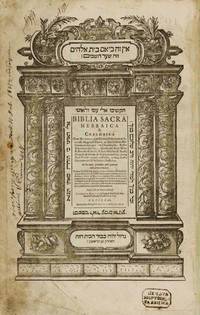
161948847Basel: Ludwig König 1619. First editions. Hardcover. Good. Seven parts in two volumes folio biblical texts and commentary in four parts continuously foliated; two supplemental sections each with separate foliation; Tiberias 1620 with separate pagination here bound after the second part - Vol. 1: 6 title and prelims 1-228 1 sect. title 234-441 1 blankff.; 6 sect. title and prelims 2 blank 114 2 blankpp. Vol. 2: 442-946; 8 Targum Yerushalmi; last leaf unfoliated; 67 Masora 1 blankff. Largely arranged in two columns of biblical texts in square font surrounded by commentaries in rabbinic Rashi font; text reads from right to left. This copy with collective Latin title surrounded by biblical quotations in Hebrew set within elaborate woodcut architectural borders. Hebrew sectional titles set within the same woodcut borders for the second and fourth parts with a plain letterpress half-title for the Five Megillot. The third sectional title for the Latter Prophets is lacking as are the Ashkenazi Haftarot readings not found in all copies. Apart from these lacks the Rabbinic Bible collates complete despite numerous errors in foliation throughout as per the detailed notes in Prijs Die Basler hebräischen Drucke. Opening word of each biblical book set in large one-third to one-half page cartouche vignettes with elaborate woodcut borders and surrounding letterpress Hebrew text. Main Latin title dated 1619 with the editor's Latin preface to the reader appearing at the verso. Jewish date chronogram for the second section Former Prophets dated 5378 1618/1619. Early twentieth-century black cloth boards worn at extremities gilt-lettered spine. Title moderately soiled re-inforced at gutter; neat old repairs to corners and fore-edge of title and next three leaves; old Russian stamp at bottom margin title manuscript entry in Russian along fore-edge dated 1837; intermittent mild to moderate marginal dampstains largely confined to corners and embrowning throughout both volumes somewhat more heavily in the first especially throughout Tiberias; top right corner of the opening leaf in vol. 2 repaired with loss of about 12 words surrounding title cartouche recto and some text in 9 lines of the commentary at the verso. Overall a good set with a notable chain of provenance. <br /> <br /> Sixth Rabbinic Bible in Hebrew: Mikra'ot Gedolot edited by Johann Buxtorf I 1565-1629 professor of Hebrew at the University of Basel and the foremost Christian Hebraist of his era with the assistance of the Jewish scholars Abraham Braunschweig who served as the principal corrector and Mordechai Gumplin of Posen. This was "a truly audacious undertaking for his time" Burnett From Christian Hebraism to Jewish Studies as no Christian scholar had yet attempted to edit the entire biblical corpus including the Aramaic versions Targumim and masoretic notes. Based mainly on the third Rabbinic Bible published by Daniel Bomberg at Venice in 1546-1548 the editor has carefully incorporated elements from two other Venetian editions. At the verso of the Latin title Buxtorf provides a detailed bibliographical excursus on the earlier Venetian editions and offers a tribute to Bomberg's industry by reprinting the colophon of the second Venetian Rabbinic Bible 1524-1525 at the conclusion of the masoretic appendix with text by the Hebrew grammarian and lexicographer Elijah Levita 1468 or 1469-1549 and a new introduction by Abraham Braunschweig. The design of the sectional titles and separate book title vignettes closely model those of the Venetian editions. "Buxtorf did not plan simply to reprint one of the existing Venice editions but rather to assemble the best features of them all into one work" and "to provide theologians with what he considered the most important tools for interpreting the Old Testament" Burnett. Buxtorf served in an official capacity as Basel's Hebrew censor charged with the oversight of all Jewish printing in the city and insuring that "no 'blasphemies' or slurs against Christians or Christianity appear in any book printed in Basel" Burnett. He carefully edited the Jewish commentaries in the Rabbinic Bible in accordance with this mandate "and removed many words and phrases which had escaped the attention of earlier censors" Burnett. <br /> <br /> The Rabbinic Bible contains the vocalized Masoretic text of the Hebrew Scriptures with accents and a vocalized Targum an Aramaic paraphrase of the biblical text: Onkelos for the Pentateuch; Jonathan b. Uzziel for the Prophets; and Targum Hagiographa for the Writings. The Hebrew and Aramaic versions are printed in square characters and presented in facing columns at the center of each page. The Jerusalem Targum of the Pentateuch appears as an appendix. In addition to the Aramaic paraphrases the Rabbinic Bible includes a massive scholarly apparatus of biblical commentaries by Rashi Ibn Ezra Baal ha-Turim Jacob b. Asher R. David Kimchi Radak R. Levi b. Gershon Ralbag Saadia Gaon and R. Isaiah along with the Masora a corpus of critical notes on the external form of the Biblical text compiled by Jewish scholars from late antiquity through the medieval era. As frequently occurs a copy of Buxtorf's work on the textual history of the Hebrew Bible Tiberias the 1620 first edition is bound-in. This work was made possible by the publication in 1538 of Elijah Levita's Masoret ha-Masoret a commentary on the Masora which Buxtorf translated into Latin for his own private use in 1593. "Buxtorf was concerned with the integrity of the consonantal text and the origin and integrity of the vowel points and accents of the Hebrew Bible from the very beginning of his scholarly career" and while he had earlier published a long excursus on the age of the vowel points and accents in his 1609 Thesaurus Grammaticus "Tiberias is Buxtorf's fullest and most impressive work on the history of the biblical text" Burnett. Intended as a reference work for Christian students and scholars interested in studying the Masora Buxtorf was also keen to refute the view advanced by Levita that the Hebrew vowel points were early medieval innovations. Our folio version of Tiberias was intended to accompany the Rabbinic Bible and has the same architectural borders at the title. König also published a quarto edition in the same year but only the folio version includes a critical commentary on the Masora in which Buxtorf proposes various corrections to the Masoretic notes. <br /> <br /> As noted at the title Buxtorf's faithful study and tireless labor studio fido et labore indefesso yielded notably long-lasting results: "The Basel rabbinical Bible became a standard tool for research among Christian scholars and would remain so. until the end of the nineteenth century" Burnett. A vast array of early modern scholars including Protestants like Johannes Drusius and John Selden as well as Roman Catholics like Robert Bellarmine and Andreas Masius owned a copy or two of the Rabbinic Bible. "Johannes Buxtorf's thoroughly censored "Christian" version of the Rabbinic Bible Basel 1618-19 only made it easier for Hebraists to own copies of their own" Burnett Christian Hebraism in the Reformation Era p.163.<br /> <br /> A note on the date of publication: "The actual printing began between the mid-August and mid-September of 1618. According to the colophon production ended on the 24 of Ab 5379 = August 4 1619 but since this date also appeared on the colophon of the Bomberg Biblia rabbinica edition of 1524-25 reprinted unchanged in the 1546-48 and 1568 editions it is suspect. Prijs suggested that the probable completion date was sometime during Ab of 5379 between July 12 and August 10 of 1619" Burnett. <br /> <br /> Provenance: from the library of acclaimed theologian and biblical scholar Brevard Childs with his entry at the free endpaper in the second volume. The earlier bookplate of judge Samuel Heller with his motto in Hebrew: Mi-kol melamdai hiskalti from all my teachers I have learned appears at the front paste-down. An old blue ink-stamp in Hebrew characters makes occasional appearances the text: Bet ha-Midrash ha-Gadol Minsk The Great Synagogue of Minsk. A Russian entry dated 1837 appears at the fore-margin of the main title along with an old ink stamp in Russian at the bottom margin the last word of which reads "Rabbina" References: Biblia Sacra: Burnett 7. Cowley 87. Darlow & Moule 5120 bound with the 1665 second edition of Tiberias cf. 5093. Davidson Otsar ha-shirah vol.1 p.406 no.8954. Prijs 219. Steinschneider 423 423b. VD17 23:675325G. S. Burnett Christian Hebraism in the Reformation Era Leiden: Brill 2012 p.163. Tiberias: Burnett 111. Prijs 222a. For detailed analyses of both works see: S. Burnett From Christian Hebraism to Jewish Studies Leiden: Brill 1996 pp.169-239 chaps. 6 & 7.<br /> <br /> Full Latin title: Biblia Sacra Hebraica & Chaldaica cum Masora quae critica Hebraeorum sacra est Magna & Parva ac selectissimis Hebraeorum interpretum commentariis Rabbi Salomonis Jarchi R. Abrahami Aben Esrae R. Davidis Kimchi R. Levi Gerson R. Saadie Gaon R. Jeschajae & Notis ex authore quem Baal Turim vocant collectis quibus textus grammaticè & historicè illustratur. In his nunc primum post quatuor editiones Venetas textus Chaldaicus qui Targum dicitur à deformitate punctationis & pravitate vocum innumeratum vindicatus; loca in Masora transposita deficientia pugnantia numeris depravata subsidio diversorum exemplarium & Concordantiarum Hebraicarum quantum fieri potuit reposita restituta & conciliata sunt ut in praefatione amplius declarabitur. Studio fido & labore indefesso Johannis BuxtofI linguae sanctae in Academia Basileensi Professoris Ord. Basileae: Sumptibus & typis Ludovici König 1619.<br /> <br /> Collation vol. 1 Rabbinic Bible: ital.a6 a-z8 A-E8 F4 G-Z8 Aa-Hh8 Ii9 Ii10 blank; 1 blank :3 1 blank A-N4 O5.<br /> <br /> Collation vol. 2 Rabbinic Bible: Kk-Rr8 Kk1 lacks Ss6 Tt10 Vv-Zz8 AA-PP8 QQ-TT6 VV9 VV10 blank XX-ZZ8 Aaa-Nnn8 Ooo3 Ooo4 blank PppTtt8 Vuu3 Vuu4 blank Xxx-Zzz8 AAaa-EEee8 8 A-G8 H6 I5 I6 blank. Ludwig König hardcover
1633156London: Robert Barker.by the Assignes of John Bill 1633. Very Early Elizabethan Printing. Tooled leather. Very Good /Custom Case. 12mo original tooled leather 17th century binding engraved frontispiece very closely cut borders all edges gilded original green silk page divider viii blank ~ 524 vi blank pages. THE NEW TES_/ TAMENT / Of our Lord and / S A V I O V R / - Jesus Christ Newly translated out of the / Originall Grrek : and / with the former transla- / tions diligently compared / and revised by his Maie- / sties special commande- / ment. ---------------------------- Imprinted at London / By Robert Barker Printer / to the Kings most Excel- / lent Majesty and by / the Assignes of John Bill 1633. Cum privilegia. A GEM! In an original tooled leather binding no less. Beautiful clear type. Minimal wear. Some pages so closely cropped by the printer that the chapter headings at the top have been partially excised though not the text. In order to ensure its proper long-term preservation we commissioned Scott Kellar distinguished Chicago bookbinder and restorer to make minor professional repairs and to construct a protective box for this already Exceptional and Rare tiny edition of the Authorized King James version of the New Testament. Finely bound in contemporary tan embossed calf over wooden boards richly gilt to spine. four hubs and boards. Marbled pastedowns & endpaper. a.e.g. and gauffered. Spine very slightly rubbed with partial loss of caps at head and foot restored and almost invisible. Edges of engraved title page reinforced; overall a fine copy. Ink inscriptions on two front free endpapers naming "Edmund James Gore" & his London addresses. The continental binding on this small format Authorized version MAY suggest that it might be a pirated edition of the English Bible pirated in Amsterdam. For example the Stam printing family were printing small format Bibles in 1673-- after our publication see Cambridge History of the Book in Britain IV p.467. Herbert 713-14 Wing B2511A. Robert Barker...by the Assignes of John Bill hardcover books
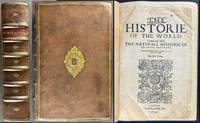
16341634SSLondon: Printed by Adam Islip 1634. 2nd edition in english. Leather-bound Hardcover. Very Good /no dj as issued. 2nd edition in English Very Good<br /> --- --- --- <br /> London printed by Adam Islip 1634 second English edition two Volumes bound in One 13.5" x 9"'<br /> Vol I 58 614 pages plus 42 pages Index for Tombe I; Vol II 632 pages plus 82 pages Index for Tombe II 2.<br /> Two volumes in one bound in modern full calf decorated papered boards six raised bands to spine gilt lettering and decorations on spine and front and back board.<br /> Elaborate woodcut printers device on title page woodcut initials head and tailpieces copious indexes of both volumes small piece of paper on final sheet saying that the previous issue had a lengthy Errata sheet which is no longer required as the errors have been corrected for this edition.<br /> Faint ownership inscription on top of the title page dated 1647.<br /> <br /> The Historie of the World was first translated into English by Philemon Holland in 1604. The original work of Pliny was published two years before he perished at Pompeii during the eruption of Mount Vesuvius in 79 CE.<br /> <br /> Gaius Plinius Secundus or Pliny the Elder was a Roman author naturalist scientist and naval and army commander of the early Roman Empire. He wrote several works and was dedicated to study in his life. <br /> <br /> The work is in good to very good condition overall. There is some marginal toning. There are some restored marginal losses to prelims and concluding leaves. There is very light intermittent spotting. There may be a few minor imperfections or faint marks to be expected with age. ---- ---- ---- <br /> The Historie of the World was first translated into English by Philemon Holland in 1604. The original work of Pliny was published two years before he perished at Pompeii during the eruption of Mount Vesuvius in 79 CE.<br /> <br /> Gaius Plinius Secundus or Pliny the Elder was a Roman author naturalist scientist and naval and army commander of the early Roman Empire. He wrote several works and was dedicated to study in his life. <br /> <br /> The work is in good to very good condition overall. There is some marginal toning. There are some restored marginal losses to prelims and concluding leaves. There is very light intermittent spotting. There may be a few minor imperfections or faint marks to be expected with age. Printed by Adam Islip hardcover
16191903070006Lutetiae Parisiorum: Typis Regiis 1619. First Edition. Hardcover. Good. 1st edition of Du Val's collected works of Aristotle. 2 volumes bound in 4. Folio 40 x 26 cm. Bound in contemporary Cambridge-style paneled calf. Rebacked and restored bindings. 6 raised bands. Title pages in red and black with engraved portrait of Aristotle. Text in Greek and Latin in parallel columns. Institutional blind stamps. Dampstaining along bottom scattered marginal staining. First title has its margins trimmed and conserved. Collated: Tome 1 part 1: 16 430 p.; T.1 p.2: 431-1251 p. 19; T.2 p.1: 3 469 p. 1; T. 2 p.2: 470-1104 p. 16. <br> According to John Lempriere's Classical Dictionary Aristotle's "treatises have been published separately; but the best edition of the works collectively is that of Duval." p. 96. Refs: Brunet I. 459. <br> Subtitle: "Veterum ac recentiorum interpretum ut Adriani Turnebi Isaaci Casauboni Julii Pacil studio emendatissima. Cum Kyriaci Strozae Patritii Florentini libris duobus Graecolatinis de Republica in supplementum politicorum Aristotelis. Sed nouissimae huic editioni omnium quae hactenus prodierunt ornatissimae accessit breuis ac perpetuus in omnes Aristotelis libros commentarius siue Synopsis Analytica Doctrinae Peripateticae non antehac visa; in qua ut in expeditiore tabella Aristotelis philosophia omnis provt ea suo ordine descripta est perspicue breuiterque indicatur & pro rerum dignitate exponitur. ; Authore Guillelmo Du-Val Pontesiano Philosophiae Graecae & Latinae in Parisiensi Acade" <br> This is an oversized or heavy book which requires additional postage for international delivery outside the US. Lutetiae Parisiorum: Typis Regiis hardcover
169141859Leipzig, Grosse & Gleditsch, 1691. 4to. Contemp. full vellum. Faint handwritten title on spine. a small stamp on titlepage. In: ""Acta Eruditorum Anno MDCLXXXXI"". (8),590,(6) pp. and 13 (of 15) folded engraved plates. The 2 first plates lacks, but they do not belong to the papers listed.Leibniz' papers: pp.277-281 a. 1 plate, pp. 435-439. Johann Bernoulli: pp. 274-276 a. 1 plate. Huygens: pp. 281-282. - Jacob Bernoulli: pp. 282-290 a. 1 plate.
167944323Paris, Thomas Jolly, 1679. Small8vo. (15x9 cm.). Contemp. full sprinckled calf., raisedbands, richly gilt spine. Top of spine a bit worn. Edges of covers gilt. (12),86,(1) pp. Last page ""Extrait du Privilege du Roy"". 34 fine full-page engravings (25 copper-engraved a. 9 in woodcut). A paperflw at foot of titlepage neathly repaired, no loss of paper or letters. Internally clean and fine, printed on thick, good paper.
167944323Paris Thomas Jolly 1679. Small8vo. 15x9 cm. Contemp. full sprinckled calf. raisedbands richly gilt spine. Top of spine a bit worn. Edges of covers gilt. 12861 pp. Last page "Extrait du Privilege du Roy". 34 fine full-page engravings 25 copper-engraved a. 9 in woodcut. A paperflw at foot of titlepage neathly repaired no loss of paper or letters. Internally clean and fine printed on thick good paper. <br/><br/><em>Extremely scarce first edition of Leclerc's important work on binocular vision in which he finds that one of the eyes has a dominant status thus announcing the discovery of the "Master-eye" - a discovery of outmost importance in the theory of shooting and elsewhere. With use of diagrams he shows that "things that can be seen clearly are seen with but one single eye.". He records and depicts a large series of experiments with binocular vision and shows geometrically the relation to the science of perspective and points out the importance of understanding the physiology of binocular vision for perspective painting in general.Sebastien Leclerc was originally an engraver who studied physics and geometry in relation to perspective theory a field of which he became famous. In 1672 he was appointed to "l'Academie de Peinture" as professor in perspective. He was also engraver to Louis XIV and was appointed professor at "l'Ecole des Gobelins". </em> unknown
169141859Leipzig Grosse & Gleditsch 1691. 4to. Contemp. full vellum. Faint handwritten title on spine. a small stamp on titlepage. In: "Acta Eruditorum Anno MDCLXXXXI". 85906 pp. and 13 of 15 folded engraved plates. The 2 first plates lacks but they do not belong to the papers listed.Leibniz' papers: pp.277-281 a. 1 plate pp. 435-439. Johann Bernoulli: pp. 274-276 a. 1 plate. Huygens: pp. 281-282. - Jacob Bernoulli: pp. 282-290 a. 1 plate. <br/><br/><em>All papers first apperance. All 5 of extreme importence in the development of the Calculus. Leibniz' 2 papers on the catenary curve paper 1-2 offered here was written at the instigation of Jacques Bernoulli. Following the example of Blaise Pascal who had initiated in 1658 a contest for the construction of the cycloid Leibniz also provoked the geometers of his time by challenging them to submit at the fixed date of mid-1691 their geometric method for the construction of the catenary curve. Leibniz later provided the answer followed by Johann Bernoulli and Huygens.'These two papers are a historical account of the origin of the study of this transcendental curve and at the same time the first physical-geometric construction showing the species-relationship between the catenary and the logarithmic curves as two companion curves; one arithmetic the other geometric. All of the differentials of the catenary curve are arithmetic means of corresponding differentials of the logarithmic curve; and all of the differentials of the logarithmic curve are geometric means of the catenary.'"The Catenary is the form of a hanging fully flexible rope or chain the name comes from "catena" which means 'chain' suspended on two points. The interest in this curve originated with Galileo who thought that is was a parabola. Young Christiaan Huygens proved in 1646 that this cannot be the case. What the actual form was remained an open question till 1691 when Leibniz Johann Bernoulli and the then much older Huygens sent solutions to the problem to the "Acta" Jakob Bernoulli 1690 Johann Bernoulli 1691 Huygens 1691 and Leibniz 1691 - these 4 1691-papers offered here - in which the previous year Jakob Bernoulli had challenged mathematicians to solve it. As published the solutions did not reveal the methods but through later publications of manuscripts these methods have been known. Huygens applied with great paper 4 virtuosity the by then classical methods of 17th century infinitesimal mathematics and he needed all his ingenuity to reach a satisfactory solution. Leibniz the papers 1-2 and Bernoulli paper 3 applying the new Calculus found the solutions in a much direct way. In fact the catenary was a test-case between the old and the new style in the study of curves and only because the champion of the old style was a giant like Huygens the test-case can formally be considered as ending in a draw." Grattan-Guiness in "From the Calculus to Set Theory 1630-1910.".The paper by JACOB BERNOULLI no. 5 offered here is a milestone papers as it marks the invention of the "SYSTEM OF POLAR COORDINATES" with points located by reference to a fixed point and a line through that point. Although newton had earlier also devised such a coordinate system in 1671 his work was not known so that the credit for the discovery generally goes to Bernoulli. Parkinson Breakthroughs 1691.Further papers contained in this volume of Acta Eruditorum:DENYS PAPIN: Mecanicorum de Viribus Motricibus sententia asserta a D. Papino adversius C.G.G. L. Leibniz objectiones. pp. 6-13. The plate lacks. - and Dion. Papini Observationes quaedam circa materias ad Hydraulicam spectantes. Pp. 208-213 a. 1 plate. This importent paper is part of the LEIBNIZ-PAPIN-CONTROVERSY.JACOB BERNOULLI: Specimen Calculi Differentialis in dimensione Parabolæ helicoidis ubi de flexuris curvarum in genere carundem evolutionibus. Pp. 13-22. The plate lacks. - and J.B. Demonstratio Centri Oscillationis ex Natura Vectis reperta occassione eorum quæ super hac materia in Historia Literaria Roterodamensi recensentur articulo.Pp.317-321.LEIBNIZ: O.V.E. Additio ad Schediasma de Medii Resistentia publicatum in Actis mensis Febr. 1889. Pp. 177-178. and O.V.E. Quadratura Arithmetica Communis Sectionum Conicarum quæ centrum babent.Pp. 178-182 a. 1 plate.TSCHIRNHAUS: Singularia Effecta Vitri Caustici bipedalis quod omnia magno sumtu hactenus constructa specula ustoria virtute superat per D.T. Pp. 517-520 </em> hardcover
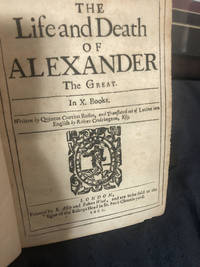
1661Bv1103<p>"NONE BUT ALEXANDER COULD PERFORM WHAT ALEXANDER HATH DONE": SCARCE 1661 EDITION IN ENGLISH OF QUINTUS CURTIUS RUFUS' LIFE AND DEATH OF ALEXANDER THE GREAT CODRINGTON Robert translator. The Life and Death of Alexander the Great. In X. Books. London: E. Alsop and Robert Wood 1661. Small quarto 6 x 7-1/2 modern full brown calf elaborately gilt-decorated spine raised bands black morocco spine label. Housed in a custom black linen slipcase. 1661 edition the scarce second edition of Robert Codrington's esteemed translation into English of this life of Alexander the Great a splendid volume attractively bound in full calf. Curtius Rufus flourished in the first century C.E.; particulars of his life are unknown. His Historiarum Alexandri Magni "introduces a number of picturesque details which are grouped effectively; and the career of the great Macedonian is regarded as a series of brilliant and romantic adventures. There are a number of carefully finished speeches worked into the narrative and much sententious reflection. The style is evidently formed on that of Livy" Peck 449. Preceded by John Brende's 1553 first translation into English which ran through a number of printings in the intervening century before Codrington undertook his new translation "exactly conferred with the Original and purged from many gross errors and absurdities with which it before abounded." Codrington's translation first appeared in 1652 under a slightly different title see Wing C7699. Title page with wood-cut engraved vignette engraved headpieces and ornamental initials. Occasional mispagination toward the end as issued without loss of text. A superlative example handsomely bound. Book Bv1103. $4000. We specialize in rare Ayn Rand as well as other legends and landmarks.</p> E. Alsop and Robert Wood hardcover
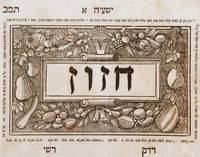
161952679Basel: Ludwig König 1619. First edition in part. Hardcover. Good. Eight parts in three volumes folio biblical texts and commentary in four parts continuously foliated; three supplemental sections each with separate foliation; Tiberias 1655 with separate pagination here bound after the Haftarot - Vol. 1: 6 title and prelims 1-228 1 sect. title 234-441 1 blank ff. Vol. 2: 1 sect. title 442-705 3 blank 707 sect. title-837 1 blank ff. Vol. 3: 839 half-title-881 1 blank 883-946; 8 Targum Yerushalmi; last leaf unfoliated; 67 Masorah 1 blank; 1 title 2-36 Haftarot ff.; 8 title and prelims 108pp. Despite the gap in foliation between the first and second parts and numerous errors in foliation throughout the Rabbinic Bible collates complete with all blanks noted in Prijs Die Basler hebräischen Drucke and the Haftarot bound at the end. Largely arranged in two columns of biblical texts in square font surrounded by commentaries in rabbinic Rashi font; biblical texts read from right to left. This copy with collective Hebrew title surrounded by biblical quotations in Hebrew set within elaborate woodcut architectural borders; brief preface in Hebrew by Abraham Braunschweig at the verso. Hebrew sectional titles set within the same woodcut borders for the three other biblical sections and the Haftarot with a plain letterpress half-title for the Five Megillot. Opening word of each biblical book set in large one-third to one-half page cartouche vignettes with elaborate woodcut borders and surrounding letterpress Hebrew text. Main title Jewish date chronogram = 5378 1618-1619. Near-contemporary half calf over speckled boards worn and rubbed; spines with raised bands gilt morocco lettering pieces and old paper labels heavily faded. About two-thirds of the text embrowned ranging from minimal to moderately heavy; worm tracing in a 1- by 2-inch section at leaves 541-553 affecting text. A good complete set notably containing the Ashkenazi Haftarot readings not found in all copies.<br /> <br /> Sixth Rabbinic Bible in Hebrew: Mikra'ot Gedolot edited by Johann Buxtorf I 1565-1629 professor of Hebrew at the University of Basel and the foremost Christian Hebraist of his era with the assistance of the Jewish scholars Abraham Braunschweig who served as the principal corrector and Mordechai Gumplin of Posen. This was "a truly audacious undertaking for his time" Burnett as no Christian scholar had yet attempted to edit the entire biblical corpus including the Aramaic versions Targumim and masoretic notes. Based mainly on the third Rabbinic Bible published by Daniel Bomberg at Venice in 1546-1548 the editor has carefully incorporated elements from two other Venetian editions. At the verso of the Latin title Buxtorf provides a detailed bibliographical excursus on the earlier Venetian editions and offers a tribute to Bomberg's industry by reprinting the colophon of the second Venetian Rabbinic Bible 1524-1525 at the conclusion of the masoretic appendix with text by the Hebrew grammarian and lexicographer Elijah Levita 1468 or 1469-1549 and a new introduction by Abraham Braunschweig. The design of the sectional titles and separate book title vignettes closely model those of the Venetian editions. "Buxtorf did not plan simply to reprint one of the existing Venice editions but rather to assemble the best features of them all into one work" and "to provide theologians with what he considered the most important tools for interpreting the Old Testament" Burnett. Buxtorf served in an official capacity as Basel's Hebrew censor charged with the oversight of all Jewish printing in the city and insuring that "no 'blasphemies' or slurs against Christians or Christianity appear in any book printed in Basel" Burnett. He carefully edited the Jewish commentaries in the Rabbinic Bible in accordance with this mandate "and removed many words and phrases which had escaped the attention of earlier censors" Burnett. <br /> <br /> The Rabbinic Bible contains the vocalized Masoretic text of the Hebrew Scriptures with accents and a vocalized Targum an Aramaic paraphrase of the biblical text: Onkelos for the Pentateuch; Jonathan b. Uzziel for the Prophets; and Targum Hagiographa for the Writings. The Hebrew and Aramaic versions are printed in square characters and presented in facing columns at the center of each page. The Jerusalem Targum of the Pentateuch appears as an appendix. In addition to the Aramaic paraphrases the Rabbinic Bible includes a massive scholarly apparatus of biblical commentaries by Rashi Ibn Ezra Baal ha-Turim Jacob b. Asher R. David Kimchi Radak R. Levi b. Gershon Ralbag Saadia Gaon and R. Isaiah along with the Masora a corpus of critical notes on the external form of the Biblical text compiled by Jewish scholars from late antiquity through the medieval era. As frequently occurs a copy of Buxtorf's work on the textual history of the Hebrew Bible Tiberias the 1655 revised edition is bound-in. This work was made possible by the publication in 1538 of Elijah Levita's Masoret ha-Masoret a commentary on the Masora which Buxtorf translated into Latin for his own private use in 1593. While "Buxtorf was concerned with the integrity of the consonantal text and the origin and integrity of the vowel points and accents of the Hebrew Bible from the very beginning of his scholarly career." While he had earlier published a long excursus on the age of the vowel points and accents in his 1609 Thesaurus Grammaticus "Tiberias is Buxtorf's fullest and most impressive work on the history of the biblical text" Burnett. Intended as a reference work for Christian students and scholars interested in studying the Masora Buxtorf was also keen to refute the view advanced by Levita that the Hebrew vowel points were early medieval innovations. Our folio version of Tiberias was intended to accompany the Rabbinic Bible and has the same architectural borders at the title. König also published a quarto edition in the same year but only the folio version includes a critical commentary on the Masora in which Buxtorf proposes various corrections to the Masoretic notes. <br /> <br /> As noted at the title Buxtorf's faithful study and tireless labor studio fido et labore indefesso yielded notably long-lasting results: "The Basel rabbinical Bible became a standard tool for research among Christian scholars and would remain so. until the end of the nineteenth century" Burnett. A vast array of early modern scholars including Protestants like Johannes Drusius and John Selden as well as Roman Catholics like Robert Bellarmine and Andreas Masius owned a copy or two of the Rabbinic Bible. "Johannes Buxtorf's thoroughly censored "Christian" version of the Rabbinic Bible Basel 1618-19 only made it easier for Hebraists to own copies of their own" Burnett Christian Hebraism in the Reformation Era p.163.<br /> <br /> A note on the date of publication: "The actual printing began between the mid-August and mid-September of 1618. According to the colophon production ended on the 24 of Ab 379 = August 4 1619 but since this date also appeared on the colophon of the Bomberg Biblia rabbinica edition of 1524-25 reprinted unchanged in the 1546-48 and 1568 editions it is suspect. Prijs suggested that the probable completion date was sometime during Ab of 379 between July 12 and August 10 of 1619" Burnett. References: Biblia Sacra: Burnett 7. Cowley 87. Darlow & Moule 5120 like our copy bound with the 1665 second edition of Tiberias cf. 5093. Davidson Otsar ha-shirah vol.1 p.406 no.8954. Prijs 219. Steinschneider 423 423b. VD17 23:675325G. S. Burnett Christian Hebraism in the Reformation Era Leiden: Brill 2012 p.163. Tiberias: Burnett 114. Prijs 272a. For detailed analyses of both works see: S. Burnett From Christian Hebraism to Jewish Studies Leiden: Brill 1996 pp.169-239 chaps. 6 & 7. Ludwig König hardcover
1630SAV156Strassburg: In Verlegung Lazari Zetzners Seligen Erben 1630. Hardcover. Good. 1625-1630. Four parts in one volume separately titled two with engraved borders. Oblong 8vo 133x175mm. Pagination: Part 1: 3-111 1pp. lacking title; Part II: 135 1pp. pp. 19-20 misbound but present ; Part III: 87 1pp.; Part IV: 159 1pp lacking 5 engravings at pp. 69-70 89-90 141-144 157-158. Sold as is. 228 oblong copperplate engravings of Old and New Testament compositions covering biblical books of Genesis to Apocalypse with Latin German and French text from a chronicle by Johann Ludwig Gottfried. Old German Type. This copy opening with the dedication by Merian to the austere and noble Frankfurt town mayor Johann Martin Bawer von Eiseneck Baur von Eysseneck and followed by the Favorable Reader pages. Part I of the Icones Biblicae covers the books of Genesis to end of Deuteronomy. Part II is dedicated to Anna Maria Königin and Jacob Sandrarts a burger and tradesman of Frankfurt respectively and covers the books of Joshua to second book of Kings. Part III the shortest and dated 1630 covers books of Chronicles to II Maccabees. Part IV dated 1629 with engraved title with Christ as Humilitas and astounded St. Paul in Glory covers New Testament chronicles and scenes including all four Gospel writers Acts of the Apostles and the Apocalypse. Later half calf over speckled boards; front cover loose some minor excisions as noted above preliminary leaves and some corners and margins repaired some margins shaved close with loss scattered stains overall a good compact copy rich in engravings. <br/><br/>Merians engravings and Gottfrieds trilingual chronicle together an iconographic compendium to the Bible the Icones Biblicae published between 1625 and 1630 by Zetzners in Strassburg. The printers De Bry in Frankfurt produced another edition of the same title from 1625 to 1627. After 1631 other editions of the "Icones Biblicae" appeared in Amsterdam and Cologne. The initial work was conceived as a monumental collection of great scenes from the Bible designed by Merian and accompanied with short descriptive texts in German Latin and French by German theologian and historian Johann Ludwig Gottfried. Swiss-born engraver Matthaeus Merian the Elder lived in Frankfurt most his life where he produced several religious historical and topographical publications for the European market. Perhaps best known for his detailed prints of European cities Merians biblical imagery both of Old and New Testament compositions were also well integrated into the vernacular culture of his time. Merians superb engravings are reminiscent of seventeenth century European landscapes plentiful in period details and notable for Baroque-ized exaggerations consisting of raucous figures in high drama situations. It is purported Rembrandt van Rijn consulted a copy of the "Icones Biblicae" for ideas for his compositions. OCLC locates only one copy but that of De Bry in a US institution. This Zetzners edition is uncommon outside Europe. Altogether a scarce work and commonly lacking a few engravings which were probably pulled for artistic reference. In Verlegung Lazari Zetzners Seligen Erben hardcover
163238184London: Printed by M. Flesher for Rich: Royston in Ivie-lane next the exchequer Office London 1632. Hardcover. Very Good. Hardcover. This is the third edition of Montaigne's influential and famous essays and on the title page it says that whereunto this edition is now more newly added an index of the principal matters and personages mentioned in the book. The celebrated architectural illustration that is engraved on the title page is by Martin Droeshout responsible for the iconic portrait of Shakespeare in the First Folio also appeared in this edition for the first time Montaigne is credited with pioneering the modern essay form. His Essays are a collection of personal reflections exploring a wide range of topics from human nature to philosophy literature and personal experiences. Published in three books they were written and revised over several decades with the first edition appearing in 1580. The remarkable modernity of thought apparent in Montaigne's essays coupled with their sustained popularity made them arguably the most prominent work in French philosophy until the Enlightenment. Their influence over French education and culture is still strong. Wikipedia They were originally written in Middle French and published in the Kingdom of France. Montaigne's stated design in writing publishing and revising the Essays over the period from approximately 1570 to 1592 was to record "some traits of my character and of my humours." Montaigne's Essays went through several stages of publication evolving from a two-book work in 1580 to a final posthumous edition in 1595. The first English translation of Montaigne's Essays was published in 1603 by John Florio. This translation titled The Essayes or Morall politike and millitarie discourses was a significant event in English literature introducing the French philosopher's work to an English-speaking audience. <br /> <br /> Bound in full brown leather; the spine has raised bands with titling and ornaments in gilt. There are small chips on the right side of each band. A small piece of leather at the bottom of spine edge is torn away and their is a slight crack to the top of spine along the front cover. The covers have some bumping and rubbing and a few small spots. It appears that the formal endpapers are missing and there is just rough paper covering the inside covers. It is torn and revels glue remnants <br /> <br /> The front inside cover has a bookplate with a coronet and the Latin motto "Vernon Semper Viret" meaning in English "Vernon Always Flourishes". This appears to belong to George John Warren Venables-Vernon 5th Baron Vernon 1803-1866 who was a British politician and member of parliament. He was also a devotee of Dante and The Inferno.<br /> <br /> The text pages have bright white margins but the printed text sections are somewhat browned. There small brown spots along the margins of pages 55-60 with one having become a hole. There are three books of essays with the second and third books having title pages dated 1631. The first book: pages 1 - 177; the second book: pages 183-440; the third book: pages 443-631. It is followed by the "Index or Table of subjects that is unpaginated. Despite the noted condition issue this is still a very good copy of this important book. LIT/073125. Printed by M. Flesher, for Rich: Royston, in Ivie-lane next the exchequer Office, London hardcover
168736Paris: Paris chez Mademoiselle Jablier 1687 1687. First Edition. Rebound in full calf.Octavo 7.5 x 6 inches Latin and French Condition: Near Fine. 24 engraved tables in Latin and 24 parallel tables in French. Near Fine. A Rare Parallel Latin-French Edition of Sabbathier's Christian Kabbalah Engravings<br /> 1687<br /> <br /> Esprit Sabbathier edited by François-Marie of the same order<br /> Idealis Umbra Sapientiae Generalis 1687<br /> <br /> Publisher: Paris chez Mademoiselle Jablier 1687<br /> Octavo 7.5 x 6 inches<br /> Latin and French Condition: Near Fine<br /> <br /> A rare mystical work of Christian Kabbalah authored by the Capuchin friar Esprit Sabbathier and edited by his brother François-Marie. The book sets out a symbolic system of universal wisdom presented through 24 engraved tables in Latin and 24 parallel tables in French. Both parts were originally engraved onto one or two very large copperplates by the engraver Caumartin then cut apart glued down and bound on tabs a curious production method that explains why surviving complete copies are so scarce. This a very rare work of high mysticism and Christian Kabbalah.<br /> <br /> Rebound in modern full leather with five raised bands gilt title to the spine over a red paste down and blind-stamped ruling to the borders of the boards. Inside are the two parts one in Latin and one in French each containing 24 double-page engraved tables mounted as described above.<br /> <br /> Near Fine condition with only light smudging to some pages and smudge marks at the base of the title page. Paris, chez Mademoiselle Jablier, 1687 unknown
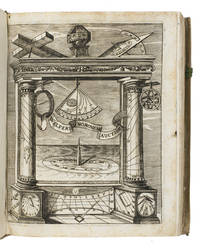
16723992Nuremberg 1672. 4to. Paulus Fürstens printed by Christoph Gerhard Contemporary parchment sewn on 3 supports with a hollow back each board with a frame of blind double fillets green cloth ties. With a finely engraved frontispiece an architectural gate with a wide variety of sundials and other astronomical instruments 2 title-pages each in a decorative frame built up from typographic ornaments 16 engraved plates 1 folding in the first part that for p. 48 repeated - at the end of vol. 2 - in accordance with the instructions to the binder and numerous mathematical illustrations and figures on 13 folding engraved plates lettered A-N in the second part. Further with letterpress tables on the integral leaves woodcut tailpieces and decorative gothic initials and headpieces built up from typographic ornaments. Set in fraktur types with incidental roman and Schwabacher. 2 volumes bound as 1. 12 88; 74 2 pp. Rare second edition 1st issue in 2 volumes extensively revised and enlarged of a mathematical study of the construction of sundials by Eberhard Welper the elder 1590-1664 first published in 1625 and here with useful additional observations and enlarged with a second part by Johann Christoph Sturm. Welper was born in Lohr near Marburg but studied in Strasbourg where he worked as a bookseller printer mathematician astrologer and astronomer. The first edition of the present work was one of his earliest publications. Sturm greatly expanded Welpers Gnomonica for the 1672 edition which was originally complete in the present two volumes. In 1681 Sturm added a third volume so the present two volumes were reissued with the third. Doppelmayer added a fourth volume in 1708.Occasionally browned but still in good condition. A rare 17th-centry work on sundials.l BMC STC 17th cen. W815 vols. 1-2; VD17 39:119761M & 39:119760D vols. 1-2 6 copies; Zimmer Astronomische Instrumente pp. 546 & 583; cf. Zimmer Astronomischen Literatur 5023 1625 ed.; not in Honeyman; Poggendorff; Wheeler gift. hardcover
1666ALDR0371London, Printed for J. Starkey 1666. Kl.4°. 96 S. [Frontispiz fehlt]. - Angebunden: STUBBE, Henry. The Miraculous Conformist: Or An account of severall Marvailous Cures, performed by the stroaking oft the Hands of Mr Valentini Greatarick (sic!); With A Physicall Discourse thereupon, In a Letter to...Robert Boyle Esq;...By Henry Stubbe, Physician at Stratford upon Avon (etc.) - Oxford, Printed by H. (Henry) Hall Printer to the University, for Ric. (Richard) Davis 1666. Kl.4°. 2 unbedr. Bl., Titelbl., 2 nn. Bll., 44 (= 40) S. (Ss. 35 bis 38 überspr.) - Angebunden: LLOYD, David. Wonders No Miracles; Or, Mr. Valentine Greatrates (sic!) Gift of Healing Examindet, Upon occasion of a Sad Effect of his Stroaking, (etc.) - London, Printed for Sam. (Samuel Speed) 1666. Titelbl., 46 S. Lederband d. Zeit, Einbandrücken restauriert, Reste des früheren Rückenbezugs mit (abgeriebener) Goldprägung und des von alter Hand beschriebenen Rückenschildchens aufgeklebt, Einbanddeckel mit Zierrahmen in Goldprägung, mit dreiseitiger, grossteils abgeriebener Stehkantenverzierung, Buchschnitt rotgefärbt, Vorsatz erneuert. Wenig gebräunt, nur schwach stockfleckig. Mit ausführlichen bibliographischen und biographischen Anmerkungen von alten Händen auf den unbedruckten Blättern (This Book is very Curious & very Scarce), eine Anmerkung betreffend die falsche Seitenzählung am zweiten und eine Autorenangabe (by David Bryde) am dritten Titelblatt. NUC 216,238. 574,340 u. 336,191 - Sammelband mit drei selbständig erschienenen Schriften in Erstausgaben (bzw. im Jahr der Erstausgabe erschienen) von bzw. über den zu seiner Zeit berühmten und umstrittenen - auch noch später immer wieder in Publikationen erwähnten - Wunderheiler - Valentine Greatrakes (1628-1682). Der aus Irland stammende 'Geistheiler', wirkte in Irland und England und hatte neben Erfolgen auch Misserfolge zu verzeichnen. Der Sammelband enthält eine Schrift des Naturwissenschaftlers und anerkannten Altphilologen H. Stubbe (auch Stubbes; 1632-1676), die Greatrakes Heilungen durch Handauflegen ins Bereich des Wunderbaren und Mysteriösen verweisen, sowie eine Schrift, die heute dem Biographen David Lloyd (1635-1692) - nicht David Bryce, wie auf dem Titelblatt vermerkt - zugeschrieben wird, in welcher er gegen Greatrakes Stellung nimmt. Als Reaktion darauf verfasste Greatrakes den vorliegenden 'Brief Account' in Form eines Briefes an den bekannten Naturforscher Robert Boyle. Der aus Irland stammende Boyle (1627-1692) gilt als Mitbegründer der modernen Naturwissenschaften. Diese drei zeitgenössischen, noch zu Greatrakes Lebzeiten erschienenen, Schriften sind überaus selten. - Das fehlende Frontispiz liegt in Kopie bei. - Differenzbesteuert
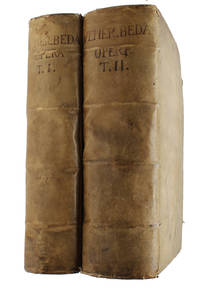
1688000011508Coloniae Agrippinae = Cologne: Ioannem Wilhelmum Friessem 1688. Later edition. Hardcover. Very Good. 4 vol. 8 vol. bound in 4. Folio. 8 2-452 2; 1-238 with a section of these leaves mispaginated; 4 2-499 2; 4 2-916 1; 2 2-815; 2 2-851; 4 2-486 1; 4 2-967 a lengthy unpaginated index of words and subjects at the end of the volume plus a blank before the rear endpaper pp. Contemporary full blind-tooled pigskin contemporary ink titling on the spines with the volumes numbers; all edges decoratively stained black. Volume one with an engraved title page and its title page printed in red and black also with several in-text woodcuts and charts. The later volumes each have their own title page all volumes with woodcut initials head and tailpieces. Brunet 276. Graesse 321. NCBEL 346. Oxford DNB J. Campbell "Bede St Bede Bæda known as the Venerable Bede 673/4–735". This edition was first published in Cologne in 1612 these volumes are the second edition printed there. Saint Bede is remembered for his contributions to ecclesiastical and British historical writings. Bede wrote analytically and was fascinated by time and the creation of life as they were written about in early Christian sources. The sources available to him included Eusebius of Caesarea Orosius Eutropius and the earlier British historian Gildas. Historians label his Historia Ecclesiastica Anglis Gentorum as the greatest culmination of his writings and some point out that it helped to create the sense of a national English identity at a time when the Angles and the Saxons were still forging intertribal unity. His history of Christianity in Britain largely focuses on the years 597-731 after a brief explanation of Christianity in Roman-controlled Britain. Bede wrote in his own autobiography that his life was devoted to "learning and letters" and he was well-beloved in his own time and long after including by Britain's first king Alfred which is largely why most of his work survives today. His translations of various religious histories and lives of the Saints into Latin made these works accessible to his fellow monks and Bede even did an Old English translation of St. John's Gospel which had it survived would be the earliest lengthy work of prose in English. Bede was an author who was influenced greatly by the writers of Late Antiquity and his career is one of the most significant among those who wrote during the early Middle Ages. With a small later bookplate and an 18th century ownership mark Signet Library on each front pastedown. No other institutional markings. Boards with a few small spots of wear and yellowing overall a lovely set. Ioannem Wilhelmum Friessem hardcover
161228124Coloniae Agrippinae (Köln), Sumptibus Anton. Hierati et Ioan. Gymnici, 1612. Folio. Bound in two contemporary, uniform full vellum bindings with remains of silk-ties on boards. Some traces of use to extremities. Some pages evenly browned, some brownspotted. First two volumes richly illustrated with woodcut diagrams, musical notes, earth- and heaven-maps etc. in the text, numerous woodcut initials throughout, engraved title-page. (10) pp, columns 1-168 (84 pp.), pp. 169 - 322, columns 323 - 452 (65 pp.) + (1) f., 238 pp. + (2) ff., columns 1 - 500 (250 pp.) + (2) ff., columns 1 - 916 (458 pp.) + (1) f., columns 1 - 816 (408 pp) + (1) f., columns 1 - 852 (426 pp.) + (2) ff., columns 1 - 485 (243 pp.) + (2) ff., columns 1 - 968 (484 pp.), 55 ff. (Index).
161228124Coloniae Agrippinae Köln Sumptibus Anton. Hierati et Ioan. Gymnici 1612. Folio. Bound in two contemporary uniform full vellum bindings with remains of silk-ties on boards. Some traces of use to extremities. Some pages evenly browned some brownspotted. First two volumes richly illustrated with woodcut diagrams musical notes earth- and heaven-maps etc. in the text numerous woodcut initials throughout engraved title-page. 10 pp columns 1-168 84 pp. pp. 169 - 322 columns 323 - 452 65 pp. 1 f. 238 pp. 2 ff. columns 1 - 500 250 pp. 2 ff. columns 1 - 916 458 pp. 1 f. columns 1 - 816 408 pp 1 f. columns 1 - 852 426 pp. 2 ff. columns 1 - 485 243 pp. 2 ff. columns 1 - 968 484 pp. 55 ff. Index. <br/><br/><em>Very rare early and apparently first complete edition of the seminal works by the "Father of English History" the venrable Bede. Bede’s most famous work his "An Ecclesiastical History of the English People" Historia Ecclesiastica Gentis Anglorum begins with the invasion of the British Isles by Roman forces and is considered one of the most important historical records documenting Roman rule Anglo-Saxon settlement and the evolution of the Church on the island. With its focus on Anglo-Saxon history the work is considered a key foundational text in the forming of a national English identity. The "Ecclesiastical History" contains stories that serve as the only source documenting the conversion to Christianity of the Anglo-Saxon tribes. It tells the story of Britons from Julius Caesar’s invasion to the time of Bede himself . He tells the story of battles conversions and miracles performed by monks and bishops and details Britain’s early history from the Roman invasion. He furthermore describes the organization and establishment of Christianity in the English church and covers the personal history of Holy Ethelwald and miracles of growth within the English church such as the development of the bishopric. "Bede’s works fall into three groups: grammatical and “scientific†scriptural commentary and historical and biographical. His earliest works included treatises on spelling hymns figures of speech verse and epigrams. His first treatise on chronology De temporibus “On Times†with a brief chronicle attached was written in 703. In 725 he completed a greatly amplified version De temporum ratione “On the Reckoning of Time†with a much longer chronicle. Both these books were mainly concerned with the reckoning of Easter. His earliest biblical commentary was probably that on the Revelation to John 703–709; in this and many similar works his aim was to transmit and explain relevant passages from the Fathers of the Church. Although his interpretations were mainly allegorical treating much of the biblical text as symbolic of deeper meanings he used some critical judgment and attempted to rationalize discrepancies. Among his most notable are his verse 705–716 and prose before 721 lives of St. Cuthbert bishop of Lindisfarne. These works are uncritical and abound with accounts of miracles; a more exclusively historical work is Historia abbatum c. 725; “Lives of the Abbotsâ€. In 731/732 Bede completed his Historia ecclesiastica. Divided into five books it recorded events in Britain from the raids by Julius Caesar 55–54 BCE to the arrival in Kent 597 CE of St. Augustine of Canterbury. For his sources he claimed the authority of ancient letters the “traditions of our forefathers†and his own knowledge of contemporary events. Bede’s Historia ecclesiastica leaves gaps tantalizing to secular historians. Although overloaded with the miraculous it is the work of a scholar anxious to assess the accuracy of his sources and to record only what he regarded as trustworthy evidence. It remains an indispensable source for some of the facts and much of the feel of early Anglo-Saxon history." Encycl. Britt. Only three editions of Bede's Opera Omnia are known before Dr. Giles' edition from 1843 - 44. The first was printed in 1563 and the third in 1688. The 1688-edition constitutes the second edition of the present 1612-edition which is "According to Dr. Henry the only complete edition" Lowndes I:143. These three editions are also the only ones known to have been printed in folio though Lowndes mentions the 1688-edition as 4to. The 1612-edition is the rarest. Some of the works contained in this edition are said not to be Bede's own as some of the many scientific richly illustrated works on geography the heavens the universe music etc. bear small resemblance to his other works. Lowndes I:143 Brunet 1:731. </em> hardcover
16702080502106917709Not Available 1670. Soft Cover. Fine. The book is in fine condition. Not Available paperback
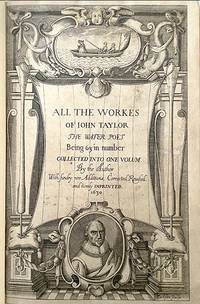
163029102London: Printed by J. B. for James Boler 1630 1630. First edition. ESTC S117734; STC 23725; Pforzheimer 1006. A lightly washed copy with the following repairs: engraved title-page and one leaf Mmm5 pages 139-40 skillfully remargined with slight loss of a few letters on the final two lines on page 140; fore-edges occasionally trimmed close without loss; binding a little rubbed at the hinges and edges; remains of a bookseller's description on the front free endpaper; overall a fine copy. Folio late 19th century full olive morocco by Riviere gilt rules decorations spine lettering and gilt ornamental wreath on the boards a.e.g. Engraved title-page by Thomas Cockson and numerous woodcuts in the text. The collected works of a colorful member of the London literary scene in the late 16th and early 17th centuries - not a major figure but an extraordinary one. John Taylor 1578-1653 moved in the circles of Ben Jonson John Fletcher Thomas Coryate George Wither Thomas Dekker and Samuel Daniel among others. His background was modest and by trade he was a waterman on the Thames ferrying passengers across the river from the city to the Bankside but he was also a poet satirist pamphleteer self-promoter adventurer and traveller. He published over 150 titles usually in the ephemeral format of a broadside or pamphlet in prose and verse and on an array of subjects: comic narratives about London characters rhyming squibs on the travails of everyday life mock eulogies panegyrics upon himself anagrams sonnets narratives of real and imaginary travels invectives at rival poets and writers politics and low-life etc. In 1630 Taylor proudly arranged to have his works collected in the handsome folio format that previously had been used only for three other English authors - Daniel Jonson and Shakespeare - thus placing himself in select company. Whether or not All the Workes collected all of Taylor's works to 1630 is in question and he continued to publish almost until his death in 1653 little of which has been collected in any format. All the Workes itself was not reprinted until almost 250 years after this first edition. Robert Southey in his Lives of Uneducated Poets London 1836 wrote that the first poet to overcome the unfavorable obstacles of a poor education and humble beginnings "was John Taylor the Water-Poet a man who has long been more known by name than by his writings." ¶ Copies of Taylor's All the Workes are difficult to find in the marketplace in an unsophisticated state and this copy bears some evidence of repairs. See below. But it is also has very good provenance. On the front paste-down is the bookplate of collector Kenneth Rapoport with his catalogue slip laid in which states "Purchased from Seven Gables 9/22/77 @ $1040." A note on the verso updates it value as of 2004 to "$3-4000.". London: Printed by J. B. for James Boler, 1630 unknown