1 329 résultats
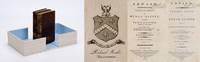
179843089Paris Fuchs et Guillaume An VIe. 1798. Contemp. hcalf. Spine gilt. Very slightly rubbed. Small stamps on verso of titlepage. In: "Annales de Chimie ou Recueil de Mémoires concernant la Chemie" Tome 25. - 3353 pp. 2 engraved folded plates and 1 folded table.the entire volume offered. Vauquelin's papers: pp. 21-32 a. pp. 194-204. Some brownspots to the first and last leaves otherwise fine and clean. <br/><br/><em>First printing of the papers in which Vauquelin describes and announces his discovery of Chromium. The first paper was simultaneously printed in Mem.de l'Institut. Because of its many coloured compounds Fourcroy and Haüy suggested the name 'chromium' for the new metal. Greek chroma-colour.In 1797 Vauquelin began his own studies of Siberian red lead. He was convinced that the mineral contained a new element. None of the elements then known could account for his results. He reported "a new metal possessing properties entirely unlike those of any other metal." A year later Vauquelin was able to isolate a small sample of the metal itself. He heated charcoal nearly pure carbon with a compound of chromium chromium trioxide Cr 2 O 3 . When the reaction was complete he found tiny metallic needles of chromium metal. DSB XIII p. 597 - Parkinson "Breakthrough" 1798 C.The volume contains other importent papers in the history of chemistry Guyton "Examen de quelques propriétés du Platine" a. "Examen de quelques critiques de la nomenclature de chimistes francais" Chaptal "Observations sur la fabrication de l'acétite de cuivre verd-de-gris etc. </em> unknown
1792007314Paternoster-Row London: Printed For T. Evans 1792 Publisher's pagination error text is not duplicated just incorrect numbering 1-218 207-342pp 4; 2 311pp printed on laid paper bound in tree calf with bright gilt borders raised bands on gilt decorated spine all edges marbled marbled endpapers inner dentelles binding and hinges tight. With ownership signature of "L. MacKinnon Lachlan MacKinnon / Advocate / Aberdeen" of L. MacKinnon & Son of Aberdeen at 54 Union Street opening it's doors in 1842. Printed For T. Evans hardcover
175338780London: Printed for and sold by the Booksellers 1753. First edition. 12mo. xxviii 140 pp. Contemporary full sheep spine with raised bands renewed gilt lettered red label old ink ownership stamp of a John Beard to the front free endpaper. Repairs to the spine some wear to the corners semicircular brown stain to the fore margin of the last leaves a decent copy. London: Printed for and sold by the Booksellers unknown
1797974Q22London: B. Macmillan 1797 . First edition. Leather. Very Good Indeed. 8.5" by 5.5". Not Stated. An uncommon first edition of Arthur Young's agricultural study relating to Suffolk complete with a hand coloured folding map and two additional folding plates. The first edition. Illustrated with a hand coloured folding map and two engraved folding plates. Collated complete. The work of Arthur Young an English agriculturalist known for his various writings on the subject as well as his travel works. Despite not being a successful farmer himself Young built up a reputation as an expert on agricultural improvement. This particular work presents a view of agricultural practices in Suffolk compiled by Young when he was secretary of the Board of Agriculture for consideration of the board to make improvements. Young was appointed to this role in 1793 spending the following years preparing surveys to try and bring change to farming practices. Rebound in half cloth with marbled paper-covered boards with the endpapers and blanks renewed and the half title discarded. Rebound in half cloth with marbled paper-covered boards with the endpapers and blanks renewed and the half title discarded. Externally lovely. Internally firmly bound. Pages are bright and generally clean with the occasional mark or spot. Very Good Indeed B. Macmillan hardcover
1778W132Dublin: John Exshaw Dame Street 1778. paper wrappers. Fine. 8vo. 593-648pp. Frontis. folding engraving 'A PERSPECTIVE VIEW OF COXHEATH CAMP Representing a Grand Review of the Army'.20x38 cms O'Neil/ W. Esdal. Reverse engraved for the Dublin issue of the Gentleman's Magazine in fine condition. Also a folding plate 'Dispositions of the Army Encamped on Coxheath with a treatise to the reverse by Lewis Lochee'. Also folding printed manuscript plate of 'A Song on Coxheath and A favourite Duet to the reverse'; Articles include Humours of a camp from an officer at Coxheath; Progress of English Commerce in Bengal; History of Europe; etc etc; List of births deaths bankrupts promotions and marriages in Ireland. NB This not the Gentleman's Magazine from London but the much rarer Dublin magazine pub. by John Exshaw. <br/> <br/> John Exshaw, Dame Street unknown
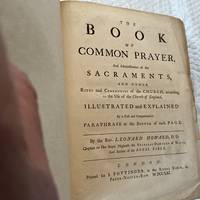
1761013265London: Printed For I. Pottinger At The Royal Bible In Pater-Noster-Row. MDCCLXI. 1761. Decorative Calf. Very Good. 4to - over 9" - 12" tall. Printed in 1761. Size Quarto 10" x 7.75" 578 pages including index plus engraved plates inserted not paginated. Contemporary binding of dark brown calf decorated with ornate gilt tooled central panel to front and back covers ornate gilt corner pieces initials A.B. in centre of panel. Fiveraised bands to the spine with gilt title on black morocco label in the second and ornate fine gilt decoration in the remaining compartments. Marbled endpapers. Condition very good binding repaird and rebacked at some point outer corners restored original endpapers retained. The internal condition is very clean a few faint spots to margins of about 10 pages else contents clean. With frontispiece portrait of George III and numerous full page plates throughout of Biblical New Testament Scenes and Saints. Leonard Howard was the Personal Chaplain to the Dowager Princess of Wales. Princess Augusta of Saxe-Gotha was the Princess of Wales from 1736-1751 and became Dowager Princess of Wales when her husband Frederick Prince of Wales died. He produced The Royal Bible for her. She was the mother of King George III who came to the throne in 1760. <br/> <br/> Printed For I. Pottinger, At The Royal Bible, In Pater-Noster-Row. MDCCLXI. unknown
172240474Canterigii: James Nisbet & Co. Good with no dust jacket. 1722. Cloth green rebind. Engravings; Folio 19; 805 pages; Bede's magnum opus was first printed at Strassburg in c. 1475 but this is the first critical edition which was only superseded in 1896. John Smith was a prebendary at Durham Cathedral; the proposal for this work was issued in 1710 and after Smith's death in 1715 it was seen through the press by his son George who had studied Anglo-Saxon at Oxford. Lowndes 143-44: 'The best edition with learned notes and dissertations. Gucht of the altar of Bede and St. Cuthbert below the east window of Durham cathedral two full-page eng. Plts. By van der Gucht Tomb of St. Cuthbert facing p. 264 & Tomb of the Venerable Bede facing p. 805 large engraved Leaves are all VG. Map of Britannia Saxonica facing p. 654 . Back cover present but detached. Library tape repair to spine rebound in green library cloth. Text Is firm and clean. No half title present. . James Nisbet & Co hardcover
179729726AB1797. First Irish Edition. Two Volumes complete set. Dublin Printed for P.Wogan P.Byrne J.Moore J.Rice W.Watson and Son G. Folingsby etc. etc. 1797. Small-Octavo 11.5 cm x 17.5 cm. 331 376 pages. Hardcover / Original 18th-century leather with original spinelabels. Both Volumes in protective Mylar and now housed in a bespoke Solander Box. Bindings a little shaky but still intact; stronger rubbed with loss to labels. Bookplate / Exlibris of Richard Meade of Ballymartle attached to pastedown of Volume I. John Moore FRSE 1729 1802 was a Scottish physician and travel author. He also edited the works of Tobias Smollett. He was born on 10 October 1729 in Stirling the son of Rev Charles Moore of Rowallan d1735 and his wife Marion Anderson. The family moved to Glasgow in his youth and he was educated at Glasgow Grammar School. He was then apprenticed to Dr. John Gordon in Glasgow 1745 to 1747. After taking a medical degree at Glasgow he served as a Surgeon's Mate with the army in Flanders during the Seven Years' War then proceeded to London to continue his studies and eventually to Paris where became surgeon to the household of the British ambassador there. In 1751 he returned to Glasgow to rejoin Dr. John Gordon also then practising with Dr. Thomas Hamilton. From 1769 to 1778 he accompanied the Duke of Hamilton who was linked to Thomas on a Grand Tour of Europe. On his return he took up residence in London. In 1792 he accompanied Lord Lauderdale to Paris and witnessed some of the principal scenes of the Revolution. His Journal during a Residence in France 1793 is the careful record of an eye-witness and is frequently referred to by Thomas Carlyle. In 1784 he was elected a Fellow of the Royal Society of Edinburgh. His proposers were Andrew Dalzell James Gregory and John Robison. He died in Richmond in Surrey now part of London on 21 February 1802. He is buried in Stirling. His novel Zeluco 1789 a close analysis of the motives of a selfish profligate produced a great impression at the time and indirectly through the poetry of Byron has left an abiding mark on literature. Byron said that he intended Childe Harold to be a poetical Zeluco and the most striking features of the portrait were undoubtedly taken from that character. Moore's other works have a less marked individuality but his sketches of society and manners in France Germany Switzerland Italy and England A View of Society and Manners in France Switzerland and Germany London W. Strahan & T. Cadell in the Strand 1779 2 vol.; A View of Society and Manners in Italy with anecdotes related to some eminent characters London W. Strahan & T. Cadell 1781 2 vol. were also very popular during his lifetime and furnish valuable materials for the social historian. "Mordaunt. Character Sketches of Life Characters and Manners in Various Countries; including the Memoirs of A French Lady of Quality" was a powerfully written anti-French Revolution novel in three volumes in the form of 34 character sketches of famous politicians royalty generals the wealthy and the celebrity of the day. It also offers detailed eyewitness accounts of John Moore's observations as he travelled throughout Europe in the last years of the 18th century. There are gripping accounts of the heroic feats of a dashing British Officer included which were actually accounts of John Moore's son General Moore. Wikipedia hardcover
17721241827Leiden, Johannes le Mair, 1772. 4 Bl., 615, (1) S., 1 Bl. weiß u. 1 Bl., 613, (1) S., 1 Bl. weiß u. 1 Bl., 607, (1) S., 14 Bl. Wörterverzeichnis, 1 Bl. weiß. Pgtbde d. Zeit auf 5 Bünden m. blindgeprägtem Deckeldekor u. handgeschriebenen Rückentiteln (Einbde leicht fleckig, Ausschnitte auf den Titeln ergänzt, etwas braunfleckig).
179200TP75VERSAILLES FRANCE 1792. Archive of two 2 handwritten letters both dated January 14th 1792 both physically attached at the bottom left corner with sealing wax. Very interesting: The first letter beautifully penned whose author's signature is indecipherable yet whose status as a 'ancient surgeon to the King' is foremost in presentation tells of the story of a young boy named Colinot. The boy has been severely injured to the point of blood building up under his eye lids and that he required many sutures to the head and around the nose. The second letter in a much rougher handwriting style than the refined Chiel Surgeon by M. DeLaBique recounts the same injuries but as told to him by a M. George LaFleur they were acquired in a street brawl between a group of young boys. Biographical Notes: SIR THOMAS PHILLIPPS 1792-1872. Born in 1792 Sir Thomas Phillipps from childhood was obsessed with the idea of obtaining virtually anything written or printed on paper including cartloads of documents from wastepaper merchants and the entire inventories of booksellers. "I wish to have one copy of every book in the world" he declared to a friend. He very nearly succeeded. His collection ultimately grew to more than 100000 books and at least 60000 manuscripts. As a result of his extravagant purchases Sir Thomas was permanently on the verge of bankruptcy and was constantly pursued by creditors. So many books arrived at his house that it was impossible to unpack his acquisitions much less keep pace with them. Visiting scholars driven to distraction would spend days hunting for an elusive text in the dusty heaps that filled every room. Because Sir Thomas has a morbid dread of fire most of his collection was housed in coffinlike boxes that could be carted away quickly. Visitors to Middle Hill were struck too by the presence of numerous logs a ploy he used to lure beetles away from his books. As Sir Thomas relentlessly pursued his passion the house itself began to crumble and its floors started to sag under the cast weight of hundreds of tons of paper. His neglect of Middle Hill was partly deliberate however. Sir Thomas's chief enemy in life James Halliwell had married his daughter against his wishes. It appears that Halliwell was in Sir Thomas' eyes the worst kind of criminal a book thief who had stolen valuable works from university libraries and even from his father-in-law. Having no sons Sir Thomas was unable to prevent Halliwell from inheriting his estate. To ensure that his detested heir would never receive anything of value Sir Thomas's solution was to allow Middle Hill to fall unto complete disrepair. He even went so far as to chop down and sell for lumber the centuries-old oak trees that lined the majestic mile-long drive to his home. In 1863 Sir Thomas decided to move - in order to accommodate his books. With the aid of 160 men 103 wagonloads of books and papers drawn by 230 horses the books were lumbered from Middle Hill top their new estate in nearby Cheltenham. It is said that for years afterwards the countryside was littered with the remains of carts that had collapsed under the sheer weight of the Phillipps collection. Sir Thomas continues to add to his library until his death in 1872. After Sir Thomas's death his immediate family had no room for his collection. So vast was the library that although individual items and large sections were sold privately or through numerous auction sales the Phillipps collection is still being sold more than a century after the death of its owner. In the course of its sales many treasures have come to light. As late as 1964 part of the long-lost and unique medieval manuscript of the Roman poet Ovid's Metamorphoses appeared and was subsequently reunited with its other half at Magdalen College Oxford. Once destined for destruction as worthless wastepaper this and many other priceless works were saved by the single-minded obsession of the greatest bibliomaniac of all time. Autograph. Manuscript. Very Good. 12mo - over 6¾" - 7¾" tall. Paperback
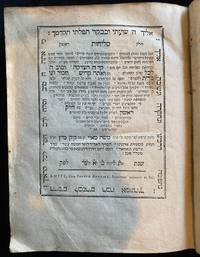
176542165Mets Metz Bi-defus Mosheh Mai 1765. Hardcover. 8vo; Hebrew Date 525. Period full leather with raised bands and interspersed gilt floral design and leather spine label 4to large 18 leaves i.e. 36 pages 152 leaves i.e. 304 pages 69 leaves i.e. 138 pages i.e. 478 pages total. 27 cm. In Hebrew and Judeo-German German in Hebrew script. Includes indexes. Vinograd Metz 10.<br> "In France Hebrew presses were established in Metz c. 1760 Strasbourg 1770 and later in Paris 1806" Jewish virtual library this being an early example of Hebrew printing in Metz. <br> SUBJECTS: Judaism -- Liturgy -- Texts. Repentance -- Prayers and devotions. Judai¨sme -- Liturgie -- Textes. <br> OCLC: 265896805. OCLC lists 6 copies worldwide British Library Loyola NYPL YIVO Stanford HUC. The British library holding lists an engraved frontis; however no other holdings nor auction records which we have seen ever list an engraved frontis so we assume that to either be a mistake or added later or a variant. <br> Some wear to leather boards as expected especially at corners but paper and binding remain clean and strong. About Very Good- Condition. A beautiful copy with attractive leather binding. BK5 Rab-66-33-'belccm. Mets [Metz] Bi-defus Mosheh Mai hardcover
177726884London England: Printed for the Company of Stationers 1777. Twenty-two issues of this yearly British almanac bound in one volume; consecutive and inclusive from the 1777 issue to 1797. These are printed in red & black have the tax stamps on the margins of the title pages and are of 32 pages' length with exceptions or notes as below: 1782: On page 31 the section "VI Rebus by Mr. R. Richardson of Frosterly" has been solved with the manuscript letters & names of clues neatly written at the margins. 1786: pgs 1-2 15-32; However another issue is bound after this incomplete issue that is entire in 48 pages. These almanacs are noted on the title pages as printed for the Company of Stationers; and this "extra" issue is noted on the title page as "Printed for T. Carnan in St. Paul's Church Yard; who after an expensive Suit in Law and Equity by the unanimous Opinion of the Judges of the Court of Common Please dispossessed the Stationers' Company of their pretended exclusive Privilege of Printing Almanacks which they had usurped for two Centuries; a convincing Proof that no unjust Monopoly will ever stand the Test of an English Court of Justice." 1788: pgs 1-2 15-32 only. 1793 Misbound pages out of order and complete 32 pages. 1795: A name of "Old Batholomew" has been added in ms. at the 4th Sept. in the monthly almanac pages section. 1797 pgs 1-16 only. "The existence of the Ladies' Diary or the Woman's Almanack an 18th century English magazine devoted largely to problems and puzzles in mathematics indicates that stereotypes about the inability of women to understand and enjoy mathematics were less strongly believed in the 18th century than they are today.The Ladies' Diary became one of the widely read 18th century magazines devoted to the popularization of science and mathematics; these were addressed mainly to readers with no specialized training in the subjectsThe Ladies' Diary differed from these others primarily in the language used in some of the problems--language which reminds the reader that the problems were addressed to women" from the excellent overview of the magazine its influence & impact by Teri Perl San Francisco State Univ. Historia Mathematica 6 1979 article on the 'Diary' Indecipherable by us previous owner name on back endpaper.Approx. 4" x 6 3/8" size; bound in marbled-paper covered boards leather corners edges tinted yellow; spine covering gone; wear to the edges tips of the binding; bottom cord of top board let go; the block still solidly sewn some edges trimmed close; contents generally clean and in good condition. . First Edition. Hard Cover. Good. Printed for the Company of Stationers hardcover books
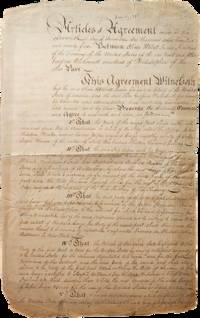
1795List3024Philadelphia Pennsylvania 1795. Two pages measuring 10 x 16 ¼ inches. Toned folded with tears at folds and marginal damage; excellent. A contract dated December 11th 1795 between Philadelphia merchant John Godfried Wachsmuth and Secretary of the Treasury Oliver Wolcott Jr. in which Wachsmuth agrees to ship $113000 worth of coffee sugar and cocoa to Amsterdam for which the US government would advance Wachsmuth the funds. The items would be consigned to an Amsterdam banking house the bankers would pay the proceeds to the United States and the US would in turn pay Wachsmuth in specie.<br /> <br /> At the time the US was finally recovering from the precarious financial situation that followed the Revolutionary War and had successfully negotiated trade deals with Great Britain and Spain. Despite political upheaval in the Netherlands the country had been and remained a significant trading partner for and investor in the US. This contract specifies that the goods will be consigned to Wilhelm and Jan Willink Nicolaas and Jacob Van Staphorst and Nicholas Hubbard; this group in particular invested heavily in the US making large loans to the government and purchases of land via the Holland Land Company including investing in the Louisiana Purchase.<br /> <br /> A deal of this sort had a number of benefits for the new country; most importantly it would continue to build a positive trade relationship with the Netherlands and improve the US’s credit abroad and it would bring more specie into the US which was experiencing a specie drain due to its imports exceeding its exports.1 It involved significant risk for Wachsmuth—he would be responsible for ensuring the bankers ultimately received the value of the goods in specie—but the potential reward in terms of both profits and a relationship with Amsterdam’s most important bankers seem to have been worth it.<br /> <br /> Of interest to scholars researching the economic growth of the early United States especially in terms of foreign trade relations.<br /> <br /> 1 Nicholas A. Curott and Tyler A. Watts “What Caused the Recession of 1797†Studies in Applied Economics 48 February 2016. unknown
171521225London 1715. A petition to Parliament by the officers of Lieutenant General George Hamilton's Regiment of Foot seeking pay due for services abroad in the War of the Spanish Succession. Lord George Douglas-Hamilton 1666-1737 was a Scottish Williamite officer during the Glorious Revolution who later married William III's mistress Elizabeth Villiers became a confidant of William was created Earl of Orkney in 1696 was appointed Governor of Virginia in 1714 and in 1736 was the first British general promoted to the rank of Field Marshal. In 1701 at the beginning of the War of the Spanish Succession Hamilton led the First Regiment of Foot the Royal Scots to the Netherlands where the regiment fought for the remainder of the war. Despite their long service and the high position of Hamilton the officers suggest in the present petition that having been so long overseas they had been forgotten by the British government and charge that they had not received their pay even after frequent petitions. The document is an early example of lobbying literature which first began proliferating in the lobby of the House of Commons at the time of the accession of King George I and the British general election of 1715. ESTC records four copies two at the British Library one at Oxford and one at the National Library of Scotland. unknown
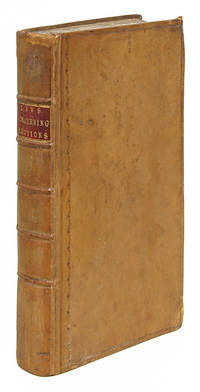
1774669331774. London: Printed for W. Owen 1774. 2nd ed. London: Printed for W. Owen 1774. 2nd ed. One of the First Works to Draw on Blackstone's Commentaries A Gentleman of the Inner Temple Editor. Bohun William Attributed. Laws Concerning the Election of Members of Parliament; With The Determinations of the House of Commons Thereon and All Their Incidents; Continued Down to the Present Time. The Whole Digested Under Proper Titles; Also an Appendix of Precedents With a Table of the Principal Matters. A New Edition With Additions. London: Printed for W. Owen 1774. xx 94 2 95-392 12 6 pp. Includes 6-page publisher catalogue. Octavo 8-1/4" x 5". Contemporary calf blind rules to boards blind fillets along joints raised bands and lettering piece to spine joints and head of spine mended. Some rubbing to extremities corners bumped and somewhat worn hinges cracked. Light toning to text somewhat heavier in places brief early owner annotation to front free endpaper. A handsome copy. $450. Second edition. With an index of parliamentary acts. The anonymous editor notes in the advertisement that he has drawn extensively on Comyns' Digest of the Laws of England Lyttleton's Life of King Henry II Whitelocke's Notes Upon the King's Writ for Choosing Members of Parliament in Morton's edition and Blackstone's Commentaries on the Laws of England then a recent work. One of the very first books to draw on the Commentaries Laws Concerning the Election is a landmark in the history of its reception by the English bar. It is also a remarkably thorough work that considers causes determined by parliamentary committee and the House of Commons and the laws of England Scotland and Wales from 1382 to 1780. Some references attribute this work to William Bohun. The first edition was published in 1768 its last edition the third in 1780. English Short-Title Catalogue N10410. unknown books
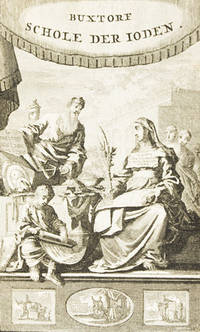
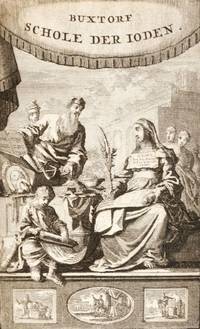
173121201Rotterdam: Jan Daniel Beman 1731. Third edition. Hardcover. vg. 12mo. 16 548pp. 44pp. plus 4 foldout copper engravings first plates trimmed at caption. Original full vellum with black lettering on spine. Half title-page with a series of engravings. In the larger engravings Moses with the tablets dictating the Torah to a scribe writing on a scroll while a boy holds on to the end of the scroll. The smaller engravings at the bottom have Abraham sacrificing Isaac King David with his harp and a horned Moses with the tablets. Title-page with printer's emblem. Decorated initials. First published in German in 1603 Johannes Buxtorf the Elder's “Jewish Synagogue†is a guide to Jewish thought culture and ritual observances. Buxtorf goes through Jewish daily practices such as the wearing of phylacteries reciting prayers and the keeping of kosher as well as Jewish holidays such as the Sabbath New Moon High Holidays Tabernacles Passover and Purim. The work transliterates many Hebrew and Aramaic terms and offers translations of two Sabbath hymns. Buxtorf also gives a history of Jewish thought from biblical times to his day. In terms of sources Buxtorf quoted extensively from the Old Testament and New Testaments but also used classic rabbinic sources such as the Talmud and Midrashim as well as medieval and early modern sources such as Isaac Alfasi Solomon Yarchi Abraham ibn Ezra David Kimchi Bahya ben Asher Judah the Pious' “Sefer Hasidim†Isaac Aboab Elias Levita's "Bovo-Bukh†and Joseph Kairo's "Shulchan Aruch.†Buxtorf also made use of kabbalistic explanations for various Jewish practices. Also includes a dialogue between a Jew and a Christian in which the Christian responds to the Jew's attacks on Christianity. Foreword for the Christian reader. Passage from Martin Luther on the Jews. Printed notes in the margins giving sources and translations of terms. Foldout copper plate engravings showing the lifting up of the Torah in a synagogue a Passover Seder Jews parading with palm branches and citrons during Tabernacles and a bride and groom standing under a wedding canopy. While often hostile Buxtorf's work stands as the most scholarly early modern Christian treatment of Jews and remained the chief source for Christian information on Jews through the Enlightenment. Text in Dutch with some Latin and Hebrew. Titles underneath engravings cut off. Binding and interior in overall very good condition. Title-page information: "Uit hun eige Boeken en Schriften merendeels den Christenen onbekend grondig met aanwyzing van yder Boek plaats en blad verklaard. Eertyds tot nut der Christenen beschreven door M. Joannes Buxtorf Opper-meester in de Hebreewsche spraak tot Bazel. Op Nieuws overzien en met Nieuwe kopere Platen door Jan Luyken verçierd. Hier agter is bygevoegt een Reden-Strydt tusschen een Jood en een Christen waar in het Christen Geloof werd verdedigt. Derde druk. Te Rotterdam by Jan Daniel Beman. M. D. C. C. XXXI." <br /> <br /> Johannes Buxtorf the Elder was a 17th century Hebraist who served as professor of Hebrew for thirty-nine years at Basel and known by the title "Master of the Rabbis." He was one of the most important Christian Hebraists of his day and was largely responsible for transforming Hebrew studies from an amateur hobby into an established academic discipline in the early seventeenth century. He was succeeded by his son Johannes Buxtorf the Younger who also became a renowned professor. Jan Daniel Beman hardcover
173128935Rotterdam: Jan Daniel Beman 1731. Third edition. Hardcover. g. 12mo. 16 548 44pp. Original full vellum. Engraved frontispiece. Printer's device on title-page. Decorative initials. Profusely illustrated with 4 folding engraved plates by Jan Luyken. Johannes Buxtorf the Elder was one of the most important Christian Hebraists of his day and was largely responsible for transforming Hebrew studies from an amateur hobby into an established academic discipline in the early seventeenth century. His book "Schoole der Jooden" presents a recognizable if unsympathetic portrayal of the life of Jews in contemporary Germany. Buxtorf's work had far-reaching and long-lasting influence appearing in a wide variety of editions and languages over the next century. Some soiling and age-toning on binding. 1" closed tear on upper back joint. Minor age-toning along paper margin. Minor and sporadic foxing throughout. Ex-library copy Reichinstitut für Geschichte des neuen Deutschlands with library stamp on free front endpaper fly leaf and title page. Back hinge starting. Text in Dutch. Binding in overall good- interior in good to very good condition. Johannes Buxtorf the Elder was a 17th century Hebraist who served as professor of Hebrew for thirty-nine years at Basel and known by the title "Master of the Rabbis." He was one of the most important Christian Hebraists of his day and was largely responsible for transforming Hebrew studies from an amateur hobby into an established academic discipline in the early seventeenth century. He was succeeded by his son Johannes Buxtorf the Younger who also became a renowned professor. Jan Daniel Beman hardcover
179936252Germantaun: Gedruckt bey Michael Billmeyer 1799. Bound in original sheep raised spine bands lacking the clasps some chipping but a firm binding. Frontispiece. pp 8 148 8 585 9- Register 26 pp. Printed in two columns per page. Very Good. Some music is included.<br/>Evans 35453 36193. ESTC W6294. Gedruckt bey Michael Billmeyer unknown books
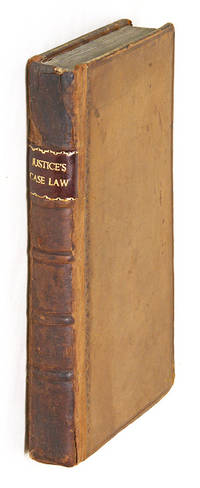
1731662071731. London 1731. Only edition. London 1731. Only edition. A Handy Digest of Cases of Criminal Law with References for Justices Great Britain. Justices of the Peace. The Justice's Case Law: Being a Concise Abridgment of All the Cases of Crown Law Relating to Justices of Peace And Their Business and Proceedings With References to the Books of Reports And Other Law Treatises on the Subject. Digested In a New Alphabetical Method And Very Necessary to be Perused by All Justices As an Immediate Direction to Them How to Proceed in Their Offices. And Likewise Of Use to Barristers at Law Clerks of the Peace Coroners &c. London: Printed by E. And R. Nutt And R. Gosling 1731. iv 302 14 pp. Octavo 7-1/2" x 4-1/2". Contemporary calf blind rules to boards blind fillets along joints which have neat recent repairs raised bands and recent lettering piece to spine gilt tooling to board edges hinges mended. A few minor nicks and scratches to boards some rubbing to extremities small chip to head of spine corners bumped and lightly worn. Light toning to text occasional very faint dampstaining light foxing to a few leaves. A nice copy of a scarce title. $450. Only edition. This book is organized alphabetically by topic and has a detailed index. Each heading contains a list of general statements each supported by a list of citations from case reports legislative acts and treatises. English Short-Title Catalogue T145554. unknown
1796942London: Thomas Malton 1796. Aquatint printed in brownish ink with extensive hand coloring in watercolor on buff paper 10 1/4 x 12 1/2 inches 260 x 317 mm sheet uneven narrow to full margins. Laid down to a contemporary wove paper support. Scattered condition issues on the sheet excluding the mount include surface soiling creasing a significant vertical repaired tear and toning despite these issues the hand coloring remains good. Suitable for framing. From A Picturesque Tour Through the Cities of London and Westminster Illustrated With the most interesting Views accurately delineated And executed in Aquatinta By Thomas Malton published by Thomas Malton London 1796. The work was published serially in twenty-five numbers. The plates in Volume I carry the dates 1792 1793 1794 1795 1796 or 1797; those in Volume II the dates 1797 1798 1799 1800 or 1801. In most copies the title page of Volume I carries the publisher's later address of 103 Long Acre to which he moved in 1792. Dedicated to the Prince of Whales. Thomas Malton unknown
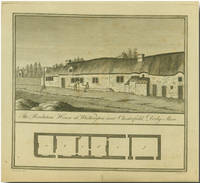
1788WRCLIT56785Nottingham: Printed by Samuel Tupman 1788. 111pp. plus plate. Oblong small quarto. Contemporary sewn marbled wrappers. Old vertical crease with short break in lower margin at crease small tidemark in gutter at crown of spine modest foxing early ink name inside upper wrapper otherwise a very good copy. First edition of this work commemorating the 1688 Revolution accompanied by an engraving of the house near Chesterfield Derbyshire by Hayman Rooke. The whole including the text derived from a letter from Pegge was prepared by Rooke for presentation to friends and his prefatory note to that end has a small textual revision in ink. Both Rooke and Pegge made considerable contributions to the antiquarian and topographical studies of the area. An uncommon production; ESTC Online locates six copies: BL Bodleian Nottinghamshire County Library Yale Harvard and UCLA. ESTC N9997. Printed by Samuel Tupman unknown books
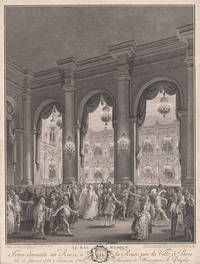
178221681782. Copper-line engraving. 520mm by 390mm sheet. Depiction of the arrival of King Louis XVI of France and the Queen Marie Antoinette escorted by soldiers entering the Hotel de Ville in Paris for the feast of the birth of the Dauphin Louis Joseph in 1782; in the background a large room where a masked ball is taking place. <br /> Faint toning to thin margins. Trimmed within platemark. Small worm damage in title area. unknown
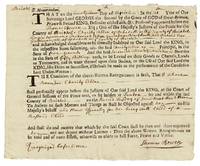
174856612Taunton Mass. 1748. Pro-forma document approx. 6¼" x 7½" accomplished in ink in a neat and legible hand concerning Charity Allen a single woman evidently with child and who with her presumed father a blacksmith and one Richard Tree acknowledge themselves to be severally indebted to the King for five pounds Charity and 50 shillings each Jeremiah and Richard "to be levied on their goods and chattels lands or tenements and in want thereof upon their bodies . the condition of the above Written Recognizance is such that if" above bounden Charity Allen "shall personally appear before the Justices . to be holden at" Taunton "in the County of" Bristol . "on the" second Tuesday of June next . "to answer to such matters and things as shall be objected against her on His Majesty's behalf" and more especially for her being with child of a bastard child." I take this to be a subpoena of sorts obliging the pregnant Charity together with her father to appear before the court . but why Birth records for Rehoboth show Charity was born July 5 1729 so at the time she would have been almost 19 and that she gave birth to a boy named Jacob in June of 1748 the "reputed son of Thomas Peck and Charity Allen." <br/><br/> unknown books
17282410240334xbvk'Venezia. Apresso Cristoforo Zane. Con Licenza de' Superiori, e Privilegio. MDCCXXVIII' (1728). xl, 454 pages, 1 blank sheet. - Strong italian vellum binding of the period over 5 slightly raised bands with blank endpapers, all edges sparkled red; 8vo.(ca. 18 x 12 x 3 cm).
1714AQ15134London: Printed and Sold by J. Roberts 1714. 21pp 1. Without half-title. Recent red half-morocco red cloth boards lettered in gilt T.E.G. A trifle rubbed and marked. Marbled endpapers internally clean and crisp. The sole edition of an anonymous elegiac satirical epitaph upon army officer and politician John 1st Duke of Marlborough who contrary to the title survived until 1722 and indeed would certainly not have been interred at Antwerp given the allied offensive against the city during the recently concluded War of Spanish Succession. The prefatory remarks addressed to the publisher are signed by Thomas Johnson presumably the pseudonym of the unknown author. In those same remarks our author claims membership of the apparently fictional Marlborough Club who desired that he carry out this translation so that 'our own People may see the just Esteem which Foreigners have for the Memory of that Great MAN' a highly ironic proclamation that informs the intention of the epitaph as a whole. ESTC locates only copies at only three locations in the UK BL Cambridge Trinity and Oxford and ten in the United States Duke Folger Illinois Indiana Kansas Minnesota Missouri Newberry North Caroline and Texas. ESTC T120685. First edition. 8vo. Printed, and Sold by J. Roberts hardcover