1 329 résultats
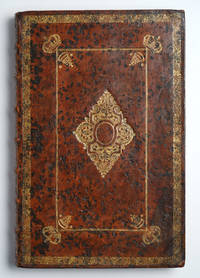
171548763Augsburg.: Jeremias Wolff. c.1715. Full contemporary blond calf boards with elaborate neo-classical decorative borders composed of rules foliate floral and rope-work tools vase tools at head and foot and mask corner tools all to surround a central lozenge with a decorative composition of floral foliate and mask tools later banded spine with elaborate decorative tooling in gilt in seven compartments turn-ins tooled in gilt red speckled edges. Folio. 554 x 423 mm. Engraved allegorical title with Latin and German text leaf with letterpress text in German in double columns and 56 engraved allegorical plates all after the Deckers by various engravers see below. Sheet size: 435 x 560 mm. An exceptional copy of Decker’s very rare suite of engravings – here in-plano and with exceptional additional colouring and highlighting in gilt by hand – illustrating the battles of the War of the Spanish Succession.Decker’s suite depicts the battles of the complex series of engagements that became known as the War of the Spanish Succession 1701–1714. Prompted by the death of the last of the Spanish Habsburg Kings the childless Charles II and with a shifting group of alliances and a field of warfare that included not only Continental Europe and the Mediterranean but also the Caribbean and North America the War of the Spanish Succession has a case to be a true world war. In part an attempt to check French hegemony the war featured a number of outstanding victories for the Duke of Marlborough and Prince Eugene of Savoy including Blenheim although the war was ultimately at best indecisive.Each of Decker’s magnificent plates features a single engagement depicted in the central portion of the plate the whole image surrounded with a decorative border composed of architectural allegorical and armorial symbols and motifs in the Baroque manner and a descriptive text concerning the battle. Many of the plates feature an additional small vignette of the battlefield keyed to the descriptive text and illustrating the placement of the armies and the most significant figures involved.The colouring and highlighting by hand of the present copy is remarkable. The painstaking detailing and the additional ornamentation in liquid gold is lavish and in combination with the binding suggests this copy was important and worthy of presentation. The printed text 'Kurze Beschreibung des Spanisch Successions-Krieg . &c.' here and unusually in German gives a detailed outline of the origins and history of the conflict and concludes with the list of plates and the engagements they depict. The text appears in other copies in other languages suggesting a commercial flexibility of distribution.It is a measure of the importance attached to Decker’s suite that the painter Ignaz Preissler used Decker’s plates as the basis for the decoration of an important tea service and garniture now at least partly in the collection of the Metropolitan Museum in New York see ‘Repraesentatio Belli ob successionem in Regno Hispanico . A Tea Service and Garniture by the Schwarzlot Decorator Ignaz Preissler’ by Maureen Cassidy-Geiger.‘Such commemorative series were considered works of art as well as encapsulations of recent events and were highly valued by collectors of the period who acquired them for their libraries or print cabinets.’ Maureen Cassidy-Geiger.Decker’s suite is very rare outside Germany: COPAC lists copies at the British Library and V & A only while KVK lists copies at the Polish National Library the Bibliothèque Nationale and the Université de Charles de Gaulle Lille in France and the Rijksmuseum Amsterdam; the only traceable copy in North America is at Brown University. We can locate no other copies with contemporary colouring or highlighting by handBerlin 103 incomplete; Bobins III 1165; Brunet V 626 for the French edition. Jeremias Wolff. hardcover
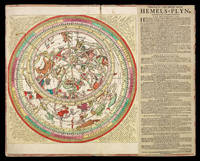
17221992Amsterdam: Jochem Hasebroek c1722. 500 by 630mm. 19.75 by 24.75 inches. Large engraved celestial chart by Stampioen with a rotating printed paper ring volvelle or rete on an off-centre axis to indicate the part of the sky visible at any date and time and to make a variety of celestial calculations all for the Netherlands' latitude of 52 degrees. With letterpress instructions by Calman on a separate slip at the right. The sky image 33 cm in diameter; the whole chart with the letterpress slip as mounted 49 x 61.5 cm. A string with a bead serves as a pointer for aligning the scales in the stationary and rotating parts. Coloured by a contemporary hand and mounted on contemporary boards covered with marbled paper apparently by the publisher so that it can be folded in half for carrying. The chart is here in its third state but we have located no complete example of any earlier version. The Boerhaave Museum in Leiden has the chart without volvelle or instructional text published by Doncker but the 1664 edition described in Doncker's advertisement clearly included the volvelle and instructional text. Perhaps the surviving chart is the 1684 version mentioned but not seen by Bierens de Haan who provides neither a detailed description nor a source for his information. They and the present version printed from Doncker's plate c1722 seem to have appeared only as separate publications hence their great rarity. The circular border around the sky image and the outer part of the volvelle include scales with several kinds of data so that the chart can be used for various purposes. One can use the string to align the time in the volvelle with the date in the border of the chart so that the part of the sky visible at that moment appears inside the volvelle. The chart with its volvelle scales and string can also be used to calculate times for the rising and setting of constellations at various dates or to calculate the present time based on the position of the stars. Fifty-three constellations are numbered quarter by quarter 15 9 14 and 15 with a Dutch key identifying them in each corner. Calman's instructional text printed letterpress on a separate slip 495 by 185 cm and mounted to the right of the chart itself describes the different scales etc. then presents nine "proposals" giving examples of the use of the chart. If the volvelle is turned with 12 midnight to the right the boards can be folded to each other like a portfolio protecting the chart and making it easier to carry. It may have been published in this form for the only other copy located at the Adler Planetarium in Chicago is similarly mounted. The marbled paper covering the portfolio similar to Wolfe 33-35 was common in the Netherlands in the late seventeenth and early eighteenth centuries. In the plate of the star chart itself is engraved "Auct. J. Stampioen. 't Amsterdam by Iochem Hasebroek" but Hasebroek's name is larger and in a different style than the rest of the lettering and one can see traces of an earlier name under it. Although the older name cannot be deciphered one can see that "Hendrick Doncker" would fit with traces of the h and Do and marks where the ascenders to the d k and k would have been making it clear that the present chart is printed from Doncker's original plate. Calman advertised his Amsterdam boarding school for calligraphy mathematics etc. in 1722 and Hasebroek 1682- 1756 is recorded as a sea chart publisher and instrument maker from 1714 to 1743. Koeman IV p. 5 no location noted; cf. p. 153; Warner Sky Explored p. 260 no. 1c no location noted; cf. p. 247; Alder Planetarium on-line database A-259; cf. Bierens de Haan 4516 1684 ed. not seen: see his Bouwstoffen II pp. 386 & 429 note 5; E.O. van Keulen et al. "In de Gekroonde Lootsman" item 4 & illustration between pp. 64 & 65 1680/1696 Vooght/Van Keulen ed.; not in BMC Printed Maps; Zinner Astron. Instrumente; NCC/Picarta; OCLC WorldCat. Jochem Hasebroek, hardcover
1796ABC_49403Various places including Saudi Arabia and Yemen 1796. Contemporary or slightly later half black morocco marbled boards. Small folio ca. 19 x 30.5 cm. English manuscript on watermarked paper. With a loosely inserted manuscript map titled A Chart shewing the Track of HMS Ship Myrtle of the Bay of Biscay and Portugal and a hand-coloured manuscript signal chart. A detailed description of the voyage of the East India company vessel the Swift from 1794-1795 featuring visits to both Saudi Arabia and Yemen. Twelve pages of observations are dedicated to Jeddah alone witnessed at the height of the influx of pilgrims during the Hajj followed by a description of Mocha also Mokha in Yemen. Other ports visited include those of Brazil South Africa India the Nicobar Islands Malaysia and Sri Lanka.Jeddah the author says "has a very pleasant appearance as you approach it from the sea . The houses are all of stone of the coral kind." However as the Swift had arrived in the midst of the Hajj and its crew found provisions difficult to acquire as thousands of pilgrims poured into Jeddah: "It is astonishing the number of Mahometans arriving from all parts of the world to attend the yearly ceremony at Mecca called Hadgi from thence to Medina." Several accounts are given of particular Muslim practices through occasionally somewhat confused British eyes: "When near Geddah all the Pilgrims going their first journey altered their dress assuming what is called the Ihhram a piece of linnen ! which is wrapped round the loins leaving the rest of the body naked in this state they proceed through the rest of the pilgrimage till they have visited the Kaaba at Mecca; the other garment they are then suffered to wear is a cloth of linen over their shoulders. . Some of them carry a trade of muslins and some other little articles which if they are not robbed by the Bedouins wild Arabs they make out tolerably well . The landing of the pilgrims with their wives and household utensils would have been an excellent view for the inimitable Hogarth."The Swift appears to be one of the ships which accompanied the Suffolk a 64-gun ship to escort a convoy to India under the command of Captain Peter Rainier 1741-1808 later Admiral of the Blue and namesake of Mount Rainier. This particular voyage was in itself notable as a trial for the implementation of a citrus diet for sailors to ward off scurvy which was ultimately successful and became Admiralty policy the following year. On the first page of the account we find the following: "The beer being expended ordered the Company to be served wine mixed with 1oz of sugar and oz of lemon juice to every pint it was very nice tipple."The boards show mild traces of use. With a few small smudges on some of the leaves. Otherwise in excellent condition. hardcover
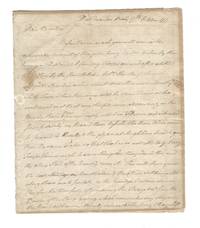
1777BB002<p>CLINTON George First Governor of New York State 1777-1795 1801-1804; also 4th Vice-President of the United States 1805-1812 under Thomas Jefferson and James Madison.<br /></p><p>"Kingston laid in ashes by the Enemy" . <br /></p><p>8vo 7-3/4 x 6-1/2 inches 1-1/2 pages on laid paper with integral address leaf remnants of wax seal some fading to text and signature scattered minor<br /></p><p>It should be noted that Clinton was sworn in as New York's first governor on 9th July 1777 shortly after Kingston was established as its first capitol 20th April 1777. Thus the burning of Kingston and change of capitol to eventually Albany was a consequence of the War for Independence. <br /></p><p>Remarkable handwritten manuscript explaining that the British troops arrived at Kingston before his own re-enforcements whereupon 1000 men burned the town and immediately returned to their ships warning that a similar fate awaits the settlements along the shore and that forage and property should be moved from the path of the enemy reminding him to take the sleigh from the barn as it is all the personal property that remains to him after the destruction in Kingston noting that the enemy is advancing up the river to Saugerties with Tryon commanding on the east side and Vaughn on the west.<br /></p><p>Transcript</p><p><i>Head Quarters Hurley 17th October 1777</i></p><p><i>Dear Brother</i></p><p><i>"Before this can reach you you will receive the – disagreeable account of Kingston being laid in ashes by the Enemy. They landed before my troops arrived after a little opposition by the few militia Cols Pawling & Snyder could collect and marched about 1000 Men immediately up to Town - where they were told by some Tories who continued in it that my People were advancing on the Hurley Road & they immediately set it in Flames and extracted precipitately on Board their Vessels tho their Orders were to proceed to Hurley & the adjacent Neighborhoods to give them the same Fate so that tho I was not able to get my Troops Time enough to save Kingston they saved this and the other Parts of the Country near it. This will show you the Fate New Windsor & the other settlements along shore are to partake on the Enemy's Return down. Therefore the Necessity of removing the Forage &c from the Banks of the River among which remember my Slay in the Barn as it is now the only moveable Property I have left the Best being removed to Kingston shared its Fate tho indeed a great share of Property has been saved out of Town. The enemy sailed up the River this Morning as high as Saghertyes burning along Shore as they go. When they go a little higher I will follow them. They have Parties on both Sides of the River. Tryon commands those on the East & Vaughan on the West Side of the River.</i></p><p><i>Yours Sincerely</i></p><p><i>Geo Clinton</i></p><p>On Friday evening 16 October 1777 a British fleet commandeered by James Wallace and John Vaughn the latter on board the 'Friendship' which had anchored near Easopus Island the day before came into the mouth of Rondout Creek and engaged the gallery "Lady Washington". Shortly after noon the British landed on Rondout Creek and the Cove above Columbus Point. Vaughn personally led the march capturing and forcing a negro to lead them into town without meeting resistance. The troops went through the streets in parties led by Tories setting the whole place on fire in response to the occasional resistance lodged by residents from within their houses. There was looting and vandalism. Meanwhile part of the fleet went a bit up the River and creek to destroy landings and sloops. By the time George Clinton arrived into Kingston the whole town was ablaze and the British party had set out to return to their ships.</p><p>In a letter on 18 October penned at Little Britain NY in response to this letter his brother B. Genl. James Clinton writes:</p><p><i>D'r Brother</i></p><p><i>Yours of yesterday's Date I have just received. I am sorry for the Loss of Kingston &c. </i><i>Five of the Enemy's Shipping Returned Down the River last night without Doing any Damage Except fireing Some Cannon and small arms at our men and wounding one of ours on Board of a Ferry Boat…"</i></p><p>The war became personal for the governor specially after what had happened to Kingston. In a letter to William Smith @ 31 October 1777 his sentiments and commitment are laid bare:</p><p><i>"The Cruelties as well Cowardice with which this Warr has been conducted ag't us must I think be sufficient at this late Hour to convince every Man that all connection with Great Britain is at an End…"</i></p><p>Reference: <b><i>Public Paper of George Clinton</i></b> First Governor of New York War of the Revolution Series. New York: Wynkoop Hallenbeck Crawford Co. 1900. Volume II pp. 457-459. Our letter of 17 October 1777 appears to be unknown to the editors of the Clinton papers although they do list and transcribe the 18th October response by his brother James. Consequently our letter appears to be the only firsthand account by the governor of New York on the actual burning of Kingston an event historically reenacted locally each year within Ulster County.</p> Autograph Letter Signed, “Geo Clintonâ€, written to his brother Gen. James Clinton in New Windsor (“Dear Brotherâ€), from books
178063128Head Quarters Bergen County NJ 1780. Folio one page approximately 125 words in part: "I perceive . that you had collected about two hundred Cattle more and that a further number might be obtained . I cannot of right command the services of the militia . let the commanding officers know how distressed the Army has been and is likely to be for provisions and that it will be rendering splendid service to us and distressing the enemy to remove the Cattle from those parts of the Coast which furnish the New York Markets." Very good. Browned one small piece detached one word of text easily repaired. After Washington's victory at Monmouth June 1778 during which battle Forman had served as an advisor to Charles Lee the war settled into stalemate with Washington's army in New Jersey and the British forces content to remain in New York both sides keeping an eye on each other while trying to provide for their soldiers the American forces suffering deprivation similar to that of Valley Forge. Meanwhile on the day this letter was written word reached Washington of the complete rout of Horatio Gates and his troops at Camden South Carolina opening Virginia to British invasion from the South. Bolstered by American victories at Kings Mountain Oct. 1780 and Cowpens Jan. 1781 and the depletion of Cornwallis's army at its victory over Nathaniel Green at Guilford Court House Washington in conjunction with his French allies moved south to envelop Yorktown earning the British surrender in October 1781 effectively ending the war. General David Forman 1745-1797 born and raised in Monmouth County New Jersey was appointed colonel of a New Jersey regiment that reinforced Washington at New York in June 1776. After suppressing a loyalist uprising later that year during which time he earned the nickname "Devil David" he was chosen to lead a regiment in the Continental army and in 1777 was commissioned brigadier general to lead the New Jersey militia commanding that force in the battle of Germantown Oct. 1777. Disagreements with the New Jersey legislature led to his resignation from that command and he spent the rest of the war running listening posts especially along the coast of New Jersey providing Washington with intelligence on the movements of the British fleet and army a service he was providing at the time of this letter. see DAB Tench Tilghman 1744-1786 born and raised in Talbot County Maryland graduated from the precursor to the University of Pennsylvania in 1761 taking up a mercantile business until the outbreak of the revolution. After serving briefly as a captain in the army he joined Washington as a volunteer and served continuously as an aide-de-camp to the general for the balance of the war. "The amount of secretarial work in addition to military duties that he performed for Washington was prodigious" DAB and he was granted a regular commission of lieutenant-colonel in 1781. After the victory at Yorktown Tilghman was chosen by Washington to carry the announcement of the surrender of Cornwallis to the Continental Congress. Provenance: When recently purchased the letter was in an old frame and removal revealed an autograph note inside the backing included here as follows: "This letter was bought by me about 1860 of Miss Brown residing at 92 Columbus Street Albany New York. She was a sister of an old minister of St. Peters Church. This Miss Brown was a client of Orlando Meads and myself and found this letter in a barrel in the garret of the home occupied by her sister at Manalapan New Jersey formerly owned by General David Forman. signed Dexter Reynolds / Albany Sept. 7 1902. Presented to my son Marcus T. Reynolds." A newly discovered Washington letter shedding light on the general's relationship to state militias and his concerns for providing for his troops while disrupting the supply lines of the British. Not in Fitzgerald or the Founders Online from the National Archives which lists 57 other Washington letters to Forman 1777-1782 showing a gap from 24 July 1780 to 17 May 1781 and two others post-war. 9836. <br/><br/> unknown books
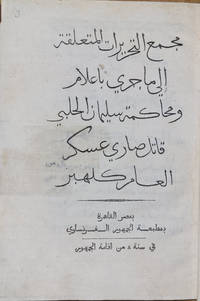
1800000228<p><strong>EGYPT – NAPOLEONIC PERIOD – ARABIC PRINTING</strong> <em>A Compilation of the Decisions Relating to the Condemned Criminal and the Judgments Passed upon Him the Killer of the Commander-in-Chief the Renowned Kléber</em></p><p>Cairo: <strong>مطبعة الجمهور Ø§Ù„ÙØ±Ù†Ø³Ø§ÙˆÙŠ</strong> Press of the French Republic <strong>Year 8 of the Republic</strong> 1800–1801.</p><p>Rare and historically significant <strong>Arabic imprint produced during the French occupation of Egypt</strong> documenting the <strong>trial judgment and execution of SulaymÄn al-ḤalabÄ«</strong> the assassin of <strong>General Jean-Baptiste Kléber</strong> Commander-in-Chief of French forces in Egypt.</p><p>This work constitutes the <strong>official Arabic-language publication of judicial decrees and legal decisions</strong> issued by the French military authorities in Cairo following the assassination of Kléber in June 1800. It was intended for circulation among the Arabic-speaking population serving both as a legal record and as an instrument of political communication and authority.</p><p>Printed at the <strong>Press of the French Republic in Cairo</strong> one of the earliest European-operated printing presses in Egypt the book forms part of the pioneering Napoleonic effort to employ <strong>Arabic typography for governance law and propaganda</strong>. The text reflects the adaptation of French revolutionary legal concepts into Arabic juridical language making it a landmark in the history of <strong>Arabic legal printing</strong>.</p><p>The publication corresponds to a French counterpart titled <em>Traduction Arabe des pièces relatives à la procédure et au jugement de Soleyman el-Haleby</em> confirming its role within a bilingual documentary corpus produced by the occupation authorities.</p><p><strong>Historical Significance</strong></p><ul><li>Primary source for the <strong>assassination of Kléber</strong> one of the most consequential events of the Egyptian Expedition</li><li>Early example of <strong>state-sponsored Arabic printing</strong> under European colonial rule</li><li>Key document in the history of <strong>Franco-Arabic legal translation</strong></li><li>Important witness to the emergence of <strong>modern political and legal Arabic print culture</strong></li></ul><p><strong>Rarity</strong></p><p>Extremely scarce. Arabic imprints from the <strong>French Egyptian press 1798–1801</strong> are notably rare and judicial publications relating specifically to the Kléber assassination are seldom encountered on the market. Examples are held in a small number of institutional collections; private ownership is exceptional.</p><p><strong>References</strong></p><p>Cf. Galland <em>Imprimerie arabe du Caire</em>; Napoleon in Egypt bibliographies; WorldCat records under variant French and Arabic titles.</p> Press of the French Republic hardcover
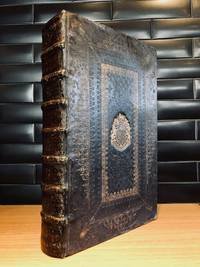
17177186Oxford: John Baskett 1717. First Edition Thus. Royal binding in full morocco. Very Good. John Sturt. Two volumes in one. Large stout folio. Double column with columns separated by double rule. Text ruled in red and title pages printed in red and black. Engraved vignette title pages for Old and New Testaments the latter dated 1716. With the engraved additional general title page by cartographer and renowned illustrator John Sturt 1658–1730. With striking copper-engraved vignette head- and tail-pieces and many engraved historiated initials. Complete with Apocrypha.<p>Marbled endpapers. All edges gilt. Bound in contemporary full black morocco rebacked with original elaborate gilt-tooled spine neatly laid-down gilt-tooled arms of King George II featuring the motto "Most Noble Order of the Garter" as centerpieces and his monogram in spine compartments raised bands and gilt-decorated borders. Only moderate wear to the splendidly complete royal binding. First edition of the monumental illustrated "Vinegar Bible" with additional title page engraved by John Sturt including the vignette of a church interior featuring the figures of Moses Aaron et al. per Darlow and Moule. According to the DNB Sturt "specialized in miniature work and it was said that he could engrave the creed on a silver penny but could also work on a large scale and in 1692 he produced a notable engraving of Britannia the royal first capital ship of England printed on four sheets". Presented in a handsome King George II armorial binding. Carter notes that " . Bibles with the royal arms may have come from one of the Royal Chapels - but they may equally have come from any loyal parish church" ABC p. 157. That said a limited print run coupled with the high cost of Baskett's elaborate opus would suggest the former.<p>In 1709 printer John Baskett secured the exclusive royal patent to print Bibles in England. Of those he and his family published this is the most magnificent being a triumph of legible elegant type that contributes to an easy readability accessible today. Alas a typographical error in the running head of Luke XX among other typos rendered the parable of the vineyard as the "parable of the vinegar" overshadowing Baskett's magnificent achievement.<p>A scarce and stately copy of a high spot in 18th-century printing. DARLOW & MOULE 736-B "the engravings differ considerably from those in A". John Baskett unknown
179052510New York: John Fenno no. 41 Broad-Street near the Exchange 1790. First edtion. Softcover. Fine. Two leaves folio 16.25 by 10 in. Edges slightly trimmed; a touch of mild foxing else a fine crisp copy. Housed in linen clamshell box with gilt paper label at spine and previous owner's dediction pasted to inside cover.<br /> <br /> The first known published appearance of Jewish support for the newly elected president of the United States George Washington. One week after Washinton's inauguration Levi Sheftall on behalf of the newly reorganized Savannah Hebrew Congregation wrote him an elegant and effusive letter of congratulation. This letter along with Washington's reply was published for the first time by the United States Gazette:<br /> <br /> "Sir We have long been anxious of congratulating you on your appointment. and of testifying our unbounded confidence in your integrity and unblemished virtue. Your unexampled liberality and extensive philanthropy have dispelled that cloud of bigotry and superstition which has long as a veil shaded religion -- unrivetted the fetters of enthusiasm -- enfranchised us with all the privileges and immunities of free citizens and initiated us into the grand mass of legislative mechanism. May the great Author of worlds grant you all happiness and a continuance of guardianship to that freedom which under the auspices of heaven your magnanimity and wisdom have given these States."<br /> <br /> Washington's reply is undated but addressed "To the Hebrew Congregation of the City of Savannah." After accepting their congratulations he extends this hope: "May the same wonder-working Deity who long since delivering the Hebrews from their Egyptian Oppressors planted them in the promised land -- whose providential agency has lately been conspicuous in established these United States as an independent nation -- still continue to water them with the dews of Heaven and to make the inhabitants of every denomination participate in the temporal and spiritual blessings of that people whose God is Jehovah. George Washington." <br /> <br /> Provenance: old entry of . Hopkins at top margin first leaf trimmed. Six weeks later <br /> <br /> References: Enc. Jud. first ed. 1972 vol. 16; Evans Amer. Bibl. vol. 8; From the Ends of the Earth Judaica Treasures of the Library of Congress. John Fenno, no. 41 Broad-Street, near the Exchange unknown
17183874591718. Unbound. Near Fine. A remarkable archive of 24 letters from Admiral of the Fleet George Byng sent to Rear Admiral George Delaval who commanded the Blue Squadron under Byng’s command along with associated documents from George Saunders and Josiah Burchett Secretary of the Admiralty relating to the British naval campaign of 1718 in the Mediterranean culminating in the Battle of Cape Passaro Sicily on the 11th August. A mix of quarto and folio sheet with many folded once to form four pages. Each letter is Signed by Byng with one signed twice. Despite their age the letters are near fine or better with only light wear and housed in a custom cloth chemise with printed labels.<br /> <br /> The Battle of Cape Passaro resulted in the defeat of the Spanish by the British Fleet under Sir George Byng four months before the War of the Quadruple Alliance. The Spanish refused to re-embark their army from the Sicilian mainland. Despite war not having been formally declared Byng correctly anticipated approval from home and attacked and routed the Spanish fleet thwarting their ambitions to take Italy and Sicily.<br /> <br /> The subject matter of the letters is concerned with supplies day-to-day naval matters and continuing hostilities against the Spanish and includes details of several rendezvous for meeting up in the event of separation owing to bad weather. Common problems are mentioned such as desertion and shortage of food and more particularly wine. The earliest is dated May 17th concerning the mobilization of troops and pressed men for the campaign. The letter of May 29th regards the Line of Battle detailing ships ordnance and men commanders and formation and pennants and the signals to be used. On July 3rd Byng gives orders to oppose the landing of the Spanish in Italy with a warrant order of operations to “take sink burn or destroy†the King of Spain’s ships; the last of the series dates from the December 9th from the Admiralty office not by Byng congratulating Delaval on his safe arrival at Spithead and requesting him to escort the fireship Griffin to Deptford. Byng sent mail from on board his ship the Barfleur whilst at sea and also from the Admiralty office in London.<br /> <br /> Byng was sent on subsequent diplomatic missions on behalf of England to negotiate with Italian princes and states and was instrumental in the acceptance of the terms of the Quadruple Alliance by Spain. In 1718 Byng was already a respected member of the establishment having supported the accession of William and Mary at the Glorious Revolution contributed to the burning of the French fleet at Vigo and leading the bombardment squadron during the capture of Gibraltar. He was rewarded with a knighthood and a regular promotion. After the success of 1718 this included membership in the Privy Council admittance to the Order of the Bath and the title of Viscount Torrington which his descendants still bear today. In 1727 Byng was made First Lord of the Admiralty and the Royal Naval College at Portsmouth was founded in his memory.<br /> <br /> Delaval also had a distinguished naval and diplomatic career from a young age with victory at the Battle of Malaga in 1704 and missions to Spain and Portugal as well as his promotion to Rear Admiral and leadership of The Blue Squadron. He is perhaps best known for rebuilding his ancestral seat the celebrated Seaton Delaval Hall in Northumberland now a National Trust property with architect Sir John Vanbrugh.<br /> <br /> It is important to note that Admiral George Byng should not be confused with his fourth son John Byng also present at the Battle of Cape Passaro as a 13 years old who built a respectable career as a naval officer and became an Admiral but was court-martialed and shot by firing squad on 14 March 1757.<br /> <br /> A remarkable collection of letters from the First Lord of the Admiralty during the reign of King George II. <br /> <br /> A detailed list of the correspondence is available upon request. unknown
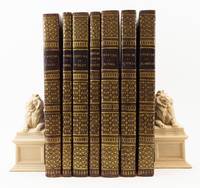
1800ST17757London: William Miller; T. M'Lean; William Bulmer 1800-18. 370 x 270 mm. 14 1/2 x 10 1/2". Seven volumes. <br/> Uniformly bound in stately contemporary dark burgundy straight-grain morocco covers with gilt palmette-and-wheat-sheaf border inner frame of blind-stamped grapevine raised bands spine compartments densely gilt with repeating botanical tools gilt lettering gilt-rolled turn-ins all edges gilt. Two engraved titles with hand-colored vignettes not included in plate count and 356 FULL-PAGE HAND-COLORED PLATES FEATURING COSTUMES OCCUPATIONS AND SOCIAL INTERACTION OF VARIOUS NATIONS. Volume I-III V and VI with text in French as well as English. Front pastedown with armorial bookplate of Edward Gordon Douglas-Pennant 1st Baron Penrhyn. Abbey Life 430; Abbey Travel 71 244 370 373 532 533. Joints and extremities lightly rubbed one board with a couple of faint scratches two rear boards with neat older repairs to short tears at tail edge but the bindings quite sound and most attractive on the shelf. Flyleaves a little foxed minor offsetting from plates to text leaves occasionally more pronounced but never offensive isolated minor marginal foxing to plates otherwise very fine WITH CLEAN BRIGHT PLATES.<br/> <br/> This is a collection of major early 19th century color plate books with well-drawn and richly-colored engravings in bindings that make a handsome appearance on the shelf. All of these works have appealing plates where the costumes of the various social strata are carefully and colorfully delineated. And two of the volumes--those showing British costumes and the book on Chinese punishments--contain in addition a good deal of diverting background detail that serves as a revealing context for each of the costumes depicted. The content of each of the volumes is worth noting. With a few exceptions the plates in the "Costumes of China" portray ordinary working-class men and women toiling at their trades. We see a bookseller with his wares spread out on a mat women sewing and embroidering a butcher a fisher a barber a man with a "magic lantern" show and a "man striking a small gong during an eclipse" an ancient ritual that the author tells us he was privileged to witness on 17 November 1789. The "Punishments of China" volume is filled with almost gleefully painful depictions of all degrees of disciplinary action from the relatively minor twisting of the ears or chaining to an iron pole to the humiliating ordeal of the wooden collar to methods of execution by beheading or by crucifixion using a cord. The opulent and brightly colored costumes in Dalvimart's volume on Turkey are mostly those of the ruling classes although also represented is a wide variety of native dress from the many regions of the vast Turkish empire of the day which included Bosnia Albania Syria Egypt and parts of Greece. It is particularly interesting to contrast the clothing of the very heavily veiled Turkish and Egyptian women with the much more relaxed style of the Greek women and the nearly immodest garb of the female Bedouin. We also are shown a eunuch an odalisque from the harem a grand vizier various royal functionaries and government officials all splendidly attired. The Russian costumes based on engravings done by C. W. Müller at the request of Empress Catherine the Great are focused on the ethnic dress of the empire's many holdings. The Laplanders and Finns wear clothing that would look familiar to most Europeans but the Mongols in their Oriental dress would be quite exotic. The clothing of the northern tribes such as the Kamchatkans Aleutians Koriaks and Tungoosi will impress the modern reader with their similarity to the traditional dress of Native American and First Nation peoples. The Tchutski woman is even depicted naked to display her tattoos. Bertrand de Moleville's Austrian costumes also illustrate the native dress of the empire's citizens but the illustrations here are less fashion plates than romanticized scenes: peasant couples are shown courting and dancing; Croatian women gossip beside a stream; and a wild-haired Bohemian gypsy whose "profession is not hard to guess" from her state of "déshabillé" flees with her naked and no doubt illegitimate child. Pyne's "Costumes of Great Britain" is one of the most highly praised works in this set and for good reason: the simple working men and women of Britain it depicts are always shown going about their daily tasks in the midst of a well-realized scene. The woman selling "salop" a hot morning beverage is seated at her cart with its urn judiciously located by the watchman's stall surrounded by customers including soldiers and a woman with her market basket. A fireman with an ax and a torch hurries toward his engine company while they unwrap their hose. The potter is at his wheel the tanner is cleaning skins and the bill-sticker posts the winning lottery numbers. The clothing while carefully detailed is almost secondary to the depictions of everyday life. The "Military Costumes of Turkey" illustrates the official regalia "uniform" is much too drab a word for these outfits worn by officers in various regions of the empire. Perhaps the most intriguing plate here is that of the Ladle Bearer a post that was also illustrated in "Costumes of Turkey." What appears to be a man with a giant spoon is in fact the holder of an important military position equivalent to the color-bearer in a western army. We are told that the loss of its ladles is the greatest disgrace that can befall a Turkish regiment: if the two great ladles the size of a grown man that are borne into battle at the head of the troops are captured the regiment must be disbanded and formed anew. Former owner Edward Gordon Douglas-Pennant 1st Baron Penrhyn 1800-86 was a leading figure in the Welsh slate industry; he owned the Penrhyn Quarry the largest slate quarry in the world at the end of the 19th century. He was known for his paternalistic attitude to his employees creating the "model village" of Llandegai to house the quarry workers. It was notable for having "no corrupting alehouse." He was ruthless enough to fire 80 men in 1868 because they did not vote for his son George who was running for a seat in Parliament. Single volumes from this set appear with frequency in the marketplace; full sets show up much less often; sets as handsome and well preserved as the present are rarely seen. William Miller; T. M'Lean; William Bulmer unknown
18000008<p><strong>printed leaf</strong> <strong>10 lines in Ottoman Turkish</strong>. Undated and without place of printing but apparently printed at the <strong>Imprimerie Nationale Cairo</strong> during the <strong>French Expedition to Egypt</strong>.</p><p>The document is a <strong>proclamation</strong> concerning <strong>Napoleon Bonaparte's reply</strong> to a letter from the Ottoman Sultan <strong>Selim III</strong> stating that <strong>Napoleon and Selim are allies</strong> that <strong>no force can disturb their alliance</strong> and that <strong>all victories on both sides are the result of this alliance</strong>.</p> Divan du Caire (the Napoleonic committee in Cairo)
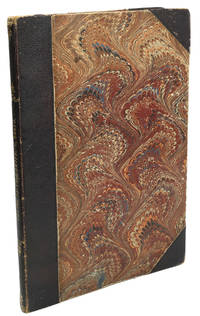
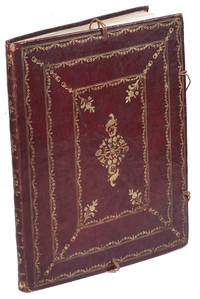
1800ABC_48443The Netherlands 1800. Splendid late 18th-century ca. 1790 gold-tooled red morocco sewn on 4 supports with a smooth spine bound by the so-called Second Dissertation Bindery Leiden ca. 1780-ca. 1794; Storm van Leeuwen IIA pp. 350-358 with 4 closing loops on the front board 1 top edge 2 fore-edge 1 bottom edge connecting to 4 closing knotted buttons on the back board. Both boards show 3 gold-tooled floral frames built up from 2 different rolls with small corner pieces in between the inner frame with 4 larger floral corner pieces and a large lozenge shaped centrepiece built up from multiple impressions of 5 different floral and animal stamps. Further with a gold-tooled spine and board edges gilt edges and marbled endpapers. Large 4to. With 162 signatures on 160 vellum or paper cuttings mostly vellum including 2 cuttings with 2 signatures each mostly from the 17th century some from the 18th century and a few from the early 19th century. Further with one large printed coat of arms of the Wassenaer family on the verso of the title-page an engraving ca. 9.5 x 7 cm showing the house of Jacob Cats on the verso of leaf 34 and with 19 printed coats of arms on the versos of several leaves 16 depicting a coat of arms with the name of the family below and 3 blank shields. The title page headings and captions all in a very neat late-18th-century or early 19th-century cursive script written in Dutch using brown ink. Remarkable collection of 162 signatures of mainly 17th-century 16th- to early 19th century Dutch and international prominent people - from statesmen like Stadtholder Maurice of Orange Count of Nassau etc. and Grand Pensionary of Holland Johan de Witt 1625-1672 royals like King Philip II of Spain 1527-1598 and William III of Orange Stadtholder of the Dutch Republic and later King of England Scotland and Ireland 1650-1702 and government officials like "Griffier" to the States General François Fagel 1629-1746 the most important clerk of the Dutch Republic's government to authors poets and scholars like P.C. Hooft 1581-1627 and Nicolaas Tulp 1593-1674. For each individual mentioned in the present work their signature - on a separate vellum or paper cutting mounted on the recto of the leaf - appears next to a short biographical description. Some biographical descriptions are more extensive than others but two names appear without any further information. The first is Caspar Clotterbooke leaf 30 who is listed as a secretary for the council of the States of Holland in the 18th century 1778. He was born in The Hague in 1720 held several high positions in the councils of Haarlem and the States of Holland as a representative of that city and died childless in 1817. The second is Hendrik Nobel who is listed in the second part among royals statesmen military commanders scholars and others. He lived from 1568 to 1649 and was appointed as "bewindvoerder" administrator or governor of the Rotterdam Chamber of the Dutch East India Company VOC. In two cases one cutting contains two signatures - those of Johan van Hoorn and Abraham van Riebeek appear together as well as those of Adriaan Valkenier and Johannes Thedens; all four were Governor General of the Dutch East Indies resp. from 1704-9 1709-13 1737-41 and 1741-43. In the case of William III two signatures are included for one single individual - the first is his signature as Prince of Orange and the second is his signature as King of England Scotland and Ireland "William R.". The work was bound by the so-called Second Dissertation Bindery in Leiden which was active at the end of the 18th-century between ca. 1780-1794 Storm van Leeuwen. The work was most likely produced as an album with blank leaves to be used as a notebook or scrapbook album of some sort at a later date. The paper used in the album is clearly watermarked throughout for example a lion within a crowned medallion pro patria eiusque libertate countermarked J. Honig & Zoonen. The firm Honig or Honigh Zaandam the Netherlands was active from the late 17th century until the late 19th century but was known as J. Honig & Zoonen during the 18th century. The paper is most likely contemporary to the binding. While several of the cuttings containing signatures are also dated - as part of the signature itself or separately added - these dates represent the exact or otherwise approximate date the particular signature was produced. The majority of the signatures can be traced back to the 17th century but were probably cut from official hence the vellum documents to be sold as collector's items around the beginning of the 19th century.The present work was part of the collection of A.M. van den Broek 1932-1995 an antiquarian book print and art collector from Haarlem. His collection mainly contained works focussed on Haarlem and its surroundings. The present work includes 7 signatures from prominent Haarlem representatives in the "Commons" the council of the States of Holland during the 17th- and 18th centuries.The binding shows very slight signs of wear two scratches on the front board some rubbing along the spine and closing knotted buttons on the back board the gutter of the first and second front flyleaves is slightly exposed without affecting the integrity of the binding. Further with some minor offsetting on the blank versos of the leaves from the signature cuttings. Otherwise in very good condition. A remarkable collection of signatures from mainly 17th century prominent Dutch and international statesmen and other famous people.l Cf. for the binding: Storm van Leeuwen IIA pp. 350-358. hardcover
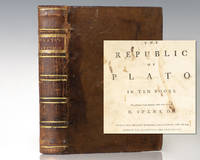
1763138322Glasgow: Printed by Robert and Andrew Foulis 1763. First edition in English of Plato's Republic marking the first appearance in the English language of Plato's profoundly influential dialogue concerning the nature of justice. Quarto bound in full polished calf with raised gilt bands to the spine morocco spine label lettered in gilt all edges speckled red. Harry Spens was a minister at the parish of Wemyss in Fife and respected classicist. In his introduction he professes his intent in his translation is: "To give the English Reader a view of Plato's sentiments and manner of writing and to stir up the youth to the study of the Ancients." Richard Garnett in his own introduction of the Everyman's Library reprint of this translation laments the relative lack of critical attention paid to it writing: "On the whole Spens's version should not be lightly esteemed. It is clearly the work of a scholar and a man of considerable literary ability." The brothers Robert and Andrew Foulis were renowned printers of classical works in their time sometimes referred to as 'the Elzevirs of Britain.' Their works mostly intended for scholars were "much sought after as admirable specimens of typography and are noticeable for their severely plain elegance" DNB 7: 514. In very good condition. Rare and desirable. "Its setting and its characters are full of political meaning. Its arguments are tantalizing and its fables fascinating… Plato's utopia is alarming and his metaphysics are intoxicating" Levi 348. The Republic "has reinforced dedication awakened vocations to leadership and strengthened the morale of those modest and competent souls who are always in reality the guardians of society" Rexroth 79. Printed by Robert and Andrew Foulis unknown
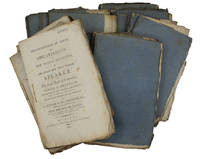
1789AQVBF8<p>8vo. 51 volumes. Preserved in the original states; the vast majority stitched as issued many uncut and in the original plain paper wrappers.</p><p>A remarkably fresh collection of pamphlets relating to Ireland and - largely - the proposed and later completed political union between Ireland and Great Britain dating from the final decade of the eighteenth- and first decade of the nineteenth- centuries. Included are historical and literary works references to the 1798 Irish Rebellion and numerous speeches made by Irish and British politicians during the long debates in both Houses of Parliament.</p><p>Highlights include:</p><p>- AN INDEPENDENT OBSERVER REDFOORD Archibald. Union necessary to security. Addressed to the loyal inhabitants of ireland. Dublin. Printed for J. Archer 1800.</p><p>8vo. 2 106pp. Uncut and partially unopened in original publisher's powder blue wrappers. Occasional inked corrections to text some dampstaining to margins.</p><p>Presentation copy inked inscription to head of title: 'For William Smith Esq. / from his sincere friend / The Author'.</p><p>ESTC T194733.</p><p>- AN OFFICER. TAYLOR Sir Herbert. Impartial relation of the military operations which took place in Ireland in consequence of the landing of a body of French troops under general Humbert in august 1798. Dublin. Printed for J. Milliken 1799.</p><p>8vo. 2 69pp 1. With two engraved folding plates and a folding table. Uncut and partially unopened in original publisher's marbled wrappers. ESTC T114958.</p><p>- A REAL FRIEND. A letter to the people of Ireland which they all can understand and ought to read. Dublin. Printed for J. Milliken 1799.</p><p>8vo. 3 6-33pp 1. In this edition the text ends on p.34 with 'I am your real friend. Finis'. Uncut and unopened in original publisher's powder blue wrappers. Foxed.</p><p>ESTC records a single copy of this edition in North America Missouri and none elsewhere.</p><p>From the collection - recently dispersed - of the Marquesses of Lothian who also held the Earldom of Ancram at Newbattle Abbey; many were presumably acquired by William Kerr 5th Marquess of Lothian 1737-1815 British soldier and peer.</p><p>A full list of the contents of this collection is available on request.</p> [vs.].
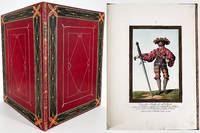
17901485Basel: C. de Mechel 1790. First Edition. Fine. Chrétien de Mechel after Hans Holbein. Folio 14 1/8 x 10 1/2 inches 360 x 263 mm; hand-colored aquatint title and 12 etchings & aquatint plates with hand-colroing in watercolor by Chrétien de Méchel after Hans Holbein the Younger. Handsome contemporary mosaic binding in red morocco inlaid dark green border with red and yellow dots and yellow corner piece designs gilt board edges and turn-ins gilt designs on spine and green label with gilt title spine a little rubbed marbled endpapers a.e.g.; preserved in a slipcase with marbled paper and red morocco profiles a little rubbed and faded. <br /> <br /> Cohen / deRicci 493; Colas 1462; Rahir Bibliothèque de l'Amateur p. 661; Brunet III 251-252; Cicognara 2044; Bobins 490; Vinet 2177. Housed in a stunning mosaic binding this rare folio contains a complete suite of 12 magnificently-colored plates the third part of a series of 4 comprising Holbein's oeuvre published in Basel by Chrétien de Méchel from 1780 to 1792 and usually found in uncolored state. The Swiss civil and military costumes originally drawn by Hans Holbein the Younger 1497 - 1543 and housed in the Basel Public Library. Chrétien de Méchel renders these drawings in a robust and precise manner for this edition featuring 6 women and 6 men some in military costume. More commonly encountered lacking the hand-coloring en bistre each of these scarce engravings appears fresh and in superb condition with excellent saturation and extensive bright coloration. An excellent exemplar of this rare hand-colored volume.<br /> A copy can be found in the Robert Wylie Lloyd collection at the British Museum inv. 1958.0712.3056.1-12. C. de Mechel unknown
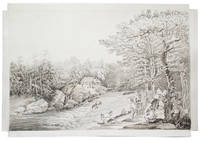
180052601Canada 1800. Graphite pen-and-ink and grey wash on wove paper watermarked "W. Elgar 1796". 13 5/8 x 20 inches. Corners clipped outside the image verso toned. Graphite pen-and-ink and grey wash on wove paper watermarked "W. Elgar 1796". 13 5/8 x 20 inches. Along the falls of a tree-lined river two First Nations men are pulling a canoe into the water directed by another in an elaborate feather headdress; a wigwam with mother and child is on the same shore to their left; across the river a longhouse and structure for smoking fish with another group of native people can be seen; at the far left a First Nations man is standing in his canoe fishing with a pole in the water just below the rapids.<br /> <br /> Although the 1796 watermark on the paper is consistent with drawings by Heriot the unfinished quality of this work make attribution difficult. However it is somewhat reminiscent of a smaller grisaille watercolor signed by Heriot titled FALLS OF THE POQUISQUE ON THE RIVER ST JOHN on verso sold at Waddington's March 15 2018 lot 137.<br /> <br /> Furthermore this scene is reminiscent of one described by Heriot in his Travels in the Canadas 1807 in which he describes Native American fishing on the cacasdes of St. Mary nine miles below the entrance to Lake Superior: "It is at the bottom of the rapids and even among their billows which foam with ceaseless impetuosity that innumerable quantities of excellent fish may be taken from the spring until the winter; the species which is found in the greatest abundance is denominated by the savages atticameg or white fish; the Michilimakinac trout and pickerell are likewise caught here. These aflford a principal means of subsistence to a number of native tribes. No small degree of address as well as strength is employed by the savages in catching these fish; they stand in an erect attitude in a birch canoe and even amid the billows they push with force to the bottom of the waters a long pole at the end of which is fixed a hoop with a net in the form of a bag into which the fish is constrained to enter. They watch it with the eye when it glides among the rocks quickly ensnare it and drag it into the canoe. In conducting this mode of fishing much practice is required as an inexperienced person may by the efforts which he is obliged to make overset the canoe and inevitably perish."<br /> <br /> Trained by Paul Sandby at the Royal Military Academy Woolwich London Heriot worked as a clerk for Board of Ordnance. "In 1792 Heriot was posted to Quebec and promoted clerk of the cheque in the Ordnance department. Heriot was to remain in Lower Canada until 1816 except apparently for two periods of absence in 1796-97 and in 1806. His first years at Quebec are not well documented. Sketches record visits in and about Quebec and Montreal perhaps on Ordnance business. In November 1792 he published a sketch of Jersey in the Quebec Magazine and the following year he prepared a view of Quebec perhaps also intended for publication. When he returned to Britain in 1796 he resided in London travelled to the south coast and made at least one sketching foray into Wales . A watercolour prepared from his sketches of Wales and two Canadian views were accepted by the Royal Academy of Arts for exhibition in the spring. Heriot probably sailed for Lower Canada soon afterwards taking notes and making sketches on the voyage. The impact of his visit to Britain was considerable. While there he had been stimulated by the art he had seen and by his success as an artist. He returned with a fresh enthusiasm for the Canadas; he began to read about their past and to make elaborate notes and numerous sketches of the places he visited and the peoples he encountered. His sojourn abroad had affected his artistic vision of the Canadas; his drawings and water-colours assumed a new confidence and his landscape forms developed a new strength and grandeur. In London he had probably studied the simply handled and remarkably strong water-colours of younger British artists such as Thomas Girtin Joseph Mallord William Turner and John Varley. Either in Britain or in Lower Canada he had also become familiar with Lieutenant George Bulteel Fisher's Six views of North America . London 1796. He was influenced by this work especially by Fisher's use of the Picturesque in depicting Canadian landscape" Dictionary of Canadian Biography. unknown
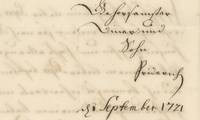
17213633109/1721. <blockquote><p>Theirs was a famously combative relationship; Frederick would attempt to flee to Britain 9 years later</p></blockquote><p>In his early youth Frederick lived with his mother and sister Wilhelmine although they regularly visited their father's hunting lodge at Königs Wusterhausen. Frederick and his older sister formed a close relationship which lasted until her death in 1758. Frederick was educated to speak both French and German and many of his tutors were French Calvinists.</p><p>The relationship between Frederick the Great and his father Frederick William I was deeply strained and often hostile. Frederick William I was a rigid militaristic ruler who valued discipline obedience and a strong army above all else while his son was drawn to music literature and French Enlightenment culture. The King saw these interests as weak and unmanly and he frequently criticized and even physically punished Frederick in an attempt to force him into a more soldierly mold.</p><p>Their conflict reached a peak in 1730 when Frederick attempted to flee Prussia to escape his father’s control. The plan failed and Frederick William I reacted harshly—he had Frederick arrested and forced him to watch the execution of his close friend Hans Hermann von Katte who had helped in the escape attempt. Although Frederick later became a brilliant military ruler the emotional distance between father and son never fully disappeared. In fact Frederick’s later embrace of culture and philosophy can be seen partly as a reaction against his father’s severity.</p><p>Wusterhausen was an important royal residence in early 18th-century Prussia and played a key role in the upbringing of Frederick the Great. In the early 1720s when Frederick was still a child he spent time there with his father Frederick William I who used the palace as a retreat from Berlin. The site was known for the King’s informal “Tobacco Parliament†where political and military matters were discussed. For the young Frederick Wusterhausen symbolized the strict militaristic environment imposed by his father which sharply contrasted with his own developing interests in culture music and Enlightenment thought—tensions that would later shape his character and reign.</p><p><strong>Autograph letter signed</strong> in old Germanic script from then Prince Frederick to the King ""<em>My dear Papa"" ""in September 1721.""</em> The General mentioned is likely Johann Matthias von der Schulenburg.</p><p><em>""I hope that my dear Papa is still doing well and I am longing very much to go to Wusterhausen. I am constantly hoping that my dear Papa will order for me to come. I am awaiting with the greatest impatience to see my dear Papa. I am humbly requesting my dear Papa that he may let me come to Wusterhausen. I remain my dear Papa’s Most obedient servant and son Frederich.""</em></p><p><em>""The general Schulenburg has told me that my dear Papa is still doing well about which I am very glad and he also asked me to be godfather.""</em></p><p><img class=""alignnone wp-image-25018 size-post-window"" src=""https://cdn.raabcollection.com/wp-content/uploads/20231204144051/Folder-site-11-1600x1327.jpg"" alt=""historical memorabilia dealer"" width=""1600"" height=""1327"" /></p> unknown
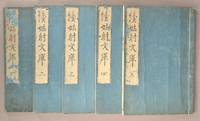
179890506a<p>ChÅ Gessho 張月樵 and Kazaore YÅ«jo 風折有丈 artists.<b> Zoku Koya Bunko 続姑射文庫 5 vols.</b> Nagoya Kansei 寛政 10 1798. 5 volumes 27 X 18cm string-bound Japanese-style fukuro-toji. Original format with original covers and title labels housed in a modern striped chitsu with clasps 27.3 x 19cm. Original monochrome woodblock prints many double page with Japanese text. Edited by BÅkŠ暮雨巷. A sequel to Koya Bunko 姑射文庫 done in 1768.</p><p>The "Sequel to the Koya Library" done by principal artist ChÅ Gessho 張月樵 1765-1832 and Kazaore YÅ«jo 風折有丈 is a remarkable rarity that captures the vibrant world of art and poetry centered on haikai and haiga in Nagoya. It is justly celebrated by critics from Brown to Hillier and was featured in the Library of Congress' major Japanese art exhibition "The Floating World of Ukiyo-e: Shadows Dreams and Substance." With hundreds of full-page black and white woodblock images it is probably the most extensive original example of the Haiga aesthetic in existence. Vol 1 has 52 cho Vol 2 has 50 cho Vol 3 has 53 cho Vol 4 has 53 cho and Vol 5 has 56 cho including colophon. Identical to Volumes held in ARC Koten Seki portal database online Ritsumeikan University ç«‹å‘½é¤¨å¤§å¦ with the exception of an added modern page to their introduction in Vol 1.</p><p>In very good condition throughout worn original covers and title labels worming on rear wrapper of vol 5 very good impressions. Mitchell 564</p><p><br /></p> books
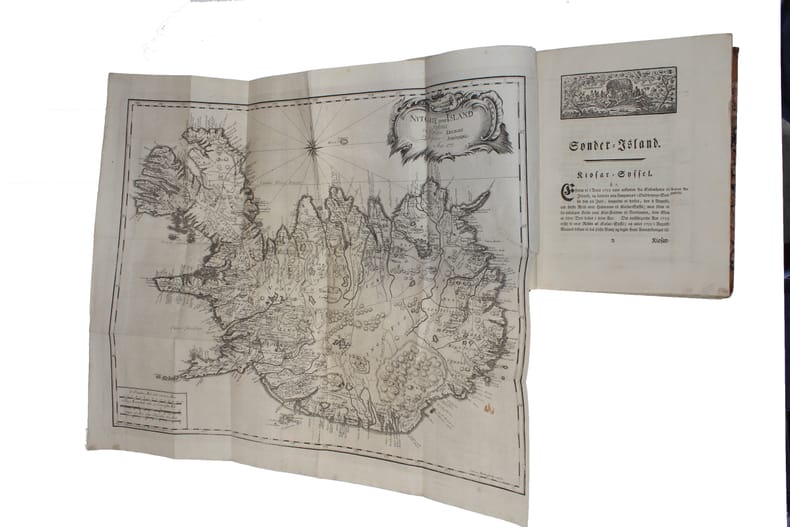
177260321Sorøe, Jonas Lindgrens, 1772. 4to (260 x 214 mm). 2 volumes, uniformly bound in two nice contemporary half calf bindings with five raised bands and gilt title- and tome-labels to spines. Ex-libris (Hjalmar Hartmann) pasted on to pasted down front end-paper in both volumes. Previous owner's stamp (Hvedholm Castle) to upper part of title-page in both volumes and two small paper-labels (stating respectively 1592 and 1593 - indicating the booknumber in Hvedholm Castle's catalogue) to lower compartment on spines. A few leaves in vol. 1 with brown stripe in upper margin. An excellent and wide-margined copy. (12), 618 pp. Pp. (2), 519-1042, (62), 20, (2) + 51 engraved plates (numered I-L, with 2 plates numbered XXX) and 1 large folded map.
1794000035bNew Spain Mexico. Fine with no dust jacket. 1794. Full-Leather. Handsome Folio Manuscript in early calf with gilt written by the Attorney of the Real Audiencia see Bibliografia Mexicana 220 and prepared for the Viceroy. Lengthy stipulations of taxes for the freed mestizos mulattoes and negroes as well as exemptions for Indians of the repartimientos even when married to Spanish women. These taxes were the root of the perceived injustice that explains why freed men formed the core of the Revolution when it came. EXTREMELY RARE AND IMPORTANT FIRST HAND TEXT OF MEXICAN HISTORY. see Archivo General de la Nation "Los Precursores Ideologicos della Guerra de Independencia 1929 pgs 137.139." LAID IN NOTE: Arce Y Echeagary J. Yinstruction para que los Administradores de Aduanas del Reyno de Nueva Espana hagan la legitima exaccion de los dros. de Alcabalas y Pulques en los casos que por lo regular se ofrecen en las propias Aduanas. Mexico 1794. ADDITIONAL BACKGROUND: In 1519 the Spaniards conquered Mexico. This led to the formation of a new state called New Spain and later into a new hybrid culture. Several military expeditions were led to extend 'New Spain'. The whole of Central America West Indies Philippines and parts of the current Texas and California were later conquered to become part of New Spain. The Spanish political control over Mexico lasted for three centuries. The entire region was formed into a viceroyalty in 1535. The colony was divided into provinces ruled by governors. These provinces were divided into departments and subdivided into districts. Magistrates controlled the districts and mayors led smaller villages. The parliament court handled all political matters and the Council of Indies controlled the other administrative matters. Off course the supreme authority over the Spanish empire belonged to the king. This system was pretty inefficient as it took several years for directives from the king to be implemented at the lower levels. During the initial administration grants called Encomiendas were given to colonists which controlled Indian labor and produce. This led to the misuse of power and atrocities against the Indians increased. The Indians revolted against the Spaniards in 1541 but were easily subdued. The Spanish emperor Charles V initiated the decline of the Encomienda system in 1542. This decline saw the emmergence of the Roman Catholic Church. The church was successful in carrying out mass conversions. The Spaniards protected the Indians that converted. Missions and monasteries dominated much of the land. The Spaniards thrived by the new found wealth in the colonies. They amassed huge wealth by controlling silver mining large ranches and estates that grew wheat sugarcane and indigo for export. Spanish merchants exported such goods as cotton silk and dye that were produced by the Indians. The prosperity of New Spain began to decline in the 17th century. Disease and natural disasters destroyed most of the Indian population. Most others migrated slowly to remote parts. Mines were abandoned and large areas of farmland were destroyed. The economy of New Spain collapsed. In 1810 a catholic priest named Miguel Hidalgo called upon Mexicans to rise up and fight the Spanish. Although father Hidalgo was killed another priest Jose Morelos continued to lead the fighting. New Spain finally won its independence from Spain in 1810 and came to be called Mexico. ; Spanish Language; 4to - over 9¾" - 12" tall; MEXICO MEXICAN TAXES NEW SPAIN MEXICAN REVOLUTION NAPOLEON BONAPARTE CHARLES V HIDALGO MORELOS HANDWRITTEN HISTORICAL HISTORY HAND WRITTEN HOLOGRAPH MANUSCRIPT MANUSCRIPTOS SPANISH ESPANOL VICEROY mestizos repartimientos antiquité contrat vélin document manuscrit papier Antike Brief Pergament Dokument Manuskript Papier oggetto d'antiquariato atto velina documento manoscritto carta antigüedad hecho vitela documento manuscrito papel. . hardcover
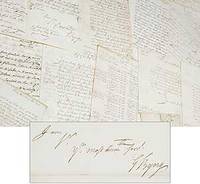
1787122705Downing Street: 2 November 1787. Pitt attempts a joint Anglo-French abolition of the slave trade Autograph letter signed by Pitt the Younger as prime minister to his close advisor William Eden at the height of Eden's influence as envoy to France in which Pitt attempts to gauge potential French support for the early Abolitionist movement spearheaded by his friend and political ally William Wilberforce and the prospect of a joint Anglo-French abolition of the trade. "You have had a letter from my friend Wilberforce on a scheme which may appear to some people chimerical but which I really believe may with proper management be made practicable. If it can I am sure it is an object well worth attending to and perhaps you may be able to learn the private sentiments of the French Government upon it. to Judge whether it can be carried further. I mean the idea of the two nations agreeing to discontinue the villainous traffic now carried on in Africa". 1787 saw the foundation of the Society for the Abolition of the Slave Trade and was also the year in which Wilberforce took political leadership of the Abolition movement. There is no evidence that any overtures Eden made to France for a joint anti-slave trade approach made any impression - had this letter achieved its aim the history of transantlantic slavery would have been vastly different. Although Pitt's support for the movement to abolish slavery was unflagging throughout his tenure as prime minister the eventual abolition of the trade would not occur until a year after his death in 1807. In December 1785 the penal reformer and diplomatist William Eden 1st Baron Auckland 1744-1814 was sent by Pitt the Younger to serve "as an envoy to negotiate a commercial treaty with France a task which particularly suited Eden's expertise in matters of finance and commerce. This step inaugurated the most important and successful phase of Eden's career" ODNB. The skill and delicacy with which he cajoled both Britain and France through the Versailles negotiations eventually resulted in the signing of the final treaty in September 1786 as well as two further commercial agreements between the countries one to resolve the disputes between the British and French East India companies. However Eden's peers viewed his successes as proof of his francophile leanings and he was swiftly reassigned as ambassador to Madrid. "Following the end of his diplomatic career Auckland remained a political figure of some significance. He was still close to Pitt and his public pronouncements were often regarded as reflecting the thinking of the prime minister. Pitt was indeed so close to Auckland and his family at this time that he came very near to marrying Auckland's daughter Eleanor Eden 1777-1851 in 1796-7 only to break off his dalliance suddenly and mysteriously for reasons which are not fully understood to this day. Although this episode curtailed the social relationship between Auckland and Pitt they remained politically close. In 1798 Auckland was appointed by Pitt to the position of joint postmaster-general and he was one of Pitt's closest advisers on the prospective union with Ireland in the years 1798-1800" ODNB. Single sheet quarto 239 x 196 mm handwritten in ink across two pages. Remains of verso guard where laid down overwritten in another hand annotated at foot of second page in a later hand "To Lord Auckland." Browned with a few areas of discolouration or marks tiny wear and puncture to left edge not obscuring text else in very good condition. unknown
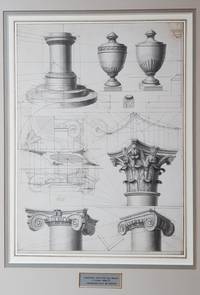
17753622n.p. n.p. n.d. pre-1775 1775. Original drawing of classical capitals and urns with lines of perspective. Pen and brown and black ink pencil and grey wash on laid paper without visible watermark ruled border in brown ink. Sheet 302x218mm window mount 350x275mm. Very slight soiling and foxing but overall in excellent condition. A very good and rare example of a study for an important book on perspective. � In 1775 Thomas Malton the Elder 1726-1801 published A Compleat Treatise On Perspective In Theory and Practice; on the True Principles Of Dr. Brook Taylor. This drawing is a preliminary study for plate XXII from this book. Such drawings are rare; the last to appear before this one was sold at Christie's in 2011. Malton's book was important: the Royal Academy had been founded only seven years before and in its Instrument of Foundation there was a specific requirement that the art and science of perspective be taught. A Compleat Treatise was the first book to be published on the subject following the founding of the RA. Malton was perhaps making a bid for his book to be adopted as a sort of "set text" and many Royal Academicians were among the initial subscribers. It was from the outset regarded as one of the best modern books on the subject based as it was on the newest contemporary mathematical studies of perspective. The combination of science and art is captured beautifully in this drawing. Bad luck in business forced Malton to leave England to start afresh as an artist in Dublin where he died in 1801 but his influence extended well into the nineteenth century thanks to his son also called Thomas and to Turner's use of A Compleat Treatise in his own lectures at the Royal Academy where he was Professor of Perspective. Malton's book and drawings would almost certainly have been introduced to Turner by Malton's son in whose studio Turner worked as an apprentice in the 1780s and whom Turner regarded as his "my real master". Some of Turner's own drawings and sketches used in these lectures are held at the Tate and among them are two of the capitals from plate XXII of A Compleat Treatise whose origins can be traced back to this drawing by Thomas Malton the Elder. n.p. n.p. n.d. [pre-1775]
17205138<p><em>The World's first Global Stock Market Bubble Illustrated</em></p><p>STOCK MARKET - THE GREAT MIRROR OF FOLLY. Het groote Tafereel der Dwaasheid.The great mirror of folly showing the rise progress and downfall of the bubble in stocks and windy speculation especially in France England and the Netherlands in the year 1720 being a collection of all the terms and proposals of the incorporated companies. with prints comedies and poems published by various amateurs scoffing at this terrible and deceitful trade. n.p. Amsterdam after 1720.</p><p>Folio pp. ii 25 1 52 26 29-31 thus complete 1 8 10 engraved frontispiece Muller plate No.1 title printed in red and black Cole version 2 text in double columns and 74 engraved plates 2 of them in duplicate mostly double-page and/or folding including maps portraits playing cards broadsides; text a little browned due to paper quality some foxing; plates generally clean and crisp one plate cropped at foremargin with loss of text but not to image; contemporary full mottled panelled calf spine gilt in compartments sides with rich gilt decoration head and tail of spine repaired corners strengthened; a good copy.</p><p>The classic rare literary and pictorial satire on John Law's 'system' and the wild speculation in stocks at that time. As part of Law's well-conceived plan to finance the French national debt funds were raised a portion of which was invested in the 'Compagnie d'Occident' which was given rights to exploit trade in Louisiana and Canada. The underlying plan was sound but unprecedented wild speculation sent the share price rocketing to unrealistic levels. Inevitably the 'bubble' burst; the Company was bankrupted and many investors ruined and the 'Système Law' unfortunately discredited. Law himself had foreseen the developments and had withdrawn funds from the French scheme to invest in the British South Sea affair which was being set up at that time. This 'bubble' also burst in 1720.</p><p>'Rarely does a single volume combine in itself so much economic interest. in neither of these countries France and England however did appear such a stout and extravagant piece as this Dutch volume' Cole p. 1.</p><p>Each copy of this work is unique. The number of plates varies from 60 to 90 though generally around 70 and the order of the text and the plates differs from copy to copy. The present copy has the regular plates 1-23 25 28 30-51 53-68 70 - 73 with 36 and 37 bound in twice in different places as well as the supplementary plates 1 2 4 and 5. This includes the very uncommon 'Register of all the prints' first issue with 47 prints listed and a further one added in ink and a fascinating portrait of Madame Law.</p><p>In addition to the vivid portrayals of the 'wind-trade' and stock market frenzy the double-page folding plate with playing cards known as Aprilkaart 65 and the Magic card 73 are particularly appealing. The special feature of this copy is the etched portrait of Madame Law but not with the usual richly decorated border of scrolls foliage fruits and flowers but surrounded by Callot style figures of dwarves. This border has been used on another print in the collection of de Koninklijke Bibliotheek Den Haag see BM 1868-0808-9693.</p><p>Arthur H. Cole The Great Mirror of Folly 1949; Sperling The South Sea Company 205; Kress 3217; Goldsmiths 5879; Sabin 28932; Lipperheide 3550; see Goetzmann et al The Great Mirror of Folly Finance Culture and the Crash of 1720 2013.</p>
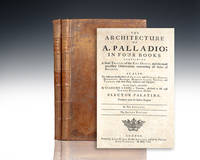
1721146284London: Printed by John Darby for the Author 1721. Rare second English edition of Leoni's English translation of Palladio's monumental work containing new typesetting but reusing the same plates from the first edition. Folio two volumes bound in full contemporary polished calf with gilt titles and ruling to the spine in six compartments within raised bands double gilt ruling and decorative stamping to the front and rear panels engraved frontispiece portrait of Palladio illustrated with 104 numbered engraved plates on 203 leaves including 15 double-page plates as well as 12 engraved in-text plates. Armorial bookplate to the pastedown of each volume. In very good condition. One of the giants of Venetian Renaissance architecture of the 16th century Andrea Palladio based his designs on the values of Greek architecture and the traditions of Roman architecture as outlined by Vitruvius. He is regarded as one of the greatest architects in the history of Western art best known for his villas in the Veneto as well as his palaces Vicenza and churches Venice all located within the Venetian Republic. His architectural theories were laid out in his treatise Quattro Libri dell Architettura The Four Books of Architecture which had a profound impact on building design throughout Europe and America. His style of architecture - a blend of Greek Roman and Renaissance art later known as Palladianism - accorded the greatest priority to maintaining symmetry perspective and overall harmony in the manner of Greco-Roman temple architecture and was widely imitated during the 17th and 18th centuries. Printed by John Darby for the Author hardcover
17016399London: T. Ilive 1701. Early English editions. Bound together with:<br /> <br /> The Most Pleasant and Delightful History of Reynard the Fox. The Second Part. Containing Much Matter of Pleasure and Content. Written For the Delight of young Men Pleasure of the Aged and Profit of all. To which is added many Excellent Morals. London: Printed by A.M. and R.R. for Edward Brewster 1681.<br /> <br /> And:<br /> <br /> The Shifts of Reynardine The Son of Reynard the Fox Or a Pleasant History of His Life and Death. Full of Variety &c. And may fitly be applied to the Late Times. Now Published for the Reformation of Mens Manners. London: Printed by T.J. for Edward Brewster and Thomas Passenger 1684.<br /> <br /> Three parts in one small quarto volume 7 5/16 x 5 9/16 inches; 186 x 141 mm. 156 2 table of contents 2 publisher's advertisements; 111 1 publisher's advertisements; 8 160 pp. Mostly black letter with titles and side notes in roman letter. Sixty-two woodcuts in the first part printed from thirty-nine blocks and fifteen woodcuts in the second part five repeated all repeats from the first part. Most cuts signed "E.B." Edward Brewster. Woodcut on C1 recto Part I printed upside down. Some browning occasional light damp staining and soiling. Part I with tiny puncture marks in the lower blank margin through gathering I just touching one letter in the imprint on the title-page six small holes in I3 and one tiny hole in I4 causing loss of a couple of letters. Part III with paper flaw in the upper blank corner of A3 and A4 tiny tear 1/4 inch in the lower blank margin of F4 and paper flaw in the lower blank corner of I2 none affecting text. Contemporary sprinkled sheep. Covers ruled and decoratively tooled in blind spine decoratively tooled in gilt in compartments with two red morocco gilt lettering labels. Some expert restoration to joints and corners. Armorial bookplate of Gloucester on front free endpaper. Bookplate of Hugh Cecil Lowther 5th Earl of Lonsdale 1857-1944 on front pastedown his sale 12 July 1937 lot 445. An excellent copy. Housed in a felt-lined quarter brown morocco clamshell case spine with five raised bands decoratively tooled and lettered in gilt in compartments.<br /> <br /> Reynard the Fox "hero of several medieval European cycles of versified animal tales that satirize contemporary human society. Though Reynard is sly amoral cowardly and self-seeking he is still a sympathetic hero whose cunning is a necessity for survival. He symbolizes the triumph of craft over brute strength usually personified by Isengrim the greedy and dull-witted wolf. . The main literary tradition of Reynard the Fox descends from the extant French 'branches' of the Roman de Renart about 30 in number nearly 40000 lines of verse. The facetious portrayal of rustic life the camel as a papal legate speaking broken French the animals riding on horses and recounting elaborate dreams all suggest the atmosphere of 13th-century France" Merriam-Webster's Encyclopedia of Literature. There is some variation in chapter number within the early editions: From "Caxton's first edition 1481 to Thomas Gaultier's only edition 1550 the story is divided into 43 chapters" while the anonymous edition 1560-1585 has 58 chapters Varty. By the 17th century when the text is titled The Most Delectable History of Reynard the Fox it appears with only 25 chapters and maintains its image cycle. Early 17th century editions also maintained this "picture cycle" through Edward Brewster's 1662 edition but at this point the Wynkyn de Worde blocks were extremely worn and new set was created Varty. Forty images were used for his second edition 1671 and all contain his initials EB. "He published further illustrated editions in 1676 1681 1694 and 1701. in 1672 he grafted new life onto the old story with A Continuation Or Second Part of the Most Pleasant and Delightful History of Reynard the Fox" Varty for which he eventually created an additional 15 illustrations. In 1684 he would produce an additional sequel following the adventures of Reynard's son Reynardine. <br /> <br /> Brunet IV cols. 1228-1229. Lowndes p. 2076. Varty Appendix Three: "A Short-Title List of All Extant Illustrated Histories of Reynard the Fox from Wynkyn de Worde c. 1495 to A. Soulby c. 1800 which are kept in United Kingdom libraries based on H. Menke Bibliotheca Reinardiana" 24 18 and 21. Wing S3512 Part II and S3436 Part III. T. Ilive unknown