122 150 résultats
37970London: H.S. Nichols Ltd. 1897. . Limited Library edition one of 570 sets and one of only a few sets issued in the publisher’s full morocco bindings set of twelve volumes full brown bevelled morocco with lavishly decorated boards in gilt gilt decorations to spine five raised bands inner dentelles gilt t.e.g. patterned endpapers b/w frontispiece portrait to first volume b/w plates with caption-sheets; neat ink ownership autograph to front paste-down endpaper and to front free endpaper verso light wear to leather at extremities a very good set. London: H.S. Nichols Ltd., 1897. hardcover
1790K1VF2DNXCCLTSt. Petersburg 1790. Folio. 30 x 20 and 29.5 x 20.5 cm. Imperial Printing Office Unsewn marbled paper spine ad 1; side stitched blue paper spine ad 2. With the text in Russian and French in parallel columns and with ornamental rules at the head of each page. 10; 20 pp. First and only editions of two peace treaties between Catherine the Great of Russia and Gustav III of Sweden which concluded the Russo-Swedish war of 1788-1790 each page with the Russian text in the left column and the French text in the right column. The Treaty of Värälä signed on 14 August 1790 though here dated 6 August by Catherine's representative Otto Heinrich Igelström and Gustav II's proxy Gustaf Mauritz Armfelt effectively restored the pre-war status quo and barred Russia from interferring in Swedish internal affairs which had been one of the reasons Gustav III a cousin of Catherine the Great declared war on Russia in 1788. After initial defeats Sweden was able to destroy nearly a third of the Russian fleet at sea. The second treaty signed on 19 October 1791 at Drottningholm outside of Stockholm established a close military alliance between Sweden and the Russian Empire with each power pledging active support and Catherine agreeing to pay Sweden annual subsidies. Since it was signed with a keen eye on the French Revolution the treaty can been seen as a predecessor to the war of the first coalition of 1792-1797 though neither Russia nor Sweden participated in the latter. Both are printed on Russian paper with cyrillic names and initials in the watermarks. Very good copies old horizontal crease first and last leaves lightly soiled.l KVK & WorldCat ads 1 & 2 SUB Göttingen ad 1 Ohio State ad 2 Strassbourg; not in Bitovt. unknown
1596F75BBB01U79OBrescia 1596. Small 8vo 14.5 x 10 cm. Pietro Maria Marchetti Contemporary limp sheepskin parchment sewn on 3 alum-tawed thongs with manuscript title on smooth spine. With Marchetti's woodcut anchor and dolphin device imitating Aldus's on the title-page 16 numbered engraved emblematic illustrations plate size 8.5 x 6.5 cm woodcut headpieces tailpieces and decorated initials 3 series and decorations built up from cast fleurons. With the Latin text set in italic and the Italian translation in roman. 106 6 blank pp. First edition of the so-called Oracles of Leo the Wise with a bilingual Latin an Italian text and 16 lovely and rather surreal engravings: an emblematic book of prophecies traditionally attributed to Leo VI 866-911/12 Emperor of Byzantium from 866 to his death and at least here also to Antonius Severus 188-217 sole Emperor of Rome from his murder of his brother in December 211 to his death the book does not indicate which Severus is intended but the preface notes that he reigned from 212. The Latin text was circulated already attributed to Leo the Wise in the 12th century but Christians revived it in the 16th century and interpreted it as a prophecy that the Ottoman Empire would fall in 1622. These oracles remained popular in the 17th century when they were presented as having predicted the setbacks that the Ottomans suffered in Europe in that period.Owner's inscriptions on the title-page further with a bookplate. With a water stain in the first quire but otherwise in very good condition with only very minor foxing. The sewing supports have broken at the back hinge the thong ties are lost and the vellum is slightly wrinkled but the binding is still in good condition.l BMC STC Italian p. 622; Caillet 11042; Edit16/ICCU CNCE 28586; Mortimer Italian 254. hardcover
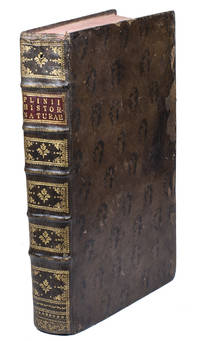
1532K7GAXLMCHM25Paris 1532. Folio. Jean Parvum index: Jean Petit 18th-century cat's paw calf richly gold-tooled spine with red title-label red edges. With a woodcut printer's device on the individual title-page for the index. 36 671 188 pp. Praised 1532 edition of Pliny's Naturalis historia: "Cette édition citée avec éloge par Ernesti et par Rezzonico." Brunet. Pliny's Natural history is one of the largest single works to have survived from the Roman Empire and purports to cover the entire field of ancient knowledge based on the best authorities available at the time. It encompasses the fields of botany zoology astronomy geology and mineralogy as well as the exploitation of those resources. It remains a standard work for the Roman period and the advances in technology and understanding of natural phenomena at the time. ''We know from Pliny that there were important pearl fisheries in the Gulf Pliny identifies Tylos Bahrain as a place famous for its pearls He attests that pearls were the most highly rated valuable in Roman society and that those from the Gulf were specially praised The pearl related finds at the site of El-Dur indicate the site was integrated into the maritime trade routes linking the Roman Empire the Persian Empire India and South Arabia'' Carter.With bookplate on paste-down some ink notes on the title-page the first page and occasionally in the margins; title-page a bit soiled; some wormholes near the end of the book mostly in the margins. Binding slightly worn along the extremities. Overall in good condition.l Brunet IV col. 715; Carter ''The history and prehistory of pearling in the Persian Gulf'' in: Journal of the economic and social history of the orient 48 2005 pp.139-209; Graesse V p. 339 "Excellente édition"; for Pliny: DSB XI pp. 38-40. unknown
1521Imprinted at London: By Robert Barker printer to the Queenes most excellent Maiestie 1606. Hardcover. Good. Quarto. 2 435 i.e. 434 4 441-554ff. Geneva version. Contemporary blindstamped calf hinges weak. Spine partially missing. All bosses intact. ESTC S102033; STC 2nd ed. 2197. Bound with: Herrey Robert F. Tvvo right profitable and fruitfull concordances or large and ample tables alphabeticall. Imprinted at London: By Robert Barker printer to the Kings most excellent Maiestie 1606. Quarto. Unpaginated. 164pp. A8-K8 L2. ESTC S102034; STC 2nd. Ed 13230. <br/> <br/> Imprinted at London: By Robert Barker, printer to the Queenes most excellent Maiestie, 1606. hardcover
1671Imprinted at London by Robert Barker 1611. Hardcover. Good. Quarto. 602 ff. --4 A8-E8 F6 A8-Z8 Aa8-Zz8 Aaa8-Hhh8 Iii2 4 Kkk-Yyy8 Zzz10. Text ends on fo. 554 really 552; and tables on L2. Contemporary calf rebacked. With bosses. Clasps missing. Illustrated. Darlow & Moule 239. Bound with: The vvhole book of Psalmes: collected into English meeter by Thomas Sternhold Iohn Hopkins and others. London: printed by R. Feld for the Companie of Stationers 1612. Octavo. x 100 iipp. ESTC S124338; STC 2nd ed. 2542. Imperfect; lacks all after page 76 and Herrey Robert F. Two right profitable and fruitfull concordances or large and ample tables alphabeticall. Imprinted at London: by Robert Barker printer to the Kings most excellent Maiestie 1611. Quarto. Unpaginated. 164pp. A8-K8 L2. ESTC S122433; STC 2nd. Ed 13232.5. <br/> <br/> Imprinted at London by Robert Barker, 1611. hardcover
1797035987London: G. Nicol 1797. 1st Edition 1st Printing. Hardcover. Very Good . 11 1/8" Tall. Frontispieces Plates And Illustrations. Ii Xxxiv518; Ii Xx 626. The Two Complete Text Volumes In Full Size Text Blocks 10 5/8" Tall; The Plates Were Issued 1796 In A Separate Volume Not Present Here; But The Plate Of The Camellia Sesanqua Is Present Between Pp 466 And 467. Original Quarter Morocco Binding Five Bands Morocco Spine Labels Over Boards Covered With Marbled Paper Original Off-White Endpapers Preliminary And Final Blank In Each Volume. Bindings With Old Wear But Nicely Furbished Morocco Labels Clean With Brilliant Gilt A Little Loss Of Leather At Tops Of Spines And At Top Right Front Spine Edge Paper Frayed Along All Edges Of Boards Hinges Tight Contents Clean Just A Few Tiny Foxing Spots. Small Very Old Booksellers' Label Of The China Times Bookseller 94 Consular Road Tientsin. And Another From Sydney. Former Owner's Signature Dated 1894 Erased In Volume 1 Of George Ernest Morrison And A Few Marginalia Which Appear To Be His; George Ernest "G. E." Morrison 1862 - 1920 Also Known As Morrison Of Peking Or Chinese Morrison Was An Australian Adventurer Appointed In February 1897 As The Times Correspondent In Peking Despite His Lack Of Knowledge In The Chinese Language. He Traveled To Vladivostok And Reported To The Times That Russian Engineers Were Making Preliminary Surveys From Kirin Towards Port Arthur Then Sent A Telegram To Say That Russia Had Presented A Five-Day Ultimatum To China Demanding The Right To Construct A Railway To Port Arthur. This Was A Triumph For The Times And Its Correspondent But He Had Also Shown Prophetic Insight In Another Phrase Of His Dispatch When He Stated That "The Importance Of Japan In Relation To The Future Of Manchuria Cannot Be Disregarded". After A Visit To Siam And England Then To Australia 1899-1900 He Returned To Peking. When The Boxer Uprising Broke Out And During The Siege Of The Legations From June To August Morrison As An Acting-Lieutenant Showed Great Courage Always Ready To Volunteer For Every Service Of Danger. After A Siege Of 55 Days The Legations Were Relieved By A Multinational Force Which Then Ransacked Much Of The Palaces In Peking With Morrison Taking Part In The Looting. There Was Great Uncertainty Regarding The Future Of China In The Following Months And Through The Times Morrison Managed To Depict A Skewed Picture Before The British Public. While Russia And Japan United In Opposing Any Dismemberment Of China The Country Was Nevertheless Punished By The Imposition Of A Heavy Indemnity. In 1904 Morrison Became A Correspondent With The Japanese Army. He Was Present At The Entry Of The Japanese Into Port Arthur Early In 1905 And Represented The Times At The Usa Peace Conference. In 1907 He Crossed China From Peking To The French Border Of Tonkin And In 1910 Rode From Honan Across Asia To Russian Turkestan. From Andijan He Took A Train To St Petersburg And Then Traveled To London Arriving On 29 July 1910. A Great Chinese Physician Dr. Wu Lien-Teh Succeeded In Staying The Spread Of This Mortal Sickness Which Seemed To Threaten The Whole World. Morrison Published A Series Of Articles Advocating The Launching Of A Modern Scientific Public Health Service In China. When The Chinese Revolution Began In 1911 Morrison Took The Side Of The Revolutionaries. In August Morrison Resigned His Position On The Times To Become Political Adviser To The Chinese Government And Immediately Went To London To Assist In Floating A Chinese Loan Of £10 Million. In China During The Following Years He Had An Anxious Time Advising And Endeavoring To Deal With The Political Intrigues That Were Continually Going On. He Visited Australia Again In December 1917 And Returned To Peking In February 1918. He Represented China During The Peace Discussions At Versailles In 1919 But His Health Began To Give Way And He Retired To England Well Aware That He Had Only A Short Time To Live. He Died On 30 May 1920 . A Nice Historical Association. Later Ownership Signatures Of G B Wilson. <br/> <br/> G. Nicol hardcover
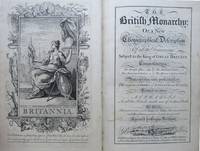
17483799Frontispiece of Britannia enthroned engraved Title list of Subscribers Contents Title of 1743 and 190 engraved plates many illustrated with head & tail pieces: Folding map of the King's Dominions in Europe Africa and America follows plate 7; A folding Table of Several Particulars. as plate 163. Tastefully rebound in eighteenth century style full lozenge blind ruled calf; five raised bands; ruled green morocco label. A handsome supple copy.; All shipments through USPS insured Priority Mail. George Bickham hardcover
19672091202133103941Nihonhyoronsha 1967. Soft Cover. Fine. Number of books: 29 Nihonhyoronsha paperback
19742083002115804196Institute of Modern Chinese History Academia Sinica 1974. Soft Cover. Fine. Number of books: 21 Institute of Modern Chinese History, Academia Sinica paperback
19892110502151001315Agricultural policy review meeting 1989. Soft Cover. Fine. Number of books: 14 Agricultural policy review meeting paperback
2110502150901931Not Available N.A. Soft Cover. Fine. Volume: 1 Not Available paperback
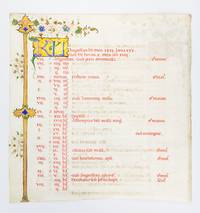
1441ST19882Italy Ferrara 1441-48. 205 x 200 mm. 8 x 7 7/8". 35 lines in a very fine rounded gothic hand. <br/> Text in dark brown and red capitals touched with yellow two four-line "KL" initials in blue pink and green on burnished gold ground with leafy marginal extensions the initials on the recto crowned with an exuberant spray of green blue and gold acanthus hairline tendrils pink flowers and gilt bezants and leaves the verso initials with a long bar border on outer margin painted pink on gilt ground with pink green and blue motifs at middle and top the border traced with black the top of the border accompanied by a spray of hairline tendrils colorful flowers gold bezants and leaves. ◆Lower margin of the verso trimmed away with loss of the end of bar border though not the text some of the other margins trimmed close crowding but not affecting the decoration some fading to brown ink less faded on recto legible on both sides in any case negligible dampstain in upper margin short closed tear just entering gold bar at top left of verso; not without imperfections but still an exquisite and very desirable leaf with richly colored and gilt embellishment.<br/> <br/> This item presents a very special perhaps singular opportunity to own the only known calendar leaf from the renowned Llangattock Breviary to emerge since the manuscript was taken apart in the 20th century. Executed with great skill and delicacy in sensitive Italianate colors highlighted by spring green and pink our leaf is unsurprisingly from a manuscript intended for a powerful aristocrat. It comes from the celebrated Breviary illuminated for the chapel of the Marquises of Este rulers of Ferrara and Mantua a manuscript commissioned by Leonello d'Este duke of Ferrara from 1441-50. According to the d'Este family records this manuscript seems to be the Breviary done for Leonello by Giorgio d'Alemagna Bartolomeo de Beninc Guglielmo Giraldi and Matteo de' Pasti see Toniolo "La Miniatura a Ferrara dal Tempo di Cosm Tura all'eredit di Ercole de' Roberti" 1998 pp. 19-20 and 76-77. Leaves from this manuscript show subtle variations in the style of the illuminations a result of work performed individually by a team of artists doing variations on a theme. At one time in a Spanish library the manuscript was brought to Britain during the Peninsular War and came to be owned by the Rolls family later Lords Llangattock of Monmouth in Wales from whom it takes its name. By the time the work reached Britain most of the miniatures had already been cut out. The Breviary sold at Christie's on 8 December 1958 lot #190 after which it was acquired and subsequently dismembered by Goodspeed's of Boston. The attribution of this leaf to the Llangattock Breviary is based its script ruling and style of decoration as well as physical attributes such as width of the leaf and the appearance of the vellum which all correlate to other known leaves from this manuscript. Furthermore according to the 1958 auction description of the complete manuscript the entire calendar section had its lower margins trimmed away as here. The present leaf appeared in a 1979 catalogue of bookseller Kenneth Rendell and it remains the only known calendar leaf from this manuscript that has ever been advertised. unknown
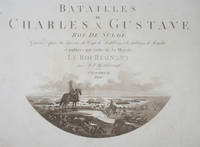
180645461Stockholm 1806. Large folio oblong. 44 x 61 cm. Contemp. hcalf covers with marbled paper. Titlelabel in red and gilt pasted on frontcover. Wear to foot of spine otherwise fine. Engraved titlepage battle view engraved plate depicting the Carl Gustav on horseback in front of a battle scene and 11 engraved plates showing battlescenes after Dahlberg's drawings. All engravings in beautiful toned sepia aquatint. A few marginal brownspots. A very fine copy. <br/><br/><em>Very scarce first printing of this series of plates aiming at glorifying the Swedish victories showing battlescenes - Warsaw Carnova Columbi Guesne and the crossing of the Belt in Denmark - from the wars against Poland and Denmark 1655-58 in fine engravings by Skjöldebrand. </em> unknown
17952111902160201111Suharaya Mohei 1795. Soft Cover. Fine. Number of pages: 74 pages 84 pages Size: 2.5 cm x 13.6 cm Number of books: 5 volumes 2 volumes Suharaya Mohei paperback
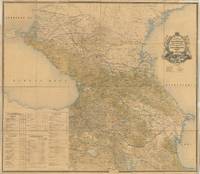
65574Tbilisi: Compiled and Lithographed at the Military Topographical Department of the Caucasus Military District 1870 with corrections to August 1896. Original large-format colour-lithographed map of the Caucasus 132 x 151 cm dissected into 24 panels and backed onto linen text in Cyrillic script folding down to 33.5 x 27 cm. With an extensive key decorative title cartouche and table showing the divisions of the Caucasus. The linen backing is in places dust-soiled and stained some tiny holes in the edges from former wall mounting that have been repaired somewhat browned overall and with a few minor brown spots a few small marginal tears not affecting map repaired with contemporary strips of paper linen edges are slightly frayed in places withal a very good example of this scarce and impressive map. A rare and large-format wall map of the Caucasus region in Russian. The map covers the modern territories of Armenia Georgia Azerbaijan Dagestan Chechnya Kalmykia etc. The map extends south to Tehran and north to Astrakhan. The eastern Black Sea is on the left and the western Caspian Sea is on the right. Beneath the title is a depiction of a railway winding through the mountains and opposite it a galloping horse with a cart crossing the mountains. Later editions were published at least until 1883 and 1903. The later edition is mentioned in 20th-century works dealing with international border disputes in the Caucasus. At the time of its creation it was almost certainly the finest map of the Caucasus produced in the Russian Empire. Tbilisi: Compiled and Lithographed at the Military Topographical Department of the Caucasus Military District, 1870 (with correc unknown
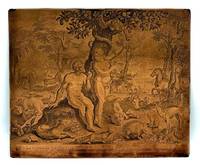
16001745Original printing plate: Johannes Galle. c.1600-1650. Engraved copper printing plate depicting Adam and Eve in the Garden of Eden surrounded by all manner of creatures with Adam sitting at the foot of the tree of knowledge about to take a bite from an apple whilst Eve takes another from the hand of a serpentine creature coiling around the branches above. 22.7 x 19.1cm. The plate incorporating text to the foot from Genesis 3. Signed at the foot "M. de Vos invenit / Corn. Galle Sculp. / Io. Galle excudit". The plate with some old fine scratches is otherwise in very good order. WITH: A later mid nineteeth-century and somewhat weak impression of the plate on paper. This laid down to board with manuscript French labels dated 1851 to the reverse apparently gifting the item from Mademoiselle C. Thyes of Brussels to "Monsieur Delpy"; the print with two pin holes to the blank lower margin and a few spots of faint foxing. A beautifully-executed original engraved copper printing plate by the Flemish engraver Cornelis Galle the Elder 1576-1650 forming a typically busy depiction of the Garden of Eden with Adam and Eve sealing their fate amidst a varied menagerie of peaceable beasts including an elephant camel bear porcupine ostrich and rearing unicorn amongst others.</p><p>Cornelis Galle was first taught engraving by his father the engraver and publisher Philip Galle 1537-1612. He subsequently resided in Rome for several years where he acquired an accuracy of design and freedom of style which marked him out as a master of his art form. Following his return to Antwerp he continued to engrave numerous plates after the works of his countrymen as well as his own designs becoming a master of the Antwerp Guild of St Luke in 1610.</p><p>The present engraving was made after an original painting by the prominent Flemish artist Maerten de Vos 1532-1603. A prolific draughtsman de Vos produced numerous designs for the engravers of Antwerp the resulting prints of which circulated widely in Europe and the Spanish colonies significantly contributing to his international reputation and influence.</p><p>Hollstein XLIV.61.243. [Original printing plate]: Johannes Galle. unknown
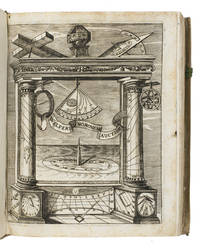
16723992Nuremberg 1672. 4to. Paulus Fürstens printed by Christoph Gerhard Contemporary parchment sewn on 3 supports with a hollow back each board with a frame of blind double fillets green cloth ties. With a finely engraved frontispiece an architectural gate with a wide variety of sundials and other astronomical instruments 2 title-pages each in a decorative frame built up from typographic ornaments 16 engraved plates 1 folding in the first part that for p. 48 repeated - at the end of vol. 2 - in accordance with the instructions to the binder and numerous mathematical illustrations and figures on 13 folding engraved plates lettered A-N in the second part. Further with letterpress tables on the integral leaves woodcut tailpieces and decorative gothic initials and headpieces built up from typographic ornaments. Set in fraktur types with incidental roman and Schwabacher. 2 volumes bound as 1. 12 88; 74 2 pp. Rare second edition 1st issue in 2 volumes extensively revised and enlarged of a mathematical study of the construction of sundials by Eberhard Welper the elder 1590-1664 first published in 1625 and here with useful additional observations and enlarged with a second part by Johann Christoph Sturm. Welper was born in Lohr near Marburg but studied in Strasbourg where he worked as a bookseller printer mathematician astrologer and astronomer. The first edition of the present work was one of his earliest publications. Sturm greatly expanded Welpers Gnomonica for the 1672 edition which was originally complete in the present two volumes. In 1681 Sturm added a third volume so the present two volumes were reissued with the third. Doppelmayer added a fourth volume in 1708.Occasionally browned but still in good condition. A rare 17th-centry work on sundials.l BMC STC 17th cen. W815 vols. 1-2; VD17 39:119761M & 39:119760D vols. 1-2 6 copies; Zimmer Astronomische Instrumente pp. 546 & 583; cf. Zimmer Astronomischen Literatur 5023 1625 ed.; not in Honeyman; Poggendorff; Wheeler gift. hardcover
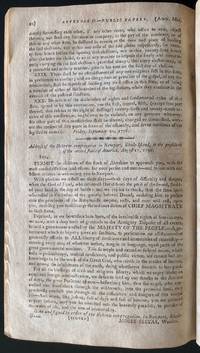
179143202Philadelphia: Mathew Carey; Carey Stewart and Co. No. 188 Market-street 1791. Original Sewn Binding without outer wrappers or boards 8vo pages 285-344 1-48 1-40 1-48 total 196 pages with different sections correctly paginated for this issue.<br> With Moses Seixas’ famous letter to President George Washington<br> Seixas wrote to President Washington on behalf of the Newport congregation whose home is the Touro Synagogue the oldest synagogue still standing in America. This letter which appears on p 40 of Appendix II and Washington's reply comprise one of the most famous statements on religious freedom of this period. <br> Here published in America’s first literary magazine George Washington’s famous phrase describing a government that "gives to bigotry no sanction and to persecution no assistance" was originally coined by Seixas in this very letter. It is a moving Biblically toned greeting to the president and was repeated by Washington in his reply assuring it a place among the most cherished in the American historical vocabulary.<br> George Washington's visit to Newport Rhode Island August 17-18 1790 ranks among the seminal episodes in the history of American Jewish religious liberty. Washington left Rhode Island off his travel itinerary the previous year in response to the state's failure to ratify the Constitution. By 1790 after becoming the last state to ratify Washington visited Newport along with members of his administration including Thomas Jefferson. <br> Moses Seixas 1744-1809 a Newport merchant warden of Kaal Kadosh Yeshuat Israel Newport Hebrew Congregation and a prominent Mason was one of the civic leaders who met with Washington. Seixas had a long history as a revolutionary patriot: he remained in the city after it was occupied by the British during the war and signed a document during the occupation pledging loyalty to the patriotic cause. <br> Additionally his brother Rabbi Gershon Mendes Seixas minister of New York's Shearith Israel Congregation known as the "patriot rabbi" was one of fourteen clerygymen officiating at Washington's 1789 Presidential inauguration. <br> Finally as a fellow Mason he and Washington would have had a natural connection. Seixas' eloquent message reads in part: <br> "Deprived as we heretofore have been of the invaluable rights of free Citizens we now with a deep sense of gratitude to the Almighty Disposer of all events behold a Government erected by the MAJESTY OF THE PEOPLE – a Government which to bigotry gives no sanction to persecution no assistance – but generously affording to ALL Liberty of conscience and immunities of Citizenship: – deeming every one of whatever Nation tongue or language equal parts of the great governmental Machine: – This so ample and extensive Federal Union whose basis is Philanthropy Mutual confidence and Public Virtue we cannot but acknowledge to be the work of the Great God who ruleth in the Armies of Heaven and among the Inhabitants of the Earth doing whatever seemeth him good." <br> Grounding religious freedom in natural rights and echoing Seixas' words Washington later replied with an echo of Seixas' language regarding religious freedom: <br> "The Citizens of the United States of America have a right to applaud themselves for having given to mankind examples of an enlarged and liberal policy: a policy worthy of imitation. All possess alike liberty of conscience and immunities of citizenship. It is now no more that toleration is spoken of as if it was by the indulgence of one class of people that another enjoyed the exercise of their inherent natural rights. For happily the Government of the United States which gives to bigotry no sanction to persecution no assistance requires only that they who live under its protection should demean themselves as good citizens in giving it on all occasions their effectual support."<br> See JE Vol. IX pp. 294-295; EJ. Vol. XIV p. 1117; J.L. Blau and S.W. Baron The Jews of the United States 1790-1840 A Documentary History Vol. 1 1963 pp. 8-10.<br> Other pieces of interest include notes on the slave trade by Benjamin Franklin and notes on the Revolutionary War. <br> “The American Museum or Repository of Ancient and Modern Fugutive Pieces &c. Prose and Poetical “title changed to “The American Museum or Universal Magazine†in January 1790 was America's first literary magazine featuring early printings of the US Constitution the Bill of Rights various State constitutions Alexander Hamilton's Report on Manufactures and parts of the Federalist Papers. <br> Complete issue in original sewn binding. Overall condition is very good with scattered darkening and foxing though paper and binding remain nice and strong with clean crisp edges including the notable page containing the address to Washington<br> A Cornerstone of American Judaica. BAMR-69-7A. Philadelphia: Mathew Carey; Carey, Stewart, and Co. No. 188 Market-street unknown
1928347h5608London: Arrowsmith. Good. 1928. First Edition. Hardcover. "Whatever place its author may ultimately occupy in future histories of England one thing is certain that in the history of the Jewish people the name of Balfour will enjoy unchallenged immortality evoking comparison with that of Cyrus for the issue of the Balfour Declaration marked the opening of a new epoch in the annals of Jewry which will be recognised as such even in the remotest centuries to come. In this little book have been gathered together all the utterances of Lord Balfour on the interpretation and implications of his Declaration on its political aspects and its practical realisation made during the last ten years." - Preface. 4 5-128 pp. 7" x 4.75". Original spine label present and intact. Front free endpaper professionaly replaced. Tanning to central portion of half-title. Prior owner's ink stamp upon title page. Duplicate spine label bound at p.128. Average external wear. Binding intact with moderate forward lean. Quarter inch notch from top of backstrip. Includes replica dust jacket preserved in glossy new archival-grade Brodart. A sound example of this jewel of Zionist history. Emanuel p.48. ASIN B000852UV4; 12mo - over 6¾" - 7¾" tall; Zionism - History Balfour Declaration Lord Balfour Arthur James Balfour Israel - History Lord Rothschild Palestine Mandate The Hebrew University . Arrowsmith hardcover
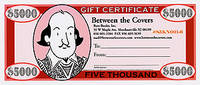
54789Unbound. A gift certificate redeemable for up to five thousand U.S. dollars $5000 worth of merchandise from Between the Covers Rare Books Inc. Individually numbered and bearing a portrait of the Bard by artist Tom Bloom. unknown
17681206031768. First Edition. CATHERINE THE GREAT. The Grand Instructions to the Commissioners Appointed to Frame a New Code of Laws for the Russian Empire: Composed by Her Imperial Majesty Catherine II. Empress of All the Russias. To which is prefixed A Description of the Manner of opening the Commission with the Order and Rules for Electing the Commissioners. London: T. Jefferys 1768. Quarto contemporary marbled boards rebacked in period-style calf-gilt red morocco spine label raised bands; pp. i-v vi-xxiii 1 3-258. $5000.First edition in English of the celebrated Nakaz of Catherine the Great drawing extensively on Montesquieu's Spirit of the Laws heralded by Voltaire and Diderot initially issued in Russia in 1767 ""the single piece of Russian legislative material best known abroad""aligned with the later American constitution for its ""shared characteristics and techniques"" highly elusive in contemporary boards.""Born into a family of obscure German aristocrats delivered to St. Petersburg at the age of 14 and married in great pomp to the feckless heir to the Russian throne Catherine found herself"" in a loveless marriage and without political support Smithsonian. In 1765 after Peter's death and several years into her reign Catherine began crafting the Nakaz working on its almost daily for nearly two years. ""Fundamentally the Nakaz which Voltaire is said to have called the finest monument of the century is a legal and a political document. It represents Catherine's ambition early in her reign to remodel Russia's laws in accordance with new principles expounded in Western Europe. The Nakaz consists of three parts containing 655 articles in all. The major part 526 articles was made public in Moscow on July 30 1767. It treats the historical development of Russia and monarchial absolutism; the nature and forms of laws; crime and punishment; social structure and religious freedom. On February 28 and April 8 1768 two supplements of 40 and 89 articles respectively dealing with police expenditures revenues and taxation were added to the Nakaz"" Dmytryshyn Economic Content 1-2. ""While she worked alongside a secretary it was Catherine herself who selected and organized the material and wrote out the finished version."" In creating the Nakaz she chose her texts carefully. Nearly 300 ""owe something to Montesquieu's Spirit of the Laws 1748"" with about 100 clauses traced to Beccaria's On Crimes and Punishments 1764 and many from Voltaire's Encyclopédie."" While the Nakaz is ""not a written constitution it nonetheless shared characteristics and techniques with later texts that were constitutions"" Colley Gun Ship and Pen 61-73 emphasis in original.Catherine was ""not out to create a constitutional monarchy"" yet her Nakaz ""was innovative and influential the Legislative Commission that met in Moscow in August 1767 to discuss the Nakaz differed from later seminal constitution-making assemblies but it also anticipated and even exceeded them. Like the convention that met in Philadelphia in 1787"" this Russian Commission assembled delegates from across the empire. Further these ""Moscow deputies were also markedly more diverse in terms of social economic religious and ethnic background than the men of Philadelphia women too received some recognition in this Moscow commission something that did not happen in revolutionary America Moreover in sharp contrast with the men of Philadelphia in 1787 not all of the Moscow deputies were white and not all of them where Christian"" Colley 73-77. ""It was doubtless because of its 'radical' content that its publication was banned in France The significance of the Nakaz centers not only in its West European content"" but also on distinctive aspects of Russian culture that ""make the Nakaz an outstanding document in Russian political economic and historical literature"" Dmytryshyn 9. The Nakaz was never enacted yet it is ""the single piece of Russian legislative material best known abroad. It secured for Catherine the encomium 'the Great'"" Yale Law School. First edition in English. Catherine's manuscript was written in French from which she produced a Russian translation First editions were published in Moscow on August 10 1767 in Russian and German: a first German edition appeared in 1769. Little is known of translator Mikhail Tatischeff other than that he was attached to the Russian Embassy in London. Engraved ornamental initials and headpieces. Mispaginated as issued without loss of text. ESTC N6651. With trace of bookplate removal; later blank free endpapers. Bookseller ticket.Text fresh and fine light edge-wear rubbing to contemporary marbled boards. A handsome wide-margined near-fine copy. hardcover
20831EBeverly Hills CA: National Pictures Corp n.d. Original 109 page shooting script with color rewrite pages for the classic 1953 science fiction film Invaders from Mars written by Richard Blake directed by William Cameron Menzies starring Helena Carter Arthur Franz Jimmy Hunt and Leif Erickson. Bradbound in printed studio covers. Very good lightly used copy with some minor spotting to the front cover and minor edge wear. Enclosed in a handsome custom red morocco and cloth clamshell box. Due in large part to Menzies’ innovative techniques Invaders from Mars was the first feature science fiction film to show aliens and their spacecraft in color and was rushed into production to premiere before the much-anticipated George Pal film of H.G. Wells’ novel War of the Worlds. William Cameron Menzies 1896 - 1957 worked to great acclaim primarily as a production and set designer notably for The Thief of Bagdad 1924 The Adventures of Tom Sawyer 1938 David O. Selznik’s Gone With the Wind 1939 and Alfred Hitchcock’s Spellbound 1945. Mr. Menzies won two Oscars at the very first Academy Awards in 1929 for Best Art Direction for The Dove and Tempest and in 1940 at the 12th Academy Awards won an Academy Honorary Award for “outstanding achievement in the use of color for the enhancement of dramatic mood†for Gone With the Wind. Some of his other films include The Iron Mask 1929 Our Town 1940 The Pride of the Yankees 1942 For Whom the Bell Tolls 1943 and Duel in the Sun 1946. National Pictures Corp hardcover
1890101R86Sienna. Ca: . 1890 Two decorated wooden panels painted in polychrome tempera gold gilt and gesso with a leather spine. 330 x 250 mm. Elaborately decorated on one board with four armorial shields surrounded by incised stamps on gilt fields and gilt floral sprays on a blue field. The text below the shields reads: "INVENTARIO DELLE COSE DEL LA SAGRESTIA DEL DUOMO EDE LALTRE COSE MOBILI DELU OPARA RIFATTO LASICO DA VOLTA AL TENPO DEL UENE RABILE UOMO FRANCESCHO DI PAOLO TADDEI ANNO D. 1475." Roughly translated: Inventory of the things in the sacristy of the Duomo Ede. Taken from the last by the incomparable Frances Taddei in the year 1475. The front board has a lovely Rennaisance Madonna and Child with "Samis de Petris" below. This de may have been an attempt to attribute the painting to the artist Sano di Pietro. Beveled edges. Brass bosses at each corner. Very good. RARE. A contemporary of the famed "Spanish Forger" Icilio Federico Joni 1866-1946 was born in Siena. As a young man he worked in the shop of a gilder and art restorer. He began as a sideline to produce imitations of fifteenth century Sienese painted wooden panel book covers. He based these tempera painted wooden panels on the Tavolette in the Archivio di Stato which he probably never saw in person. It is quite clear from his autobiography 1932 that he was proud of his skill and his brilliant imitations of the ancient art of Siena. He considered them original art rather than 'forgeries'. There are probably no more than twenty examples of his work extant today. From the Bridwell Library SMU: "A skilled producer of imitation "Gothic" altarpieces he received a commission c. 1890 to create a book cover in imitation of those found on Siena's Tavole di Biccherna the elaborately gilt and painted fourteenth-century tax registers. Without ever seeing a real Biccherna he established a lucrative business of faking Biccherna covers. Joni later boasted of incidents in which the local police were alerted to books purportedly stolen from Siena Cathedral or the state archives only to discover that they were by Joni. A number of book collectors were deceived by Joni's creations and several of his works were published as Gothic originals. Today Joni's forgeries are highly valued in their own right. In his autobiography Joni discussed his methods for antiquing the covers by mixing soot turmeric chrome yellow and gilding gesso with gum arabic to produce the patina on the gold. The bosses were bathed in ammonia and the clasp plates were dipped in iodine "which rusted them in just the right way." Note that Joni's boards are simply glued onto a rough leather spine; he apparently did not know how to replicate a fifteenth-century sewing structure." Research in America has clarified Joni's role as a restorer in such works as Piermatteo d'Amelia's Annunciation Gardner Museum and the half-length figures in Fra Angelico's Annunciation Mrs E. Ford Collection. There are probably only about 50 of these known. RARE. SAFE. Hardcover. Very Good. [Sienna. Ca: ]. hardcover
1451Francfurt: Apud Haeredes Christiani Egenolphi 1563. Hardcover. Good. Quarto. viff. 42 43 iii 57 v pages. With separate title-pages to parts II and III. Poorly bound margins trimmed. In some instances catchwords and signature marks have been cut off not affecting text. Sheep somewhat worn. Kleinheyer/Schröder Deutsche Juristen aus 5. Jhdtn. 1983 147-149. Bound with: Kling M. Matrimonialium . Melchior Kling 1504-1571 from Hanau was an important 16th century German jurist and proponent of the systematic school of jurisprudence. <br/> <br/> Francfurt: Apud Haeredes Christiani Egenolphi, 1563. hardcover