122 150 résultats
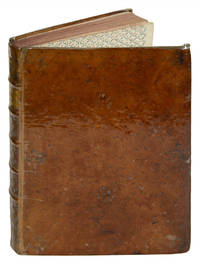
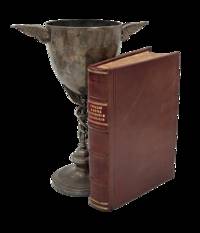
1450Francfurt: Apud Haeredes Christiani Egenolphi 1559. Hardcover. Good. Quarto. iv 44ff. Sheep somewhat worn. Kleinheyer/Schröder Deutsche Juristen aus 5. Jhdtn. 1983 147-149. Bound with: Kling M. In Feudorum usus Consuetudines . Melchior Kling 1504-1571 from Hanau was an important 16th century German jurist and proponent of the systematic school of jurisprudence. <br/> <br/> Francfurt: Apud Haeredes Christiani Egenolphi, 1559. hardcover
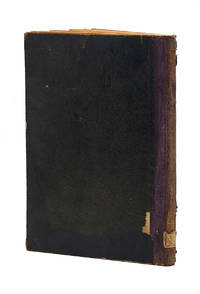
1896056105Mecca: Hicâz Vilâyet Matbaasi Mecca AH 1314 CE 1896/97. 1896. 1st Edition . Hardcover. Very Good. 8vo - over 7¾ - 9¾" tall. Contemporary quarter purple cloth. 4to. 28 x 20 cm. In Ottoman Turkish and Arabic with sporadic Persian verses. 1 blank page 3 222 p. A label on spine slight wear to spine single leaf of index is loosely inserted. Else a very good and collectible copy "Al-Matba'a al-Miriyya" seal on colophon as a common practice of preventing counterfeits in the period. An exceptionally rare first Mecca edition of a single-volume work containing two celebrated texts representing the final nineteenth-century Turkish commentaries on the Qasîda-i Burda. Authored by Necib Bey of Antioch an Ottoman official who served in the Hijaz the volume was printed at the first press established in the region by Osman Nuri Pasha. The Qasîda-i Burda is a thirteenth-century ode of praise to Muhammad composed by the Egyptian Shadhili mystic al-Bûsîrî. The first two pages of the work are devoted to complimentary letters written for the book by the then Governor of the Hijaz Ahmed Ratib Pasha 1846-1913 and by the Arab scholars Abd al-Jalil Burade and Arif Khan Tashkendi. One of the letters is in Arabic the other in Ottoman Turkish. The final Turkish commentary on the Qasîda-i Burda produced in the nineteenth century belongs to Necib Bey of Antioch d. after 1319/1902 who served as an official in the Hijaz region. Necib Bey held administrative posts at both institutions known as al-Tekiyyât al-Miriyya The Egyptian Tekke charitable imarets established by Mehmed Ali Pasha of Kavala the Khedive of Egypt d. 1265/1849 one in Mecca and the other in Medina. As he himself states in his commentary Necib Bey received his education in Western Anatolia and travelled extensively across a wide geographical area including regions beyond Ottoman territory such as Europe and Russia marking him as a Turkish traveller and scholar of broad experience. In addition to these qualities he was also active as an educator and is known to have tutored members of the elite including Khedive Abbas Hilmi II of Egypt d. 1944 and his brother Mehmed Ali Pasha. Two works by Necib Bey are known both of which are Turkish commentaries on the Qasida-i Burda poems of Ka'b b. Zuhayr and al-Bûsîrî. The first bears the title Is'âd: Shar-i Bânet Su'âd and the second Mukhtaar Tawassul: Shar-i Qasîda-i Burda. These two works were published together in a single bound volume in 1896/97 at the Hijaz Provincial Printing House. The title Mukhtaar Tawassul derives from the fact that this work is an abridgement of the commentary entitled Tawassul by Mekkî Mehmed Efendi d. 1212/1797. The commentary entitled Is'âd takes its name from the Arabic commentary Is'âd 'alâ Bânet Su'âd written by the Egyptian scholar Ibrâhîm b. Muammad al-Bâjûrî d. 1277/1860. The commentator explains this choice of title with the statement: "This commentary being in the nature of a translation of Bâjûrî's commentary has therefore been named Is'âd after its original title." However the diversity of sources evident in the work the inclusion of autobiographical details Sufi narratives poetic examples in three languages and several critical remarks directed at the primary source clearly demonstrate that the text stands much closer to an original composition ta'lîf than to a mere translation tarjama. Gürler. ON THE FIRST PRINTING HOUSE IN THE HIJAZ: The distinctive cultural character of Meccan society as a centre for learning intellectual exchange and scholarly debate was a decisive factor in the introduction of printing to Mecca. This development was welcomed by both scholars and the local population and materialized in 1882 under the auspices of the Ottoman governor of the Hijaz Osman Nuri Pasha. Although the Ottoman government had established the first printing press in the Arabian Peninsula earlier in Sana'a in 1877 1295 AH Mecca became acquainted with printing shortly thereafter in 1300 AH 1882-83 with the founding of an official government press. The Meccan pres <br/> <br/> Hicâz Vilâyet Matbaasi, Mecca, AH 1314 [CE 1896/97]. hardcover
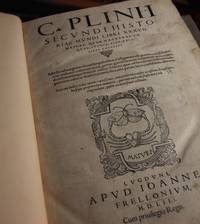
155328<p>C. Plinii Secundi Historiae mundi libri XXXVII majore quam hactenus unquam studio fide religione emedati adjectis ad marginem succinctis . . . una cum indice totius operis copiosissimo.<em> Lugduni Apvd Ioannem Frellonivm. M.D.L.III.</em></p><p>Pliny's <em>Natural History</em> is Shakespeare's source for the famous description in <em>Othello</em> of "men whose heads grow beneath their shoulders." See Kenneth Muir <em>Shakespeare's Sources </em>London 1957 p. 127.</p><p>Although there were translations of Pliny into French and English some scholars have argued that Shakespeare read Pliny in Latin. See T. W. Baldwin "A Note upon William Shakespeare's Use of Pliny" in <em>Essays in Dramatic Literature </em>London 1935 pp. 157-82.</p><p>Folio. 3 parts in one vols. A2-A4 B-C4 a-z5 A-Z5 AA-ZZ4 Con2 m4; l.; 34 679 236 p. Title-page vignette. Medium brown calf blindtooled border on both boards.</p><p>Provenance: Inverchapel bookplate.</p><p>The <em>National Union Catalog of Pre-1956 Imprints</em> lists only two known copies not including the present one.</p><p>References: NUC: 461 671-90 NP 0424260. Not in USTC.</p> John Frellonium
186975295Washington D.C.:: The American Bond and Currency Detectory Company 1869. First edition. publisher's pebbled green gilt-lettered cloth. Small stray pen mark on the title page; neat tissue reinforcements to the inner hinges front and rear and evidence of a removal on the rear pastedown. The cloth is rubbed at the corners and extremities of the spine; tight and sound. A beautiful copy. Oblong small folio. Complete with twenty-two engraved plates many with multiple figures of registered bonds; and nine embossed chromolithograph plates of coins and coinage printed in gold silver and copper on dark maroon paper by J. Haehnlen Philadelphia. Issued under the Sanction of the United States Treasury Department and Containing Superb Illustrations in Genuine Tints Printed at the Treasury Department from the Original Dies in the Possession of the Government. The American Bond and Currency Detectory Company, hardcover
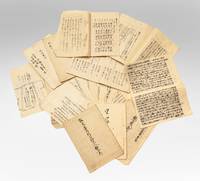
7712Several dozen manuscripts in various formats incl. long folded sheets stitched pamphlets sewn volumes and letters. Japan: ca. 1853-63.<br/> <br/> A substantial group of documents revealing internal high-level debates and discussions in response to Commodore Perry’s landings and later controversies that arose as Western powers established a foothold in Japan. This is an exceptional collection filled with top-secret information on government intrigues as the Japanese state responded to aggressive foreign expansion and dissenting groups within the government urging top-to-bottom reforms.<br/> <br/> The manuscripts touch upon pivotal events in Japan’s history:<br/> <br/> –Commodore Perry’s two expeditions July 1853 & February-March 1854 and the resulting ratification of the Treaty of Shimoda.<br/> <br/> –Japanese translations of the treaties signed with the United States Russia France and the United Kingdom from 1854 to 1858.<br/> <br/> –The assassination of Ii Naosuke in March 1860 also known as the Sakuradamon Incident which precipitated a violent backlash against foreigners under the banner of Sonno joi “Honor the Emperor expel the barbariansâ€.<br/> <br/> –General dissatisfaction with the bakufu and efforts to reform it.<br/> <br/> –The attempted assassination of Ando Nobumasa a chief councillor during this period.<br/> <br/> –The Namamugi Incident in September 1862 when the British merchant Charles L. Richardson was killed by Satsuma domain warriors.<br/> <br/> –The bombardment of Kagoshima August 1863.<br/> <br/> Among all these materials we must highlight several examples of manuscript kengen proposals and commentaries written by aristocrats with policy advice on the difficult situations faced by the Japanese state. These offer compelling perspectives on the most pressing dilemmas of the day. While they were not composed by the decision-makers these documents are filled with the minutiae and data employed in the policy-making process.<br/> <br/> All of the items are in a fine state of preservation.<br/> <br/> â§ John McMaster “Alcock and Harris. Foreign Diplomacy in Bakumatsu Japan†Monumenta Nipponica Vol. 22 No. 3/4 1967 pp. 305-367. unknown
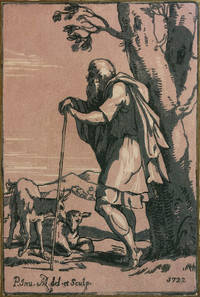
5521722. Chiaroscuro woodcut on cream laid paper laid down to a cream laid paper matrix as issued printed from three blocks in dusky pink olive green and grayish blue with a gold border and pink watercolor frame. Printed area measures 6 11/16 x 4 5/8 inches 170 × 117 mm watercolor frame measures 8 1/2 x 6 3/8 inches 215 x 160 mm and the matrix measures 15 1/2 x 11 inches 393 x 278 mm full margins. Inscribed "P. Inv. AMZ del et Sculp" in the block lower left and dated "1722" in the block lower right. An excellent example with rich color in very good condition and with no visible defects. <br /> <br /> Bartsch 22. Count Antonio Maria Zanetti the Elder visited London from his native Venice in 1721. During the course of that trip Zanetti purchased 130 drawings by Parmigianino from the collection of Thomas Howard the late Earl of Arundel and also had the opportunity to view some early chiaroscuro woodcuts which belonged to William Cavendish then the second Duke of Devonshire. Zanetti was completely taken by the painterly nature of the chiaroscuro prints and upon his return to Italy he set out to teach himself the technique of printing from multiple wooden blocks. Zanetti experimented widely with the appearance of color and the influence it had on his printed images and he explored the emotional and visual evocations which different pigment combinations generated. Zanetti reimagined Parmigianino's masterful Mannerist compositions using this method and the results were so well received that they initiated an 18th century revival of the romantic art form. This particular print is among those works after Parmigianino which launched this resurgence in chiaroscuro printmaking. unknown
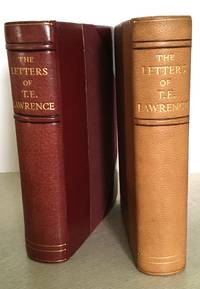
1938062639London: Jonathan Cape 1938. Book. Fine. Hardcover. Signed by Publisher. 1st Edition. 8vo - over 7¾" - 9¾" tall. Two sumptuously bound volumes of the David Garnett edition of the "Letters of T.E. Lawrence" specially bound for the partners in the Jonathan Cape company. Probably the only two so bound in fine near identical half leather bindings Jonathan Cape's copy in scarlet leather and Wren Howard's in brown leather. Cape's copy is signed by Jonathan Cape and Wren Howard has a note from his widow giving provenance to the copy laid in. Both volumes in fine condition. These two copies surely deserve to be kept together to mark the triumvirate that meant so much to this publishing House Jonathan Cape the eponymous partner Wren Howard and of course T.E. Lawrence to whom much of the early success of the company rested. Still the most important collection of T.E. Lawrence correspondence. O'Brien A202. Remains one of the best sources for information on T.E. and his life. 896pp each volume. Jonathan Cape Hardcover
2000G0711932093I4N00Music Sales Ltd 2000. Paperback. Very Good. May have limited writing in cover pages. Pages are unmarked. ~ ThriftBooks: Read More Spend Less.Dust jacket quality is not guaranteed. Music Sales Ltd paperback
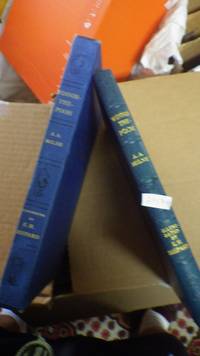
29574HB NODJ 1973 STATED 1ST PUBLISHED this EDITION THUS LIMITED EDITION #77/300 COPIES NEAR FINE SLIPCASE BLUE LEATHER CVR WITH CHRISTOPHER ROBIN & WINNIE THE POOH IN GOLD GILT Blue leather bound with gilt stamp to front cover and gilt lettering & RAISED BANDS along spine which shows light sunning otherwise in Near Fine condition. goldGilt page edges. In original BLUE Slipcase which is in Very Good condition shows light shelf wear and rubbing to edges .NO JACKET. Methuen Children’s Books ( LONDON PRINTED IN GREAT BRITAIN hardcover
17701845<p><strong>A rare example of Russian text of the Enlightenment --- "The best and most luxurious edition" of Catherine's famous 'Great Instructions' </strong>such described by Count M.A. Korf then director of the Imperial Library. First published and "signé de la propre main de Sa Majesté Impériale" in 1768; this edition however is the only in several languages and illustrated.</p><p>These instructions were "largely compiled and adapted by Catherine personally from the texts of Montesquieu and Beccaria. Although the project was never brought to fruition the impulse behind it stands as one of the nobler concepts of Catherine's reign" Fekula 2013 for a later edition.</p><p>A major document of the Enlightenment it condemned torture and capital punishment and endorsed such principles as the equality of all before the law.</p><p>The illustration consists of two detailed symbolic engravings each repeated once by Roth d. 1798 an engraver from Nuremberg who mostly worked in Russia.</p><p><strong>"The most magnificent and desirable of the more than 40 editions of the Nakaz"</strong> Widener <strong>"one of the most remarkable political treatises ever compiled and published by a reigning sovereign in modern times"</strong> I. de Madariaga Russia in the Age of Catherine the Great 1981 p. 151. Some great scholarly publications have taken place among these numerous editions especially published in St. Petersburg in 1893 using the French text from this edition and 1907 as well as the more recent The Nakaz of Catherine the Great: Collected Texts 2010 with a bibliography of the 43 editions edited by Butler and Tomsinov.</p><p><strong>Physical description:</strong> Quarto 26.3 x 20.5 cm. Title pages in Russian Latin German and French 403 pp. with 4 allegorical head- and tailpieces engraved by Christopher Melhior Roth after Jacob Shtelin. Contemporary full Russian calf spine with raised bands stamped in bling label lettered in Russian patterned endpapers red edges.</p><p><strong>Condition</strong>: Binding covered with clear adhesive film dampstain to back cover; very occasional light spotting otherwise a lovely attractive example.</p><p><strong>Bibliography</strong>: Drage 208; Fekula 2013; Sopikov 6456 'best edition'; SK 2151; Widener M. Yale Law School Lillian Goldman Law Library on their copy exhibited in 2012.</p> Imp. Akad. Nauk, Skt. Peterburg, hardcover
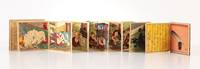
9815A total of 17 panels with color-printed woodcuts one double-page & one four panels wide. Oblong 12mo 70 x 84 mm. orig. wooden boards orig. purple silk title label but no title! on upper cover. Japan: late 19th century.<br /> <br> <br> <br /> <br /> A very rare kind of shunga this is an example of a mitate an “appropriation of a classical source…then used to portray the modern urban demi-monde.â€â€“C. Andrew Gerstle “Shunga and Parody†in Timothy Clark et al. eds. Shunga. Sex and Pleasure in Japanese Art British Museum: 2013 p. 335.<br /> <br> <br> In this shunga the appropriation is the tea ceremony. The text is full of sexual puns. For example skill in the tea ceremony really means skill in sexual matters. Tea ceremony tools are actually references to sexual acts and techniques. The finely color-printed frontispiece panel depicts a haboki the feather brush used to arrange the ashes and a natsume a tea caddy.<br /> <br> <br> The next set of images shows three well-dressed men in a tea ceremony room receiving a tea ceremony performance from an equally distinguished-looking woman. However when one opens the flaps a four-panel scene is revealed where we see the same three men having an orgy with the woman.<br /> <br> <br> Each of the remaining ten images has in the upper outer corner a small image of tea ceremony tools or rituals including kuchikiri the breaking of the seal on a jar of new tea koboshi a vessel to drain the liquid after warming the tea bowl chausu a utensil to grind the tea leaves into a powder chawan tea bowl fukusa silk cloth used for ritual purification mizusashi fresh water container kama kettle hishaku bamboo ladle chasen tea whisk and natsume tea caddy. These are followed by ten panels of text explaining the sexual meaning of each tea ceremony implement.<br /> <br> <br> The ten images show various sex acts all referring to the tea ceremony tools. For example the kuchikiri image shows a man deflowering a virgin. The text below is a conversation between the two: The woman says “Please wait. I can’t handle it.†The man replies “The time has come. Stay still here it is. How does it feel†For the kama which is also slang for homosexuality we see an old man a monk having anal sex with a young male lover.<br /> <br> <br> The color printing is at a very high level with the use of embossing and metallic pigments and twice impressed black ink that gives a rich sheen. The woodblocks are very fresh: there is excellent definition of the strands of hair of both men and women.<br /> <br> <br> We suspect that this rare object was produced for the pleasure of a tea ceremony enthusiast.<br /> <br> <br> In very fine and fresh condition. We do not find this cited in any of the usual reference works. unknown
19712090502126801504Macmillan 1971. Soft Cover. Fine. Number of books: 27 Macmillan paperback
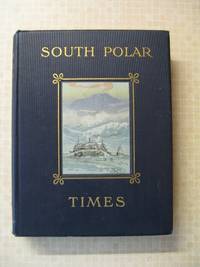
191440Smith Elder London 1914. First Edition. Hardcover Original Cloth. Very Good Condition/No Dust Jacket. 1st Edition; This copy is 243 of a limited edition of 350. Volume 1 & 2 were Scott's 1st "Discovery Expedition" whilst this Volume 3 is from his 2nd "Terra Nova" Expedition. Although often sold as a set Volume 3 is a complete book in its' own right. The original broadsheets were produced at Cape Evans to amuse the men on the 'Terra Nova' Expedition. It was designed to be published separately from Volume 1 & 2. Cherry-Garrard was the Editor and typist and Wilson the main illustrator. The 1st issue was presented on Midwinter's Day 1911 the 2nd on 8th September and the 3rd on 15th October. Content included poetry humorous articles illustrations of sledging flags and caricatures. Includes Wilson's moving poem 'The Barrier Silence' and Ponting's hilarious tongue twister 'The Sleeping Bag'. Original covers all page edges gilt. Copiously illustrated drawings in the text and full-page plates from sketches and paintings by E. Wilson H. Ponting and others. Ex Library with stamps on some pages Croydon Library. Spine shaken gutta-percha binding delicate some pages loose as is usual with the 1st Edition. Gutta Percha was used as the binding glue in many early books it is not a difficult job to remove and reback using modern glues The South Polar Times was a magazine written and printed by the members of Antarctic Expeditions during the various voyages they undertook. In 1907 the batches were printed and issued in some 250 copies. The South Polar Times form what is perhaps the most personal of the printed documents to have come out of that most remarkable of periods of Antarctic adventures revealing so many often contradictory aspects of these men's various personalities. It contains a diary of the events of each month a record of the proceedings of the local Debating Society a monthly acrostic humorous notes besides articles of a more solid nature as well as stories sketches of various kinds and poems. One of the corner stones of an Antarctic collection. PLEASE NOTE: This book will incur extra postage and insurance charges. Please contact us for a quote. Limited Edition. Quantity Available: 1. Shipped Weight: Under 5 kilogram. Category: Arctic & Antarctic; Antarctic; 1900-1920; Exploration. Pictures of this item not already displayed here available upon request. Inventory No: 40. . This book is extra heavy and may involve extra shipping charges to some countries. Smith Elder hardcover
Koch, Eva & Thomas BobergNot in perfect condition. unknown
19802091502135707611Gakushu Kenkyusha 1980. Soft Cover. Fine. The book is in fine condition. Gakushu Kenkyusha paperback
18542111902160200045Touto Bunnoyagura 1854. Soft Cover. Fine. Number of pages: 42 pages Size: 18.8cmx12.6cm 42p Number of books: 1 Touto Bunnoyagura paperback
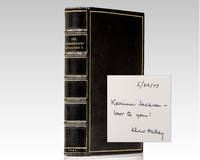
1965150961New York: Grove Press Inc. 1965. First edition of one of TIME Magazine's ten most important nonfiction books of the twentieth century. Octavo bound in full morocco by the Harcourt Bindery with 22 karat gilt titles and tooling to the spine in six compartments within raised gilt bands gilt ruling to the front and rear panel gilt inner dentelles stamp-signed by the Harcourt Bindery marbled endpapers all edges gilt in 22 karat gold. Presentation copy inscribed by Alex Haley on a page bound in. Founded over a century ago in 1900 the Harcourt Bindery is the oldest and largest traditional bindery in America exclusively devoted to fine traditional leather bookbinding by hand. In fine condition. Rare and desirable. In the searing pages of this classic autobiography originally published in 1964 Malcolm X the Muslim leader firebrand and anti-integrationist tells the extraordinary story of his life and the growth of the Black Muslim movement. His fascinating perspective on the lies and limitations of the American Dream and the inherent racism in a society that denies its nonwhite citizens the opportunity to dream gives extraordinary insight into the most urgent issues of our own time. The Autobiography of Malcolm X stands as the definitive statement of a movement and a man whose work was never completed but whose message is timeless. It is essential reading for anyone who wants to understand America. Grove Press, Inc. hardcover
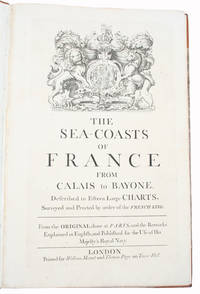
171534417London Printed for William Mount and Thomas Page on Tower Hall no date c. 1715. Folio. 53X35 cm. Cont. hcalf with marbled boards. Rebacked and recornered in old style with raised bands. Engraved typographical titlepage with a large engraved vignette showing the English King's Coat of Arms. With all 15 double-page engraved sea-charts numbered 1-15 in lower right corners. Neat repairs to inner margins of free endpapers and titlepage. Some browning to charts. Chart 5 45x755 cm having the right margin shaved reaching the printed frame. <br/><br/><em>Second edition of this scarce "Atlas Maritime". According to Shirley it was first published by Richard Mount and Thomas Page in 1701 and re-issued with undated title as this in ab. 1715 but with the charts unchanged and a new engraved titlepage. A third issue came out in 1737 with a dated title. The fine charts are copied from Pieter Mortier's famous "Neptune Francois" 1693-1702 and reduzed in size."The charts in this early Mount & Page atlas "The Sea-Coasts of France" are re-engravings reduzed in size from the charts in the French Neptune of 1693. The charts may also be found in the 1702 edition of Mount and Page's Atlas Maritimus Novus." Rodney Shirley. - Not in Phillips. - Shirley Vol. II: M.M&P - 12 b. </em> hardcover
192349718Paris Gauthier-Villars et Cie 1923. 4to. Bound in one contemp. full buckram. Spines gilt and with gilt lettering. In: "Comptes Rendus Hebdomadaires des Séances de L'Academie des Sciences" Tome 177. Bound with orig. printed front-wrapper to No. 1 half-title and title-page to vol. 177. 1513 pp. Entire volume offered. De Broglie's papers: pp. 507-510 pp. 548-551 a. pp. 630-32. Clean and fine. A punched stamp on foot of title-page. <br/><br/><em>First edition of these papers which ESTABLISHED A NEW ERA IN PHYSICS by introducing the epochal new principle that particle-wave duality should apply not only to radiation but also to matter and thus CREATING QUANTUM MECHANICS. These 3 papers were extended to form his doctoral thesis of 1924 "Recherches sur la Théorie des Quanta."De Broglie relates "After long reflection in solitude and meditation I suddenly had the idea during the year 1923 that the discovery made by Einstein in 1905 should be generalized by extending it to all material particles and notably to electrons" Preface to his PhD thesis 1924."He made the leap in his September 10 1923 paper: E=hv should hold not only for photons but also for electrons to which he assigns a 'fictitious associated wave'. In his September 24 paper he indicated the direction in which one 'should seek experimental confirmations of our ideas': a stream of electrons traversing an aperture whose dimensions are small compared with the wavelenght of the electron waves 'should show diffraction phenomena' ."Pais "Subtle is the Lord" pp. 425-436.In the third paper October 8 he discusses "The interplay between the propagation of the particle and of the waves could be expressed in more formal terms as an identity between the fundamental variational principles of Pierre de Fermat rays and Pierre Louis Maupertuis particles as de Broglie discussed it further in his last communication . Therein he also considered some thermodynamic consequences of his generalized wave-particle duality. He showed in particular how one could using Lord Rayleigh’s 1900 formula for the number of stationary modes for phase waves obtain Planck’s division of the mechanical phase space into quantum cells.Louis de Broglie achieved a worldwide reputation for his discovery of the wave theory of matter for which he received the Nobel Prize for physics in 1929. His work was extended into a full-fledged wave mechanics by Erwin Schrödinger and thus contributed to the creation of quantum mechanics. After an early attempt to propose a deterministic interpretation of his theory de Broglie joined the Copenhagen school’s mainstream noncausal interpretation of the quantum theory."DSB."This idea i.e. de Broglie's that matter might behave as waves was tested and confirmed by Davisson and Germer in 1927. Thus the duality of both light and matter had been established and physicists had to come to terms with fundamental particles which defied simple theories and demanded two sets of 'complementary' descriptions each applicable under certain circumstances but incompatible with one another." Printing and the Mind of Man 417. </em> hardcover
192346949Paris Gauthier-Villars et Cie 1923. 4to. Bound in 2 contemp. full cloth. Spines gilt and with gilt lettering. In: "Comptes Rendus Hebdomadaires des Séances de L'Academie des Sciences" Tome 177. With htitle a. titlepage. 1513 pp. Entire volume offered. De Broglie's papers: pp. 507-510 pp. 548-551 a. pp. 630-32. Clean and fine. A stamp to verso of titlepage. <br/><br/><em>First edition of these papers which ESTABLISHED A NEW ERA IN PHYSICS by introducing the epochal new principle that particle-wave duality should apply not only to radiation but also to matter and thus CREATING QUANTUM MECHANICS. These 3 papers were extended to form his doctoral thesis of 1924 "Recherches sur la Théorie des Quanta."De Broglie relates "After long reflection in solitude and meditation I suddenly had the idea during the year 1923 that the discovery made by Einstein in 1905 should be generalized by extending it to all material particles and notably to electrons" Preface to his PhD thesis 1924."He made the leap in his September 10 1923 paper: E=hv should hold not only for photons but also for electrons to which he assigns a 'fictitious associated wave'. In his September 24 paper he indicated the direction in which one 'should seek experimental confirmations of our ideas': a stream of electrons traversing an aperture whose dimensions are small compared with the wavelenght of the electron waves 'should show diffraction phenomena' ."Pais "Subtle is the Lord" pp. 425-436.In the third paper October 8 he discusses "The interplay between the propagation of the particle and of the waves could be expressed in more formal terms as an identity between the fundamental variational principles of Pierre de Fermat rays and Pierre Louis Maupertuis particles as de Broglie discussed it further in his last communication . Therein he also considered some thermodynamic consequences of his generalized wave-particle duality. He showed in particular how one could using Lord Rayleigh’s 1900 formula for the number of stationary modes for phase waves obtain Planck’s division of the mechanical phase space into quantum cells.Louis de Broglie achieved a worldwide reputation for his discovery of the wave theory of matter for which he received the Nobel Prize for physics in 1929. His work was extended into a full-fledged wave mechanics by Erwin Schrödinger and thus contributed to the creation of quantum mechanics. After an early attempt to propose a deterministic interpretation of his theory de Broglie joined the Copenhagen school’s mainstream noncausal interpretation of the quantum theory."DSB."This idea i.e. de Broglie's that matter might behave as waves was tested and confirmed by Davisson and Germer in 1927. Thus the duality of both light and matter had been established and physicists had to come to terms with fundamental particles which defied simple theories and demanded two sets of 'complementary' descriptions each applicable under certain circumstances but incompatible with one another." Printing and the Mind of Man 417. </em> hardcover
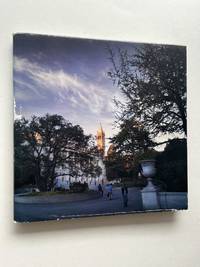
2053Berkeley: University Relations 2008. First edition. Hardcover. Fine/Very good. An uncommon photo book that commemorates the launch of the Campaign for UC Berkeley in 2008 highlighting the campus in pictures and in words from renown alumni and others. This is Joan Didion's copy with a university notecard to her laid in from one "Mary Kay" likely someone in University Relations. It reads in full: "Dear Joan Greetings from Berkeley! We have found yet another way to use your inspirational words about Berkeley. The enclosed book include the summary of your essay in 'There Was Light'--the version you approved for the television spot--as well as another well-used quote of yours at the end of the book. Should you ever want to read your essay again there are many people who have asked about it and would love to hear you read it again--or for the first time. I continue to follow your work and life and admire your strength and optimism. I hope this note finds you filled with hope for the new year. With warmest regards Mary Kay." There Was Light: An Autobiography of a University: Berkeley 1868-1968 referenced in the note was published in 1970 and featured essays about the university from thirty-one notable alumni including Didion. She attended Berkeley from 1953-1956 and went on to become one of California's greatest chroniclers as literary journalist and essayist. See photos for the pages that hold Didion's words. A short quarto in denim blue cloth with the title stamped on the front board; dark blue endpapers and a transparent page guarding the half-title; 130 pages. A short introduction from Chancellor Robert J. Birgeneau on the photo-illustrated jacket's front flap. The jacket depicts the campus's famous Sather Tower The book is fine; the jacket is very good with rubbing to all edges and some faint dampstaining at the center of its spine mainly visible from the jacket's interior and with no discernible effect on the book itself. An incredible UC Berkeley association copy and keepsake; we dare say this would make a one-of-a-kind graduation gift. University Relations hardcover
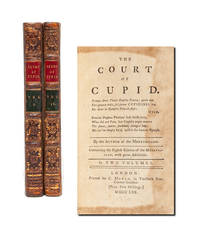
17705057London: Printed for C. Moran 1770. First collected edition. Contemporary speckled calf skillfully rebacked with original spines laid down. Gilt and morocco labels to spines. Marbled endpapers. Measuring 155 x 96mm and collating complete including final advert leaf to volume II: 2 ii 147 1 blank; 2 v 1 advert 139 3. Bookplates of J. O. Edwards to front pastedowns of each with additional bookseller's ticket to front endpaper of volume II. Front endpaper of volume I detached at base but holding well else; some offsetting to preliminary and terminal leaves of both volumes. Occasional light pencil marginalia. Overall a fresh copy of a scarce work on the women of the London sex trade. ESTC reports only 8 copies in libraries and its most recent appearance at auction was in 1931. The present is the only complete copy on the market.<br /> <br /> Edward Thompson's position as a satirist "has drawn the attention of commentators from Dr. Johnson to modern times" and given that his "verse and prose was generally in the manner of his declared mentors the ancients Horace Juvenal and Ovid.his targets were frequently political and ad hominem" Bibliographic Society. Among his most notable works were those that addressed London's widespread sex trade praising and critiquing the women who had been immortalized as Toasts of the Town in Harris' Guide to Covent Garden Ladies. These were drawn together for the first time as a collection under the title The Court of Cupid: The Meretriciad 1761 The Temple of Venus 1663 The Courtesan 1765 and The Demi-Rep 1765. <br /> <br /> The Court of Cupid allowed Thompson to capitalize on the fame of London's courtesans reprinting and expanding works that were already popular; but it was also commercially beneficial to the demi-reps as well. For the most successful members of the trade staying in the public eye was necessary. It could help young courtesans develop reputations and clientele; it could ensure that established courtesans continued to be seen as desirable and thus could justify or increase their fees. Certainly this was the case for Kitty Fisher who appeared among a multitude of other Toasts and bawds in The Meretriciad and then became the central focus of The Courtesan four years later. By this time poetry satires and gossip columns could not get enough of her. "Her name grew familiar to the beaux of clubland and curiosity was piqued when it was known that she was an exclusive young lady who would accept no present and grant no interview without a formal introduction" Bleackley. As a woman immortalized in print and paint Joshua Reynolds famously did a series of portraits of her she could even publicly turn down and humiliate Casanova as being beneath her.<br /> <br /> Kitty is not alone among the multitude of women mentioned in this collection --- bawds and brothels friends and rivals were preserved for literary critics and historians to remember. Satires like Thompson's assist us in remembering that during the height of London's sex trade there existed a vibrant and successful community of women who profited from their sexual desirability and who used those profits to carve out a desirable social space outside of the constrained domestic roles into which patriarchy had insisted they fit.<br /> <br /> Register of Erotic Books 1097. ESTC T126148. Printed for C. Moran unknown
168736Paris: Paris chez Mademoiselle Jablier 1687 1687. First Edition. Rebound in full calf.Octavo 7.5 x 6 inches Latin and French Condition: Near Fine. 24 engraved tables in Latin and 24 parallel tables in French. Near Fine. A Rare Parallel Latin-French Edition of Sabbathier's Christian Kabbalah Engravings<br /> 1687<br /> <br /> Esprit Sabbathier edited by François-Marie of the same order<br /> Idealis Umbra Sapientiae Generalis 1687<br /> <br /> Publisher: Paris chez Mademoiselle Jablier 1687<br /> Octavo 7.5 x 6 inches<br /> Latin and French Condition: Near Fine<br /> <br /> A rare mystical work of Christian Kabbalah authored by the Capuchin friar Esprit Sabbathier and edited by his brother François-Marie. The book sets out a symbolic system of universal wisdom presented through 24 engraved tables in Latin and 24 parallel tables in French. Both parts were originally engraved onto one or two very large copperplates by the engraver Caumartin then cut apart glued down and bound on tabs a curious production method that explains why surviving complete copies are so scarce. This a very rare work of high mysticism and Christian Kabbalah.<br /> <br /> Rebound in modern full leather with five raised bands gilt title to the spine over a red paste down and blind-stamped ruling to the borders of the boards. Inside are the two parts one in Latin and one in French each containing 24 double-page engraved tables mounted as described above.<br /> <br /> Near Fine condition with only light smudging to some pages and smudge marks at the base of the title page. Paris, chez Mademoiselle Jablier, 1687 unknown
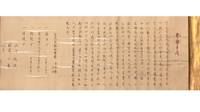
7413Scroll 365 x 5560 mm. with gold endpaper at beginning on a wooden roller. Japan: at end in trans.: “this secret information was given by Shichibei Itsuki to Shingobei Saijo in 1769.â€<br/> <br/> The spear yari was one of the primary weapons used in the feudal period of Japan. Many variations of the head of the spear were developed some for thrusting by foot soldiers and some for slashing designed for men on horseback.<br/> <br/> This finely illustrated scroll describes the teachings of the Oshima ryu school of fighting with a spear sojutsu. The Oshima ryu traces its origins to the 16th century and the first prominent teacher was Yoshitsuna Oshima 1588-1657. He taught the fiefdom lord of Kii Wakayama Yorinobu Tokugawa 1602-71 the tenth son of Ieyasu Tokugawa. The school continued for several centuries with branches throughout Japan.<br/> <br/> The scroll is beautifully heightened with gold and silver motifs of mist throughout. It begins with a history of the school and its essential tenets and disciplines necessary to fight skillfully with a spear. The following text describes the varieties of spearheads used by the school naginata jumonji two kinds of kagi techniques of handling the spears using wonderfully poetic phrases physical positioning of the body for the most efficient use of the spear the nuances of movement in combat and additional remarks.<br/> <br/> The motto of the school given next is in rough translation “Reach high for the school’s knowledge with a clear and sharp mind and focus on understanding your opponent.â€<br/> <br/> Following this are a series of illustrations beginning with icons of the school and five illustrations of different spears and spearheads. For each spear measurements are given. Each spearhead is painted with gold pigment.<br/> <br/> At the end there is written a certificate granting permission to transmit this secret information and then a most valuable family tree of the primary teachers of the Oshima school beginning with Yoshitsuna Oshima. Finally there is the seal of Shichibei Itsuki the provider of this secret information.<br/> <br/> In fine condition. unknown
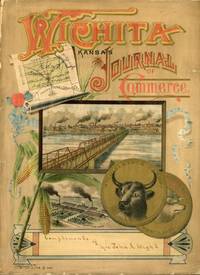
188854232Wichita Kansas: Eagle Printing House 1888. 1888. KANSAS. First edition.4to. Original color pictorial wrappers 92 pp. introduction numerous illustrations numerous advertisements mostly printed in double column. This promotional publication by the Wichita Board of Trade was published to counter the "malignant attacks" conducted by "powerful newspapers all over the country" who have "deliberately leveled their batteries at Wichita." The promotional contains an historical overview of Wichita in the cattle trade information on crops and capabilities of Kansas and calls Wichita "The Southwestern Metropolis." Illustrations include street cars telegrams churches private residences and schools. Containing also a directory of wholesale business information on Wichita's railroads and railway connections lists of industrial enterprises the meat packing centers the livestock market and information on taxes and building enterprises. In addition there are numerous advertisements for various businesses in Wichita. Light cosmetic touch-up to the spine and extremities by a master paper conservator else an attractive informational and scarce promotional for Wichita. Housed in a quarter leather and color decorated boards with raised bands and titles stamped in gilt on the spine. Not in Adams Herd. Not in Graff Eberstadt or Howes. OCLC locating only three copies. Considered to be very scarce with only a few known surviving copies. Eagle Printing House, 1888. hardcover