BYNG, Admiral of the Fleet Sir GeorgeBiblio.com
122 150 résultats
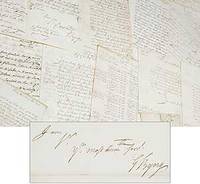
17183874591718. Unbound. Near Fine. A remarkable archive of 24 letters from Admiral of the Fleet George Byng sent to Rear Admiral George Delaval who commanded the Blue Squadron under Byng’s command along with associated documents from George Saunders and Josiah Burchett Secretary of the Admiralty relating to the British naval campaign of 1718 in the Mediterranean culminating in the Battle of Cape Passaro Sicily on the 11th August. A mix of quarto and folio sheet with many folded once to form four pages. Each letter is Signed by Byng with one signed twice. Despite their age the letters are near fine or better with only light wear and housed in a custom cloth chemise with printed labels.<br /> <br /> The Battle of Cape Passaro resulted in the defeat of the Spanish by the British Fleet under Sir George Byng four months before the War of the Quadruple Alliance. The Spanish refused to re-embark their army from the Sicilian mainland. Despite war not having been formally declared Byng correctly anticipated approval from home and attacked and routed the Spanish fleet thwarting their ambitions to take Italy and Sicily.<br /> <br /> The subject matter of the letters is concerned with supplies day-to-day naval matters and continuing hostilities against the Spanish and includes details of several rendezvous for meeting up in the event of separation owing to bad weather. Common problems are mentioned such as desertion and shortage of food and more particularly wine. The earliest is dated May 17th concerning the mobilization of troops and pressed men for the campaign. The letter of May 29th regards the Line of Battle detailing ships ordnance and men commanders and formation and pennants and the signals to be used. On July 3rd Byng gives orders to oppose the landing of the Spanish in Italy with a warrant order of operations to “take sink burn or destroy†the King of Spain’s ships; the last of the series dates from the December 9th from the Admiralty office not by Byng congratulating Delaval on his safe arrival at Spithead and requesting him to escort the fireship Griffin to Deptford. Byng sent mail from on board his ship the Barfleur whilst at sea and also from the Admiralty office in London.<br /> <br /> Byng was sent on subsequent diplomatic missions on behalf of England to negotiate with Italian princes and states and was instrumental in the acceptance of the terms of the Quadruple Alliance by Spain. In 1718 Byng was already a respected member of the establishment having supported the accession of William and Mary at the Glorious Revolution contributed to the burning of the French fleet at Vigo and leading the bombardment squadron during the capture of Gibraltar. He was rewarded with a knighthood and a regular promotion. After the success of 1718 this included membership in the Privy Council admittance to the Order of the Bath and the title of Viscount Torrington which his descendants still bear today. In 1727 Byng was made First Lord of the Admiralty and the Royal Naval College at Portsmouth was founded in his memory.<br /> <br /> Delaval also had a distinguished naval and diplomatic career from a young age with victory at the Battle of Malaga in 1704 and missions to Spain and Portugal as well as his promotion to Rear Admiral and leadership of The Blue Squadron. He is perhaps best known for rebuilding his ancestral seat the celebrated Seaton Delaval Hall in Northumberland now a National Trust property with architect Sir John Vanbrugh.<br /> <br /> It is important to note that Admiral George Byng should not be confused with his fourth son John Byng also present at the Battle of Cape Passaro as a 13 years old who built a respectable career as a naval officer and became an Admiral but was court-martialed and shot by firing squad on 14 March 1757.<br /> <br /> A remarkable collection of letters from the First Lord of the Admiralty during the reign of King George II. <br /> <br /> A detailed list of the correspondence is available upon request. unknown
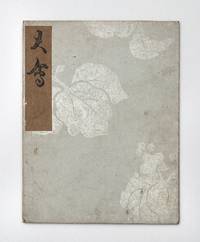
1117114 pages of text & two pages forming paste-downs of varying shades of pale pink & cream gofun biki torinoko mica-printed paper all printed with mica patterns endpapers printed with mica patterns of plum flowers on branches & autumnal weeds bound in two “quires†& sewn together. Small 4to 240 x 180 mm. orig. pale gray semi-stiff wrappers with mica woodblock-printed designs of hydrangea leaves orig. printed label on upper cover. Saga near Kyoto: about 1608 or shortly thereafter.<br /> <BR> <BR> An ultimate luxury copy tokusei bon 特製本 in very fine condition with mica-printed text leaves and covers using paper of shades of pale pink cream and gray. This is the second time we have handled a copy of a KÅetsu utai bon in the most luxurious state of three.<br /> <BR> <BR> This is one of the series of 100 Noh plays produced at the famous private press in Saga just north of Kyoto. These sumptuous luxury editions were printed for the wealthy and enlightened merchant Suminokura Soan 1571-1632 in collaboration with his calligraphy teacher KÅetsu a leading cultural figure of his day famous as an artist potter lacquerer and connoisseur. These books are amongst the most remarkable printed works created in Japan or anywhere else; their design is far in advance of anything produced in the West. Issued in limited numbers they were intended for private distribution to an elite audience friends and acquaintances of the creators who formed the patrons of the Saga artistic community.<br /> <BR> <BR> Printed with movable type on luxurious thick paper the books have according to Hillier a modernity in design matched only by the works of William Blake and the French artists’ books of the late 19th and early 20th centuries. They reveal the beauty of native Japanese calligraphy. The movable type is based on the calligraphy of KÅetsu.<br /> <BR> <BR> This series of mostly chants from Noh plays comprises “small pamphlet-size books each of about twelve or thirteen sheets whose outstanding feature is the decoration invariably of mica-printed patterns on stained or dyed paper which is of a distinction that immediately links them with the collaborative scroll works by KÅetsu and SÅtatsu and which has led to their being called KÅetsu-bon…These designs resulting from a sophisticated adaptation or distortion of natural forms are notable examples of one of the unique contributions of Japan to world art…<br /> <BR> <BR> “But decoration apart these No booklets are remarkable in other ways. An unusually thick and opaque kind of paper was used no doubt made specially for these editions and contrary to normal practice it was printed on both sides of the sheet. This ruled out the normal construction of a book whereby the sheets printed on one side only were folded in two and bound at the loose edges. The majority of the KÅetsu-bon were made up by an entirely different method. A number of sheets usually six in this copy three in the first “quire†and two in the second the outer leaves used as paste-downs were placed flat one above the other and the batch was then folded in two; two such sections would form a complete book. The binding again was unusual. The outer covers though printed first as a single sheet invariably with a mica-printed design were cut in two and each given a folded turnover along one edge in which one batch of the folded sheets was lodged. The two halves were then sewn together through the turn-overs of the two halves of the cover brought together at the inner edge. This is a binding method unique to Japan and is known as Yamato-toji or recchÅsÅ…<br /> <BR> <BR> “These KÅetsu-bon represent an astonishing leap forward to something entirely unprecedented in the history of the illustrated or decorated book. This was the first time a book had been conceived as a single unified work of printed decorative art…not until we come to William Blake’s Prophetic Books do we encounter anything remotely comparable and the creation in the West on any appreciable scale of books composed as homogeneously decorated printed works of art did not occur until the appearance of the French livres d’artiste in the late nineteenth and early twentieth centuries.â€â€“Hillier The Art of the Japanese Book pp. 51-54.<br /> <BR> <BR> The KÅetsu utai bon were produced in three levels of luxury. The finest such as our example has mica patterns or images printed on the text leaves and covers before the text was printed with movable type. The next level also had mica-printed covers but employed papers of different colors with no mica printing on the text pages. The least luxurious version used only cream-colored text paper and had mica patterns printed on the covers.<br /> <BR> <BR> The covers of our copy are mica-printed with images of bamboo and with backgrounds of sprinkled mica. Each of the five sheets with text exhibits different mica-printed images including grass adorned with dew in the field Japanese pampas grass plum blossoms on branches and waves.<br /> <BR> <BR> The movable type characters are based on the calligraphy of Hon’Ami KÅetsu 1558-1637; this type is called hiragana majiri a combination of kanji and kana accompanied by dashes next to each syllable. These dashes are the notations for the pitches to be sung. The notes are not written as specifically as they are in Western sheet music. If the dash goes up the pitch is raised; if it is straight the same pitch is continued; and if it goes down the pitch is lowered.<br /> <BR> <BR> A very fine and fresh copy preserved in a wooden box. These KÅetsu utai bon are very rare on the market especially when in excellent condition like our example. Covers a bit dusty and a few unimportant marks.<br /> <BR> <BR> ⧠Fischer et al. The Art of Hon’Ami Koetsu Japanese Renaissance Master pp. 174-75–“The deluxe editions of utai-bon that were printed at the Saga presses where Koetsu and Suminokura Soan collaborated to produce classics of earlier Japanese literature were intended for amateur connoisseurs like themselves. The thick paper mica-printed motifs and carved wood type were all part of an artistic whole meant to complement the aesthetic pleasure of the utai vocal performance.†Murase Tales of Japan. Scrolls and Prints from the New York Public Library pp. 157-59. unknown
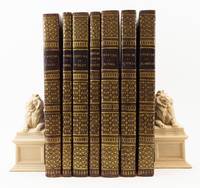
1800ST17757London: William Miller; T. M'Lean; William Bulmer 1800-18. 370 x 270 mm. 14 1/2 x 10 1/2". Seven volumes. <br/> Uniformly bound in stately contemporary dark burgundy straight-grain morocco covers with gilt palmette-and-wheat-sheaf border inner frame of blind-stamped grapevine raised bands spine compartments densely gilt with repeating botanical tools gilt lettering gilt-rolled turn-ins all edges gilt. Two engraved titles with hand-colored vignettes not included in plate count and 356 FULL-PAGE HAND-COLORED PLATES FEATURING COSTUMES OCCUPATIONS AND SOCIAL INTERACTION OF VARIOUS NATIONS. Volume I-III V and VI with text in French as well as English. Front pastedown with armorial bookplate of Edward Gordon Douglas-Pennant 1st Baron Penrhyn. Abbey Life 430; Abbey Travel 71 244 370 373 532 533. Joints and extremities lightly rubbed one board with a couple of faint scratches two rear boards with neat older repairs to short tears at tail edge but the bindings quite sound and most attractive on the shelf. Flyleaves a little foxed minor offsetting from plates to text leaves occasionally more pronounced but never offensive isolated minor marginal foxing to plates otherwise very fine WITH CLEAN BRIGHT PLATES.<br/> <br/> This is a collection of major early 19th century color plate books with well-drawn and richly-colored engravings in bindings that make a handsome appearance on the shelf. All of these works have appealing plates where the costumes of the various social strata are carefully and colorfully delineated. And two of the volumes--those showing British costumes and the book on Chinese punishments--contain in addition a good deal of diverting background detail that serves as a revealing context for each of the costumes depicted. The content of each of the volumes is worth noting. With a few exceptions the plates in the "Costumes of China" portray ordinary working-class men and women toiling at their trades. We see a bookseller with his wares spread out on a mat women sewing and embroidering a butcher a fisher a barber a man with a "magic lantern" show and a "man striking a small gong during an eclipse" an ancient ritual that the author tells us he was privileged to witness on 17 November 1789. The "Punishments of China" volume is filled with almost gleefully painful depictions of all degrees of disciplinary action from the relatively minor twisting of the ears or chaining to an iron pole to the humiliating ordeal of the wooden collar to methods of execution by beheading or by crucifixion using a cord. The opulent and brightly colored costumes in Dalvimart's volume on Turkey are mostly those of the ruling classes although also represented is a wide variety of native dress from the many regions of the vast Turkish empire of the day which included Bosnia Albania Syria Egypt and parts of Greece. It is particularly interesting to contrast the clothing of the very heavily veiled Turkish and Egyptian women with the much more relaxed style of the Greek women and the nearly immodest garb of the female Bedouin. We also are shown a eunuch an odalisque from the harem a grand vizier various royal functionaries and government officials all splendidly attired. The Russian costumes based on engravings done by C. W. Müller at the request of Empress Catherine the Great are focused on the ethnic dress of the empire's many holdings. The Laplanders and Finns wear clothing that would look familiar to most Europeans but the Mongols in their Oriental dress would be quite exotic. The clothing of the northern tribes such as the Kamchatkans Aleutians Koriaks and Tungoosi will impress the modern reader with their similarity to the traditional dress of Native American and First Nation peoples. The Tchutski woman is even depicted naked to display her tattoos. Bertrand de Moleville's Austrian costumes also illustrate the native dress of the empire's citizens but the illustrations here are less fashion plates than romanticized scenes: peasant couples are shown courting and dancing; Croatian women gossip beside a stream; and a wild-haired Bohemian gypsy whose "profession is not hard to guess" from her state of "déshabillé" flees with her naked and no doubt illegitimate child. Pyne's "Costumes of Great Britain" is one of the most highly praised works in this set and for good reason: the simple working men and women of Britain it depicts are always shown going about their daily tasks in the midst of a well-realized scene. The woman selling "salop" a hot morning beverage is seated at her cart with its urn judiciously located by the watchman's stall surrounded by customers including soldiers and a woman with her market basket. A fireman with an ax and a torch hurries toward his engine company while they unwrap their hose. The potter is at his wheel the tanner is cleaning skins and the bill-sticker posts the winning lottery numbers. The clothing while carefully detailed is almost secondary to the depictions of everyday life. The "Military Costumes of Turkey" illustrates the official regalia "uniform" is much too drab a word for these outfits worn by officers in various regions of the empire. Perhaps the most intriguing plate here is that of the Ladle Bearer a post that was also illustrated in "Costumes of Turkey." What appears to be a man with a giant spoon is in fact the holder of an important military position equivalent to the color-bearer in a western army. We are told that the loss of its ladles is the greatest disgrace that can befall a Turkish regiment: if the two great ladles the size of a grown man that are borne into battle at the head of the troops are captured the regiment must be disbanded and formed anew. Former owner Edward Gordon Douglas-Pennant 1st Baron Penrhyn 1800-86 was a leading figure in the Welsh slate industry; he owned the Penrhyn Quarry the largest slate quarry in the world at the end of the 19th century. He was known for his paternalistic attitude to his employees creating the "model village" of Llandegai to house the quarry workers. It was notable for having "no corrupting alehouse." He was ruthless enough to fire 80 men in 1868 because they did not vote for his son George who was running for a seat in Parliament. Single volumes from this set appear with frequency in the marketplace; full sets show up much less often; sets as handsome and well preserved as the present are rarely seen. William Miller; T. M'Lean; William Bulmer unknown
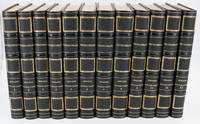
184991066Paris: EugèneVictor Penaud frères 1849. Fine. With plates from the first illustrated edition and a letter by Chateaubriand: ""but I am dead utterly dead"" Eugène Victor Penaud frères Paris 1849-1850 ; 14 avril 1839 lettre manuscrite 13.7 x 21.2 cm 12 volumes reliés et une lettre signée Rare and sought-after first edition first issue with exceptionally added plates from the first illustrated edition published that same year. 34 full-page engravings after Demoraine Gagnier Staal and engraved by F. Delannoy. Includes the subscribers list and the foreword which will be removed for the second issue when the remainder of this edition was bought by another publisher Dion-Lambert. It also features the pagination error in volume two: page 164 instead of 364. With a scribal letter by the author bearing his autograph signature. One page written in black ink on a leaf. Slightly darkened at the upper edge with occasional foxing and the usual folds. Black half-morocco bindings flat spines with double gilt fillets and double blind-stamped compartments black paper boards slight superficial rubbing to some boards marbled paper pastedowns and endpapers sprinkled edges; contemporary bindings. Sparse foxing. Exceptional prophetic and macabre letter by François-René de Chateaubriand. Signed with the authors faltering hand this apparently unpublished letter was penned by his secretary. Black half-morocco bindings flat spines with double gilt fillets and double blind-stamped compartments black paper boards slight superficial rubbing to some boards marbled paper pastedowns and endpapers sprinkled edges; contemporary bindings. Sparse foxing. You will recognise the hand of Pilorge whom I employ to replace my own suffering from gout. I shall read your recollections with the greatest pleasure but as for me I am dead utterly dead and if I were required to write a single word in a paper I would sooner be buried a thousand feet underground. I am done with life; it would be a sweet thing indeed to rise again if only to be of some use to you Rest assured that no one will take a more genuine interest nor share more wholeheartedly in your success than I shall. Entirely yours from the depths of my grave Chateaubriand 14 April 1839. This letter was dictated by the author to his secretary who provided invaluable assistance in the very preparation of the Mémoires: Having remained in Chateaubriands service for twenty-five years Hyacinthe Pilorge was the principal hand behind the transcription of the Mémoires doutre-tombe. His task was to make a legible copy of Chateaubriands texts progressively transcribing everything his master wrote or dictated. Chateaubriand revised and corrected from these copies and when the newly written pages became excessively amended Pilorge would write a new copy. Pilorge was tasked in 1840 of transcribing the first complete copy of the Mémoires doutre-tombe. For many years this manuscript served as the reference text. It comprised over four thousand pages assembled by quires and kept in cardboard folders with each leaf designed to be corrected moved or replaced at will. Once this monumental task was completed in 1841 Chateaubriand set his work aside for some time. Yet thanks to its highly adaptable structure the Mémoires doutre-tombe continue to stand as a living evolving work a perpetual work in progress. Bibliothèque nationale de France The recipient of the letter is the author of Souvenirs which Chateaubriand here declines to promote. The writer speaks as though from beyond the grave almost ten years before his actual death: as for me I am dead utterly dead and if I were required to write a single word in a paper I would sooner be buried a thousand feet underground. I am done with life; it would be a sweet thing indeed to rise again if only to be of some use to you. These masterful lines carry the humour so often encountered in the pages of the Mémoires which André Lebois describe EugèneVictor Penaud frères hardcover
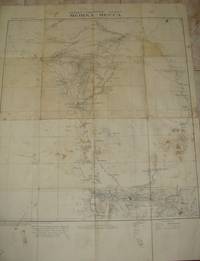
000041<p><strong>Paper on cloth 114 × 89 cm.</strong><br /><em>The British Expedition in the Arabian Hejaz during the First World War – Arab Revolt Medina–Mecca.</em><br />Reprint of the first provisional issue with large corrections. Published by the Survey of Egypt for the Arab Bureau under authority of the War Office November 1916.</p><p>This map is a collection of sketches compiled by Egyptian pilgrimage officers and members of the Sharif's forces. An attempt was made to verify the information using local native sources but without success. The coastline is derived from Admiralty charts. The Jedda–Taif area is taken from G.S.G.S. sources.</p><p>Some light staining but generally in good condition.</p>
000059<p><strong>Huda Sha'rÄwÄ« 1879–1947</strong><br /><strong>Collection of 19 Photographs</strong></p><p>A group of <strong>nineteen individual photographic prints of varying sizes</strong> depicting <strong>Huda Sha'rÄwÄ«</strong> the pioneering Egyptian feminist leader nationalist and founder of the Egyptian Feminist Union.</p><ul><li><strong>Four photographs are signed by Huda Sha'rÄwÄ«</strong> including <strong>two dedicated and signed in Paris to Majd ed-Din Nasif</strong>.</li><li>Approximately <strong>fourteen are studio photographs</strong> taken predominantly in <strong>Paris</strong> with several examples from <strong>Cairo</strong>.</li><li>One notable photograph shows Sha'rÄwÄ« in <strong>Egyptian local dress</strong> <strong>signed by the photographer Lekegian Cairo</strong>.</li></ul><p>The photographs document Sha'rÄwÄ« in both European and Egyptian contexts reflecting her transnational life and public persona during the early twentieth century.</p><p><strong>Biographical Note:</strong><br />Huda Sha'rÄwÄ« June 23 1879 – December 12 1947 was a leading figure in Egyptian feminism and nationalism. Born into a wealthy family in Minya she was the daughter of Muhammad Sultan the first president of the Egyptian Representative Council. Raised in the seclusion of an upper-class harem she married her cousin Ali Pasha Sha'rÄwÄ« at the age of thirteen. A later separation allowed her to pursue formal education and develop an early sense of independence. Educated in Quranic studies Arabic Turkish and Islamic subjects she also wrote poetry in Arabic and French. Her memoir <em>Harem Years: The Memoirs of an Egyptian Feminist 1879–1924</em> remains a key source for understanding her life and era.</p>
18000008<p><strong>printed leaf</strong> <strong>10 lines in Ottoman Turkish</strong>. Undated and without place of printing but apparently printed at the <strong>Imprimerie Nationale Cairo</strong> during the <strong>French Expedition to Egypt</strong>.</p><p>The document is a <strong>proclamation</strong> concerning <strong>Napoleon Bonaparte's reply</strong> to a letter from the Ottoman Sultan <strong>Selim III</strong> stating that <strong>Napoleon and Selim are allies</strong> that <strong>no force can disturb their alliance</strong> and that <strong>all victories on both sides are the result of this alliance</strong>.</p> Divan du Caire (the Napoleonic committee in Cairo)
1931001618London: The Golden Cockerel Press 1931. 7 6-268pp 4. Original half pigskin and buckram over boards by Sangorski and Sutcliffe raised bands spine in six panels title in gilt to second panel cockerel device to fifth t.e.g. remainder untrimmed. Spine very slightly rubbed usual light foxing to cloth covers internally bright and clean and signed by Eric Gill to title 'Eric G' within a small illustration of a ball and chain attached to the foot of the cockerel vignette on the title page. Number three hundred and seventy-two of five hundred copies on paper with another twelve on vellum. Now housed in a drop back box made by Temple Bookbinders. The Four Gospels is widely regarded as one of the best private press books. Cave and Manson 78; Chanticleer 78 "a flower among the best products of English romantic genius"; A Century for the Century 26; Gill 285. Signed by Illustrator. First Thus. Half Pigskin and Buckram. Very Good. Illus. by Gill Eric. Folio. Private Press. The Golden Cockerel Press Hardcover
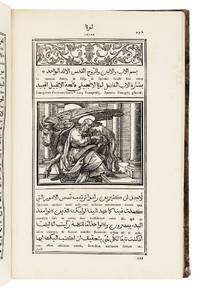
65425Romae Rome: In Typographia Medicea 1591. FIRST EDITION. Folio 32.25 x 21.25 cm. pp.9-4621 colophon. Full 18th-century marbled vellum spine with gilt rules gilt decoration and red morocco label. With 149 text woodcuts by Leonardo Parassole c.1570-c.1630 after Antonio Tempesta 1555-1630 their monograms appearing on a number of the illustrations. The woodcuts are remarkable examples of Tempesta's work notable for their clarity of composition and their didactic narrative of the episodes depicted. Old bibliographical remark in Latin to verso of final leaf. From a German private collection. Some partial browning due to paper stock and occasional light foxing generally a very handsome copy. First edition of the Gospels in Arabic and Latin - a landmark cultural encounter. In 1584 the last year of the papacy of Gregory XIII who had constantly endeavoured to effect a union between the Church of Rome and the eastern Christians Cardinal Ferdinando de' Medici the brother and later the successor of the Grand Duke of Tuscany founded a printing press in Rome with a vast selection of oriental types cut by the French typographer Robert Granjon. Run by a versatile orientalist Giovan Battista Raimondi the press had various aims. One was to produce propaganda which would attract the eastern Christians to Roman Catholicism. Another was to corner the publishing market in an area where typography was prohibited and to make a financial profit from the sale in the east of books printed in Arabic. The third aim was to further European knowledge and to provide good editions of Arabic versions of certain standard non-religious texts. These included the writings of Avicenna al-Idrisi's geographical compendium al-Tusi's adaptation of Euclid's text on geometry and various works on Arabic grammar and syntax. The first major publication was the 1591 edition of the Gospels. This copy has an interlinear Latin translation but the work was also issued solely in Arabic. It contains 149 fine woodcut illustrations made by Leonardo Parasole mainly after designs by one of the best known Florentine artists of his day Antonio Tempesta who owed much of his fame to the frescoes he painted in the Vatican and in a number of Roman palaces. The woodcut in the Gospel of St Mark of the presentation of the head of John the Baptist to Salome Mark 6:28 by a man in Turkish dress reminds us of the common association between the great enemy of Christendom in the sixteenth century and the ancient heathens. The Arabic text is printed in Robert Granjon's famous large fount generally considered the first satisfactory Arabic printing type; as all early printed editions of the Arabic Gospels it is based on the Alexandrian Vulgate cf. Darlow/M. 1636. The Latin version is by Leonardo Sionita. The work begins with page 9 without a title-page or any preliminary matter at all: "the intended prefatory matter was apparently never published" Darlow/M.; these first eight pages were not supplied until the 1619 re-issue. Brunet 1122-1123 Romae [Rome]: In Typographia Medicea, 1591. hardcover
20202081502111906507Hoo shubbansha 2020. Soft Cover. Fine. The book is in fine condition. Hoo shubbansha paperback
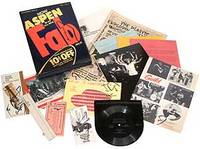
1966349700New York: Aspen 1966. Unbound. Near Fine. The Pop Art Issue." Designed by Andy Warhol and David Dalton. Complete see below. Both the front and the inside front cover of the box are Signed and eight other pieces in the box have been Signed by Warhol a couple of them are Inscribed including: the Ten Trip Ticket Book the movie flip book the Pop-Art Paint card folder the Guild Instruments flyer the Folk Music on Vanguard pamphlet the tabloid newspaper a cardboard divider and the 33 1/3 flexi-disc acetate recording containing the song "Loop" written by John Cale and credited to the Velvet Underground one of the first commercially available recordings by the band. Additional contributors include Willem de Kooning Roy Lichtenstein Claes Oldenburg Ernest Trova Kenneth Noland Gerald Laing Jasper Johns James Rosenquist Lou Reed and Timothy Leary. The box designed to look like a box of detergent is a little crushed as usual with two corners torn some offsetting at the bottom of the box very good with contents fine. Further details available upon request. Aspen unknown
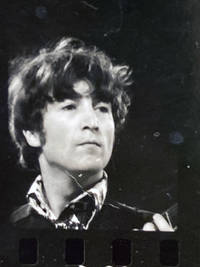
19662777San Francisco 1966. First edition. Very Good. One-of-a-Kind Beatles Images Portend the End of an Era. This original contact sheet of rare 1966 images of The Beatles was discovered by artist photographer musician and Beatles enthusiast Dave Seabury at a garage sale near San Francisco in the late 1980s. These photos which we have on offer were taken at the Fab Four's final concert at Candlestick Park on August 29 1966. <br /> <br /> The story of how these images were discovered is almost as fascinating as the images themselves. Seabury frequented garage sales for years inquiring about Grateful Dead or Beatles photos and never had any luck. On one fateful day the seller said "Yeah there are some Beatles pictures in that box over there." Marks In the box Seabury found a contact sheet with 73 black-and-white images of The Beatles taken by someone who clearly had privileged access to the band. The photos were close-up and deeply moving however there was no date on the photos and no photographer stamp. <br /> <br /> Seabury recalls that every once in a while he'd take out these photos and think "These are really great they deserve some attention." Then many years later he read Joel Selvin's article in the San Francisco Chronicle about The Beatles' last concert at Candlestick Park which included Jim Marshall's famous photos. After looking at the pictures Seabury thought "Those shirts look familiar." He quickly pulled out his Beatles contact sheet and voilà they were wearing the same shirts. Seabury said "That's when I realized the photos on my contact sheet were taken at Candlestick in 1966." Marks<br /> <br /> In 2015 Seabury began his quest to find the photographer. With the 50-year anniversary of The Beatles' final concert on the horizon he said "I contacted all The Beatles collectors I could find. I just kept coming up zero." Marks At the same time Seabury a photographer in his own right was working on a photo exhibition and concert to be called "Lost and Found Beatles." Scheduled to open on the 50th anniversary of the Candlestick show at The Reclaimed Room Gallery in San Francisco he started a Kickstarter campaign to raise the money to turn the contact sheet images into prints. It was a labor of love.<br /> <br /> When the pictures were finally printed Seabury realized that rather than the usual stock photos taken at concerts these images were unusually pensive and intimate. Unbeknownst to their fans at the time John Paul George and Ringo had a secret - they had recently decided that this would be their last live concert together. Amidst 25000 screaming fans the photographer was able to capture what The Beatles knew that this was the end of an era.<br /> <br /> When the "Lost and Found Beatles" show opened on September 29 2016 the identity of the photographer was still a mystery. At the exhibition closing party professional collector Derek Taylor realized that a photo in the exhibit looked familiar. He explained ". the way Lennon's hair was tousled. I just knew I'd seen that photo before like something I'd bought. A few weeks later I happened to be looking for a record and boom that Lennon photo an 8-by-10 falls out." Taylor flipped the photo over and saw a stamp that read "Photo: Eric Weill." Marks Mystery solved. <br /> <br /> Eric Weill who struggled with bipolar disorder for most of his life died in 2006. He was well known for his photos of Bob Dylan and for claiming to be the Zodiac killer on a call-in radio show in 1969. Ethan Byxbe nephew of Weill described his uncle as "a professional photographer. whose news photo called 'The First Hippie Riot' from 1968 is in the collection of the Smithsonian." One of Weill's acquaintances explained that "Eric was just one of those guys who showed up everywhere with a camera." Marks <br /> <br /> Seabury was eager to meet Weill's nephew his only living relative and explains "When I finally connected with Ethan and explained everything to him he was totally blindsided. He was like 'Whoa wait a minute. You published his photos' And I said 'Look man. I want to meet with you. I cede all rights to these photos to you.'" Byxbe was grateful for Seabury and explained "thanks to Dave's project people can enjoy some of my uncle Eric's photographs and he can get credit for some of the work he did. I think he would be happy about that." Marks <br /> <br /> Though the mystery was solved it was still not clear how the contact sheet ended up in a garage sale. Ethan Byxbe believes that "The bulk of my uncle's material was stolen right under our noses. When I was a little kid in the 1970s my grandmother had hired some older neighborhood kids to help her clean up her garage.There were several milk crates full of original negatives and photographs including most of The Beatles' material. I had a bad feeling about them and said 'Grandma maybe you should put Eric's pictures in a closet or something.' She said 'Oh no they're fine.' She was very trusting. And sure enough after they left I checked the garage and the milk crates with Eric's original materials were gone. They had taken everything." Byxbe remembers another theft that occurred years later. He said "My uncle was living in an old 1930s milk truck. People would be in and out of the truck visiting him and one time someone ripped off much of what he had left. Between those two incidents most of his photographic materials that I knew about were gone." Marks Byxbe does not know when the contact sheet was stolen but he assumes that's how it started its journey to a garage sale in Northern California.<br /> <br /> This original contact sheet would be a thrilling addition to any Beatles collection. Weill memorialized one of the most significant turning points in the history of the world's greatest band by inviting the observer into The Beatles' souls and capturing a moment that the audience was not aware of at the time - the beginning of their separation.<br /> <br /> Also part of this lot is a poster-size image of the contact sheet 46x61 cm 18"x24" as well as a poster a flier and 6 postcards promoting the "Lost and Found Beatles" exhibition presented by Seabury in 2016.<br /> <br /> Provenance: From the collection of Dave Seabury artist photographer and musician. <br /> <br /> Contact sheet with 73 photographs by Eric Weill. 21.5x27.5 cm 8½x11". Numerous small creases and surface skratches short closed tear to bottom edge; very good. Poster-size image of the contact sheet 46x61 cm 18x24" and a poster a flier and 6 postcards promoting the "Lost and Found Beatles" exhibition included. <br /> <br /> References:<br /> <br /> Kevin Courrier. Artificial Paradise: The Dark Side of The Beatles' Utopian Dream. New York: Bloomsbury Press 2008.<br /> <br /> Ana Leorne. "The story of The Beatles' last official concert which took place in San Francisco 55 years ago the Fab Four played Candlestick Park." SFGATE. August 25 2021.<br /> <br /> Ben Marks. "A Garage Sale Find of Rare Beatles Photos Took a Collector on a Magical Mystery Tour." Collectors Weekly. March 8 2018.<br /> <br /> Jordan Runtagh. "Remembering Beatles' Final Concert." Rolling Stone. August 29 2016. unknown
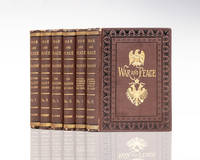
1886149532New York: William S. Gottsberger Publisher 1886. First edition in English of Tolstoy's masterpiece a pillar of world literature. Octavo six volumes in the publisher's original pictorial brown cloth stamped in gilt and black brown coated endpapers with the cursive imprint in each part. Translated by Clara Bell. In near fine condition. Housed in two custom marbled slipcases. An exceptional set of Tolstoy's masterpiece one of the finest we have seen. Widely considered the greatest novel ever written War and Peace is at once an epic of the Napoleonic Wars a philosophical study and a celebration of the human spirit. Tolstoys genius is seen clearly in the multitude of characters in this massive chronicleall of them fully realized and equally memorable. Out of this complex narrative emerges a profound examination of the individuals place in the historical process one that makes it clear why Thomas Mann praised Tolstoy for his Homeric powers and placed War and Peace in the same category as the Iliad: "To read him . . . is to find ones way home . . . to everything within us that is fundamental and sane." "There remains the greatest of all novelists--for what else can we call the author of War and Peace" Virginia Woolf. William S. Gottsberger, Publisher hardcover
1800ABC_48443The Netherlands 1800. Splendid late 18th-century ca. 1790 gold-tooled red morocco sewn on 4 supports with a smooth spine bound by the so-called Second Dissertation Bindery Leiden ca. 1780-ca. 1794; Storm van Leeuwen IIA pp. 350-358 with 4 closing loops on the front board 1 top edge 2 fore-edge 1 bottom edge connecting to 4 closing knotted buttons on the back board. Both boards show 3 gold-tooled floral frames built up from 2 different rolls with small corner pieces in between the inner frame with 4 larger floral corner pieces and a large lozenge shaped centrepiece built up from multiple impressions of 5 different floral and animal stamps. Further with a gold-tooled spine and board edges gilt edges and marbled endpapers. Large 4to. With 162 signatures on 160 vellum or paper cuttings mostly vellum including 2 cuttings with 2 signatures each mostly from the 17th century some from the 18th century and a few from the early 19th century. Further with one large printed coat of arms of the Wassenaer family on the verso of the title-page an engraving ca. 9.5 x 7 cm showing the house of Jacob Cats on the verso of leaf 34 and with 19 printed coats of arms on the versos of several leaves 16 depicting a coat of arms with the name of the family below and 3 blank shields. The title page headings and captions all in a very neat late-18th-century or early 19th-century cursive script written in Dutch using brown ink. Remarkable collection of 162 signatures of mainly 17th-century 16th- to early 19th century Dutch and international prominent people - from statesmen like Stadtholder Maurice of Orange Count of Nassau etc. and Grand Pensionary of Holland Johan de Witt 1625-1672 royals like King Philip II of Spain 1527-1598 and William III of Orange Stadtholder of the Dutch Republic and later King of England Scotland and Ireland 1650-1702 and government officials like "Griffier" to the States General François Fagel 1629-1746 the most important clerk of the Dutch Republic's government to authors poets and scholars like P.C. Hooft 1581-1627 and Nicolaas Tulp 1593-1674. For each individual mentioned in the present work their signature - on a separate vellum or paper cutting mounted on the recto of the leaf - appears next to a short biographical description. Some biographical descriptions are more extensive than others but two names appear without any further information. The first is Caspar Clotterbooke leaf 30 who is listed as a secretary for the council of the States of Holland in the 18th century 1778. He was born in The Hague in 1720 held several high positions in the councils of Haarlem and the States of Holland as a representative of that city and died childless in 1817. The second is Hendrik Nobel who is listed in the second part among royals statesmen military commanders scholars and others. He lived from 1568 to 1649 and was appointed as "bewindvoerder" administrator or governor of the Rotterdam Chamber of the Dutch East India Company VOC. In two cases one cutting contains two signatures - those of Johan van Hoorn and Abraham van Riebeek appear together as well as those of Adriaan Valkenier and Johannes Thedens; all four were Governor General of the Dutch East Indies resp. from 1704-9 1709-13 1737-41 and 1741-43. In the case of William III two signatures are included for one single individual - the first is his signature as Prince of Orange and the second is his signature as King of England Scotland and Ireland "William R.". The work was bound by the so-called Second Dissertation Bindery in Leiden which was active at the end of the 18th-century between ca. 1780-1794 Storm van Leeuwen. The work was most likely produced as an album with blank leaves to be used as a notebook or scrapbook album of some sort at a later date. The paper used in the album is clearly watermarked throughout for example a lion within a crowned medallion pro patria eiusque libertate countermarked J. Honig & Zoonen. The firm Honig or Honigh Zaandam the Netherlands was active from the late 17th century until the late 19th century but was known as J. Honig & Zoonen during the 18th century. The paper is most likely contemporary to the binding. While several of the cuttings containing signatures are also dated - as part of the signature itself or separately added - these dates represent the exact or otherwise approximate date the particular signature was produced. The majority of the signatures can be traced back to the 17th century but were probably cut from official hence the vellum documents to be sold as collector's items around the beginning of the 19th century.The present work was part of the collection of A.M. van den Broek 1932-1995 an antiquarian book print and art collector from Haarlem. His collection mainly contained works focussed on Haarlem and its surroundings. The present work includes 7 signatures from prominent Haarlem representatives in the "Commons" the council of the States of Holland during the 17th- and 18th centuries.The binding shows very slight signs of wear two scratches on the front board some rubbing along the spine and closing knotted buttons on the back board the gutter of the first and second front flyleaves is slightly exposed without affecting the integrity of the binding. Further with some minor offsetting on the blank versos of the leaves from the signature cuttings. Otherwise in very good condition. A remarkable collection of signatures from mainly 17th century prominent Dutch and international statesmen and other famous people.l Cf. for the binding: Storm van Leeuwen IIA pp. 350-358. hardcover
1950ABC_47136Cleveland Ohio: Cleveland Institute of Art or Western Reserve University 1950. Publishers original portfolio 48.5 x 34 x 4.5 cm covered with black cloth with on-lays in black and red on the front and the authors name in white and title in red on the spine with three pairs of black ties one on the inside and a label on the inside of the right black flap giving information about the limited edition: "Edition limited to forty numbered sets of which this is No 33". 15 manuscript leaves in one case a fragment of a scroll of various formats and sizes some glazed see the detailed list of contents for specific dimensions 7 written on straight-forward laid paper European and non-European 6 more problematic probably all non-European 1 on straight-forward wove paper no. 14 supposedly made in Russia and one on vellum no. 7 most rubricated and/or decorated in various colours some decorated or highlighted in gold. Each manuscript leaf is mounted hinged on one edge to allow access to both sides of the leaf in a passe-partout 46.5 x 33 cm and each has a letterpress slip 10 x 18 cm with explanatory text tipped onto the foot of the passe-partout. The publication has no title-page but includes a letterpress folio leaf that serves as a table of contents and has the drop-title given above the present copy contains two copies of that contents leaf. The display typeface used in the letterpress leaves and on the portfolio is the 1938 Libra by the Dutch designer Sjoerd de Roos inspired by uncial manuscripts. Copy number 33 from a limited edition of 40 of Eges famous portfolio containing a collection of 15 leaves from oriental manuscripts written between the 12th and 18th centuries. The press run had to be limited because some of the manuscripts probably had no more than about 40 leaves.Otto Frederick Ege 1888-1951 was the dean of the Cleveland Institute of Art a lecturer on the history and the art of the book at Western later Case Western Reserve University in Cleveland and a famous or infamous biblioclast. He was one of the key figures in creating a market for medieval manuscript leaves in America during the 20th century. Between 1917 and his death in 1951 Ege acquired broke up and subsequently dispersed hundreds of medieval and other interesting manuscripts and early printed books wanting to give as many private collectors and public institutions as possible the opportunity to own these individual leaves. He was convinced that his purpose of inspiring as many people as possible by bringing them in contact with historical and artistic heritage justified the means of scattering the manuscript leaves. In fairness to Ege these were almost certainly incomplete manuscripts to begin with though one could wish he had provided a detailed description of each manuscript before breaking them up and disbursing them and his publications did make them available albeit in the limited form of a single leaf to a much greater audience than could have hoped to see let alone own original manuscripts of this sort. Fortunately people are now more reluctant to break up early manuscripts but that also means that similar publications are less likely to appear in the future. Beginning in the 1940's Ege compiled his most famous portfolios as two limited editions in press runs of 40 copies each: one portfolio with western medieval manuscript leaves and the present one with 12th to 18th century oriental manuscript leaves.The present portfolio includes leaves from 15 manuscripts produced from the 12th to the 18th century in Egypt Iran the Byzantine/Ottoman Empire Persia/Iran Russia Tibet and other places. These mainly religious texts were written in several different languages including Arabic Syriac Armenian Ethiopic Persian Tibetan Greek and Church Slavonic. Two of the fragments one in Greek and one in Church Slavonic even include music notation neumes. Although the publication names no publisher and gives no date of publication Ege compiled it himself and wrote the notes about each manuscript leaf but it is said to have been published after probably soon after his death in 1951 the description of Ege as late dean of . is slightly ambiguous but may indicate that he had died. His brief notes on the manuscripts lack many details and are often not reliable particularly the dating so we have tried to make some additions and corrections in our detailed list of the contents. One of the Cleveland institutions where he worked probably published the portfolio. It is listed in the National Union Catalog of pre-1956 imprints. As Ege intended many of his portfolios and other fragments were sold and distributed worldwide. Beinecke Rare Book & Manuscript Library at Yale University acquired his personal collection including 50 unbroken manuscripts for their special collections in 2015.A detailed list of contents is available upon request.The portfolio the two copies of the contents leaf and the 15 passe-partouts with the manuscript leaves are in very good condition. A detailed condition report of the 15 manuscript leaves included in the detailed list of contents available upon request.l WorldCat 15372178 7 copies 78768040 2 copies 1322443218 1 copy. [Cleveland Institute of Art or Western Reserve University?], hardcover
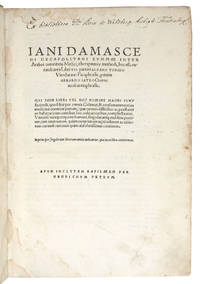
1543IB7BGV3WR8OIBasel: Heinrich Petri 1543. 17th century black vellum made from an earlier liturgical music manuscript. Folio 20.5 x 29 cm. Important Latin edition of an Arabic medical compendium first printed also in Latin in 1479 with additions by Gerard de Cremona. It provides a collection of opinions voiced by Greek and Arabic physicians on pathology and therapeutics. "No Arabic printed edition exists so far" Choulant. The ninth-century Christian physician perhaps in or near Damascus Yahya ibn Sarabiyun son of a Bagarma physician wrote his great medical work Al-Kunnas in Syriac but it was soon translated into Arabic by scholars such as Musa Ibrahim al-Haditi and ibn Bahlul. Manuscripts survive in twelve and in seven books. "The seven-book edition was frequently printed in Latin translations as 'Breviarium' and 'Practica therapeuticae methodus' or here Therapeutice methodi. Albanus Torinus the editor of the Basel 1543 edition called the author Janus Damascenus for which reason he has been confused with the well-known theologian of that name. He is also often mistaken for his younger namesake Serapio junior" GAL. Some catalogues even ascribe this work to the Baghdad physician Abu-Zakariya Yuanna Ibn-Masawaih.Minor water stains; some unobtrusive worming to front board and flyleaves. Binding rubbed; extremities bumped with chipping to spine-ends. A wide-margined copy. With a 1677 owners inscription of the pharmacist and medical student Joseph Franz König on front paste-down; later owners inscription on the title-page of Bonifacius Brix von Wahlberg 1726-1776 court physician to the Princes of Fürstenberg.l Adams I14; BM STC German p. 932; Choulant Handb. p. 347; Durling 4778; GAL I 233 & S 417; USTC 606427; VD16 Y11; not in Waller. Heinrich Petri, hardcover
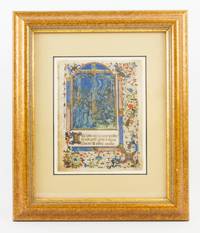
1440ST19540aMetz ca. 1440. Leaf: 162 x 124 mm. 6 3/8 x 4 7/8". Frame: 308 x 258 mm. 12 1/8 x 10 1/8". Single column three lines of text under the miniature obverse with 18 ruled lines five of which contain text in a gothic book hand. <br/> Attractively matted and framed. Recto with one three-line initial in gold on pink and blue ground WITH A LARGE MINIATURE OF THE CRUCIFIXION WASHED IN BLUE Christ on a painted gold cross flanked by two thieves on painted gold crosses surrounded by throngs of people including the Virgin St. John Mary Magdalene and numerous soldiers all in an arched gold frame inside a three-sided painted and gilt baguette and a FULL BORDER of colorful vine sprays and flowers inhabited by a peacock. See: "The Jeanne Miles Blacburn Collection of Manuscript Illuminations" nos. 29-38; Avril & Reynaud pp. 182 & 190. Minor soiling/browning right at inner edge away from border and image otherwise IN VERY FINE CONDITION THE MINIATURE REMARKABLY WELL PRESERVED WITHOUT ANY LOSS OF PAINT.<br/> <br/> This stunning miniature with its memorable nocturnal scene comes from a very fine Book of Hours probably executed by Henri d'Orquevaulz or d'Orquevaulx or a member of his workshop. D'Oquevaulz was active during the second quarter of the 15th century in Metz the cultural and commercial capital of Lorraine during the period and the center of a growing book trade. According to the catalogue of the Jeanne Miles Blackburn Collection in the Cleveland Museum of Art which owns 10 leaves from the original manuscript the parent Book of Hours can be localized based on the Lorraine dialect found in the French text on some of the leaves including the present example and because the calendar singled out two bishop-saints of Metz Clement and Arnoul. Although little is known about d'Orquevaulz his dated signature in the colophon of a Livy manuscript that he illuminated for an alderman of Metz indicates that he was active in that city in 1440. Artistic affinities with northern European styles make it possible that d'Orquevaulz had emigrated from the Netherlands or Germany to Lorraine; another possibility one that Avril and Renaud suggest is that the master himself was from Metz but that he had German associates perhaps from the Rhineland area. According to these two scholars the painter's use of large flat areas of colors is more typical of the Rhineland the Netherlands or Bohemia than of France; in any case they praise his "exquisite color harmonies." The artist has outdone himself in the present miniature rising to the height of pathos and making it one of the most extraordinary leaves we have ever offered for sale. In contrast to the bright colors used in Books of Hours even to depict the most serious scenes the present leaf presents a remarkable visual nocturne with the figures and buildings painted in the same shades of blue as the sky suggesting that heaven itself is darkening at the death of Christ. Mary Magdalen kneels at the foot of the cross while St. John supports the devastated Virgin as a soldier pierces the Savior's side with a lance. The miniature is crowded with figures we see well-defined faces of no fewer than 18 persons and two horses but the artist has not lost his dramatic focus as Christ on his cross of brushed gold dominates the scene. In choosing to make this a darkened composition the artist has risked obscuring detail but his skill has been equal to his concept here as he has used a diluted blue paint that allows for a very successful delineation in various shades almost like grisaille this technique not incidentally has prevented the cracking and erosion so commonly seen with the normal thick applications of typical cobalt blue. The result of the decision to show the world in eclipse at Christ's death is to heighten and universalize the drama here to such an extent that the scene leaves a powerful and lasting impression. The text on this leaf is entirely in French in rhyming verse. Roughly it translates as: "Jesus on the cross did hang / And took upon himself our sins / Gave to humankind redemption / Rendered up his soul to God. / The sunshine lost its glowing light / The earth did tremble and did crack / Grieving for the bitter death / Suffered by the son of God." Although the original Book of Hours was dismembered some time in the 20th century extant leaves suggest that its visual program was much bigger than usual and probably the result of an important commission by a wealthy patron--something likely to be painted by one of the chief artists in the workshop. Illuminated manuscripts from Metz--let alone examples of this quality--are uncommonly seen on the market. unknown
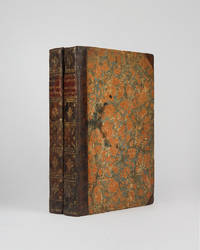
121437London Printed by Adam Islip 1601. . First edition in English first issue with the Islip imprint; 2 vols folio 30.5 x 20.7 cm; 2 title pages each with woodcut allegorical device woodcut head- and tailpieces decorative initials last leaf with errata on recto and colophon on verso one or two instances of early marginalia; lacking first blank leaf in each volume scattered light foxing and staining a few marginal open and closed tears scattered small rust holes costing a few letters faint dampstaining to a few gatherings; late 18th-century half calf over marbled paper-covered boards edges speckled red sometime rebacked with original spines laid down gilt tooling to spines red morocco title labels to spines lettered in gilt; a handsome copy.<br /> 'Over and over again it will be found that the source of some ancient piece of wisdom is Pliny.' PMM 5<br /><br />A handsome first edition first issue of Philemon Holland's renowned English translation of Pliny's Natural History. The most popular of Holland's translations it had never before been printed in English and would not be attempted again for another 250 years.<br /><br />One of the greatest translators of the Elizabethan age Holland's Pliny was an important source for Shakespeare. 'In Othello's allusion to the Pontic Sea Shakespeare was clearly drawing upon Pliny's Historie as translated by Holland Similarly Pliny has also been cited as a source for Othello's reference to the "medicinal gum" of "the Arabian trees"' Payne Search for Meaning 63 and many trace Caliban in The Tempest to Holland's Pliny.<br /><br />'The importance of Pliny lay not so much that he was an inexhaustible source for monsters eclipses and the stranger habits of all created things but that in the pages of Philemon Holland's translation Shakespeare found that emphasis on Nature which he employed and re-interpreted in the tragedy' Evans The Language of Shakespeare's Plays.<br /> STC 20029.5; Pforzheimer 496; ESTC S115918; Brueggemann 670; Lowndes 1885; cf. PMM 5. London, Printed by Adam Islip, 1601. hardcover
156785Cologne: Taschen 2014 . Signed by the artist and by the band Limited Art Edition of 75 numbered copies with a print of Mick Jagger signed by David Bailey on the verso from the photo shoot used for the Goat's Head Soup album cover. This is number 35. From a total edition of 1600 copies signed by the band members of the Rolling Stones: Jagger Richards Watts and Wood. A photographic record charting the Stones' remarkable history and lifestyle. With an appendix including the Stones in the media a Stones timeline discography and photographers' biographies. Folio. Over 500 pages of photographs including 3 fold-outs by David Bailey Peter Beard Cecil Beaton Bob Bonis Anton Corbijn Annie Leibovitz Gered Mankowitz Helmut Newton Norman Parkinson Bent Rej Ethan Russell Albert Watson and others. Original illustrated boards. Housed in a full leather purple clamshell box with The Rolling stones lips logo to the front cover. With the print Mick Jagger 1973 housed in full leather purple folder with The Rolling stones lips logo on the front cover. With the original packing box. In fine condition. hardcover
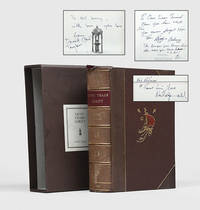
174385Guildford: Genesis Publications Limited in association with Hedley New Zealand and Hedley Australia 1984. Ringo's manager's copy signed by three of the Beatles First edition number 121 of a limited edition of 2000 copies signed by George Harrison Derek Taylor the Beatles's publicist and the illustrator Larry Smith. This is a presentation copy to Hilary Gerrard Ringo Starr's manager and director of Apple Corps and is inscribed to him by Taylor Harrison Paul McCartney Ringo Starr Barbara Bach Starr's wife Neil Aspinall chief executive of Apple Corps and singer-songwriter Harry Nilsson nicknamed the "American Beatle". Ringo Starr and his wife Barbara Bach have inscribed the copyright page "To Our Dear Friend Once you have met Him you never forget Him Love Ringo xxx & Barbara xxx". Bach has added "The longer you know him the more you love him! & I do! B". The limitation page is inscribed "For Hilary I love him too Neil Aspinall". Aspinall was first employed by the Beatles as a road manager and went on to head Apple Corps. Below the author has written "For Hilary another fine limited edition from an old admirer and friend. Lots of love & warmth - Derek aka Derek Taylor. George Harrison has inscribed beneath his foreword "To Hilary - with lots of love and wishes for all our Peace of Minds for ever and ever Amen - with a drawing of an Om and a cross. An inscription on the verso of the Author's Note reads "To Hill 'arry with love yea love from Derek Paul Taylor" an in-joke from Paul McCartney. Lastly inscribed on the afterword by Harry Nilsson "To the greatest man alive! And to Viv - Onward and upward said the progressive midget with love at Xmas '84 signature or H. N. or Hubba OK and more love & more & more & more.". Hilary Gerrard was Ringo Starr's business manager from the early 1970s and a director of the Beatles Apple Corps Limited. Fifty Years Adrift is the autobiography of Taylor and is "the companion volume to I Me Mine" prospectus. "Taylor was many things: an elegant writer who could flip into the crudest earthiest language; a press officer who would go beyond the call of duty at the same time as he placed advertorial copy in the pop magazines of the time; a Beatle intimate taking remedial acid trips with John Lennon at the same time as he was an employee if not a servant. He defined and extended what it was to be a PR at the same time as he retained a cool journalistic eye. In the end he preserved what was best about the high Sixties for future generations. Taylor had remained close to George Harrison who contributed addenda to 1984's Fifty Years Adrift a limited-edition book that expanded the Sixties' coverage of As Time Goes By" Savage. Quarto. Colour frontispiece with tissue guard lavishly illustrated with Beatles memorabilia and half-tones from photographs. Original half calf red morocco spine label spine lettered and ruled in gilt compartments stamped in blind sides and corners trimmed with single gilt fillet brown cloth sides vignette on front cover in red and gilt rear cover with Derek Taylor's signature stamped in gilt illustrated endpapers from a design by Larry Smith edges gilt original red silk ribbon and colour concert ticket bookmark. Housed in the publisher's brown slipcase with paper title label. Spine of book scuffed and slipcase lightly bumped a very good copy. hardcover
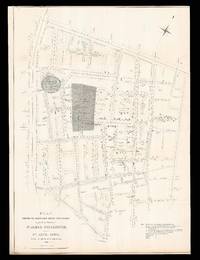
185516264London: HMSO 1855. 810 by 580mm. 32 by 22.75 inches. Folding lithograph plan. Rare epidemiological plan of Soho that accompanied the General Board of Health's exhaustive report into the 1854 Broad Street cholera outbreak. Cholera is a contagious disease caused by the bacterium vibrio cholerae. The bacteria lives in warm salty stagnant waters and is contracted when an individual ingests water or food contaminated with the bacteria. In the most severe strains the bacteria multiplies dramatically within the individual's gut causing the intestine to release increasing amounts of water leading to severe diarrhoea vomiting and rapid loss of the fluids and can if untreated lead to death within 24 hours. The majority of epidemics are caused when the faecal matter of an infected individual contaminates the water supply. It has been estimated that since the beginning of the nineteenth century cholera has been responsible for some 50 million deaths and although relatively simple rehydration treatments are now readily available according to the World Health Organisation some 120000 people a year still die from the disease. The Broad Street outbreak The London epidemic of 1853-54 was part of the larger 1846-1860 cholera pandemic - the third such pandemic to occur since 1817 - and the second time that the disease had spread to British shores. The Broad Street outbreak which was to be traced by Dr John Snow to a contaminated water pump outside number 40 Broad Street was a particularly virulent strain and would result in the deaths of 500 people over a period of just ten days; by the end of the outbreak a total of 619 people would have succumbed to cholera leading the Observer newspaper to note that "such mortality in so short a time is almost unparalleled in this country". The Broad Street outbreak led to the publication of two reports and a monograph: The General Board of Health BoH The Report on the Cholera Epidemic of 1854 1855; The Cholera Inquiry Committee 1855 set up by the Parish of St James's; and Doctor John Snow On the Mode and Communication of Cholera 2nd edition 1855. Although Snow's work is now seen as one of the foundation stones of epidemiology its argument - that cholera was a waterborne disease - was not widely held by the Victorian medical establishment with prominent people such as Edwin Chadwick head of the first General Board of Health expounding the view that cholera was an airborne disease brought about by foul odours caused by unsanitary conditions. Although Snow was to prove that the airborne hypothesis was erroneous the 'miasmatic' theory with its instance that "all smell is disease" would be the catalyst for many of the great municipal sanitary improvements - such as Bazalgette's great sewer - carried out during the Victorian era. Formation of the General Board of Health In 1848 Parliament passed the Public Health Act which instituted the Board of Health for a period of five years with powers to sanction expenditure for sanitary improvements requested by local government and in the event of an epidemic to provide guidance to the government's response. The board was headed by and was the brainchild of Edwin Chadwick whose 1842 General report on the Sanitary condition of the Labouring Population of Great Britain has been called the "fundamental document on modern public health" Rosen. "The creation of the Board of Health was a high point of the great Victorian enterprise of sanitary reform whose central idea was that environmental circumstances particularly pollution of the air and water defective sanitation dampness filth and overcrowding were causes of disease particularly epidemic disease and these diseases often killed the wage earners left poor working families impoverished pushed widows and orphans into workhouses and undermined the moral fibre of the working classes" Paneth. Although the Board was successful in enacting a great many sanitary improvements over the next five years Chadwick's brusque and arrogant manner led to the board's charter not being renewed by Parliament and on 31st July 1854 the members of the board were dismissed. Unfortunately for the government the disbanding of the board coincided with a sharp increase in the number of cholera cases in London from 1 a week to 133 a week during the month of July. On Augsut 1st Parliament instituted another but much weaker Board of Health: its charter had to be renewed annually and consisted of only one board member which had to be filled by a sitting Member of Parliament. The MP chosen was Sir Benjamin Hall who by dint of not being Chadwick was deemed eminently qualified for the job; by the time he assumed his role on the 12th August cases of cholera in London had increased to 644 a week. The Board of Health's Cholera Investigation On the 13th August Hall met with his advisory council which he had rapidly put together the council consisted of some of the most eminent medical practitioners of the day including: John Ayrton Paris and James Alderson president and treasurer respectively of the Royal College of Physicians; William Lawrence vice-president of the Royal College of Surgeons; James Clark physician ordinary to the Queen; Benjamin Babington founder and president of the London Epidemiological Society; and William Farr compiler of the Weekly Returns which included among other statistics deaths and cause of death - a resource that greatly aided Snow in his research. The council divided itself into three sub committees: Committee for Scientific Inquiries CSI which would be responsible for the majority of the cholera report; the Committee for Treatments; and the Committee for Foreign Correspondence. The work of the CSI started on the 5th September 1854 when Drs Fraser Hughes and Ludlow began house to house investigations of the Golden Square area around the same time that Snow was also commencing his investigations; and three days before St James's parish would remove the handle from the water pump on Broad Street on the advice of Snow. The report details some 800 houses listing their inhabitants any deaths from cholera and the sanitary state of the premises which was often terrible and included the condition of any cesspools "bad-smells from water-closets" and untrapped drains. The house to house investigations were supplemented by the scientific report. Hall employed three men to carry out investigations for the committee: James Glaisher superintendent of the magnetic and meteorological department at Greenwich and a founder of the British Meteorological Society; Richard Dundas Thomson professor of chemistry at St. Thomas Hospital; and Arthur Hill Hassall author of the first textbook of microscopic anatomy in English 1846 and famed for his revelations through microscopy of the extraordinarily frequent contamination of food and water in London by adulterants and animalcules Paneth. Although Chadwick was no longer in charge a brief look at the committee's make up clearly shows that the sanitarians still dominated. Their belief that the atmosphere was critical in the spread of disease is demonstrated by the fact that almost a third of the scientific report contains the investigations of meteorologist James Glashier. The Map The map that accompanies the report is a great deal larger and includes much more information than the map that Snow produced for his monograph. Based on the map produced by the Metropolitan Commission of Sewers which was also published in the report carried out by the St James's Parish it covers a much greater area and marks not only cholera deaths and pump locations but also: house numbers new and old sewers sewer grates trapped and untrapped side entrances and ventilators. The map has been updated with the number of cholera deaths in the area tracing people who were hospitalised and those that worked or visited the area. To the upper left are two shaded areas. The first a circle which bisects Little Marlborough Street titled: The erroneously supposed position of the ancient plague pit shewn in the map of the Commissioners of Sewers and the second a rectangle titled: Extent of Craven Estate corresponding with site of pest-field three acres two chains which covers much of Marshall Street and houses either side and ends just west of the water pump on Broad Street - the epicentre of the outbreak. Both sites mark supposed burial pits dug during the Great Plague of 1665. Many had argued that the disturbance of the pits when new sewers where dug in the 1840s and 1850s was responsible for the severity of the Golden Square outbreak. However this theory is conclusively dismissed in the report stating that no burial remains were encountered when the sewers were dug. A comparison of the maps that accompany Snow's monogram and the BoH's report clearly illustrates the authors' varying approach to the epidemic. Snow's map is narrowly focused on the centre of the outbreak and marks only the individual deaths marked by black coffin like lines to each house together with the position of the water pumps; Snow clearly wanting the viewer to draw the causal link between the Broad Street pump and its proximity to a large number of cholera deaths. The BoH's map on the other hand shows a much great area and contains much more information sewers drains plague pits etc. Snow's correlation just like the report that this map accompanied is lost under a mass of miasmic information. In hindsight the report just like the present map can be seen as too large and unwieldy the miasma theory at its heart "predicted to much and therefor was difficult to contradict or falsify"Paneth. In contrast Snow's economy of purpose his monograph at just 162 pages is almost a third the length of the BoH report shines through. "The strength of Snow's hypothesis lies in its exclusion of other alternatives; by insisting on the singular mode of transmission i.e. water Snow was able to imagine circumstances that would invalidate his hypothesis" Paneth. For example the exclusion of both the Broad Street Brewery works and the local Poor House from the cholera epidemic led Snow to investigate their water supply both drew them from independent sources; as did the death of a widow from cholera in faraway Hampstead who was so fond of the Broad Street water that she had her nephews send her bottles of it. Snow is keen to challenge his hypothesis where ever possible alas the BoH report contains no such challenges with the authors suffering from a large degree of confirmation bias. Although the BoH report is now largely forgotten and its hypothesis discredited it was favourably received at the time and would be the catalyst for the creation of The Metropolitan Board of Works arguably the body whose policies would make the greatest impact on the health and wellbeing of Londoners in the nineteenth century. Setup by the head of the BoH Joseph Hall in 1855 it would be responsible for among other things the clearing of slums the creation of London's numerous parks and Bazalgette's great sewerage works. Rarity We are unaware of individual examples of the plan appearing on the market in the last fifty years. HMSO, unknown
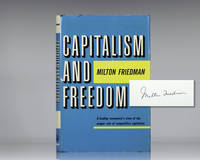
196223005Chicago: University of Chicago Press 1962. First edition of Friedman's magnum opus. Octavo original blue cloth. Signed by Milton Friedman on the front free endpaper in a contemporary hand. Fine in a very good dust jacket with light rubbing. Housed in a custom half morocco clamshell box made by the Harcourt Bindery. Rare signed. "Friedman a laissez-faire economist and professor at the University of Chicago is considered one of the leading modern exponents of liberalism in the 19th-century European sense. In Capitalism and Freedom he argued for a negative income tax or guaranteed income to supersede centralized bureaucratized social welfare services which in his view are inimical to the traditional values of individualism and useful work" Britannica. Selected by the Times Literary Supplement as one of the "hundred most influential books since the war". It also placed tenth on the list of the 100 best non-fiction books of the twentieth century compiled by National Review and on Time Magazine's top 100 non-fiction books written in English since 1923. University of Chicago Press hardcover
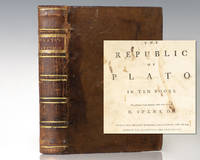
1763138322Glasgow: Printed by Robert and Andrew Foulis 1763. First edition in English of Plato's Republic marking the first appearance in the English language of Plato's profoundly influential dialogue concerning the nature of justice. Quarto bound in full polished calf with raised gilt bands to the spine morocco spine label lettered in gilt all edges speckled red. Harry Spens was a minister at the parish of Wemyss in Fife and respected classicist. In his introduction he professes his intent in his translation is: "To give the English Reader a view of Plato's sentiments and manner of writing and to stir up the youth to the study of the Ancients." Richard Garnett in his own introduction of the Everyman's Library reprint of this translation laments the relative lack of critical attention paid to it writing: "On the whole Spens's version should not be lightly esteemed. It is clearly the work of a scholar and a man of considerable literary ability." The brothers Robert and Andrew Foulis were renowned printers of classical works in their time sometimes referred to as 'the Elzevirs of Britain.' Their works mostly intended for scholars were "much sought after as admirable specimens of typography and are noticeable for their severely plain elegance" DNB 7: 514. In very good condition. Rare and desirable. "Its setting and its characters are full of political meaning. Its arguments are tantalizing and its fables fascinating… Plato's utopia is alarming and his metaphysics are intoxicating" Levi 348. The Republic "has reinforced dedication awakened vocations to leadership and strengthened the morale of those modest and competent souls who are always in reality the guardians of society" Rexroth 79. Printed by Robert and Andrew Foulis unknown
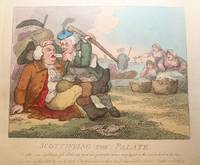
1805007260London: E. Jackson and G. Kearsley 1805. First Edition. Quarter Calf. Cloth slipcase. Very Good. Scarce hand-colored copy of work two parts bound in one. Oblong 27 by 34.5 cm. 20 hand-colored etched plates. The prints are inspired by Boswell's "Journal of a Tour in the Hebrides with Samuel Johnson" which originally appeared in 1785. Additional plates include an engraved portrait of Johnson by Thomas Trotter two hand-colored Cruikshank plates satirizing life in Scotland and the seven etched plates from "Outlines of the Opposition Collected from the Designs of the Most Capital Jacobin Artists" published by Hannah Humphrey in 1794 -- these plates are not colored. Binding heavily rubbed along edges with some chipping and loss of paper pastedown. Calf abraded. Title written in ink on front cover. The etched plate series with a fair amount of light foxing. E. Jackson and G. Kearsley unknown
197478309Washington DC: U. S. Government Printing Office 1974. Presumed First Edition First printing. Wraps. Good/No dust jackets present. This is a complete set of the Statement of Information--28 separately bound items. The July 12 1974 the Committee released of its accumulated evidence on the case which ran to thousands of pages. Book I: Events Following the Watergate Break-in June 19 1972-March 1 1974 ix 1 242 pages; Book II: Department of Justice-ITT Litigation ix 1 208 6 pages; Book III: Political Contributions by Milk Producers Cooperatives: The 1971 Milk Price Support Decision ix 1 217 1 pages; Book IV: White House Surveillance Activities ix 1 225 1 pages. Book II: Events Following the Watergate Break-in June 17 1972-February 9 1973 xii 680 4 pages; Book III Part 1 Events Following the Watergate Break-in June 20 1972-March 22 1973 xii 687 5 pages; Book III Part 2 Events Following the Watergate Break-in June 20 1972-March 22 1973 iii 1 689-1281 3 pages; Book IV Part 1 Events Following the Watergate Break-in March 22 1973--April 30 1973 xii 551 5 pages; Book IV Part 2 Events Following the Watergate Break-in March 22 1973-April 30 1973 iii 555-1080 pages; Book IV Part 3 Events Following the Watergate Break-in March 22 1973--April 30 1973 iii 1 1081-1659 1 pages spine discolored; Book V--Part 1 Department of Justice/ITT Litigation--Richard Kleindienst Nomination Hearings xii 477 1; Book V--Part 2 Department of Justice/ITT Litigation--Richard Kleindienst Nomination Hearings ii 2 479-980 4; Book VI--Part 1 Political Contributions by Milk Producers Cooperatives: The 1971 Milk Price Support Decision ix 1462 pages; Book VI--Part 2 Political Contributions by Milk Producers Cooperatives: The 1971 Milk Price Support Decision iii 1463-984 2 pages; Book VII--Part 1 White House Surveillance Activities and Campaign Activities xii 522 2 pages; Book VII--Part 2 White House Surveillance Activities and Campaign Activities iii 1 523-1177 3 pages; Book VII--Part 3 White House Surveillance Activities and Campaign Activities iii 1 1179-1613 1 pages; Book VII--Part 4 White House Surveillance Activities and Campaign Activities iii 1 1615-2090 2 pages; Book VIII: Internal Revenue Service xii 440 4 pages; Book IX--Part 1: Watergate Special Prosecutors Judiciary Committee's Impeachment Inquiry April 30 1973-July 1 1974 xii 521 3 pages; Book IX--Part 2: Watergate Special Prosecutors Judiciary Committee's Impeachment Inquiry April 30 1973-July 1 1974 iii 1 523-1069 1 pages; Book X: Tax Deduction for Gift of Papers vii 1 552 pages; Book XI: Bombing of Cambodia xii 599 1 pages; Book XII: Impoundment of Funds Government Expenditures on President Nixon's Private Properties at San Clemente and Key Biscayne vii 1 187 1 pages; Appendix I: Presidential Statements on the Watergate Break-in and Its Investigation iv 110 2 pages; Appendix II: Papers in Criminal Cases Initiated by The Watergate Special Prosecution Force June 27 1973-August 2 1974 iv 379 3 pages; Appendix III: Supplementary Documents: White House Edited Transcripts April 4 1972 March 22 1973 June 23 1972; John Ehrlichman Handwritten Notes: Affidavit of Bruce A. Kehrli ii 2271 1 pages; and Appendix IV: Political Matters Memoranda August 13 2972-September 18 1972 v 1 151 3 pages. The impeachment process against Richard Nixon began in the United States House of Representatives on October 30 1973 following the series of high-level resignations and firings widely called the "Saturday Night Massacre" during the course of the Watergate scandal. The House Committee on the Judiciary set up an impeachment inquiry staff and began investigations into possible impeachable offenses by Richard Nixon the 37th president of the United States. The process was formally initiated on February 6 1974 when the House granted the Judiciary Committee authority to investigate whether sufficient grounds existed to impeach Nixon of high crimes and misdemeanors under Article II Section 4 of the United States Constitution. This investigation was undertaken one year after the United States Senate established the Select Committee on Presidential Campaign Activities to investigate the break-in at the Democratic National Committee headquarters at the Watergate office complex during the 1972 presidential election and the Republican Nixon administration's attempted cover-up of its involvement; during those hearings the scope of the scandal became apparent and the existence of the Nixon White House tapes was revealed. On May 9 1974 formal hearings in the impeachment inquiry of Nixon began culminating July 27-30 1974 when the Judiciary Committee approved three articles of impeachment. These articles charged Nixon with: 1 obstruction of justice; 2 abuse of power; and 3 contempt of Congress. These articles were reported to the House of Representatives for final action with members of the committee voting in favor of one or more of the articles. Republican congressional leaders met with Nixon and told him that his impeachment and removal were all but certain. Thereupon Nixon gave up the struggle to remain in office resigning the presidency on August 9 1974 before the full House could vote on the articles of impeachment. The House brought the impeachment process against him to an official close two weeks later. U. S. Government Printing Office paperback