122 150 résultats
lennon-and-mccartney-shar<p data-mce-fragment="1"><span data-mce-fragment="1">On the 19th of February 1963 John Paul George and Ringo discovered that 'Please Please Me' had reached Number One on the UK singles chart. On that very day photographer Michael Ward embarked on a journey from London to photograph them</span></p><p data-mce-fragment="1"><span data-mce-fragment="1">"I didn't know who they were; I'd never heard of them" he quipped. "I wasn't interested in them and they weren't remotely interested in me — or in having their photographs taken!"</span></p><p data-mce-fragment="1"><span data-mce-fragment="1">After becoming acquainted Ward's photographs beautifully captured The <span class="il" data-mce-fragment="1">Beatles</span> on the brink of Beatlemania performing one of their final gigs at The Cavern. This is one of those famous and highly sought after shots. Here signed titled and dated by the famous photographer Michael Ward the print s</span><span data-mce-fragment="1">hows John Lennon and Paul McCartney onstage the Cavern Club sharing the microphone.</span></p><p data-mce-fragment="1">Michael Ward 1929-2011 documented renowned musicians actors and visual artists such as Pattie Boyd Julie Christie Marianne Faithfull Gary Cooper Hugh Grant David Hockney and Pauline Boty. He captured iconic images of The Beatles at The Cavern Club in 1963 and went on to photograph The Rolling Stones a year later.</p><p data-mce-fragment="1">Ward was a contributor to The Evening Standard for 4 years and then worked at The Sunday Times for 30 years until retirement covering many events from the Troubles in Northern Ireland to the Turkish invasion of Cyprus. He was married to Elizabeth Seal an award-winning actress for 40 years before passing away in 2011. His works reside in the National Portrait Gallery’s permanent collection.</p> unknown
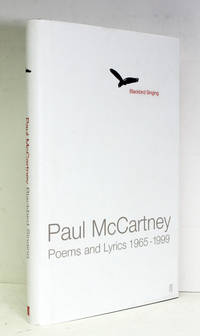
031664UK: Faber 2001. First Edition 2nd Printing. Cloth. Fine/Near Fine. 8vo - over 7¾" - 9¾" tall. 1st Edition 2nd Imp 2001. Signed by Paul McCartney to the endpaper. Inscription reads 'Cheers! Paul McCartney. Book is fine and bright. The complete wrapper is near fine and bright. Full provenience. Ref A1234 <br/> <br/> Faber hardcover
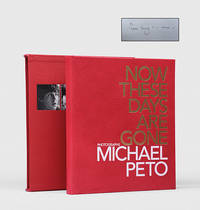
167179Guildford: Genesis Publications Limited 2006. First edition first impression no 61 of 350 deluxe copies signed by Alan Langlands Principal and Vice-Chancellor of the University of Dundee and Richard Lester director of Help and A Hard Days Night with three additional photographic prints of John Lennon and Peter Cook presented in a red envelope from a total edition of 2500. When Peto died in 1970 he left the University of Dundee a collection of 130000 prints and negatives including photos of the Beatles taken in 1965 while shooting their film Help. Quarto. Full page photographs by Peto throughout. Original full red leather lettering to front cover in white and gilt all edges gilt printed on 200 gsm matt art paper. With the red leather tipped slipcase inset with four portraits of The Beatles. All housed in a printed draw-string cloth bag. All in fine condition. hardcover
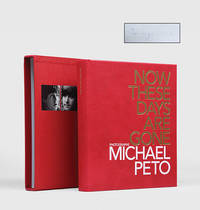
176208Guildford: Genesis Publications Limited 2006. First edition first impression number 336 of 350 deluxe copies signed by Alan Langlands Principal and Vice-Chancellor of the University of Dundee and Richard Lester director of Help and A Hard Days Night with three additional photographic prints of John Lennon and Peter Cook presented in a red envelope from a total edition of 2500. When Peto died in 1970 he left the University of Dundee a collection of 130000 prints and negatives including photos of the Beatles taken in 1965 while shooting their film Help. Quarto. Full-page photographs by Peto throughout. Original full red leather lettering to front cover in white and gilt all edges gilt printed on 200 gsm matt art paper. With the red leather tipped slipcase inset with four portraits of The Beatles. All housed in a printed draw-string cloth bag. A fine copy. hardcover
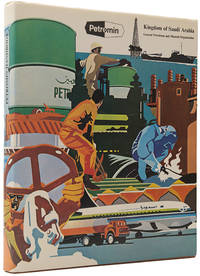
111289Riyadh Petromin 1977. . First edition. 4to 324 pp. illustrated throughout original brown cloth gilt pictorial dustwrapper a fine copy.<br /> Original issued in English as here French and Arabic this is a fine copy of the history of Petromin The General Petroleum and Mineral Organization from its foundation in 1962 up to 1977. The Kingdom's first national oil company Petromin was founded to develop petroleum and mineral resources to the optimum economic advantage of the Kingdom of Saudi Arabia guided by the Government.<br /> Riyadh, Petromin, 1977. hardcover
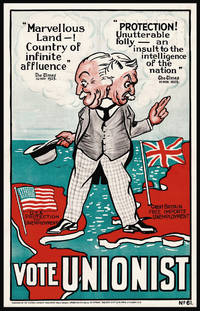
192412879London: National Unionist Association Palace Chambers ND but 1924. 844 by 535mm 33.25 by 21 inches. Lithograph printed in blue red and black at neat line plus margins folds flattened a bit of offsetting at top backed with poster canvas. The poster depicts David Lloyd George leader of the Liberal Party in 1924. He had previously been the Prime Minister of a Conservative-Liberal coalition during the war and kept much of that coalition with the Conservative party in order to win the 1918 election which he did. The coalition had broken down by 1922 and Lloyd George had mended his fences with the other Liberal politician H.H. Asquith. In the 1924 election a reunited Liberal party ran against the Conservative party led by Stanley Baldwin which was advocating tariffs on imported goods. Free Trade had been a British policy for most of the Victorian and Edwardian area especially within the Liberal party. This Conservative poster quotes David Lloyd George's opinions on protectionism and the dynamism of America when interviewed by The Times newspaper and makes the point that the USA have high tariffs and lots of employment whilst the UK has no tariffs and unemployment. National Unionist Association, Palace Chambers, unknown
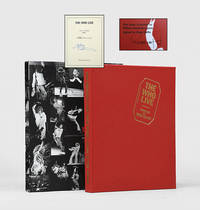
165640Guildford: Genesis Publications Limited 2000. Signed by Pete Townshend First edition first printing. No. 100 of 250 deluxe copies signed by Pete Townsend and Halfin together with a CD "Live at Leeds" inside a pocket on the front pastedown. Quarto. Photographs compiled by Halfin include George Bodner Jim Cummins Ian Dickinson Carl L. Dunn Robert Ellis Harry Goodwin Ross Halfin Laurens van Houten Jim Marshall Paul Natkin Terry O'Neill Gilbert Nencioli Barry Plummer Ron Pownall Chuck Pulin Micheal Putland Jean-Louis Rancurel Christian Rose Chris Walter Barrie Wentzell Michael Zagaris and Neil Zlozower. Original full red leather lettering to front cover and spine gilt. Housed in an illustrated slipcase. With the original packing box. Fine in fine slipcase. hardcover
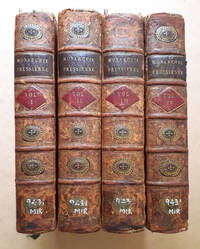
#BIBLIO-1316<p>De la Monarchie Prussienne sous Frédéric le Grand; avec un appendice contenant des recherches sur la situation actuelle des principales contrées De L'allemagne. Par le Comte de Mirabeau. Tome I-IV.</p> On the Prussian Monarchy under Frederick the Great; with an appendix containing research on the current situation of the principal countries of Germany. By Honoré Gabriel Riqueti the Count of Mirabeau. Volume I-IV. Four-volume set. First edition. Quarto/4to. Each volume measures around 8" x 10 1/4" x 2" 203mm x 260mm x 50mm. Pagination: 4 xliv 522 2; 4 566 6; 4 710; 4 560 3 pp. Published in London 1788. Hardback full mottled calf. Raised bands. Gilt-tooled borders to boards gilt decoration to spines and gilt-blocked titles with brown title labels and red volume labels. All page edges gilt. Marbled endpapers. Frontispiece portrait of Frederick the Great to first volume engraved by H. Marais in 1788 after A. Graf and a plate of the "Metropolis of Scotland Colledge" opposite page 489 of the third volume. Contains numerous foldout tables. Notes of errata at rear. Green silk ribbon markers to volumes I II and IV lacking in volume III.Ex-library books containing typical markings including white library numbering to spines labels and cards to front pastedowns and endpapers and stamps to titles & final leaves. A little pencil writing to endpapers. Scuffing and marking to binding some tearing. Other signs of wear rubbing at edges and on hinges. Bumped and torn corners and some chipping and loss to heads and tails of spines. Some cracking to hinges but binding quite firm. Some scuffing and marking to page edges but gilt detail still vivid. A little tearing to the odd page. Some toning foxing soiling and staining to endpapers. A little grub here and there and minor toning to outer edges throughout but otherwise page surfaces generally quite clean with no underlining marginalia etc. A lovely set. See pictures for further information. About the author:<em>Honoré Gabriel Riqueti Count of Mirabeau French: miÊabo; 9 March 1749 – 2 April 1791 was a French writer orator statesman and a prominent figure of the early stages of the French Revolution.</em><em>A member of the nobility Mirabeau had been involved in numerous scandals that had left his reputation in ruins. Well-known for his oratory skills Mirabeau quickly rose to the top of the French political hierarchy following his election to the Estates-General in 1789 and was recognized as a leader of the newly organized National Assembly. Among the revolutionaries Mirabeau was an advocate of the moderate position of constitutional monarchy built on the model of Great Britain. He was also a leading member of the Jacobin Club.</em><em>Mirabeau died of pericarditis in 1791 and was regarded as a national hero and a father of the Revolution. He received a grand burial and was the first to be interred at the Panthéon. During the 1792 Trial of Louis XVI the discovery that Mirabeau had secretly been in the pay of the king brought him into posthumous disgrace and two years later his remains were removed from the Panthéon. Historians are split on whether Mirabeau was a great leader who almost saved the nation from the Terror a venal demagogue lacking political or moral values or a traitor in the pay of the enemy.</em> Source: Wiki hardcover
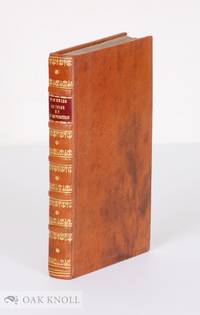
1759137120Paris: J. Barbou 1759. Full period French binding in Calf five raised bands gilt ornamentation on spine author and title in gilt on red leather spine label in second compartment. 8vo. Full period French binding in Calf five raised bands gilt ornamentation on spine author and title in gilt on red leather spine label in second compartment. 263 pages. First edition Bigmore and Wyman p.228. Minor soiling to the text block else a fine copy.<BR> <br /> <BR> <br /> In this volume Fournier sets out to prove that Gutenberg was not the inventor of the printing press by examining the history of printing. He believes that the technology Gutenberg made popular existed long before the German printer's work. <BR> <br /> <BR> <br /> "Peter Simon Fournier a French engraver and letter-founder was born at Paris 1712 and died 1768. He studied under Colson painter of the Academy of Saint Luc and devoted himself first to the art of wood-engraving; he afterwards as an engraver on steel rendered himself famous in all countries. In some of his works he seeks to prove that Gutenberg is not the inventor of printing and maintains that long before Gutenberg engraving on wood had been employed for printing images and inscriptions; that during his residence in Strasburg Gutenberg attempted the application of this art to the printing of books and that on his return to Mayence he first printed the Donatus and the Catholicon of Johannes de Janua with engraved and solid blocks. Fournier's ingenious theories were ably refuted by Baron Heinecken in his "Idée Générale d'une Collection complette d'Estamples" Leipsic: 1771" Bigmore & Wyman p 229. J. Barbou unknown
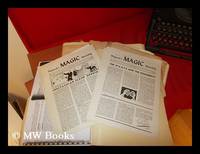
280956Various Publishers. First Edition. Softcover. Near fine archive in the original stiff-card wrappers; edges very slightly dust-dulled and toned. Remains particularly and surprisingly well-preserved; tight bright clean and especially sharp-cornered. Physical description; 8 folders. Notes; Various dates and publishers. Subjects; Magic. Conjuring Tricks. Mac the Magician. Wilfred MacEwan. Various Publishers paperback
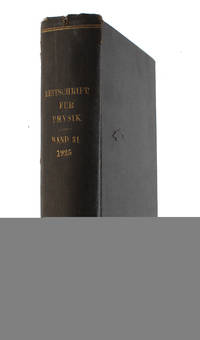
192547417Berlin Julius Springer 1925. 8vo. Contemp. full cloth. Gilt spine. Wear to top of spine and with 2 tears to hinges at upper spine. Inner backhinge nearly broken. A stamp to foot of a few leaves In: 'Zeitschrift für Physik' Volume 31. VIII952 pp. textillustr. Entire volume offered. Pauli's paper: pp.765-783. Internally clean and fine. <br/><br/><em>First edition of the first announcement of Pauli's Exclusion Principle which gives a criterion for the electronic structure of atoms and explains the periodic table and the combining properties of the elements.Pauli first formulated his exclusion principle in this article in an attempt to explain the structure of the periodic table. By introducing an additional quantum number namely the spin of an electron to the already known three quantum numbers in Bohr's atom model and by postulating that no two electrons can have the same four quantum numbers Pauli could explain the number of electrons allowed in the outermost shell e.g. explaining the varying lengths of successive periods in the table. The exclusion principle turned out to be applicable to all fermions and thus plays a role in a variety of physical phenomena. For example it explains the formation of degenerate matter in white dwarfs and neutron stars. In 1945 Pauli received the Nobel Prize in physics "for the discovery of the Exclusion Principle also called the Pauli Principle".This volume also contains a paper by Heisenberg: 'Über eine Anwendung des Korrespondenzprinzips auf die Frage der Polarisation des Floureszenzlichtes' A. Einstein: "Bemerkung zu P. Jordans Abhandlung "Zur Theorie der Quantenstrahlung"and another paper by Pauli: 'Über den Einfluss der Geschwindigkeitsabhängigkeit der Elektronenmasse auf den Zeemaneffekt' Zeeman-Effect and the Dependence of Electron-Mass on the Velocity. </em> hardcover
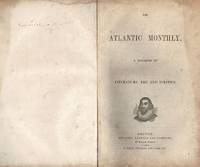
185731942AB1857. Boston The Atlantic Monthly 1857-1858. Octavo. IV 768 pages. Hardcover / Original Half-leather with gilt lettering on spine. Binding in poor but still good condition with some stronger signs of wear spine starting mild foxing throughout and some faded damp-staining to the outer paper-margins inside only. Endpaper Half-title and titlepage slightly detached. This is the very rare inaugural Atlantic Volume with a wonderful irish provenance possibly even a relation to Fitz-James O'Brien. The Atlantic is an American magazine and multi-platform publisher based in Washington D.C. It features articles on politics foreign affairs business and the economy culture and the arts technology and science. It was founded in 1857 in Boston as The Atlantic Monthly a literary and cultural magazine that published leading writers' commentary on education the abolition of slavery and other major political issues of that time. Its founders included Francis H. Underwood and prominent writers Ralph Waldo Emerson Oliver Wendell Holmes Sr. Henry Wadsworth Longfellow Harriet Beecher Stowe and John Greenleaf Whittier. James Russell Lowell was its first editor. During the 19th and 20th centuries the magazine also published the annual The Atlantic Monthly Almanac. Wikipedia _________________________________ O'Brien Fitz-James 182862 writer was born Michael Fitzjames O'Brien in Cork the only child of James O'Brien 17801839 county coroner and his wife Eliza daughter of Michael O'Driscoll of Baltimore Co. Cork. They were well off and lived at 58 South Mall Cork city. Eliza's father was a wealthy landowner from an old well established family and was known locally as The O'Driscoll. His grandson always called Fitzjames which he later wrote as Fitz-James was his sole heir. After James O'Brien's death c.1839 his widow a noted beauty married a wealthy Corkman De Courcy O'Grady. They settled in Castleconnell Co. Limerick and Fitzjames was educated privately and enjoyed an active sporting life. His first published poem was inspired by the famine and advocated escaping English tyranny by flight to America. Charles Gavan Duffy qv published it in The Nation 15 March 1845 under the caustic introduction: This might be called The Coward's Resource. Undeterred O'Brien continued to send in verse under pseudonyms such as Heremon and Fineen Dhuv. His most celebrated poem was the romantic I know a lake which appeared on 26 July 1845. Its unattributed inclusion in Edward Hayes's popular The ballads of Ireland 1855 ensured it lasting fame. From July 1848 he also contributed to the Cork Magazine and sent patriotic verse to the Irishman. O'Brien always claimed falsely to have attended TCD. He probably spent some time in France as he was fluent in the language. On his twenty-first birthday in 1849 he came into his inheritance of around £8000 and left for London. There he ran through his money in two years of luxurious living. He had work published in the Metropolitan and the Parlour magazines but later complained of the difficulty of breaking into literary London. His first story The phantom light made good use of Irish peasant superstition and appeared in the Home Companion. Afterwards he seldom used Irish settings in his stories and turned his back on his earlier patriotism. American friends noted that he seemed ashamed of his nationality and was delighted when mistaken for an Englishman. After an unhappy love affair with the wife of an officer he left London penniless at the end of 1851 for New York. He never returned never again lived within his means and never again fell in love although he had numerous affairs. O'Brien's entrée into New York's literary scene was swift and successful. He first contributed to the Lantern a comic magazine established by a fellow Irishman the actor John Brougham qv. For this he provided an autobiographical sketch of himself as The sentimental poet: of medium height with large eyes large nose and a head shaped like an isoceles triangle Wolle 37. This was a reference to his tiny chin caricatured by contemporary artists. Within months he was drama critic of the Saturday Press and by the end of the year was on the staff of the New York Daily Times to which he contributed stories poems literary reviews and essays. Other publications with which he was sporadically associated included Young Americans the Saturday Whig Review and the Atlantic Monthly. His play A gentleman of Ireland a picaresque tale of an Irishman in London opened Christmas 1854 and was a resounding success. The role of Gabriel Fitzmaurice was one of Brougham's favourites and he revived it frequently. At one such revival O'Brien reviewed his own play as a wonderfully crude production . . . the dialogue is sometimes smart but never witty . . . There is no characterisation everybody talks like everybody else Saturday Press 13 Nov. 1858. His most important connection was to the Harper brothers owners of Harpers Monthly and Harpers Weekly. To this he contributed his Man about town column from January to September 1857. A gossipy exuberant account of his adventures in which he amusingly satirises his poverty it made him famous; his biographer Francis Wolle credits him with initiating the column of personal comment . . . America's first columnist in the modern sense Wolle 133. However he was unable to sustain it for longer than nine months; though brilliant he was erratic and undisciplined. His friend the journalist R. H. Stoddard wrote: No American writer ever had such chances of success as Fitzjames O'Brien and but one American writer Poe ever threw such chances away so recklessly New York Tribune 6 Mar. 1881. O'Brien was among the most colourful characters in the circle centred on Pfaff's Cellar tavern at 653 Broadway where a table seating thirty was permanently reserved for bohemians including Henry Clapp Ada Clare and Walt Whitman who referred to O'Brien as very bright and the talk as very good. O'Brien always well dressed and generally well mannered got into brawls when drunk. He appeared thinly disguised in two novels of the period William North's The slave of the lamp 1855 and Bayard Taylor's John Godfrey's fortunes 1864. The three stories on which O'Brien's fame rests were written in 1858 and 1859. The diamond lens deals with a man who commits murder to obtain the perfect lens. This enables him to see a sylph in a drop of water; when the water evaporates he goes mad. What was it concerns an encounter with an invisible monster while The wondersmith is about diabolic toys which eventually attack their creator. Cleverly blending scientific rationalism with gothic horror they electrified readers and are still anthologised. O'Brien was named the Celtic Poe. Hoffmann Dickens and Sheridan Le Fanu qv were other discernible influences while he foreshadowed de Maupassant and H. G. Wells. On the outbreak of civil war in 1861 he enlisted in the 7th Regiment of the New York National Guard. Anxious for active service in June he began recruiting for a New York volunteer regiment to be called the McClellan Rifles. Numbers failed to reach the minimum regimental requirement but in January 1862 he was taken on to the staff of Gen. Frederick W. Lander and departed for Western Virginia. His high spirits athleticism and ability to turn out marching songs made him a great favourite. He received honourable mention for his bravery at the battle of Bloomery Gap 13 February 1862 and three days later his audacious behaviour during a skirmish led to a shoulder wound. This was improperly treated and he died of tetanus in camp on 6 April 1862 . His body was brought back to New York and held in the vault of Greenwood cemetery until it was finally interred on 27 November 1874. A compilation with biographical sketch by his friend William Winter was published in 1881 and brought him back to public notice. Since then his stories have survived in anthologies of the supernatural. His poetry has been largely dismissed as facile and derivative. His 1940s Dictionary of American Biography entry characterises him as minor and more significant as a personality than a writer and he is not included in American National Biography 1999; but his work has proved stubbornly popular with niche audiences. He has been translated into French Japanese Spanish and Italian and a new American edition of his stories appeared in two volumes in 1988. His literary criticism was recently compiled in Fitz-James O'Brien: selected literary journalism 18521860 edited by Wayne R. Kime 2003. Source: Bridget Hourican for THE DICTIONARY OF IRISH BIOGRAPHY hardcover
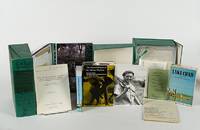
1937120361AB1937. Africa and the UK Various 1937 - 2012. 21 cm x 26 cm - 24.5 cm x 31 cm. Circa 2500 pages. Numerous monochrome and colour photographs throughout the collection. Includes Hardcover book with dustjacket softcover book reprints of academic journal articles in paper wrappers and a variety of loose material in cellophane files. The archive running from 1937 to 2012 is contained in two green 24.5 cm x 31 cm x 10.5 cm boxes four additional folders 32 cm x 24 cm and two hardcover volumes 21.5 cm x 26cm. Very good condition. Includes for example the following: Sylvia K. Sikes Lake Chad London: Eyre Methuen 1972 / Sylvia K. Sikes Lake Chad Versus the Sahara Desert Newbury: Mirage 2003 / Sylvia K. Sikes Habitat and Cardiovascular Disease: Observations made on Elephants Loxodonta Africana and Other Free-Living Animals in East Africa' Transactions of the Zoological Society of London 1969 32: 1-104 / Sylvia K. Sikes's hand-written notebook Records of Beetles of Interest 1937-1942 / Dr. Sylvia K. Sikes 'A Spotted Hyaena Crocuta Crocuta Erxl. as a Pet.' The Nigerian Field - The Journal of the Nigerian Field Society Vol.XXXIII No.2 April 1968 p.66-72 / Sylvia K. Sikes The Natural History of the Elephant London: Weidenfeld and Nicolson 1971 / Sylvia K. Sikes 'How to Tell the Age of an African Elephant' African Wild Life September 1967 Vol.21 No.3 p.191-202 / Dr Sylvia K. Sikes 'The Disturbed Habitat with Its Effect on the Health of Animal Populations with Special Reference to Cardiovascular Disease in Elephants' Proceedings of the Royal Society of Medicine February 1968 Vol.61 No.2 p.160-61 / Sylvia K. Sikes A typed 13-page account tipped-in on A4 of a 1951 safari / Sylvia K. Sikes printed copy of a letter from Sikes to Unknown for private circulation dated from 21.1.57. Sikes's newsletter from Nigerian College of Technology in Zaria in Northern Nigeria describing her missionary life and her evangelism / 'Report of a Workshop 'An International Centre for Manatee Research' 7-13 February 1974 Georgetown Guyana: The NATIONAL Science Research Council 1974 / Sylvia K. Sikes 'Cardiovascular Disease in Freeliving Wild Animals with Particular Reference to the African Elephant Loxodonta Africana' Thesis for Ph.D. University of London 1967 and etc. Sylvia K. Sikes 1925-2012 was a British Kenyan-born zoologist who wrote the first authoritative guide to the African elephant and established wildlife conservation programmes in Nigeria. A world-leading expert on the African elephant Sikes specialised in elephant heart health. She also authored two studies on the worsening ecological conditions in and around Lake Chad as its waters disappeared. Also trained as an educator Sikes taught in missionary schools in a number of African countries and helped set up and organise Evangelical Christian fellowship groups among students in Nigeria and Kenya. Due to political turmoil in Nigeria Sikes returned to the UK to farming and retirement. A detailed inventory of archival material of Sylvia Sikes is available as a Word document upon request. Please contact Inanna Rare Books for further information related to this collection. paperback
1913000743Washington State WA ALASKA AK. Good. 1913. On offer is a remarkable reference treasure trove and artifact of the Civil War - a 1913-1932 ledger of 225 certificates of application for membership to the Daughters of Union Veterans of the Civil War 1861-1865. The book a 'Horn' Gum Stub File relates to Tent No. 4 The Department of Washington and Alaska. Each woman has listed the soldier's being their father's or in some cases their grandfather's names their length of service from call up to mustering out battalions regiments company reasons for discharge current address of relatives . The women that filled out these certificates were applying for membership and were required to provide handwritten information on their relations. All forms are detailed and such information included; soldiers dying in Andersonville disabilities for wounds and amputations service till the end of the war discharged by Secretary of War etc. etc. Each certificate is attached in the book by itself and not affecting any other certificate. The book proper is approx. 9 x 11 inches and each certificate is approx. 7 x 9 inches. Usual folds age blemishes small splits edge wear and the like associated with old paper. Overall G. ; Manuscript; 4to - over 9¾" - 12" tall; CIVIL WAR HANDWRITTEN MANUSCRIPT DOCUMENT LETTER AUTOGRAPH KEEPSAKE WRITER HAND WRITTEN DOCUMENTS SIGNED LETTERS MANUSCRIPTS HISTORICAL HOLOGRAPH WRITERS AUTOGRAPHS PERSONAL MEMOIR MEMORIAL PERSONAL HISTORY AMERICANA ARCHIVE WAR BETWEEN THE STATES BROTHER AGAINST BROTHER UNION VETERANS WASHINGTON ALASKA AUTOGRAPHS UNION SPOKANE YAKIMA SEATTLE BELLEVUE . unknown
200452683AW Fine Arts. New. 2004. Hardcover. 1556603150 . FREE UPGRADE to Courier/Priority Shipping Upon Request IN STOCK AND IMMEDIATELY AVAILABLE FOR SHIPMENT - Flawless copy brand new pristine never opened - A revision of the 1971 French language edition with titles and descriptions in English reproductions of multiple states a chronology and concordances to Baer Geiser Mourlot and Cramer. 455 works illustrated and described. 296 pp. Catalogue Raisonné Catalogue Raisonne Catalog Raisonnee Complete Works -- with a bonus offer; 1.2 x 12.2 x 9.3 Inches; 272 pages . AW Fine Arts hardcover
196793637Harry N Abrams Inc. New. 1967. Hardcover. FREE UPGRADE to Courier/Priority Shipping Upon Request - IN STOCK AND IMMEDIATELY AVAILABLE FOR SHIPMENT - Flawless copy brand new pristine never opened -- Corresponds to ASIN: B0000CNNY2. 231 pages; nearly 500 illustrations. Catalogue Raisonne Catalog Raisonné Complete Works Life and Work Raisonnee Harry N Abrams Inc hardcover
20092081502111904309China Broadcasting Television Publishing Company 2009. Soft Cover. Fine. Number of books: 5 books in each case China Broadcasting Television Publishing Company paperback
189454359Washington: Government Printing Office 1894. 1894. First Edition. Thick 4to. Original cloth vi 2 683 pp. nearly 200 plates 25 maps. A rare and important report. All aspects of the conditions of the American Indians in 1890 are reported here. The lengthy introduction provides charts and tables summarizing Indian populations in 1822 1832 1850 1853 1860 1867 1870 1880 and 1890. The introduction is followed by a historic review an overview of policy and administration of Indian affairs. The next section is comprised of a review of the 1890 Indian population Indian schools Indian lands and reservations including much additional statistical information. The majority of the volume pages 129-634 is comprised of a report of "Condition of Indians Taxed and Indians Not Taxed" for each state or territory individually. These are detailed reports addressing each tribe within each state or territory. This splendid volume contains 11 striking chromolithographic plates by Julian Scott 1st Congressional Medal of Honor Recipient; two 2-1/2 page colored fold-out plates by Walter Shirlaw; and 6 colored plates by Peter Moran and Gilbert Gaul. The 3 important large folding colored maps are in exceptionally fine condition: "Map Showing Indian Reservations Within the Limits of the United States" 33"x21" "Map of the Linguistic Stocks of the American Indians" 20"x17" by J.W. Powell and the map of "Indian Territory and Oklahoma" 29"x22". "This is an exhaustive census of the Native American population of the United States at the close of the frontier. As American Indians had not been treated in detail in previous censuses it was decided under the administration of Superintendent Robert Porter to prepare this mammoth undertaking as part of the 1890 census. Included are discussions of Indian populations by state status reports concerning life on the reservations disbursement of populations on and off reservations progress in schooling and employment and a wealth of other data. The highly prized chromolithograph plates have long drawn collectors to this work."--Bill Reese The Best Of The West 214. An attractive very good internally clean tight copy with spine lettering a bit dull. Rarely seen. especially complete with all maps and plates in fine bright condition including tissues. Government Printing Office, 1894. hardcover
1940C1549<p>295 pages. small octavo 7 3/4" x 5 1/2" bound in original publisher's black cloth with gilt lettering to spine. Signed by the author. First edition.<br /><br />At the end of his life Lasker wrote "<em>The Community of the Future</em>" - a book in which he tried to put down his idea for an ideal society. Two problems were especially dear to his heart: the fate of the European Jews and the problem of unemployment. To solve the first Lasker proposed Alaska as a possible place for immigration - a proposal that at that time did not sound as absurd as it may sound today. Lasker also thought about the origin of antisemitism and identified unemployment as one of the main reasons that made people turn against the Jews. His remedy against unemployment was the idea to erect camps modeled after the Kibbuz system in Israel to train people for the job-market.<br /><br />Not only was Emanuel Laster World Chess Champion for 27 years - longer than any other player before or after him - but he also held a PhD in Mathematics published a number of philosophical works wrote one drama and regularly commented upon political events. In his prime Lasker was one of the most dominant champions and he is generally regarded as one of the strongest players ever. He finally lost the title to Capablanca in 1921. Lasker demanded high fees for playing matches and tournaments which aroused some criticism. He had seen how Steinitz's life had ended in poverty and was determined to avoid this fate. The conditions which Lasker demanded for World Championship matches in the last ten years of his reign were controversial and prompted attempts to define rules for championship matches. Lasker was also a talented mathematician and his Ph.D. thesis is regarded as one of the foundations of modern algebra. He was a first-class contract bridge player and wrote about this and other games including Go and his own invention <em>Lasca</em>. Emanuel Lasker was the son of a Jewish cantor. At the age of eleven he was sent to Berlin to study mathematics where he lived with his brother Berthold eight years his senior who taught him how to play chess. To supplement their income Emanuel Lasker played chess and card games for small stakes especially at the Cafe Kaiserhof. In 1890 he finished third in Graz then shared first prize with his brother Berthold in a tournament in Berlin. In spring 1892 he won two tournaments in London the second and stronger of these without losing a game. At New York 1893 he won all thirteen games one of the few times in chess history that a player has achieved a perfect score in a significant tournament. In 1892 Lasker founded the first of his chess magazines <em>The London Chess Fortnightly</em> which was published from August 15 1892 to July 30 1893. In the second quarter of 1893 there was a gap of ten weeks between issues allegedly because of problems with the printer. Shortly after its last issue Lasker traveled to the USA where he spent the next two years. The match was played in 1894 at venues in New York Philadelphia and Montreal. Steinitz had previously declared he would win without doubt so it came as a shock when Lasker won the first game. Steinitz responded by winning the second and was able to maintain the balance through the sixth. However Lasker won all the games from the seventh to the eleventh and Steinitz asked for a week's rest. When the match resumed Steinitz looked in better shape and won the 13th and 14th games. Lasker struck back in the 15th and 16th and Steinitz was unable to compensate for his losses in the middle of the match. Hence Lasker won convincingly with ten wins five losses and four draws. Lasker thus became the second recognized World Chess Champion and confirmed his title by beating Steinitz even more convincingly in their re-match in 1896-1897 ten wins five draws and two losses.<br /><br /><strong>Condition:</strong><br /><br />Signed on the front end paper with a stamp "Chess Festival Chamber of Commerce Sonoma California" corners bumped small split at spine head ring stains to cover else about very good.</p> M J Bernin hardcover
1651CA1001<p>1651 Mexico City Imprenta de Juan Ruyz. From the library of Luis Garcia Pimentel<br /><br />2 of 7136 leaves of 141. Octavo 8 1/2" x 6" bound in original period vellum with title hand written to spine. Last 36 leaves are headed "Lib. II" Libros 3 and 4 were issued separately the following year. From the library of Luis Garcia Pimentel. Medina Mexico 724; Palau 72254 First edition.<br /><br />Juan DÃaz de Arce born in Mexico towards the end of the 16th century he graduated as a bachelor from the Royal and Pontifical University on October 23 1603 he entered the College of Santa MarÃa de Todos Santos where he obtained the chair of theology which he taught for 30 years. Among other positions he was an archdeacon in charge of administering a diocese or part of it under the orders of the bishop he was appointed vicar general; He was also appointed as the schoolmaster which means that he was in charge of teaching the ecclesiastical scenes as well as archbishop of Santo Domingo but whether or not he took office is unknown. the pope appointed him delegate of the Augustinian cause over the alternative he died on June 1 1653.<br /><br />Bernardino Alvarez 1514–1584 promoted the formation of a congregation to take care of the ill founding the hospital in 1569. This congregation was given all the privileges of which the Brothers Hospitallers of St. John of God enjoyed. The Brothers remained as a congregation until 1700 when the petition of Hipolitos and Pope Innocence XII gave them the possibility of making chastity votes poorness obedience and hospitality under the rule of San AgustÃn. The San Hipólito Brothers' order was important for New Spain because seven hospitals were under their charge six of which were founded by money obtained from alms. One of those was San Hipólito hospital also founded by Bernardino Ãvarez. He was a priest born on Rosales León Spain. He studied humanities and Latin on a preceptorship located on Vegarienza León. He did his training prior making his vows before being a member of the religious institute on El Escorial Monastery where he finalized his novitiate in September 22 1531. He worked in Rome in the Real Monastery in the Ucles Monastery and in Santiago Monastery. He became a priest in 1538. He went back to Spain where he worked as a teacher in El Escorial Monastery. Bernardino Ãlvarez was imprisoned on August 6 1547. When he was released he went to Mexico after the fall of Tenochtitlan. When he arrived he started the religious order of the Hipólitos. He founded San Hipolito Hospital and "Santa Cruz" hospital in Oaxtepec Morelos Mexico. This hospital was also dedicated for patients with mental diseases. During the next years he opened other hospitals one in Puebla that was named "San Roque" which was for female psychiatric patients another one in Jalapa Veracruz called "La Concepción" and one in Acapulco Guerrero. Ãlvarez decided the foundation of five hospitals in Mexico was not enough so he traveled to Mesoamerica and founded more hospitals than he expected all the way from La Habana Cuba to Mexico. The information about his death is nonexistent but it is known that today there is a tribute to the priest on the Hospital de Jesús.<br /><br />Luis GarcÃa Pimentel 1835-1930 He was the son of and the also bibliographer and historian JoaquÃn GarcÃa Icazbalceta. He continued the compilation that his father started and carried out photolithographic essays on the work <em>Bibliography of the 16th century</em>.<br /><br /><strong>Condition:</strong><br /><br />Ownership tag of Luis Garcia Pimente to front vellum verso. .Moderate wear with stains to vellum lacking frontispiece plate lacking 5 preliminary leaves lacking the 6 final leaves table of contents lacking rear pastedown minor worming to inner margin; early ownership inscription on title page unidentified Carmelite marca de fuego on top edge. Spine lettering faded defective but only 7 in OCLC.</p> Imprenta de Juan Ruyz
164This book is in very good condition. The cover has no wear the edges are clean as well as the corners. The previous owners signature and title are written on the inside of the front cover board. His seal is affixed to the title page. There is a slight tear on the front end page and some wrinkling on the page also. The pages are crisp white and clean. The binding is tight and solid.<br /><br />This Draft Proposal was presented to the General Convention of 1976 by the Standing Liturgical Commission in compliance with the directions of the General Convention of 1973. The previous owner was the Deputy to the General Convention of 1976. This book is rare and was only published for the convention.<br /><br /> "It is a most invaluable part of that blessed "liberty wherewith Christ hath made us free" that in his worship different forms and usages may without offence be allowed provided the substance of the Faith be kept entire; and that in every Church what cannot be clearly determined to belong to Doctrine must be referred to Discipline; and therefore by common consent and authority may be altered abridged enlarged amended or otherwise disposed of as may seem most convenient for the edification of the people "according to the various exigency of times and occasions."" - Preface The Draft Proposal Book of Common Prayer and Administration of the Sacraments and Other Rites and Ceremonies of the Church According to the use of the Protestant Episcopal Church in the United States of America otherwise known as The Episcopal Church Together with the Psalter or Psalms of David The Church Hymnal Corporation hardcover
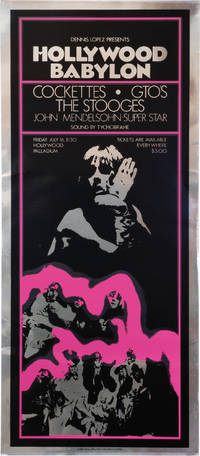
158636N.p.: N.p. 1971. Vintage two-color poster for an unseen performance by punk icons the Stooges queer hippie theatre troupe the Cockettes all-girl rock group The GTOs and John Mendelsohn's short-lived rock band Super Star held at the Hollywood Palladium on July 16 1971. The show would ultimately be canceled after The Stooges formally broke up on July 9 1971.<br /> <br /> A preview of The Cockettes' satirical 1971 film "Tricia's Wedding" was also to have been shown. The film featured The Cockettes reenacting President Nixon's daughter Tricia's wedding to Edward Cox interspersed with a number of humorous scenes including Eartha Kitt spiking the punch bowl with LSD.<br /> <br /> Even before it was canceled it's hard to imagine how this concert would have come together given the clashing styles of the acts. Founded in 1969 in San Francisco the Cockettes were a performance art group that performed improvised musical numbers in elaborate genderbending costumes and had become a sensation among the West Coast arts and culture scene. The GTOs were a satirical rock band formed in Los Angeles with ties to Captain Beefheart and Frank Zappa who would produce the band's only album Permanent Damage 1969. And the Stooges were simply the Stooges.<br /> <br /> 11.25 x 26 inches. About Near Fine. N.p. unknown
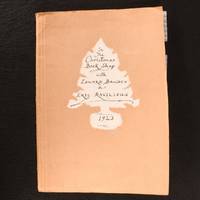
1923957Z15London: The Studio Limited 1923 . First edition. Paperback. Very Good Indeed. 11.5" by 8.5". Eric Ravilious; Edward Bawden. The vanishingly scarce first collaboration between the celebrated artists Eric Ravilious and Edward Bawden. One of the earliest examples of their impressive artwork being an advertisement for Christmas gift books from 'The Studio'. The first edition. A vanishingly scarce piece of art history being the first ever collaboration between Eric Ravilious and Edward Bawden. Not held by any institutional library. Illustrated with their dual tone wood engraving to the title page and six pages of dual tone wood engraved vignettes. Collated complete. An advertisement insert for the December issue for 'The Studio' advertising a number of Christmas gift books published by 'The Studio' and other notable publishers. 'The Studio' was an illustrated art magazine and publisher of art and design works. This advertisement is one of the earliest known published works for the noted artists Eric Ravilious and Edward Bawden and is the first collaboration between the two made while the two were still studying at the 'Royal College of Art'. Both Bawden and Ravilious are notable artists from the first half of the twentieth century being renowned for their work as war artists during WWII. The two collaborated many times on murals and other projects. In the publisher's original paper covers. In the publisher's original paper covers. Externally excellent with only minimal creasing. Bookseller's label to the verso of the rear cover. Internally firmly bound with light spotting. Very Good Indeed The Studio Limited paperback
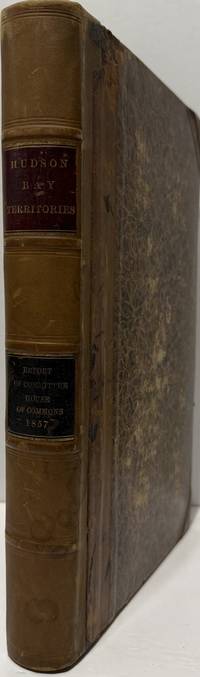
185767368Printed in the UK: Great Britain. Parliament. House of Commons. Select Committee on the Hudson's Bay Company 1857. First edition. Leather and paper over boards. As described. Hardcover 1/4 leather brown over paper marbled over boards. 4to. xviii 547 pp. Illustrated with 3 large colour folded maps in a pocket on the inside of the back board 2 of the maps have 4'' enclosed tears without loss of substance. Maps by John Arrowsmith. Sympathetically rebound with a new spine. Six compartment spine with five raised ribs. Red label in compartment two and black label in compartment four have the the title and subtitle in gilt. Head darkened. Six small ink stains on the fore edge. Bookplate on front pastedown. Previous own was Mr. John White 1863-1928 appointed Chief Geographer of the Canadian Department of the Interior in 1899. Pages 212-225 329 and 374-379 have pen markings and some marginalia by Mr. White. Mild age toning mostly to the edges. The text block is clean unmarked except where noted and square with a strong binding. Boards are rubbed with some of the marbling worn off. Edges are worn through in places. The spine is rubbed and has some small water stains near the tail. Corners bumped. An extremely rare volume this copy is supple and easy to handle despite its rough exterior. Condition as described. References: TPL 3729/30 Sabin 33549 Lowther 52 Peel 188. Laid in this copy is a bibliographical description from Acadia Book Store. Great Britain. Parliament. House of Commons. Select Committee on the Hudson's Bay Company unknown
19982081502111901395Bunbutsu 1998. Soft Cover. Fine. Size: A4 precision box Bunbutsu paperback