The Socialist Party of Great BritainBiblio.com
122 150 résultats
1917261279UK: The Socialist Party of Great Britain 1917. First Edition. Softcover. Near fine set in the original stiff-card wrappers; edges very slightly dust-dulled and toned. Remains particularly and surprisingly well-preserved; tight bright clean and especially sharp-cornered. Physical description; 300 issues approximately. Subjects; The Socialist Standard. Socialist Periodicals. The Socialist Party - Great Britain. 20th century periodicals. UK: The Socialist Party of Great Britain paperback
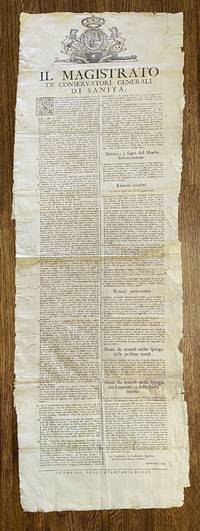
17444109Turin Italy: Stamperia Reale 1744. Very good. Huge letterpress broadside 1070 x 360 mm printed on 2 1/2 folio sheets edges untrimmed. A few sections underlined and annotated in a contemporary hand in the left blank margin worn; paper extensions mainly in the right margin; prominent horizontal central fold other folds reinforced on verso with occasional lost of one or two letters. A remarkable survival preserved in mylar L-sleeve backed with lig-free board. GIGANTIC APPARENTLY UNRECORDED BROADSIDE ISSUED BY THE STATE MAGISTRATE WARNING AGAINST THE 1744 "CATTLE PLAGUE" EPIDEMIC IN NORTHERN ITALY A FLIMSY ATTEMPT AT GOVERNMENTAL MANAGEMENT AND DISEASE CONTROL. <br /> <br /> The disease described herein was almost certainly RIDERPEST a highly contagious viral infection which can produce a 100% death rate among herds the colloquial term "cattle plague" is a misnomer because sheep and goats can also be afflicted by it. <br /> <br /> The 1744 outbreak had been observed in The Netherlands in the months before our broadside was printed but the Magistrate mentions only the reports from Franche Comté. While the devating consequences of cattle plague in The Netherlands are well researched its effects in Italy at this same time are not well-known probably due to the comparatively low survival rate of contemporary documentation. <br /> <br /> Indeed no other copy of our broadside can be found. Here the Magistrate of the Conservatory General of Health gives warning signs of the infection and preventative measures against its spread including mandatory "lazarettos" quarantine areas for livestock. The "nature and the signs" of the disease is addressed along with a dubious and ineffectual attempt at a remedy which involved cold water salt vinegar pepper and camphor; "Rimedi preservativi" prophylactic measures are recommended and steps for "fumigating" i.e. disinfecting livestock and their owners are given. <br /> <br /> The urgency of Magistrate's is justified: less than 30 years earlier through circuitous trade routes cattle plague had spread like wildfire even the most remote regions of Eastern and Western Europe and Britain. Such trade networks had become larger and more sophisticated in order to supply food to growing urban centers.<br /> <br /> Throughout history outbreaks of cattle plague led to severe economic crisis: the resulting famine inflation civil unrest and overall moral decay destabilized societies with crippling effect as had been seen in The Netherlands in the first outbreak of 1713-1720. Wherever and whenever cattle plague emerged religious figures government officials technocrats and the public wrested with the meaning and consequences of these disasters.<br /> <br /> Students and scholars of socio-economics in the Early Modern era would do well do incorporate primary sources of veterinary history in their research.<br /> <br /> NB: Interested parties are advised that this huge broadside will be shipped folded. Stamperia Reale unknown
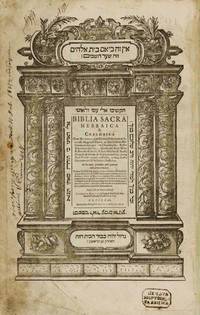
161948847Basel: Ludwig König 1619. First editions. Hardcover. Good. Seven parts in two volumes folio biblical texts and commentary in four parts continuously foliated; two supplemental sections each with separate foliation; Tiberias 1620 with separate pagination here bound after the second part - Vol. 1: 6 title and prelims 1-228 1 sect. title 234-441 1 blankff.; 6 sect. title and prelims 2 blank 114 2 blankpp. Vol. 2: 442-946; 8 Targum Yerushalmi; last leaf unfoliated; 67 Masora 1 blankff. Largely arranged in two columns of biblical texts in square font surrounded by commentaries in rabbinic Rashi font; text reads from right to left. This copy with collective Latin title surrounded by biblical quotations in Hebrew set within elaborate woodcut architectural borders. Hebrew sectional titles set within the same woodcut borders for the second and fourth parts with a plain letterpress half-title for the Five Megillot. The third sectional title for the Latter Prophets is lacking as are the Ashkenazi Haftarot readings not found in all copies. Apart from these lacks the Rabbinic Bible collates complete despite numerous errors in foliation throughout as per the detailed notes in Prijs Die Basler hebräischen Drucke. Opening word of each biblical book set in large one-third to one-half page cartouche vignettes with elaborate woodcut borders and surrounding letterpress Hebrew text. Main Latin title dated 1619 with the editor's Latin preface to the reader appearing at the verso. Jewish date chronogram for the second section Former Prophets dated 5378 1618/1619. Early twentieth-century black cloth boards worn at extremities gilt-lettered spine. Title moderately soiled re-inforced at gutter; neat old repairs to corners and fore-edge of title and next three leaves; old Russian stamp at bottom margin title manuscript entry in Russian along fore-edge dated 1837; intermittent mild to moderate marginal dampstains largely confined to corners and embrowning throughout both volumes somewhat more heavily in the first especially throughout Tiberias; top right corner of the opening leaf in vol. 2 repaired with loss of about 12 words surrounding title cartouche recto and some text in 9 lines of the commentary at the verso. Overall a good set with a notable chain of provenance. <br /> <br /> Sixth Rabbinic Bible in Hebrew: Mikra'ot Gedolot edited by Johann Buxtorf I 1565-1629 professor of Hebrew at the University of Basel and the foremost Christian Hebraist of his era with the assistance of the Jewish scholars Abraham Braunschweig who served as the principal corrector and Mordechai Gumplin of Posen. This was "a truly audacious undertaking for his time" Burnett From Christian Hebraism to Jewish Studies as no Christian scholar had yet attempted to edit the entire biblical corpus including the Aramaic versions Targumim and masoretic notes. Based mainly on the third Rabbinic Bible published by Daniel Bomberg at Venice in 1546-1548 the editor has carefully incorporated elements from two other Venetian editions. At the verso of the Latin title Buxtorf provides a detailed bibliographical excursus on the earlier Venetian editions and offers a tribute to Bomberg's industry by reprinting the colophon of the second Venetian Rabbinic Bible 1524-1525 at the conclusion of the masoretic appendix with text by the Hebrew grammarian and lexicographer Elijah Levita 1468 or 1469-1549 and a new introduction by Abraham Braunschweig. The design of the sectional titles and separate book title vignettes closely model those of the Venetian editions. "Buxtorf did not plan simply to reprint one of the existing Venice editions but rather to assemble the best features of them all into one work" and "to provide theologians with what he considered the most important tools for interpreting the Old Testament" Burnett. Buxtorf served in an official capacity as Basel's Hebrew censor charged with the oversight of all Jewish printing in the city and insuring that "no 'blasphemies' or slurs against Christians or Christianity appear in any book printed in Basel" Burnett. He carefully edited the Jewish commentaries in the Rabbinic Bible in accordance with this mandate "and removed many words and phrases which had escaped the attention of earlier censors" Burnett. <br /> <br /> The Rabbinic Bible contains the vocalized Masoretic text of the Hebrew Scriptures with accents and a vocalized Targum an Aramaic paraphrase of the biblical text: Onkelos for the Pentateuch; Jonathan b. Uzziel for the Prophets; and Targum Hagiographa for the Writings. The Hebrew and Aramaic versions are printed in square characters and presented in facing columns at the center of each page. The Jerusalem Targum of the Pentateuch appears as an appendix. In addition to the Aramaic paraphrases the Rabbinic Bible includes a massive scholarly apparatus of biblical commentaries by Rashi Ibn Ezra Baal ha-Turim Jacob b. Asher R. David Kimchi Radak R. Levi b. Gershon Ralbag Saadia Gaon and R. Isaiah along with the Masora a corpus of critical notes on the external form of the Biblical text compiled by Jewish scholars from late antiquity through the medieval era. As frequently occurs a copy of Buxtorf's work on the textual history of the Hebrew Bible Tiberias the 1620 first edition is bound-in. This work was made possible by the publication in 1538 of Elijah Levita's Masoret ha-Masoret a commentary on the Masora which Buxtorf translated into Latin for his own private use in 1593. "Buxtorf was concerned with the integrity of the consonantal text and the origin and integrity of the vowel points and accents of the Hebrew Bible from the very beginning of his scholarly career" and while he had earlier published a long excursus on the age of the vowel points and accents in his 1609 Thesaurus Grammaticus "Tiberias is Buxtorf's fullest and most impressive work on the history of the biblical text" Burnett. Intended as a reference work for Christian students and scholars interested in studying the Masora Buxtorf was also keen to refute the view advanced by Levita that the Hebrew vowel points were early medieval innovations. Our folio version of Tiberias was intended to accompany the Rabbinic Bible and has the same architectural borders at the title. König also published a quarto edition in the same year but only the folio version includes a critical commentary on the Masora in which Buxtorf proposes various corrections to the Masoretic notes. <br /> <br /> As noted at the title Buxtorf's faithful study and tireless labor studio fido et labore indefesso yielded notably long-lasting results: "The Basel rabbinical Bible became a standard tool for research among Christian scholars and would remain so. until the end of the nineteenth century" Burnett. A vast array of early modern scholars including Protestants like Johannes Drusius and John Selden as well as Roman Catholics like Robert Bellarmine and Andreas Masius owned a copy or two of the Rabbinic Bible. "Johannes Buxtorf's thoroughly censored "Christian" version of the Rabbinic Bible Basel 1618-19 only made it easier for Hebraists to own copies of their own" Burnett Christian Hebraism in the Reformation Era p.163.<br /> <br /> A note on the date of publication: "The actual printing began between the mid-August and mid-September of 1618. According to the colophon production ended on the 24 of Ab 5379 = August 4 1619 but since this date also appeared on the colophon of the Bomberg Biblia rabbinica edition of 1524-25 reprinted unchanged in the 1546-48 and 1568 editions it is suspect. Prijs suggested that the probable completion date was sometime during Ab of 5379 between July 12 and August 10 of 1619" Burnett. <br /> <br /> Provenance: from the library of acclaimed theologian and biblical scholar Brevard Childs with his entry at the free endpaper in the second volume. The earlier bookplate of judge Samuel Heller with his motto in Hebrew: Mi-kol melamdai hiskalti from all my teachers I have learned appears at the front paste-down. An old blue ink-stamp in Hebrew characters makes occasional appearances the text: Bet ha-Midrash ha-Gadol Minsk The Great Synagogue of Minsk. A Russian entry dated 1837 appears at the fore-margin of the main title along with an old ink stamp in Russian at the bottom margin the last word of which reads "Rabbina" References: Biblia Sacra: Burnett 7. Cowley 87. Darlow & Moule 5120 bound with the 1665 second edition of Tiberias cf. 5093. Davidson Otsar ha-shirah vol.1 p.406 no.8954. Prijs 219. Steinschneider 423 423b. VD17 23:675325G. S. Burnett Christian Hebraism in the Reformation Era Leiden: Brill 2012 p.163. Tiberias: Burnett 111. Prijs 222a. For detailed analyses of both works see: S. Burnett From Christian Hebraism to Jewish Studies Leiden: Brill 1996 pp.169-239 chaps. 6 & 7.<br /> <br /> Full Latin title: Biblia Sacra Hebraica & Chaldaica cum Masora quae critica Hebraeorum sacra est Magna & Parva ac selectissimis Hebraeorum interpretum commentariis Rabbi Salomonis Jarchi R. Abrahami Aben Esrae R. Davidis Kimchi R. Levi Gerson R. Saadie Gaon R. Jeschajae & Notis ex authore quem Baal Turim vocant collectis quibus textus grammaticè & historicè illustratur. In his nunc primum post quatuor editiones Venetas textus Chaldaicus qui Targum dicitur à deformitate punctationis & pravitate vocum innumeratum vindicatus; loca in Masora transposita deficientia pugnantia numeris depravata subsidio diversorum exemplarium & Concordantiarum Hebraicarum quantum fieri potuit reposita restituta & conciliata sunt ut in praefatione amplius declarabitur. Studio fido & labore indefesso Johannis BuxtofI linguae sanctae in Academia Basileensi Professoris Ord. Basileae: Sumptibus & typis Ludovici König 1619.<br /> <br /> Collation vol. 1 Rabbinic Bible: ital.a6 a-z8 A-E8 F4 G-Z8 Aa-Hh8 Ii9 Ii10 blank; 1 blank :3 1 blank A-N4 O5.<br /> <br /> Collation vol. 2 Rabbinic Bible: Kk-Rr8 Kk1 lacks Ss6 Tt10 Vv-Zz8 AA-PP8 QQ-TT6 VV9 VV10 blank XX-ZZ8 Aaa-Nnn8 Ooo3 Ooo4 blank PppTtt8 Vuu3 Vuu4 blank Xxx-Zzz8 AAaa-EEee8 8 A-G8 H6 I5 I6 blank. Ludwig König hardcover
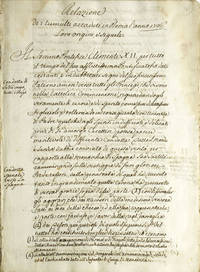
1736257005Rome 1736. 59 pp. in all on laid paper. 4to all with one exception approx. 27 x 20 cm. Provenance: Frederick North 5th Earl of Guilford 1766-1827; library of Sir Thomas Phillipps ex Ms. 7544; with H.P. Kraus. 59 pp. in all on laid paper. 4to all with one exception approx. 27 x 20 cm. Following the acquisition of the Kingdom of Naples and the Two Sicilies by the Bourbons of Spain in 1736 the conquering Spanish troops returning through Rome and Papal States provoked anti-Spanish riots in March of 1736. The following 6 manuscripts each in a different contemporary hand all from the collection of Sir Thomas Phillips and comprising Phillips Ms. 7544 relate to those events. They are as follows:<br /> <br /> 1 CONTI Antonio attributed to. "Relazione dei tumulti accaduti on Roma l'anno 1736. Loro origine e sequele." 13 pp. on 7 leaves.<br /> 2 "Sopra il tumulto populare seguito in Roma il 13 Marzo 1736." 6 2 blank pp. on rectos of 7 leaves. <br /> 3 "Se domanda se un Popolo si solleva tumultiamente nel Domnio altrui contro una nazione con offesa del Sovrano di essa ottenuto il perdona generale ." 4pp. on two leaves.<br /> 4 Same text as above with minor differences e.g. "amnistà" for "perdona". 4 pp. 21.5 x 15 cm.<br /> 5 Manuscript Letter fair copy headed "Sigl. Mio" 2 Giuglio 1736" beginning: "Non potevate far cosa pui grata all mia amicizia che commnicarmi la lettera trasmessa da Roma ."12 4 blank pp. Docketed on final page: "Relazione dei tumulti seguiti in Roma l'anno 1736 per i scrivi Austrici contro i Spagnuoli"<br /> 6 Manuscript Letter fair copy headed "Sigl. Mio". 15 pp. N.p. n.d. <br /> <br /> From the collection of Thomas Phillips 1792-1872. "His collection of over 60000 manuscripts was an outstanding achievement in the annals of bibliophily" ODNB and such was the scale that over 100 years passed after his death until the last tranche of the papers were finally sold in 1977 to H.P. Kraus.<br /> <br /> The attribution would seem to be based on a manuscript of the same title in the University of Chicago Special Collections Library v. OCLC: 154339939. unknown
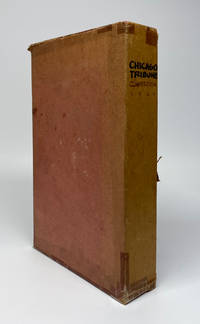
192311036Chicago: The Tribune Company 1923. First Edition. Hardcover. Fine/fine. Large quarto 103pp. followed by 281 full-leaf plates. A crisp clean lovely copy about fine with the rear inner hinge just starting and two tiny and inexplicable tape mends to a rear blank. Touch of foxing to the edges. In the publisher’s notoriously fragile burlap binding with absolutely no repairs. In the rare dust jacket about fine with a few mild scrunches to the crown but no notable tears or chips. In what appears to be the publisher’s original box with hand-written title. Box with a number of partial cracks and some tape mends but still rather sound and complete. A very important volume of architectural history as this 1922 competition drew contestants from some of the most innovative firms in the field all of whom were working just after the widespread use of steel frame technology which allowed for the safe construction of buildings more than a few storeys tall. Among the entrants were Eliel Saarinen whose design was perceived by many to be the best Walter Gropius Adolf Loos Bertram Goodhue and many others. The winning entry conceived by Howells and Hood still stands today; an imposing neo-Gothic skyscraper at 435 N. Michigan Avenue. When the book is found in commerce it is almost always rebacked as the fragile burlap binding was absolutely no match for the heft of the coated paper used for the nearly 300 plates. Similarly burlap bindings have a tendency to destroy dust jackets which is why we’ve only even encountered one other copy in a jacket. As this copy was hardly ever taken out of its box it has been spared the seemingly inevitable fate of its brethren. An important volume of modern Architectural history genuinely rare in this condition. The Tribune Company hardcover
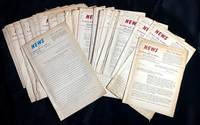
195142943New York American Council for Judaism 1951. 1st edition. Original stapled pages. "News" is 8.5"x11" and generally 4 single sided leaves. Press releases are legal size 8.5"x14" 2-4 single sided leaves each. Approximately 160 leaves total. <br> News is subtitled "Highlights of the Yiddish and Hebrew Press. A weekly Digest prepared by the Publicity and Research Departments American Council for Judaism." Maurice Spector is listed as Publicity Directory though the OCLC listing indicates Bill Gottlieb as editor perhaps for earlier or later issues <br> Each issue of the NEWS is headed with the warning "This is not for release - for your information only." <br> <br> Some headlines from the NEWS often quoting the Zionist press when it shines poorly on Zionism include: <br> -Nationalist-Zionist Education Endangers Judaism<br> - To the Rescue of Yiddish<br> - The Sin of the Histadrut<br> - Treatment of the Arab Minority in Israel<br> - And Now it is Israel's Turn to Use the Hostage Weapon.<br> - The Religious Bloc is Powerful for Reasons that aren't Religious<br> - We Want Peace Unity Discipline-But on our Own Terms.<br> - Israel's Election Campaign Opens.Here in America<br> <br> Some headlines from the press releases include: American council for Judaism Calls NCRAC Action Partisan: <br> -Declares Zionism and Jewish Nationalism Responsible for Creating 'Dual Loyalties' Issue<br> - Carroll Binder Warns Minority Pressure Blocs Endanger U.S. National Interests<br> - President Truman Say American Council for Judaism Deeply Rooted in U.S. Traditions of Individual Rights<br> - Zionist Pressure Seek Change of Judaism Values from Universal Religion to Status of Tribal Cult Rabbi Charges<br> - Dorothy Thompson Warns Zionism's Viewing All Jews as Members of a Jewish Nation" Seeking Privileged Minority Status in U.S. Gives Aid to Antisemitism<br> - Cause of DP's Pleaded at American Council for Judaism's Annual Meeting: Leading Social Workers Charges Pro-Israel Pressures Deprived Many Thousands of Sanctuary<br> - U. S. Culture Infiltration Seen as world Zionism Aim<br> - Israel has No Rights Authority Over Lives of U.S. Jews Rosenwald Says: Assumptions in Ben-Gurion's Knesset Speech Rejected by Head of American Council for Judaism<br> <br> "The American Council for Judaism ACJ is an organization of American Jews committed to the proposition that Jews are not a national but a religious group adhering to the original stated principles of Reform Judaism as articulated in the 1885 Pittsburgh Platform. In particular it is notable for its historical opposition to Zionism. Although it has since moderated its stance on the issue it still advocates that American Jews distance themselves from Israel politically and does not view Israel as a universal Jewish homeland.<br> The rabbis of Reform Judaism had opposed Zionism prior to World War I supporting freedom democracy and equal rights for Jews in the countries where they lived. The influential American Jewish Committee was also anti-Zionist until 1918 when it shifted to a non-Zionist platform until the 1967 Six-Day War. The Central Conference of American Rabbis of the Reform movement declared itself officially neutral on Zionism in 1937.<br> In 1942 a split within the Reform movement occurred due to the passage of a resolution by some rabbis endorsing the raising of a 'Jewish Army' in Palestine to fight alongside the Allies of World War II. The American and British general staffs opposed placing Jews in segregated armed forces.The founders of the American Council for Judaism regarded the potential segregation of Jews to be a highly regressive and harmful measure.<br> The ACJ was founded in June 1942 by a group of leading Reform rabbis including six former presidents of the Central Conference of American Rabbis and the president of the Hebrew Union College as well as laymen who opposed the creation of a religiously segregated Jewish Army to fight alongside the Allies and the new political direction of some in their movement including but not limited to on the issue of Zionism as redefined by the Biltmore Program in May 1942.The leading rabbis included Louis Wolsey Morris Lazaron Abraham Cronbach David Philipson and Henry Cohen but their most vocal representative for a time became Elmer Berger who became the council's Executive Director.<br> The ACJ described itself as anti-nationalist and followed a universalist interpretation of Jewish history and destiny. According to its statement of principles the ACJ supported the 'rehabilitation' of Palestine and did not support political Zionism. It also declared that 'Jewish nationalism tends to confuse our fellowmen about our place and function in society and diverts our own attention from our historic role to live as a religious community wherever we may dwell.' The ACJ's leaders felt that they represented the views of a majority of American Jews and began a large membership drive. By 1946 it had numerous local chapters throughout the United States and regional offices in Richmond Chicago Dallas and San Francisco.<br> During World War II the council was active in opposing Zionism. In 1944 it protested the formation of the Jewish Brigade by the British Army which was composed of Palestinian Jews led by British-Jewish officers.it stated that.'Americans of the Jewish faith are and always have been in the American armed forces. The flag of Americans of the Jewish faith is the Stars and Stripes.'<br> While protesting the White Paper of 1939 which imposed strict limits on Jewish immigration to Palestine and land purchases in the country it also opposed 'Zionist nationalism' and urged American Jews to 'organize in strength out of deep concern for oppressed Jews everywhere behind a non-nationalistic program to deal with the total Jewish problem.' <br> It declared that 'Beyond the abrogation of the White Paper lies the need for a basic solution. That solution we believe can come only when there is world wide recognition of the rights of Jews to full equality. It can come in Palestine only when the pretensions to Jewish Statehood are abandoned and we seek instead freedom of migration opportunity based on incontestable rights and not on special privilege.<br> We look forward to the ultimate establishment of a democratic autonomous government in Palestine wherein Jews Moslems and Christians shall be justly represented; every man enjoying equal rights and sharing equal responsibilities; a democratic government in which our fellow Jews shall be free Palestinians whose religion is Judaism even as we are Americans whose religion is Judaism.'<br> Following World War II with the question of Palestine's future being considered the ACJ continued to support a joint Jewish-Arab state rather than a Jewish state in Palestine and opposed dispossessing the Arabs who were then living in Palestine.<br> The presidency of the ACJ was accepted by the well-known philanthropist Lessing J. Rosenwald who took the lead in urging the creation of a unitary democratic state in Mandatory Palestine in American policy-making circles. Rosenwald testified before the Anglo-American Committee of Inquiry in 1946 urged the creation of a unitary Jewish-Arab state in Palestine and allowing Jewish immigration to Palestine to continue only upon 'renunciation of the claim that Jews possess unlimited national right to the land and that the country shall take the form of a racial or theocratic state' and said that the United States and other UN member states should allow more Jewish immigration to solve the European-Jewish refugee problem.<br> It later endorsed the Committee of Inquiry's recommendations including that Palestine become neither a Jewish or Arab state and the admittance of 100000 Jewish refugees into Palestine. In addition it opposed the establishment of a Jewish state anywhere else in the world not just in Palestine. The ACJ's official position was that European Jews should be rehabilitated by restoring their civil political and economic security. <br> During the Jewish insurgency in Palestine a campaign against the British by Jewish underground groups in Palestine the Haganah Irgun and Lehi the ACJ opposed what it viewed as Jewish terrorism. Following the King David Hotel bombing it issued a statement calling for American Jews to 'repudiate the perpetrators of those outrages and those leaders of Jews in and out of Palestine whose incitement is equally responsible.' In a statement Lessing Rosenwald called for the American Jewish community to condition any further assistance to the Yishuv Palestinian Jewry on the end of violence.<br> After the State of Israel declared independence in 1948 the ACJ continued its anti-Zionist campaign.<br> Its position was that to American Jews Israel was not the state or homeland of the Jewish people but merely a foreign country. In December 1948 Lessing Rosenwald urged that the US condition friendship with Israel on Israel building an inclusive Israeli nationalism confined to its own borders and inclusive of its Muslim and Christian citizens rather than Jewish nationalism.<br> The ACJ switched its focus to battling what it viewed as its primary foe-the political influence of Zionism upon American Jewry. In addition to supporting a network of religious schools committed to Classical Reform Judaism the Council fought American-Jewish fundraising for Israel and agitated against the merging of Zionist fund-raising organizations with local Jewish community boards provided financial aid to Jews emigrating from Israel and to Palestinian refugees and enjoyed friendly relations with the Eisenhower State Department under John Foster Dulles. <br> The ACJ also vocally supported the efforts of William Fulbright to have the lobbyists for Israel in the United States legally registered as foreign agents. In 1955 the ACJ's head Elmer Berger advocated the complete assimilation of Jews into American life by switching the Jewish Sabbath from Saturday to Sunday creating a new menorah to 'reflect the appreciation of American Jews of the freedom of life in the United States' and for the interpretation of the holiday of Sukkot 'to be broadened to take on meaning to all citizens of an industrial society.'<br> In 1957 the Union of American Hebrew Congregations now known as the Union for Reform Judaism denounced the American Council for Judaism. In a statement the UAHC alleged that the ACJ misrepresented classical Reform Judaism undermined the unity of the Reform movement questioned the national loyalty of Jews who supported Zionism aided antisemites and 'played directly into the hands of Arab propagandists'.<br> Jewish intellectuals who at one time or another passed through the Council included David Riesman Hans Kohn Erich Fromm Hannah Arendt Will Herberg Morrie Ryskind Frank Chodorov and Murray Rothbard. Among the notable gentile friends of the council were Dorothy Thompson Norman Thomas Freda Utley Arnold J. Toynbee and Dwight Macdonald. The ACJ was particularly influential in San Francisco Philadelphia Houston Chicago Baltimore Washington D.C. Atlanta and Dallas" Wikipedia.<br> SUBJECTS: Zionism and Judaism -- Periodicals. Jews -- United States -- Sionisme -- Aspect religieux -- Judai¨sme -- Pe´riodiques. Juifs -- E´tats-Unis. OCLC: 12373966. OCLC lists only 3 holdings worldwide HUC UTexas Wisc Hist all in the midwest and none at any Ivy League institution.<br> Toning to edges pencilled institutional numbers to cover corner margins some original corner staples removed paper strong Good Condition solid. Rare and important especially as much of Liberal Progressive and Secular American Jewry rethinks its relationship to Israel and Zionism in light of the present Israel-Gaza war. B Zion2-3-5-'l. New York, American Council for Judaism unknown
1967List2885Sheffield United Kingdom 1967. 20 x 30 inch poster on heavy cardstock. Some staining and scuffing pinholes and some tears at edges fine contrast; overall excellent. A poster advertising Stevie Wonder at Sheffield’s Mojo Club in October 1967. Wonder would have been just seventeen at the time though he had already dropped “Little†from his stage name. The Mojo Club in working-class Sheffield was the project of brothers Peter and Geoff Stringfellow; the pair had previously worked as promoters and were preternaturally talented having booked the Beatles for April of 1962 shortly before the release of “Love Me Doâ€.1 Stevie Wonder would be the last live act at the Mojo as it was shut down by the city three days later on October 10.<br /> <br /> 1 Steve Walker “The King Mojo Club†2020 https://www.kingmojostory.com. unknown
1973568755San Diego California: Community Congress Press 1973. Softcover. Near Fine. First edition. Complete in six volumes. Octavos. Stapled printed and unprinted wrappers. Overall near fine with some light spine toning a bit of light edgewear and a small indentation and some discoloration on rear wrap of Part #5. The first of Acker's three six-volume novels preceded only by her poetry collection Politics written in parts and issued separately in very limited numbers and consequently very difficult to find complete and in original form. A wonderful copy. Community Congress Press) unknown
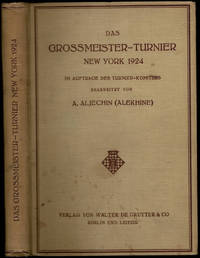
1925C2887<p>xx3373 ad pages with diagrams plates and tables. Octavo 8 1/4" x 5 3/4" bound in original publisher's light brown cloth with brown lettering to spine and cover. Forward by Herman Helms. Inscribed by Alexander Alekhine. Bibliotheek Bibliotheca van der Linde-Niemeijeriana: 5367 First German edition. First published in English.</p><p>Personal dedication from the former world chess champion Alexander Alekhine to Tarrasch: "Mr. Doctor Tarrasch with the highest respect from the author. Paris 14/2 1925."</p><p>New York 1924 was an elite chess tournament held in the Alamac Hotel in New York City from March 6 to April 18 1924. It was organized by the Manhattan Chess Club. The competitors included world champion Jose Raul Capablanca and his predecessor Emanuel Lasker. Nine other top players from Europe and America were also invited. Emanuel Lasker met Alexander Alekhine Efim Bogoljubow Geza Maroczy Richard Reti Savielly Tartakower and Frederick Yates in Hamburg. They steamed with the SS Cleveland on February 28 1924 and joined Capablanca Frank Marshall Dawid Janowski and Edward Lasker in New York. The tournament was played as a double round robin with each player meeting every other one twice. Emanuel Lasker got $1500 for his first prize generous payment for expenses and still complained. Capablanca gained $1000 compensation for costs and an extra fee. Everyone expected World Champion Capablanca to win and wondered how Lasker the 55 year old dethroned lion would perform. Lasker ran away with the tournament scoring a phenomenal 80% against the elite of the chess world. Brilliancy prizes went to Reti for his win over Bogoljubow Marshall for his win over Bogolijubow and to Capablanca for his win over Lasker. There are some mistakes but this is probably the best tournament book written rivaled only by Bronstein's Zurich 1953.</p><p><strong>Condition:</strong></p><p>With a personal dedication from Alekhine to Tarrasch on title Lightly soiled light rubbing to spine ends some toning to pages spine head rubbed covers soiled else very good.</p> Walter de Gruyter and Company hardcover
189433189Wien; Leipzig: Verlag der Goldenen Klassiker-Bibel Max Herzig 1894. First edition thus. Hardcover. g. Folio. 76 1080 columns 38 540pp 708 columns 354pp 127pp plates. Splendid blind and gilt-stamped crushed full morocco with gold lettering and decoration on front covers and spines. Beveled edges. Raised bands. All edges gilt. Decorative endpapers. Double ribbon marker in each volume. Title pages in red and black lettering. Text in two columns within double red and black ruled box. This remarkable edition of The Old and New Testaments is magnificently illustrated with 127 captioned chromolithographs after classical and modern paintings by the most renowned German Italian Spanish Dutch and French artists such as Ridinger C. W. E. Dietrich Luca Giordano Andrea Appiani Giorgio Barbarelli Ferdinand Boll Philippe de Champagne Nicolas Poussin Alessandro Turchi Jean Germain Drouet Carlo Dolci Rafael Santi Paolo Veronese Francesco Barbieri Leonardo da Vinci Michelangelo etc. Each plate is protected with a tissue-guard. Paper size 14 1/2 x 11 inches; image size varies ca 11 x 8 1/4 inches. Spine of first volume slightly discolored. Spine and front cover of second volume partly discolored. Bottom edge of the first six leafs first volume and of the first four leafs second volume partly damaged by silverfish not affecting pages throughout. Text in German gothic script. Bindings in overall good interior in good to very good condition. Verlag der Goldenen Klassiker-Bibel Max Herzig hardcover
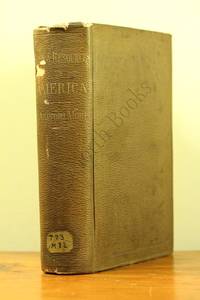
1871H48Washington D.C.: No Statement of Publisher 1871. Hardcover. First Edition. 12mo. 404pp. engraved frontispiece. Bound in the original full cloth with blindstamped decoration. Signed by the author with inscription on the front free endpaper: Prof. Seelye Compliments of Arinori Mori. Viscount Arinori was the infamous Japanese ambassador to the United States who was assassinated in 1889 the same day as the institution of the Meiji Constitution which was considered by Japanese nationalists to be a Westernizing of Japan. The inscription is to Prof. Seelye who with other academics and dignitaries carried on a correspondence with Mori published by Appleton in 1873 and titled Education in Japan: A Series of Letters Addressed by Prominent Americans to Arinori Mori. Howes M809 GOOD. Shows some chipping at the topmost and bottommost of the spine a chip from the cloth at the spine a numbered label at the bottommost of the spine slightly cocked an institutional presentation bookplate and withdrawn stamp on the front paste-down an institutional stamp of the title page light off-set mark of the frontispiece at the title page some light handling marks in the margins of the preliminary pages otherwise the binding is strong and tight the text is clean and unmarked and the boards remain relatively distinct. As pictured. No Statement of Publisher hardcover
005982Columbia High School Yearbook Staff 1973 1973. Hardcover. Very Good/No Jacket. 31 cm. green and blue cloth ; numerous photos several in color ; extremely rare Beatles-related collectible: This is the high school annual for the senior year of MARK DAVID CHAPMAN the murderer of JOHN LENNON. Chapman is featured in the seniors section with the photo that was first used in worldwide distribution during the breaking news story in 1980. Included are photos of Chapman's teachers friends and siblings ; VG <br/> <br/> [Columbia High School Yearbook Staff], 1973 hardcover
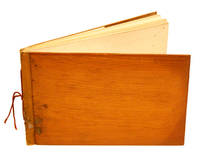
1893607017Lowman & Hanford 1893. First Edition. Wraps. Very Good. A Rare Northwest imprint; this was from the library of noted historian Edmond S. Meaney with his signature to the front pastedown and further inscribed 'From C. T. Conover Seattle Wash.' This copy has been specially bound with a leather spine and two bevelled and varnished wooden boards. 38pp. with 10 b/w plates one panorama shot of the waterfront and one map. Issued as a souvenir for Seattle's guests on the occasion of the celebration commemorating the completion of the Great Northern Railway to its Pacific terminus at Seattle and the inauguration of through traffic June 1893. WorldCat only located 3 copies. [Lowman & Hanford] unknown
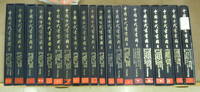
63106Beijing: Wen Wu Chuban She 1986. Hardcover. Very Good/No Jacket. Cloth with slipcase. A census of Classical Chinese paintings and calligraphy in the major museums of China. 20 volumes of the 24 published. Volumes 15. Wen Wu Chuban She hardcover
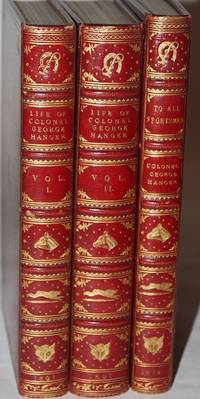
1814006406London: J. Debrett for Life; Sportsmen: self-published printed by J. J. Stockdale 1814. Full Decorated Morocco. Near FIne. Extra-illustrated three volumes with 96 additional plates 45 of the plates being hand-colored and beautifully bound by R. Wallis in full straight-grained red morocco. 8vo. The two works are not exactly the same size although they match very well and work well as a set. A number of folding plates as well and of these two frontises folding and hand-colored. The two volume Life is 21.5 by 13.5 cm the To All Sportsmen: 22.5 by 14.5 cm. Life: 330 474 pp. Sportsmen: 226 8 pp. Extra plates include many portraits and also architectural views of people and/or places with some nexus to the texts and as typical of Graingerized books that nexus at times might seem tenuous. Still the plates especially the color plates are a pleasing addition to the books. Hanger 1751-1824 also known as the fourth Baron Coleraine is one of the great picaressque figures of the Regency period. He commanded troops for the British during the American Revolution during which he was injured and because of his recklessness or incompetence his troops were ambushed and bested in battle. Upon return to Britain he became a close friend of the Prince Regent and was appointed his equerry. While flirting with politics Hanger racked up debts that ultimately led to his going to debtor's prison. Throughout his "career" he was a notorious womanizer as well as a holder of many unconventional views on just about everything. But he was widely regarded as an authority on sports and thus "To All Sportsmen" his final publication. In The Life it is fair to say that Hanger was more concerned about entertaining his readers than literal veracity of the events related. Binding with five raised bands gilt decoration including hunting devices on spine a fox a greyhound a horse head a horseshoe and a shooter with pointer device as centerpieces on all the boards with the spine devices repeated in each of the corners. Gilt ruled perimeters on the boards palmette-based turn ins marbled endpapers. Gilt edges to Life with Sportsmen because of uneven page edges no edge decoration to text block. Condition: all volumes with light rubbing in typical places -- joint extremities spine extremities corners. Typical offsetting of plates. Some light scattered soiling but overall volumes read as clean and bright. J. Debrett for Life; Sportsmen: self-published, printed by J. J. Stockdale unknown
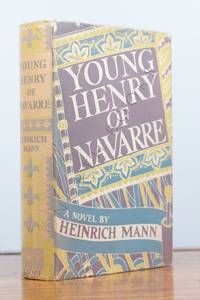
1937L685New York: Alfred A. Knopf 1937. Hardcover. Stated First Edition First Printing. 5.5 x 8in. ix. 585pp. Publisher's cloth boards. Signed and inscribed by the author on the half-title page: 'For W. Bryher with my best wishes and thanks Heinrich Mann. Nice Sept. 1937.' An association copy the inscription is to Annie Winifred Ellerman the poet novelist and editor who used the pen name Winnifred Bryher. She and Mann frequently corresponded during his time in Nice which was the first of his many sanctuaries from the Nazi regime in the years to come being one of the earliest to intimate Germany's future. In their letters several years prior to the publication of 'Young Henry of Navarre' they discuss the special importance of English publishers translating the work of modern German authors with strong anti-Nazi sentiment. Mann calls these publications a 'practical help.' Friedman S. 2002. 'Analyzing Freud: Letters of H.D. Bryher and Their Circle' p. 73 90 330 250 Signed books by Mann are scarce generally but especially so in English translation. VERY GOOD in Very Good dust jacket protected in a removable archival cover. The book itself shows shelf rubbing along the edges and corners boards with a hint of toning a small section ever so lightly discolored at the foot of the spine otherwise the binding is strong and tight the text is clean and completely unmarked and the boards remain bright and distinct. The dust jacket shows some light bouts of scuffing and several very small shallow chips from the edges spine somewhat tanned otherwise is not price-clipped remaining bright colorful and distinct. As pictured. Alfred A. Knopf hardcover
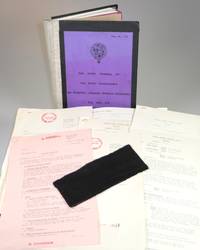
1965008279Horse Guards Whitehall: Headquarters London District 1965. First and only edition. This is a remarkably rich and extensive archive of official documents relating to preparation for the State Funeral of Sir Winston Churchill Saturday 30th January 1965. While we have handled numerous planning documents from the days leading up to Churchills elaborate State Funeral we have not previously encountered anything quite so extensive in the way of official planning documents. <br /> <br />All of the documents and mementos reside within an enormous canvas-bound two-ring binder comprising an incredibly detailed document Copy No. 323 of the indexed and tabbed "Special District Order By Major-General E. J. B. Nelson General Officer Commanding London District and Major-General Commanding The Household Brigade. This enormous document measures 13.5 x 8.75 inches is nearly 1.5 inches thick and features 16 separate purple-tabbed sections these sections teeming with details about every aspect of the public ceremonies and terminating in 15 maps. <br /> <br />The separate but related documents laid in are also extensive. These include: Amendments 2-5 to the Special District Order; the official and confidential list of Operation Hope Not Telephone Numbers; a confidential summary document for the Operation Hope Not; a State Funeral Warning Order and accompanying large folding tabular detail of "Troops Taking Part in the Procession". <br /> <br />An ink-stamp at the head of the Operation Hope Not Telephone Numbers document states HEADQUARTERS 19 INF BDE GP. Our presumption is that this indicates that this binder and the documents therein belonged to a senior military officer participating in the State Funeral. <br /> <br />Perhaps most poignant also laid in is an original black crepe sewn and lined arm band for participation in the State Funeral ceremonies ostensibly the one worn during the Funeral by the participating military officer to whom these documents belonged. <br /> <br />Of course the document is primary source history of one of the twentieth centurys most elaborate memorial services for one of its greatest public figures. Beyond historical significance the overall effect of this mammoth trove of documents is to convey by sheer volume of detail the mammoth organizational scope of official public mourning for Winston Churchill. <br /> <br />On Sunday 24 January 1965 Winston Churchill died at the age of 90. By the time of his death he had become a living national memorial" of the time he had lived and the Nation Empire and free world he had served. His death completed his transformation into a national icon. <br /> <br />The day after Churchill died on 25 January the Queen sent a message to Parliament announcing: "Confident in the support of Parliament for the due acknowledgement of our debt of gratitude and in thanksgiving for the life and example of a national hero" and concluded "I have directed that Sir Winston's body shall lie in State in Westminster Hall and that thereafter the funeral service shall be held in the Cathedral Church of St. Paul. This was in accord with longstanding plans; twelve years before in 1953 at the direction of Queen Elizabeth II planning for Churchills eventual state funeral had begun. The elaborate plans came to be called Operation Hope Not. <br /> <br />Churchill's full state funeral at the Cathedral of St. Paul in London was attended by the Queen herself other members of the royal family the Prime Minister Harold Wilson and representatives of 112 countries. Churchill was interred in St. Martins churchyard Bladon Oxfordshire. It was the first time in a century that a British monarch attended a commoners funeral. <br /> <br />The outpouring of national and international sorrow and regard - from friends and foes sympathizers and opponents alike - was both remarkable and effusive. Before the service in St. Pauls Cathedral Churchills coffin had passed through the countryside on a train. The Oxford don Dr. A. L. Rowse recorded The Western sky filled with the lurid glow of winter sunset; the sun setting on the British Empire. <br/><br/> Headquarters, London District unknown
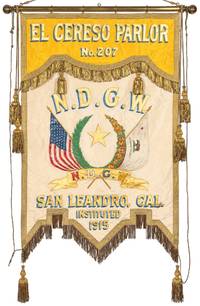
1915435400San Leandro California: N.D.G.W. 1915. Unbound. Near Fine. Elaborately embroidered silk banner bordered with silk ribbon fringed and suspended from brass rod with brass finials. Approximately 30" x 54". White silk bonded in gold with heavy golden fringe hand-painted with the American Flag and the Bear Flag framing a wreath and a star with yellow silk overlay with heavy fringe and tassels and draped with heavy golden cord swags and backed in red silk. Paint very slightly rubbed but easily near fine.<br /> <br /> The Native Daughters of the Golden West a women's group of native-born Californians was founded in 1886 in Jackson in Amador County and subsequent chapters or Parlors were certified over time and exist to this day although many Parlors including the San Leandro Parlor are now defunct. Every indication is that this elaborate and detailed banner was created around 1915 about the time this particular Parlor was founded and was likely displayed at meetings of the Society. N.D.G.W. unknown
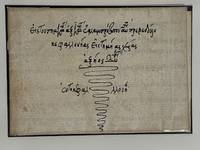
1591BOSTONVB11<br />MOREA OTTOMAN GREEK TURKISH PRISONERS Entire Letter writen from Chlonmontsi to "Lord David di Bembo Lord of Cephelonia" acknowledging receipt of nine Turkish Prisoners who are listed sent by the Lord of Cephalonia to "our Lord Bairakbasha Governor of the Morea". A very interesting and early letter during the period that Morea was under Ottoman rule expressing gratitude for the lenient treatment of Turkish prisoners. Surviving Ottoman letters in Greek are extremely rare. in commerce. A full translation and transcription is included.
191763378Pittsburgh Pennsylvania:: Pittsburgh Dry Goods Co. 1917. First edition. publisher's printed stiff front wrapper; tied with cord as issued; later stiff rear cloth board supplied. . Some chips and staining to the front wrapper; samples a little discolored; but a very attractive and rare early 20th c. trade catalogue. . Oversized folio. A trade catalogue featuring 32 sheets 16.8 x 14.7 inches depicting linoleum layout designs in color identified on verso; followed by eight actual colored flooring samples each measuring 16.8 x 4.7 inches. Pittsburgh Dry Goods Co., hardcover
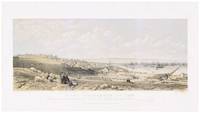
5441Port Elizabeth: Richards Impey & Co. 1862 or a bit later. Three-stone lithograph 13 7/8" x 33 3/4" plus margins. CONDITION: A few small nicks in sky a few small thin areas in sky at upper left reinforced on verso with 7" x 1.5" strip of Japanese paper light toning minor stains moderate cockling in margins. <p>An early important and very rare depiction of the Port Elizabeth South Africa.</p> <br /> <br /> <p>Roughly equidistant from Cape Town and Durban Port Elizabeth was founded in 1820. As a seaport it grew rapidly to the extent that in 1861 the year before Bowler drew this image the town was granted autonomous status. After this plate was printed the arrival of the railways brought even greater growth so that Bowler's finely-observed drawing captures the town at an important juncture in its history.</p> <br /> <br /> <p>The view is taken from the Southwest from inland looking across the Bakensrivier towards the town with the harbour beyond. The crowded harbor indicates the importance of the sea in the development of the town with the lighthouse prominent on the skyline. The principal features of the town and harbour facilities are identified by labels below the image. Among these are at far left the Military Hospital built by the British in 1799 while the impressive three-story structure surmounted by a cupola is the Town Hall and Commissariat.</p> <br /> <br /> <p>Thomas Bowler 1812-1869 <br /> <p>Bowler joined the staff of Thomas Maclear newly appointed as Her Majesty's Astronomer at the Cape of Good Hope and travelled to South Africa in 1834. After leaving Maclear's appointment he advertised his services as a drawing master and landscape painter. At this juncture he had received no formal training but was entirely entirely self taught. As his career flourished he returned briefly to London in 1854-1855 to study under landscape artist and lithographer James Duffield Harding.</p> <br /> <br /> <p>For thirty-five years from 1834 to 1868 Bowler travelled widely through southern Africa. As he travelled he documented the sights and scenes before him leaving behind him a substantial body of work: upwards of five hundred original drawings and paintings survive as well as some seventy large-format prints from his artwork and a large number of smaller illustrations used in the magazines and books of the day. His final foray was to Mauritius where he painted a series of views intended for publication as Twenty Views of Mauritius. He travelled to London in 1868 to oversee publication but died there shortly after arrival.</p> <br /> <br /> <p>In all Bowler is one of the most important European pictorial eye-witnesses of southern Africa for the mid-19th century capturing the early flowering of the region's towns expanding settlement the development of the railways and important historical events including the wars with the local population. Seeking to increase his income Bowler frequently endeavoured to see his artwork into print but his attempts at raising subscription income were invariably unsuccessful. and his prints circulated in only limited numbers.</p> <br /> <br /> <p>This plate was lithographed in London by Thomas Pickens and printed there by the great printing house "John Bellenie Day & Son" although the publication line bears the imprint of the firm "Richards Impey & Co." the partnership formed in Port Elizabeth by James Richard and William Impey newspaper proprietors and letterpress printers. This large format print was published separately and should be distinguished from the smaller prints that appeared in Bowler's Pictorial album of Cape Town with views of Simon's Town Port Elizabeth and Graham's Town published by Jan Carel Juta in Cape Town in 1866.</p> <br /> <br /> <p>Despite its London origin the view is surprisingly rare with no impressions found in COPAC OCLC or the British Museum's online catalog. The only institutional location traced thus far is a colored example in the London National Maritime Museum. OCLC records only five copies of the later Pictorial Album outside South Africa with two in America and two in the United Kingdom.</p> <br /> <br /> <p>Offered in partnership with Boston Rare Maps of Southampton Massachusetts.</p> Port Elizabeth: Richards Impey & Co., [1862 or a bit later] unknown
194980332Garden City:: The Crime Club 1949-1954. Fine. The jackets are preserved in jacket sleeves and enclosed in modern brad-bound stiff wrappers. Additional postage applicable. Titles: The Cat and Capricorn. Board Stiff. Not in the Script. Murder Twice Removed. Grave Consequences. Deadly Beloved. The Three Widows. Tread Lightly Angel. Divining Rod for Murder. The Widow of Bath. Scared to Death. Night Train to Paris. Tragic Target. From This Death Forward. The Mamo Murders. Murder Repeat Murder. The Judas Goat. The Clock that Wouldn't Stop. Grow Young and Die. Heavy Heavy Hangs. Elk and the Evidence. Mask for Murder. The Saint vs. Scotland Yard. M'Lord I am Not Guilty. Glass on the Stairs. A Rag and a Bone. The Other Side of the Wall. The Moon Gate. Inspector Maigret and the Strangled Stripper. Seeing Red. Miscast for Murder. The Devil Threw Dice. The Body in the Basket. Shroud of Darkness. Fatal in my Fashion. The Black Italian. The Crime Club, unknown
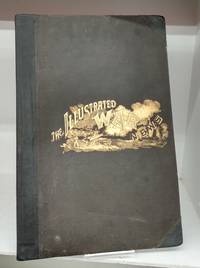
1885145249Toronto 1885. Vol. I No. 1 April 4th 1885 - Vol. I No. 18 August 1st 1885. Hardcover. Good. 152 p. 46 cm. Numerous b&w engravings. 15 unnumbered inserts of tinted illustrations. Map of battleground of Batoche. Map of the North-West Territories. Respined and recornered in black leather. Black cloth with gilt impressing. Some wear including chipped edges. Hinges repaired internally. Some tears chips rough edges to text block. Label removed from title page leaving residue. Hole in rear free endpaper. Tape repairs. Lacks 4 p. supplementay Honour Roll. <br/><br/>Weekly reporting on the violent five-month insurgency against the Canadian government fought mainly by Métis and their native allies in 1885. Articles convey the latest news from the northwest the mounted police medals for bravery bios and so on. Contains numerous scenes of Western towns battles military life and training as well as portraits and caricatures. Much advertising mainly Toronto. Peel 1460. Land 1245. hardcover
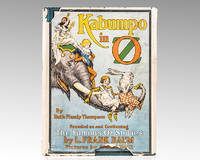
1922151941Chicago: The Reilly & Lee Co 1922. First edition of the second Oz book written by Ruth Plumly Thompson after Baum's death and the 26th Oz book overall. First printing with the elephant on the half-title and page 299 captioned "Princess Dorothy." Quarto original dark blue-green publisher's cloth with large pictorial paper onlay to the front panel the publisher's spine imprint with the "standard" ampersand illustrated endpapers printed in black all edges stained yellow illustrated with 12 full-color plates coated on one side only and numerous illustrations throughout by John R. Neill. Bienvenue and Schmidt pp. 103-104; Hanff & Greene XVI. Near fine in the rare first issue dust jacket with with titles listed through "15 Kabumpo in Oz" on the rear flap. The dust jacket is in good condition. Rare in the original dust jacket. In Kabumpo in Oz Ruth Plumly Thompson continues and expands the imaginative world established by L. Frank Baum while introducing a more comic and energetic narrative style. Published in 1922 as the twenty-sixth book in the official Oz series and Thompson’s second contribution to the canon the novel follows the adventures of Prince Pompadore and the Elegant Elephant Kabumpo as they undertake a quest across Oz and its neighboring kingdoms. Thompson preserves many of Baum’s central themes including friendship transformation and the restoration of rightful social order while placing greater emphasis on humor wordplay and fast-paced adventure. The character of Kabumpo whose wit and vanity distinguish him from Baum’s earlier companions reflects Thompson’s tendency to create more eccentric and theatrical personalities within the Oz universe. At the same time the novel maintains the utopian and escapist qualities that defined the original series reinforcing the enduring appeal of Oz within early twentieth-century children’s fantasy literature. The Reilly & Lee Co hardcover
182548082Paris Crochard 1825. 8vo. Bound in 2 uniform later hcloth. Gilt lettering to spines. In: "Annales de Chimie et de Physique Par MM. Gay-Lussac et Arago." tome 29 a. 30. - 448 pp. and 3 folded engraved plates 448 pp. and 2 folded engraved plates. The entire volumes offered. Ampère's papers: pp. 381-404 tome 29 Suite pp. 29-41 tome 30 "Lettre à Gerhardi": pp. 373-381 tome 29. Some scattered brownspots. <br/><br/><em>First appearance of this famous memoir in which Ampère presented his collected results on electrodynamics to the French Academy creating the foundation of 19th century developments in electricity and magnetism. In the words of James Clark Maxwell "We can scarcely believe that Ampère really discovered the law of action by means of the experiments which he describes. We are led to suspect what indeed he tells us himself that he discovered the law by some process which he has not shown us and that when he had afterwards built up a pefect demonstration he removed all traces of the scaffolding by which he raised it."The offered memoir was published BEFORE the famous "Theorie mathématique des phénomènes électro-dynamiques uniquement déduite de L'expérience" which did not appear until 1827. That 1827-Memoire incorporates together with a new presentation of Ampère's results from 1820 1822 1823 the offered memoir 1825. Horblit: 100 - Dibner: 62."From 1814 until 1820 Ampére did not perform the kind of research that would have made it into the annals of the histrory of science but on September 11 1820 when he heard Francois Arago speak about Oersted's work he got fresh inspiration and started the work that made him famous. Arago related how Oersted had found that a steady electric current influences the orientation of a compass needle. After a weak Ampère had determined experimentally that that two straight parallel and current-carrying wires execute a force on each other. The magnitude of the force is inversely proportional to the distance between the wires and proportional to the strenghts of the current. During the following years he continued his researches both experimentally and theoretically. he built an instrument for measuring electricity that later was developed into the galvanometer. Finally in 1825 he presented his collected results to the Academy IN ONE OF THE MOST CELEBRATED MEMOIRS IN THE HISTORY OF NATURAL PHILOSOPHY The paper offered." Citizen's Compendium p. 2. - Norman No 47.The volumes contain many other notable papers by: Wöhler Fresnel Marcet Berzelius Felix Savart De la Rive Braconnet Boussingault Magnus Poncelet Vaugelin Poisson Gay-Lussac Faraday Laplace etc. </em> hardcover