9 306 résultats
18180JT114France 1818. 1818 formal ADS calling upon M. Rouen to present himself on the 3rd of June 1818 to the Court of Bourges of the 21st Division. Multiple signatures require further research. In good shape save for some soiling and slight discoloration. Autograph. Manuscript. Good. 4to - over 9¾" - 12" tall. Paperback
18190TP83BCharenton France 1819. Dated September 17th 1819 Doctor Dumanpan writes Monsiuer Mirbel Director General of the Ministry of the Interior advising the Minister that Madame Gensur is in need of government assistance as she is in failing health. Handwritten notes in the margin acknowledge the message has been circulated accordingly to the request. Biographical Notes: SIR THOMAS PHILLIPPS 1792-1872. Born in 1792 Sir Thomas Phillipps from childhood was obsessed with the idea of obtaining virtually anything written or printed on paper including cartloads of documents from wastepaper merchants and the entire inventories of booksellers. "I wish to have one copy of every book in the world" he declared to a friend. He very nearly succeeded. His collection ultimately grew to more than 100000 books and at least 60000 manuscripts. As a result of his extravagant purchases Sir Thomas was permanently on the verge of bankruptcy and was constantly pursued by creditors. So many books arrived at his house that it was impossible to unpack his acquisitions much less keep pace with them. Visiting scholars driven to distraction would spend days hunting for an elusive text in the dusty heaps that filled every room. Because Sir Thomas has a morbid dread of fire most of his collection was housed in coffinlike boxes that could be carted away quickly. Visitors to Middle Hill were struck too by the presence of numerous logs a ploy he used to lure beetles away from his books. As Sir Thomas relentlessly pursued his passion the house itself began to crumble and its floors started to sag under the cast weight of hundreds of tons of paper. His neglect of Middle Hill was partly deliberate however. Sir Thomas's chief enemy in life James Halliwell had married his daughter against his wishes. It appears that Halliwell was in Sir Thomas' eyes the worst kind of criminal a book thief who had stolen valuable works from university libraries and even from his father-in-law. Having no sons Sir Thomas was unable to prevent Halliwell from inheriting his estate. To ensure that his detested heir would never receive anything of value Sir Thomas's solution was to allow Middle Hill to fall unto complete disrepair. He even went so far as to chop down and sell for lumber the centuries-old oak trees that lined the majestic mile-long drive to his home. In 1863 Sir Thomas decided to move - in order to accommodate his books. With the aid of 160 men 103 wagonloads of books and papers drawn by 230 horses the books were lumbered from Middle Hill top their new estate in nearby Cheltenham. It is said that for years afterwards the countryside was littered with the remains of carts that had collapsed under the sheer weight of the Phillipps collection. Sir Thomas continues to add to his library until his death in 1872. After Sir Thomas's death his immediate family had no room for his collection. So vast was the library that although individual items and large sections were sold privately or through numerous auction sales the Phillipps collection is still being sold more than a century after the death of its owner. In the course of its sales many treasures have come to light. As late as 1964 part of the long-lost and unique medieval manuscript of the Roman poet Ovid's Metamorphoses appeared and was subsequently reunited with its other half at Magdalen College Oxford. Once destined for destruction as worthless wastepaper this and many other priceless works were saved by the single-minded obsession of the greatest bibliomaniac of all time. Autograph. Manuscript. Very Good. 8vo - over 7¾" - 9¾" tall. Paperback
18190TP83AParis 1819. Dated October 18th 1819 Jean-Baptiste Regnault physician to Louis XVIII writes an official missive to the Director of the Annals of Architecture regarding an unstated 'deal' that has been proposed and now accepted. Biographical Notes: SIR THOMAS PHILLIPPS 1792-1872. Born in 1792 Sir Thomas Phillipps from childhood was obsessed with the idea of obtaining virtually anything written or printed on paper including cartloads of documents from wastepaper merchants and the entire inventories of booksellers. "I wish to have one copy of every book in the world" he declared to a friend. He very nearly succeeded. His collection ultimately grew to more than 100000 books and at least 60000 manuscripts. As a result of his extravagant purchases Sir Thomas was permanently on the verge of bankruptcy and was constantly pursued by creditors. So many books arrived at his house that it was impossible to unpack his acquisitions much less keep pace with them. Visiting scholars driven to distraction would spend days hunting for an elusive text in the dusty heaps that filled every room. Because Sir Thomas has a morbid dread of fire most of his collection was housed in coffinlike boxes that could be carted away quickly. Visitors to Middle Hill were struck too by the presence of numerous logs a ploy he used to lure beetles away from his books. As Sir Thomas relentlessly pursued his passion the house itself began to crumble and its floors started to sag under the cast weight of hundreds of tons of paper. His neglect of Middle Hill was partly deliberate however. Sir Thomas's chief enemy in life James Halliwell had married his daughter against his wishes. It appears that Halliwell was in Sir Thomas' eyes the worst kind of criminal a book thief who had stolen valuable works from university libraries and even from his father-in-law. Having no sons Sir Thomas was unable to prevent Halliwell from inheriting his estate. To ensure that his detested heir would never receive anything of value Sir Thomas's solution was to allow Middle Hill to fall unto complete disrepair. He even went so far as to chop down and sell for lumber the centuries-old oak trees that lined the majestic mile-long drive to his home. In 1863 Sir Thomas decided to move - in order to accommodate his books. With the aid of 160 men 103 wagonloads of books and papers drawn by 230 horses the books were lumbered from Middle Hill top their new estate in nearby Cheltenham. It is said that for years afterwards the countryside was littered with the remains of carts that had collapsed under the sheer weight of the Phillipps collection. Sir Thomas continues to add to his library until his death in 1872. After Sir Thomas's death his immediate family had no room for his collection. So vast was the library that although individual items and large sections were sold privately or through numerous auction sales the Phillipps collection is still being sold more than a century after the death of its owner. In the course of its sales many treasures have come to light. As late as 1964 part of the long-lost and unique medieval manuscript of the Roman poet Ovid's Metamorphoses appeared and was subsequently reunited with its other half at Magdalen College Oxford. Once destined for destruction as worthless wastepaper this and many other priceless works were saved by the single-minded obsession of the greatest bibliomaniac of all time. Autograph. Manuscript. Very Good. 8vo - over 7¾" - 9¾" tall. Paperback
18230001421Leeward Island Station. Very Good with no dust jacket. 1823. Unbound. On offer is a super original 1823 manuscript letter handwritten by a staff member of Sir Thomas John Cochrane 1789-1872 Royal British Navy officer and Governor of Newfoundland from 1825-1834. He would have had this letter written for him while in command of the Leeward Island Station which had been handed over to him by Sir Edward Owen in late 1822. He would remain in command of this station until he returned to England in late 1824. The letter was written to one Captain Porter and is transcribed below: "Sir Thomas Cochrane presents his compliments to Captain Porter. He thinks he heard Captain Porter mention that he had information about Pirates in the neighbourhood the particulars of which Sir Thomas forgot to ask Captain Peters who might oblige Sir Thomas by favouring him with any information he may be at liberty to disclose Sir Thomas not having the means of posessing such Intelligence there being neither English Coastal or Merchants at this port." dated March 7 1823. It is signed by an unknown secretary of Sir Cochrane's. This letter is an important piece of both British naval and political history as well as Canadian history as Cochrane was a key figure in Newfoundlands early days. BIO NOTES: Sir Thomas John Cochrane 1789-1872 son of Admiral Sir Alexander Inglis Cochrane 1758-1832 was a British Royal Navy officer and politician. He became Governor of Newfoundland from 1825-1834. During that time he was a controversial figure and helped establish representative government. He was elected as a Conservative MP for Ipswich Suffolk in England and was in office from 1839-1841. Other highlights of his career include his time as second in command and then commander-in-chief of the China Station 1842-47 and commander-in-chief for Portsmouth 1852-55. Cochrane became Admiral of the Fleet in 1865. In his personal life Cochrane married Matilda Ross later Wishart and they had two sons including the well-known Alexander Cochrane-Wishart-Baillie 1816-1890 and two daughters. Sir Thomas John Cochrane is often confused for his cousin cousin of Lord Thomas Cochrane Earl of Dundonald 1775-1860. ; Manuscript; 32mo - over 4" - 5" tall; KEYWORDS: MARINE PIRACY NAVAL BRITISH ROYAL NAVY NAVAL HISTORY PIRATES PRIVATEERS PATRICK O'BRIAN CAPTAIN JACK AUBREY HORATIO HORNBLOWER COCHRANE LOUP DES MERS NAPOLEON NAPOLEONIC ERA NAPOLEONIC WARS EARL OF DUNDONALD HANDWRITTEN MANUSCRIPT DOCUMENT LETTER AUTOGRAPH DIARY JOURNAL LOG KEEPSAKE WRITER HAND WRITTEN DOCUMENTS SIGNED LETTERS MANUSCRIPTS HISTORICAL HOLOGRAPH WRITERS DIARIES JOURNALS LOGS AUTOGRAPHS PERSONAL MEMOIR MEMORIAL PERSONAL HISTORY Archive Lot antiquité contrat vélin document manuscrit papier Antike Brief Pergament Dokument Manuskript Papier oggetto d'antiquariato atto velina documento manoscritto carta antigüedad hecho vitela documento manuscrito Papel; Signed by Author . unknown
1823BTETM0001846London: C. and J. Rivington : J Nunn : J. Scatcherd : Longman Hurst Rees Orme and brown : T. Cadell : E. Jeffery and Son : Harvey and Darton : E. Williams : T. Boosey and Sons : R. Scholey : W. Stewart : W. Ginger : Baldwin Cradock and Joy : J. Harris and Son : Sherwood Jones and Co. : G. and W.B. Whittaker : Simpkin and Marshall : E. Edwards : B. Reynolds : T. Hill 1823. 5th Edition or Later Reprint. Leather. Good/No Jacket. octodecimo or eighteenmo 18mo 4 × 6 12 in 102 × 165 mm . Thomas Bewick. Please email for Photographs or further information. Good - Previous owner inscription on FEP. Some bumps and rubbing to boards. Front board attached but weak hinge. Collation: pp. 224 Please see Photos as part of condition report. 1823 Reprint FABLES By The Late Mr Gay Author Bio: John Gay 30 June 1685 4 December 1732 was an English poet and dramatist and member of the Scriblerus Club. He is best remembered for The Beggar's Opera 1728 a ballad opera. The characters including Captain Macheath and Polly Peachum became household names Illustrated By: Thomas Bewick Illustrator Bio: Synopsis: 2 parts in 1 volume; pagination is continuous. Brown calf binding. Illustrated throughout with wood engravings attributed to Thomas and John Bewick. With Gay's dedication to Prince William Augustus Duke of Cumberland. Format: Leather octodecimo or eighteenmo 18mo 4 × 6 12 in 102 × 165 mm Note: Binding/size selection follows standard bibliographic conventions and is approximate; exact measurements may vary. Language: English Published By: C. and J. Rivington : J Nunn : J. Scatcherd : Longman Hurst Rees Orme and brown : T. Cadell : E. Jeffery and Son : Harvey and Darton : E. Williams : T. Boosey and Sons : R. Scholey : W. Stewart : W. Ginger : Baldwin Cradock and Joy : J. Harris and Son : Sherwood Jones and Co. : G. and W.B. Whittaker : Simpkin and Marshall : E. Edwards : B. Reynolds : T. Hill London Condition Report: Dust Jacket: No Jacket Dust Jacket Condition: No Jacket Good - Previous owner inscription on FEP. Some bumps and rubbing to boards. Front board attached but weak hinge. Collation: pp. 224 Please see Photos as part of condition report. SKU: BTETM0001846 Shipping Info: Approximate Package Dimensions H: 12.5 L: 30 W: 25 Units: cm W: 2Kg Tracked Shipping Insurance Coverage as per Customer Request C. and J. Rivington : J, Nunn : J. Scatcherd : Longman, Hurst, Rees, Orme, and brown : T. Cadell : E. Jeffery and Son : Harvey a hardcover
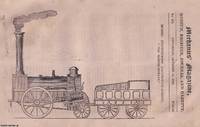
1829507894Knight and Lacey London 1829. Card Covers. Very Good Condition. The Mechanics' Magazine in October 1829 documented one of the most pivotal moments in railway history the Rainhill Trials a competition held to determine the best locomotive for the Liverpool & Manchester Railway. This event showcased several steam engines : The Rocket designed by Robert Stephenson won the competition and established a standard for future steam engines. It introduced a multi-tubular boiler improving efficiency and speed. The Sans Pareil built by Timothy Hackworth this locomotive was a strong contender but was ultimately less efficient than the Rocket and The Novelty designed by John Braithwaite and John Ericsson this locomotive was lightweight and innovative but suffered mechanical failures during the trials. The Rainhill Trials proved that locomotives were feasible for railway transport shaping the future of rail travel and marking the beginning of the age of speed transforming how people lived worked and travelled. Three complete issues of the Mechanics' Magazine No's 323 324 & 325 for October 1829. Genuine Original and Packed with Innovation! This weekly magazine isn't just a fragment of history it's a window into the cutting-edge advancements of the Victorian era! Since 1823 The Mechanics' Magazine has tackled revolutionary topics from printing presses to vapor baths hydrostatics and hydraulics. It dives into breakthrough safety measures preventing explosive contaminated air while exploring the mechanics of oxy-hydrogen blowpipes and self-laying rail carriages. Every page crackles with Victorian-era engineering brilliance capturing the relentless drive for invention that shaped the modern world! This is an exclusive standalone issue carefully separated from its original volume; authentic original and uniquely crafted. It is not a reprint or reproduction but a distinct piece in its own right. Preserved in a modern card cover prepared for practicality - an unassuming but serviceable presentation that favours function over finery. Size: 13 x 21 cms. Category: Mechanics' Magazine; New Arrivals; Special Interest. This item may require more postage than the rates shown for delivery outside the UK. If extra postage is required we will contact you before processing your order and you will be given the details and option to decline the extra cost. Knight and Lacey unknown
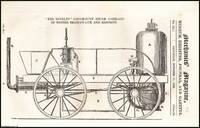
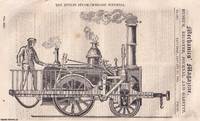
1830350540Knight and Lacey London 1830-31. Card Covers. Very Good Condition. The Rainhill Trials of 1829 were a landmark event in railway history but the subsequent reports in Mechanics' Magazine from 1830 and 1831 provided deeper insights into the development of the Liverpool and Manchester Railway including its construction costs and early operations. These reports covered ; Preparatory experiments leading up to the railway's full operation ; Detailed descriptions of the railway infrastructure and engineering challenges ; The opening of the railway including the tragic accident that led to the death of William Huskisson a prominent politician ; The performance of the engines including Stephenson's Northumbrian which played a crucial role in early railway operations ; The locomotive designs by Stephenson Braithwaite and Ericsson showcasing innovations in steam-powered transport ; The commencement of goods transport marking the railway's transition into commercial use : and incidents such as derailments including those involving The Meteor and The William the Fourth highlighting early challenges in railway safety. These reports were invaluable in documenting the early successes and setbacks of railway transport shaping future developments in locomotive engineering and railway management. The collection consists of the following complete issues: No. 372 Sept 25th 32 pages; No. 373 Oct 2nd 16 pages; No. 375 Oct 16th 16 pages; No. 378 Nov 6th 16 pages; No. 380 Nov 20th 16 pages; No. 384 Dec 18th 16 pages No. 389 Jan 22nd 16 pages; 1830 & 1831. These seven issues continue the contemporary reporting in this journal of the Rainhill Trials and the development of the Liverpool & Manchester Railway. The Rainhill Trials held in October 1829 aimed to test George Stephenson's assertion that locomotives would be the best motive power for the nearly completed Liverpool and Manchester Railway. Five locomotives participated running along a one mile stretch of level track at Rainhill Lancashire. Stephenson's Rocket was the only locomotive to complete the trials and was declared the winner. Consequently the directors of the Liverpool and Manchester Railway decided that locomotives should operate services on their new line awarding George and Robert Stephenson the contract to produce them. The opening ceremony of the Liverpool and Manchester Railway on 15 September 1830 was a significant event attracting notable figures from the government and industry including the Prime Minister the Duke of Wellington. The day began with a procession of eight trains departing from Liverpool for Manchester. The parade was led by Northumbrian driven by George Stephenson and included Phoenix driven by his son Robert; North Star driven by his brother Robert Sr.; and Rocket driven by assistant engineer Joseph Locke. Unfortunately the day was marred by the death of William Huskisson the Member of Parliament for Liverpool who was struck and killed by Rocket at Parkside. Genuine Original and Packed with Innovation! This weekly magazine isn't just a fragment of history it's a window into the cutting-edge advancements of the Victorian era! Since 1823 The Mechanics' Magazine has tackled revolutionary topics from printing presses to vapor baths hydrostatics and hydraulics. It dives into breakthrough safety measures preventing explosive contaminated air while exploring the mechanics of oxy-hydrogen blowpipes and self-laying rail carriages. Every page crackles with Victorian-era engineering brilliance capturing the relentless drive for invention that shaped the modern world! This is an exclusive standalone issue carefully separated from its original volume; authentic original and uniquely crafted. It is not a reprint or reproduction but a distinct piece in its own right. Preserved in a modern card cover prepared for practicality - an unassuming but serviceable presentation that favours function over finery. Size: 13 x 21 cms. Category: Mechanics' Magazine; New Arrivals; Special Interest. This item may require more postage than the rates shown for delivery outside the UK. If extra postage is required we will contact you before processing your order and you will be given the details and option to decline the extra cost. Knight and Lacey unknown
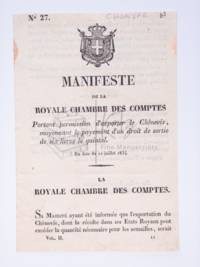
18340010174Kingdom OF Sardinia. Good with no dust jacket. 1834. Ephemera. On offer is an interesting Royal Decree regarding the export of hemp seed in early 19th century Europe. This decree was issued in July 1834 by the Royal Office of Accounts of the Kingdom of Savoy. It deals with the export of hemp seed a grain crop that was traded on the grain markets across Europe. The decree says: Manifest de la royale chambre des comptes portant permission d'exporter le chenevis moyennant le payement d'un droit de sortie de six livres le quintal. Translation: Manifesto of the royal chamber of accounts bearing permission to export the hemp seed by paying an exit fee of six pounds per hundredweightThe decree goes on to say: Sa Majeste ayant ete informee que l'exportation du Chenevis dont la recolte dans ses Etats Royaux peut exceder la quantite necessaire pour les semailles serait avantageuse a la agriculture en ce qu'elle formerait un objet de commerce actif a l'etranger a daigne par son Billet Royal en date du 10 de ce mois Nous communiquer ses Determination Souveraines a cet egard et Nous charger de les porter a la connaissance du public par notre ManifesteTranslation: His Majesty having been informed that the export of Hemp Seed whose harvest in his Royal States may exceed the quantity necessary for sowing would be advantageous to agriculture in that it would form an object of active trade abroad deigns by his Royal Ticket dated the 10th of this month to communicate to us his Sovereign Determinations in this regard and to instruct us to bring them to the attention of the public by our Manifesto. Further it states: L'exportation de la semence du Chanvre sera desormais permise moyenannt le payment d'un droit de sortie de six livres la quintal Translation: Export of hemp seed will now be permitted subject to payment of an exit fee of six pounds per hundredweight. What this document hints at is a general liberalization in the Kingdom of Sardinia. Charles Albert reigned as King of Sardinia and Duke of Savoy between 1831 and 1849. Although a very conservative person he made efforts to modernize his Kingdom and this included reducing taxes on grain and a general liberalizing of commerce. Also at this time Giuseppe Mazzini was beginning to organize his drive to unite the many small states on the peninsula to form the country of Italy. The document measures 7.5 inches by 5.0 inches. It is a 4 page printed document with text printed on two pages. There is a little staining along the edges but nothing to interfere with text. The document bears the arms of the Kingdom of Sardinia. ; 7.5"x5"; 2 pages . unknown
1835373895Salmon London 1835. Booklet - Unbound Pages. Very Good Condition. 32 Pages with woodcuts. Small piece missing from inner margin of first leaf with no loss of text. See pictures for detail. Genuine Original and Packed with Innovation! This weekly magazine isn't just a fragment of history it's a window into the cutting-edge advancements of the Victorian era! Since 1823 The Mechanics' Magazine has tackled revolutionary topics from printing presses to vapor baths hydrostatics and hydraulics. It dives into breakthrough safety measures preventing explosive contaminated air while exploring the mechanics of oxy-hydrogen blowpipes and self-laying rail carriages. Every page crackles with Victorian-era engineering brilliance capturing the relentless drive for invention that shaped the modern world! This is an exclusive standalone issue carefully separated from its original volume; authentic original and uniquely crafted. It is not a reprint or reproduction but a distinct piece in its own right. Preserved in a modern card cover prepared for practicality - an unassuming but serviceable presentation that favours function over finery. Size: 13 x 21 cms. Category: Mechanics' Magazine;. Salmon unknown
1846NNJT77/81France. Very Good. 1846. Manuscript. On offer is an outstanding archive of forty-seven 47 letters from the personal files of famed Admiral of the French Navy and Great Astronomer Amédée Ernest Barthélemy Mouchez. The archive dates 1846 through 1891 and is made up of a few letters from his sister a letter to his mother and then the balance from colleagues notables and friends; a number are on stationery of the Republic of France; Sociedad Cientifica "Antonio Alzate" Mexico; Ecole Normale Superieure Laboratoire de Chime; Senat and some French Ministerial Office letterheads. This fascinating archive touches upon many of Mouchez' career highlights as the letters deal with a number of different areas - Mouchez' work in China matters of the Observatory Mexico personal communications of friends and colleagues etc. Mouchez had a spectacular career embarking on a career in the French Navy as an ensign in 1843. This was a period of relative international maritime peace and much of the navy's activities were dedicated to exploration and discovery. Mouchez was initially occupied with hydrographic studies along the coasts of Korea China and South America penetrating 320 km up the Paraguay River and exploring the Abrolhos Islands. He improved the practice of surveying at sea adapting terrestrial instruments for naval use and was especially concerned with the problems of determining longitude. He developed the use of the theodolite and meridian telescope to improve the error in establishing longitude. Attaining the rank of Captain in 1868 he embarked on a series of expeditions to chart the coast of Algeria. At the conclusion of his project in 1873 he was elected to the Bureau des Longitudes and in the following year was sponsored by the Académie des Sciences to observe the transit of Venus from St. Paul Island in the Indian Ocean. On December 9 he made a sequence of superb photographic plates of the event. In 1875 the Académie elected him a member of the astronomy section and in 1878 he was promoted to rear admiral and awarded the role of director of the Paris Observatory. The observatory had fallen into disrepair and disrepute since the chaos of the Franco-Prussian War of 1870 and the Paris Commune of 1871. Mouchez set about a programme of reconstruction but failed to persuade the government to fund a new observatory outside the centre of Paris. In 1887 he collaborated with Sir David Gill to host an international astronomical conference in Paris. The principal outcome of the conference was a multi-national project to compile and index a photographic atlas of the heavens the Carte du Ciel. The project consumed massive effort over several decades before it was rendered obsolete by modern astronomical methods. He is also credited with founding Mountsouris Observatory and he is the author of six books on astronomy navigation nautical instruction etc. A grand boulevard in Le Havre and a village in Algeria are named for Mouchez. This is a great archive of intersecting and diverse worlds being astronomy France and her Navy Algeria militaria geography cartography and South America. VG.; 12mo - over 6¾" - 7¾" tall; CLIMATE CLIMATOLOGY METEOROLOGICAL WEATHER ASTRONOMY ASTRONOMER NAVY NAVAL MARITIME MONTSOURIS HANDWRITTEN MANUSCRIPT DOCUMENT LETTER AUTOGRAPH WRITER HAND WRITTEN DOCUMENTS SIGNED LETTERS MANUSCRIPTS HISTORICAL HOLOGRAPH WRITERS AUTOGRAPHS PERSONAL PERSONAL HISTORY MEMOIR MEMORIAL OBSERVATORY ORRERIES SCIENCE NAUTICAL NAVIGATION MAPS CARTOGRAPHY ALGERIA AFRICA antiquité contrat vélin document manuscrit papier Antike Brief Pergament Dokument Manuskript Papier oggetto d'antiquariato atto velina documento manoscritto carta antigüedad hecho vitela documento manuscrito Papel; Signed by Autograph . unknown
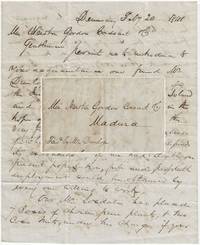
1841010706British Guiana Guyana 1841. Envelope or Cover. Very good. This two-page stampless folded letter measures 8" x 9.75". It was sent by the Murray Brothers of British Guiana Guyana to Newton Gordon Cossart & Company in Madeira. It is datelined "Demerary Demerara Feby 1840". The front of the letter bears the manuscript annotation "Fav'd by Mr Dunlap" indicating it was favor-carried. In nice shape. A transcript will be provided. </p> <br /> <br /> <p>The letter introduces an "Immigration Society" agent Mr. Dunlap and request he be assisted in soliciting post-slavery labor for the sugar plantations of the colony. It reads in part:</p> <br /> <br /> <p style="margin-left:5%; margin-right:10%;">"Permit me to introduce as your acquaintance our friend Mr. Dunlap whos proceeds as Agent for the Immigration Society to your Island and thence to Sierra Leone in the hopes of obtaining laboreres for this very fine colony and on the success of which we may safely say depend its existence if we had double our present population sure and profitable employment could be obtained by every one willing to work. . . Our Mr. Loxdale is bringing 7 boxes of choice pineapple plants and two coco nuts. If Mr. Gordon has more than he requires he will be able to spare some to his friends. They number three dozen in one box . . . our very best specimens . . . Blue Jamaica Montserrat and Indian. . . If it will not give you too much trouble would you send us a few choice plants in duplicate and the tea plant. . ."</p> . Although the Abolition Act of 1833 officially abolished slavery throughout the British Colonies de facto slavery continued unabated throughout its Caribbean lands via the "coolie" trade which enticed impoverished East Indians into oppressive indentured contracts after which they were treated only slightly better than the enslaved laborers they replaced. Almost 40000 were brought to British Guiana.</p> <br /> <br /> <p>The planters of British Guiana also established a successful "Immigration Society" subsidized by the government which recruited Portuguese laborers and former coolies from Madeira and more importantly African "recaptives" who had been bound for Spanish and Portuguese colonies until their slave ships were captured by the British Navy. Once freed the Africans were taken to Sierra Leone where Admiralty courts legally confirmed their free status. Afterwards they were consigned to a variety of unfree labor apprenticeships at the hands of the Nova Scotian Settlers and Jamaican Maroons Afro-Caribbeans who had freed themselves from slavery and established black communities throughout the West Indies. Mr. Dunlap in this letter and other immigration agents were quite successful. Between 1840 and 1865 almost 14000 African recaptives from Sierra Leone had immigrated to British Guiana along with over 30000 Portuguese laborers and several thousand former coolies from Madeira.</p> <br /> <br /> <p>For more information see Erickson's "The Introduction of East Indian Coolies into the British West Indies" in The Journal of Modern History - June 1934 "The Arrival of the Portuguese" at the Gonsalves of Guyana website and "Abolition's Adolescence: Apprenticeship as 'Liberation' in Sierra Leone 1808-1848" in The English Historical Review - June 2022.</p> <br /> <br /> <p>Perhaps unique. At the time of listing nothing related to the recruitment or use of "receptive" labor is for sale in the trade; neither has any related material appeared at auction per the Rare Book Hub. OCLC shows no related items are held by institutions.</p> . unknown
1849587978Bonaire Leeward Antilles 1849. Very Good. Partially printed document measuring 8’ x10†completed in manuscript. Signed and dated July 29 1849 by U.S. Vice-Consul William Boye and blindstamped with the U.S. Consulate seal of Bonaire. Partially split along two horizontal folds very good. A rare well-preserved document from the Denis Vandervelde Collection of Disinfected Mail of the World 1590-2020 see below.<br /> <br /> The certificate reads in part: “I William Ernst Boye Vice-Consul of the United States of America for the port of Bonaire do hereby certify that the Schooner … Sylvan of Stockton California of the registered burden of 137 tons whereof B.E. Young is Master … being in all Seven persons on board cleared this day at port for Boston. I further certify that in this port and its vicinity good health prevails without suspicion of plague or contagious distemper whatsoever … .â€<br /> <br /> To prevent the spread of serious diseases ship Bills of Health were issued by government officials to certify that a ship’s cargo passengers and crew were likely free of contagious disease. Bonaire at this time had been established by the Dutch government as an official slave plantation for the harvesting of salt. According to an accompanying note by Denis Vandervelde who over nearly 50 years assembled a collection of more than 3000 items of disinfected mail "letters that have been punctured perfumed or otherwise purified to prevent the transmission of disease" the Sylvan was registered at Stockton California which had been founded in 1849 by the German Captain Charles Weber on a grant of 50000 acres from the Spanish government to accommodate the initial waves of '49ers and other participants in the gold rush.<br /> <br /> An exceptionally scarce document linking public health the California gold rush and the African slave trade. unknown
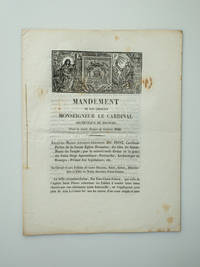
18490010113Bourges France. Good with no dust jacket. 1849. Ephemera. On offer is a printed Roman Catholic pastoral letter dated 1849 and intended as an open letter to clergy and members of the church in the jurisdiction. Its author was Jacques-Marie Antoine Célestin Dupont the Cardinal Archbishop of the Diocese of Bourges France. Dupont was born in 1792 in Sardinia. He was ordained a priest in 1815. In 1823 he was appointed Bishop and over the next 36 years served in several dioceses. His various postings were not without controversy. He was a reformer sent into several large dioceses to bring about much-needed changes and this frequently did not sit well with local clergy or the people of the diocese. In 1847 he was made a Cardinal. He maintained close relationships with the court of Louis Phillippe the so-called July Monarchy. Dupont passed away in 1859 in Bourges France. He begins his long letter with this exhortation: La belle recommendation nos tres-chers freres que celle de l'apotre St. Pierre exhortant les fideles a rendre leurs ames chastes par obeissance toute fraternelle en s'appliquent avec plus de soin a s'aimer les uns les autres d'un coeur simple et sans defiance. Translation: The beautiful recommendation our dearest brothers that the apostle St. Peter exhort the faithful to make their souls chaste by fraternal obedience apply themselves with more care to love each other with a simple heart and without hesitation. The front cover carries the coat of arms of Cardinal Du Pont. The letter is issued over his printed signature and sealed with his coat of arms. It also bears the printed signature of his secretary Jean Figier. This document offers a valuable insight into the teachings of the Roman Catholic Church in mid-19th century Europe. Pastoral letters such as this one were frequently sent out at particular times of the year coinciding with ecclesiastical seasons such as Lent or Christmas. However they were not limited to any particular event or celebration. In this case this Pastoral Letter was published for the Lenten season of 1849 the 40 day. Period preceding Easter. The document measures 10.75 inches by 8.5 inches. It is a 16-page printed document. The binding is a simple threaded binding that is intact and in good condition. The pages have some staining due to age but otherwise the document is in very good condition. ; Letters; 10.75"x8.5"; 16 pages; Signed by Notable Personage Unrelated . unknown
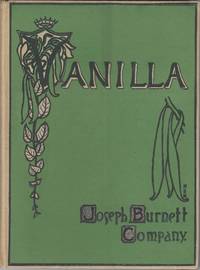
19009901Boston: Published by the Joseph Burnett Company; Press of Mipps & Knight Co 1900. Octavo in stiff boards 19.5 x 14.5 cm. 44 4 pages. Illustrated in black and white. Title page printed in red and black. FIRST EDITION. A handsome promotional book about the vanilla plant and vanilla extract sold by the Joseph Burnett Company commemorating the 50th anniversary of the firm and promoting Burnett's Vanilla Extract. The book contains three sections: "The Plant: Its Habitat and History" "Its Culture" and "Its Curing" with information on the vanilla plant or the vanilla orchid; its countries or regions of origin; and the cultivation and curing processes of vanilla. Text at the end warns customers of unscrupulous door-to-door salespeople peddling fraudulent or low-quality vanilla extracts advocates for grocers to carry only high-quality vanilla extract and advertises Burnett's Vanilla Extract and Burnett's edible Standard Color Pastes. Internally fresh clean and sound. Original publisher's beige and green paper-covered boards titled and decorated in green and black on the front panel; no title to spine. Fine and rare thus. Published by the Joseph Burnett Company; Press of Mipps & Knight Co hardcover
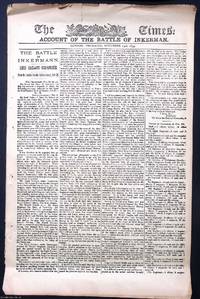
1854373729The Times London 1854. Newspaper. Good Condition. The two Times Special Reports dated 13 November 1854 The Attack on Balaclava and 23 November 1854 The Battle of Inkermann provide detailed contemporary accounts of two of the most significant engagements of the Crimean War. The Balaclava issue contains the earliest extended reports of the battle of 25 October including the now-legendary Charge of the Light Brigade official despatches from Lord Raglan and narrative descriptions that shaped public perception of both the disaster and the heroism involved. The Inkermann issue presents Lord Raglan's despatches and extensive coverage of the desperate fighting on 5 November 1854 when outnumbered British and French forces repelled a much larger Russian army. Together these issues stand as immediate first-hand printed records of events that soon became iconic in British military history. These copies are original 1854 issues of The Times not later reprints or bound compilations. Issued as separate folio supplements printed on rag-based paper and headed with the distinctive Times masthead and royal crest they were sold individually to provide the public with full stand-alone accounts of major battles. Survival of such ephemeral publications is uncommon making these examples both scarce and historically significant. Their value lies not only in their rarity but also in their role as primary sources that convey how the war was reported understood and remembered at the time. Two issues each four pages in length. Some minor marginal tears probably inevitable with newspapers of this sort. Preserved in a modern card cover prepared for practicality - an unassuming but serviceable presentation that favours function over finery. Size: 29 x 44.5 cms. Category: Antiquarian & Rare; Newspapers; Special Interest. This item may require more postage than the rates shown for delivery outside the UK. If extra postage is required we will contact you before processing your order and you will be given the details and option to decline the extra cost. The Times unknown
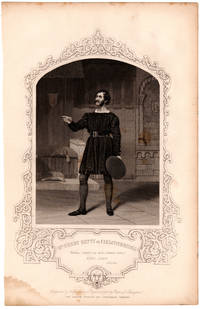
1860010827London: The London Printing and Publishing Company 1860. Soft cover. Very Good. 4to - over 9¾" - 12" tall. Hollis of The London Printing and Publishing Company engraving; Paine of Islington daguerreotype. London: The London Printing and Publishing Company 1860. Steel engraving by Hollis from a daguerreotype by Paine of Islington. Small quarto size in this case 10 3/4" 6 7/8" overall; image area at largest decorative extremities is 9" x 6". Depicted is "Mr. Henry Betty as Faulconbridge" in William Shakespeare's "King John" Act 1 Scene 1 see scan. Henry Betty was likely a descendant of the renowned British child actor William Henry West Betty. Small light dampstain at lower left several small and light points of foxing see scan. Very Good to about Near Fine. L-eph <br/> <br/> The London Printing and Publishing Company paperback
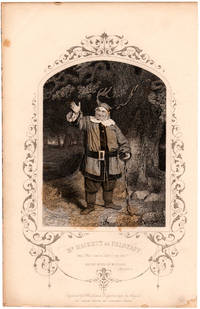
1860010829London: The London Printing and Publishing Company 1860. Soft cover. Very Good. 4to - over 9¾" - 12" tall. Hollis of The London Printing and Publishing Company engraving; Mayall daguerreotype. London: The London Printing and Publishing Company 1860. Steel engraving by Hollis from a daguerreotype by Mayall. Small quarto size in this case 10 3/4" 6 7/8" overall; image area at largest decorative extremities is 8 3/4" x 6 1/4". Depicted is "Mr. Hackett As Falstaff" wearing antlers in William Shakespeare's "Merry Wives of Windsor" Act 5 Scene 5 see scan. Very small dampstain at lower right one small point of foxing see scan. Better than Very Good just short of near fine. L-eph <br/> <br/> The London Printing and Publishing Company paperback
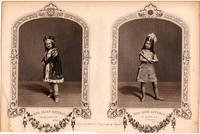
1860010830London: The London Printing and Publishing Company 1860. Soft cover. Very Good. 4to - over 9¾" - 12" tall. Hollis of The London Printing and Publishing Company engraving; Mayall daguerreotype. London: The London Printing and Publishing Company 1860. Steel engraving by Hollis from a daguerreotype by Mayall. Small quarto size in this case 10 3/4" 7 1/4" overall; image area at largest decorative extremities is 9 3/4" x 7 1/8". Depicted are "Miss Ellen Bateman as Richard 3rd. Act 4. Sc 4." and "Miss Kate Bateman as Richmond. "Richard 3rd. Act 5. Scene 3." respectively. Hollis of The London Printing and Publishing Company engraving; Mayall daguerreotype see scan. Light small dampstain at lower left somewhat uneven trim at overall bottom edge. Very Good. L-eph <br/> <br/> The London Printing and Publishing Company paperback
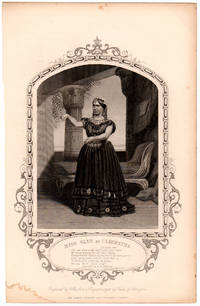
1860010831London: The London Printing and Publishing Company 1860. Soft cover. Very Good. 4to - over 9¾" - 12" tall. Hollis of The London Printing and Publishing Company engraving; Paine of Islington daguerreotype. London: The London Printing and Publishing Company 1860. Steel engraving by Hollis from a daguerreotype by Paine of Islington. Small quarto size in this case 10 3/4" 6 7/8" overall; image area at largest decorative extremities is 9" x 6". Depicted is "Miss Glyn as Cleopatra" in William Shakespeare's "Antony and Cleopatra" Act 2 Scene 5 see scan. Small light dampstain at lower left several small and light points of foxing see scan. Very Good to about Near Fine. L-eph <br/> <br/> The London Printing and Publishing Company paperback
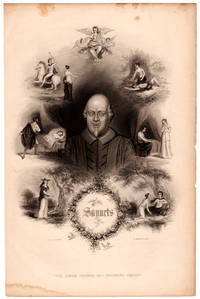
1860010832London: The London Printing and Publishing Company 1860. Soft cover. Very Good. 4to - over 9¾" - 12" tall. T.D. Scott and G. Greatbach of The London Printing and Publishing Company engraving from the Somerset Portrait. London: The London Printing and Publishing Company 1860. Steel engraving by T.D. Scott and G. Greatbach from the Somerset Portrait. Small quarto size in this case 10 3/4" 6 7/8" overall; image area at largest decorative extremities is 9" x 6". Depicted is a bust of Shakespeare with scenes from sonnets surrounding it see scan. Modest dampstain; several small points of foxing. See scan. Very Good or a bit better. L-eph <br/> <br/> The London Printing and Publishing Company paperback
1861621779The Builder London 1861. Unframed Print. Very Good Condition. A single sheet print image area approx. 18 x 28 cms. With another page containing a floor plan and some accompanying text. A picturesque utility building with ornamental detailing blending agricultural function with royal charm. The illustrations found in leading architectural journals of the nineteenth and early twentieth centuries such as The Builder Building News and The Architect are masterpieces of visual craftsmanship. These illustrations capture the elegance intricacy and stylistic flair of the period's architecture. Rich in ornamental detail and atmospheric depth they reflect not only the buildings themselves but the artistic sensibilities and design discourse of their age. THIS IS AN ORIGINAL PAGE FROM THE JOURNAL PRINTED AT THE DATE SHOWN IN THE TITLE NOT A REPRINT OR COPY. Category: Builder & Building News; Unframed Prints : Old; New Arrivals; PRINTS : Buildings & Places. This item may require more postage than the rates shown for delivery outside the UK. If extra postage is required we will contact you before processing your order and you will be given the details and option to decline the extra cost. The Builder unknown
1865BTETM0002547London: Sumptibus Societatis Camdenensis Camden Society 1865. 1st Edition. Hardcover. Very Good/No Jacket. Octavo Standard 8vo 6 נ9 in 152 נ229 mm . Please email for Photographs or further information. Very Good - 8vo. General title 1865; Advertisement xi pp; Preface pp. ixliii; Appendix pp. ixxxvi; Orthographic Index pp. iii; Main text pp. 1563 incl. Additional Notes & Corrections; 1 blank; 4 Camden matter publisher list/series leaves. Plate: 3 litho plates of manuscript samples present. Binding: 19th-century full calf period ms. paper spine label Way 1865. Collation: pp. 666 Please see Photos as part of condition report. 1865 1st Edition PROMPTORIUM PARVULORUM Sive Clericorum Dictionarius Anglo-Latinus Princeps By Geoffrey the Grammarian Galfridus Grammaticus Albert Way Author Bio: Geoffrey the Grammarian Galfridus Grammaticus a Dominican friar of Norfolk active c. 1440. Very little is known of his life beyond his order and region; his reputation rests on the Promptorium which he compiled from teaching practice and contemporary usage. It is prized for glossing ordinary medieval objects crafts dress and domestic life. Albert Way A.M. 18051874 English antiquary long associated with the Camden Society and the Society of Antiquaries. Way edited and greatly annotated the Promptorium adding long linguistic notes source citations Chaucer Piers Plowman etc. sample manuscript hands your plate with red W initial and multiple indices that make the edition still heavily used. Synopsis: Middle-English to Latin lexicon compiled by a Norfolk Dominican c.1440the earliest substantial EnglishLatin dictionary and a cornerstone source for everyday medieval vocabulary crafts dress & domestic life. Albert Ways definitive Camden Society edition here bound as one thick volume under the general 1865 title-leaf bringing together the three parts issued 1843/1845/1865 with extensive notes indices and three lithographed plates of manuscript hands. Format: Hardcover Octavo Standard 8vo 6 × 9 in 152 × 229 mm Note: Binding/size selection follows standard bibliographic conventions and is approximate; exact measurements may vary. Language: Latin/English Published By: Sumptibus Societatis Camdenensis Camden Society London Condition Report: Dust Jacket: No Jacket Dust Jacket Condition: No Jacket Very Good - 8vo. General title 1865; Advertisement xi pp; Preface pp. ixliii; Appendix pp. ixxxvi; Orthographic Index pp. iii; Main text pp. 1563 incl. Additional Notes & Corrections; 1 blank; 4 Camden matter publisher list/series leaves. Plate: 3 litho plates of manuscript samples present. Binding: 19th-century full calf period ms. paper spine label Way 1865. Collation: pp. 666 Please see Photos as part of condition report. SKU: BTETM0002547 Shipping Info: Approximate Package Dimensions H: 12.5 L: 30 W: 25 Units: cm W: 2Kg Tracked Shipping Insurance Coverage as per Customer Request Sumptibus Societatis Camdenensis (Camden Society) hardcover
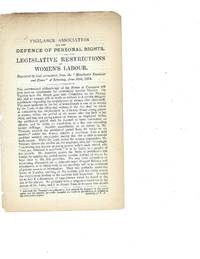
1874165761874. Woman Employment Vigilance Association for the Defence of Personal Rights. "Legislative Restrictions on Women's Labour." Extract Reprinted by kind permission from the "Manchester Examiner and Times" of Saturday June 20th 1874. First edition Extract. 4 pages. Original paper wrappers. 8 1/2 x 5 in. "Who in thousands of cases where there is no helper will assure them and their children bread" This report criticizes a proposed labor bill that would ban women from working in factories for a period of 6 months after having a child. They find fault in the over-regulation of poor women as opposed to women from wealthy families and the fact that there is no social support for married women who cannot work: ".many married women deserted or uncared for by their husbands.no marriage law secures to the wife a share in the earnings of the father of her children." They compel women to raise their voices against this proposed regulation. The Vigilance Association for the Defence of Personal Rights was a British organization dedicated to watching restraining and influencing legislation especially in matters affecting the interests of women and the personal rights and liberties of the people. At the time that this description is being written no copies are recorded in American institutions. OCLC search results are at best an estimate and can vary over time. unknown
18760009090SILVER INLET MINE SIBLEY PENINSULA ONTARIO CANADA. Good. 1876. On offer is an 1876 Metallurgical assay and analysis book of silver mining only a few years after silver had been discovered at Silver Islet in Northwest Ontario. The diarys first page has a title: Analyses & Assays made for the Silver Islet Mining Co. at Silver Islet Lake Superior 1876 to 77 by Carl O. Wederkinch. The book is true to its title. Throughout the handwritten book which covers a period from November 2 1876 to mid-1877. This book has a tremendous amount of information in it relating to the complicated and fascinating metallurgical process of Silver mining. Wederkinch who was at the time the lead engineer of the Silver Islet Mining Co. keeps incredibly detailed and comprehensive notes on a wide variety of topics related to his work at the Silver Islet mine. There are probably over 200 different samples assayed in the book. Silver is assayed through titration and the calculations are often written out in full. For example: Nov. 2nd. Samples assayed for purposes of finding amount of loss that will occur in concentrating ore. No. 1: Pink spar and slate some silver sprinkled throughout the spar nearest the slate. Ore taken = 3 A.T. = 87.498 grm. 1/20 A.T. = 34.4 = 694. Concentrations = 7.290 grm. Failings = 72.242grm. Loss = 7.966 grm or 9.1% This is done many times with many different types of samples each taken from different places and described differently. On some dates a Diamond-drill-core is used and samples are tested for their silver content. A detailed map can be found about a quarter through the book which gives the locations of all the different samples taken. There are many many pages where the assay calculations done on the samples are fully fleshed out. These calculations are done by titration and are very complex and incredibly interesting to those who know what is being done. Silver is commonly found in various ores such as argentite chlorargyrite and galena a lead ore often containing significant amounts of silver. Galena is mentioned most often especially when Wederkinch writes on smelting the ore into silver. The last part of the book roughly 40 pages appear to have been written by another person other than Wederkin. They concern a trip to Central America Ecuador Panama Honduras and what appears to be a feasibility assessment of a number of mines in that part of the world: Loma Larga Mine. No Frills report says the ore goes averages from $90 to $100 pr. Ton. Mr. Williamson says that the ore will average from $40 to $50 pr. Ton. They have wored as much as 250 tons in a month from 3 mines and he says his ___ at one time showed an average of $50 pr. Ton. He says they had some ___ ore that was sent to England which he thinks will go near $1000 pr. ton but says of late they have not taken out any parking ore for shipment. The date on this section is 1888. Wederkin would die in 1881 in Honduras. Also included are a number of pages on how to calculate latitude and longitude pages on the use of a smelting furnace to extract base metals from their ore including the financial details of the use of the furnace i.e. cost in versus return pages concerning the details of various metallurgical instruments Leffel Water Wheel Riveted Iron Pipe Smelting Furnace etc. pages on the temperatures experienced on a multi-month trip to Honduras to test the feasibility of mining in the country. The book is in fair condition. There is an unattached front cover and no back cover. The pages are in good shape but are not bound to each other. They are not completely loose as they are in gatherings of 16 pages or so but the separate gatherings are not bound to each other anymore. The book is roughly 200 pages of which there is writing on almost every single page. The handwriting is legible and readable. Background: Silver Islet refers to both a small rocky island and a small community located at the tip of the Sibley Peninsula in northwestern Ontario Canada. A rich vein of pure silver was discovered on this small island in 1868 by the Montreal Mining Company. At that time the island was approximately 50 m² in size and only 2.5 metres above the waters of Lake Superior. In 1870 the site was developed by Alexander H. Sibley's Silver Islet Mining Company which built wooden breakwaters around the island to hold back the lake's waves and increased the island's area substantially with crushed rock. The islet was expanded to over 10 times its original size and a small mining town was built up on the shore nearby.; Manuscript; 8vo - over 7¾" - 9¾" tall; KEYWORDS: HISTORY OF CARL O. WEDERKINCH SILVER ISLET MINING COMPANY SILVER ISLET NORTHWEST ONTARIO SILVER MINING METALLURGICAL ASSAY BOOK TITRATION CALCULATION ANALYSIS OF ORE SAMPLES SIBLEY PENINSULA LAKE SUPERIOR SMELTING OF ORE CENTRAL AMERICAN SILVER MINES RESOURCE EXTRACTION CANADIAN SILVER RUSH ONTARIO SILVER MINING ALEXANDER H. SIBLEY CANADIANA HANDWRITTEN MANUSCRIPT DOCUMENT LETTER AUTOGRAPH WRITER HAND WRITTEN DOCUMENTS SIGNED LETTERS MANUSCRIPTS HISTORICAL HOLOGRAPH WRITERS AUTOGRAPHS PERSONAL MEMOIR MEMORIAL ANTIQUITÉ CONTRAT VÉLIN DOCUMENT MANUSCRIT PAPIER ANTIKE BRIEF PERGAMENT DOKUMENT MANUSKRIPT PAPIER OGGETTO DANTIQUARIATO ATTO VELINA DOCUMENTO MANUSCRITTO CARTA ANTIGÜEDAD HECHO VITELA DOCUMENTO MANUSCRITO PAPEL . unknown
18780001257COLERAINE MASSACHUSETTS MASS MA. Very Good. 1878. On offer is an original manuscript diary handwritten by a young woman who with her pencil and her words paints a picture of toil and hardship. Dated Coleraine in Franklin County Massachusetts near Greenfield and Deerfield River which are frequently mentioned collectors and researchers of the area will delight in the specific and detailed genealogical information as our author does a superb job in her entries. A casual reading suggests this woman is married to the 27 year old Charlie and they are part of the Miner 'clan' with mention of many many Miners in their daily life. A washerwoman for the most part everyday she says whose sheets whose pillowcase whose other articles are washed along with her own family's duties food preparation travels to church visitors who frequently stay over and other domestic chores the reader will wonder at her strength and her grit. Throughout the 5 x 4.5 inch 'chunk' of what was obviously a larger note pad roughly cut in half she writes clearly in tight script a gem of Massachusetts Americana. She mentions many dozens of names including: Uncle Wash Frankie Jerre N. and D. Brown Elder Whittaker Miss Rug Willie Richardson Baldwin Miner his singing school Carrie and Marilla Shearer Payson Flagg Charlie Miner. Sam Miner 'his whole conversation show him to be a true Christian whom it always gives me pleasure to find' Ed Coombs Atta Barber Clarence Brigham Charlie Denison. Besides the work the family information and local news and events she will make a particular entry as with Sam Miner and sometimes incredibly personal intimate revelations when tragedy strikes: Timmie died this forenoon about nine. G___G___G___ How grievous this affair I am very sorrowful today for one more grief is fresh and will leave its mark on my mind through all time '. 'I washed for us. Mr. M. and D.B. came. I did not shed tears til evening. Memories are so unpleasant when they are of suffering.'; 'perhaps my self reproach is unjust that I know it was'. Cover is absent but text block is clean and overall VG.; English; 16mo - over 5¾" - 6¾" tall; MASSACHUSETTS COLERAINE FARMING WASHERWOMAN LABOR STUDIES PRE SUFFRAGE GENDER STUDIES WOMEN'S STUDIES antiquité contrat vélin document manuscrit papier Antike Brief Pergament Dokument Manuskript Papier oggetto d'antiquariato atto velina documento manoscritto carta antigüedad hecho vitela documento Manuscrito HANDWRITTEN MANUSCRIPT DOCUMENT LETTER AUTOGRAPH DIARY JOURNAL LOG KEEPSAKE WRITER HAND WRITTEN DOCUMENTS SIGNED LETTERS MANUSCRIPTS HISTORICAL HOLOGRAPH WRITERS DIARIES JOURNALS LOGS AUTOGRAPHS PERSONAL MEMOIR MEMORIAL PERSONAL HISTORY GENEALOGY . unknown