323 résultats
169316116(No place, no date(1693)). Very large engraved seechart, measuring 60 x 86,5 cm. in original outline colouring. The chart showing the Northern part of England from Lancaster to Banf, of Ireland from Blackrock to Carlingford and all the Islands to the north: Shetland, Orkney, Faroe etc. etc. A fine impression on good thick paper with the watermark: BYCOLUMBIER. Folded down the center.
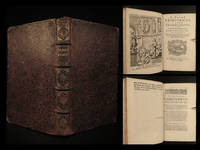
1633306616Paris: Societatis Typographic Librorum Officii Ecclesiastici . 1633. Engraved title numerous small and large engraved vignettes head-and tail-pieces one full-page engraving; text printed in black running headlines and chapter headings in red numerous large decorated initial capitals. 1 vols. Folio. Full red crushed morocco covers decorated with single black and gilt fillets including a central diamond in black and gilt with a gilt-rolled frame spine in six compartments with raised bands gilt lettered in two others with simple frame of black and gilt fillets wide gilt turn-ins with large gilt cornerpieces a.e.g. gilt-stamped on the turn-in of the inside front cover "French Binders Garden City NY" and on that of the rear cover "H. Hardy Relieur 1934 G. Pilon Doreur." Very slight rubbing to extremities still near fine with some toning to text. In a quarter morocco slipcase with chemise. Engraved title numerous small and large engraved vignettes head-and tail-pieces one full-page engraving; text printed in black running headlines and chapter headings in red numerous large decorated initial capitals. 1 vols. Folio. Bound by The French Binders 1934. Beautifully bound in full red morocco by The French Binders successors to The Club Bindery and signed on the rear turn in by two of the firm's most distinguished binders Henry Hardy and Gaston Pilon. <br/>The French Binders traces its lineage back to The Club Bindery founded in 1895 by members of the Grolier Club to provide exceptionally fine bindings for American collectors. The Club Bindery moved to Cleveland where it was successively renamed the Rowfant Bindery 1909-1913 the Booklover's Shop 1914-1917 and finally The French Binders 1918-1920s as in-house bindery to Doubelday in Garden City New York. Henry Hardy worked for all incarnations of the bindery starting with The Club Bindery; his brother-in-law Gaston Pilon worked with Chambolle-Duru in Paris and came over to America to join the Rowfant Bindery. Both Hardy and Pilon were named Officers of the French Academy in 1933 the highest recognition given by the French government to naturalized Americans see Martin Antonetti's essay in Bound to Be the Best: The Club Bindery. Provenance: Estelle Doheny red morocco booklabel; Carl C. Kalbfleisch brown morocco booklabel Societatis Typographic Librorum Officii Ecclesiastici .. unknown books
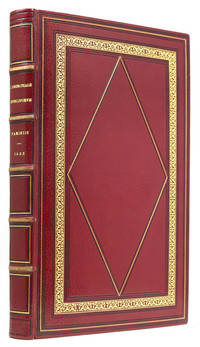
1633306616Paris: Societatis Typographic Librorum Officii Ecclesiastici . 1633. Engraved title numerous small and large engraved vignettes head-and tail-pieces one full-page engraving; text printed in black running headlines and chapter headings in red numerous large decorated initial capitals. 1 vols. Folio. Full red crushed morocco covers decorated with single black and gilt fillets including a central diamond in black and gilt with a gilt-rolled frame spine in six compartments with raised bands gilt lettered in two others with simple frame of black and gilt fillets wide gilt turn-ins with large gilt cornerpieces a.e.g. gilt-stamped on the turn-in of the inside front cover "French Binders Garden City NY" and on that of the rear cover "H. Hardy Relieur 1934 G. Pilon Doreur." Very slight rubbing to extremities still near fine with some toning to text. In a quarter morocco slipcase with chemise. Engraved title numerous small and large engraved vignettes head-and tail-pieces one full-page engraving; text printed in black running headlines and chapter headings in red numerous large decorated initial capitals. 1 vols. Folio. Beautifully bound in full red morocco by The French Binders successors to The Club Bindery and signed on the rear turn in by two of the firm's most distinguished binders Henry Hardy and Gaston Pilon. <br /> The French Binders traces its lineage back to The Club Bindery founded in 1895 by members of the Grolier Club to provide exceptionally fine bindings for American collectors. The Club Bindery moved to Cleveland where it was successively renamed the Rowfant Bindery 1909-1913 the Booklover's Shop 1914-1917 and finally The French Binders 1918-1920s as in-house bindery to Doubelday in Garden City New York. Henry Hardy worked for all incarnations of the bindery starting with The Club Bindery; his brother-in-law Gaston Pilon worked with Chambolle-Duru in Paris and came over to America to join the Rowfant Bindery. Both Hardy and Pilon were named Officers of the French Academy in 1933 the highest recognition given by the French government to naturalized Americans see Martin Antonetti's essay in Bound to Be the Best: The Club Bindery. Provenance: Estelle Doheny red morocco booklabel; Carl C. Kalbfleisch brown morocco booklabel Societatis Typographic Librorum Officii Ecclesiastici .. unknown
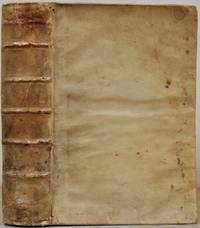
16437451baX3no place: Petrum and Jacobum Chouer 1643. Book. Very good- condition. Hardcover. 646 pages of text followed by 24 pages of index and additional sections with 168 pages and 151 pages each. Hardcover binding in full vellum stained and darkened; author name and title word on top edge of pages; Title page slightly defective; missing corner not affecting text; bookplate; owner marks on clipped flyleaf. Roman history philosophy. Petrum and Jacobum Chouer Hardcover books
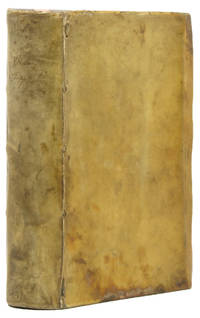
1659310832Amsterdam: Elzevir 1659. 24 404 28 pp. 12mo. Contemporary vellum. Very good. 24 404 28 pp. 12mo. Provenance: royal stamp on title; various early ownership signatures; Siebold ownership signature dated 1825 stamp on verso of title; Kirby Flower Smith bookplate Elzevir unknown books
1659310832Amsterdam: Elzevir 1659. 24 404 28 pp. 12mo. Contemporary vellum. Very good. 24 404 28 pp. 12mo. Provenance: royal stamp on title; various early ownership signatures; Siebold ownership signature dated 1825 stamp on verso of title; Kirby Flower Smith bookplate Elzevir unknown
1640109T2Ex Officina Elseviriorum Elzevier Lvgd. Batavorvm Leiden: 1640. 1640 pp. 12 414 i.e.404 28. Printer's device the Hermit on title page. 24mo. 13 cm. Latin text. Worn original full leather binding boards detached. The Dutch family of Elzevier Elzevir; Elsevier were the foremost printers of their time. They produced a vast variety of well printed scholarly and popular books; many in a very small handy format. Louis Elzevier the founder of the firm produced his first book in Leiden in 1583. The 'golden age' of Elzevier printing was between 1620 and 1680. The Elzevier dynasty probably produced their last publication in 1770. Gaius Plinius Caecilius Secundus born Gaius Caecilius or Gaius Caecilius Cilo 61 c. 113 better known as Pliny the Younger was a lawyer author and magistrate of Ancient Rome. Pliny's uncle Pliny the Elder helped raise and educate him. Pliny the Younger wrote hundreds of letters of which 247 survive and are of great historical value. Some are addressed to reigning emperors or to notables such as the historian Tacitus. Pliny served as an imperial magistrate under Trajan and his letters to Trajan provide one of the few surviving records of the relationship between the imperial office and provincial governors. Willems 506; Copinger 3646. PRICE JUST REDUCED! SMALL BOX 4 Language: eng. Hardcover. Fair. Ex Officina Elseviriorum [Elzevier], Lvgd. Batavorvm [Leiden]: 1640. hardcover
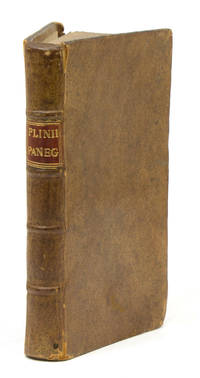
167520227<p><b>1675 Pliny the Younger Panegyricus Emperors Trajan & Domitian ROME Military </b></p><p>Pliny the Younger one of the most notable 1st-century historians is best remembered for his written works and orations. His best-known and still widely popular work is his '<i>Epistles'</i> which was a series of personal letters to other Roman figures. They give an important view of Roman everyday life as well as an interesting perspective on Pliny's views against Christianity.</p><p>In addition to his letters Pliny is remembered by his only known oration – '<i>Panegyricus'</i>. '<i>Panegyricus'</i> was a speech given to the Senate describing Emperor Trajan his administrative actions views on justice military discipline and commerce. He compares Trajan to other figures most notably Emperor Domitian. This 1675 edition was published in Lugduni Batavorum by Hackiana and includes notes and annotations by Dominique Baudius.</p><p>Item number: #20227</p><p>Price: $499</p><p>PLINY the Younger</p><p><b><i>C. PlinI Panegyricus liber Trajano dictus : cum annotationibus antehac ineditis Dominici Baudii</i></b></p><p>Lugduni Batavorum Leiden: Ex officina Hackiana 1675.</p><p><br /></p><p><u>Details</u>:</p><p>· Collation: Complete with all pages</p><p>o 38 427 43</p><p>o Includes engraved frontispiece</p><p>· Armorial bookplate – The Right Hon.ble the Earl of Berkshire Lord Marshall of England anno 1720</p><p>o Henry Bowes Howard 11th Earl of Suffolk 4th Earl of Berkshire 1686–1757 was an English peer. After the death of Henry Howard 6th Earl of Suffolk in 1718 he was appointed Deputy Earl Marshal an office he held until 1725. He also became Recorder of Lichfield in 1755. Motto: NOUS MAINTIENDRONS</p><p>· Language: Latin </p><p>· Binding: Leather; tight and secure</p><p>· Size: ~8in X 5in 20.5cm x 12.5cm</p><p>Our Guarantee:</p><p>Very Fast. Very Safe. Free Shipping Worldwide.</p><p>Customer satisfaction is our priority! Notify us with 7 days of receiving and we will offer a full refund without reservation!</p><p>20227</p><p>Photos available upon request. </p> officina Hackiana hardcover
1652310102Trajecti ad Rhenum Typis Gisberti à Zijll & Theodori ab Akersdijck 1652. 263pp. 16mo 5 x 2-3/4 inches. Bound in near contemporary speckled calf. Fine. 263pp. 16mo 5 x 2-3/4 inches. Trajecti ad Rhenum Typis Gisberti à Zijll, & Theodori ab Akersdijck unknown books
1652310102Trajecti ad Rhenum Typis Gisberti à Zijll & Theodori ab Akersdijck 1652. 263pp. 16mo 5 x 2-3/4 inches. Bound in near contemporary speckled calf. Fine. 263pp. 16mo 5 x 2-3/4 inches. Trajecti ad Rhenum Typis Gisberti à Zijll, & Theodori ab Akersdijck unknown
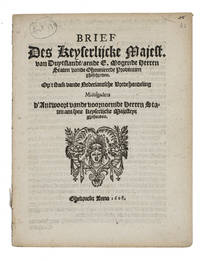
1608A86AMHKI23W2Amsterdam 1608. Small 4to. Disbound. With a woodcut device on the title-page. 8 pp. A letter from the Holy Roman Emperor Rudolf II to the Dutch States General dated 19 October 1607 concerning the peace negotiations with Spain with the States General's undated answer in fact from 7 January 1608 and longer than the Emperor's letter. The Emperor notes that King Philip of Spain and his governor in the Netherlands Archduke Albert have already recognized the United Provinces as a "Free Republic" regrets that the negotiations for peace have stalled and implies that the States could do more to facilitate progress. The States General's reply to the Emperor says that King Philip and Archduke Albert have not fully informed him and that the Spanish have continued to attempt to undermine the United Provinces by violence on land and at sea contrary to the agreements reached in Cologne.The pamphlet went through two editions which were issued with all three editions of the Nederlandtsche Bye-Korf between April and August 1608.With minor tears on or near the fold of the outer bifolium not approaching the text and slightly browned otherwise a very good copy.l Asher 26 27 or 28/33; Knuttel 1513; Simoni G 43; Tiele 716; OCLC WorldCat 5 copies. unknown
1682500020180Leyden: Lugduni in Batavis 1682. Hardcover. Poor. 12mo. Title missing nothing before Page 1pp1-374 & 1-286 . With prices of the books written by hand <br/> <br/> Lugduni in Batavis hardcover
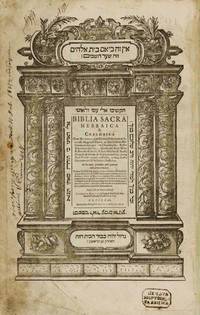
161948847Basel: Ludwig König 1619. First editions. Hardcover. Good. Seven parts in two volumes folio biblical texts and commentary in four parts continuously foliated; two supplemental sections each with separate foliation; Tiberias 1620 with separate pagination here bound after the second part - Vol. 1: 6 title and prelims 1-228 1 sect. title 234-441 1 blankff.; 6 sect. title and prelims 2 blank 114 2 blankpp. Vol. 2: 442-946; 8 Targum Yerushalmi; last leaf unfoliated; 67 Masora 1 blankff. Largely arranged in two columns of biblical texts in square font surrounded by commentaries in rabbinic Rashi font; text reads from right to left. This copy with collective Latin title surrounded by biblical quotations in Hebrew set within elaborate woodcut architectural borders. Hebrew sectional titles set within the same woodcut borders for the second and fourth parts with a plain letterpress half-title for the Five Megillot. The third sectional title for the Latter Prophets is lacking as are the Ashkenazi Haftarot readings not found in all copies. Apart from these lacks the Rabbinic Bible collates complete despite numerous errors in foliation throughout as per the detailed notes in Prijs Die Basler hebräischen Drucke. Opening word of each biblical book set in large one-third to one-half page cartouche vignettes with elaborate woodcut borders and surrounding letterpress Hebrew text. Main Latin title dated 1619 with the editor's Latin preface to the reader appearing at the verso. Jewish date chronogram for the second section Former Prophets dated 5378 1618/1619. Early twentieth-century black cloth boards worn at extremities gilt-lettered spine. Title moderately soiled re-inforced at gutter; neat old repairs to corners and fore-edge of title and next three leaves; old Russian stamp at bottom margin title manuscript entry in Russian along fore-edge dated 1837; intermittent mild to moderate marginal dampstains largely confined to corners and embrowning throughout both volumes somewhat more heavily in the first especially throughout Tiberias; top right corner of the opening leaf in vol. 2 repaired with loss of about 12 words surrounding title cartouche recto and some text in 9 lines of the commentary at the verso. Overall a good set with a notable chain of provenance. <br /> <br /> Sixth Rabbinic Bible in Hebrew: Mikra'ot Gedolot edited by Johann Buxtorf I 1565-1629 professor of Hebrew at the University of Basel and the foremost Christian Hebraist of his era with the assistance of the Jewish scholars Abraham Braunschweig who served as the principal corrector and Mordechai Gumplin of Posen. This was "a truly audacious undertaking for his time" Burnett From Christian Hebraism to Jewish Studies as no Christian scholar had yet attempted to edit the entire biblical corpus including the Aramaic versions Targumim and masoretic notes. Based mainly on the third Rabbinic Bible published by Daniel Bomberg at Venice in 1546-1548 the editor has carefully incorporated elements from two other Venetian editions. At the verso of the Latin title Buxtorf provides a detailed bibliographical excursus on the earlier Venetian editions and offers a tribute to Bomberg's industry by reprinting the colophon of the second Venetian Rabbinic Bible 1524-1525 at the conclusion of the masoretic appendix with text by the Hebrew grammarian and lexicographer Elijah Levita 1468 or 1469-1549 and a new introduction by Abraham Braunschweig. The design of the sectional titles and separate book title vignettes closely model those of the Venetian editions. "Buxtorf did not plan simply to reprint one of the existing Venice editions but rather to assemble the best features of them all into one work" and "to provide theologians with what he considered the most important tools for interpreting the Old Testament" Burnett. Buxtorf served in an official capacity as Basel's Hebrew censor charged with the oversight of all Jewish printing in the city and insuring that "no 'blasphemies' or slurs against Christians or Christianity appear in any book printed in Basel" Burnett. He carefully edited the Jewish commentaries in the Rabbinic Bible in accordance with this mandate "and removed many words and phrases which had escaped the attention of earlier censors" Burnett. <br /> <br /> The Rabbinic Bible contains the vocalized Masoretic text of the Hebrew Scriptures with accents and a vocalized Targum an Aramaic paraphrase of the biblical text: Onkelos for the Pentateuch; Jonathan b. Uzziel for the Prophets; and Targum Hagiographa for the Writings. The Hebrew and Aramaic versions are printed in square characters and presented in facing columns at the center of each page. The Jerusalem Targum of the Pentateuch appears as an appendix. In addition to the Aramaic paraphrases the Rabbinic Bible includes a massive scholarly apparatus of biblical commentaries by Rashi Ibn Ezra Baal ha-Turim Jacob b. Asher R. David Kimchi Radak R. Levi b. Gershon Ralbag Saadia Gaon and R. Isaiah along with the Masora a corpus of critical notes on the external form of the Biblical text compiled by Jewish scholars from late antiquity through the medieval era. As frequently occurs a copy of Buxtorf's work on the textual history of the Hebrew Bible Tiberias the 1620 first edition is bound-in. This work was made possible by the publication in 1538 of Elijah Levita's Masoret ha-Masoret a commentary on the Masora which Buxtorf translated into Latin for his own private use in 1593. "Buxtorf was concerned with the integrity of the consonantal text and the origin and integrity of the vowel points and accents of the Hebrew Bible from the very beginning of his scholarly career" and while he had earlier published a long excursus on the age of the vowel points and accents in his 1609 Thesaurus Grammaticus "Tiberias is Buxtorf's fullest and most impressive work on the history of the biblical text" Burnett. Intended as a reference work for Christian students and scholars interested in studying the Masora Buxtorf was also keen to refute the view advanced by Levita that the Hebrew vowel points were early medieval innovations. Our folio version of Tiberias was intended to accompany the Rabbinic Bible and has the same architectural borders at the title. König also published a quarto edition in the same year but only the folio version includes a critical commentary on the Masora in which Buxtorf proposes various corrections to the Masoretic notes. <br /> <br /> As noted at the title Buxtorf's faithful study and tireless labor studio fido et labore indefesso yielded notably long-lasting results: "The Basel rabbinical Bible became a standard tool for research among Christian scholars and would remain so. until the end of the nineteenth century" Burnett. A vast array of early modern scholars including Protestants like Johannes Drusius and John Selden as well as Roman Catholics like Robert Bellarmine and Andreas Masius owned a copy or two of the Rabbinic Bible. "Johannes Buxtorf's thoroughly censored "Christian" version of the Rabbinic Bible Basel 1618-19 only made it easier for Hebraists to own copies of their own" Burnett Christian Hebraism in the Reformation Era p.163.<br /> <br /> A note on the date of publication: "The actual printing began between the mid-August and mid-September of 1618. According to the colophon production ended on the 24 of Ab 5379 = August 4 1619 but since this date also appeared on the colophon of the Bomberg Biblia rabbinica edition of 1524-25 reprinted unchanged in the 1546-48 and 1568 editions it is suspect. Prijs suggested that the probable completion date was sometime during Ab of 5379 between July 12 and August 10 of 1619" Burnett. <br /> <br /> Provenance: from the library of acclaimed theologian and biblical scholar Brevard Childs with his entry at the free endpaper in the second volume. The earlier bookplate of judge Samuel Heller with his motto in Hebrew: Mi-kol melamdai hiskalti from all my teachers I have learned appears at the front paste-down. An old blue ink-stamp in Hebrew characters makes occasional appearances the text: Bet ha-Midrash ha-Gadol Minsk The Great Synagogue of Minsk. A Russian entry dated 1837 appears at the fore-margin of the main title along with an old ink stamp in Russian at the bottom margin the last word of which reads "Rabbina" References: Biblia Sacra: Burnett 7. Cowley 87. Darlow & Moule 5120 bound with the 1665 second edition of Tiberias cf. 5093. Davidson Otsar ha-shirah vol.1 p.406 no.8954. Prijs 219. Steinschneider 423 423b. VD17 23:675325G. S. Burnett Christian Hebraism in the Reformation Era Leiden: Brill 2012 p.163. Tiberias: Burnett 111. Prijs 222a. For detailed analyses of both works see: S. Burnett From Christian Hebraism to Jewish Studies Leiden: Brill 1996 pp.169-239 chaps. 6 & 7.<br /> <br /> Full Latin title: Biblia Sacra Hebraica & Chaldaica cum Masora quae critica Hebraeorum sacra est Magna & Parva ac selectissimis Hebraeorum interpretum commentariis Rabbi Salomonis Jarchi R. Abrahami Aben Esrae R. Davidis Kimchi R. Levi Gerson R. Saadie Gaon R. Jeschajae & Notis ex authore quem Baal Turim vocant collectis quibus textus grammaticè & historicè illustratur. In his nunc primum post quatuor editiones Venetas textus Chaldaicus qui Targum dicitur à deformitate punctationis & pravitate vocum innumeratum vindicatus; loca in Masora transposita deficientia pugnantia numeris depravata subsidio diversorum exemplarium & Concordantiarum Hebraicarum quantum fieri potuit reposita restituta & conciliata sunt ut in praefatione amplius declarabitur. Studio fido & labore indefesso Johannis BuxtofI linguae sanctae in Academia Basileensi Professoris Ord. Basileae: Sumptibus & typis Ludovici König 1619.<br /> <br /> Collation vol. 1 Rabbinic Bible: ital.a6 a-z8 A-E8 F4 G-Z8 Aa-Hh8 Ii9 Ii10 blank; 1 blank :3 1 blank A-N4 O5.<br /> <br /> Collation vol. 2 Rabbinic Bible: Kk-Rr8 Kk1 lacks Ss6 Tt10 Vv-Zz8 AA-PP8 QQ-TT6 VV9 VV10 blank XX-ZZ8 Aaa-Nnn8 Ooo3 Ooo4 blank PppTtt8 Vuu3 Vuu4 blank Xxx-Zzz8 AAaa-EEee8 8 A-G8 H6 I5 I6 blank. Ludwig König hardcover
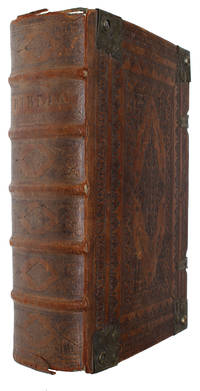
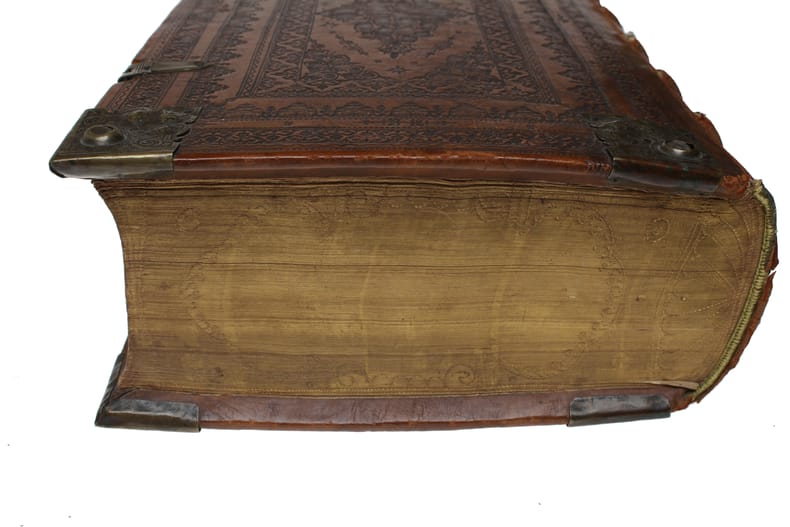
163360241Kiøbenhaffn Melchior Martzan og Salomon Sartor 1632- 1633. Folio binding: 37 x 25 cm. Bound in a spledid contemporary full calf binding over wooden boards. Rich elaborate gilding to both boards and spine. The gilding is vague especially on the front board but the tooling is very sharp and the binding overall is magnificent. With four beautiful ornamented brass edges to each board and two large ornamented brass clasps. All edges are gilt and beautifully blindtooled. Wear to capitals where the cords are loosening a bit and with a bit of loss of leather. A bit of wear to hinges at the cords which are showing. But overall the binding is in splendid condition. Also internally extremely well preserved. The title-page has a tiny restored hole to lower right corner and the first four leaves might have been inserted. They are slightly smaller at the outer margin than the other leaves. But that might also be due to restoration as the binding has not been tampered with at any point and is completely unrestored. The text is unusually nice clean and fresh by far the nicest copy we have ever come across. Pasted-down front end-paper with the ownership signature and lacquered coat-of-arms seal of Severin Svanenhielm Severin Seehusen 1664-1726 as well as the ownership signatures of Søren Schiøtz 1796-1863 with names of members of his family C. Th. Zahle and Erik Zahle. With the book plate of William Davignon d. 1924. The brass corners carry the initials HL and are depicted in Johannes Rudbeck's Svenska Bokband I fig. 26 p.53. The binding there is dated 1622 whereas our binding is from 1633 or right after. The brass fittings were a commercial merchandise for sale in Germany and probably also in both Sweden and Denmark. Engraved title-page as well as the engraved portrait of Christian IV all by the royal engraver Simon the Pas. Without the half-title which merely contains the printed words "BIBLIA / Paa Danske" which is almost never present. 21 - not counting the engraved title-page and the portrait 353 i.e. 354 due to the erroneous double pagination 353 226 159 ff. <br/><br/><em>A magnificent copy of the scarce first edition of the last i.e. the third of the Danish folio-bibles known as "Christian IV's Bible" being a slightly revised edition of the Bible of 1589. Christian IV is the most famous Danish king ever to have lived and the Christian IV bible is extremely sought-after. An unusually fresh and complete apart from the always lacking half-title copy of this splendid bible printed by the first royal printer Melchior Martzan and Salomon Sartor part 2. The numerous woodcut illustrations are the same that were used for the Frederik II Bibel from 1589. The four engraved leaves - the portrait and the three title-pages - are by Simon de Pas.Bibl. Dan.I9 - Thesaurus II 378. - Birkelund 41. - Darlow and Moule 3160. Provenance: Svanenhielm was a family of Danish and Norwegian nobility. Morten Hansen Seehuusen 1629-1694 was a merchant from Bredstedt in Schleswig-Holstein who re-located to Stavanger Norway. His son Severin Seehusen 1664-1726 was an official in Bergen as well as in Stavanger and Northern Norway. He owned among other properties Damsgård Manor outside Bergen Svanøy in Sunnfjord and Arnegård in Stavanger. In 1720 Severin Seehausen was ennobled under the name Svanenhielm. Søren Daniel Schiøtz 1796-1863 was a Norwegian bailiff and judge who was also very much engaged in religious matters and came to play an important role in the history of theology in Norway. He was one of the founders of the Norwegian Mission Society and the Norwegian Israeli Mission. He translated several important upbuilding pieces from German among them a comprehensive bible history. Carl Theodor Zahle 1866 – 1946 was a highly important Danish lawyer and politician. He was prime minister of Denmark from 1909 to 1910 and again from 1913 to 1920. In 1895 he was elected member of the lower chamber of the Danish parliament for the Liberal Party. A campaigner for peace in 1905 he co-founded the Social Liberal Party Det Radikale Venstre. He stayed on as a member of Parliament for Det Radikale Venstre until 1928 when he became a member of the upper chamber of Parliament Landstinget. In 1929 he became Minister of Justice a post which he held until 1935. Zahle was instrumental in starting negotiations for a new Danish–Icelandic Act of Union in 1917 which resulted in Iceland being recognized as a sovereign nation in a personal union with the king of Denmark the following year. Erik Zahle 1898-1969 was a famous Danish art historian author and museum director. </em> hardcover
163360241Kiøbenhaffn, (Melchior Martzan og Salomon Sartor), (1632-) 1633. Folio (binding: 37 x 25 cm.). Bound in a spledid, contemporary full calf binding over wooden boards. Rich, elaborate gilding to both boards and spine. The gilding is vague, especially on the front board, but the tooling is very sharp, and the binding overall is magnificent. With four beautiful, ornamented brass edges to each board and two large ornamented brass clasps. All edges are gilt and beautifully blindtooled. Wear to capitals, where the cords are loosening a bit, and with a bit of loss of leather. A bit of wear to hinges, at the cords, which are showing. But overall the binding is in splendid condition. Also internally extremely well preserved. The title-page has a tiny restored hole to lower right corner, and the first four leaves might have been inserted. They are slightly smaller at the outer margin than the other leaves. But that might also be due to restoration, as the binding has not been tampered with at any point and is completely unrestored. The text is unusually nice, clean and fresh, by far the nicest copy we have ever come across. Pasted-down front end-paper with the ownership signature and lacquered coat-of-arms seal of Severin Svanenhielm (Severin Seehusen (1664-1726) ) as well as the ownership signatures of Søren Schiøtz (1796-1863) (with names of members of his family), C. Th. Zahle and Erik Zahle. With the book plate of William Davignon (d. 1924). The brass corners carry the initials HL and are depicted in Johannes Rudbeck's Svenska Bokband I (fig. 26, p.53). The binding there is dated 1622, whereas our binding is from 1633 or right after. The brass fittings were a commercial merchandise for sale in Germany and probably also in both Sweden and Denmark. Engraved title-page as well as the engraved portrait of Christian IV, all by the royal engraver Simon the Pas. Without the half-title, which merely contains the printed words ""BIBLIA / Paa Danske"", which is almost never present. (21 - not counting the engraved title-page and the portrait), 353 (i.e. 354 due to the erroneous double pagination 353), 226, 159 ff.
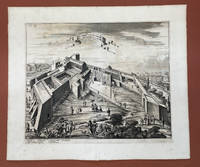
1677000192bAmsterdam: Jacob van Meurs 1677. First Edition . No Binding. Very Good. Olfert Dapper - . Beautiful depiction of the complex of the CHURCH OF THE NATIVITY IN BETHLEHEM one of the most important Christian sites in the Holy Land. Original antique etching copper plate by the Dutch topographer OLFERT DAPPER. DATED 1677. First edition Dutch . Size of image: 142 x 113 inch 36 x 29cm legend and margins. Some occasional light age toning. Untrimmed full margins. Crisp and strong paper clear imprint. <br/> <br/> Jacob van Meurs unknown
16781309277O.O. o. Vlg, 1678. Kl.-4to. 3 Bl., 91 S. Neuer Ppbd (Titel mit kl. Randausriss, ohne das Titelkupfer).
169744879Regensburg, Joh. Georg Hofmann für Joh. Zacharias Seidel, 1697. 8°. Mit gest. Frontispiz u. 12 Textkupfern. 7 Bll., 219 (1) S., 2 Bll., Pgmt. d. Zt. m. handschriftl. Rückentitel
168345600Leipzig Grosse & Gleditsch 1683. 4to. Without wrappers. In: "Acta Eruditorum Anno MDCLXXXIII" No. V May issue. Pp.177-224 entire issue offered. Tschirnhaus' paper: pp. 204-207. Some browning as usual. With titlepage to the volume 1683. Titlepage with a stamp and a faint dampstain. <br/><br/><em>First edition of Tschirnhaus' "Tschirnhaus Tranformation".Tschirnhaus work intensively on finding a general method for solving equations of higher of higher degree. "His transformations constituted the most promising contribution to the solution of equations during the seventeenth century; but his elimination of the second and third coefficients by means of such transformation was far from adequate for the solution of the quintic.Boyer. A History of Mathematics 1968 472 p.Tschirnhaus 1651-1708 a Saxon nobleman had as wide interest as acquaintances: He studied in Leyden served in the Dutch army visited England and Paris several times. He set up a glassworks in Italy and is said to have introduced Porcelain to Europe. He wrote about philosophy and mathematics and was a close friend of Leibniz."In mathematics a Tschirnhaus transformation also known as Tschirnhausen transformation is a type of mapping on polynomials developed by Ehrenfried Walther von Tschirnhaus in 1683. It may be defined conveniently by means of field theory as the transformation on minimal polynomials implied by a different choice of primitive element. This is the most general transformation of an irreducible polynomial that takes a root to some rational function applied to that root."Wikipedia.Parkinson "Breakthroughs 1683 M. </em> unknown
168345600Leipzig, Grosse & Gleditsch, 1683. 4to. Without wrappers. In: ""Acta Eruditorum Anno MDCLXXXIII"", No. V (May issue). Pp.177-224 (entire issue offered). Tschirnhaus' paper: pp. 204-207. Some browning as usual. With titlepage to the volume 1683. Titlepage with a stamp and a faint dampstain.
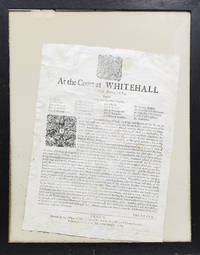
1683264178London: printed by the assigns of John Bill deceas'd; and by Henry Hills and Thomas Newcomb printers to the Kings most excellen t Majesty 1683. Printed broadside. Woodcut royal arms at head large decorative initial capital. 1 vols. 14-1/2 x 11-1/4 inches. Backed with tissue some old dampstaining some loss at margins but printed area complete except for a very small area of the royal arms. Old folds rust marks along with marginal wear suggest that this may at one time have been "affixt to some conspicuous place" as the text instructs. Printed broadside. Woodcut royal arms at head large decorative initial capital. 1 vols. 14-1/2 x 11-1/4 inches. King's Evil and the Royal Touch. From the Middle Ages in England and France it was believed that scrofula or "the King's Evil" could be cured by the touch of royalty; ceremonies were held in which the King would touch and "heal" hundreds of afflicted subjects. <br/>By the late 1400s it was believed that one could also be cured by touching a type of coin called an angel which had been touched by the monarch. After angels ceased to be minted in the 1620s the same effect was said to be achieved by touching a gold medallion embossed much like the old coin.<br/>Some monarchs touched many people. King Henry IV of France touched up to 1500 at one time. The last English monarch to carry out this practice was Queen Anne who died in 1714 but it continued in France. Louis XV touched more than 2000 scrofula sufferers and the last French monarch to do this was Charles X in 1825 Science Museum London. Cf. F Barlow "The King's Evil"Â The English Historical Review 95/374 January 1980 pp 3-27; M BlochThe Royal Touch: Sacred Monarchy and Scrofula in England and France London: Routledge & Kegan Paul 1973.<br/>The present broadside setting the dates for such ceremonies is rare on the market: no copies are listed for sale and none have appeared at auction. It also is signed in type by Lord Chief Justice George Jeffryes sic "The Hanging Judge" amongst others.<br/>An interesting manuscript note in a contemporary hand at the lower margin with significant loss calls the attention of "All Parsons Vicars and Curates" to the regulations set forth in the broadside. ESTC R34884 11 copies in UK 6 in US; OCLC 15328355 2 copies; Wing E-831 printed by the assigns of John Bill deceas'd; and by Henry Hills, and Thomas Newcomb, printers to the Kings most excellen t Maje unknown books
16754783London: Arthur Tooker at the Globe in the Strand over against lvie-Bridge; and William Battersby at Thavie's Inne Gate in Holborn near S. Andrew's Church 1675. 2nd. Good. <p>Front and back cover appear original. Spine has been replaced well done and in leather with 6 raised bands. Front and back corners also replaced at same time and with same material. In solid condition but worn. All pages and images are present including final engraving. Text is clear and easy to read with some wear to the edges of pages especially towards the rear - no impact to images. Age color to pages with some spotting. Inscriptions from previous owners on front pastedown and subsequent blanks. Some ink in pages and pencil doodling on blanks or margins.</p> <br /> <p>Provenance: On the blank side of the Frontispiece is a large signature from Abel Hold 1815-1891 with biographical details including bithdate marriage and date of his wife's passing. Abel was a landscape and game artist who did some portraiture. Never a welthy man Abel would often send a painting of a starving man to his patron who would promptly pay. He had many shows in London including at The Royal Academy and other salons of the time. Rather romantically and solely from my opinion the book has the look and feel of an artist's book and while heavily used shows care and repair to ensure longevity. Additional family and earlier owner details on front pastedown.<br /> <br /> Pages: 229 Dimensions: 8¼ x 12½ x 1</p> . Arthur Tooker, at the Globe in the Strand, over against lvie-Bridge; and William Battersby, at Thavie's Inne Gate in Holborn, ne unknown
165349198Leiden Joannis Maire 1653 - Amsterdam Ioannes Blaeu 1650. 4to. One contemp. full vellum. Contemp. handwritten titles weak to spine. First title in red/black with large engraved titlevignette. 81541 pp. Ars Historica 1653 - 169414 pp. Grammatistice etc. 1650 - 88315 pp. De Philologia 1650 - 1646733 pp. De Universae Mathesios. 1650. Fine and clean. <br/><br/><em>First edition of "De Qvattuor Artibus." which includes "De Universae Mathesios" with separate titlepage and second edition of "Ars Historica"The mathematical work: Poggendorff II 1235. "de Mathesios.": "According to prof. Cantor it is the first history of mathematics in its widest sense". Honeyman Coll. 3081. </em> hardcover
165349198Leiden, Joannis Maire, 1653 - Amsterdam, Ioannes Blaeu, 1650. 4to. One contemp. full vellum. Contemp. handwritten titles (weak) to spine. First title in red/black with large engraved titlevignette. (8),154,(1) pp. (Ars Historica 1653) - (16),94,(14) pp. (Grammatistice etc. 1650) - (8),83,(15) pp. (De Philologia, 1650) - (16),467,(33) pp. (De Universae Mathesios..., 1650). Fine and clean.
1665129134Amstelodami : Apud Danielem Elzevirium 1665. Fourth Edition. Hardback. Title-page in red and black. Text in double columns. Error in pagination: p. 539 mis-numbered 439. Full contemporary vellum very good. Dulled and toned as with age. Scans and additional bibliographic detail on request.; 888 pages; Physical desc. : 12 888 20 p. ; 25 cm. 4to. . Subject: Roman law - Early works to 1800. Referenced by: Willems A. Elzevier 1367 and Rahir E. Elzevier 1423. Language; Latin. Editio quarta / ab auctore recognita novaque & largiore cum florum tum rerum forensium aspersione exornata atque adaucta. Printer's device on title-page: la Minerve Rahir M.21 . Tail-pieces; initials. Amstelodami : Apud Danielem Elzevirium hardcover