9 306 résultats
186847990Wien, Karl Gerold's Sohn, 1868. 8vo. Uncut and unopened in orig. printed wrappers. In: ""Sitzungsberichte der kaiserlichen Akademie der Wissenschaften"", 58. Band, 1. Heft - Juni. Pp. (1-) 155 a. 7 plates.(Entire issue offered). Boltzmann's paper: pp. 54-59. Clean and fine.
186847990Wien Karl Gerold's Sohn 1868. 8vo. Uncut and unopened in orig. printed wrappers. In: "Sitzungsberichte der kaiserlichen Akademie der Wissenschaften" 58. Band 1. Heft - Juni. Pp. 1- 155 a. 7 plates.Entire issue offered. Boltzmann's paper: pp. 54-59. Clean and fine. <br/><br/><em>First apperance of an importent paper in which Boltzmann from a mathematical point of view defends atomism. "Throughout his career even in his works on subjects other than kinetic theory Boltzmann was concerned with the mathematical problems arising from the atomic nature of matter. Thus an early paper with the title "Über die Integrale linearer Differentialgleichungen mit periodischcn Koeffizienten" 1868 turned out to be an investigation of the validity of Cauchy’s theorem on this subject which is needed to justify the application of the equations for an elastic continuum to a crystalline solid in which the local properties vary periodically from one atom to the next." DSB. The issue contains an importent paper by JOHANN JOSEPH LOSCHMIDT "Ableitung des Potentiales bewegter elektrischer Massen aus dem Potentiale für die Ruhestand" pp. 7-14 in which he attempted to derive the Weber-Ampère law from that of Coulomb and in accordance with Kirchhoff to derive Ohm’s law from hydrodynamic flow laws analogous to Poiseuille’s law. </em> unknown
18871142224Erlangen, Deichert, 1887. Gr.-8vo. 158 S., 2 Bl. Hlwdbd d. Zeit (bestoßen).
18571304110Wien, Kaiserlich-königliche Hof- und Staatsdruckerei, 1857. 4to. 105, (1) S. Hlwd d. Zeit (beschabt, Rücken u. Innengelenke m. längeren Einrissen, erste Bl. fingerfleckig).
18691312015Tübingen, 1869. 4to. 45, (1) S. Rückenbroschur (erstes u. letztes Bl. braunfleckig).
18821016769Halle-Wittenberg, 1882. 43 S. Br.
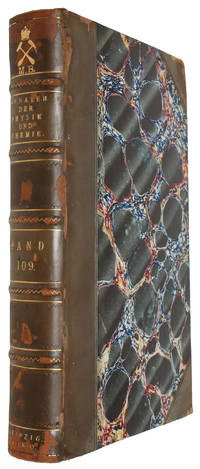
186043085Leipzig, Johann Ambrosius Barth, 1860. Contemp. hcalf, raised bands, gilt spine. A few scratches to spine. In ""Annalen der Physik und Chemie. Hrsg. von J.C. Poggendorff"", Bd. 109. X,660 pp. and 4 folded engraved plates. Kirchhoff's papers: pp. 275-301 and pp. 148-150. Internally clean and fine. Small stamps to verso of titlepage and plates.
186043085Leipzig Johann Ambrosius Barth 1860. Contemp. hcalf raised bands gilt spine. A few scratches to spine. In "Annalen der Physik und Chemie. Hrsg. von J.C. Poggendorff" Bd. 109. X660 pp. and 4 folded engraved plates. Kirchhoff's papers: pp. 275-301 and pp. 148-150. Internally clean and fine. Small stamps to verso of titlepage and plates. <br/><br/><em>First printing of a milestone paper by "The Grandfather of Quantum Theory" in which he formulates the law named after him "KIRCHHOFF'S LAW" which was the "key to the whole thermodynamics of radiation. In the hands of Planck Kirchhoff's successor to the Berlin chair it proved to be the key to the new world of the quanta well beyond Kirchhoff's conceptual horizon."DSB VII p.382."Kirchhoff's Law of Thermal Emission was formulated in 1859 Über das Verhältnis. - the paper offered. It is at the same time the simplest and least understood law in physics. Kirchhoff's law states that given thermal equilibrium with an enclosure the radiation inside will be always black or normal in a manner which is independent of the nature of the walls or the objects they contain. This is known as the concept of universality. That is that radiation within an enclosure can always be described by a universal function dependent only ontemperature and frequency. This universal function was first given us by Max Planck in 1900. Kirchhoff's law STANDS AT THE HEARTH OF ALL MODERN ASTROPHYSICS. It is the basis for setting the temperature of the stars for the gaseous model of the Sun and for believing that we now know the temperature of the entire universe."Pierre-Marie Robitaille.The research background for the paper was his unexpected observation that if the intensity of the solar spectrum increased above a certain limit the dark D lines were made much darker by the interposition of the sodium flame. he instantly felt that he had got hold of "something fundamental". These observations are described in the second paper offered here "Über die Frauenhofer'schen Linien." which was published first in 1859 in Monatsschrift der Berliner Academie.The volume contains many other importent papers in physics and chemistry by C.F. Schönbein Zöllner H. Fizeau Eisenlohr W. Heine Knoblauch K.G. Neumann W. Siemens etc. </em> hardcover
18991016783Halle - Wittenberg, 1899. 38 S. Br.
18801506117Halle-Wittenberg, 1880. Gr.-8vo. 31 S.
18949991K., 1894. Med orig.omsl.i samthldrbd.(hajskind). XLIII,276 pp. - Originaludgaven.
188533718Kjøbenhavn, Gad, 1885. 8vo. Hshirtbd. med håndskreven titeletiket på forperm. Orig. bogtrykte omslag medindbundet. X,(1),90 pp. samt 1 kortplanche. Med dedikation fra udgiveren dateret 1935.
186348186(Paris, Mallet-Bachelier), 1863 a. 1864. 4to. No wrappers. In: ""Comptes Rendus Hebdomadaires des Séances de L'Academie des Sciences"", Tome 57, No 23 a. Tome 58, No 3. Pp. (925-) 964 a. pp. (141- 180. (2 entire issues offered). Pasteur's paper: pp. 936-942 a. 142-150 and 1 engraved plate (Maladies des Vins - leurs Fermets..).
186348186Paris Mallet-Bachelier 1863 a. 1864. 4to. No wrappers. In: "Comptes Rendus Hebdomadaires des Séances de L'Academie des Sciences" Tome 57 No 23 a. Tome 58 No 3. Pp. 925- 964 a. pp. 141- 180. 2 entire issues offered. Pasteur's paper: pp. 936-942 a. 142-150 and 1 engraved plate Maladies des Vins - leurs Fermets. <br/><br/><em>First appearance of these famous papers initiating Pasteur's renowned studies on wine and its "diseases" being his most importent papers on wine."In December 1863 Pasteur published the first of the papers that culminated in his Études sur le vin 1866; 2nd ed. 1873. In that first paper dealing with the role of atmospheric oxygen in vinification he sought to establish that the aging of wine resulted from the slow penetration of atmospheric oxygen through the porous wook casks into which new wine was decanted. By virtue of this slow oxidation he claimed new wine grows less harsh and acid to the taste as it becomes clearer and lighter from the to the taste as it becomes clearer and lighter from the precipation of dark coloring matters. In his second paper January 1864 Pasteur examined the "alterations" or "diseases of wine especially wine from the Jura his native department. Reviewing the familiar disease of "turned" "acid" "ropy" or "oily " wine he associated each with a microscopic organism. He summarized the results of his first two papers by nothing that "wine which is proudced by a cellular vegetation acting as a ferment namely yeast is altered only by the influence of other vegetations of the same order; and once removed from the effects of their parasitism it is made or matured principally by the action of atmospheric oxygen penetrating slowly through the staves of the casks."DSB. </em> unknown
187844231Paris, G. Masson, 1878. 8vo. Contemp. hcalf, raised bands, gilt spine. Light wear along edges. Small stamps on verso of titlepage. In: ""Annales de Chimie et de Physique"", 4e Series - Tome 15. 512 pp. a. 3 folded engraved plates. (The entire volume offered). Janssen's memoir: pp. 414-426.
187844231Paris G. Masson 1878. 8vo. Contemp. hcalf raised bands gilt spine. Light wear along edges. Small stamps on verso of titlepage. In: "Annales de Chimie et de Physique" 4e Series - Tome 15. 512 pp. a. 3 folded engraved plates. The entire volume offered. Janssen's memoir: pp. 414-426. <br/><br/><em>First appearance of this milestone paper in chemistry physics and astronomy announcing the discovery of the helium lines in the spectrum of the sun. It was Lockyer in the same year that named it 'helium' for Helios the Greek God of the Sun. Helium was not discovered on the earth before 1895 by William Ramsay and it was Crookes who established its identity with the helium Janssen and Lockyer observed in the spectrum of the sun."He Janssen met immortality by travelling to India in 1868 to study the total eclipse. It was then that he observed the helium line and forwarded the spectral data to ockyer. He also noted the size of the solar prominences. The day after the eclipse he attempted to take their spectra again and succeeded despite the absence of the obscuring moon. he then announced jubilantly that it was the day after the eclipse that was the real eclipse day for him. Lockyer also reported this method of studying prominences without an eclipse.Like Lockyer he lived to see his observation of the helium line vindicated by Ramsay's discovery of that element on earth."Asimov."This the discovery of helium lines in the sun by Lockyer was announced on the same day by the French astronomer Janssen who was in India observing a total eclipse. As a result the French government some ten years later struck a medallion showing the heads of both scientists.By that time the two men had made a much more dramatic discovery at the same time this time in cooperation. Janssen studying the spectrum ofthe sun during the eclipse had noted a fine line he did not recognize. he send a report on this to Lockyer an acknowledges expert on solar spectra. Lockyer compared the reported position of the line with lines of known elements concluding that it must belong to a yeat unknown element possibly not even existing on the earth. He named the element from the Greek word for the sun."Asimov.Parkinson "Breakthroughs" 1868 A. - The volume contains other notable papers by Dumas Berthelot et al. </em> hardcover
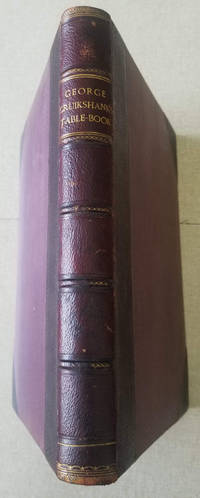
18921650<p>This Limited Edition copy of the 1892 Limited Edition of <strong>"The Cruikshankian Momus" by The Three Cruikshanks The Elder Isaac Robert and the Great George</strong> was published in 1892 in London by John C. Nimmo. This is copy No. 79 of the 520 copies "printed for England and America". The book's title is enhanced by several sub-titles such as "Pictorial Broadsides and Humorous Song-Headings" "Fifty-two Comic Designs to Popular Ballads" and "Coloured By Hand After the Originals. In Greek mythology the Momus of this book's title was the personification of satire and mockery. A book plate attached to the inner front cover identifies a previous owner to be B. Jones-Bateman of Pentre Mawr.</p><p>The book which measures approximately 7 ¾ inches wide by 11 ½ inches tall by 1 ¼ inches thick contains vii pages of preliminary matter followed by 136 numbered pages of text with small B&W text illustrations. The 52 plates colored by hand are each on an unnumbered sheet. The book is hardbound in blue cloth covered boards with gilt printing on the front and spine. The pages are gilt edged on top and untrimmed on the other edges. The pages are very lightly tanned but all text and plates are clear and easily read. There are signs of wear on the cover particularly at the outer corners and the top and bottom of the spine. The book is overall in very good condition.</p><p>The illustrations accompanying this description show the book's cover front and spine the Title page/frontispiece the text Title page a full page plate and a typical 2-page spreads of text and a colored plate.</p><p><strong>Isaac Cruikshank</strong> 1764–1811 Scottish painter and caricaturist was born in Edinburgh and spent most of his career in London. Cruikshank is known for his social and political satire. His sons Isaac Robert Cruikshank 1789–1856 and George Cruikshank 1792–1878 also became artists and the latter in particular achieved fame as an illustrator and caricaturist. Wikipedia</p><p><strong>Isaac Robert Cruikshank</strong> sometimes known as Robert Cruikshank 27 September 1789 – 13 March 1856 was a caricaturist illustrator and portrait miniaturist the less well-known brother of George Cruikshank both sons of Isaac Cruikshank. Just like them he holds importance as a pioneer in the history of comics for creating several cartoons which make use of narrative sequence and speech balloons. Wikipedia</p><p><strong>George Cruikshank</strong> 27 September 1792 – 1 February 1878 was a British caricaturist and book illustrator praised as the "modern Hogarth" during his life. His book illustrations for his friend Charles Dickens and many other authors reached an international audience. Wikipedia</p> John C. Nimmo hardcover
18941142353Berlin, Weidmann, 1894. 52, 102 S., 1 Bl. Hlwd (kl. Schabstellen, alter Besitzvermerk).
182444820Leipzig, Johann Ambrosius Barth, 1824. Without wrappers as issued in ""Annalen der Physik und Chemie. Hrsg.von Poggendorff"", Bd. 2, Jahrgang 1824, Zwölftes Stück. Pp. 345-448 (entire issue offered). Fourier's paper: pp. 359-402.
182444820Leipzig Johann Ambrosius Barth 1824. Without wrappers as issued in "Annalen der Physik und Chemie. Hrsg.von Poggendorff" Bd. 2 Jahrgang 1824 Zwölftes Stück. Pp. 345-448 entire issue offered. Fourier's paper: pp. 359-402. <br/><br/><em>First German edition in the same year as the French " Résumé théorique des Propriétés de la chaleur rayonnante" of this importent paper which gives an analytical account of surface-emissions and absorption based on the principle of equilibrium of temperature forecasting the more elaborated theories which he published in his famous work "La Therorie analytique de la chaleur. 1822". His analytical mathematical method that any continous function can be represented as a sum of sine and cosine curves is here applied to physical problems f.i. his treatment of the warming and cooling of the earth and terrestrial temperatures. The theory of terrestrial temperatures played a central role in Fourier's mathematical physics. </em> unknown
1880013908Leipzig: Verlag von Bernhard Schlicke 1880. Very Good condition. Professional-quality repair to small chip at top of title page. A few text pages wrinkled in the margin but NOT affecting the text. Appears to be collected essays on the political history of Iceland by Konrad Maurer Professor of Nordic History of Law der Nordischen rechtsgeschichte at University of Munich. Black cloth spine and corners over black paper-covered boards. With the bookplate and signature of Hans Spellmann. Also has the small ink-stamps of Arthur Biber and Robert B. Sosman. A geophysicist and physical chemist Robert Browning Sosman received his Ph.D. from the Massachusetts Institute of Technology in 1907 at the age of 26. By 1908 he had joined the Geo-Physical Laboratory of the Carnegie Institution. Dr. Sosman worked at the Geo-Physical Laboratory for 20 years serving 8 years as Assistant Director. During World War I his contributions there were instrumental in establishing America's capacity for manufacturing optical glass. In 1928 he left to join the United States Steel Corporation as Assistant Director of Research. Following his retirement from U.S. Steel in 1947 he became visiting professor of Ceramics at Rutgers University. Dr. Sosman was a past president of the American Ceramic Society. In his honor the Society established The Robert B. Sosman Award "the highest recognition of scientific accomplishment given by the Basic Science Division. in recognition of outstanding achievement in basic science of an area that results in a significant impact to the field of ceramics.". First Edition 1. Auflage. Hardcover. Very Good condition. 8vo. xi 318pp. Verlag von Bernhard Schlicke Hardcover
18961208445Leipzig 1896. 1 Bl. 1896. 1 Bl., 56 S., 1 Bl. Br.
18801016345Leipzig, (etwa 1880). 37 S. Broschur.
18891074014Tübingen, L. Fr. Fues, 1889. 4to. 74 S., 1 Karte. Rückenbroschur (etwas angestaubt u. lichtrandig).
18921268284Heidelberg, 1892. 81, (3) S. OBroschur.