1 140 résultats
1762lib5987BC9T. Becket and P. A. De Hondt 1762. Hardcover. Acceptable. full leather with loose front board the lether is worn pages are all vg but browning spine has raised ribs T. Becket and P. A. De Hondt hardcover
17721577212024536<p><strong>Author:</strong> Ossian attributed. Translated from the Original Galic by James Macpherson.<br /><strong>Title:</strong> <em>Fingal A Poem in Six Books by Ossian: Translated from the Original Galic by Mr. Macpherson; and Rendered into Verse from that Translation.<br /></em><strong>Publisher:</strong> Oxford: Printed for J. and J. Fletcher; T. Payne at the Mews-Gate; and J. and F. Rivington St. Paul's Church-Yard London 1772.<br /><strong>Language:</strong> Text in English.<br /><strong>Size:</strong> 8" x 5".<br /><strong>Pages:</strong> viii 180 pages.<br /><strong>Binding:</strong> Very good contemporary full mottled calf over boards. Gilt fillet borders and gilt corner fleurons to boards. Spine with five raised bands gilt fillets and gilt floral ornaments to compartments Outer hinges partly cracked ca. 2 cm to upper joint but still tight and secure - as shown overall slightly worn and scuffed - as shown under a protective removable mylar cover. <br /><strong>Content:</strong> Very good content bright tight and clean rare light foxing or staining - as shown light age-toning in places - as shown early ownership inscription in a late 18th-century hand "Basil Heron April 1782" to the front free endpaper - as shown.</p><p><strong> </strong></p><p><strong>The book: </strong>This 1772 Oxford edition of <em>Fingal</em> represents one of the most controversial literary works of the 18th century. Marketed as a lost Gaelic epic by the third-century bard Ossian it was "translated" by James Macpherson who claimed to have discovered fragments of ancient poetry in the Scottish Highlands. <em>Fingal</em> quickly caused an uproar in coffee houses and academic circles across Britain admired for its sublime landscapes and heroic tone but hotly contested as a possible forgery. Whether authentic or not the poems inspired an entire generation of Romantic writers and artists across Europe from Goethe to Napoleon. This copy handsomely preserved in its original late 18th-century mottled calf binding offers both literary importance and historical resonance.</p> Oxford: Printed for J. and J. Fletcher; T. Payne, at the Mews-Gate; and J. and F. Rivington, St. Paul’s Church-Yard, London, 1 hardcover
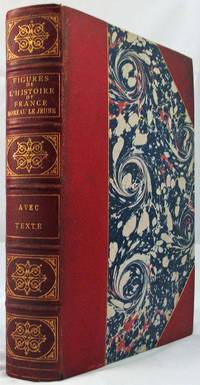
178524331Paris: Renouard n.d. 1785. This copy with the engraved bookplate of Percy Hamilton Clark perhaps the most famous American cricketer of all time who in 1903 ushered in what has been called the “Golden Age†of cricket in the U.S.A. 167 engraved plates 154 of which are numbered and 13 unnumbered by Moreau the Younger Monnet and Lepicier depicting the history of France and including frameworks for descriptive text of Monsieur l'Abbe' Garnier. Large 8vo 29 by 20.5 cm in handsome antique three-quarter red morocco over marbled boards the spine ornately gilt lettered and decorated. 167 leaves printed on one side only. A very pleasing copy internally very fine and fresh the binding with some light expected evidence of age. A VERY BEAUTIFULLY PRODUCED WORK. This impressive suite of engravings depict the history of France from the inauguration of Pharamond circa 428 to the year 1314. Moreau had intended to carry on with the engraving work and bring the book up to his own time but the project was unfortunately never completed. Renouard hardcover
1757062386Edinburgh: R. Fleming 1757. Third Edition. Leather Bound. pp. 400. 12mo. Bound in full contemporary brown leather. Five raised bands and six compartments to spine red spine label with faded gilt lettering. Light general rubbing and wear to extremities superficial cracking to spine ffep missing ink name to title page mild age-toning and tide mark to contents. Binding tight and sound contents unmarked; good. "The irregular heats and extravegencies of some late pretenders to extraordinary attainments in religion their imaginary divine impulses and extatic raptures with other effects of their disordered fancies have cast such a blemish on the Christian Profession in the eyes of unsettled and unthinking people the 'tis well if too many are not in Danger of calling Christianity itself into question from the manifestly false pretences and enthusiatic flights of some who have put in a claim to experience in divine life. R. Fleming unknown
17451217663Göttingen, Vandenhoeck, 1745. Kl.-4to. 4 Bl., 43 S. Mit kl. gestoch. Titelvignette u. 2 geneal. Tabellen auf 1 Falttafel. Neuer Ppbd.
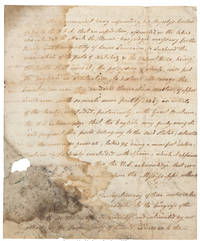
1797List2522New Orleans 1797. Three pages of a bifolium 8 x 9 ½ inches New Orleans; May 31 1797. Fair only with moisture damage and some text illegible. Fair. An interesting document from the period following the Treaty of San Lorenzo and before the eventual surrender of Natchez to the Americans in 1798 in which the governor of Louisiana and West Florida Francisco Luis Hector de Carondelet issues a statement regarding the delayed withdrawal of Spanish troops from the region. Carondelet is concerned with the British presence in the area and notes that it is a violation of “the treaty concluded with Spain†- or Pinckney’s Treaty which opened up navigation rights of the Mississippi to the United States. The letter describes the possibility of escalating hostilities between the United States Great Britain and Spain as a result of an impending American mission against the Illinois the motives of which Carondelet questions as he notes that “These hostile dispositions can naturally only concern these provinces because the U.S. are in peace with all the savages…†He raises the possibility of British invasion of Louisiana and potential danger to the city of New Orleans and states that the Spanish will maintain their presence at Natchez and Walnut Hills unless the American soldiers withdraw. This is a copy of Carondelet’s speech in the hand of Lieutenant Piercy Smith Pope and we find no other record of it. A full transcription follows:<br /> <br /> “The Government being informed by his Majesty’s Ambassador to the U.S. that an expedition assembled on the lakes was intended to attack the Illinois has judged necessary for the surety and tranquility of Lower Louisiana to suspend the evacuation of the posts of Natchez & the Walnut Hills being the posts that cover it; the possession of which will put the English in a situation to disturb and ravage the country in case they rendered themselves masters of upper Louisiana with so much more facility as by an article of the treaty concluded posteriously with Great Britain the U.S. acknowledge that the English may freely navigate and frequent the posts belonging to the said States; situated on the river in general lakes &c being a manifest contradiction to the treaty concluded with Spain which it appears. because by this the U.S. acknowledge that no other nation can navigate upon the Mississippi without the consent of Spain.<br /> <br /> . the legitimacy of these motives the .presented to the Congress of the U.S. with all the necessary veracity and intimated by our orders in the Commissary of Limits as well as to the Commandant of the Detachment of American troops now at Natchez. We are now informed that a detachment of the army of the U.S. cantoned on the Ohio are on their way by Holstein towards Natchez while the Militia of Cumberland are intimated to hold themselves ready to march at the first notice.<br /> <br /> These hostile dispositions can naturally only concern these provinces because the U.S. are in peace with all the savages the anterior menaces of the Commissary of Limits & the Commandant of the detachment of Americans now at Natchez; the immediate rupture & if the American Gazettes are to be believed already effected between France our intimate ally and the U.S. engage us to be on our guard to defend our property with that valor & energy which the inhabitants of these Provinces have manifested on all occasions with the advantage and superiority which a knowledge of our local situation will procure and that confidence which right and justice inspires. If the Congress of the U.S. had no hostile intention against these provinces they will either leave the post of Natchez or Walnut Hills the only bulwarks of Lower Louisiana that can stop the courses of the English or that they give us security against the article of the Treaty with Great Britain which exposes lower Louisiana to be pillaged and destroyed down to the Capitol. We will then deliver up the said posts and lay down our arms which they have forced us to take up by arming their Militia in time of peace and sending a considerable body of troops by round about ways to surprise us.<br /> <br /> New Orleans 31st May 1797 <br /> <br /> A copy of the Baron de Carondelet’s Proclamation. <br /> P. Popeâ€<br /> <br /> Overall a document of significance in United States / Spanish relations in the period following Pinckney’s Treaty worthy of further study for scholars of the diplomatic history of the period. unknown
1794000035bNew Spain Mexico. Fine with no dust jacket. 1794. Full-Leather. Handsome Folio Manuscript in early calf with gilt written by the Attorney of the Real Audiencia see Bibliografia Mexicana 220 and prepared for the Viceroy. Lengthy stipulations of taxes for the freed mestizos mulattoes and negroes as well as exemptions for Indians of the repartimientos even when married to Spanish women. These taxes were the root of the perceived injustice that explains why freed men formed the core of the Revolution when it came. EXTREMELY RARE AND IMPORTANT FIRST HAND TEXT OF MEXICAN HISTORY. see Archivo General de la Nation "Los Precursores Ideologicos della Guerra de Independencia 1929 pgs 137.139." LAID IN NOTE: Arce Y Echeagary J. Yinstruction para que los Administradores de Aduanas del Reyno de Nueva Espana hagan la legitima exaccion de los dros. de Alcabalas y Pulques en los casos que por lo regular se ofrecen en las propias Aduanas. Mexico 1794. ADDITIONAL BACKGROUND: In 1519 the Spaniards conquered Mexico. This led to the formation of a new state called New Spain and later into a new hybrid culture. Several military expeditions were led to extend 'New Spain'. The whole of Central America West Indies Philippines and parts of the current Texas and California were later conquered to become part of New Spain. The Spanish political control over Mexico lasted for three centuries. The entire region was formed into a viceroyalty in 1535. The colony was divided into provinces ruled by governors. These provinces were divided into departments and subdivided into districts. Magistrates controlled the districts and mayors led smaller villages. The parliament court handled all political matters and the Council of Indies controlled the other administrative matters. Off course the supreme authority over the Spanish empire belonged to the king. This system was pretty inefficient as it took several years for directives from the king to be implemented at the lower levels. During the initial administration grants called Encomiendas were given to colonists which controlled Indian labor and produce. This led to the misuse of power and atrocities against the Indians increased. The Indians revolted against the Spaniards in 1541 but were easily subdued. The Spanish emperor Charles V initiated the decline of the Encomienda system in 1542. This decline saw the emmergence of the Roman Catholic Church. The church was successful in carrying out mass conversions. The Spaniards protected the Indians that converted. Missions and monasteries dominated much of the land. The Spaniards thrived by the new found wealth in the colonies. They amassed huge wealth by controlling silver mining large ranches and estates that grew wheat sugarcane and indigo for export. Spanish merchants exported such goods as cotton silk and dye that were produced by the Indians. The prosperity of New Spain began to decline in the 17th century. Disease and natural disasters destroyed most of the Indian population. Most others migrated slowly to remote parts. Mines were abandoned and large areas of farmland were destroyed. The economy of New Spain collapsed. In 1810 a catholic priest named Miguel Hidalgo called upon Mexicans to rise up and fight the Spanish. Although father Hidalgo was killed another priest Jose Morelos continued to lead the fighting. New Spain finally won its independence from Spain in 1810 and came to be called Mexico. ; Spanish Language; 4to - over 9¾" - 12" tall; MEXICO MEXICAN TAXES NEW SPAIN MEXICAN REVOLUTION NAPOLEON BONAPARTE CHARLES V HIDALGO MORELOS HANDWRITTEN HISTORICAL HISTORY HAND WRITTEN HOLOGRAPH MANUSCRIPT MANUSCRIPTOS SPANISH ESPANOL VICEROY mestizos repartimientos antiquité contrat vélin document manuscrit papier Antike Brief Pergament Dokument Manuskript Papier oggetto d'antiquariato atto velina documento manoscritto carta antigüedad hecho vitela documento manuscrito papel. . hardcover
176045083Paris Imprimerie Royale 1760. 4to. Extract from "Mémoires de Mathematique et de Physique Présentés à l'Academie des Sciences par divers Savans" Tome III. Pp. 321-325. A faint dampstain to inner margins. <br/><br/><em>First apperance of Boskovic's paper in which he explains how light is refracted and reflected in droplets of water creating the coloured rainbow - he discusses the sphericity in connection with both refraction and reflexion of light and he comments on Newton's optics. </em> unknown
179748189Paris Guillaume/Fuchs An VI ou 1797 AN VII 1799. Without wrappers.In: "Annales de Chimie ou Recueil de Mémoires concernant la Chemie" Tome 23 4. Cahier. Titlepage to vol. 23. Tome 29 Cahier 1 Titlepage to tome 29. Stamp to verso of titlepages. Pp. 225- 336 pp. 1- 112. 2 entire issues offered. Volta's letters: pp. 276-315 1 folded engraved plate with 22 figs. pp. 91-93. <br/><br/><em>First French edition of these 3 letters to Gren in which Volta described his last steps towards his groundbreaking construction of his famous "Pile". In the letters he established the first law governing an electrical fluid and he anticipated both Davy and Faraday."In 1796 Volta wrote three letters to Gren published in German in Gren's N.J. der Physik. In THE FIRST he describes 'a very remarkable experiment'. A tin cup filled with soapy water milk of lime or better fairly strong alkaline ley was held with one or both hands moistened witn ater and the tip of the tongue dipped into the liquid. A sour taste was at once perceived by the tongue in contact with the alkaline liquid which soon changed into a salty and finally into a sharp alkaline taste. The acid taste was 'produced by the current of the electric fluid passing from the tin to thee alkaline liquer from there to the tongue then through the body to the layer of water and from there to the tin in a continous current. In his SECOND LETTER Volta repeats this 'law' of the combination of three conductors. The mutual contact of silver and tin for example produces 'an action a force by means of which the first gives the electric fluid and the second receives it. If the circuit is completed by a humid concustor a current or continous circulation of this fluid is set up in the direction indicated in the table depicted on the attached plate. In his THIRD LETTER Volta describes experiments in which plates of silver and zinc so smooth that they adhered on contact polished dry and insulated were brought in close contact and separated by pulling them perpendicularly apart. They gave small deflections when applied directly to the electrometer." Partington "A History of Chemistry" Vol. IV pp. 10-12. </em> unknown
17781321372(Haarlem, J. Enschedé en Zoonen, 1778. Kl.-Folio. 4 Bl. (davon das 1. weiß), 31 Bl. (davon das 11., 27. u. 28. weiß), 3 Bl. (das letzte weiß). Schlichter Hlwdbd. um 1900 (Ecken bestoßen, anfangs u. am Ende etwas gebräunt u. braunfleckig).
178053319Paris Théophile Barrois 1780. 8vo. Fine cont. full mottled calf richly gilt spine and gilt titlelabel in red leather. Edges gilt. LXVIII3333 pp. and 1 folded engraved plate showing his experimental apparatus. Light browning to margins of title-page otherwise clean and with broad margins. A fine copy. <br/><br/><em>First French edition of perhaps the most important work in plant physiology. It is in this work that Ingen-Housz for the first time expounds the ideas and experiments that lead to his discovery of Photosynthesis in plant life and as such it is of fundamental importance in the economy of living things. "His Experiments upon vegetables was published in the autumn of 1779 and was at once recognized as a very important advance. In brief he showed that oxygen evolution by plant is absolutely dependent on light and that it only occurs from those parts which are green.The proof that light and green tissues are both essential for oxygen production finally cleared up the apparent contradictions and variable results of earlier experiments. Priestly was "much pleased" with Ingen-Housz's experiments and pointed immediately to the salient facts that he had established." A.G. Morton: History of Botanical Science. p. 332. Dibner: Heralds of Science No. 29. - Garrison & Morton No. 103. - Horblit No. 55. All the English edition of 1779. </em> hardcover
1771mon0000028789<p>W. Johnston 1771. Leather. Good. in x in x in. Previous owner name inked on half title page: Nathan William Murray. Leather covers heavily rubbed and scuffed. Stitched binding is fine. Two fear free pages with fold marks. Pages 93 and 95 had missing corner tips. Page 93/94 is missing no words. Page 95/96 is missing a couple of letters on each page. A touch of foxing here and there not much.</p> W. Johnston hardcover
17251317950Altdorf, J. W. Kohles, 1725. Kl.-4to. 4 Bl., 103, (1) S. Mit gestoch. Titelvignette, großer gestoch. Kopfvignette u. 7 genealog. Tabellen auf 4 Falttafeln. Rücken-Broschur (angestaubt, Titel knickspurig u. mit Stempel auf Rückseite).
175849130Berlin Haude et Spener 1758. 4to. No wrappers as issued in "Mémoires de l'Academie Royale des Sciences et Belles-Lettres" Tome 12 1756 With the section-titlepage. Pp. 2389-424. <br/><br/><em>Fisr edition of an importent paper in which Maupertuis articulates his final synthesis of his earler work on the status of natural laws of motion and with is reflexions on epistemological certainty. He here coined the term "repliability" to denote the unambigouos truths of arithmetics and geometry. </em> unknown
175244743Berlin Haude et Spener 1752. 4to. No wrappers as issued in "Memoires de L'Academie Royale des Sciences et Belles Lettres" tome VI 1750 pp.144-162. <br/><br/><em>First printing of Marggraf's importent investigation of the so-called "Bologna-Stone" in which he found that its base is different from lime it is heavier and more soluble. In this memoir he anticipated Lavoisier’s conclusions by identifying the constituents of gypsum as waterlime and vitriolic acid.Bologna stone any of the dense silvery white stones first found 1603 on Mount Paderno near Bologna by an Italian cobbler-alchemist Vicenzo Cascariolo who synthesized from them a luminescent material that glowed at night after being exposed by day to the Sun. Originally thought to be the philosopher’s stone that was believed capable of transmuting base metals into gold Bologna stone ultimately was shown to be the mineral barite barium sulfate. </em> unknown
175349695Berlin Haude et Spener 1753. 4to. No wrappers as issued in "Mémoires de l'Academie Royale des Sciences et Belles-Lettres" tome VII Année 1751. Pp. 221-245 and pp. 246-254 a. 1 engraved plate. <br/><br/><em>First editions. The first paper concerns the Argument over the principle of least action relating to the famous controversy - and one of the ugliest scientific controversies - between Koenig and Maupertuis. "In 1751 a sensational new argument began when S. König published some critical remarks on Maupertuis’s principle of least action 1744 and cited a letter of Leibniz in which the principle was in König’s opinion formulated more precisely. Submitting to Maupertuis the Berlin Academy rose to defend him and demanded that the original of Leibniz’ letter a copy had been sent to König from Switzerland be presented. When it became clear that the original could not be found Euler published with the approval of the Academy "Exposé concernant l’examen de la lettre de M. de Leibnitz" 1752 where among other things he declared the letter a fake. The conflict grew critical when later in the same year Voltaire published his Diatribe du docteur Akakia médecin du pape defending König and making laughingstocks of both Maupertuis and Euler."DSB - Enestrom No. 199.The second paper - Enestrom No. 200. </em> unknown
175545935Paris Imprimerie Royale 1755. 4to. Extract from "Mémoires de Mathematique et de Physique Présentés à l'Academie des Sciences par divers Savans" Tome II. Pp. 412-434. <br/><br/><em>First printing of one of the 2 papers in which baron finally settled the composition of Borax. He showed that Borax is formed by the combination of soda with the substance boric acid previously called se sédatif. </em> unknown
1703139168London: Printed and sold by John Nutt 1703. Planting colonies in the Spanish Americas First edition preceding the second edition of that year with an added postscript. Published in the third year of the War of the Spanish Succession 1701-1714 the anonymous author proposes that in return for the support of Britain and the Netherlands for the claim of the Emperor of Austria to the Spanish crown Spain's territories in America should be ceded to the two mercantile powers. They propose a confederation which will share the treasure from the Spanish mines keeping it out of the hands of a single monarch and in so doing preserve the balance of power in Europe. They moreover support extending the war to the Spanish West-Indies at that stage untouched by the conflict and offer proposals to plant colonies there. They respond to critics who would argue that such attempts at joint control of the American mines and territories would engender war between Britain and the Netherlands as trade brings peace and also reject the arguments that American wealth flowing into the mercantile nations would weaken the nation as was believed to be the case in Spain. The polemic nonetheless offers a stark realpolitik view of world politics and of the war treating as irrelevant the moral questions of stripping the territories of their nominal ally Habsburg Spain rather than the official war aims of taking French territories and stemming the growth of Bourbon power. A scarce treatise with ESTC locating six copies for this issue and a further two copies of the second edition Library Hub and Worldcat adding several more yet still absent from many prominent institutional collections and untraced in auction records. Small quarto 205 x 162 mm. Disbound pamphlet with remnants of original spine the pages numbered in an 18th-century hand 589-654 from its original place in the sammelband vol. Lightly browned and foxed top two cords mostly gone but bottom two holding light worming at foot not affecting text tiny hole affecting one letter to pp. 25/26. A very good copy without chipping or repairs. Alden 703153; European Americana 703/53; ESTC T193661; Kress S2261. Not in Sabin. unknown
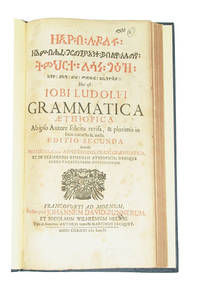
170231267Frankfurt am Main Apud Johannem David. Zunnerum et Nicolaum Wilhelmum Helwig1702. Small folio. Very nice recent blue hcalf w. gilt lettering on spine. Title-page printed in red and black w. woodcut vignette and stamp: "Jews college London". Some brownspotting but all in all a very nice copy. 12 184 8 Index pp. <br/><br/><em>Second edition of Ludolfus' groundbreaking Ethiopian Grammar. The German Job Ludolf was the first to bring the study of Etiopian subjects into a system and his present work is the first of its kind to see the light of day. It was unusal for the time to take up the study of something like the Ethiopian laguage and after Ludolfus' important philological works followed a long period of neglect which did not end till the second half of the nineteenth century when these studies were finally resumed causing them to flourish. Brunet III pp. 1223. </em> unknown
1770004213London: D. Bellamy 1770. Hardcover. Fair. 4to - over 9¾" - 12" tall. Shana Valeska . Green calf gilt borders 5 raised bands gilt bordered spine panels and gilt lettering al edges gilt gilt tooling to interior edges numerous vignette engraviings throughout. Front board is detached but present wear to edges and spine contents lightly age-toned some light spotting to a few margins slight waviness to some pages. Text block is tight and interior is attractive and in basically sound condition; just needs front board to be re-attached. <br/> <br/> D. Bellamy hardcover
1790028857Edinburgh & London: J .J. G. And G. Robinson & Bell And Bradfute 1790. Contemporary full calf leather rubbed bumped and a little worn at the spine and corners internally clean and fresh early previous owners inscription and contemporary press cutting very occasional spotting xiiipp 415pp. Alison introduces one of the earliest psychological discussions on aesthetics and the nature of beauty. He examines the effects produced on the mind when a variety of emotions are experienced such as sight sounds colours and forms along with fear and distress in the realms of music art poetry and literature. A sound tidy first edition copy of this scarce book. First Edition. Hard Cover. Very Good. 4to - over 9¾" - 12" tall. J .J. G. And G. Robinson & Bell And Bradfute Hardcover
1779C374London: Printed for Edward and Charles Dilly in the Poultry 1779. 2nd ed. corrected and revised . Hardcover. Vg. 8vo. 3822pp octavo orig. grey boards paper spine worn spine chipped and worn contents v.g. hand written title 'Knox's Essay's Vol. . <br/> <br/> Printed for Edward and Charles Dilly in the Poultry hardcover
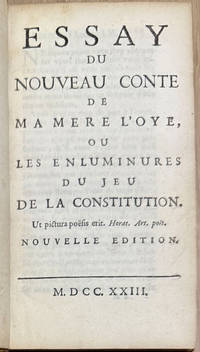
1723Debonnaire1723<p>GAME OF THE GOOSE Essay du nouveau conte de ma Mère l'Oye ou les enluminures du jeu de la Constitution by Louis Debonnaire. No imprint 1723. 8vo xiii xviii 176pp; early leather boards with original spine laid down.</p><p>Despite the claim that this is a new edition it is nonetheless an UNCOMMON IMITATION of the traditional "Game of the Goose" a rhymed pastiche as if spoken by Mother Goose written by a Jansenist priest Abbot wherein one must win the formation of a new Council here referred to as a Constitution. It introduced what became a familiar catchphrase "LIBERTY EQUALITY FRATERNITY" condemned in 1725 as anti-Rome. Barber III 880</p> No imprint hardcover