323 résultats
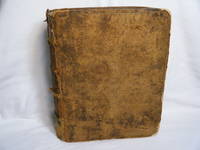
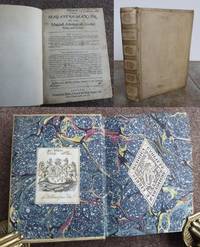
16882212130173Printed by Rawlins Roycroft and Flesher for Bassett Harper and Keble London England 1688. Hardcover. Acceptable. Folio. Bound in contemporary calf. Front board detached. WING C666. ESTC R36273. Printed by Rawlins, Roycroft, and Flesher, for Bassett, Harper, and Keble, London, England hardcover
16154007Ávila and La Horcajada 1615. Manuscript on parchment 380 x 270 mm. 18. Complete. Contents: ff. 1r-4v: Regla in Spanish in 30 numbered sections inconsistent numbering on ff. 3v-4v in a rounded script in brown ink the first page slightly larger up to 27 lines. F. 1r: incipit first four lines in large lettering with very large calligraphic initial: En el nombre de dios todo poderoso padre y hijo y espiritu sancto tres personas y una esencia. Section 30 f. 4v added in a slightly later hand. The word Cruz symbolized by a red Maltese cross. Text on ff. 2r-2v underlined in red. Calligraphic initials some with marginal extensions in brown purple or red. Marginal drawings of prickly foliage some in the shapes of fantastic animals. Later marginal notes opposite many sections. Ff. 5r-5v: Heading: Este es traslado de un testimonio followed by two notarial subscriptions on f. 5v one partially in cursive signed and dated Ávila 11 May 1527 the other in italic partly faded including the date 1615. F. 6r: A cerca de la procession de la Resurrection. After an introductory portion in a small round early 16th-century hand in brown ink the text continues from f. 4v with sections 32-37 of the Regla of which sections 33-37 are in a later sixteenth-century hand; these sections ruled through with light diagonal lines. Signatures or notes in lower margin. F. 6v: blank except for five lines heavily cancelled in red. Ff. 7r-7v: five paragraphs in a fine upright italic hand the first and third with headings in red La orden que han de tener en la procession de la Resurxection sic en la faded and illegible.; La orden que sea de tener en la procession de la Resurretion sic en el domingo de pascua es la siguente. Followed on f. 7v by a note in a different hand dated from La Horcajada 21 May 1550. Ff. 7v-8v and back inner cover: later additions some quite faded. A few later marginal annotations throughout.Rubrication and decoration: headings and line fillers in red a few ornamented line fillers or borders some passages underlined in red or light purple else ruled in dry point numerous calligraphic initials in red or brown ink opening initial with purple filigree extension filling left margin numerous foliate vegetable and zoomorphic ornamental designs in the margins in red purple and brown ink.Binding: stitched into the original parchment cover with title "Regla de la Pasion" in large letters the R with decorative extensions above a large cross in green ink entwined with the snake and in the margins apparently the instruments of the Passion.Condition: rubbing and staining vertical crease from folding causing occasional erasure of text outer edge of first page somewhat rubbed affecting legibility of text some words at line ends helpfully written over in a later hand the inks used in the last two leaves quite faded; wrapper worn and darkened with tears at top and 3 small holes in lower cover.Provenance: Confraternity of the Holy Cross of Horcajada; purchased in France with export license. An early Spanish confraternity manuscript containing the rules and statutes that governed the Confraternity of the Holy Cross referred to as the Cofradía or Hermandad de la Cruz the word Cruz being supplied by a Maltese cross in red of La Horcajada a town located in Castile y León in the province of Ávila. As in other Roman Catholic countries confraternities or lay brotherhoods played a vital role in community life in Spain functioning as mutual aid societies and venues for laypeople to express their piety and perform charitable acts. Vernacular manuscript confraternity statutes from the Iberian peninsula surface much more rarely than for example their Italian counterparts although it appears that Spain had a larger number of confraternities proportional to the population especially in Castile y Leon than the other Catholic lands. Virtually every community including small villages had at least one confraternity. While exact numbers of confraternities in sixteenth-century Spain are unknown "studies carried out for a number of cities suggest that the number of confraternities and brotherhoods in the Hispanic kingdoms was larger than elsewhere in Catholic Europe. The reasons behind the extraordinary popularity of confraternities and brotherhoods in the Hispanic kingdoms cannot yet be established however in view of the current state of research on the topic. There has been a tendency for scholars to emphasize the confraternity as a primarily urban phenomenon a reflection perhaps of their early development in Italy where they formed an essential part of civic and urban life. In the Hispanic kingdoms however these institutions were equally important in the religious and social life of the small village. Pastoral visitations carried out by the bishops of Cuenca during the sixteenth century found that `nearly every community had at least one brotherhood' even small villages of 500 inhabitants. A similar pattern prevailed in villages around Toledo during the late sixteenth century" Callahan pp. 18-19.In his article on Spanish confraternities William Callahan further points out their popular nature which "arose from the initiative of the laity rather than the clergy prime examples of the lay piety that began to flourish in late medieval Europe. This piety developed largely on its own uncontrolled by either local bishops or the pope both of whom regarded its manifestations with some suspicion. The resiliency of traditional confraternities and brotherhoods developed from their connection to local religious cultures. It also reflected a fact noted by scholars who have studied specific cities and regions the strongly popular character of membership. There were of course some associations that limited membership to the nobility or clergy but in most cases members were recruited from the popular classes. This was obviously true in the case of peasant villages where only one or two confraternities existed." pp. 22-23. In spite of the centrality of confraternities to early modern religious life in Spain there is comparatively little modern scholarly literature especially on the rural confraternities. Note the absence for example of any articles on Spain or Portugal in Brill's recently published Companion to Medieval and Early Modern Confraternities edited by Konrad Eisenbichler.This working manuscript bears witness to this central but understudied aspect of Spanish popular religious culture before the restrictions placed on confraternities by the Council of Trent and succeeding Popes. Consulted frequently and contributed to by members of the confraternity the manuscript includes abundant interlinear and marginal additions and corrections and half- or full-page later additions. The town of La Horcajada is identified in the opening page. Ff. 1r to 5v contain the introduction the first 30 statutes and a notarized testimony with heading "Este es traslado de un testimonio" which relates to the apparently recent establishment of the confraternity. The statutes cover admission of new members general rules of comportment requirements of prayer and confession for feast days and for the canonical hours charity for poorer members of the confraternity chants etc. Several paragraphs relate to processions including required habits and admission of non-members into the processions. On f. 6r a paragraph on the procession de la Resurrection is followed by six entries numbered 32 to 37 of which paragraphs 33 to 37 are in a later 16th-century hand. Several light diagonal lines through these five paragraphs may indicate that they were cancelled. The verso f.6v contains only five lines heavily cancelled in red ink and f. 7r continues discussion of the procession of the Resurrection on a feast day the name of the saint is smudged and on Easter Sunday in a different 16th-century upright cursive. This second section of which portions are difficult to read because of fading ends on f. 7v and is followed by a note in a larger hand dated from La Horcajada 21 May 1550. The final leaf and inner back cover contain later additions some quite faded. One late addition in the lower margin of f. 5v is dated 1615.The manuscript is decorated in a popular style. Some of the leafy plant designs have a thorny look that may reflect local vegetation. Animals and grotesques include a scorpion-like creature birds and possibly imaginary mammals. A witness to the central role played by religious confraternities in early modern Spain bearing the marks of its use and in original condition it is a rare survival and would repay further study.Cf. William Callahan "Confraternities and Brotherhoods in Spain 1500-1800" Confraternitas: The Newsletter of the Society for Confraternity Studies 12:1 2001 17-25. See also William A. Christian Local Religion in Sixteenth Century Spain Princeton 1981; Maureen Flynn Sacred Charity: Confraternities and Social Welfare in Spain 1400-1800 Basingstoke 1989. unknown books
16154007Ãvila and La Horcajada 1615. <p>Manuscript on parchment 380 x 270 mm. 18. Complete. Contents: ff. 1r-4v: Regla in Spanish in 30 numbered sections inconsistent numbering on ff. 3v-4v in a rounded script in brown ink the first page slightly larger up to 27 lines. F. 1r: incipit first four lines in large lettering with very large calligraphic initial: En el nombre de dios todo poderoso padre y hijo y espiritu sancto tres personas y una esencia. Section 30 f. 4v added in a slightly later hand. The word Cruz symbolized by a red Maltese cross. Text on ff. 2r-2v underlined in red. Calligraphic initials some with marginal extensions in brown purple or red. Marginal drawings of prickly foliage some in the shapes of fantastic animals. Later marginal notes opposite many sections. Ff. 5r-5v: Heading: Este es traslado de un testimonio followed by two notarial subscriptions on f. 5v one partially in cursive signed and dated Ãvila 11 May 1527 the other in italic partly faded including the date 1615. F. 6r: A cerca de la procession de la Resurrection. After an introductory portion in a small round early 16th-century hand in brown ink the text continues from f. 4v with sections 32-37 of the Regla of which sections 33-37 are in a later sixteenth-century hand; these sections ruled through with light diagonal lines. Signatures or notes in lower margin. F. 6v: blank except for five lines heavily cancelled in red. Ff. 7r-7v: five paragraphs in a fine upright italic hand the first and third with headings in red La orden que han de tener en la procession de la Resurxection sic en la faded and illegible…; La orden que sea de tener en la procession de la Resurretion sic en el domingo de pascua es la siguente. Followed on f. 7v by a note in a different hand dated from La Horcajada 21 May 1550. Ff. 7v-8v and back inner cover: later additions some quite faded. A few later marginal annotations throughout.<br /> Rubrication and decoration: headings and line fillers in red a few ornamented line fillers or borders some passages underlined in red or light purple else ruled in dry point numerous calligraphic initials in red or brown ink opening initial with purple filigree extension filling left margin numerous foliate vegetable and zoomorphic ornamental designs in the margins in red purple and brown ink.<br /> Binding: stitched into the original parchment cover with title “Regla de la Pasion†in large letters the R with decorative extensions above a large cross in green ink entwined with the snake and in the margins apparently the instruments of the Passion.<br /> Condition: rubbing and staining vertical crease from folding causing occasional erasure of text outer edge of first page somewhat rubbed affecting legibility of text some words at line ends helpfully written over in a later hand the inks used in the last two leaves quite faded; wrapper worn and darkened with tears at top and 3 small holes in lower cover.<br /> Provenance: Confraternity of the Holy Cross of Horcajada; purchased in France with export license.  <br /> <br /> An early Spanish confraternity manuscript containing the rules and statutes that governed the Confraternity of the Holy Cross referred to as the CofradÃa or Hermandad de la Cruz the word Cruz being supplied by a Maltese cross in red of La Horcajada a town located in Castile y León in the province of Ãvila. As in other Roman Catholic countries confraternities or lay brotherhoods played a vital role in community life in Spain functioning as mutual aid societies and venues for laypeople to express their piety and perform charitable acts. Vernacular manuscript confraternity statutes from the Iberian peninsula surface much more rarely than for example their Italian counterparts although it appears that Spain had a larger number of confraternities proportional to the population especially in Castile y Leon than the other Catholic lands. Virtually every community including small villages had at least one confraternity. While exact numbers of confraternities in sixteenth-century Spain are unknown “studies carried out for a number of cities suggest that the number of confraternities and brotherhoods in the Hispanic kingdoms was larger than elsewhere in Catholic Europe. The reasons behind the extraordinary popularity of confraternities and brotherhoods in the Hispanic kingdoms cannot yet be established however in view of the current state of research on the topic. There has been a tendency for scholars to emphasize the confraternity as a primarily urban phenomenon a reflection perhaps of their early development in Italy where they formed an essential part of civic and urban life. In the Hispanic kingdoms however these institutions were equally important in the religious and social life of the small village. Pastoral visitations carried out by the bishops of Cuenca during the sixteenth century found that `nearly every community had at least one brotherhood’ even small villages of 500 inhabitants. A similar pattern prevailed in villages around Toledo during the late sixteenth century†Callahan pp. 18-19.<br /> <br /> In his article on Spanish confraternities William Callahan further points out their popular nature which “arose from the initiative of the laity rather than the clergy prime examples of the lay piety that began to flourish in late medieval Europe. This piety developed largely on its own uncontrolled by either local bishops or the pope both of whom regarded its manifestations with some suspicion. The resiliency of traditional confraternities and brotherhoods developed from their connection to local religious cultures. It also reflected a fact noted by scholars who have studied specific cities and regions the strongly popular character of membership. There were of course some associations that limited membership to the nobility or clergy but in most cases members were recruited from the popular classes. This was obviously true in the case of peasant villages where only one or two confraternities existed.†pp. 22-23. In spite of the centrality of confraternities to early modern religious life in Spain there is comparatively little modern scholarly literature especially on the rural confraternities. Note the absence for example of any articles on Spain or Portugal in Brill’s recently published Companion to Medieval and Early Modern Confraternities edited by Konrad Eisenbichler.<br /> <br /> This working manuscript bears witness to this central but understudied aspect of Spanish popular religious culture before the restrictions placed on confraternities by the Council of Trent and succeeding Popes. Consulted frequently and contributed to by members of the confraternity the manuscript includes abundant interlinear and marginal additions and corrections and half- or full-page later additions. The town of La Horcajada is identified in the opening page. Ff. 1r to 5v contain the introduction the first 30 statutes and a notarized testimony with heading “Este es traslado de un testimonio†which relates to the apparently recent establishment of the confraternity. The statutes cover admission of new members general rules of comportment requirements of prayer and confession for feast days and for the canonical hours charity for poorer members of the confraternity chants etc. Several paragraphs relate to processions including required habits and admission of non-members into the processions. On f. 6r a paragraph on the procession de la Resurrection is followed by six entries numbered 32 to 37 of which paragraphs 33 to 37 are in a later 16th-century hand. Several light diagonal lines through these five paragraphs may indicate that they were cancelled. The verso f.6v contains only five lines heavily cancelled in red ink and f. 7r continues discussion of the procession of the Resurrection on a feast day the name of the saint is smudged and on Easter Sunday in a different 16th-century upright cursive. This second section of which portions are difficult to read because of fading ends on f. 7v and is followed by a note in a larger hand dated from La Horcajada 21 May 1550. The final leaf and inner back cover contain later additions some quite faded. One late addition in the lower margin of f. 5v is dated 1615.<br /> <br /> The manuscript is decorated in a popular style. Some of the leafy plant designs have a thorny look that may reflect local vegetation. Animals and grotesques include a scorpion-like creature birds and possibly imaginary mammals. A witness to the central role played by religious confraternities in early modern Spain bearing the marks of its use and in original condition it is a rare survival and would repay further study.<br /> <br /> Cf. William Callahan “Confraternities and Brotherhoods in Spain 1500-1800†Confraternitas: The Newsletter of the Society for Confraternity Studies 12:1 2001 17-25. See also William A. Christian Local Religion in Sixteenth Century Spain Princeton 1981; Maureen Flynn Sacred Charity: Confraternities and Social Welfare in Spain 1400-1800 Basingstoke 1989.</p> unknown
1650130R86Rome . 1650 248 leaves. Manuscript in Italian on the History of Germany and virtually all of Europe in the momentous era of the 1620's prepared for Pope Urban VIII Maffeo Barberini by the Papal Nuncio to the Holy Roman Emperor. Written in a graceful Italian hand. Folio. 340 mm. Text generally clean but with scattered mold stains. Remains of old vellum binding. Interesting colorful paste paper end sheets. With the bookplate of Elkin Mathews = Charles Elkin Mathews 1851-1921 London publisher bookseller and collector who played an important role in the literary life the English speaking world in the late 19th and early 20th centuries. Also with a circular Sneyd family book plate probably Ralph Sneyd 1793-1870 but perhaps earlier. This work is often attributed to Carlo Carafa an incompetent and criminal administrator who was executed for treason at Castel San Angelo on Mar 4 1561 by Pius IV. but it is certainly by a later Carlo Carafa born in Naples in 1611 who was bishop of Aversa and Papal Nuncio to Switzerland the Republic of Venice and to the Holy Roman Emperor. The Holy Roman Emperor at this time was Ferdinand II 1578-1637 a member of the House of Habsburg. He was also King of Bohemia and King of Hungary. His rule coincided with the Thirty Years' War. Ferdinand's aim as a zealous Catholic was to restore Catholicism as the only religion in the Empire and suppress Protestantism. The Neapolitan Carafa family produced a large number of bishops cardinals and some saints. Cardinals in the Carafa family include with dates of their elevation to Cardinal: Filippo Carafa 1378; Oliviero Carafa 1467; Gianvincenzo Carafa 1527; Carlo Carafa 1555; Diomede Carafa 1555; Alfonso Carafa 1557; Antonio Carafa 1568; Decio Carafa 1611; Pier Luigi Carafa seniore 1645; Carlo Carafa della Spina 1664; Fortunato Ilario Carafa della Spina 1686; Carafa di Belvedere 1764-1830; Francesco Carafa della Spina 1773; and Domenico Carafa della Spina 1844. Biographical and bibliographic confusion among them is rampant. UNIQUE. A wonderful item for further scholarly study. Chest 2/4. (Rome? ?). hardcover
166139993Cologne: Ioannem Busaeum. Fair. 1661. Hardcover. Contemporary leather. Thick quarto. Front board loose. Edges exposed. Text in Latin. PO names PO blindstamp. Moderate foxing. Spine worn. ; quarto; 790 pages . Ioannem Busaeum hardcover
16460047508London and Manchester: Luke Fawne; Sold By Thomas Smith Manchester 1646. First Edition . Soft cover. Good Plus. Quarto. FIRST EDITION. LONDON : 1646. A Sermon On Esther 4 v16. before the House of Commons at the monthly fast; May 27 1646. Old plain paper spine; sewn book; untrimmed edges as issued. Contemporary owner notes to margin of title-page and verso. Worn but sound. Last leaf grubby; strengthened to fore-edge some time ago. GOOD. 32pp. SCARCE. Will be well-packed for posting/shipping. Rosley Books for Antiquarian books CHS Cumberland Everyman GKC Inklings Keswick Literature MacDonald Rarities Theology and History. . <br/> <br/> Luke Fawne; Sold By Thomas Smith, Manchester paperback
16691267160Den Haag, H. van Wouw, 1669. Kl.-4to. 6 Bl. (das letzte weiß) mit Holzschnitt-Titelvignette. Spätere Broschur.
165252876<p>London printed for Joshua Kirton at the Kings Arms in St. Pauls Church-yard 1652. FIRST EDITION 1652. First word of title and part of running title in Greek characters. Small 4to approximately 180 x 125 mm 7 x 5 inches pages: 16 1-240 24 241-376 bound in full vellum gilt lettering and decoration to spine gilt decoration to edges of covers marbled endpapers all edges gilt 3 bookplates: Sir William Grace; Henry Cunliffe Armiger to first pastedown and first free endpaper; Fox Pointe Collection on last pastedown. Vellum slightly dusty and soiled pale age-browning and staining to title page title page slighty dusty with small ink letter and small repair on blank side to top margin trimmed copy affecting the lower margins of pages 369-374 with loss in lower margin of 4 catchwords and 2 signature numbers 16 ink pointing hands in margins plus a few ink marginalia small repair to 3 margins not affecting text occasional small ink stain or brown spot otherwise a very good copy. An attack on magical practices and beliefs with dedication to Oliver Cromwell. John Gaule 1603 1687 was an English Puritan cleric now remembered for his sceptical views on astrology witchcraft and hermetic philosophy. See: A Catalogue of Printed Books in the Wellcome Library Volume 3 page 96; William Lowndes & Henry Bohn Volume 2 page 869; Sotheby's Catalogue Tuesday 14th December 1993 The Fairfax Library and Archive No. 395; ESTC R3643. MORE IMAGES ATTACHED TO THIS LISTING ALL ZOOMABLE FURTHER IMAGES ON REQUEST. POSTAGE AT COST.</p> London, printed for Joshua Kirton at the Kings Arms in St. Pauls Church-yard, 1652. hardcover
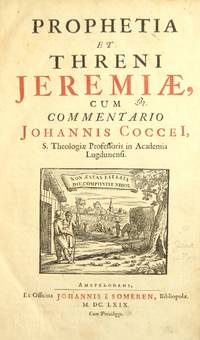
16699577Amstelodami: Johannis a Someren 1669. Folio pp. 6 319 7; bound with Prophetia Ezechielis cum commentario Johannis Coccei. Amsterdam 1669; engraved title page pp. 8 415 9; woodcut vignette on both titles titles printed in red and black 19 copper-engraved architectural plates on 16 folding or double-page sheets; old leather encrustations on front and back covers otherwise a good sound copy in full contemporary vellum. With an inscription on the flyleaf: "Library of Kenyon College Ohio. Presented by Rev. E. B. Pusey - Regis Professor of Hebrew Oxford 1835." Edward Bouverie Pusey 1800-1882 was a canon of Christ Church an esteemed orientalist and champion of orthodoxy. He counted among his intimate frinds Cardinal Newman and Gladstone. See DNB for a nine-page account of his life. <br/><br/> Johannis a Someren hardcover books
16699577Amstelodami: ex officina Joannes à Someren 1669. Folio pp. 6 319 7; bound with: Prophetia Ezechielis cum commentario Johannis Coccei. Amsterdam 1669; engraved title page pp. 8 415 9; woodcut vignette on both titles titles printed in red and black 19 copper-engraved architectural plates on 16 folding or double-page sheets; old leather encrustations on covers otherwise a good sound copy in full contemporary vellum. With an inscription on the flyleaf: "Library of Kenyon College Ohio. Presented by Rev. E. B. Pusey - Regis Professor of Hebrew Oxford 1835." Edward Bouverie Pusey 1800-1882 was a canon of Christ Church an esteemed orientalist and champion of orthodoxy. He counted among his intimate friends Cardinal Newman and Gladstone. See DNB for a nine-page account of his life. ex officina Joannes à Someren unknown
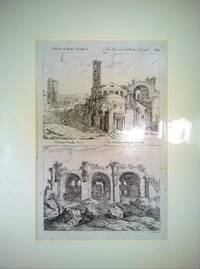
1675275166United Kingdom: Joachim von Sandrart 1675. Print. Good. No Binding. An original engraved print extracted from Joachim von Sandrart's monumental three volume Teutsche Academie der Edlen Bau- Bild- and Mahlerey- Kunste' published in 1675 1679 and 1680. Entitled Romuli et Remi Templum and Vestigia Templi. this print has been mounted and backed with card. Total measurement is 21" x 16" aperture of 13 1/4" x 8 1/2". One or two spot of foxing but overall very good. . Joachim von Sandrart unknown
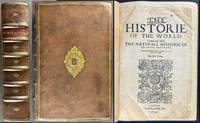
16341634SSLondon: Printed by Adam Islip 1634. 2nd edition in english. Leather-bound Hardcover. Very Good /no dj as issued. 2nd edition in English Very Good<br /> --- --- --- <br /> London printed by Adam Islip 1634 second English edition two Volumes bound in One 13.5" x 9"'<br /> Vol I 58 614 pages plus 42 pages Index for Tombe I; Vol II 632 pages plus 82 pages Index for Tombe II 2.<br /> Two volumes in one bound in modern full calf decorated papered boards six raised bands to spine gilt lettering and decorations on spine and front and back board.<br /> Elaborate woodcut printers device on title page woodcut initials head and tailpieces copious indexes of both volumes small piece of paper on final sheet saying that the previous issue had a lengthy Errata sheet which is no longer required as the errors have been corrected for this edition.<br /> Faint ownership inscription on top of the title page dated 1647.<br /> <br /> The Historie of the World was first translated into English by Philemon Holland in 1604. The original work of Pliny was published two years before he perished at Pompeii during the eruption of Mount Vesuvius in 79 CE.<br /> <br /> Gaius Plinius Secundus or Pliny the Elder was a Roman author naturalist scientist and naval and army commander of the early Roman Empire. He wrote several works and was dedicated to study in his life. <br /> <br /> The work is in good to very good condition overall. There is some marginal toning. There are some restored marginal losses to prelims and concluding leaves. There is very light intermittent spotting. There may be a few minor imperfections or faint marks to be expected with age. ---- ---- ---- <br /> The Historie of the World was first translated into English by Philemon Holland in 1604. The original work of Pliny was published two years before he perished at Pompeii during the eruption of Mount Vesuvius in 79 CE.<br /> <br /> Gaius Plinius Secundus or Pliny the Elder was a Roman author naturalist scientist and naval and army commander of the early Roman Empire. He wrote several works and was dedicated to study in his life. <br /> <br /> The work is in good to very good condition overall. There is some marginal toning. There are some restored marginal losses to prelims and concluding leaves. There is very light intermittent spotting. There may be a few minor imperfections or faint marks to be expected with age. Printed by Adam Islip hardcover
162042454ABIn s'Graven-Haghe, By Hillebrant Iacobsz Ordinaris en Ghesworen Drucker vande Hog.Mog.Heeren Staten Generael. Anno 1620. Kl.-4°. [6] Bll. (das letzte leer). Moderner Pappband mit Rückenschild. Anmerkung am Titel (alt), ein Bl. mit kl. Einriß.
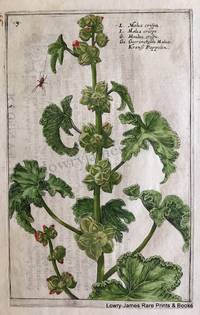
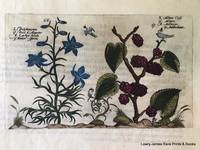
16146995Utrecht:: de Passe Crispjin van 1614. First edition. Fine. A scarce original hand-colored copperplate engraving from the First Edition of Hortus Floridus. Printed on wove stock with embellished initial capitols and text in Latin on the verso. Oblong folio 10.75 x 7.5 inches plate mark 8.25 x 5 inches. Matted in Ivory Rag to 18.5 x 16 inches. Crispijn Van de Passe The Younger Cologne 1594- 1670 produced his charming work Hortus Floridus as a young engraver of flowering plants between 1614-16: the height of the Dutch Golden Age- forever after known as the Tulipmania Period. Crispijn was born into a long line of talented Dutch engravers and learned to master the challenging skill of engraving with a needle-like instrument called the burin. His technical virtuosity was enlivened by his youthful whimsical spirit as displayed in his engaging compositions of flowering plants and landscapes teeming with insects birds and small animals as well as allegorical and mythologic themes. This charming work served to inspire a vast array of noted botanical illustrators and painters such as Sir John Hill DeBry Basilius Besler Emanuel Sweert and Sydney Parkinson well into the eighteenth century. Blunt Every print is digitally watermarked for web display purposes only. The actual print is unaltered and sold in original condition. This print is presented in our elegant and traditional matting style; Ivory Rag mat with gold French line suitable for framing. Matted in Rag Board de Passe, Crispjin van, unknown
16146996Utrecht:: de Passe Crispjin van 1614. First edition. Fine. A scarce original hand-colored copperplate engraving from the First Edition of Hortus Floridus. Printed on wove stock with embellished initial capitols and text in Latin on the verso. Oblong folio 10.75 x 7.5 inches plate mark 8.25 x 5 inches. Matted in Ivory Rag to 18.5 x 16 inches. Crispijn Van de Passe The Younger Cologne 1594- 1670 produced his charming work Hortus Floridus as a young engraver of flowering plants between 1614-16: the height of the Dutch Golden Age- forever after known as the Tulipmania Period. Crispijn was born into a long line of talented Dutch engravers and learned to master the challenging skill of engraving with a needle-like instrument called the burin. His technical virtuosity was enlivened by his youthful whimsical spirit as displayed in his engaging compositions of flowering plants and landscapes teeming with insects birds and small animals as well as allegorical and mythologic themes. This charming work served to inspire a vast array of noted botanical illustrators and painters such as Sir John Hill DeBry Basilius Besler Emanuel Sweert and Sydney Parkinson well into the eighteenth century. Blunt The print is digitally watermarked for web display purposes only. The actual print is unaltered and sold in original condition. This print is presented in our elegant and traditional matting style; Ivory Rag mat with gold French line suitable for framing. Matted in Rag Board de Passe, Crispjin van, unknown
1698275583Amstelædami : Apud Henricum Wetstenium 1698. First Edition. Hardcover. Worn copy bound in full vellum with a leather gilt-blocked label to the spine. Some wear and tear as with age. Remains well preserved overall; bright clean and sharp-cornered. Physical description; vol. V only: 462 pages. Subjects; Aesop. Fables. Amstelædami : Apud Henricum Wetstenium hardcover
1679014459London.: Printed for T. Dring C. Harper and J. Leigh. 1679. Hardcover. Poor. Folio. 13". Poor. Contemporaneous full calf. Worn with a chip or two missing from spine calf all as pictured. Sadly lacking plates IV & V and the top part of text leaf 15/16 this leaf was devoted to describing that shown in the following plates - part of plate II and a very small part of plate III and plates IV and V verso. Also lacking final blank one text leaf bears very minor hole. 24 155 1; 8 179 1; 56 2 p. VI VI leaves of plates. 6 full page copper engraved plates 'describing the several parts treated of' to each volume vol. II missing two plates <br/> <br/> Printed for T. Dring, C. Harper, and J. Leigh. hardcover
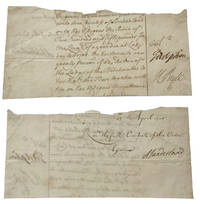
1700161541. 1700. No Binding. Very Good. ANNE COUNTESS OF SUNDERLAND Lady of the Bedchamber to Queen Anne. Part of a receipt for "the sum of Two Hundred and Fifty Pounds for one quarter of a year due at Lady Day last 1700. On her annuity or yearly pension. as one of the Ladys of the Bedchamber to her Majsty. and there together with her as her assigned attendance." It was issued by Lord Godolphin whose signature with that of H. Boyle is in the right hand margin. It is receipted on the reverse and signed A. Sunderland. 118mm x 232mm. 1700. ~ Anne Spencer second daughter of the first Duke of Marlborough became Countess of Sunderland after her marriage in 1700. She was noted for her great beauty and influence in politics and between 1702 and 1712 she served as a Lady of the Bedchamber to Queen Anne <br/> <br/> . unknown
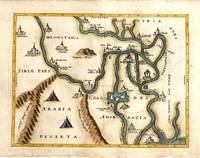
1610M11312Paris c.1610. Very Good. Notes: This map shows ancient geographical regions such as Mesopotamia Chaldea and Syria along with the Tigris and Euphrates rivers. It depicts important cities of the time: Babylon Jerusalem Antioch and Nineveh. Size : 215x278 mm 8.46x10.94 Inches Coloring: Hand Colored Category: Maps Asia Middle East; unknown
1648013686London 1648 Book. Very Good. Hardcover. ii 123 1 pages. Part of ESTC R5818 - The reasons presented by the dissenting brethren against certain propositions concerning presbyteriall government. It states there that it was probably not intended to be issued separately. Printer's signatures are - chi1 4A-4P 4Q². Pages lightly browned. In modern marbled paper covered boards with leather spine. hardcover
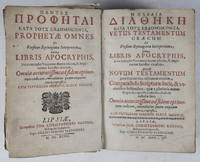
169743308Lipsiae Leipzig: Sumptibus Joh. Christophori Königii 1697. First edition. Hardcover. f to vg. Octavo 8 x 5 1/2". 20 9-56 2 1099 the following pages are misnumbered 2000-2099 3000-3018 i.e 1218 186 8 447 1pp. Original full vellum with handwritten title to spine. Title pages in red and black lettering. Publisher's device on title pages. Added title facing main title page: PantAes Prophhtai kata tous hevdomēkonta Prophetae omnes ex versione Septuaginta interpretum cum libris Apocryphis .; New Testament last 447 pp. has separate title: Tēs Kainēs Diathēkēs Apanta. Novi Testamenti libri omnes. Accesserunt parallela Scripturae loca nec non variantes lectiones ex plus 100. MSS. codicibus . The sequence of 186pp. between the Old and New Testaments has the following caption title: In Sacra Biblia Graeca ex versione LXX. interpretum Scholia; simul et interpretum Caeterorum : lectiones variantes. Decorative headpiece tailpieces and initials. <br /> <br /> "Though inferior to the London and Amsterdam editions in beauty of execution this work is very far superior to them in point of correctness. The prolegomena of John Frickis prefixed to it contain a critical notice of preceeding editions of the Septuagint Version which is said to be very accurate" see Thomas Hartwell Horne's "A Manual of Biblical Bibliography" Page 44 Nr. 9.<br /> <br /> "The LXX. was printed from a copy of the London edition of 1653 which follwed the Sixtine text. This was collated with the Aldine edition and the variants found in that and in the Frankfort edition of 1597 which closely followed the Aldine are noted in an appendix. <br /> <br /> The New Testament text is printed from Fell's edition of 1675 No. 4711 in Darlow and Moule but the variant readings are relegated to an appendix. In the N. T. the references are printed immediately below the verse to which they belong.<br /> <br /> The Prayer of Manasses and a prologue to Ecclus which are not found in the Sixtine edition are apparently taken from an edition by J. A. Fabricius 1691 and appended to the Apocrypha.<br /> <br /> An engraved headpiece depicting Fridenstein appears before Genesis; a similar engraved headpiece depicting Altenburgum before Matthew and a coat-of-arm with the motto "Amore et prudentia" before Isaiah." See: Darlow and Moule Vol. II No. 4718.<br /> <br /> Binding darkened and partly age-toned. Spine with closed vertical cracks but firm. The engraved frontispiece portrait of Frederick Duke of Saxony is missing. Minor and sporadic foxing throughout. Introductory material Dedication to Frederick Duke of Saxony and Prolegomena in Latin Bible in ancient Greek. Binding in overall good- interior in good to very good condition. Sumptibus Joh. Christophori Königii hardcover
167776196Paris: Pierre Le Petit 1677. Leather_bound. Good Plus. 241 pages. Title page vignette vignette to dedication and preface. Full calf leather 12mo approximately 6 1/2 by 4 inches Corners bumped small chip to head and tail of spine five raised bands to spine cracking to spine and title faint. A few small spots to rear board some scratches and discoloration to cover textblock square binding tight. Interior clean with uniform light toning. French translation of Pliny the Younger's Pangeric to the Emperor Trajan. Pierre Le Petit unknown
16191404548Frankfurt Germany: De Bry 1619. Hardcover. Octavo cuius 350 pages. In Poor condition. Spine torn open with stitched exposed formerly repaired with non-archival tape which has since hardened and is severely flaking. Front board mostly detached. Extremely fragile. Missing title page. Severe worming to lower exterior corner through page ten open tear from page mus through page III.P. Notable soiling throughout. Occasional graphite and ink annotations. Text in Latin. RW consignment. Shelved in Room A. OCLC: 258125024. 1404548. Special Collections. De Bry hardcover
168033353Paris: Francois Muguet. Very Good with no dust jacket. 1680-81. Hardcover. 24mo 109x53 mm; 576 pages; Headpieces and tail pieces. Bound in contemporary leather. LOUIS XIV King of France. Ordonnances . . . Sur le Fait des Gabelles & des Aydes. 156 pages Ordonnances . . . Sur le Fait des Entrées Aydes & autres Droits. 123 i. E. 223 5 pages Ordonnance . . . Pour servir de Reglement sur plusieurs Droits de ses Fermes. 192 pages. Together 3 volumes bound in one. 24mo 109x53 mm contemporary calf gilt spine rubbed slightly chipped at bottom; contents clean. Paris: François Muguet 1680; 1680; 1681 . French Language. Complete. Official ordinances on taxes and other internal problems. . Francois Muguet, hardcover
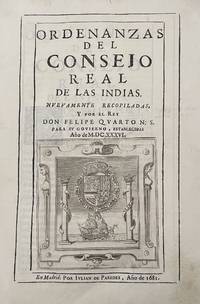
16812474Madrid: Por Julian de Paredes 1681. Second revised and enlarged edition. In contemporary limp vellum. Engraved device on title page. Woodcut initials throughout and a tailpiece at end of each part. Tinted edges. Stains on binding string missing panels with small damage at the outer edge. Tinted title on spine rubbed. 19th-century shelfmark on the inner front panel in ink. Contemporary notes and sings to the margins throughout the first part. Old restoration with paper tape to a few pages in the first part. Otherwise in very good condition. Second revised and enlarged edition. In contemporary limp vellum. 206 14 p. <p><p><br /> Revised and enlarged second edition of these substantial bodies of law relating to the New World and the treatment of Native Americans an important volume on the Administrative History of the Indies.<br /> <p><p><br /> One of the most important volumes of the administrative history of the Indies a fundamental collection of laws and ordinances decreed by the Council of the Indies the supreme governing body of Spain’s colonies in America during the reign of Philip IV. <br /> <p>The first part Ordenanzas del Consejo Real de las Indias contains 245 ordinances of the Council of the Indies pp. 3–112; first published in 1636 the second part Autos acuerdos y decretos de govierno del Conseio Real y supremo de las Indias embodies an additional 190 ordinances concerning for the most part the administration of Spanish America pp. 113–206 plus 14 p. of index; first published in 1658.<br /> <p><p><br /> Any editions of these bodies of law are extremely scarce on the market RHB lists only 2 copies of the present edition within the last 70 years. <br /> Sabin 57477. Por Julian de Paredes unknown