Pablo PICASSOBiblio.com
1 544 résultats
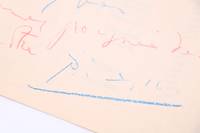
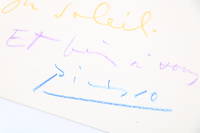
195689526Cannes 1956. Fine. A polychrome and artistic link in an epistolary chain that linked Picasso to his prominent patron for decades Cannes 5 juin 1956 13.5 x 21 cm un feuillet Multi-coloured autograph letter from Pablo Picasso to Max Pellequer signed and dated by the artist on June 5 1956. The document includes the autograph address of his villa La Californie. Twelve lines in orange pink blue yellow and purple pencil on one sheet. Minor folds. A very elegant letter written in pastel colours by Pablo Picasso. Despite his prolific correspondence Picasso's entirely autographed letters are extremely rare as Laurence Madeline points out in her article on the confidential activity of the great artist:The inertia paralyzing Picasso who preferred his work as an artist to that of a secretary made the letters he took pleasure in writing more essential and more touching Laurence Madeline Picasso épistolier L'Herne no. 106. Living on the hills over Cannes the painter was indeed helped by his faithful secretary and childhood friend Jaume Sabartés who was responsible for writing numerous missives save a few correspondents notably Pellequer. Picasso wrote each of Pellequer's letters even the most insignificant in an ample voluptuous script playing with letters and words as graphic objects blending aesthetically in the space of the page in perfect contrast to the prosaic nature of the letter's content. It could even be argued that his artistic soul largely invaded his daily and administrative correspondence with his banker and ardent collector of his works. Part of their correspondence is kept at the National Picasso Museum in Paris. An extraordinary recipient. Banker and collector Max Pellequer was introduced to Picasso in 1914 by his uncle by marriage André Level. He quickly became one of Picasso's most important collectors and his financial advisor for over 30 years. Pellequer's interest in his art began as early as the 1910's when he purchased a Picasso bronze from the art dealer Ambroise Vollard. During the 1930s and 1940s as Picasso's personal banker he secured and enhanced the painter's wealth and allowed him to settle comfortably in the South of France. Picasso created a superb ex-libris on copper for him bought him paintings including La mer à L'Estaque by Cézanne now in the Picasso museum and offered him a few works. Pellequer assembled a vast collection of paintings by the great masters of modern art: Degas Raoul Dufy Paul Gauguin Fernand Léger Henri Matisse Joan Miró Modigliani and Maurice Utrillo today preserved in the most important international museums. The epistolary art of Picasso. Picasso's epistolary production acted as an outlet for his incessant creative energy which was expressed in ceramics sculptures photographs illustrations collages or poetry. Each letter was an opportunity for genius to blossom regardless of the administrative content of his exchanges with Pellequer. Perhaps to counteract the dullness of his work Picasso redoubled his efforts: an explosion of color calligraphic letters across the page. to conjure up beauty and adorn his words in shimmering hues using oil pastels black felt-tip pens or colored pencils.These alphabet letters numbers words and sentences placed on the paper like so many musical scales are literally brought to life by the creative power of the painter. The years of La Californie in Cannes. Living with Jacqueline Roque in the villa La Californie at the time of this letter the painter was producing a series of captivating lithographed portraits of his partner. Paradoxically this colorful letter corresponds to a very monochrome period of his work a superb counterpart to the black washes on zinc. Matisse with whom Pellequer also corresponded had died a month earlier. A very beautiful and visual illustration of Picasso's need for total expression through his correspondence with one of his close advisors and friends. unknown
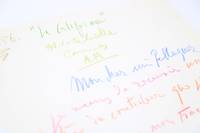
1956895241956. Fine. ""Mistral et soleil"" Mistral and sunshine 7 juin 1956 26.80 x 20.90 cm un feuillet dont deux lignes sur une page Autograph letter in blue and red pencil by Pablo Picasso to Max Pellequer signed and dated by the author on June 7 1956. The document includes the autograph address of his villa La Californie. 12 lines on the front of the letter and two lines on the back on a printed notice announcing the forthcoming publication of a book by Thérèse Leroy. Minor folds and a slight crease in the lower left corner. We have here a rare written account of Pablo Picasso engaging in self-deprecation. In his villa ""Californie"" the painter found a printed poster announcing the forthcoming publication of the book ""La technique du classement"" The Technique of Classification. On this announcement he humorously wrote the following words: ""Je vais m'y mettre. Un peu sur le tard"" I'll get started on it with slight delay well aware that he preferred to devote his time to his art rather than to administrative tasks. Picasso refers here to the topic of his letter the discovery of a new insurance document requested by its recipient. Max Pellequer who managed his finances knew only too well the disorderly nature of his friend the artist with 50000 works to his credit. Picasso's true concerns however seem to reflect in the letter's graphic composition. He changed the colour and size of the characters to highlight what really mattered to him: beauty and friendship. « Mistral et soleil. Allez bien et bonne poignée de main de votre Picasso » ! ""Mistral and sunshine and a proper handshake to you from Picasso""! Despite his prolific correspondence Picasso's entirely autographed letters are extremely rare as Laurence Madeline points out in her article on the confidential activity of the great artist:The inertia paralyzing Picasso who preferred his work as an artist to that of a secretary made the letters he took pleasure in writing more essential and more touching Laurence Madeline Picasso épistolier L'Herne no. 106. Living on the hills over Cannes the painter was indeed helped by his faithful secretary and childhood friend Jaume Sabartés who was responsible for writing numerous missives save a few correspondents notably Pellequer. Picasso wrote each of Pellequer's letters even the most insignificant in an ample voluptuous script playing with letters and words as graphic objects blending aesthetically in the space of the page in perfect contrast to the prosaic nature of the letter's content. It could even be argued that his artistic soul largely invaded his daily and administrative correspondence with his banker and ardent collector of his works. Part of their correspondence is kept at the National Picasso Museum in Paris. An extraordinary recipient. Banker and collector Max Pellequer was introduced to Picasso in 1914 by his uncle by marriage André Level. He quickly became one of Picasso's most important collectors and his financial advisor for over 30 years. Pellequer's interest in his art began as early as the 1910's when he purchased a Picasso bronze from the art dealer Ambroise Vollard. During the 1930s and 1940s as Picasso's personal banker he secured and enhanced the painter's wealth and allowed him to settle comfortably in the South of France. Picasso created a superb ex-libris on copper for him bought him paintings including La mer à L'Estaque by Cézanne now in the Picasso museum and offered him a few works. Pellequer assembled a vast collection of paintings by the great masters of modern art: Degas Raoul Dufy Paul Gauguin Fernand Léger Henri Matisse Joan Miró Modigliani and Maurice Utrillo today preserved in the most important international museums. The epistolary art of Picasso. Picasso's epistolary production acted as an outlet for his incessant creative energy which was expressed in ceramics sculptures photographs illustrations collages or poetry. Each letter unknown
195689529Cannes 1956. Fine. 'I continue my work with passion' Cannes 27 janvier 1956 21 x 27 cm un feuillet Autograph letter by Pablo Picasso to Max Pellequer vividly executed in multiple colours signed and dated by the artist 27 January 1956 addressed from his villa La Californie. Fourteen lines written in green blue pink orange red violet and turquoise pencil on a watermarked BFK Rives sheet.A few negligible transverse folds as expected from mailing. Picasso did not regularly employ colour in his correspondence. Here however he seems to have offered a gracious gesture to his friend and banker Max Pellequer as the more visually striking his letters the more sought-after they become. To speak of his work Picasso turns to red pencil: je continue mon travail avec ardeur - a telling choice that conveys the fervour he wished to bring to his art. Although Picasso maintained a substantial correspondence letters written entirely in his own hand remain exceedingly scarce. As Laurence Madeline observes in her study of this private facet of the artists life: The inertia that paralyses Picasso who prefers his activity as an artist to that of a secretary renders the letters he does choose to write all the more essential and touching Picasso épistolier LHerne no. 106. From his home overlooking Cannes Picasso was assisted by his devoted secretary and childhood companion Jaume Sabartés who penned many of the artists letters - except those destined for Pellequer. To him Picasso wrote every message himself however trivial in a generous flowing script playing with letters and words as though they were graphic elements arranged in an aesthetic dialogue across the sheet far removed from the sobriety of the text. His artistic impulse seems to have seeped into even his most routine administrative exchanges with his banker and impassioned collector. Part of the Picasso-Pellequer correspondence is held today by the Musée national Picasso in Paris. A singular recipient Max Pellequer banker and collector was introduced to Pablo Picasso in 1914 by his uncle by marriage André Level. He quickly emerged as one of the artists foremost collectors and in time became Picassos financial adviser for over three decades. Pellequers engagement with Picassos oeuvre began in the 1910s notably through a bronze jester acquired from Ambroise Vollard. During the 1930s and 1940s he became Picassos personal banker safeguarding the artists wealth and facilitating his comfortable establishment in the South of France. Their friendship was lifelong and intensely collaborative. Among other commissions Picasso executed a splendid copper ex-libris for Pellequer; Pellequer purchased paintings such as Cézannes La mer à LEstaque Musée Picasso Paris; and Picasso reciprocated with gifts of several works. A discerning and avid collector Pellequer assembled one of the finest collections of modern masterworks - Degas Dufy Gauguin Léger Matisse Miró Modigliani and Utrillo - today preserved in major international museums. The epistolary art of Picasso Picassos correspondence served as an outlet for his relentless creative energy expressed across ceramics sculpture photography illustrations collages and poetry. Every letter provided a space for the emergence of genius irrespective of the prosaic content of his exchanges with Pellequer. To counterbalance such banality Picasso took care to arrange his letters diagonally across the page enlivening them with colour from pastels felt pens or coloured pencils. Letters numerals words and sentences became visual and musical elements animated by the painters imaginative force. A striking and vividly visual illustration of Picassos imperative for total self-expression manifested through his correspondence with one of his closest friends and advisers. unknown
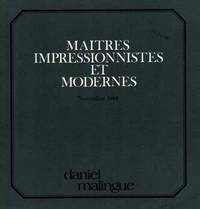
17-5174Paris France: Daniel Malingue 1984. 12mo. Ca. 40 pp. Softcovers. Very Good with minor shelfwear on cover. Color Plates. Date stamp on cover. Text in French. Paris, France: Daniel Malingue, 1984. paperback
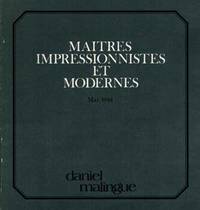
17-5175Paris France: Daniel Malingue 1984. 12mo. Ca. 40 pp. Softcovers. Very Good with edgewear on cover. Color Plates. Text in French. Paris, France: Daniel Malingue, 1984. paperback
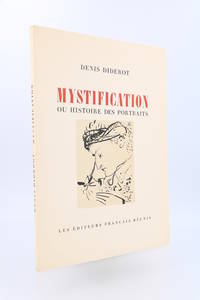
195492033Paris: Les Editeurs Français Réunis 1954. Fine. Les Editeurs Français Réunis Paris 1954 19.5 x 28.2 cm Broché Illustrated edition featuring 4 original lithographs by Picasso printed by Mourlot one of 430 numbered copies on wove paper the only issue after 5 copies on japon and 95 on Arches wove paper.A pleasing copy. Les Editeurs Français Réunis unknown
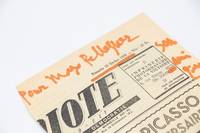
195987544Cannes 1959. Fine. Cannes 25 octobre 1959 17 x 32 cm un feuillet remplié Signed and inscribed newspaper clipping with Picasso's portrait. Newspaper clipping from 'Le Patriote de Nice et du Sud-Est' 25 October 1959 signed and inscribed by Pablo Picasso. A folded leaf inscribed with a large red felt-tip pen. A pictorial and unusual inscription signed by Picasso on the front page of a Nice newspaper celebrating his 78th birthday: For Max Pellequer / his friend / Picasso. A beautiful testimony of friendship in an important political newspaper which featured many of the artist's original creations. Banker and collector Max Pellequer was introduced to Picasso in 1914 by his uncle by marriage André Level. He quickly became one of Picasso's most important collectors and his financial advisor for over 30 years. Pellequer's interest in his art began as early as the 1910's when he purchased a Picasso bronze from art dealer Ambroise Vollard. During the 1930s and 1940s as Picasso's personal banker he made the painter exceptionally wealthy and allowed him to settle comfortably in the South of France. Picasso created a superb ex-libris for him bought him paintings including 'La Mer à L'Estaque' by Cézanne now in the Picasso museum and offered him a few works. Pellequer assembled a vast collection of paintings by the great masters of modern art: Degas Raoul Dufy Paul Gauguin Fernand Léger Henri Matisse Joan Miró Modigliani and Maurice Utrillo today in the most important international museums. The choice of this newspaper of the Nice Communist Party is particularly significant for Picasso. He had joined the Party in 1944 and advocated for peace in the post-war period with the communists. In 1946 he met the paper's future editor-in-chief Georges Tabaraud then a young journalist who had fought in the Resistance. They remained very close until Picasso's death: Le Patriote became in a way 'Picasso's newspaper' especially during the Nice Carnival: in 1951 as a gesture of friendship Picasso created a jester king for the front page of the daily newspaper for that particular day of popular jubilation and then every year from 1958 to 1967. He knew that the press was the main source of information for the French. His direct style is combined with a fraternal feeling a desire to act and work together. Georges Tabaraud and Pablo Picasso joined forces for better but also for worse when the news required serious action"" Picasso Foundation. Picasso had given the Patriote an exclusive portrait in his villa in Cannes for his 78th birthday. Highlighting the date he signs here around his photograph on the front page of the newspaper. The artist is seen sitting next to his Picador a striking linocut depicting a bullfighting scene - a theme dear to the artist throughout his long and versatile career: The painter has in fact just devoted his last weeks to linocut. He created an extraordinary collection of some thirty engravings . The entire team of our newspaper wishes good health for many years to come to the illustrious painter comrade and collaborator who make us the envy of the press all around the world is printed in the insert next to Picasso's red felt-tip pen. unknown
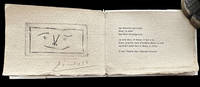
1956N - 2023 - 99<p>Rene Crevel first edition of is poem NUIT published in the "Autumn 1924 Winter 1925" issue of Little Review New York magazine illustrated with an original engraving with burin on celluloid by Picasso signed in pencil. Oblong tiny format 65 x 90mm published by PAB Alès May 1956. Limited numbered edition of 30 copies printed on fine Auvergne laid paper by Richard-de-Bas n. 29 signed in pencil by PAB Pierre Andre Benoit Ref: Cramer 74. Very Good lightly tanned.</p> PAB (Pierre Andre Benoit)
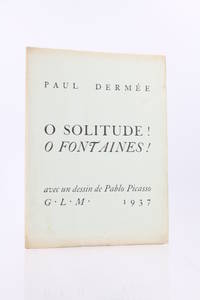
193780247Paris: GLM 1937. Fine. GLM Paris 1937 14.50 x 19.50 cm broché First edition one of 250 numbered copies on vellum the only issue after 25 Holland paper. The work illustrated with a frontispiece drawing by Pablo Picasso. Light dampstain to margins of leaves otherwise handsome copy. GLM hardcover
193766905Paris: GLM 1937. Fine. GLM Paris 1937 14.50 x 19.50 cm broché First edition one of 250 numbered copies on vellum only draw after 25 Holland paper. Illustrated book frontispiece a drawing by Pablo Picasso. Back and flat very slightly and marginally thinned as generally otherwise nice copy. Autograph dedication signed by Paul Dermée to the poet Hubert Dubois. GLM hardcover
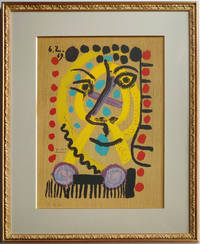
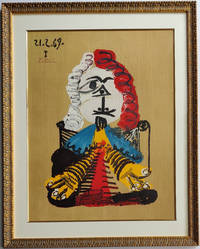
196974883<p>After Pablo Picasso<br />One plate from Les Portraits Imaginaires 1969<br />Lithograph in colors on Arches paper with printed signature as issued<br />Numbered A126 / 250 from the America edition <br />Printed by Marcel Salinas<br />Published by Éditions Cercle D'art<br />Sheet size: 66 x 50 cm<br />Frame size: 87 x 71.5 x 3 cm</p>
196974884<p>After Pablo Picasso<br />One plate from Les Portraits Imaginaires 1969<br />Lithograph in colors on Arches paper with printed signature as issued<br />Numbered F18 / 250 from the French edition with the blindstamp of the publisher/printer<br />Printed by Marcel Salinas<br />Published by Éditions Cercle D'art<br />Sheet size: 66 x 50 cm<br />Frame size: 76.5 x 61 x 2.5 cm</p>
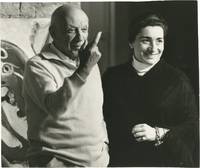
1970163146N.p.: N.p. 1970. Vintage borderless photograph of sculptor and painter Pablo Picasso and his wife and muse Jacqueline circa 1970s. Printed mimeo snipe PIX agency stamp and Camera Press stamp on the verso.<br /> <br /> Picasso met Jacqueline née Jacqueline Roque in 1952 while she was working at the Madoura Studio in Vallauris France and the couple began a relationship shortly thereafter. They married in 1961 and remained together until Picasso's death in 1973.<br /> <br /> From the archive of the PIX Agency an American photo house that acted as an intermediary between emigre photographers as well as those still living in Europe and the American magazine and newspaper market between 1935-1969. <br /> <br /> 10.25 x 8.5 inches. About Near Fine. N.p. unknown
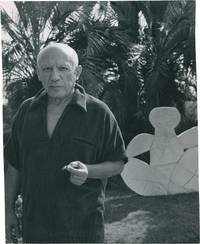
1956163145N.p.: N.p. 1956. Vintage borderless photograph of sculptor and painter Pablo Picasso standing outdoors with one of his sculptures in 1956. Stamp of noted Swiss photographer Kurt Blum on the verso along with two PIX agency labels. <br /> <br /> From the archive of the PIX Agency an American photo house that acted as an intermediary between emigre photographers as well as those still living in Europe and the American magazine and newspaper market between 1935-1969. <br /> <br /> From the archive of the PIX Agency an American photo house that acted as an intermediary between emigre photographers as well as those still living in Europe and the American magazine and newspaper market between 1935-1969. <br /> <br /> 8.25 x 10.25 inches. Near Fine. N.p. unknown
201431074Gagosian / Rizzoli March 2014. Hardcover. VG/As New. As new copy still in publishers shrinkwrap Gagosian / Rizzoli hardcover
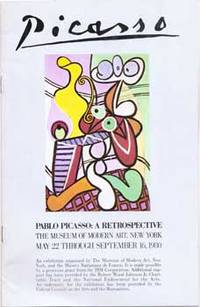
75-0828NY NY: Museum of Modern Art 1980. First Edition. 8vo. Soft Covers. 16 pp. Very Good. Color and black and white plates.Catalogue accompanies an exhibition at the Museum of Modern Art May 22 to September 16 1980.Provenance: From the estate of Gerald Nordland 1927-2019. Nordland was a museum director art critic educator and author.Dean of the Chouinard Art Institute 1960-64 Director of the San Francisco Museum of Art now SFMoMA 1966-73 Milwaukee Art Museum 1977-85 and the UCLA Wight Art Gallery 1973-1977. He is the author of over 60 publications including books on Lachaise Nakian Diebenkorn and Frank Lloyd Wright. NY, NY: Museum of Modern Art, 1980. paperback
75-0965New York NY: Christie's 2007. 4to. Soft Covers. Very Good. 70 pp. Color and Black and White plates. There might be an additional charge due to the large size of the book. New York, NY: Christie's, 2007 paperback
195923860New York: Harry N. Abrams 1959. hardcover/illustrated boards in dust jacket. die-cut panel in dj caused closed tears at two corners.very shallow soiling along bottom edge of dj. faint aura of toning to outer margins of endpapers. no markings or writing. no bumps. strong binding.; xiv-159pp. four pages of 8 color lithography plus 152 full-page gravure illustrations. introduction by maurice jardot. First Edition. Hardcover. Very Good/Good Plus. Folio - over 12" - 15" tall. Harry N. Abrams Hardcover
75-2510Sydney Australia: Rex Irwin Gallery 1989. 4to. Soft cover Very good 12pp. B&W plates. Sydney, Australia: Rex Irwin Gallery, 1989 paperback
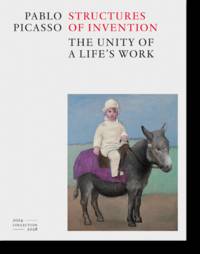
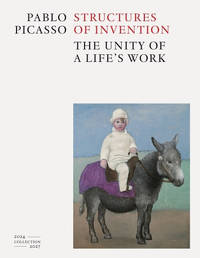
B9788410024069Hardback. New. hardcover
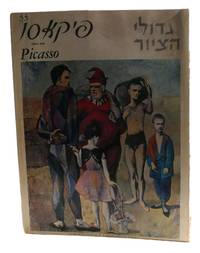
1964322558Milan: Fratelli Fabbri Editori 1964. First Edition; First Printing. Softcover. Very Good in wraps. Text in Hebrew. Front hinge cracked. Shelfwear on spine. Light creasing on panel corners.; From the personal collection of notable photojournalist Ted Spiegel known for his work with National Geographic and his portrait of John F. Kennedy. Fratelli Fabbri Editori unknown
SB05O-00068Verlag Gerd Hatje. Used - Very Good. Very Good condition. Very Good dust jacket. German. pablo picasso catalogs Verlag Gerd Hatje unknown
A9788410024069Hardback. New. hardcover
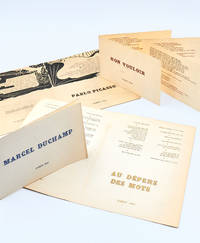
1941911351941. Fine. Complete collection of Surrealist poems published under the Nazi Occupation Non vouloir 1940 ; Pablo Picasso - Marcel Duchamp - Au dépens des mots 1941 19.4 x 29.6 cm Quatre feuillets Rare complete set of four pamphlets with poems by Georges Hugnet in first edition published during the Occupation illustrated by Picasso Joan Miro and Valentine Hugo. The first titled ""Non-vouloir"" was limited to only 26 copies; our copy is one of the 20 copies on vergé antique de Montval following 6 copies on japon. The three others on ordinary paper from a limited edition of 200 copies. ""Non-vouloir"" was the first resistance poem published openly and signed by its author without being subjected to censorship. Composed between March and June 1940 Hugnet's poem stands as a poetic manifesto of refusal against defeat and occupation echoing General De Gaulle's famous radio speach of June 18. Hugnet became an early member of the resistance and joined the group ""La Main à plume"" which printed numerous clandestine tracts. He used his bookbinding workshop to forge false documents and under the pseudonym ""Malo le Bleu"" contributed notably to ""L'honneur des poètes"" a collection of resistance poetry published clandestinely in 1943 by the famous Editions de Minuit. Non vouloir 1940. Printed in red ink. Illustrated with an original frontispiece by Joan Miro. The leaf has been trimmed to form an eight-page pamphlet a barely perceptible shadow left by a paper clip. Pablo Picasso 1941. Illustrated with 6 original zincographs by Pablo Picasso framing a poem by Georges Hugnet from January 1940. Fine copy without crease marks. Marcel Duchamp 1941. Printed in blue ink. Rare copy before the printing of the stencil by Marcel Duchamp mounted as frontispiece representing the mythical moustache he put on the Mona Lisa in 1919. Crease marks leaf cut along the fold at the top of the title page without loss of paper or text. Au dépens des mots 1941. Printed in gold ink illustrated with an original frontispiece by Valentine Hugo. A few very slight traces of sunning. Fine copy without crease marks. unknown
1435299701.Glibrary. Good. Access codes and supplements are not guaranteed with used items. May be an ex-library book. unknown