25 427 résultats
35010Genève, Skira (coll. "Qui était?"), 1967. Gr. in-8° carré, 149p. Reliure cartonnée illustrée d'éditeur, sous jaquette illustrée et rhodoïd.
15951Skira 1967 In-8, format carré, pleine toile blanche illustrée, sous jaquette illustrée, photographies pleines pages et doubles pages en noir et en couleurs, 150 pp. Bon état doccasion. Présentation de la vie du peintre Raphaël. Bon état doccasion
196723446Skira 1967 In-8, format carré, pleine toile blanche illustrée, sous jaquette illustrée, photographies pleines pages et doubles pages en noir et en couleurs, 150 pp. Bon état d’occasion.
4564Paris, Hachette et Cie, 1900, in Folio : 386 pp, br
LFA-126733595Une plaquette de 14 pages, format 245 x 315 mm, illustrée, brochée, s.d., Monrocq Frères Editeurs-Imprimeurs, bon état
6266Paris, Galeries nationales du Grand Palais, 1983. In-8 carré, broché, illustrations.
10387Genève, Skira / Musée du Luxembourg, 2001. In-4, broché.
3279Paris, Réunion des Musées Nationaux, ministère de la Culture, Galeries Nationales du Grand Palais, 15 Novembre 1983 - 13 Février 1984. Petit in-4, broché, couverture couleurs illustrée, 476 pp.
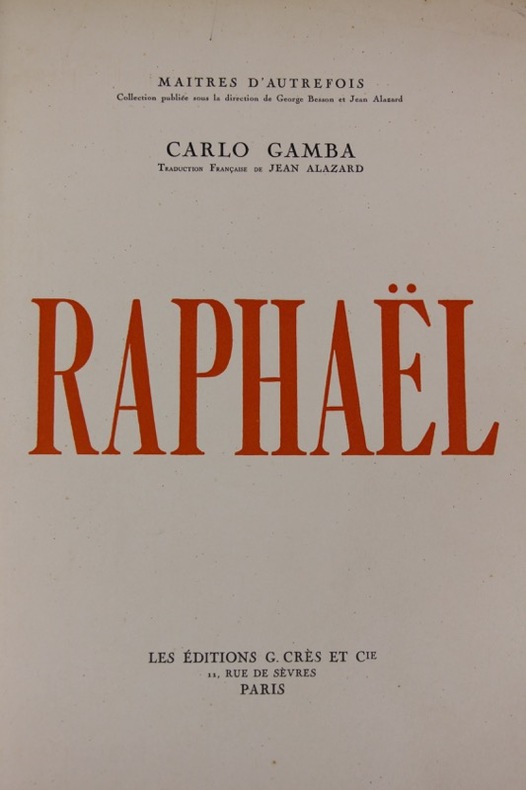
14963Paris, Crès (coll. "Maitres d'Autrefois"), 1931. In-4°, 122p. Broché, couverture rempliée.
24366Paris, Crès (coll. "Maitres d'Autrefois"), 1931. In-4°, 122p. Reliure demi-chagrin marron, couverture conservée.
25261P., Lafitte (Collection "Les Peintres Illustres"), sans date, in 8°, cartonnage illustré en couleurs de l'éditeur, 79pp. ; des rousseurs.
55956P., Renouard, 1860, 2 volumes in 8° reliés demi veau fauve, dos à faux nerfs, étiquettes vertes, VIII-579 et 614 pages ; un mors fendu ; frottis et défauts ; quelques rousseurs.
193218230Crès 1932 “Maîtres d’autrefois” In-4 demi-maroquin noir à coins, dos à nerfs, couvertures et dos conservés, 121 pp & 105 reproductions hors-texte, 30 dans le texte. Bel exemplaire.
525059P., RMN, 1983. In-8 carré, broché, 476 pp., 39 peintures, 137 dessins, 91 gravures et 6 tapisseries commentées et reproduites, dont 24 en coul. à pleine page. Section scientifique et téchnique. Bibliographie.
38320Paris, Flammarion (coll. "Les classiques de l'art"), 1969. In-4°, 128p. Reliure pleine toile d'éditeur, sous jaquette illustrée.
197131972AB1971. London Phaidon 1971. 19 cm wide x 27.2 cm high. 220 pages / Illustrated throughout. Original Hardcover with original dustjacket. Very good condition with only minor signs of wear. hardcover
77518London: W Foulsham. N.D. Paperback. Very Good. A complete run of 86 issues from 1875 to 1961 up to 1897 3rd or 4th editions published in the 1920s 6 copies lack their covers. Bound in original card covers; Small Octavo . W Foulsham paperback
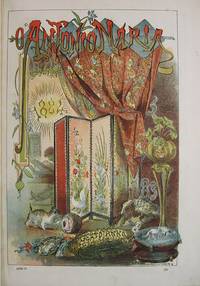
1879LL1<p><strong>Portugal's First Great Political Satirical Magazine a Complete Set</strong></p><p><strong>Includes Portuguese Poetry </strong></p><p>6vols; small folio; 315 issues COMPLETE. Contemporary half leather bindings red brown and green.2 color title pages and two chromolithographic cartoons; three full-page chromolithographic caricatures; black and white lithographs throughout.</p><p>O António Maria was Portugal's first great political satire magazine directed by Portugal's first great political cartoonist Rafael Bordalo Pinheiro 1846-1905.</p><p>The title meant as an exclamation expropriated the first half of the name of the reigning Portuguese Prime Minister António Maria Fontes Pereira.</p><p>Like Puck O António Maria usually devoted its first last and center pages to cartoons. The text pages also were dotted with cartoon art. Among the contributors were the poet Guilherme de Azevedo "João Rialto" Ramalho Ortigão "João Ribaixo" Alfredo Morais Pinto "Pan-Tarantula" João Broa Emílio Pimentel Enrique Casanova António Ramalho Ribeiro Cristino Columbano Bordalo Pinheiro Manuel Gustavo and others. Initially the magazine struck a balance between cartoons and text but as it matured the text took a subservient position to cartoons and comic strips.</p><p>Pinheiro used satire and irony in the pages of his magazine to oppose those in power and denounce the selfishness and corruption of the elites. All of Portugal's leading politicians and heads of first families appeared in caricature at one time or another in the weekly In 1884 the government revised the criminal code which seriously limited freedom of the press. It was in this repressive environment against which journalists generally adopted a passive attitude that led Pinheiro in his final issue to explain: "<em>When in a meeting of journalists' I proposed an 18-day publishing moratorium to protest the shameful situation in which the Portuguese government has placed the Portuguese press it was pointed out that O António Maria as a weekly sheet would not be seriously affected by the resolution. So I take the execution of my proposal one step further: O António Maria closes its doors forever in a sign of mourning</em>."</p><p>#WorldCat: 2 copies in US Libraries.</p>
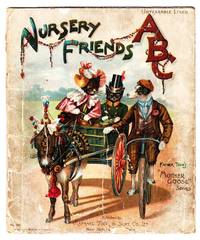
20624New York: Raphael Tuch & Sons Co. Ltd. Good/No Dust Jacket As Issued. <br /> A vibrant survivor of the Edwardian nursery. <br /> <br /> This charming alphabet book part of the legendary 'Father Tuck's Mother Goose Series' represents the pinnacle of early 20th-century children's lithography. <br /> <br /> Utilizing Raphael Tuck's Untearable linen process the book was designed to withstand the rough handling of children while providing a rich visual introduction to the alphabet. Each letter is paired with anthropomorphic animals and classic nursery-rhyme vignettes rendered in the lush saturated colors that made Tuck the most famous name in the "toy book" trade.<br /> <br /> KEY FEATURES<br /> Publisher Heritage: Produced by Raphael Tuck & Sons Publishers to Their Majesties the King & Queen known for the finest color printing of the era.<br /> Material: Printed on untearable linen; a tactile and durable format that replaced traditional paper for high-use nursery books.<br /> Visuals: Features 12 pages of alternating full-color lithographs and detailed black-and-white illustrations.<br /> Theme: An anthropomorphic alphabet where animals take on the roles of classic Mother Goose characters.<br /> <br /> CONDITION: Good to Very Good -- A remarkably sturdy example of a book meant for heavy use. The original stapled binding is strong and structural. The linen shows expected "hand-soiling" and age-toning throughout. There is minor loss to the rear cover and tiny chips to the front cover edges but the lithography remains bright and the text is fully legible. 7.25 x 8.5 inches. HISTORICAL SIGNIFICANCE --<br /> Raphael Tuck & Sons was a powerhouse of the Victorian ephemera world. Their Father Tuck brand was synonymous with quality utilizing German chromolithography that was far superior to most American or British competitors. These linen books were a technological response to the destructiveness of young readers; finding one today with the staples intact and the colors still poping provides a rare window into the visual landscape of a turn-of-the-century childhood.<br /> <br /> SUBJECTS: Children's Literature Raphael Tuck Alphabet Books Anthropomorphic Art Edwardian Ephemera Mother Goose Toy Books Linen Books Early 20th Century Juvenilia. Raphael Tuch & Sons, Co., Ltd unknown
70351Paris Joubert 1803. Large Folio 59.5 x 41.5 cm. 4 pp. Four large engraved plates. Later mottled half roan over paper boards resembling tree calf. Black morocco label with gilt title. Original printed wrappers bound in. = This work shows two - probably life-size - designs for candlesticks designed by Renaissance artists Raphael and Michelangelo on the occasion of a contest organized by Popes Julius II and Leo X. Each leaf shows either the top or the foot of a candle. The wrapper text extensively describing the candlesticks is printed in French and in English in two columns Armorial bookplate on the front pastedown. Some mostly marginal spotting. Otherwise a very good copy. Rare. Not in Brunet. hardcover
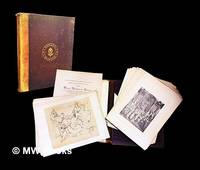
1866451247s.l. : s.n. 1866. First Edition. Hardcover. Very good portfolio copy in leather-backed cloth boards. Some light scuffs and speckling to covers with spine somewhat worn. Inside the prize sketches by Raphael are embossed on the upper margin by the awarding institution. The miscellaneous reproductions feature gilt outer edges. Some light smudges to leaves' margins with plates in very good condition. An overall well-preserved portfolio. Physical description; 30 loose leaves 29 cm. Contents; Twelve Raphael sketch reproductions on card stock constitute the Third Grade Prize in Art at the Warrington School of Art awarded in 1866 as introduced by the prize label and table of contents. An additional presumably later seventeen sketch reproductions are also enclosed with Raphael represented in addition other Renaissance artists. Subjects; Raphael 1483-1520—Reproductions. Art—Study and teaching—England—Warrington—19th century. Drawing Renaissance—Reproductions. [s.l.] : [s.n.] hardcover
17035770Rome: Gaetano Zenobi 1703. First edition. Octavo 23 cm; 114 2 pages. Vignette with arms of Pope Clement XI flanked by putti on title page. LACKS FRONTISPIECE PORTRAIT. Decorated letters and ornaments in text. Bound in mottled calf weak at joints and worn at extremities. Early inscription abraded at base of title page. Pages lightly toned with occasional stains. References: Cicognara 2404; Anthony Blunt "Don Vincenzo Vittoria" in The Burlington Magazine 109:766 1967 31-32. <br /><br />The author was a Spanish engraver and printer who lived and worked in Rome for part of his life. The text is a defense of Raphael and others from some dismissive remarks made by Carlo Cesare Malvasia in his promotion of the Carracci and of the Bolognese school "La Felsina Pittrice" 1678. Vittoria wrote the material probably in Spanish while still living in Valencia. In the preface he apologizes for his Italian which "lacks purity." The significance of the book according to the art historian Anthony Blunt lies in the author's descriptions of several drawings by Raphael and his contemporaries which are either lost or known only in engraved copies. Condition noted. Gaetano Zenobi unknown
Paris, Réunion des Musées Nationaux, ministère de la Culture, Galeries Nationales du Grand Palais, 15 Novembre 1983 - 13 Février 1984. Petit in-4, broché, couverture couleurs illustrée, 476 pp. Importante iconographie en noir et en couleurs, dans et hors-texte. Bel exemplaire.
5989POESIE 84, n° 2, mars-avril 1984. In-8, broché.
10941+rosebud, n° 3, Berlin, Die Gestalten Verlag, 2001. In-8, cartonné, illustrations, bande conservée.