325 résultats
15538Bound with orig. wrappers in private boards, gilt titlelabel. Top edge gilt. Uncut. No 457 of 940 ""sur papier de Rives"", a total of 1050. Many colour-illustrations by Carlègle.
15538Bound with orig. wrappers in private boards gilt titlelabel. Top edge gilt. Uncut. No 457 of 940 "sur papier de Rives" a total of 1050. Many colour-illustrations by Carlègle. hardcover
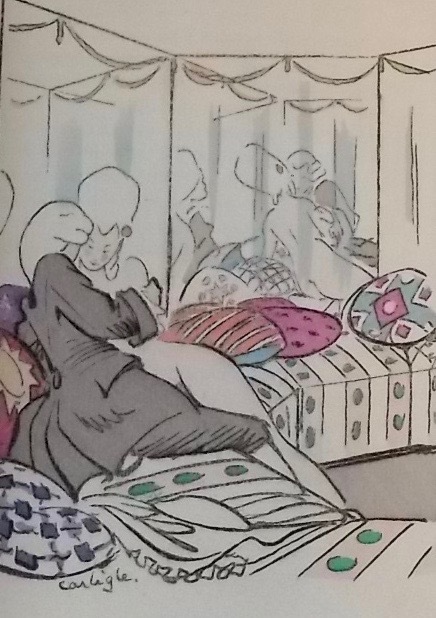
191443225Paris: Lucien Vogel éditeur 1914. Fine. Lucien Vogel éditeur Paris 1914 19.50 x 25 cm une feuille Original color print printed on vergé paper signed in the plate. An original print used to illustrate the Gazette du bon ton one of the most attractive and influential 20th century fashion magazines featuring the talents of French artists and other contributors from the burgeoning Art Deco movement. A celebrated fashion magazine established in 1912 by Lucien Vogel La Gazette du bon ton appeared until 1925 with a hiatus from 1915 to 1920 due to the war the editor-in-chief having been called up for service. It consisted of 69 issues printed in only 2000 copies each and notably illustrated with 573 color plates and 148 sketches of the models of the great designers. Right from the start this sumptuous publication was aimed at bibliophiles and fashionable society Françoise Tétart-Vittu La Gazette du bon ton in Dictionnaire de la mode 2016 and was printed on fine vergé paper using a type cut specially for the magazine by Georges Peignot known as Cochin later used in 1946 by Christian Dior. The prints were made using stencils heightened in colors some highlighted in gold or palladium. The story began in 1912 when Lucien Vogel a man of the world involved in fashion he had already been part of the fashion magazine Femina decided with his wife Cosette de Brunhoff the sister of Jean creator of Babar to set up the Gazette du bon ton subtitled at the time: Art fashion frivolities. Georges Charensol noted the reasoning of the editor-in-chief: 'In 1910' he observed there was no really artistic fashion magazine nothing representative of the spirit of the time. My dream was therefore to make a luxury magazine with truly modern artists I was assured of success because when it comes to fashion no country on earth can compete with France.' Un grand éditeur d'art. Lucien Vogel in Les Nouvelles littéraires no. 133 May 1925. The magazine was immediately successful not only in France but also in the United States and Latin America. At first Vogel put together a team of seven artists: André-Édouard Marty and Pierre Brissaud followed by Georges Lepape and Dammicourt as well as eventually his friends from school and the School of Fine Arts like George Barbier Bernard Boutet de Monvel and Charles Martin. Other talented people soon came flocking to join the team: Guy Arnoux Léon Bakst Benito Boutet de Monvel Umberto Brunelleschi Chas Laborde Jean-Gabriel Domergue Raoul Dufy Édouard Halouze Alexandre Iacovleff Jean Émile Laboureur Charles Loupot Chalres Martin Maggie Salcedo. These artist mostly unknown when Lucien Vogel sought them out later became emblematic and sought-after artistic figures. It was also they who worked on the advertising drawings for the Gazette. The plates put the spotlight on and celebrate dresses by seven designers of the age: Lanvin Doeuillet Paquin Poiret Worth Vionnet and Doucet. The designers provided exclusive models for each issue. Nonetheless some of the illustrations are not based on real models but simply on the illustrator's conception of the fashion of the day. The Gazette du bon ton was an important step in the history of fashion. Combining aesthetic demands with the physical whole it brought together for the first time the great talents of the artistic literary and fashion worlds; and imposed through this alchemy a completely new image of women: slender independent and daring which was shared by the new generation of designers including Coco Chanel Jean Patou Marcel Rochas and so on Taken over in 1920 by Condé Montrose Nast the Gazette du bon ton was an important influence on the new layout and aesthetics of that little dying paper that Nast had bought a few years earlier: Vogue. Lucien Vogel éditeur unknown
1922ABE-176688208143228 PAGES-16,5 CM X 23 CM-INTRODUCTION PAR HENRI FOCILLON-FRONTISPICE DESSINE ET GRAVE SUR BOIS PAR HERMANN PAUL-LES BANDEAUX ET LE CUL-DE-LAMPE REPRODUISENT, EN REDUCTION, DES GRAVURES SUR BOIS ORIGINALES DE CARLEGLE ET D'HERMANN PAUL EMPRUNTEES A NOS EDITIONS-(DG25)
1919016010Paris Galerie Devambez 1919 En feuilles
9729Lettre autographe signée datée du 13 janvier 1929. Il remercie Aelberts pour l’envoi de deux livres, l’un de Dévigne que Carlègle orthographie mal : « je viens de lire le livre de Desvignes qui est charmant, dès que j’aurai un instant, je lirai l’autre, mais je n’ai pas voulu attendre pour vous remercier de votre amabilité ». Une page in-8.
1701grand in 8 carré broché,276 pages,illustrations en couleurs dans le texte et frontispice par Carlègle,édition numérotée sur vélin de Rives à la forme.André Plicque & Cie 1928 édition tirée à 270 exemplaires emboîtage.
EXE-157Paris, Mornay, 1931. In-8° carré, broché, chemise et étui. Edition originale. Tiré à 555 exemplaires, celui-ci sur Hollande.
33687Paris, Xavier Havermans, 1929. Gr. in-8°, 50p. Broché, couverture rempliée.
EXE00528Paris, Société Littéraire de France, 1917. In-8° broché. Tiré à 1200 exemplaires, celui-ci sur vélin, orné de bois gravés par Carlègle.
EXE0052bParis, Fayard, 1911 ; in-8°, cartonnage de l’édition. Nombreuses illustrations dans le texte d’après des dessins de Carlègle.
192621349Paris, Émile Chamontin, 1926. Grand in-8 de [10]-210-[6] pages couverture imprimée en rouge et noire.
EXE00a82Paris, Pelletan, 1927 ; in-12 broché. Nombreuses illustrations in et hors-texte dues à Carlègle. Tiré à 1850 exemplaires ; l’un des 20 sur japon.
19141060# AUTEUR: Muller Charles et Paul Reboux # ILLUSTRATEUR: Carlègle # ÉDITEUR: Flammarion Ernest # ANNÉE ÉDITION: 1914 # COUVERTURE: 1/2 maroquin bleu à coins - liserés dorés sur les plats - dos lisse orné de fleurs rouges # DÉTAILS: In 8° relié 203pp. Nombreuses illustrations dans le texte.” Cette histoire est HENAURME! l'invention y casse-pète! Elle est d'une inspiration à la fois contemporaine et moyenâgeuse...”( Flaubert: lettre préface). Reliure signée Flammarion. Justification du tirage n°1437 # PHOTOS visibles sur www.latourinfernal.com
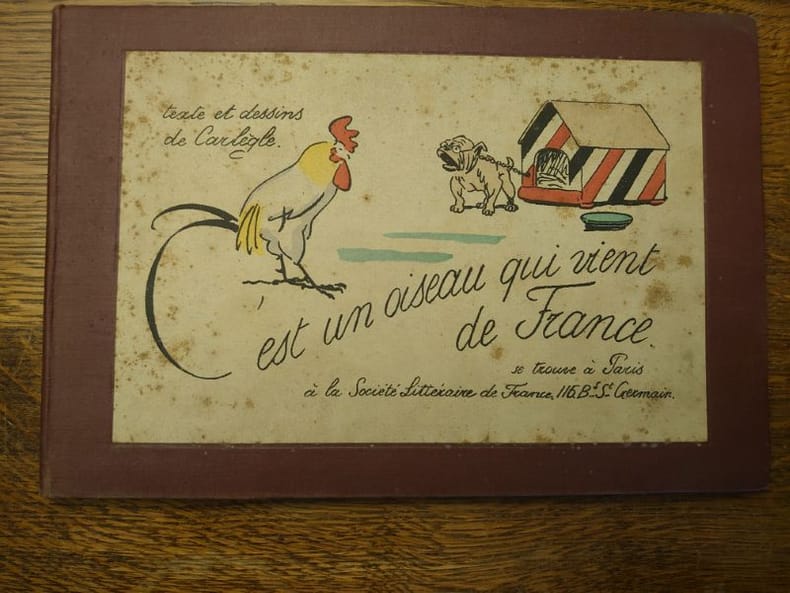
7247Paris, Durand, 1916. 28 x 19 cm, (4), 56, (1) pp. Relié cartonnage d'éditeur. Petit in-8 oblong, toile bordeaux éditeur, vignette contrecollée illustrée en couleurs d'un coq qui nargue un dogue allemand attaché à sa niche. Album à colorier accompagné d'une histoire patriotique inventée et dessinée par l'illustrateur Carlègle. Reliure légèrement usée, des rousseurs sur l'étiquette de titre sinon bel exemplaire à l'intérieur très frais.
191354503Lucien Vogel éditeur | Paris Février 1913 | 19 x 24.50 cm | une feuille
191389412Lucien Vogel éditeur | Paris Février 1913 | 19 x 24.50 cm | une feuille
191454616Lucien Vogel éditeur | Paris Janvier 1914 | 19 x 24.50 cm | une feuille
191484681Lucien Vogel éditeur | Paris Janvier 1914 | 19 x 24.50 cm | une feuille
191489465Paris Janvier 1914 | 19 x 24.50 cm | une feuille
192918964BABOU 1929 1 65 bois originaux de CARLEGLE. Paris, Henry Babou Editeur, 1929, in-4, broché, couverture rose rempliée, sous chemise demi-toile Parme et étui marbrés, 188 pages.
17961Paris, Henri Babou, 1929. In-8, 186 pp., broché, couverture originale imprimée, chemise et étui cartonnés (étui cassé, dos de la chemise insolé).
1945214731945 Grenoble, Marcel Besson, imp. Générale, 1945. Grand in-4°, non paginé,broché,20 planches couleurs de Gus Bofa, Lucien Boucher, Brunelleshi, Pierre Brissaud, Carlégle, Chimot, Hermine David, Dignimont, Dubout, Dunoyer de Segonzac, Pierre Falké, Joseph Hémard, Chas Laborde, Laboureur, Mariette Lydis, Berthold Mahn, Charles Martin, André Marty, Syvain Sauvage, Jacques Touchet. Présentation de Raymond Escholier. Edition originale tirée à 750 exemplaires numérotés sur vélin blanc N°663.
M16542P , Mornay , 1935 , in8 1/2 chagrin rouge , dos lisse , couvertures conservées , 229 pp . Edition numérotée . L ' un des exemplaires sur Rives .