325 résultats
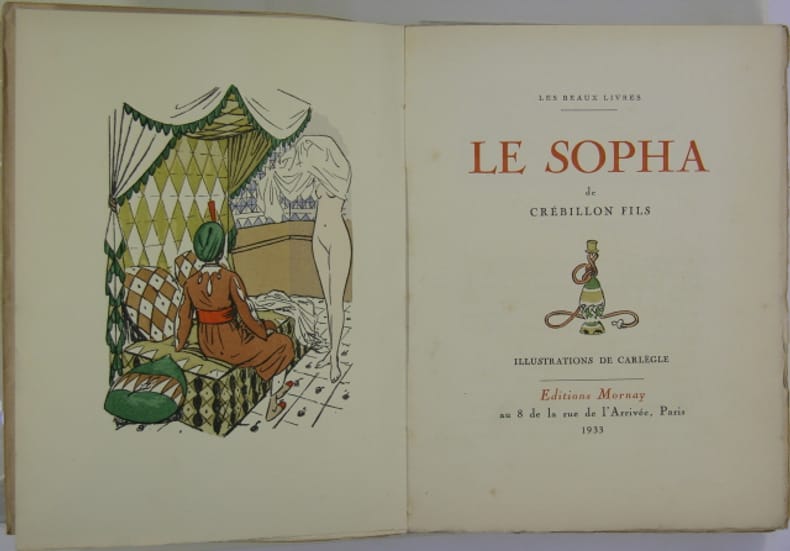
1931YMX-2081Editions Mornay 1931,25ème livre de la "Collection originale".Illustrations de Carlègle.Une plaquette in 8° carrée,brochée.Tirée à 555 exemplaires,1/450 (375) sur Hollande B.F.K. (ben)
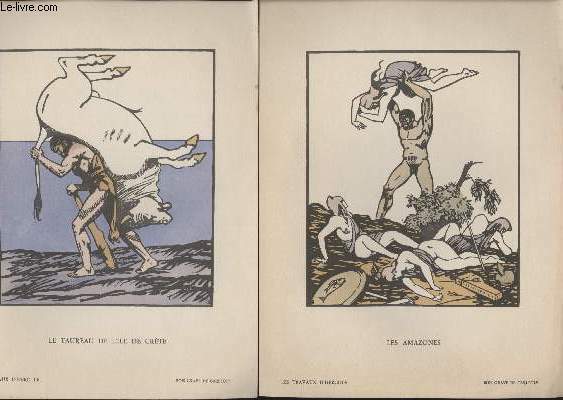
15530Bound with orig. frontwrapper in cont. hcalf. No 948 of 928 ""sur papier de Rives"", a total of 1065. Fine colourplates by Carlègle.
15530Bound with orig. frontwrapper in cont. hcalf. No 948 of 928 "sur papier de Rives" a total of 1065. Fine colourplates by Carlègle. unknown
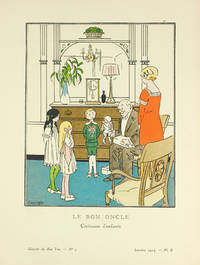
191289478Paris 1912. Fine. Paris 1912-1913 19 x 24.50 cm une feuille Original colour print printed on laid paper and signed in the plate lower right. Original engraving produced for the illustration of La Gazette du Bon Ton one of the most beautiful and influential fashion journals of the 20th century celebrating the talent of French designers and artists at the height of the Art Deco era. A celebrated fashion magazine established in 1912 by Lucien Vogel La Gazette du bon ton appeared until 1925 with a hiatus from 1915 to 1920 due to the war the editor-in-chief having been called up for service. It consisted of 69 issues printed in only 2000 copies each and notably illustrated with 573 color plates and 148 sketches of the models of the great designers. Right from the start this sumptuous publication “was aimed at bibliophiles and fashionable society” Françoise Tétart-Vittu “La Gazette du bon ton” in Dictionnaire de la mode 2016 and was printed on fine vergé paper using a type cut specially for the magazine by Georges Peignot known as Cochin later used in 1946 by Christian Dior. The prints were made using stencils heightened in colors some highlighted in gold or palladium. The story began in 1912 when Lucien Vogel a man of the world involved in fashion he had already been part of the fashion magazine Femina decided with his wife Cosette de Brunhoff – the sister of Jean creator of Babar – to set up the Gazette du bon ton subtitled at the time: “Art fashion frivolities.”  Georges Charensol noted the reasoning of the editor-in-chief: “’In 1910’ he observed ‘there was no really artistic fashion magazine nothing representative of the spirit of the time. My dream was therefore to make a luxury magazine with truly modern artists…I was assured of success because when it comes to fashion no country on earth can compete with France.’” “Un grand éditeur d’art. Lucien Vogel” in Les Nouvelles littéraires no. 133 May 1925. The magazine was immediately successful not only in France but also in the United States and Latin America. At first Vogel put together a team of seven artists: André-Édouard Marty and Pierre Brissaud followed by Georges Lepape and Dammicourt as well as eventually his friends from school and the School of Fine Arts like George Barbier Bernard Boutet de Monvel and Charles Martin. Other talented people soon came flocking to join the team: Guy Arnoux Léon Bakst Benito Boutet de Monvel Umberto Brunelleschi Chas Laborde Jean-Gabriel Domergue Raoul Dufy Édouard Halouze Alexandre Iacovleff Jean Émile Laboureur Charles Loupot Chalres Martin Maggie Salcedo. These artist mostly unknown when Lucien Vogel sought them out later became emblematic and sought-after artistic figures. It was also they who worked on the advertising drawings for the Gazette. The plates put the spotlight on and celebrate dresses by seven designers of the age: Lanvin Doeuillet Paquin Poiret Worth Vionnet and Doucet. The designers provided exclusive models for each issue. Nonetheless some of the illustrations are not based on real models but simply on the illustrator’s conception of the fashion of the day.   The Gazette du bon ton was an important step in the history of fashion. Combining aesthetic demands with the physical whole it brought together – for the first time – the great talents of the artistic literary and fashion worlds; and imposed through this alchemy a completely new image of women: slender independent and daring which was shared by the new generation of designers including Coco Chanel Jean Patou Marcel Rochas and so on… Taken over in 1920 by Condé Montrose Nast the Gazette du bon ton was an important influence on the new layout and aesthetics of that “little dying paper” that Nast had bought a few years earlier: Vogue. unknown
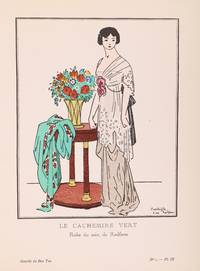
191254480Paris: Lucien Vogel éditeur 1912. Fine. Lucien Vogel éditeur Paris 1912-1913 19 x 24.50 cm une feuille Original color print printed on vergé paper signed in the plate. An original print used to illustrate the Gazette du bon ton one of the most attractive and influential 20th century fashion magazines featuring the talents of French artists and other contributors from the burgeoning Art Deco movement. A celebrated fashion magazine established in 1912 by Lucien Vogel La Gazette du bon ton appeared until 1925 with a hiatus from 1915 to 1920 due to the war the editor-in-chief having been called up for service. It consisted of 69 issues printed in only 2000 copies each and notably illustrated with 573 color plates and 148 sketches of the models of the great designers. Right from the start this sumptuous publication was aimed at bibliophiles and fashionable society Françoise Tétart-Vittu La Gazette du bon ton in Dictionnaire de la mode 2016 and was printed on fine vergé paper using a type cut specially for the magazine by Georges Peignot known as Cochin later used in 1946 by Christian Dior. The prints were made using stencils heightened in colors some highlighted in gold or palladium. The story began in 1912 when Lucien Vogel a man of the world involved in fashion he had already been part of the fashion magazine Femina decided with his wife Cosette de Brunhoff the sister of Jean creator of Babar to set up the Gazette du bon ton subtitled at the time: Art fashion frivolities. Georges Charensol noted the reasoning of the editor-in-chief: 'In 1910' he observed there was no really artistic fashion magazine nothing representative of the spirit of the time. My dream was therefore to make a luxury magazine with truly modern artists I was assured of success because when it comes to fashion no country on earth can compete with France.' Un grand éditeur d'art. Lucien Vogel in Les Nouvelles littéraires no. 133 May 1925. The magazine was immediately successful not only in France but also in the United States and Latin America. At first Vogel put together a team of seven artists: André-Édouard Marty and Pierre Brissaud followed by Georges Lepape and Dammicourt as well as eventually his friends from school and the School of Fine Arts like George Barbier Bernard Boutet de Monvel and Charles Martin. Other talented people soon came flocking to join the team: Guy Arnoux Léon Bakst Benito Boutet de Monvel Umberto Brunelleschi Chas Laborde Jean-Gabriel Domergue Raoul Dufy Édouard Halouze Alexandre Iacovleff Jean Émile Laboureur Charles Loupot Chalres Martin Maggie Salcedo. These artist mostly unknown when Lucien Vogel sought them out later became emblematic and sought-after artistic figures. It was also they who worked on the advertising drawings for the Gazette. The plates put the spotlight on and celebrate dresses by seven designers of the age: Lanvin Doeuillet Paquin Poiret Worth Vionnet and Doucet. The designers provided exclusive models for each issue. Nonetheless some of the illustrations are not based on real models but simply on the illustrator's conception of the fashion of the day. The Gazette du bon ton was an important step in the history of fashion. Combining aesthetic demands with the physical whole it brought together for the first time the great talents of the artistic literary and fashion worlds; and imposed through this alchemy a completely new image of women: slender independent and daring which was shared by the new generation of designers including Coco Chanel Jean Patou Marcel Rochas and so on Taken over in 1920 by Condé Montrose Nast the Gazette du bon ton was an important influence on the new layout and aesthetics of that little dying paper that Nast had bought a few years earlier: Vogue. Lucien Vogel éditeur unknown
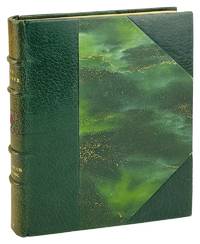
192931574Paris: Editions Mornay 1929. Very Good. Paris: Éditions Mornay 1929. First Thus Limited to 1000 copies of which this is no. 639. Small quarto; mid-century three-quarter forest green crushed morocco over marbled boards gilt spine in five compartments top edge gilt marbled endpapers original wrappers bound in; 291pp.; color frontispiece illus. throughout. Spine leather sunned to brown attractive bookseller ticket of the Montreal-based Librairie Deom to front pastedown else a Very Good to Near Fine example. Editions Mornay unknown
19141260651914. Paris: Lucien Vogel 1914. <br /> <br /> Single plate.<br /> <br /> § From a spectacularly illustrated fashion magazine of the early 1900s depicting the cutting edge of style at the time. unknown
193022252MORNAY 1930 1 Illustré par CARLEGLE. Paris., Mornay, 1930, in-8, broché, couverture illustrée en couleur rempliée, 243 pages.
6094nouvelle série,année 1909 du n° 309 du 2 janvier au n° 360 du 25 décembre,en un volume demi-cuir rouge,titre et filets dorés dessins de Carlègle,Préjelan, Goussé, A Guillaume … en noir et en couleurs, texte sur une ou deux colonnes, légères traces de pliure transversale,petits défauts, réparés, à la reliure, bon état d’ensemble
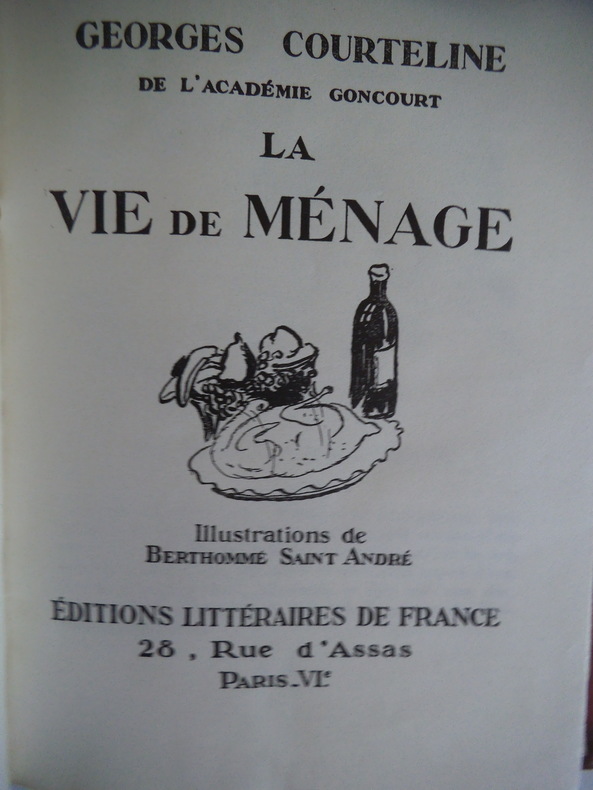
12097COURTELINE Georges. Œuvres. 10 volumes petit in 8 carré demi chagrin rouge dos lisse, titre et fers dorés. Faux-titre, titre avec vignette, couverture illustrée conservée. 1) BOUBOUROCHE suivi de la philosophie de Courteline, 318 pages, non rogné, illustrations dans le texte de Pierre FALKE éditions littéraires de France sans date.2 ) Le train de 8H47suivi de la vie de caserne 242 pages pagination continue, non rogné, illustrations dans le texte de Lucien BOUCHER éditions littéraires de France sans date.3) Les gaités de l’escadron et autres contes. 286 pages, non rogné, illustrations dans le texte et pleine page de Lucien BOUCHER éditions littéraires de France sans date, 4) Les Linottes e, 244 pages, non rogné, illustrations dans le texte et hors-texte (couleurs) de CARLEGLE éditions littéraires de France sans date,. 5)Ah ! Jeunesse et autres 318 pages, non rogné, illustrations dans et hors-texte (couleurs) de WANNER éditions littéraires de France sans date.6) Les femmes d’amis pages, non rogné, illustrations dans et hors-texte (couleurs) de ZIG BRUNNER éditions littéraires de France sans date,. 7) La vie de ménage , 252 pages, non rogné, illustrations dans et hors-texte (couleurs) de BERTHOMME SAINT ANDRE éditions littéraires de France sans date. 8) La conversion d’Alceste 270 pages, non rogné, illustrations dans et hors-texte (couleurs) de Maurice VAN MOPPES éditions littéraires de France sans date. 9) Messieurs les ronds de cuir 240 pages, non rogné, illustrations dans et hors-texte (couleurs) de André GALLAND éditions littéraires de France sans date,10) Un client sérieux 246 pages, non rogné, illustrations dans et hors-texte (couleurs) de CH. A EDELMAN éditions littéraires de France sans date.
c2409Paris,Henri Babou,éditeur,1929 ;petit in-4°,broché,couverture rempliée vieux rose imprimée en noir et rouge,chemise et étui cartonnés,dos de la chemise de toile mauve avec titre en jaune ; 186pp.,2pp.nch.,1f.nch.;chemise et étui passés,ouvrage en très bon état.
42090Paris, Mornay (coll. "Les beaux livres"), 1930. In-8°, 240p. Broché, couverture illustrée rempliée.
EXE0052aParis, Librairie Molière, [1910] ; in-8° oblong, cartonnage illustré de l’édition. Edition originale illustrée par Carlègle. Couverture et nombreux dessins en couleurs.
EXE0052eParis, Pichon, 1922 ; in-4° broché. Bois gravés de Carlègle. Tiré à 870 exemplaires, celui-ci sur vélin d’Arches.
EXE00a79Paris, Mornay, 1926 ; in-8° broché, couverture illustrée rempliée. 66 compositions coloriées au pochoir. Tiré à 507 exemplaires numérotés ; celui-ci sur hollande Van Gelder.
19253773A Paris, Chez l’impr. Léon Pichon, 1925. 1 vol. broché in-4 de 199-[6] pages, couverture blanche à rabats. Traces de plis au dos, pour le reste en belle condition.
12021Editions Mornay, Paris, 1933. In/8 broché, couverture rempliée illustrée d’une vignette, illustrations de Carlègle : 30 compositions originales en couleur, dont un frontispice, une en-tête, 27 in-texte et un cul de lampe, 326 pages. Dos insolé avec léger manque en coiffe supérieur. Monod 3303. Exemplaire numéroté sur papier de Rives
12021Editions Mornay Paris 1933. In/8 broché couverture rempliée illustrée dune vignette illustrations de Carlègle : 30 compositions originales en couleur dont un frontispice une en-tête 27 in-texte et un cul de lampe 326 pages. Dos insolé avec léger manque en coiffe supérieur. Monod 3303. Exemplaire numéroté sur papier de Rives unknown
R100004105NON PRECISE. Non daté. In-12. Broché. Bon état, Couv. convenable, Dos satisfaisant, Intérieur frais. 1 lot de 6 gravures sur bois en couleurs de 23,5 x 31 cm.. . . . Classification : 800-Gravures XX
1932LIQ-5678P. Georges Briffaut, Le Livre du Bibliophile 1932. In-8° broché, couverture rempliée.
1916130361Se trouve à Paris Se trouve à Paris, à la Société Littéraire de France, 1916. In-8 oblong, relié pleine toile prune, vignette illustrée en couleurs contrecollée sur le plat. 56 pages. Texte et dessins de Carlegle. Avis aux jeunes coloristes : Le papier sur lequel cet album est imprimé supporte les couleurs à l'aquarelle. Il est recommandé aux jeunes amateurs qui voudraient s'amuser à colorier ce livre, de n'employer que des teintes franches et vives ainsi qu'on l'a fait pour le dessin de la couverture. Non colorié, Très bon état.
70296Georges Briffaut, Le Livre Du Bibliophile Paris 1932 In-8 ( 245 X 165 mm ) de 253 pages, demi-chagrin acajou à coins, dos à nerfs janséniste, tête dorée, couvertures conservées. Edition conforme aux textes originaux établie par Louis Perceau et ornée d'illustrations en couleurs par Carlègle. 1 des 1200 exemplaires numérotés sur vélin ( N°895 ). Quelques rousseurs marginales sinon bel exemplaire agréablement relié.
ORD-6581Suivi de la fin de Psyché par Claude FARRERE. Illustrations de CARLEGLE. Paris. Mornay. 1935. In-8 (155 x 204mm) broché, couverture à rabats illustrée couleurs, 230 pages, frontispice et nombreuses illustrations couleurs dans le texte. Bel exemplaire, n°663/1635 vélin de Rives à la forme.
22770Paris Librairie des Amateurs. A. Ferroud- F. Ferroud 1936 in 8 (20x13) 1 volume reliure demi peau écaille zébrée (gros reptile ou saurien), dos lisse, pièce de titre de cuir vert, couverture conservée, 90 pages [2], avec de nombreuses illustrations en couleurs de Carlègle. Tirage limité à 1500 exemplaires numérotés, celui-ci un des 1200 exemplaires numérotés sur velin teinté. Petit cachet ex-libris ancien. Bel exemplaire, bien relié ( Photographies sur demande / We can send pictures of this book on simple request )
46742Paris Chez l'imprimeur Léon Pichon 1941 in 8 (26x18) 1 volume broché, couverture rempliée, 52 pages [2], avec 3 illustrations gravées sur bois par Carlègle, dont un frontispice hors-texte. Tirage limité à 390 exemplaires numerotés, celui-ci un des 15 exemplaires numérotés sur japon à la forme, avec une double suite d'épreuves des gravures sur japon à la forme et sur chine. Cet exemplaire renferme un état des illustration dans l'ouvrage, et une double suite d'épreuves des 2 gravures in texte sur japon à la forme et sur chine, et une épreuve du frontispice sur japon à la forme. Bel exemplaire ( Photographies sur demande / We can send pictures of this book on simple request )