10 867 résultats
4to. 244 (instead of 248) partly numbered engraved plates. Slightly later full calf with giltstamped red title label to sparsely gilt spine. Very rare edition of "one of the most splendidly illustrated devotional books of the period" (Jantz), containing only the engraved plates and neither the text nor the music. The "Geistreiche Gesänge und Lieder auf alle Sonntags-Evangelien und Episteln so in dem Christlichen Jahre enthalten seyn [...]" were first issued in 1725-26, which saw a reissue under the title "Das Christliche Jahr" in 1735. This title is stamped on the spine label of this copy, suggesting that the present copy is of this latter edition. The plates "represent scenes from biblical history and the lives of the saints [...] exhibit[ing] a high point of Baroque illustration" (Faber du Faur) and are mostly presented within ornamental frames decorated by emblematic vignettes. - Wants title-page. Later handwritten bibliographical note in ink to flyleaf. Hinges a little worn, small flaw at the top margin of the plate showing St. Theresa (not touching image), but otherwise very well preserved. From the library of the Viennese collector Werner Habel, with his ownership stamp to flyleaf. Faber du Faur 1146. Jantz 2379. Bäumker III, 56, 138. Wolffheim 2202. Seebass 301. Nagler XIII, 36 and IX, 418.
In-4° oblungo; frontespizio inciso e 50 tavole incise all’acquaforte da Pinelli (1781-1835), raffiguranti scene di costume ambientate nella campagna romana; i personaggi sono dediti a giochi, lavori, attività varie della vita quotidiana, anche a Roma e nel regno di Napoli; le ambientazioni sono in Ciociaria, Cerbara, Tivoli, Albano, Fracati, Pietra Terrazzana, Roma. L’indicazione di responsabilità presente su quasi tutti i rami è “Pinelli Fece 1815 Roma”. Buona copia.
052871Paris H. Floury, Libraire-Editeur 1906 in 4 (26,5x21) 1 fort volume reliure à la bradel toilée saumon, couverture conservée. Notre exemplaire est bien complet des 5 eaux-fortes originales: Pierre Auguste Renoir (1°/ Femme nue assise, et 2°/ Femme nue couchée, Delteil 12 & 14); Camille Pissaro (Les faneuses, Delteil 94,XII), Paul Cézanne (Portrait de Guillaumin au pendu; Venturi, 1159) and Armand Guillaumin (Vue près de Saadam). (27 plates including 5 original etchings by: Cézanne, Guillaumin, Pissaro, Renoir (2)). Première édition (First edition). Bel exemplaire ( Photographies sur demande / We can send pictures of this book on simple request )
15499472Cologne, Mart. Gymnicus, 1549 ; in-8 ; plein vélin estampé sur ais de bois, dos à trois gros nerfs, fermoirs de cuivre (reliure de l'époque) ; (16) y compris le titre, 632, [634], (76) pp. index, (1) f. blanc (*, AZ, Aa-Xx - 8, Yy - 4).
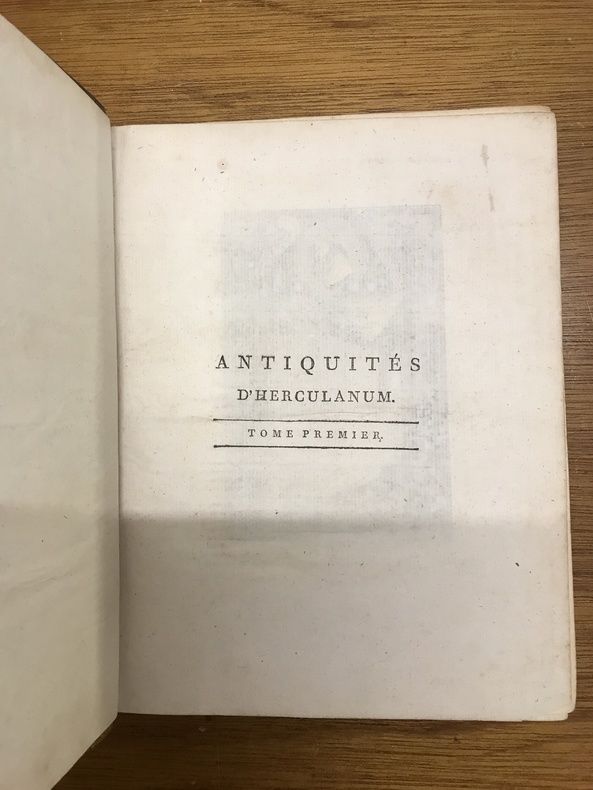
His3966MChez l'auteur, F.A. David, À Paris, 1780. Édition originale de ce superbe travail de compilation des gravures de F.A. David représentant la somme des découvertes du site d'Herculanum, alors fraîchement excavé. 9 volumes petit in-4, reliure veau brun, pièce de titre maroquin grenat, pièce de tomaison maroquin vert anglais, dos lisse, titrage et fleurons ornés, plats encadrés de filet dorés.reliures très clairement usées, mais état intérieur superbe. Tome I : 168 pages - 134 figures. Tome II : 215 pages - 141 figures. Tome III : 204 pages - 130 figures. Tome IV : 119 pages - 130 illustrations. Tome V : 100 pages - 181 figures. Tome VI : 96 pages - 144 figures. Tome VII : 104 pages - 163 figures. Tome VIII :50 pages - 70 figures. Tome IX : 108 pages - 129 figures. Reliures encore solides malgré une esthétique usée. Dos et plats frottés et accrochés par endroits. À rafraîchir. Intérieur des 9 volumes d'une fraîcheur irréprochable. COMPLETS. Tranches très bonnes. Chez l'auteur, F.A. David, À Paris, 1780. Original publication of this wonderful compilation of plates by F.A. David representing every aspect of what archeologists found and excavated on the freshly discovered, at this date, site of Herculanum. 9 volumes in small in-4, original binding in full, blond calf, red title piece, green volume piece. Vol I : 168 pages - 134 plates. Vol II : 215 pages - 141 plates. Vol III : 204 pages - 130 plates. Vol IV : 119 pages - 130 plates. Vol V : 100 pages - 181 plates. Vol VI : 96 pages - 144 plates. Vol VII : 104 pages - 163 plates. Vol VIII : 50 pages - 70 plates. Vol IX : 108 pages - 129 plates. Binding showing signs of wear but text and plates perfect condition. Binding could be restored.
5539Coupée au trait carré; taches, déchirure sans manque, contre-collée. Magnifique estampe érotique , extrêmement rare. Bartsch tome XIV, n° 338. L'Art érotique sous la Renaissance tome &, p. 103 et reproduction sur la jaquette. moyen XVIè siècle 280 x 200; 420 x 335 avec cadre.
Xilografia a 3 colori dalla cartella ''Lacrimose'' (3 legni). Questo esemplare p.d.a. presenta solo la stampa di 2 delle 3 lastre (quella centrale e quella sinistra, n. 97, pag. 115 del Catalogo dell'opera grafica di Enzo Di Martino) Firma e data a matita. Stampatore: Giorgio Upiglio, Grafica Uno, Milano. Stampa su carta Hahnemuhle. Timbri a secco dello stampatore e dell'Artista. Esemplare p.d.a.. cm 78x159,3 (Foglio cm 79x170). . . Perfetto (Mint). . Tiratura 42 esemplari. .
19741054791974 Paris, Collectif Edité par Les Ateliers de réalisations graphiques, 1974, un volumes 210x295mm , 232 pages en feuilles non paginées, sous couverture souple à rabat, un portfolio au même format contenant les œuvres, l’ensemble dans un coffret toilé noir, un relief en plomb de Noblet inséré sur la partie supérieure.
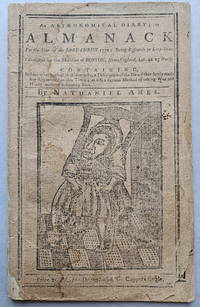
17713835<p>Three engravings by Paul Revere are certainly the most distinctive feature of this Boston almanac for 1772 namely:</p><p>Miss Emma Leach a dwarf born in Beverley Massachusetts on front cover.</p><p>The Patriotic American Farmer John Dickinson.</p><p>Mrs. Catharine M'Caulay.</p><p>Almanac making in colonial America was a rather unscrupulous affair at times. The notion of copyright was unknown among publishers. Indeed almanac piracy or perhaps liberal borrowing was the accepted industry practice.</p><p>The present almanac offers an excellent example of heavy borrowing. The Boston Ames <em>Almanack </em>for 1772 was published in two versions: one by Ezekiel Russell and the other a pirated version by an unnamed printer/publisher. The text and images of the two are very similar although the cuts of the three subjects differ very slightly between the two almanacs. Paul Revere's daybook for December 1771 identifies <strong>two</strong> purchasers of plates for a 1772 Ames almanac Ezekiel Russell and Edes & Gill. Within a matter of a week it's apparent that Revere produced two sets of plates of the same subjects for competing almanacs.</p><p>In an advertisement for Russell's version of the Ames almanac he "hopes that the publick with their usual impartiality will give him preference in buying of his Ames' genuine almanac before any pirated edition." Revere's contributions were in both the original and this pirated edition of the almanac.</p><p><strong>References: </strong> Evans: 11961; Drake <em>Almanacs of the U.S</em>.: 3205; Brigham <em>Paul Revere's Engravings</em>: pp. 202-203; Hamilton <em>Early American Book Illustrators and Wood Engravers</em>: 56; O'Neal <em>Early American Almanacs</em>: 115 mistakenly citing Russell as publisher.</p><p><strong>Condition:</strong> Disbound; leaves are separated with a later paper reinforcement in the gutter of two leaves. Chipping to lower corners of two leaves. Scattered mostly light staining and a few spots of foxing. Good.</p><p>ICN 7815.</p> [Printed by T. & J. Fleet and Edes & Gill. Price 2s. 8d. per dozen, and six coppers single. ]
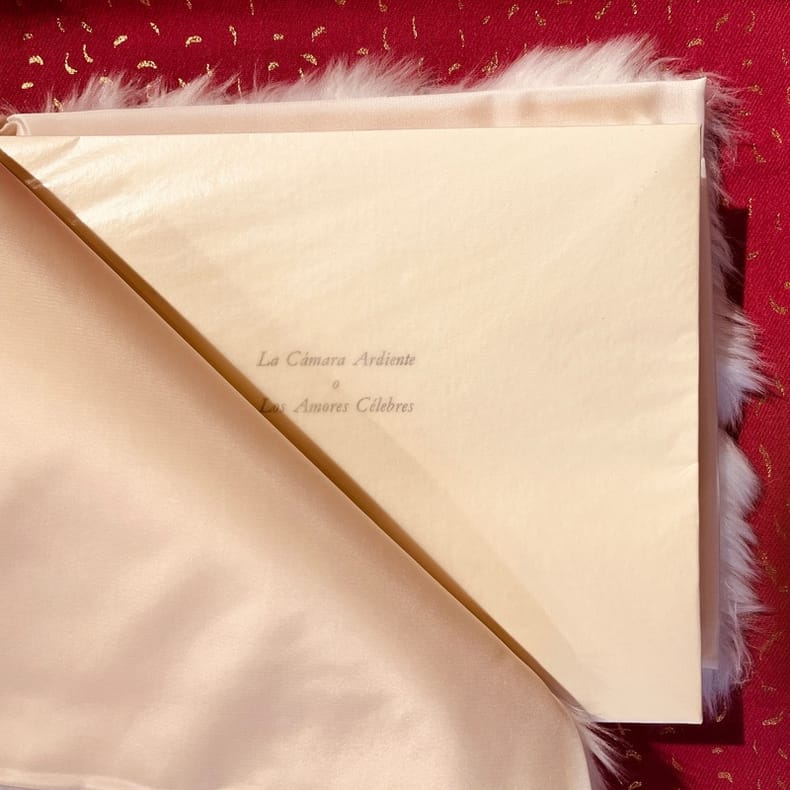
197720185Barcelone, Editorial Gustavo Gili, 1977. Grand in-8 oblong, en feuilles sous couverture rempliée, couverture en fourrure blanche, sous emboîtage en Plexiglas.
- s.d. (1924), 93x78mm, autre. - Tehura. Original proof engraved after the painting "Merahi Metua no Tehamana". Intermediate state for Noa Noa [between 1904 & 1924] | 9,3 x 7,8 cm | one sheet Original proof, likely unique, of this intermediate state of "Tehura", wood drawn and engraved after Paul Gaughin's painting "Merahi Metua no Tehamana" by George-Daniel de Monfreid. Print on fine cream laid paper, annotation by the artist in the left-hand margin. The definitive wood served as the head of chapter VI, "Le Conteur parle", page 81 of the true first edition of Noa Noa published by Crès in 1924, the first illustrated work from Paul Gauguin and a majestic tribute to one of the precursors of modern art. A most important and very first woodcut of Gauguin's masterpiece, engraved by his closest friend and executor, artist George-Daniel de Monfreid, to whom Gauguin offered the painting after two unsuccessful exhibitions. Likely unique proof, part of 17 known test prints from the project to publish prematurely Noa Noa, all made on various fine papers and annotated by the artist. Precious woodcut after Gauguin's masterpiece Merahi metua no Tehamana, showing the painter's wife, his main tahitian model. It is from the original illustrated manuscript of Noa Noa, brought back from Tahiti by Segalen on the artist's death in 1903, that Monfreid began producing this fundamental work from as early as 1904. This is the second version of this "to read and look at" notebook. The first manuscript, written on the return of his first voyage and entrusted by Gauguin to Charles Morice in 1893, responded to a different project. Gauguin had composed only the text, interspersed with blank pages for Morice's poems. But after several years without news, Morice preferred to publish a version entirely rewritten by himself in 1901. Gauguin, therefore, copied his manuscript and illustrated it during his second stay in Polynesia, with sketches, watercolors and collages. This album, that the artist enriched and safely preserved until his death, is preserved today at the Musée d'Orsay. It is, therefore, from this manuscript, the only one illustrated, that Monfreid composed the edition of Gauguin's Noa Noa. However, although Monfreid's publication was forward, it took more than twenty years to complete, in part due to a copyright dispute with Charles Morice who wanted to be co-author of the forthcoming edition and whose poems would eventually be preserved. The result of several years of reflection and work, the 1924 edition is both faithful to the watercolors and woodcut engravings illustrating the precious manuscript, and to the whole of Gauguin's Tahitian work, who died in indifference. Monfreid thus engraves several drawings from the original notebook and enriches it with woodcuts made from other works of which he is the custodian. Some of these compositions combine several paintings, while scrupulously respecting the artist's line, transforming the work into a true journey through the painter's works. The very choice of using wood engraving is a tribute to this technique prized by Gauguin, who, in Pont-Aven, produced 10 woodcuts to illustrate his manuscript between his two Polynesian stays. The intermediate woodcuts, until then unknown, testify to the slow work of composition to restore the artistic richness of Gauguin's work by his most faithful artistic companion and first champion: "When I saw Gauguin for the first time, I was greatly disconcerted by the details of art that radiated from his works as well as from the conversations of this extraordinary man... You immediately felt that he was the Master" (in L'Hermitage, 1903). [FRENCH VERSION FOLLOWS] Epreuve originale probablement unique de cet état intermédiaire de "Tehura", bois dessiné et gravé d'après le tableau Merahi metua no tehamana de Paul Gauguin par Georges-Daniel de Monfreid. Tirage sur vergé crème fin, annotation de l'artiste au crayon en marge gauche. Le bois définitif servira
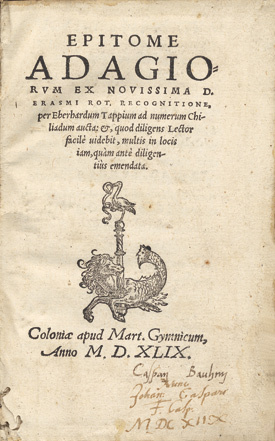
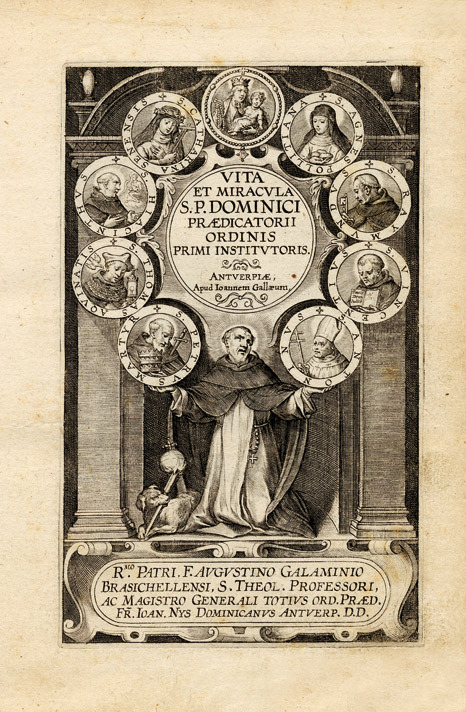
163011321Antverpiae, Joan Galle, (circa 1630) ; F. Ioannes Nys invenit, Peter de Jode figuravit, Theodor Galle sculpsit et excudit ; titre gravé, portrait et 32 planches légendées. SUIVI de 4 planches gravées par JOAN GALLE : I- Prudentia, II- Justitia, III- Fortitudo, IV- Temperantia (les 4 vertus cardinales). SUIVI de 14 planches de sujets religieux, gravées par CORNELIUS GALLE le Vieux : Silva sacra, Fugit familia sacra, S. Barbara, S. Ianvarius Neapolis patronis, S. Lucia, S. Leontius martyr miraculis gloriossus in Muris Helvetiorum, S. Iacobus Maior, Benedicite omnes bestiae et pecora domino, S. Hieromymus, Vierge à l'Enfant, etc. Soit en tout 52 planches, reliées en 1 volume petit in-4 ; plein vélin ivoire, titre au dos, tranches rouges (reliure du XIXe).
5124Filigrane : écusson avec ailes déployées. D’après Théodore Bern. Belles épreuves avec de bonnes marges. Inconnu à Bartsch, et à Leblanc. Cadres et passe-partout modernes.Tout début 17è siècle. 17,2 x 22,4 cm. 28 x 33 cm avec le cadre. Très bon Tout début 17è siècle. 17,2 x 22,4 cm. 28 x 33 cm avec le cadre.
1691D4443Amsterdam: Carel Allard 1691. Hardcover. Very Good. Oblong broadsheets 295 x 380. Lacking title-page and without the 22 pp. accompanying text. 20 large unnumbered engraved plates one with 4 separate scenes etched plates by HUGO ALLARD 4 signed I. VANDEN AVELE 2 signed and JAN LUYKENone signedone with 2-inch tear repaired some minor marginal wear. Original marbled wrappers old paper cover label; cloth folding case. VERY RARE print series illustrating the history of the ascension to the throne of WILLIAM III 1650-1702 and MARY II 1662-1694. The series begins with the Seven Bishops being brought to the Tower of London with a view up the Thames followed by the birth of the Prince of Wales on 10 June 1688 through the entrance of William and Mary into The Hague on 5 February 1691. The series contains several scenes devoted to the festivities surrounding their coronation in London on 11 April 1689. This set of the engravings correspond to Landwehr and appear to have been issued in its original binding without the text; the title-page may have been removed or was not included. Muller considered the 20 plates as a series although he had not seen a bound set with title and the text. Landwehr Splendid Ceremonies 143; Muller 2692. <br/><br/> Carel Allard hardcover
1691D4443Amsterdam: Carel Allard 1691. Hardcover. Very Good. Oblong broadsheets 295 x 380. Lacking title-page and without the 22 pp. accompanying text. 20 large unnumbered engraved plates one with 4 separate scenes etched plates by HUGO ALLARD 4 signed I. VANDEN AVELE 2 signed and JAN LUYKENone signedone with 2-inch tear repaired some minor marginal wear. Original marbled wrappers old paper cover label; cloth folding case. VERY RARE print series illustrating the history of the ascension to the throne of WILLIAM III 1650-1702 and MARY II 1662-1694. The series begins with the Seven Bishops being brought to the Tower of London with a view up the Thames followed by the birth of the Prince of Wales on 10 June 1688 through the entrance of William and Mary into The Hague on 5 February 1691. The series contains several scenes devoted to the festivities surrounding their coronation in London on 11 April 1689. This set of the engravings correspond to Landwehr and appear to have been issued in its original binding without the text; the title-page may have been removed or was not included. Muller considered the 20 plates as a series although he had not seen a bound set with title and the text. Landwehr Splendid Ceremonies 143; Muller 2692. <br/><br/> Carel Allard hardcover books
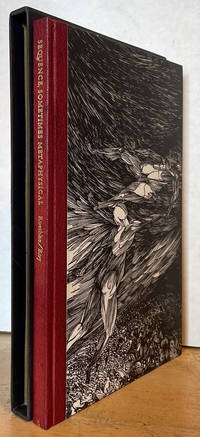
196333200Iowa City: Stone Wall Press 1963 Limited Edition in slipcase beautifully printed on Rives Heavy with interleaved illustrations on Mulberry paper one of 60 deluxe copies of a total print run of 330 bound in quarter leather and illustrated boards signed by both Roethke and engraver Roy this copy number X one tiny nick to leather at spine tail a beautiful copy of this justly-celebrated production printed by Kim Merker at the Stone Wall Press; from collection of Jenijoy La Belle who studied with Roethke at the University of Washington along with her close friend Tess Gallagher and the author of the influential book The Echoing Wood of Theodore Roethke; tall 8vo; 31 unnumbered pages and 12 engravings each on folded leaf; additional unnumbered engravings preceding title page & colophon. Signed by Author. First Edition. Hard Cover. Fine. Stone Wall Press hardcover
1963307320Iowa City: Stone Wall Press 1963. First Edition. Leather bound. Fine. A beautiful collection of poems printed by Kim Merker with illustrations printed on delicate mulberry paper bound in between. This book is generally regarded as one of the finest from the press which is known for the excellence of its letterpress printing and book design.<br /> <br /> The edition size was 270 copies of which this is one of 60 deluxe copies bound in quarter-leather and paper printed with an engraved design by Roy. These copies numbered with Roman numerals are signed by both Roy and Roethke who died soon after the printing was completed. Roethke won both the Pulitzer Prize and the National Book Award for poetry. First edition first printing deluxe issue. A fine copy no. XXX of 60 signed by Roethke and Roy. The publisher's paper-covered slipcase is beginning to split along the bottom edge. Stone Wall Press unknown
181544787S.l.n.d., , (1815 circa). Leporello in-8 (90 x 201 mm), reliure-portefeuille à soufflet de cuir de Russie rouge et vert, roulette, filet et frise dorés d'encadrement sur les plats, dos muet orné de filets dorés (reliure de l'époque).
183044487, , 1830 ca. 20 planches entoilées et assemblées mesurant 7,3 x 30 (à 33) cm chacune, veau blond, titre frappé sur le premier plat (reliure du XIXe siècle).
Kl.-Folio (280:220 mm). Album mit zus. 32 Zeichnungen auf 27 Bll. Die Zeichnungen im Postkartenformat (90:120 mm) teilweise in Blei aquarelliert und teilweise mit Tusche laviert, mit Motiven meist aus den Niederlanden, Flandern und Frankreich, zumeist monogr. "ES", jeweils flächig montiert und mit Goldlinien gerahmt. Lederband der Zeit mit goldgepr. Deckeltitel "Reise Erinnerungen 1887", gepr. Rücken und dreiseitigem Goldschnitt; Vorsatzpapiere aus goldbedrucktem Karton mit feinem ornamentalen Muster. 1 Messingschließe. Die Zeichnungen, ausgeführt von einem geübten Zeichner und jeweils beschriftet und datiert, dokumentieren die Stationen einer Reise: Nijmegen, Kampen, Enkhuizen, Ursem bei Alkmaar, Rotterdam, Utrecht, Antwerpen, Brügge, Brüssel, Mecheln, Tournai, Laon, Soissons, Paris, Rouen, Versailles, Chinon, Fontainebleau, Sully sur Loire und Moulins. - Der Künstler mit dem verschlungenen, wohl als "ES" zu lesenden Monogramm konnte nicht ermittelt werden; vermutlich trug er den Nachnamen Schmidt: Darauf deuten drei beiliegende Photokopien, die wohl die Rückseiten von drei der Zeichnungen zeigen, die als Postkarten an einen Carl Schmidt in Berlin versandt wurden. - Bis auf eine Bleistiftzeichnung mit Allgäuer Gebirgslandschaft, bezeichnet und datiert "Mädelegabel, 15. 8. [18]86", entstanden alle Zeichnungen auf der Reise durch die Niederlande, durch Flandern und Fankreich. Der Spruch "Wie hat das Gott so schön erdacht, dass er den Wanderburschen schafft" unter der Zeichnung von Kampen zu Beginn der Reise deutet darauf hin, dass die Reise zu Fuß angetreten wurde. - Der Zeichner versteht sich meisterhaft auf die minutiöse Wiedergabe von Stadtansichten und historischen Gebäuden; oft beleben treffend skizzierte Staffagefiguren den Vordergrund, oder die Landschaft ist in zarten Aquarellfarben angedeutet. Ein Selbstportrait zeigt den Künstler auf einem kleinen Schemel hockend, mit Zylinder auf dem Kopf, in der Pariser Avenue de Montaigne; ein anderes Selbstportrait, durch einen Spiegel in der Decke gesehen, entstand im Schloss von Fontainebleau. - Einband etwas berieben. Einige Zeichnungen mit Poststempel oder Abklatschspuren eines Poststempels. Innengelenke gebrochen, gering fleckig, Trägerkartons leicht gebräunt.
Zeichentusche auf Papier (Blattmaß 485:295 mm). Unter Passepartout (615:430 mm). Die schöne Dedikationszeichnung zeigt Apoll, auf eine geborstene Schrifttafel weisend. Auf derselben findet sich ein 21zeiliges kalligraphiertes Festgedicht: "Apollo spielt, die Gegend hört | Den Wunderklang der reinen Leyer; | Mir ist kein gleiches Glück beschert, | Ich lodre nicht in gleichem Feuer, | Nur Ehrfurcht ist's und wahre Treue | Die ich der Grosen Fürstin weyhe | [...]". Der Steinblock, auf dem Apolls Leier ruht, trägt außerdem eine 15zlg. Widmung "Der Durchlauchtigsten Fürstin und Frau, Frau Charlotten Amalien, Herzogin zu Sachsen, Jülich, Cleve und Berg auch Engern und Westphalen, Landgräfin zu Thüringen, Marggräfin zu Meissen, gefürsteten Gräfin zu Henneberg, Gräfin zu der Marck und Ravensberg, Frau zu Ravenstein, gebornen Landgräfin zu Hessen, Fürstin zu Hersfeld, Gräfin zu Katzenelnbogen, Diez, Ziegenhain, Nidda, Schaumburg und Hanau, auch Sayn und Witgenstein [...]"; am Schluß der Widmung vom Gratulanten Heinrich David Trinks in millimeterhoher Schrift signiert. Das Motiv von etwas Pflanzenstaffage eingerahmt; im Hintergrund ein Monopteros. Außerhalb des Rahmens vom sonst nicht nachgewiesenen Zeichner signiert: "Calamo delin." (nicht im AKL). - Charlotte Amalie (1730-1801) war die Tochter des Landgrafen Karl I. von Hessen-Philippsthal und seiner Gemahlin Christine von Sachsen-Eisenach. 1750 heiratete sie 20jährig den 43 Jahre älteren Herzog Anton Ulrich von Sachsen-Meiningen, dem sie in der verbleibenden Zeitspanne seines Lebens noch acht Kinder schenkte. 1763 übernahm sie als Vormund ihrer Söhne die Regentschaft im Herzogtum, das finanziell und wirtschaftlich völlig ruiniert war. Aufgrund ihrer straffen Reformen und Sparmaßnahmen, ihres wirtschaftlichen Wiederaufbaus und ihrer Förderung des geistigen Lebens gilt sie als "Retterin des Herzogtums". Die beliebte und volksverbundene Herzogin wurde nicht in der Fürstengruft, sondern gemäß ihrem Wunsch auf dem städtischen Friedhof begraben. - Hübsche Zeichnung als Jubiläumsgabe, womöglich auch Vorzeichnung für einen Kupferstich.
Plan view, semi-bird's-eye perspective, with key. 465 x 340 mm. Framed and glazed. Rare view of Cairo, based on the view in the "Civitates orbis terrarum" by Braun and Hogenberg. - Matteo Florimi, a student of A. Lafrery and C. Duchet, moved to Siena in 1581, where he worked as a publisher and dealer in books and prints, often for A. Carracci, C. Galle, and P. de Jode. - A longish tear to the left edge, touching the image (ca 20 cm), trimmed to the borders, smoothed creases.
Bildformat: 265 mm im Rund. Blattgröße: 390:330 mm. Gerahmt in schwarz gelackter Biedermeierleiste. Das Brustbild in Rund von Lips gilt als eines der schönsten graphischen Bildnisse Goethes. Prägnanter Abzug in tadelloser Erhaltung. - Johann Heinrich Lips gilt als künstlerischer Ziehsohn von Lavater, der seine Begabung früh entdeckte und ihn wie einen Vater förderte. Über Lavater lernte Lips auch Goethe kennen, auf dessen Verwendung hin er 1789 eine Professur an der Zeichenakademie zu Weimar erhielt.
47 (instead of 55) lithographs (c. 610 x 485 to 480 x 385 mm). In contemp. cloth portfolio with ties. Large folio (630 x 490 mm). "Privately printed at the command of Emperor Franz I and published in a very small press run, not available to the common public [...] Shows views, interiors, decorations, etc. [...] The plates are not captioned or numbered" (cf. Nebehay/W.). Drawn by Jakob Alt, Johann Rupp, Carl Bschor, and Albert von Radmannsdorf. - Slight fingerstaining and foxing (usually confined to margins); some small tears. Portfolio is rather severly rubbed. Wants nos. 1, 4-6, 15-17, and 20. The view of the castle from the South is a lithograph by Jakob von Alt, not an anonymous etching as in the Albertina copy. No. 7 ("Gothische Brücke") is a trial print from the collection of the great Austrian otologist Adam Politzer (1835-1920), whose collection was sold by Schwarz in 1922 (cf. Lugt 2037 and 2741). "Il collectionnait depuis 1870 environ, sans système bien défini, mais seulement d'après son goût artistique [...] L' amateur a consacré une attention spéciale à la lithographie, de ses debuts à l'année 1880" (Lugt, p. 513). Nebehay/Wagner 359. H. Schwarz (Anfänge der Lithographie in Österr.) 76.
Original watercoloured pen-and-ink drawing within ruled ink borders, sheet size 347 x 275 mm. Matted (510 x 400 mm). Charming, early watercoloured drawing of a Neapolitan street vendor of maccaroni. Unsigned and undated, but attributable by its style to the Neapolitan artist active ca. 1820 who signed some of his works "Raimo". - Margins a little dust-stained, but very attractive.