GAVARNI et J. MERYLivre Rare Book
10 867 résultats
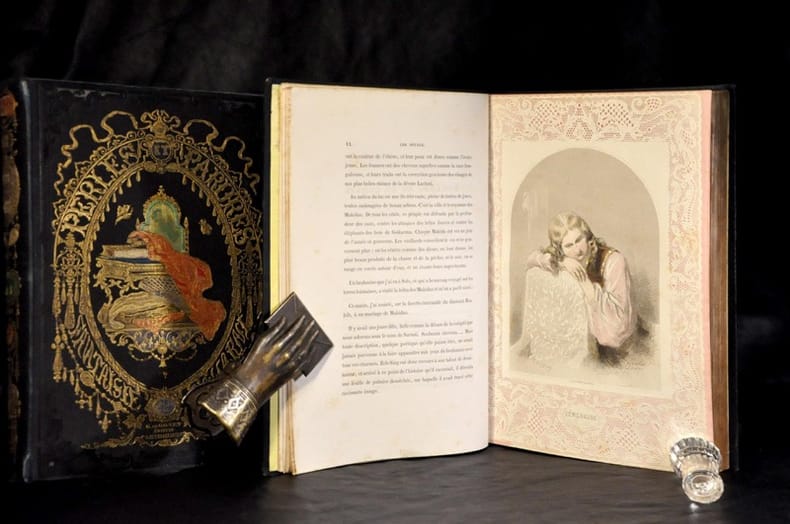
185028101850 Paris, G. de Gonet, Martinon, Vve L. Janet, à Leipzig, chez Ch. Twietmeyer, (1850), (3ff) 300pp & (3ff) 316pp Deux grands volumes in-8 d'une fraiche reliure en pleine percaline marine d'époque aux plats entièrement ornés d'un décor polychrome à fers spéciaux dorés et à froid reproduisant les couvertures, dos lisses ornés de même, tranches dorées (reliures des éditeurs). Quelques rares piqures intérieurs mais exemplaire est dans un etat de conservation excellant (la reliure des parures est légèrement passée en rapport avec le tome des joyaux). Agrémenté d'un frontispice répété et de 30 ravissantes planches gravées sur acier par Geoffroy h. t. d'après Gavarni.
196191893Mourlot | s. d. [1961] | 25.4 x 32 cm | Une feuille encadrée
18264831CBStuttgart und Tübingen, Cotta, 1826. 4°. XX S., (6) Bl. (Subskribentenliste), 370 S. Halbleinenband des 19. Jh. mit hs. Rückenschild. + Wichtig: Für unsere Kunden in der EU erfolgt der Versand alle 14 Tage verzollt ab Deutschland / Postbank-Konto in Deutschland vorhanden +, 4831C
1841013836Julius Perthes, Gotha, ab 1841. Papier-Mappen Gut
173543274Paris, , Thévenard, 1735 ca ?. 12 planches (29,5 à 30 x 20,5 cm à la cuvette) reliées en 1 vol. grand in-folio (54 x 41 cm), demi-maroquin rouge à coins, dos orné à nerfs (relié vers 1850).
1961014593Alès PAB 1961 In-8 carré Pleine reliure d'époque Signé par l'auteur et l'illustrateur
Cartella completa contenente 12 acqueforti e due disegni firmati Decroix che raffigurano due dei ritratti incisi. “Il a été tiré de cette suite 75 exemplaires numérotés sur papier de hollande. Exemplaire n. 3” con firma autografa dell’autore. I ritratti raffigurano siberiani, tartari, coreani, “enfants de troupe” ecc. Ogni acquaforte (il foglio misura cm 33x26) reca la firma di Decroix a matita, e il titolo del ritratto. Lo stesso Decroix (Lille 1878-1936 Parigi) fu prigioniero di guerra e passò due anni in un campo in Germania, liberato nel 1916 raggiunse la familgia a Berna per poi trasferirsi a Parigi. Assai raro.
189242333Paris, chez l'Auteur, 1892. In-folio de (10) pp. et 30 eaux-fortes montées sur papier, demi-chagrin lavallière à coins, dos orné à nerfs, tête dorée, non rogné, premier plat de couverture conservée (reliure de l'époque).
1730988DGAmasterdam, Jean Convens et Corneille Mortier., 1730. Grenzkolorierte Kupferstich. Blattformat: 56 x 64 cm. Gesamtgrösse der vier Teile: 112 x 128 cm. + Wichtig: Für unsere Kunden in der EU erfolgt der Versand alle 14 Tage verzollt ab Deutschland / Postbank-Konto in Deutschland vorhanden +, 988DG|988DG_2|988DG_3|988DG_4 [4 Warenabbildungen]
1964011898Paris Le Club français du livre 1964 En feuilles, couverture muette.
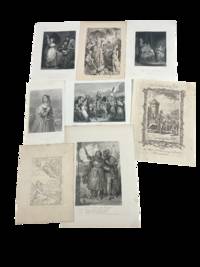
1700229131700. Cross-DressingWomen Military Joan of Arc engraving archive depicting the French military leader and martyr Jeanne d'Arc in iconic images of battle persecution and faith ca. 1770-1850s. The prints focus on Joan's leadership during the Hundred Years' War and on the gender-bending aspects of her identity and dress that contributed to her 1431 trial for heresy. Particular attention is given to her appearance in armor while directing troops or appearing before political authorities. These visual depictions emphasize Joan's adoption of male military clothing an attribute which has lead modern scholars of LGBTQ history to celebrate the saint as a queer and proto-transgender figure.<br /> <br /> Archive of eight engravings and proof impressions executed primarily in copperplate and steel engraving processes during the eighteenth and nineteenth centuries. The images depict several key episodes associated with Joan of Arc's historical narrative including portraits showing her wearing armor and holding a sword scenes of military command in which she appears mounted or directing troops and representations of her recognition by Charles VII and entry into the city of Orléans. A prison scene portrays Joan during captivity prior to her execution in 1431 emphasizing the moment when her continued cross-dressing became a major point of contention during her heresy trial. Several engravings were produced for historical publications and illustrated histories circulating in the eighteenth and nineteenth centuries including editions associated with François Guizot's History of France reflecting the renewed interest in Joan of Arc as a figure of national history. Archives includes:<br /> <br /> 1 Engraved for J. Sydney's History of England. The Maid of Orleans Receiving the Sword of St. Catherine. England c.1770-1820. A fine copper engraving framed within an elaborate Rococo border showing Joan receiving the sacred sword of St. Catherine an episode derived from medieval hagiography rather than strict historical documentation. Joan is mounted on horseback surrounded by armed men and clergy with a fortified tower rising behind her. The ornamental border and English publication context reveal the 18th-century Protestant fascination with Joan as a paradoxical figure: a warrior-prophetess both admired and viewed with suspicion.<br /> <br /> 2 Anonymous Artist. Va va fille de Dieu; délivre la France! Vision Scene. France c.1820-1850. A preparatory hand panciled engraving proof depicting Joan of Arc's divine revelation framed within penciled border guidelines. An angel descends from the clouds carrying a banner while pointing downward toward Joan who kneels in astonishment as cherubs hover above. The inscription "VA VA / FILLE DE DIEU / DELIVRE LA FRANCE!" anchors the scene as an allegory of Joan's heavenly mandate.<br /> <br /> 3 Henry Richter after. Joan of Arc Recognizes the King. London: The London Printing and Publishing Co. mid-19th century. A steel engraving portraying Joan's revelation of Charles VII at Chinon the pivotal moment when she identifies him despite his attempt at disguise. The richly detailed crowd scene and Gothic architectural setting emphasize both spectacle and legitimacy visualizing Joan as divinely guided rather than politically manipulated. <br /> <br /> 4 G. Greatbach engraver; after a painting by J. Opie R.A. Joan of Arc Declaring Her Mission. London: The London Printing and Publishing Co. Ltd. mid-19th century. Joan is shown making a dramatic gesture as she proclaims her mission before astounded soldiers and clergy. The engraving captures the tension between gender expectations and prophetic authority: Joan's outstretched arm determined expression and illuminated figure contrast with the skeptical figures behind her. <br /> <br /> 5 E. Scriven engraver. Joan D'Arc. London: H. Moore Sons & Co. mid-19th century.An engraving presenting a romanticized half-length portrait of Joan of Arc in armor holding a sword upright while gazing serenely into the distance. Behind her appear faint bystanders rendering her both an individual and an emblem of national deliverance. <br /> <br /> 6 Entry of Joan of Arc into Orléans. From Guizot's History of France. Paris/London c.1840s. A sweeping steel engraving of Joan riding triumphantly into Orléans accompanied by monks soldiers and citizens. The composition foregrounds her as a mounted military leader sword raised while crowds kneel and look upward in awe. Johannot's design visualizes Joan as a unifying national leader.<br /> <br /> 7 G. Stodart engraver; after H. E. Selous. Joan of Arc and Charles. London: Virtue & Co. mid-19th century.A dramatic steel engraving showing Joan standing beside Charles VII directing his attention toward the field of battle. The caption references their military collaboration. The interplay of armor banners and a stormy sky underscores Joan'smilitary might. <br /> <br /> 8 T. Brown engraver; after E. Corbould. Joan of Arc in Prison. London: The London Printing and Publishing Co. mid-19th century. A somber interior scene depicting Joan in captivity clasping her hands as guards and clergy surround her. Corbould emphasizes her steadfastness and the emotional gravity of her final days. Produced for an illustrated royal history King Henry the Sixth the image cast Joan as a martyr of conscience.<br /> <br /> In recent decades scholars in LGBTQ history and gender studies have increasingly examined Joan of Arc as a proto-queer icon who challenged traditional ideas of gender identity and expression. Medieval trial records document that Joan consistently wore male military clothing during her campaigns and continued to wear such clothing during imprisonment a choice that became a central accusation in the charges brought against her in 1431. Some historians and queer theorists have interpreted Joan's refusal to abandon male dress even under threat of execution as evidence of a personal gender identity that did not conform to contemporary expectations for women. Joan of Arc has been cited as an example in Medieval history of an individual navigating queer identity long before the modern understanding of terms like trans non-binary or genderfluid. <br /> <br /> Light toning and mild foxing to some edgewear and staining present to some margins. Prints are clear and paper crisp. Overall very good condition. A compelling and diverse archive of eight Joan of Arc engravings and artistic proofs representing two centuries of European historical illustration and devotional imagery. The collection captures Joan's transformation from medieval visionary to modern nationalist and feminist icon. unknown
1786376505Venezia 1786. Ora la prima volta con le stampe pubblicate. Engraved title page with vignette. Engraved Title portrait and 24 leaves of plates XIII page of text. Frontispiece & 15 engraved plates. 1 vols. Folio. Quarter morocco and green boards. Binding showing signs of wear. Interior with light foxing but overall Near Fine. Bookplate of C. W. H. Sotheby. Ora la prima volta con le stampe pubblicate" Engraved title page with vignette. Engraved Title portrait and 24 leaves of plates XIII page of text. Frontispiece & 15 engraved plates. 1 vols. Folio. Including engravings after the works of great Venetian Renaissance painters Giorgione Titian Tintoretto Zelotti and Veronese. With Titian's frescoes for the exterior of the Fondaco dei Tedeschi in Venice which have since perished. Also with engravings after the great draftsman Parmigianino.<br /> <br /> Antonio Maria Zanetti is known as a printmaker for his contributions to the style of chiaroscuro woodcuts as well as for his career as an art dealer and collector. Girolamo Francesco Zanetti was a historian and philologist known for being the first to publish one of the oldest Venetian chronicles the Chronicon Altinate. OCLC 272605179. Provenance: Bookplate of C. W. H. Sotheby d.1887 of Ecton Hall Northampton England unknown
WITH ONE OF KIYOSHI HASEGAWA'S MOST IMPORTANT PRINTS. *** 12 pp. plus 6 loose engravings. *** A monograph on engraving followed by short biographies of each of the six artists, accompanied by a suite of six large engravings, one each by Cami, Cottet, Decaris, Jeannisson, Hasegawa, and Lemagny. From a total edition of 320 copies, all printed on fine Marais wove paper. Hasegawa's engraving, "Anemones et fleurs de champs dans un verre a facettes" (Kyoto 368, also known as "Bouquet sur fond de dentelle"), is considered one of his masterpieces. Folio (38 x 28 cm). Loose as issued. Missing title-page and justification, but with complete text and all prints. The Cami and Jeannisson prints have a bit of mat burn on the recto and the Lemagny a bit on the verso. The other three prints, including the Hasegawa, are FINE AND BRIGHT.
NUMBER ONE OF ONLY TEN SETS OF THIS OUTSTANDING PORTFOLIO OF EXPRESSIONIST ETCHINGS, WITH MANY OF THE ETCHINGS PRINTED ON OLD JAPANESE PAPER. In 1918 German novelist Hans Bethge wrote "Satuila oder vom Zauber der Suedsee" ("Satuila or the Enchantment of the South Sea"), the story of a young woman in Samoa. It is a sensual, escapist tale: the situation in Germany was quite terrible after the defeat in WWI, and there was great demand for escapism. This novel was a hit, and a deluxe edition, with 6 original etchings by German Expressionist artist Georg Alexander Mathey, was published in Berlin in 1921. The etchings are extremely beautiful, perfectly capturing the lush sensuality of the landscape and the unabashed sexuality of the characters (similar to the depictions of Gypsies by Otto Mueller, from about the same time). This edition of the novel was limited to 250 copies. Aside from the book edition, 10 sets of the etchings were printed, with large margins. In these 10 sets, each of the etchings is signed and numbered by the artist. I OFFER ONE OF THESE 10 SETS: SET NUMBER 1, with each of the etchings numbered 1/10 and signed in pencil by the artist. FOUR OF THE SIX ETCHINGS IN THIS SET ARE PRINTED ON OLD JAPANESE PAPER, AND ARE PERHAPS UNIQUE AS SUCH. Additionally, there is a signed working proof of an early version of one of the etchings, also printed on old Japanese paper. This proof is probably unique, as the etching was never published. The set is as it was issued. Each etching (sheet size 8 1/2 x 7 inches--22 x 18 cm) is individually matted, and the original parchment-backed cloth portfolio case (16 1/2 x 13 inches--42 x 33 cm). There is a little light wear to the portfolio, but the etchings are fine and bright. An important and extremely rare item (and perhaps the only German Expressionist depictions of the South Pacific!)
17945009Ces deux rares séries d’estampes (20 planches pour la 1ère série, 13 pour la seconde) ont été montées dans un album. Les gravures ne sont que légèrement collées aux angles. Quelques rousseurs. Album en vélin avec lacets. Rome 1794 14 x 20 et 16 x 10
5568XVIIIè siècle Taille-douce sur papier vergé fin. 22,5 x 32 Très importante suite, rare. Inconnu du musée national des arts et traditions populaires. Il manque une planche pour avoir la série complète. Les estampes, rehaussées à l’époque, sont dans des cadres en bois sombre très simples avec 3 vitres anciennes. cadres Très bon XVIIIè siècle
5567XVIIIè siècle Taille-douce sur papier vergé fin. 22,5 x 32 Très importante suite, rare complète. Inconnu du musée national des arts et traditions populaires. Dans un beau cartonnage 1/2 parchemin et plats papier escargot XVIIIè, avec les planches en feuilles libres à l’intérieur. en feuilles Très bon Avignon XVIIIè siècle
5566XVIIIè siècle Taille-douce sur papier vergé fin. 22,5 x 32 Très importante suite, rare complète. Le musée national des arts et traditions populaires n’a que 3 estampes sur les 6 que doit avoir la série complète. Dans un beau cartonnage 1/2 parchemin et plats papier escargot XVIIIè, avec les planches en feuilles libres à l’intérieur. en feuilles Très bon XVIIIè siècle
18264831CBStuttgart und Tübingen, Cotta, 1826. 4°. XX S., (6) Bl. (Subskribentenliste), 370 S. Halbleinenband des 19. Jh. mit hs. Rückenschild.
1730988DGAmasterdam, Jean Convens et Corneille Mortier. 1730. Grenzkolorierte Kupferstiche. Blattformat: 56 x 64 cm. Gesamtgrösse der vier Karten: 112 x 128 cm.
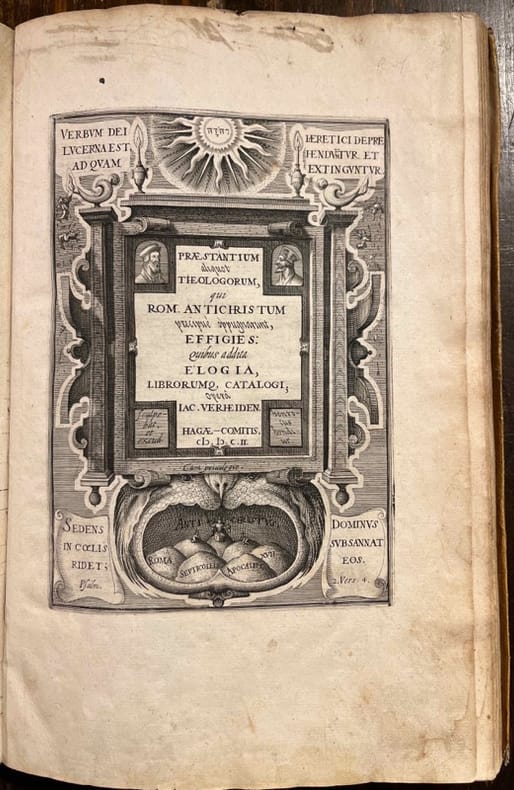
160216378Hagae Comitis [La Haye], Ex officina Bucoldi Cornelii Nieulandii, 1602. In-folio de [12]-226 pages [*6; A-Z4;Aa-Cc4; Dd6-Ee3], plein vélin à rabats, étiquette de titre manuscrite (en vélin), traces d'attaches. Ex-libris JFC, inscription ancienne au verso du titre.
365:325 mm. Mounted on cardboard. In passe-partout. Fine portrait of an Arabian horse. - Slightly spotty.
Signed "A. Alintor" (?). 205 x 460 mm. An imaginative rendering of the Masjid-i Jahan-Numa (World-reflecting Mosque) in Delhi, shown here in the midst of a desert, with camels and bedouins in the foreground. - Mounted on cardboard; two small tears to lower edge.
14 Aquarelle (teils auf Tonpapier) und 4 Bleistiftzeichnungen (2 auf Tonpapier, deckweißgehöht) sowie eine Photographie (Albuminabzug). Zum Teil auf Trägerkarton aufgezogen; Maße ca. 170 x 106 mm. Verso von zeitgenöss. Hand datiert und beschriftet: "Osterwiz, 10tes (bzw.) 9tes Thor von der Rükseite", "Hammerwerk Gurk, Strassburg", "Magdalenenkapelle, Weitensfeld, Altenmarkt", "St. Jakob ober Gurk", "Gundersdorf und Portendorf. Mittagskogel, SIngerberg", "Das schwarze Kreuz bei Gurk", "Draschlbach-Teich und Graben", "An der Gurk: Fernschau nach Mieger und auf den Obir", "Die Gurk: Pregradhof und Zweiniz", "Althofen von Rabenstein aus gesehen", Gut Gundersdorf", "Maiereiteich in Gurk, Aussicht gegen Westen auf die Amtmannwiese", "Verweserhaus am Drahtzuge St. Magdalene, mit der Fernsicht auf Althofen" (Aquarelle); "Silbereck, Fuchshof, Althofen, Grebenze", "Maitratten mit dem Koflachgebirge", "Launsdorf. Mannsberg, Teich bei Osterwiz", "Kalvarienberg Klagenfurt" (Bleistift). Die Photographie (91 x 55 mm auf Träger) zeigt Treibach-Althofen. - Sauberes, wohlerhaltenes Ensemble.
255 x 180 mm. Copperprint engraving, cut, hand-coloured and dressed with several fabric fragments, some with metallic threads, metallic lace details, and ground glass. Stitched at an early date to a ruled paper mount. Later giltwood frame and glazing with framer’s label ("Collard Doreur sur bois. Versailles’", ca. 1830-40). Striking and well-preserved example of a so-called "dressed print", based on a devotional engraving of Mary Magdalene by the German engraver and publisher Martin Engelbrecht (1684-1756), dating to the mid-18th century. The materials and style of the adornments point to the 18th century, though a later reuse of older fabrics cannot be ruled out. As often, the dressing has been ingeniously applied both under and over the surface of the original engraving. The penitent Mary Magdalene has been modified by being pasted onto glazed paper, producing a dramatic black-sky background, her body is embellished with three different brocade fabrics (two with metallic threads), and the print was further enhanced with hand-colouring, some metallic lace and ground glass. The saint is characterized by her traditional attributes of a cross, a book, a myrrh jar, a straw mat, and a skull, while her left foot rests on a globe or orb. The precious clothes that were added to Mary Magdalene, who is usually just covered by her long open hair as an expression of her ascetism and atonement, almost transforms her into a celestial Mary, thus altering the meaning of the engraving. - The fashion for dressing prints existed probably from the beginning of printed illustrations themselves, though it was a widespread, predominantly female recreation, especially in nunneries and convents, during the 17th and 18th centuries. Dressed prints were often overlooked by art historians and, due to their fragile nature, are rarely preserved in such good condition.