(VIONNET Madeleine) RUEG MadeleineMareMagnum

10 867 résultats
- Lucien Vogel éditeur, Paris 1924-1925, 18x24cm, une feuille. - Original color print, printed on vergé paper, signed in the plate. An original print used to illustrate the Gazette du bon ton, one of the most attractive and influential 20th century fashion magazines, featuring the talents of French artists and other contributors from the burgeoning Art Deco movement. A celebrated fashion magazine established in 1912 by Lucien Vogel, La Gazette du bon ton appeared until 1925, with a hiatus from 1915 to 1920 due to the war (the editor-in-chief having been called up for service). It consisted of 69 issues printed in only 2,000 copies each and notably illustrated with 573 color plates and 148 sketches of the models of the great designers. Right from the start, this sumptuous publication "was aimed at bibliophiles and fashionable society," (Françoise Tétart-Vittu, "La Gazette du bon ton", in Dictionnaire de la mode, 2016) and was printed on fine vergé paper using a type cut specially for the magazine by Georges Peignot, known as Cochin, later used (in 1946) by Christian Dior. The prints were made using stencils, heightened in colors, some highlighted in gold or palladium. The story began in 1912, when Lucien Vogel, a man of the world involved in fashion (he had already been part of the fashion magazine Femina) decided, with his wife Cosette de Brunhoff - the sister of Jean, creator of Babar - to set up the Gazette du bon ton, subtitled at the time: "Art, fashion, frivolities." Georges Charensol noted the reasoning of the editor-in-chief: "'In 1910,' he observed, 'there was no really artistic fashion magazine, nothing representative of the spirit of the time. My dream was therefore to make a luxury magazine with truly modern artists...I was assured of success, because when it comes to fashion, no country on earth can compete with France.'" ("Un grand éditeur d'art. Lucien Vogel" in Les Nouvelles littéraires, no. 133, May 1925). The magazine was immediately successful, not only in France but also in the United States and Latin America. At first, Vogel put together a team of seven artists: André-Édouard Marty and Pierre Brissaud, followed by Georges Lepape and Dammicourt, as well as eventually his friends from school and the School of Fine Arts, like George Barbier, Bernard Boutet de Monvel and Charles Martin. Other talented people soon came flocking to join the team: Guy Arnoux, Léon Bakst, Benito, Boutet de Monvel, Umberto Brunelleschi, Chas Laborde, Jean-Gabriel Domergue, Raoul Dufy, Édouard Halouze, Alexandre Iacovleff, Jean Émile Laboureur, Charles Loupot, Chalres Martin, Maggie Salcedo. These artist, mostly unknown when Lucien Vogel sought them out, later became emblematic and sought-after artistic figures. It was also they who worked on the advertising drawings for the Gazette. The plates put the spotlight on, and celebrate, dresses by seven designers of the age: Lanvin, Doeuillet, Paquin, Poiret, Worth, Vionnet and Doucet. The designers provided exclusive models for each issue. Nonetheless, some of the illustrations are not based on real models, but simply on the illustrator's conception of the fashion of the day. The Gazette du bon ton was an important step in the history of fashion. Combining aesthetic demands with the physical whole, it brought together - for the first time - the great talents of the artistic, literary, and fashion worlds; and imposed, through this alchemy, a completely new image of women: slender, independent and daring, which was shared by the new generation of designers, including Coco Chanel, Jean Patou, Marcel Rochas, and so on... Taken over in 1920 by Condé Montrose Nast, the Gazette du bon ton was an important influence on the new layout and aesthetics of that "little dying paper" that Nast had bought a few years earlier: Vogue. [FRENCH VERSION FOLLOWS] Estampe originale en couleur, tirée sur papier vergé, signée en bas à droite de la planche. Gravure originale réalisée pour l'illu
192455191Lucien Vogel éditeur | Paris 1924-1925 | 18 x 24 cm | une feuille
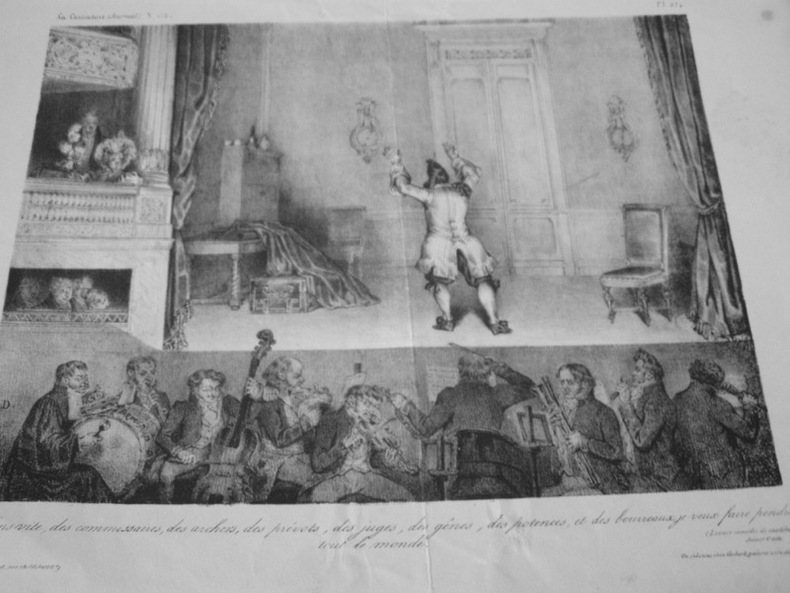
1833250771833 1833. Planche 274 de La Caricature N° 132.La Caricature, 16 mai, 1833. Lithographie originale sur Velin blanc. . . Belle épreuve en noir et pli vertical,plis;lithographie en noir sur velin blanc,,tirage bien noir malgré l'image jaunie
- Lucien Vogel éditeur, Paris 1921, 18x24cm, une feuille. - Original color print, printed on vergé paper, signed in the plate. An original print used to illustrate the Gazette du bon ton, one of the most attractive and influential 20th century fashion magazines, featuring the talents of French artists and other contributors from the burgeoning Art Deco movement. A celebrated fashion magazine established in 1912 by Lucien Vogel, La Gazette du bon ton appeared until 1925, with a hiatus from 1915 to 1920 due to the war (the editor-in-chief having been called up for service). It consisted of 69 issues printed in only 2,000 copies each and notably illustrated with 573 color plates and 148 sketches of the models of the great designers. Right from the start, this sumptuous publication "was aimed at bibliophiles and fashionable society," (Françoise Tétart-Vittu, "La Gazette du bon ton", in Dictionnaire de la mode, 2016) and was printed on fine vergé paper using a type cut specially for the magazine by Georges Peignot, known as Cochin, later used (in 1946) by Christian Dior. The prints were made using stencils, heightened in colors, some highlighted in gold or palladium. The story began in 1912, when Lucien Vogel, a man of the world involved in fashion (he had already been part of the fashion magazine Femina) decided, with his wife Cosette de Brunhoff - the sister of Jean, creator of Babar - to set up the Gazette du bon ton, subtitled at the time: "Art, fashion, frivolities." Georges Charensol noted the reasoning of the editor-in-chief: "'In 1910,' he observed, 'there was no really artistic fashion magazine, nothing representative of the spirit of the time. My dream was therefore to make a luxury magazine with truly modern artists...I was assured of success, because when it comes to fashion, no country on earth can compete with France.'" ("Un grand éditeur d'art. Lucien Vogel" in Les Nouvelles littéraires, no. 133, May 1925). The magazine was immediately successful, not only in France but also in the United States and Latin America. At first, Vogel put together a team of seven artists: André-Édouard Marty and Pierre Brissaud, followed by Georges Lepape and Dammicourt, as well as eventually his friends from school and the School of Fine Arts, like George Barbier, Bernard Boutet de Monvel and Charles Martin. Other talented people soon came flocking to join the team: Guy Arnoux, Léon Bakst, Benito, Boutet de Monvel, Umberto Brunelleschi, Chas Laborde, Jean-Gabriel Domergue, Raoul Dufy, Édouard Halouze, Alexandre Iacovleff, Jean Émile Laboureur, Charles Loupot, Chalres Martin, Maggie Salcedo. These artist, mostly unknown when Lucien Vogel sought them out, later became emblematic and sought-after artistic figures. It was also they who worked on the advertising drawings for the Gazette. The plates put the spotlight on, and celebrate, dresses by seven designers of the age: Lanvin, Doeuillet, Paquin, Poiret, Worth, Vionnet and Doucet. The designers provided exclusive models for each issue. Nonetheless, some of the illustrations are not based on real models, but simply on the illustrator's conception of the fashion of the day. The Gazette du bon ton was an important step in the history of fashion. Combining aesthetic demands with the physical whole, it brought together - for the first time - the great talents of the artistic, literary, and fashion worlds; and imposed, through this alchemy, a completely new image of women: slender, independent and daring, which was shared by the new generation of designers, including Coco Chanel, Jean Patou, Marcel Rochas, and so on... Taken over in 1920 by Condé Montrose Nast, the Gazette du bon ton was an important influence on the new layout and aesthetics of that "little dying paper" that Nast had bought a few years earlier: Vogue. [FRENCH VERSION FOLLOWS] Estampe originale en couleur, tirée sur papier vergé, signée en bas à gauche de la planche. Gravure originale réalisée pour l'illustrat
5726Aritmetica, Poesis, Geometria, Astronomia, Architectura (seule planche gravée par Frid. Lottes), Pictura, Sculptura. D'après les dessins très baroques de l'architecte et décorateur Paul Decker XVIIIè siècle 30,5 x 20
1919011332Berlin Verlag Fritz Gurlitt 1919 In-8 broché, couverture illutrée
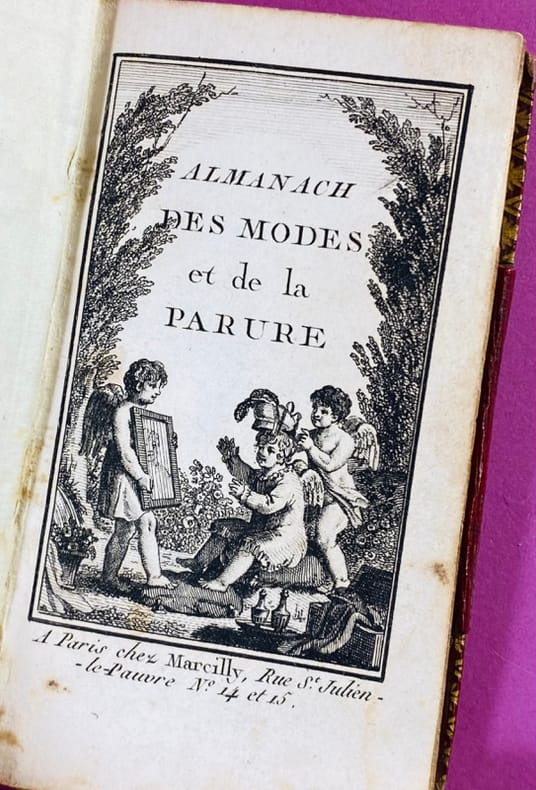
180417061804 Couverture rigide Paris, Marcilly, 1804. Un volume in-24 (11 x 6,5 cm), cartonnage maroquiné de l'éditeur, dos lisse orné, roulette dorée d'encadrement sur les plats, fermoir maroquiné (sans son crayon), tranches dorées, coiffe supérieure fendue, coins émoussés. Titre gravé, calendrier révolutionnaire en 2 feuillets dépliants ornés de petits bandeaux illustrés, 1-20 et 45-62 pages (pagination non continue), 24 pages et 21-44 pages (pagination non continue), 30 feuillets blancs avec filigrane destinés à la prise de notes, almanach illustré de 12 figures gravées autour de la mode, rousseurs éparses. La pagination non continue s'explique par le fait que les feuillets dédiés au budget (pages 21-44) ont été déplacés en fin d'ouvrage ; exemplaire bien complet. Sous le Premier Empire, les almanachs étaient des publications très prisées, mêlant informations pratiques, divertissement et illustrations. Ils pouvaient être généralistes ou spécialisés, comme l’Almanach des Modes et de la Parure. Le nôtre contient des chansons, des notices historiques sur la mode et la toilette, ainsi que des pages dédiées à la gestion du budget, et en fin d’ouvrage, des feuillets blancs pour prendre des notes. Charmant almanach illustré témoignant de l’élégance du Premier Empire. Bon exemplaire, en assez bon état.
192721056<p>London: Faber & Gwyer 1927. First edition. Faint stains to covers else very good. 6 unpaginated leaves; illustrated with black and white wood engraving on front cover and full-page color wood engraved frontispiece; 12mo white card wrappers. <br /><br />#298 of 350 copies on Zander's hand made paper. Printed at the Curwen Press.</p> Faber & Gwyer)
1640525X32 cm.
18727660BBZürich, Hch. Keller, (1872). 16 x 116,5 cm. Gef., lithogr. und koloriertes Panorama. Orig.-Halbleinenband.
1890628CGZürich, Hofer & Burger o.J. (um 1890). Lithographie gez. von H. Schmid. Blattformat: 17,5 x 189 cm.
1890628CGZürich, Hofer & Burger, o.J. (um 1890). Lithographie gez. von H. Schmid. Blattformat: 17,5 x 189 cm. + Wichtig: Für unsere Kunden in der EU erfolgt der Versand alle 14 Tage verzollt ab Deutschland / Postbank-Konto in Deutschland vorhanden +
18921679AGAarau, Müller & Co., 1892. Farbige Lithografie von H. Hubacher. Format: 24 x 220 cm. + Wichtig: Für unsere Kunden in der EU erfolgt der Versand alle 14 Tage verzollt ab Deutschland / Postbank-Konto in Deutschland vorhanden +, A
18804606DBSchaffhausen, Carl Schoch, 1880. 12°. (16 x 385 cm). Farbiges (Chromolithographie) Panorama in 40 Teilen in illustriertem Originalumschlag. Halbleinenumschlag. + Wichtig: Für unsere Kunden in der EU erfolgt der Versand alle 14 Tage verzollt ab Deutschland / Postbank-Konto in Deutschland vorhanden +, 4606DB|4606DB_2 [2 Warenabbildungen]
18804606DBSchaffhausen, Carl Schoch, 1880. 12°. (16 x 385 cm). Farbiges (Chromolithographie) Panorama in 40 Teilen in illustriertem Originalumschlag. Halbleinenumschlag.
192826418ABInterlaken, K.J. Wyss Erben, (1928). 8°. 8 S. Orig.-Heft. + Wichtig: Für unsere Kunden in der EU erfolgt der Versand alle 14 Tage verzollt ab Deutschland / Postbank-Konto in Deutschland vorhanden +
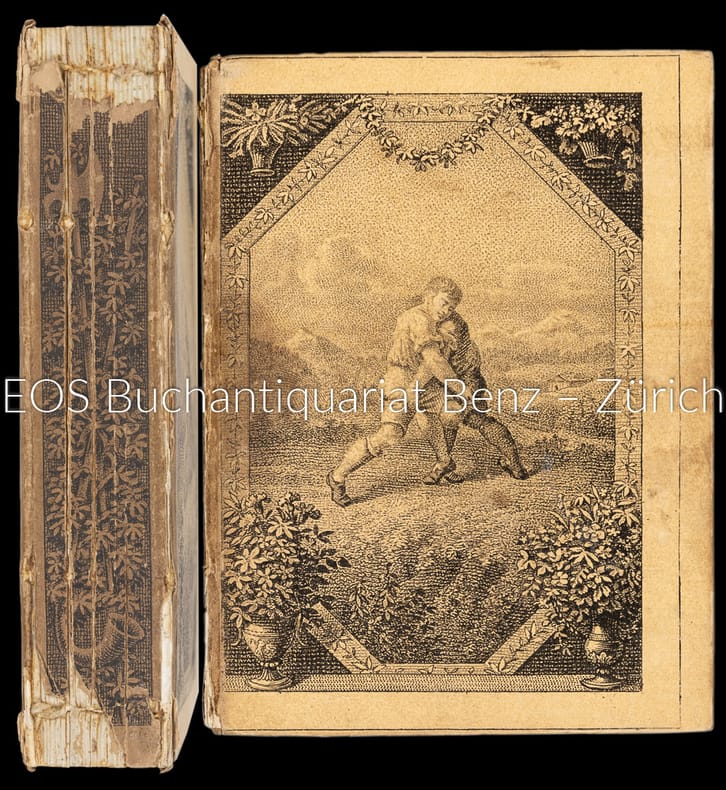
181414356ABBern u. Leipzig, Burgdorfer, 1814. 12°. 356 S, 2 Bl. 6 gest. Taf., dv. 3 gef., und 2 gef. Notenbl. Illustr. Orig.-Pappband.
181714412ABBern, Lpz, Burgdorfer, Burgdorfer u. Schmid, 1817. 12°. 346 S. 6 gest. Taf., dv. 3 gef., und 4 Notenbl.. Illustr. Orig.-Pappband.
181914408ABBern u. Leipzig, Burgdorfer u. Schmid, 1819. 12°. 392 S. Mit 6 gest. Tafeln (davon 2 gef.) und 4 gef. Notenbl. Illustr. Orig.-Pappband in Schuber.
182014402ABBern u. Leipzig, Burgdorfer u. Schmid, 1820. 12°. (2) 388 S., (4) S. Mit 7 gest. Taf., dv. 4 gef., und 2 gef. Notenbl. Illustr. Orig.-Pappband in Schuber.
181414356ABBern u. Leipzig, Burgdorfer, 1814. 12°. 356 S, 2 Bl. 6 gest. Taf., dv. 3 gef., und 2 gef. Notenbl. Illustr. Orig.-Pappband. + Wichtig: Für unsere Kunden in der EU erfolgt der Versand alle 14 Tage verzollt ab Deutschland / Postbank-Konto in Deutschland vorhanden +
181714412ABBern, Lpz, Burgdorfer, Burgdorfer u. Schmid, 1817. 12°. 346 S. 6 gest. Taf., dv. 3 gef., und 4 Notenbl.. Illustr. Orig.-Pappband. + Wichtig: Für unsere Kunden in der EU erfolgt der Versand alle 14 Tage verzollt ab Deutschland / Postbank-Konto in Deutschland vorhanden +
181914408ABBern u. Leipzig, Burgdorfer u. Schmid, 1819. 12°. 392 S. Mit 6 gest. Tafeln (davon 2 gef.) und 4 gef. Notenbl. Illustr. Orig.-Pappband in Schuber. + Wichtig: Für unsere Kunden in der EU erfolgt der Versand alle 14 Tage verzollt ab Deutschland / Postbank-Konto in Deutschland vorhanden +, bild
182014402ABBern u. Leipzig, Burgdorfer u. Schmid, 1820. 12°. (2) 388 S., (4) S. Mit 7 gest. Taf., dv. 4 gef., und 2 gef. Notenbl. Illustr. Orig.-Pappband in Schuber. + Wichtig: Für unsere Kunden in der EU erfolgt der Versand alle 14 Tage verzollt ab Deutschland / Postbank-Konto in Deutschland vorhanden +, A|B [2 Warenabbildungen]
18214993CBBern u. Leipzig, J. J. Burgdorfer u. E. G. Schmid, 1821. 12°. IV, 370 S. Mit 1 gest. Frontisp., 5 (davon 2 gef.) Kupfertafeln und 4 Seiten gef. Noten. Illustr. Orig.-Pappband in Schuber.