52 943 résultats
192642279Paris.: Établissements Pathé-Cinéma. 1926. Original morocco-backed marbled boards. 8vo. In the early years of the twentieth century the largest film production company was the Société Pathé Frères Pathé Brothers Company. Founded in 1897 the company was at its height in 1920s when it unveiled the first home movie projector the Pathé Baby. This book is one of the company’s first publications explaining the secrets of processing “virgin†film. Illustrations in the text offer incredible images of the scale of mass production of thousands of silent movies including the first newsreels sports films and animation.The book remains the first major technical publication regarding the processing and development of film illustrated throughout with numerous black-and-white illustrations and diagrams and most fascinatingly containing six fold-out leaves of hand-constructed film negatives bound in at the rear providing 107 examples of different techniques available at the time including colour tinting and various exposures.This copy with a loosely inserted letter from Pathe's commercial director typed on the company's headed paper letter dated 28 July 1926 presenting this copy of the book. Établissements Pathé-Cinéma. hardcover
Royal folio (360 x 440 mm). Illustrated, colored title page and dedication, 2 ff. of Austrian costumes and views, and 14 ff. notes in alternating decorative borders. Chromolithographed throughout (some raised in gold). Brown morocco portfolio with inlayed arms of the Emperor of Brazil (in green and red calf with brass applications) and imperial crown above the arms in engraved brass with calf inlays in various colors. Spine in six compartments bordered in gold; wide giltstamped cover borders and simple fillets. All edges gilt. Blue silk endpapers and gilt ornamental inner dentelle (signed: "Rosenberg, Graben 17, Wien"). Splendid work dedicated to Emperor Franz Josef, with illustrations by Franz Alt, P. J. N. Geiger, and others. A very few of the small number of copies printed were presented as personal gifts of the Emperor to the highest dignitaries, for whom the Viennese bookbinder Franz Felix Rosenberg manufactured elaborate, customized bindings with the insignia of the recipients. - Very rare: international library catalogs list only a single copy of the normal edition (BSB Munich). One of Rosenberg's splendidly bound special editions appeared in the trade recently (the copy intended for Pope Pius IX). - Interior slightly foxed, as usual; spine-ends insignificantly rubbed, otherwise perfect. Wurzbach LV, 172.
Large 4to. 19 (instead of 20) issues. With engraved title-page (using an original wrapper cover) and altogether 114 (instead of 120) etched plates by Wilhelm and Moritz Henschel and 2 pp. of subscription ads. Contemporary boards with ms label to spine. First edition of this series of performance sketches, published in 20 separate issues. Iffland himself is depicted in the roles of King Lear and Shylock, of the Miser in Molière's eponymous play, and of Nathan the Wise. Extremely rarely encountered thus near completeness, lacking only the final issue ("Der arme Poet"). German auction records since 1950 list a single complete copy (Bassenge 1990) and one separate issue only (Dörling 84, 24 Nov. 1975, no. 792 [issue 19 with 6 plates, DM 240]). Even a dedicated exhibition held at the Zentral- und Landesbibliothek Berlin in 2005, which focused exclusively on the present work, was able to present only an incomplete copy acquired the previous year. - From the collection of the director and actor Franz Stoß (1909-95) with his bookplate on the front pastedown. A fine copy with largely clean, spotless interior. Kippenberg coll. 5082 (only 15 issues with a total of 90 plates). Lipperheide Uce 9. Hiler 456. Thieme/Becker XVI, 430 (dated 1808-1819). Not in Colas or Ornamentstichslg. Berlin. Not in Kayser or Goedeke.
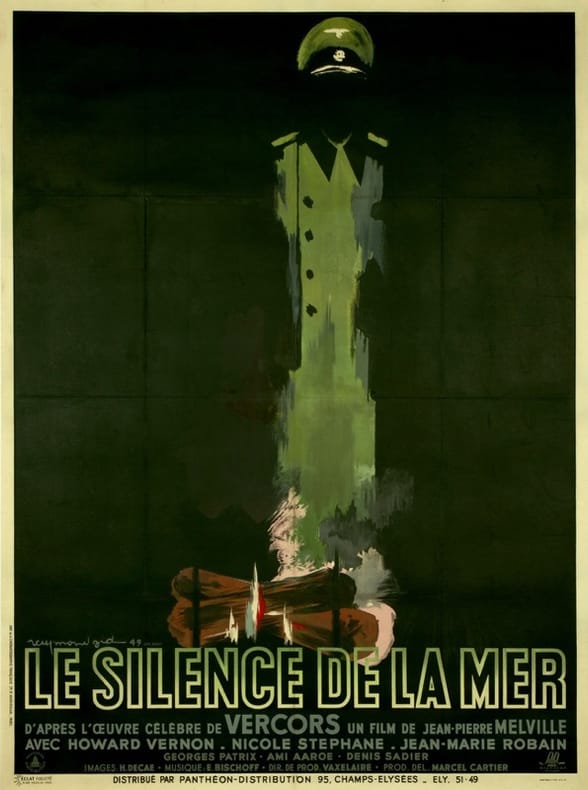
194726758Affiche myhtique Cinématographie française, [1947]. 1 affiche (120 x 160 cm) en couleurs, entoilée. Rarissime affiche du premier long métrage de Jean-Pierre Melville que les historiens du 7e art tiennent pour l'un des films fondateurs de la Nouvelle Vague : une merveilleuse adaptation du chef-d'œuvre de Vercors.
103 x 82 mm. Silver print. The photograph shows Gershwin in front of the office of Chappell & Co., one of the leading music publishers and piano manufacturers in Great Britain, located at 52 Maddox Street, together with the orchestra leader, composer, pianist and actor Harry Rosenthal and the former Managing Director of the New York branch of Chappell & Co., Walter Eastman, who had moved to London. On the reverse Eastman inscribed the photograph "to Maude Hamill [of Chappell & Co.] from Walter Eastman Nov. 14. 45 Rhapsody in Blue Day". - Traces of tape around the edges and traces of mounting on verso.
1 S. 375 x 325 mm. Von dem vierstimmigen, in Chorbuchform gedruckten Gesang ("Lob Gott getrost mit Singen") konnten wir kein weiteres Exemplar nachweisen. Weder in Melodie noch in Text mit dem bei Zahn Nr. 5354a aufgezeichneten Kirchenlied identisch. Lochovius bezeichnet sich als Brandenburgischer Musicus. - Unterlegt.
Esemplare molto bello, freschissimo e a pieni margini. Edizione di superba bellezza, un vero capolavoro dell’arte tipografica. Cfr Morazzoni, »Il libro illustrato veneziano del Settecento», 243: «ad ogni atto tavola circondata da fregio architettonico-scenografico: altra vignetta scenografica serve da testata al testo». 7 voll.
12mo. (48), 920 [but: 921], (13) pp. (lacking the double-page-sized engraved title page). Contemporary copy with ms. spine title. Only edition. - "Interesting literary-critical introduction by the author. The musical compositions are by Michael Jakobi, Heinrich Pape, and Rist. The 'Nebenbergelein' (857-920) contains poetic tributes from Justus Georg Schottel, Johann Michael Moscherosch, Johann Matthias Schneuber, Nicolaus Peucker, David Schirmer, Christian Brehme, Georg Neumark, Georg Greflinger, Sigmund von Birken, and others" (Jantz). The notes are in letterpress. "Rist's importance for the history of music lies in his influence as a poet of Protestant hymns, works for which he was capable of winning as well-reputed composers as he did for his secular poetry" (cf. Riemann). - Well preserved. Faded contemporary ownership of Henning von Eitzen on title page; later handwritten ownership of "v. Arnswaldt" on the flyleaf. RISM B I, 1652/5 (only 3 copies). Eitner VIII, 248f. Jantz 2129. Faber du Faur 396. Goedeke 3, 84, 38a. Hansen I, 17.
- s.n. 1943, 29x22,8 cm, une photographie. - Large photographic portrait of Jean Cocteau inscribed by Cocteau to Willy Michel 1943 | 29 x 22.8 cm | one photograph Extremely rare photographic portrait of Jean Cocteau, in contemporary silver print, produced during the shooting of Serge de Pologny's film Le Baron fantôme for which he wrote the dialogues. Beautiful, signed autograph inscription, in the upper margin of the photo, to which Cocteau has added his famous little star: "à mon cher willy Michel. Souvenir très amical de nos complicités cinématographiques. Le Baron fantôme, Jean Cocteau. 1943" "To my dear Willy Michel. Very fond memory of our film-making complicity. Le Baron fantôme, Jean Cocteau. 1943" Some tiny lacks in the left margin of the photograph. Magnificent large photographic portrait offered to the photographer Willy Michel, who installed the first photo booth in France in his studio and became famous for his "selfies" with all the artists, actors and writers of his time. With this superb, highly expressive, photograph in costume, Cocteau offers this bibliophile, patron of artists and accustomed to cinema sets, an item of choice for his famous collection of portraits and artists' signatures. A wonderful highly expressive portrait of which we have not found any other copy in international public collections. [FRENCH VERSION FOLLOWS] Rarissime et large portrait photographique de Jean Cocteau, en tirage argentique d'époque, réalisé durant le tournage du film de Serge de Pologny Le Baron fantôme dont il a écrit les dialogues et interpreté le personnage du baron "fantome" Julius Carol. Bel envoi autographe signé, en marge haute du cliché, auquel Cocteau a adjoint sa célèbre petite étoile : "A mon cher Willy Michel. Souvenir très amical de nos complicités cinématographiques. Le Baron fantôme, Jean Cocteau. 1943" Quelques très infimes manques en marge gauche de la photographie. Magnifique grand portrait photographique offert au photographe Willy Michel, qui installa dans son atelier le premier photomaton de France et devint célèbre pour ses "selfies" avec tous les artistes, comédiens et écrivains de son temps. Avec cette superbe photographie en costume d'une grande expressivité, Cocteau offre à ce bibliophile, mécène des artistes et habitué des plateaux de cinéma une pièce de choix pour sa célèbre collection de portraits et de signatures d'artistes. Nous n'avons pu trouver aucun autre exemplaire dans les collections publiques internationales.
- Paris 21 janvier 1946, 21x27cm, 1 page 1/2 sur un feuillet. - Précoce lettre autographe signée du jeune premier Yves Montand adressée à Marcel Duhamel à propos du film Les Portes de la nuit de Marcel Carné. Une page et demie rédigée à l'encre bleue sur un feuillet ligné. Pliure inhérente à l'envoi et deux perforations en marge gauche sans manque de texte. Jamais publiée, cette lettre a été lue sur France Culture dans l'émission «?La Boîte à lettres?» en novembre 2014. Dandy aux multiples casquettes, Marcel Duhamel fut directeur d'hôtel, éditeur et créateur de la Série noire chez Gallimard, traducteur notamment d'Hemingway et de Steinbeck et amant de... Simone Signoret. Grand amateur de jazz, il fut également l'un des piliers des caves germanopratines et eut même droit à son occurrence dans le célèbre Manuel de Saint-Germain des Prés dans lequel Boris Vian écrivit à son sujet?: «?Duhamel [...] a eu une vie fort variée dont le récit nous entraînerait en dehors des limites de ce volume?; mais, à tous les moments de son existence, il a conservé une dignité dans l'allure très caractéristique, et on ne m'ôtera jamais l'idée que Marcel Duhamel est un enfant naturel de feu le roi George V d'Angleterre?» Très belle lettre, évoquant Jean Gabin, Marlène Dietrich et Jacques Prévert, écrite au lendemain des essais d'Yves Montand pour le film Les Portes de la nuit de Marcel Carné, deuxième film dans lequel joua le jeune premier. Après l'immense triomphe des Enfants du Paradis l'année précédente, le duo Carné-Prévert se reforma en 1946 pour la réalisation des Portes de la nuit et le choix du rôle principal se porta rapidement sur Jean Gabin qui avait déjà travaillé avec eux sur Le Quai des Brumes et Le Jour se lève. Avec Marlène Dietrich, ils étaient supposés incarner les rôles principaux mais abandonnèrent finalement le projet à la dernière minute, l'Ange bleu ne souhaitant pas interpréter le rôle de la fille d'un collaborateur. Les réalisateurs furent donc contraints de trouver de nouvelles têtes d'affiche et Édith Piaf, quelques mois après leur séparation, recommanda Yves Montand à Jean Carné. Il semblerait pourtant que Marcel Duhamel ait également appuyé la candidature du jeune homme?: «?Je veux te dire combien j'ai été toucher [sic] l'orsque [sic] j'ai appris la façon avec la quelle [sic] tu m'as défendu et mis en valeur aux yeux de Carné. Je n'ai jamais été très fort pour composer, ou tourner de belle [sic] phrases - je ne trouve qu'au fond de mon cur qu'un grand merçi [sic].?» Yves Montand, vingt-six ans à l'époque, connaissait déjà un grand succès au Théâtre de l'Étoile où il faisait la première partie de la Môme, mais n'avait à son actif qu'un seul film tourné la même année, Étoile sans lumière de Marcel Blistène. Cette belle lettre témoigne de l'enthousiasme et de la candeur du jeune Yves Montand, subjugué par l'univers du septième art et très honoré d'interpréter un rôle destiné à une étoile du cinéma?: «?Carné m'avais [sic] proposé tout simplement le rôle de Jean Gabin - oui mon vieux, j'ai fait des essais jeudi 17 janvier, 14 numéros exactement - des scènes de violence et d'homme. Nous avons vu la projection, le samedi matin, crois mon cher Marcel, que je n'exagère pas en te disant que c'était vraiment extraordinaire [...] tu pourras d'ailleurs demandé [sic] à Jacques Prévert et à Carné lui-même...?» Marcel Duhamel fit la connaissance de Prévert à Istanbul au service militaire et les deux compères ne se quittèrent dès lors plus. Prévert semble avoir été totalement conquis par le jeu de Montand?: «?Je passe sous silence les compliments à n'en plus finir de Prévert.?» Carné, quant à lui, paraît hésitant?: «?Tu me connais, j'ai demandé à Carné samedi si oui ou non je faisais le film [...] Il m'a répondu "mon cher Montand, je ne sais pas encore tout ça ne dépend pas de moi, le film a été déjà vendu à l'étranger avec comme distribution Gabin et Marlène. Je ne peux que vous dire que je suis désolé si je fais maintenant l
Edizione originale Zatta (completa di 120 opere teatrali e delle “Memorie” tradotte in italiano) Esemplari in ottime condizioni, a pieni margini con rare e marginali fioriture alle carte. Edizione Zatta in 47 tomi delle opere teatrali di Goldoni (44 tomi organizzati in “Commedie serie in prosa”, “Commedie buffe in prosa”, “Commedie e tragedie in versi di vario metro”, “Drammi giocosi” e 3 occupati dalle “Memorie”), pubblicata a Venezia tra il 1788 e il 1795. Contiene la prima edizione italiana delle «Mémoires» scritte per raccontare la storia «della propria vita e del proprio teatro» e pubblicate per la prima volta a Parigi nel 1787, quando il grande commediografo aveva ormai ottant’anni. Nel corso del Settecento, quattro furono le edizioni goldoniane degne di essere ricordate perché curate direttamente dell’autore (benché molte fossero già le edizioni non curate da lui e neppure autorizzate): quella Bettinelli del 1750 - 1755, pubblicata a Venezia e contenente 36 commedie suddivise in 9 tomi; quella Paperini del 1753 - 1757, pubblicata a Firenze e contenente 50 commedie suddivise in 10 tomi, con frequenti toscanizzazioni di passi in dialetto veneto; quella Pasquali del 1761 - 1768, organizzata in 19 tomi; e la presente edizione Zatta del 1788 - 1795, voluta e curata da Goldoni al termine della propria vita (l’autore veneziano morirà nel 1793) e di gran lunga la più completa fra quelle che videro la luce in questo secolo. Si tratta infatti di 120 opere (più le già ricordate memorie), tutte accompagnate in apertura da una vignetta di Novelli incisa in rame, tra gli altri, da Zuliani, Zatta e Daniotto, con quest’ultimo autore anche dell’incisione del ritratto di Goldoni posto all’antiporta del primo tomo. Cfr. P. Spezzani, «La stratificazione delle “centodiciassette” commedie del Goldoni nei principali “corpus” editoriali settecenteschi e in una appendice editoriale novecentesca», in «Lettere italiane», vol. 47, n. 2 (aprile - giugno 1995). 47 voll.
054802Sans lieu 1931 23,5 x 17,5 cms 1 photographie oruiginale, tirage de l'époque signé au crayon Robertito Biarritz 1931?. Charles Spencer Chaplin, dit Charlie Chaplin, Londres (?) 1889 - Corsier-sur-Vevey 1977, acteur, réalisateur, scénariste, producteur et compositeur britannique. Charlie Chaplin, amateur de tennis assiste à un match à Guéthary avec Henri Cochet, René Lacoste et Martin Plaa, lors de vacances à Biarritz au mois d'août 1931 . Tirage photographique en noir et blanc de format 40 x 30 cms, portant sur la marge inférieure une dédicace manuscrite à l'encre noire signée par Charlie Chaplin: To Monsieur xx? (nom du dédicataire biffé à l'encre noire) From Charlie Chaplin. Rare document original. Bel exemplaire ( Photographies sur demande / We can send pictures on simple request )
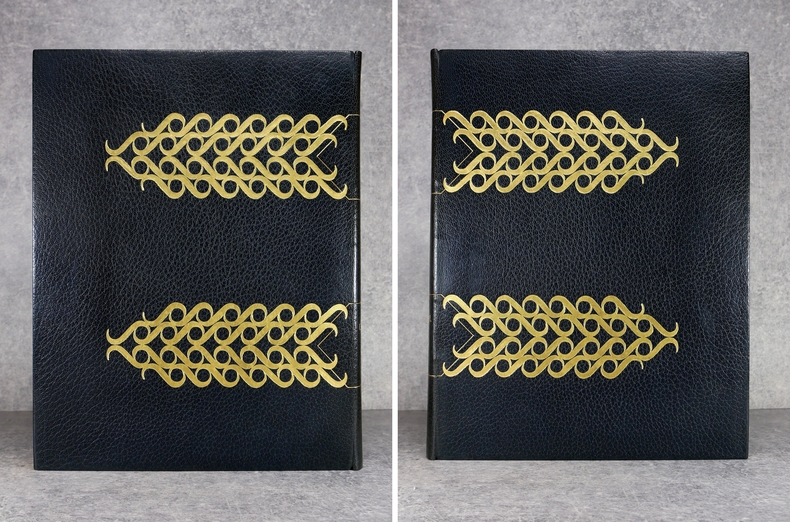
19473681PARIS 9°. NOUVELLES EDITIONS FRANCAISES. 1947. IN-4 (34 X 26,5 X 5,5 CENTIMETRES ENVIRON) DE 156 PAGES, RELIURE PLEIN MAROQUIN BLEU NUIT, PLATS ORNES D’UN DECOR GEOMETRIQUE DORE, TITRE ET TETE DORES, COUVERTURE ET DOS CONSERVES, SOUS ETUI BORDE (MICHEL KIEFFER, RELIEUR). TEXTE IMPRIME EN ROUGE ET EN NOIR, AVEC DE BELLES LETTRINES. ILLUSTRE DE 21 PHOTOGRAPHIES HORS TEXTE DE LAURE ALBIN GUILLOT, TIREES DU FILM REALISE EN 1943 AVEC MADELEINE SOLOGNE ET JEAN MARAIS, REPRODUITES EN NOIR ET BLANC, TIREES SUR LES PRESSES HELIOGRAVURES DE DRAEGER FRERES, ET PRESENTEES CONTRECOLLEES SOUS MARIE-LOUISE. PREMIER TIRAGE LIMITE A 625 EXEMPLAIRES NUMEROTES. UN DES 25 EXEMPLAIRES SUR ARCHES NUMEROTES EN CHIFFRE ROMAINS DE XXVI A L, CELUI-CI PORTANT LE NUMERO XXXVII, COMPORTANT LE PORTRAIT PHOTOGRAPHIQUE ORIGINAL DE JEAN COCTEAU PAR LAURE ALBIN GUILLOT SUR PAPIER DE RIVES SENSIBILISE, SIGNE AU CRAYON PAR L’AUTEUR ET PAR LE PHOTOGRAPHE, ET UNE SUITE DES 21 PHOTOGRAPHIES HORS TEXTE. DE LA BIBLIOTHEQUE DE GERALD LEISING AVEC SON EX-LIBRIS ET LA MENTION MANUSCRITE «SOUVENIR DE JEAN MARAIS». BEL EXEMPLAIRE.
Kleines Visitkartenformat. Stellenweise leicht fleckig und mit kleinen Montagespuren verso.
(56) SS. Mit Holzschnitt-Initialen zu Beginn der Gesänge bzw. Gesangsabschnitte. Neuer Halbpergamentband unter Verwendung einer alten Notenhandschrift mit gedr. Titelschild am Vorderdeckel. Verblasster dreiseitiger Rotschnitt. Qu.-8vo. Typendruck zu 24 Kompositionen: Diskantstimme einer von drei Motettensammlungen, die Wannings noch nachweisbares Schaffen repräsentieren (es gehören dazu noch außerdem die Tenor-, Alt- und Bass-Stimmen sowie die für die Quinta und Sexta vox). Der aus dem niederländischen Kampen gebürtige Komponist Johann Wanning (1537-1603), 1560 an der Universität Königsberg immatrikuliert, wirkte bis 1567 als Altist in der Kapelle des Herzogs; 1569 wurde er Kapellmeister an der Marienkirche in Danzig. "Die rund einhundert Stücke enthaltenden Drucke zeigen [Wanning] als beachtenswerten Komponisten lateinischer Evangelienmotetten, die er in vollständigen Jahrgängen veröffentlichte. Dabei hängen die drei Sammlungen eng miteinander zusammen: die 'Sententiae' enthalten de tempore-Stücke für sämtliche 52 Sonntage, die beiden anderen Sammlungen solche für alle anderen kirchlichen Feiertage, die 'Sacrae Cantiones' von 1580 überdies, zum Teil besonders vielstimmig, Motetten für Festgottesdienste bei Ratswahlen und ähnlichen Anlässen. Wannings Motetten, größtenteils ein- und zweiteilig, sind von gediegener polyphoner Satzarbeit, oftmals farbig im Klang und reich in Ausdruck und Wortausdeutung; sie stellen beste liturgische Gebrauchsmusik ihrer Zeit dar und zeugen zugleich vom hohen Leistungsstand der Danziger Marienkapelle" (MGG XIV, 238). "Der Name Wanning’s erklang bis nach Italien und Angelo Gardano in Venedig druckte beide Sammlungen 1590 in Stimmbüchern nach" (ADB). - Stellenweise wasserrandig und fleckig. VD 16, ZV 18797. RISM W 203. Eitner X, 179. BUC, S. 1056. ADB XLI, 159. OCLC 497745167.
L'esemplare presenta caratteristiche di entrambe le versioni descritte dal Gamba. Importante prima edizione delle commedie (tutte in cinque atti), dedicata dallo stampatore a Giovanni Mocenigo. Questo "libro primo" è anche l'unico. Contiene (con frontespizio e paginazione propria) 7 commedie: «La dote», «La moglie», «Il corredo», «La stiava», «Il donzello», «Gli incantesimi», «Lo spirito». Queste due ultime sono imperniate su magie e stregonerie di ogni sorta, fra verosimile e assurdo, con effetto comico (cfr. Sanesi, La Commedia, I, 314 e seg.). Cecchi, notaio fiorentino, morì nel 1587. Si veda: Gamba, n. 274; Razzolini, 109; Chiesa, 51, con ulteriori richiami.
4to. XI, (1), 58 pp. With an engraved title vignette, 5 initials, 5 head- and tailpieces, and 8 engraved plates. Modern full calf with giltstamped red spine label. First edition of this famous treatise on the musical instruments of classical antiquity, posthumously published. The engraved plates show a total of 59 instruments, including 24 different wind instruments. Bianchini (Blanchinus, 1662-1729) served in high offices under Popes Clement XI and Innocent XIII. - Very wide-margined, untrimmed copy in excellent state of preservation, showing only a little staining to the title page; one leaf with marginal repair and some 5 lleaves browned in the upper margin. RISM (écrits impr.) p. 148. Eitner II, 32. Hirsch I, 71. Wolffheim I, 1126. Fétis I, 406.
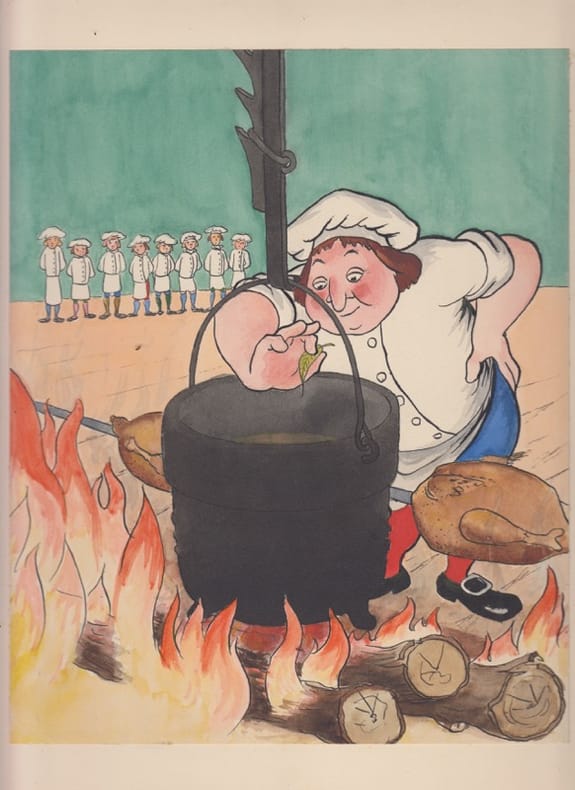
27284aquarelle originale 26 x 21 cm; collée sur carton ,avec cachet les films Paul Grimault au dos.- Réalisation : Paul Grimault - Scénario : Jacques Prévert et Paul Grimault, d'après La Bergère et le Ramoneur de Hans Christian Andersen - provenance archives Henri Lacam,bon état.
8vo. VIII, 572, (28) pp. (tables, index, errata and list of available works). Contemporary blue wrappers as issued. Extremely rare publication, the author's last theoretical work to appear in print. "The comprehensive 'Anleitung zu Temperaturberechnungen' [was] written with the most scrupulous scientific exactitude (it was printed by 1806 but, owing to the political situation, did not appear until 1808). In it he described in terms readily comprehensible to specialist and layman alike all the systems of equal, unequal and approximately equal temperament in use at the time, and subjected them to close critical examination without, however, pronouncing in favour of any particular one" (New Grove). There are also copies with the imprint "at the expense of the author" on the title. The German theorist and composer Türk (1750-1813) was also a notable organist and music professor. - Old stamp to title-page. Slighly foxed. An untrimmed copy, binding somewhat frayed along edges, occasional slight edge flaws. Eitner IX, 469. New Grove XIX, 267. MGG XIII, 952. Not in Wolffheim.
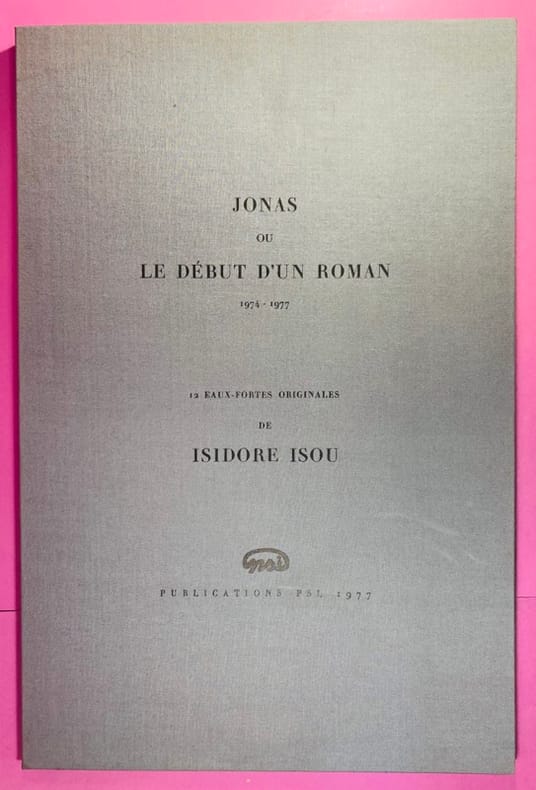
197717991977 Couverture souple Paris, Publications PSI, 1977. Un volume in folio (50 x 32,5 cm), en feuilles sous un portfolio de l'éditeur titré et entoilé, portfolio à rabats, quelques marques fines et marginales au portfolio. Feuillet de titre, 12 eaux-fortes originales de l'artiste sous serpente, toutes justifiées et signées par l'artiste à la mine de plomb, feuillet de justification du tirage. Tirage à 78 exemplaires, le nôtre un des 60 exemplaires numérotés sur grand vélin d'Arches. Les gravures ont été imprimées sur les presses à bras des publications Psi, la typographie en Didot est de Fequet-Baudier, l'emboîtage a été réalisé par Bernard Duval. Achevé d'imprimer le 15 juin 1977. Isidore Isou est le fondateur (avec Gabriel Pomerand) du lettrisme, mouvement qui repose sur l'idée de dépasser les formes traditionnelles de l'art en utilisant les lettres, les signes et les sons comme matériaux de base, plutôt que les mots ou images conventionnelles. "Jonas ou le début d'un roman" s'inscrit dans la série des "romans hypergraphiques" d'Isou, qui repoussent les limites du roman traditionnel en associant gravure, dessin, photographie et texte. Ce titre a été exposé dans le cadre de rétrospectives consacrées à Isou, notamment à l'Institut culturel roumain de Stockholm en 2012. Bel état des planches, bel exemplaire.
27283aquarelle originale 26 x 21 cm; collée sur carton ,avec cachet les films Paul Grimault au dos.- Réalisation : Paul Grimault - Scénario : Jacques Prévert et Paul Grimault, d'après La Bergère et le Ramoneur de Hans Christian Andersen - provenance archives Henri Lacam,bon état.
272862 aquarelles originales 26 x 21 cm; collées sur carton ,sans le cachet des films Paul Grimault au dos.- Réalisation : Paul Grimault - Scénario : Jacques Prévert et Paul Grimault, d'après La Bergère et le Ramoneur de Hans Christian Andersen - provenance archives Henri Lacam,bon état.
Oblong folio (265 x 345 mm). 15, (1) pp., including engraved title designed around Princess Augusta royal cypher. Contemporary full red panelled morocco. The boards each with a border made up of roll tools of flowers and etc. in gilt and blind, the corners with onlaid black morocco squares of harps enclosing a leaf and star roundel; the whole enclosing around central "gothic" window design silk; end leaves (edges perished) gilt edges. Neat ink royal cypher stamp of Princess Augusta of Hesse-Kassel, Duchess of Cambridge on corner of title-page. A finely bound presentation copy from the composer to the dedicatee. Anton Wallerstein (1813-92) was a virtuoso violinist and composer. Born in Dresden to a family of Jewish merchants, he first received violin lessons at an early age and began to play at local inns and private gatherings before making a concert debut at fourteen in 1827, establishing his career as a musician. Though still a teenager, he began a concert tour through Germany and at sixteen attained the post of violinist to the Dresden Court Ensemble. In 1832 he held a similar position in Hanover and it was through this employment that he was to dedicate his Opus 8 to his patron the Princess Augusta of Hesse-Kassel, Duchess of Cambridge (1797-1889). - The work contains six settings to German poets: 1) Goethe's "Romanze aus Erwin und Elmire Romanze"; 2) Antoine-Francois-Claude Ferrand's "Der Rosenstrauch"; 3) Emil Reiniger's "Sehnsucht"; 4) August Schumacher's "Der Schiffer"; 5) Franz von Gaudy's "Das Trauerhaus"; 6) Julius Moser's "Der Mond und Sie!" (uncredited). Until 1837, when they moved to London, Adolphus Duke of Cambridge and his wife Augusta lived in Hanover, where the Duke was Governor General. Augusta was very keen on music and the theatre, so this special copy of Wallerstein's composition probably travelled to London with them. The same year Anton Wallerstein also seems to have lost his post at Hanover, anti-Semitic issues having been indicated as the reason, but in general he had a fairly good career as a travelling violin virtuoso in Germany and Britain, publishing more commercial, if probably less cultured, polkas and waltzes. OCLC locates one copy at the British Library.
- M. & J. de Brunoff, Paris s.d. (circa 1930), 22x27,5cm, agrafé. - (COLLECTIVE) Théâtre de la pantomime futuriste [Futurist Pantomime Theater] M. & J. de Brunoff, Paris n. d. [c. 1930], 22 x 27,5 cm, stapled First edition. Biographies of the most celebrated futurists, richly illustrated. A very good copy despite a light foxing to upper cover. $ 2 500 [FRENCH VERSION FOLLOWS] Edition originale. Biographies des futuristes les plus illustres, riche iconographie. Bel exemplaire malgré d'infimes piqûres sur le premier plat.
In 8', br. ed. pp. XIX, 26 tavole fotografiche in n. f.t. in fine.strappetti e piccole mancanze al dorso, cop. e carte leggermente brunite, margini delle tavole lievemente ingiallite, sovrac. mancante.Editore Edizioni di Corrente dirette da Ernesto TreccaniAnno pubblicazione 1941Materia/Argomento Cinema, FotografiaCollana Arte- IV