52 942 résultats
Typendruck auf elfenbeinfarbiger, an drei Seiten im Zickzack beschnittener Seide. 1 S. Mit figürlicher Holzschnitt-Vignette. Folio (225 x 350 mm). Seltener, sonst nicht nachweisbarer Theaterzettel auf Seide für eine Karlsbader Doppelaufführung. Im Hauptprogramm wurde "Die Wiener in Berlin" gegeben, Karl Eduard von Holteis beliebte Posse von 1824, deren Erfolg der Autor dann mit seinen "Berlinern in Wien" zu wiederholen versuchte - Liederspiele, in denen Holtei auf witzig-moralisierende Weise die idiomatischen Unterschiede der beiden Stadtvölker ausbeutete. - "Karlsbad. Mit hoher Präsidial-Bewilligung wird heute Samstag, den 31. May 1828 von der Sänger- und Schauspielergesellschaft, unter der Direktion der Therese Schantroch aufgeführt: Das Räthsel. Lustspiel in 1 Akte in Alexandrinnern, von Kontessa [...] Hierauf: Die Wiener in Berlin. Liederposse in 1 Akte von Karl Holtei, die Musik von Herrn Blum [...] Anfang um 5 Uhr". - Mittige Knickfalte, sonst ungewöhnlich sauber und frisch. Hübscher Seidendruck des frühen 19. Jahrhunderts.
Choix de Christian Strich. Préface de Georges Simenon. Il testo è in francese. Dedica con autografo di Fellini "A mon ami George 1978". Strappi alla sovracoperta<br/>Legatura rilegato in tela editoriale con sovracoperta<br/>Formato Quarto<br/>Num Pagine 342<br/>Illustrazioni 400 fotografie in b/n e a colori fuori testo<br/>Prima Edizione
4to (220 x 265 mm). 16 pp. With 6 lithographed illustrations on 5 plates. Contemporary blue glazed wrappers. Only edition. - The composer Barraga (1825-99) served as choir master and music teacher in Munich (cf. RISM). His doctrine followed the mathematical system of harmony established by Georg Joseph Vogler (1749-1814), a composer of the Mannheim school and a diligent reformer of baroque organs. Barraga's theory describes harmonical and metrical knowledge as the grammar of musical rhetoric, while the necessary prerequisite for the representation of beauty is logic, paired with sentiment. Harmonical and metrical relations are to be expressed by a system of signs similar to the Roman numeral analysis anticipated by Vogler, of which Barraga provides numerous examples in the text and on the plates. For the author, music is to be conceived as a living "mathematica integra", as attested by Mozart in particular. Perhaps surprisingly, Barraga does not mention Johann Sebastian Bach. - Very light foxing; wrappers slightly creased. A clean copy on large paper. OCLC 831087605.
Prima edizione, tiratura di testa. CON DEDICA Esemplare 30 di 50 che compongono la tiratura di testa, intonso e in eccellenti condizioni. Firma autografa di Bontempelli alla prima sguardia e bell’ex libris xilografico di collezione privata. Della tiratura di testa furono tirate complessive 86 copie variamente contrassegnate (I-XII, A-Z e 1-50). Comprende «Valoria», «Nembo» (già editi in rivista), «Primo spettacolo», «Nostra dea», «Minnie la candida», «Bassano padre geloso» e «La fame». Nel testo anche 36 pagine di partiture musicali.
Edizione originale. CON DEDICA Esemplare in ottime condizioni, con dedica autografa di Carlotta Pisani Dossi, moglie di Carlo, all’occhiello. Rara, tirata in soli 100 esemplari non venali. Spiritosa e arguta commedia in dialetto milanese ambientata (e composta) nel 1873 a Milano. Uscì solo 32 anni più tardi, nel 1905, come ricordato nella Nota degli autori: «Sta comedia, o per dì mèj, sta giavanada, l’è stada scritta da duu amis in d’ona settimana, la bellezza de trentaduu ann fà». E i due amici, nascosti sotto lo pseudonimo collettivo di “Pisper”, non sono altro che Carlo Dossi Pisani e Luigi Perelli, cfr. A. Saccone, «Il Dossi studierà il Dossi. Il Libro delle prefazioni di Carlo Dossi», “Modern Language Notes”, 110/1 (1995), p. 58. Splendida copia, impreziosita dalla dedica della moglie di Dossi, Carlotta, “all’ottimo amico Dottor Achille Fumagalli perché possa passare un momento di buon umore”, che dunque riprende, nel suo invio, proprio le intenzioni che spinsero gli autori alla pubblicazione: «la “Famiglia de cilapponi” l’è tornada su dalla foppa, sana, viscora e con la voeuja anmò de fà rid - roba, che, dopo tutt, in stoo mond chi pien de miseri l’è ben mèj del fà piang». Isella - Reverdini, La vita di Alberto Pisani, 1921.1; A. Saccone, «Il Dossi studierà il Dossi. Il Libro delle prefazioni di Carlo Dossi», Modern Language Notes, 110/1 (1995), p. 58
197769858Presse : Chantal Poupau - 325.86-58 (28-94) Assistance Florence Bory, 1 vol. grand in-8 br (sous adhésif noir d'origine), couverture illustrée, 13 ff. dactylographié reprographiés, s.n. [ L'Institut National d'Audio-Visuel et Stéphane Tchalgadjieff ], s.d. [ 1977 ]
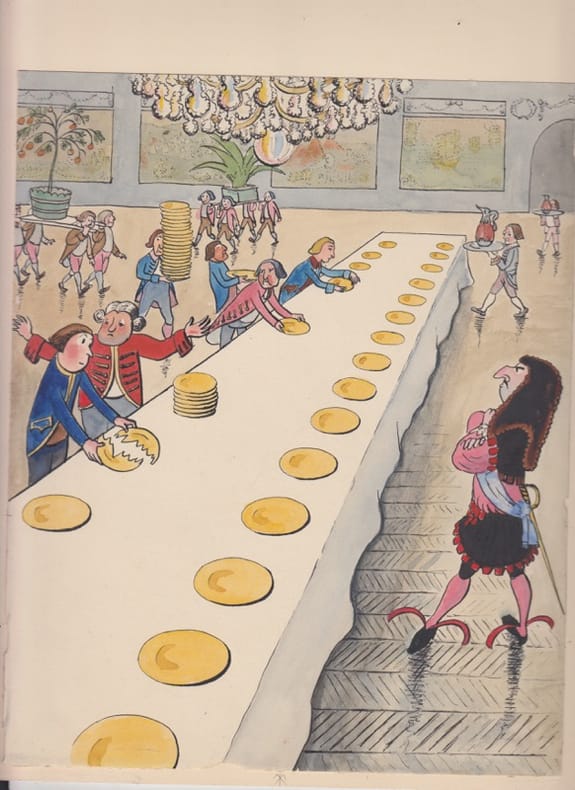
27281aquarelle originale 25 x 21,5 cm; collée sur carton ,avec cachet les films Paul Grimault au dos.- Réalisation : Paul Grimault - Scénario : Jacques Prévert et Paul Grimault, d'après La Bergère et le Ramoneur de Hans Christian Andersen - provenance archives Henri Lacam,commentaire au crayon : exceptionelle qualité à tous...,bon état.
27282aquarelle originale 26 x 21 cm; collée sur carton ,avec cachet les films Paul Grimault au dos.- Réalisation : Paul Grimault - Scénario : Jacques Prévert et Paul Grimault, d'après La Bergère et le Ramoneur de Hans Christian Andersen - provenance archives Henri Lacam,bon état.
192930108Exemplaire réimposé, avec un tirage d'époque par Henri Martinie Paris, Gallimard, (26 janvier) 1929. 1 vol. (170 x 215 mm) de 235 p. et [1] f. Broché. Édition originale. Un des 110 premiers exemplaires réimposés sur vergé (n° XLV). Il est joint à l'exemplaire un tirage contemporain du jeune Kessel, photographié de face par Henri Martinie. [Paris, circa 1930]. 1 tirage argentique (130 x 175 mm). Tampon « H. Martinie. Ses portraits. 19 rue de Penthièvre. Paris ».
12mo. (4), 188 pp. With woodcut title vignette and folding lithographed plate. Contemporary printed wrappers. Second edition. "Curious little book" (Guyaux) of memoirs by the famous French acrobat Léotard (1838-70), who invented the flying trapeze as well as the gym tights that became the ubiquitous wear of the dance class and were subsequently named after him. The first edition also appeared in 1860 and is identical in text. "Telling less of [Leotard's] art than of his good fortune" (ibid.), this interesting work includes a striking lithograph by Jean Émile Durandeau (1827-80), showing the artist clasping his trapeze in mid-air high above Paris, surrounded by drolleries of female figures also holding on to trapezes, one of them sticking out her tongue. The image suggests the "mixture of audacity and vanity which characterizes the tone of the whole work" (ibid.). - Born in Toulouse as the son of a gymnastics instructor, Léotard practised gymnastics from a young age and later joined the renowned Cirque Napoléon. In 1859 he invented the first flying trapeze known in the Western world. He built an act around his trapeze and played it for a decade throughout Europe, a performance attended by many famous personalities, including Charles Dickens, who wrote in a letter to the actor William Macready: "I have been beguiled into seeing Léotard, and it is at once the most fearful and most graceful thing I have ever seen" (11 June 1861). - Binding slightly worn. Paper somewhat waterstained near lower right corner and near the gutter; occasional foxing; small tear to the plate, not touching image. Rare in the trade. Guyaux/Marchal, La vie romantique 14. Toole-Stott, Circus and Allied Arts 349, 66. OCLC 561945474.
Large 8vo. (4), 207, (1) pp. With 20 folding engr. plates of musical notes. - (Bound with) II: Asioli, B[onifacio]. Principi elementari di musica adottati dal R. Conservatorio di Milano per le ripetizioni giornaliere degli alunni. Mailand, (Carlo Dova for) Giovanni Ricordi, [1811]. 49, (3) pp. With 3 folding engr. plates of musical notes. Contemporary half calf with giltstamped title to spine. Second edition of this splendid instructional work (first published by Zerletti in 1775). Treats the entire field of singing technique, common musical ornaments and instrumental flourishes, and the rules of accompaniment and harmonization. In addition, Manfredini provides advice on how to interpret certain pieces (cf. MGG). V. Manfredini (1737-99) had been Kapellmeister of Empress Katharine II and teacher of her son Paul before retiring to Bologna in 1768, where he wrote his present chief theoretical work. His views on voice instruction drew severe criticism from Mancini. "The second edition (Venice, 1797) was much revised and enlarged with new sections on singing and counterpoint" (New Grove). - Bound with the undated "seconda edizione" of Asioli's principal instructional work, the "Principi elementari de musica" (first published in Milan in 1809). Asioli enjoyed a great teaching reputation; Mozart's son was among his students. Next to Simon Mayr, Asioli was regarded as one of the foremost masters in Italy. His writings on musical theory and methodology remained influential throughout most of the 19th century (cf. MGG I, 753f.). Rare in all editions; no copy at auctions since 1950. - Spine somewhat rubbed; interior slightly browned due to paper. Altogether a fine sammelband containing two important works of theoretical and practical musical instruction. I: Hirsch I, 343. Eitner VI, 299. New Grove XI, 615. MGG VIII, 1580. RISM B/VI, 533 & M-019b. ICCU CFIE\024653. OCLC 17704373. Cf. Fétis V, 427. Wolffheim I, 800. Gregory/Bartlett I, 164. - II: Eitner I, 218. Cf. MGG I, 754. New Grove I, 656.
Half-length figure within an oval, in profile to right. Coloured stipple engraving by John Chapman, from "Encyclopaedia Londinensis", 1817. Platten measurements 162 x 114 mm, leaf size 275:210 mm. The blank margins show some age toning, otherwise well preserved. The portrait has recently become the focus of scholarly debate; cf. the article by Peter Kothe, "Wie 'echt' ist John Chapman's Mozart-Porträt? Betrachtungen zu einem englischen Kupferstich des Jahres 1817" (in: Mitteilungen der Internationalen Stiftung Mozarteum 33).
1933R100009207NON PRECISE. 1932-1933. In-12. Broché. Bon état, Couv. convenable, Dos satisfaisant, Intérieur frais. 1 lot de 65 photos anciennes situées en noir et blanc de 12 x 17 cm. Représentant : des rassemblements sous le 3° reich, Thams & Gare, Porte de Berlin, portraits, délifés, feu d'artifice, navale, défilé cycliste, montagnes, recherches, hôpital.. . . . Classification : 0-Affiches Cinéma
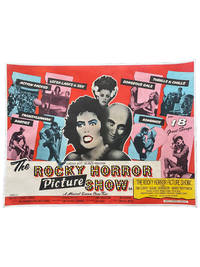
004941Bradford: W. E. Berry Ltd. 1975. Printed poster UK quad approximately 1010mm x 760mm in size backed on to linen with another 10mm margin all around. Hint of old folds with minor wear to the folds some colour retouching to the pink colour on one of the folds otherwise quite bright and clean. The cult classic by Richard O'Brien starring Tim Curry and Susan Sarandon with the poster designed by John Pasche who is probably best known for the Rolling Stones' lips and tongue logo. The original issue with the 'AA' rating rather than the later re-release with the '15' rating. An attractive example of an uncommon poster. First Edition. Unbound. Good. Illus. by Pasche John. Double Elephant Oblong. Poster. W. E. Berry Ltd. Paperback
Edizione originale. Tutto il pubblicato (196 fascicoli) della prima e della seconda serie (marzo 1954 - febbraio 1958) del settimanale «Il Contemporaneo». Fascicoli sciolti in ottime condizioni conservati in eleganti astucci con titoli al dorso raccolti in 6 cofanetti in tela. Rivista di letteratura, politica e cultura d’ispirazione marxista fondata a Roma nel 1954 sotto la direzione di Romano Bilenchi, Carlo Salinari e Antonello Trombadori. Settimanale fino al febbraio 1958 (quando terminano le pubblicazioni della “seconda serie” caratterizzata dal grande formato 42 x 58 cm), il periodico - che vantava nel proprio comitato direttivo, oltre ai già ricordati Salinari e Trombadori, Abe Steiner, Glauco Viazzi, Carlo Melograni e Renato Guttuso - comincerà a uscire dal marzo di quell’anno con cadenza mensile. Con articoli, interviste e approfondimenti di altissimo livello dedicati alla letteratura, all’arte e alla politica e con le sue pregevoli illustrazioni in bianco e nero, «Il Contemporaneo» si propose, fin dal numero inaugurale, di favorire la «conquista di un modo nuovo di guardare il mondo, senza evasioni e senza pessimismo [...] ma con ferma fiducia nelle possibilità umane di progresso; la conquista di una nuova vita morale è un fatto essenziale per una nuova cultura del nostro tempo».
- Denoël, Paris 1943, 14,5x23cm, broché. - The definitive edition, first in parts, one of 25 numbered copies on vélin d'Arches paper, the only large paper copies. Illustrated. One small insignificant lack to foot of spine, a few small wormholes principally to endpapers, two tiny marginal tears without lack to lower cover, internally good. Rare. [FRENCH VERSION FOLLOWS] Edition définitive et en partie originale, un des 25 exemplaires numérotés sur vélin d'Arches, seuls grands papiers. Iconographie. Un léger manque sans gravité en pied du dos, quelques petites piqûres affectant essentiellement les gardes, deux infimes déchirures marginales sans manque sur le deuxième plat, agréable état intérieur. Rare.
In quarto 23x33,5, mezza pelle, astuccio in tela, tagli sup. dorati, pp. 512. 5 acqueforti di Renato Guttuso, numerate e firmate conservate in cartellina in fine. Esemplare n. 55.Segni di usura alla tela dell'astuccio, volume in buone condizioni, lievi fioriture su 3 acqueforti.Questa edizione esce postuma per la scomparsa dell'Autore avvenuta in Verona il 26 ottobre 1982 mentre rivedeva le ultime bozze di questo suo volume.La tiratura di 220 esemplari di cui duecento sono numerati da 1 a 200 e venti fuori commercio recano i numeri romani da I a XX. Ogni esemplare contiene sciolte cinque acqueforti originali di Renato Guttuso firmate e numerate eseguite nel 1982 e tirate da Nicola e Caterina Manfredi. La rilegatura in mezza pelle. Sono stati inoltre tirati cento esemplari del solo testo numerati da 201 a 300 e rilegati in tutta tela. L'opera stata composta e impressa su carta Magnani a cura di Martino Mardersteig nella stamperia Valdonega per la Libreria Antiquaria Prandi di Reggio Emilia.Luogo di pubblicazione Reggio EmiliaEditore Libreria PrandiAnno pubblicazione 1983Materia/Argomento Biografie, Cinema, Arte
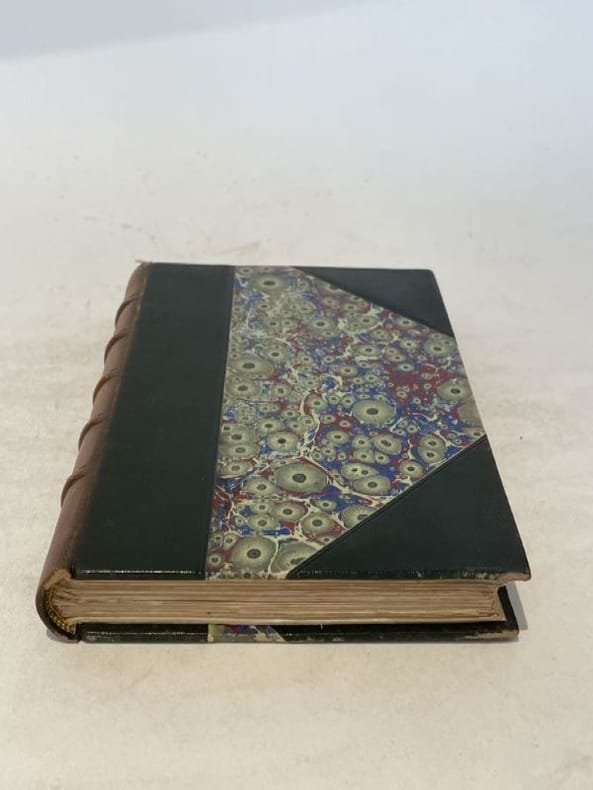
18944587Paris, G. Masson, 1894. Un volume in-8 de VI-335 pages, demi-maroquin vert, dos lisse orné de filets, roulettes et titre dorés.
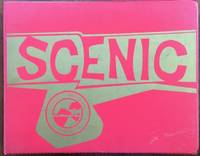
196560316Los Angeles CA: Scenic Backgrounds Inc. 848 North La Brea Avenue ca. 1965. Oblong 4to. 12.75 x 10 in. 106 leaves unnumbered. photo illustrations throughout two leaves extra-illustrated with four sample silver gelatin photos sized 4 x 5 in. mounted on blank leaves some offset toning to leaves below from blue marks sections demarcated with thumb-tab separator leaves. Red printed vinyl 3-ring binder title in gilt on front cover & spine on background rounded corners minor dustsoiling to first leaf couple corrections in pencil & ink manuscript minor pulling at gutter margin to a few leaves soiling to back cover still a VG- copy from the library of Joe Emil Joseph Minneci 1912-2002 a Chicago-born carpenter and scene painter who moved to Los Angeles following World War II with his family and worked for years in the studios w/ ownership in gilt cursive on front cover. First edition thus of this exceedingly scarce and extra-illustrated sample catalogue for scenic backdrops in order to lower production costs on movie and television production by offering ready-made and large painted scene flats for studios & theaters. These here include depictions of Residential Western & Commercial Architectural backdrops City Skylines Western Parks Hills & Mountains and Tropical Landscapes Skies & Clouds Transportation Miscellaneous and birds-eye cityscape profiles. Available sizes range from 14 x 19 feet up to 20 x 40 feet and include surrealistic backdrops animated and those with signage. Although undated the commercial architectural scenes include images of readily identifiable cars including 1965 Dodge GTO 1964 Camaro 1964-5 Mustang as well as 1962 Ford Falcon and also mentions the increasing use of colour for television broadcasting. In addition many of the scenes include those for the very popular Western genre films and shows during the Mid-20th-Century and some very distinctive Mid-Century Modern homes and exteriors are presented here as well. Two of the extra-illustrated scenes appear to depict a bucolic Northern California countryside of rolling hills and spreading trees above which measured 18 x 20 feet each to tie-in with one another; while the others focus on a tropical backdrop. Scenic Backgrounds Inc. appears to have been founded sometime around 1950-1952 with the introduction indicating that they had employed the best artists for over 12 years. In addition the Company appears in none of the contemporary street directories or trade journals we could search however it did place advertisements in some of the contemporary magazines and appeared to operate until about 1970. Whether Joe Minneci was an owner it is difficult to determine but originally the Minneci’s lived in West Los Angeles in the Fairfax area before moving to Encino. Often these scene and backdrop companies would rent out their scenery to stage productions opera houses and even fraternal order productions. These original sales catalogues for this essential part of the film and television industry are quite scarce. No copies in Worldcat. Scenic Backgrounds, Inc., 848 North La Brea Avenue, unknown
Prima edizione autonoma, uscita lo stesso anno dell’editio princeps senese. Eccezionale esemplare in condizioni pressoché perfette, in barbe. Nel 1782, mentre Alfieri si trovava a Roma insieme all’amata contessa d’Albany, mise in scena l’Antigone, riscuotendo un grande successo. Si convinse dunque a pubblicare le sue tragedie (Filippo, Polinice, Antigone e Virginia), affidando la stampa alla tipografia senese dei fratelli Pazzini Carli. L’esito, però, fu deludente, e il poeta arrivò a definire l’edizione “sudiciamente stampata” (Bustico, Bibliografia di Vittorio Alfieri, n. 1). L’anno successivo uscì dunque l’edizione torinese, la prima autonoma. All’antiporta bel ritratto di Vittorio Alfieri dipinto da Xaverio Faber e inciso da Luigi Paradisi. -- Molto raro, censito in soli quattro esemplare nel catalogo Sbn (Biblioteca del Centro nazionale di studi alfieriani, Asti; Biblioteca Medicea Laurenziana, Firenze; Biblioteca Angelica, Roma; Biblioteca Nazionale Universitaria, Torino). Sconosciuto al Bustico.
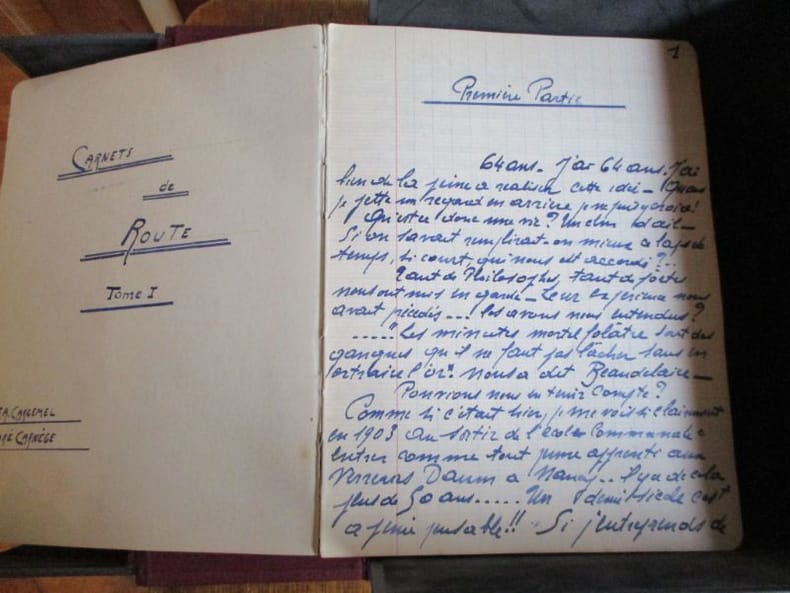
66074 cahiers manuscrits de format 22,5cmX17cm 285, 280, 284 et 273 pages dans une boite relure titrée André Carnège carnets de route 1890-1961 manuscrit inédit
1926101874Paris Bernard Grasset 1926 1 vol. relié in-12, demi-chagrin vert sapin à coins, dos à nerfs, caissons ornés d'un fleuron doré, tête dorée, couvertures et dos conservés, 252 pp. Édition originale de ce roman d'inspiration surréaliste, hommage à un acteur comique d'Hollywood, "Cecil, Adams", dans lequel on reconnaît aisément Charlie Chaplin. Un des 7 exemplaires de tête numérotés sur Japon, avec un bel envoi autographe signé de l'auteur à Paul Eluard : "Un coup de dés, jamais n'empêchera cet exemplaire d'être à Paul Eluard, bien amicalement René Clair, 1930". En cet été 1930, Eluard et Nush passaient quelques jours sur la côte d'Azur en compagnie du cinéaste, proche des surréalistes depuis qu'il avait réalisé en 1924 le film Entr'acte où apparaissent notamment Francis Picabia, Erik Satie, Man Ray et Marcel Duchamp. Dos passé, mais excellente provenance.
19701032601970 Tokyo, Shinsen-sha, octobre 1970-septembre 1973, 258x182mm, 120-160pp, couvertures illustrées ainsi que les vignettes par Genpei Akasegawa du n°1 au n°24, puis par Fujio Akatsuka du n°25 au n°36, textes critiques, 6 planches imprimées en photogravures en frontispice du no.1 au no.24Broché, dos carré, couverture illustrée.Revue critique du cinéma d’avant-garde, expérimental. Textes sur : J-L Godard, Buñuel, Pasolini, J-P Sartre, Gillo Pontecorvo, Satyajit Ray, Dziga Vertov, Luchino Visconti, Mikhail Il’ich Romm, Giuliano Montaldo, Robert Enrico, Louis Malle, Pier Paolo Pasolini, Joseph Losey, Kijû Yoshida, Toshio Matsumoto, Kôji Wakamatsu, Kaneto Shindô, Masahiro Shinoda, Akio Jissôji, cinéma russe, cinéma grecque et d’autres, chroniques, articles de fond sur l’Histoire, la Sociologie, ou la Politique du monde entier.Frontispice en photogravure :No.4-no.9, Takuma Nakahira et Masao Matsuda.No.10-no.13, Takuma Nakahira et Genpei Akasegawa.No.14 : Genpei Akasegawa, Kôji Wakamatsu, Masao Adachi.No.15 : Genpei Akasegawa. No.16-no.24, Chronique « Sakura Graph » texte, manga et photos par Genpei Akasegawa.Réf.The 70s in Japan 1968-1982, Museum of Modern Art, Saitama, 2012, p.140-141. (103260)
27287une feuille sans marge,31x23 cm,sans indication - provenance archives Henri Lacam,bon état.