8 853 résultats
1915136474Neuilly-sur-Seine France: Gaumont 1915. Vintage double weight matte finish still photograph from the legendary 1915 silent film serial. With the Gaumont logo at the lower right corner. Shown here is Musidora as Irma Vep conferring with another member of The Vampires an anarchist criminal gang at the center of the story. <br/><br/>The director's magnum opus "Les vampires" is one of the great crime epics nearly 7 hours in length acknowledged as a strong influence on the surrealists and by directors Alfred Hitchcock and Fritz Lang in the development of the thriller as well as the earliest masters of avant-garden cinema. The second of Feuillade's three film serial masterpieces preceded by "Fantomas" 1913 and followed by "Judex" 1915 combining elements of both. <br/><br/>11 x 9 inches. Near Fine. <br/><br/>Hardy The BFI Companion to Crime. Gaumont unknown books
1960141447Tokyo: Shockiku Ofuna 1960. Draft script for the 1960 film. Text in Japanese. <br /> <br /> A young woman is hitchhiking when the driver who picks her up attempts to molest her. A young gangster comes to her aid and then leads her on a wild relationship through the Japanese underground towards the eventual destruction of both of them. <br /> <br /> White titled perfect-bound wrappers. Title page present. 40 leaves with last page of text numbered 40. Mechanical duplication. Pages Near Fine wrapper Near Fine bound with two staples. <br /> <br /> Godard Histoires du cinema. Shockiku Ofuna unknown
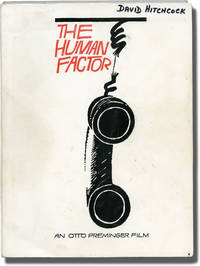
145780Beverly Hills CA: Metro-Goldwyn-Mayer MGM 1978. Draft script for the 1979 film. Illustrated front wrapper based on Saul Bass' poster design for the film. Copy belonging to uncredited crew member David Hitchcock with his name in manuscript ink on the front wrapper. Manuscript annotations throughout primarily indicating deleted scenes. <br /> <br /> Also included is a carbon typed letter signed by Otto Preminger dated 19th October 1979 to dubbing editor Peter Pennell terminating his employment at the conclusion of production. <br /> <br /> The final film directed by director Otto Preminger based on the 1978 novel by Graham Greene with screenplay written by Tom Stoppard about a low-level bureaucrat in the British Secret Service M16 who finds himself unknowingly used by the Soviets as he struggles with his love for his family and the ambiguity of his ethical responsibilities.<br /> <br /> Set and shot on location in UK and Kenya. <br /> <br /> White illustrated titled wrappers. Title page present dated 1978 with credits for screenwriter Tom Stoppard and novelist Graham Greene rubber stamped copy No. 146. 146 leaves with last page of text numbered 146. Xerographic duplication rectos only. Pages Fine wrapper Very Good plus bound internally with a silver prong binding. Metro-Goldwyn-Mayer [MGM] unknown
1978145780Beverly Hills CA: Metro-Goldwyn-Mayer MGM 1978. Draft script for the 1979 film. Illustrated front wrapper based on Saul Bass' poster design for the film. Copy belonging to uncredited crew member David Hitchcock with his name in holograph ink on the front wrapper. Holograph annotations throughout primarily indicating deleted scenes. <br/><br/>Also included is a carbon typed letter signed by Otto Preminger dated 19th October 1979 to dubbing editor Peter Pennell terminating his employment at the conclusion of production. <br/><br/>The final film directed by director Otto Preminger based on the 1978 novel by Graham Greene with screenplay written by Tom Stoppard about a low-level bureaucrat in the British Secret Service M16 who finds himself unknowingly used by the Soviets as he struggles with his love for his family and the ambiguity of his ethical responsibilities.<br/><br/>Set and shot on location in UK and Kenya. <br/><br/>White illustrated titled wrappers. Title page present dated 1978 with credits for screenwriter Tom Stoppard and novelist Graham Greene rubber stamped copy No. 146. 146 leaves with last page of text numbered 146. Xerographic duplication rectos only. Pages Fine wrapper Very Good plus bound internally with a silver prong binding. Metro-Goldwyn-Mayer [MGM] unknown books
1969141375New York: Two Faces / New Yorker Films 1969. Vintage poster for the 1969 film an experimental mix of documentary and fiction. Poster designed by Robert Frank. <br /> <br /> Director Robert Frank's first feature film in which he follows poet Peter Orlvosky and his mentally ill brother Julius as they move through the late 1960s Beat scene while Peter tries to care for his mostly catatonic brother. When Julius wanders off he is replaced in the film by actor Joseph Chaikin. The film examines the boundaries of reality and sanity and features the screenwriting debut of Sam Shepard and the first feature film appearance of Christopher Walken. <br /> <br /> The film was restored and released by Steidl in 2007 along with a book publication outlining the film. From the Steidl book: "Frank's feature debut was first screened in 1968 at the Venice Film Festival. Everything which had defined Frank's art up to that point turns up in this film - the look at America 'from the outside' the poetic libertinage of the Beats the marginal in a central role. It celebrates the return of the poetic essay as assemblage the affirmation of the underground as a wild cinematic analysis in the form of a collage and skillfully weaves together opposites plays counterfeits against the authentic pornography against poetry acting against being Beat cynicism against hippie romanticism monochrome against colored. The story contains bizarre twists and turns and appears to be a rather artless-film-within-a-film being shown at a rundown movie theater."<br /> <br /> 26.75 x 20.75 inches. Near Fine. In a custom frame. Two Faces / New Yorker Films unknown
1957154183Hollywood: Howco Productions 1957. Draft script for the 1957 film. Copy belonging to actor Dick Miller with his manuscript pencil annotations throughout. Miller was apparently considered for the role of Stanley as many of Stanley's lines are marked with manuscript pencil and then struck through but was ultimately cast in the role of Ben. <br /> <br /> The gangster owner of a nightclub on a carnival pier is tormented by his love for the club's star who herself is in love with a local businessman with dreams of buying out the club. An early role for Miller who appeared in 14 films directed by legendary independent filmmaker Roger Corman between 1955 and 1961 and would continue to work with Corman throughout his career.<br /> <br /> Red titled wrappers. Title page present undated with credits for screenwriter Leo Lieberman. 72 leaves with last page of text numbered 71. Mimeograph duplication rectos only. Pages Near Fine wrapper Near Fine bound internally with three gold brads. Howco Productions unknown
1966141426Tokyo: Nikkatsu 1966. Draft script for the 1966 film. Text in Japanese. <br /> <br /> Based on a novel by Takashi Suzuki a repressed Catholic young man living in a boardinghouse is infatuated with the landlady's daughter and when he cannot express his feelings he turns to violence. He joins a gang and begins a fighting routine exploiting the weakness of classmates. <br /> <br /> Set in Okayama shot on location in Japan. <br /> <br /> Red titled perfect-bound wrappers. Title page present. 113 leaves with last page of text numbered 19. Mechanical duplication. Pages Near Fine wrapper Near Fine. <br /> <br /> Criterion Collection 269. Nikkatsu unknown
1959141461Tokyo: Nikkatsu 1959. Draft script for the 1959 film. Text in Japanese. <br /> <br /> Based on Sueko Yasumoto's novel and one of the first examples of media dealing with the plight of zainchi or ethnically Korean Japanese citizens and their identity and struggles. One man has always worked faithfully for the Toho Company and another man is working for an underworld boss trying to scam Toho. They find each other again when one begins trailing and investigating the other. <br /> <br /> White titled perfect-bound wrappers. Title page present. 177 leaves with last page of text numbered 16. Mechanical duplication. Pages Very Good plus wrapper Very Good plus bound with two staples. Nikkatsu unknown
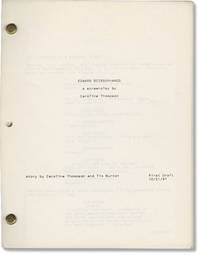
162755Los Angeles: Twentieth Century-Fox 1987. First Draft script for the 1990 film.<br /> <br /> Tim Burton's second "Modern Prometheus" film following his 1984 short "Frankenweenie" about a mad scientist who dies before he can complete his latest creation: a nearly complete human being. The creation is left with scissors for hands and doomed to live a life of solitude until a kindly mild-mannered Avon Lady welcomes him into her home.<br /> <br /> Often cited as the director's masterpiece released two years after his hilarious and creepy romp "Beetlejuice" 1988 one year after his beloved comic adaptation "Batman" 1989 and two years before his second and final contribution to the Dark Knight legend "Batman Returns" 1992. <br /> <br /> Self wrappers integral with title page dated October 21 1987. Noted as First Draft with credit for screenwriter Caroline Thompson. 117 leaves with last page of text numbered 116. Xerographic duplication circa late 1980s font rectos only. Pages about Fine wrapper Near Fine bound with two gold brads. Twentieth Century-Fox unknown
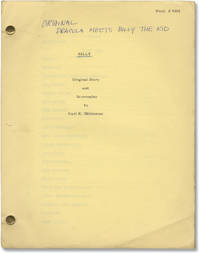
1965158305N.p.: N.p. 1965. Draft script for the 1966 film here under the working title "Billy." Annotation in manuscript ink on the title page amending the title to "Original Dracula Meets Billy the Kid." Copy likely belonging to screenwriter Carl K. Hittleman with annotations in manuscript ink and pencil on virtually every page amending dialogue and scene numbers with two unnumbered pages bound in created on a different typewriter.<br /> <br /> Dracula travels to the American West intent on making the fiancée of the now reformed Billy the Kid his next victim. One of director William Beaudine's final films originally released on a double bill with Beaudine's other Western horror picture "Jesse James Meets Frankenstein's Daughter." <br /> <br /> Front wrapper integral with title page with credits for screenwriter Carl K. Hittleman. 114 leaves with last page of text numbered 110. Ribbon copy typescript rectos only. Pages Near Fine with cello tape repair and reinforcement to final page bound with two gold brads. N.p. unknown
1969143218Tokyo: Gendai Eigasha 1969. Draft script for the 1969 film. Front wrapper notes a date of 1969 and credit as a Gendai Eigasha production. <br /> <br /> The second page is a elegaic introduction to the film story: "On the erotology and insurrection of sugi Sakae who wrote of dancing as flowers strangled and left in spring and It Noe who lived her entire life in confused beauty-we the youth and you and I in our degenerate joy which reaches an unbalanced complicity are talking."<br /> <br /> Based on the life of anarchist Sakae sugi and his relationship with three women.It is the first film in Yoshida's trilogy of Japanese radicalism followed by "Heroic Purgatory" 1970 and "Coup d'Etat" 1973. Considered to be one of the most representative films from the Japanese New Wave movement. <br /> <br /> Set in and shot on location in Japan. <br /> <br /> White titled wrappers dated 1969. Title page present. 86 leaves with last page of text numbered d-44. Mechanical duplication. Pages Near Fine wrapper Very Good plus with mild foxing on rear wrapper title on spine. Gendai Eigasha unknown
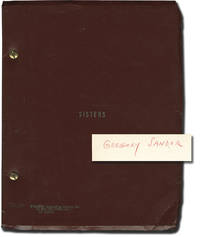
1970146086New York: Pressman Williams 1970. Draft script for the 1973 film. Copy belonging to cinematographer Gregory Sandor with his name in holograph pencil on the verso of the title page and holograph pencil annotations throughout.<br/><br/>Danielle is a beautiful model separated from her conjoined twin Dominique. When her neighbor an aspiring journalist suspects Danielle of a brutal murder the horror of Danielle's disturbing past begins to surface. Director Brian De Palma based his original story on a Life magazine article about conjoined twins in the Soviet Republic who had been successfully separated but were experiencing psychological problems as a result of the operation. <br/><br/>With its use of visually dense point-of-view and split-screen camera techniques "Sisters" is one of De Palma's earliest forays into erotic voyeurism as a conduit for psychological horror paving the way for a string of idiosyncratic psychosexual projects in the ensuing years such as "Obsession" 1976 "Dressed to Kill" 1980 "Blow Out" 1981 and "Body Double" 1984 among others. Given its focus on the anxiety of the gaze "Sisters" can also be read as an homage to Alfred Hitchcock-openly referencing "Rope" 1948 "Rear Window" 1954 and "Psycho" 1960-and indeed the film was even scored by Bernard Hermann a frequent musical collaborator for Hitchcock's films.<br/><br/>Set and shot on location in New York. <br/><br/>Maroon titled wrappers. Title page present dated 1970 with credits for screenwriters Brian De Palma and Louisa Rose. 138 leaves with last page of text numbered 138. Xerographic duplication rectos only. Pages Near Fine wrapper Very Good plus bound with two gold brads.<br/><br/>Arrow 1578. Criterion Collection 89. Grant US. Spicer US Neo-Noir. Pressman Williams unknown books
152527N.p.: N.p. 1970. Dialogue transcript for the infamous unfinished film musical undated circa 1968. Copy belonging to Frank Zappa with a single annotation in Zappa's hand on the top of the first page. <br /> <br /> Full provenance available.<br /> <br /> A transcript detailing multiple takes of ten scenes shot by Zappa for his long-planned but never finished experimental film. Transcript primarily addresses scenes featuring Don Preston and Phyllis Smith Altenhaus but also contains dialogue intended to be spoken by Carl Zappa Billy Mundi Aynsley Dunbar Jimmy Carl Black and Zappa himself. <br /> <br /> Originally innovated in 1967 by Zappa featuring his then-band the Mothers of Invention the film would morph in various ways over the course of the next decade but would ultimately never come to fruition due to a lack of financing. In 1969 the Mothers of Invention released the acclaimed double album "Uncle Meat" an instrumental soundtrack to the unfinished film. Finally in 1987 a direct-to-video "making of" documentary of the uncompleted film was released.<br /> <br /> Transparent front wrapper with orange back wrapper and spine. 59 leaves with last page of text numbered 58. Mimeograph duplication rectos only. Pages with light stain on first leaf else Near Fine wrapper Very Good plus bound internally with three silver brads. N.p. unknown
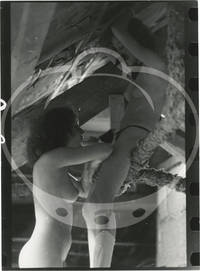
153250N.p.: N.p. 1975. Archive of 95 vintage borderless reference photographs essentially keybook photos demonstrating sequences from the 1975 French pornographic film. Included with the collection is a French pressbook for the film.<br /> <br /> Class barriers dissolve and invert in unusual and unexpected ways at the reading of an aristocratic patriarch's will.<br /> <br /> 9.5 x 7 inches. Near Fine. <br /> <br /> Bier 160. N.p. unknown
1970143238Tokyo/Kyoto: Daiei Studios 1970. Final script for the 1970 Japanese film seen here under the alternate title "Zatochi: The Killer's Song." Single folded leaf with a xerographically duplicated character list laid in with single holograph ink notation. Text in Japanese. <br/><br/>The longest-running action series in Japanese history and one of the screen's great heroes the character of Zatoichi a blind masseur and swordmaster was created by novelist Kan Shimozawa first appearing on film in 1962. A total of 26 films were made from 1962 to 1989. "Zatoichi Goes to the Fire Festival" is the 21st film of the series where Zatoichi is mentored by the blind leader of a secret organization as he contends with both the Yakuza and a jealous husband. <br/><br/>Set in the Japanese Edo period. <br/><br/>Blue titled wrappers. Title page present. 69 leaves with last page of text numbered c-50. Mechanical duplication. Pages Near Fine with mild foxing on papers edge wrapper Very Good plus title on spine. <br/><br/>Criterion Collection 679. Daiei Studios unknown books
1966148795N.p.: N.p. 1966. Collection of 20 vintage borderless photographs from the 1966 film 18 reference photographs and 2 fashion photographs of Rosaleen Murray and Ann Norman. Mimeo snipes on the verso of three of the photographs. <br/><br/>Inspired by the 1959 short story "Las Babas del Diablo" by Julio Cortazar.<br/><br/>Michelangelo Antonioni's first English-language film marking the beginning of the final phase of his work co-produced by companies in Italy the United States and the United Kingdom and featuring an international cast. The director's brash use of color set design non-standard editing techniques and typical emphasis of atmosphere over plot would carry over into the two major films that followed "Zabriskie Point" 1970 and "The Passenger" 1975. <br/><br/>In his 2009 essay on the film Danny Lyon notes "It is apt that through his established style Antonioni made a movie that is perhaps closest to communicating the myth of the swinging Sixties scene but also the confusion of the time. . Britain's new and very chaotic cultural revolution was perhaps most effectively captured by an Italian."<br/><br/>Winner of the Palme d'Or. Nominated for two Academy Awards for Best Director and Best Screenplay.<br/><br/>8 x 10 inches. Lightest edgewear else Near Fine. <br/><br/>Complete collation details available on request.<br/><br/>Criterion Collection 865. Ebert I. Grant UK/Italy. N.p. unknown books
1969136883N.p.: N.p. 1969. Original ribbon copy typescript for Tay Garnett's screenplay adaptation of Mickey Spillane's 1967 novel. Profusely annotated by Garnett in blue and red ink on every page and with a annotations by him at the top right corner of the first leaf: "First Draft Work Copy" "Screenplay by Tay Garnett" and "From Mickey Spillane's novel."<br/><br/>Raoul Walsh eventually worked with Garnett on the script but this draft precedes his involvement. The film was released on May 15 1970 and starred Yvette Mimieux Christopher George and Yvonne De Carlo. <br/><br/>182 leaves rectos only. Leaves supple Very Good plus overall. N.p. unknown books
1977143728N.p.: Objektiv Film 1977. Studio Dialogue script for the 1979 Hungarian film seen here under the Hungarian title "Magyar rapszodia." Text in Hungarian. <br/><br/>The first of Jancso's two-part dramatized history of Hungary from the turn of the century to World War II as told by the conflicted son of a wealthy landowner. Nominated for the 1979 Palme d'Or at Cannes. <br/><br/>Shot on location in Hungary. <br/><br/>Gray titled wrappers dated 1977. Title page not present presumably as issued. 112 leaves with last page of text numbered 112. Mimeograph duplication. Pages Fine wrapper Very Good plus side stapled. Objektiv Film unknown books
1963146288N.p.: The Landau Company 1963. Draft script for the 1968 film. <br/><br/>As early as 1950 there was talk of adapting Carson McCullers' 1940 debut novel "The Heart is a Lonely Hunter" for the screen. In 1963 producer David Susskind took over Jose Quintero's attempt at adapting the novel which began two years earlier with a script from British screenwriter Gavin Lambert. Susskind passed on Lambert's script opting for a script from Thomas C. Ryan.<br/><br/>Susskind planned to shoot the film in New York City with director Sidney Lumet but the project ended up being held up indefinitely. Four years later Marc Merson's Brownstone Productions had taken over the film rights with Thomas C. Ryan's original 1963 script and with Ryan co-producing. During filming Ryan and director Robert Ellis Miller would make extensive re-writes as they went.<br/><br/>One of the great film adaptations of any American novel starring Sondra Locke in her debut film opposite Alan Arkin. Although much of the political aspect of McCullers' novel was removed from the film the themes present in the author's work are readily apparent: race loneliness impoverishment and anger. Arkin and Locke were nominated for Best Actor and Best Supporting Actress Oscars. <br/><br/>Set in in a small Southern town shot on location in Selma Alabama.<br/><br/>Red titled vinyl Hart Stenographic Bureau wrappers. Title page present dated 8/26/63 with credits for novelist Carson McCullers and screenwriter Thomas C. Ryan. 130 leaves with last page of text numbered 127. Mimeographed rectos only with pink revision pages throughout dated 8/26/63. Pages Very Good plus wrapper Very Good plus bound with two metal screw brads. The Landau Company unknown books
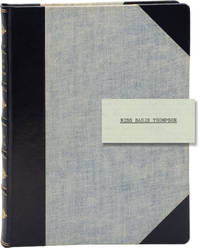
1953161400N.p.: N.p. 1953. Third Revised Final Draft script for the 1953 film with rainbow revisions. Specially bound copy belonging to producer Jerry Wald with his name in gilt on the spine. <br /> <br /> Jerry Wald is best remembered for his long and successful association with Warner Brothers as both a screenwriter and producer of a number of notable films including "Mildred Pierce" 1945 "Humoresque" 1946 "Key Largo" 1948 and "Flamingo Road" 1949. In the 1950s he moved to Twentieth Century-Fox and was the producer there for "An Affair to Remember" 1957 "Peyton Place" 1957 and "Sons and Lovers" 1960. <br /> <br /> Based on W. Somerset Maugham's 1921 short story "Miss Thompson" wherein a Christian missionary makes the salvation of a Hawaiian nightclub singer his personal project.<br /> <br /> Set and shot on location in Kauai Hawaii.<br /> <br /> Bound in light blue cloth with navy quarter leather binding with five raised bands and gilt titles on the spine. Title page present dated March 31 1953 noted as THIRD REVISED FINAL DRAFT with credits for screenwriter Harry Kleiner. 131 leaves with last page of text numbered 123. Mimeograph duplication rectos only with blue yellow pink teal goldenrod and white revision pages throughout dated variously between April 3 1953 and June 5 1953. Pages Near FIne binding Near Fine. N.p. unknown
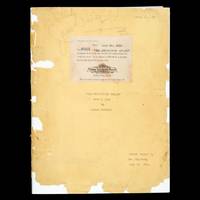
29792Culver City Calif. : Metro-Goldwyn-Mayer MGM July 24 1928. Original yellow wrappers preserved with some marginal loss on later card covers 303 x 230 mm front wrapper with typed title at centre '""The Mysterious Island"" / Screen Play / by / Lucien Hubbard'; at top right is typed 'Prod. No. 273' and at lower right 'Script Okayed by Mr. Thalberg. July 24 1928'; above the title is the original MGM studio label rubber-stamped 'No. 4664' with the typed film title and same date of July 24 1928; the pencilled name 'Jane Daly' i.e. Jacqueline Gadsden above the label appears to be written in the film star's own hand while her name is also written in pencil but in a different hand near the foot of the front wrapper; 121 leaves 280 x 215 mm mimeograph duplication; the film's title crediting Hubbard as the screenwriter and dated July 24 1928 is integral with the first page of the script; contents very clean throughout corners a little dog-eared with the two original brads in place. Rare and important draft shooting script for the Hollywood film The Mysterious Island. Loosely adapted from Jules Verne's science fiction novel L’ile mystérieuse this MGM production - a part-talkie - was filmed in two-strip Technicolour and had a checkered production history: shooting had commenced in 1926 but the film was not released until 5 October 1929. Lucien Hubbard 1888-1971 was officialy credited as the writer of the screenplay and as director even though scenes shot earlier by Maurice Tourneur and Benjamin Christensen - both removed from the project by Irving Thalberg because of their painstaking approach to filmmaking - were used in the final version. Lucien Hubbard is today perhaps best-known as the producer of the silent film Wings 1927 for which he won an Academy Award. Until recently a single ten-minute reel with a colour sequence in the UCLA Film and Television Archive was thought to be the only portion of The Mysterious Island that had survived in Technicolour although complete black-and-white prints had always been known. Then in 2013 experts from George Eastman House discovered that a colour print had been preserved in the Czech National Film Archive; the restored colour print of the film was screened at the 33rd Pordenone Silent Film Festival in October 2014. The cast of The Mysterious Island included Lionel Barrymore Count Andre Dakkar Jane Daly Jacqueline Gadsden Sonia Lloyd Hughes Nikolai Montagu Love Falon Harry Gribbon Mikhail Snitz Edwards Anton Gibson Gowland Dmitry Dolores Brinkman Teresa and Major Roup an underwater creature. Art direction was by Cedric Gibbons with technical effects by James Basevi Louis H. Tolhurst and Irving R. Ries. Jacqueline Gadsden 1900-1986 was an American film actress during the silent era. Her most famous role was in It 1927 in which she starred alongsde Clara Bow. In 1924 she had married William Harry Daly and in fact she made two other films in the same year that The Mysterious Island was released 1929 - one for Columbia and another for MGM - in which she was billed under the name Jane Daly. The Mysterious Island was her last film prior to retirement from motion pictures.  unknown
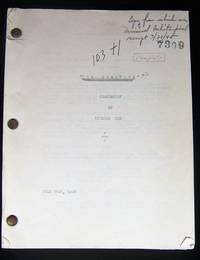
1945003033Los Angeles: Universal Studios 1945. Doyle A. Conan Leonard Lee screenwriter. PURSUIT TO ALGIERS here bearing the initial title "The Fugitive." Los Angeles: Universal Studios 1945. Dated July 26th 1945 Leonard Lee's complete brad-bound studio mimeographed draft script production number #7309 stamped on the cover consists of 113pp of typescript bearing numerous penciled revisions emendations and additions - along with another 20pp of massively hand-corrected typescript which clearly had contained so many penciled changes that the pages had to be retyped. These remarkably annotated pages have been appended to the rear of the screenplay creating a 133pp comprehensive look at the evolution of the script. Given the fragile nature of WW2-era scripts this example is in excellent original condition very good indeed the pages are a little soft with some very light edge-wear and tears. As fully marked up as any script in our nearly complete Universal Studio archive. PURSUIT TO ALGIERS set almost entirely on a passenger ship required elaborate sets and thus became the series's most expensive production; it premiered at the Rialto Theatre in New York on October 26th 1945. The twelve Sherlock Holmes films produced by Universal Pictures during the years 1942-1946 are legend; they are surely the best known screen-adapted adventures of English Literature's most iconic character and Basil Rathbone and Nigel Bruce are still cherished despite our current superb 21st century film and TV adaptations as the definitive Holmes and Watson. A treasure for the fan of the Universal Sherlock Series. Please see our other scripts from the same archive. Signed. Original Wraps. Very Good. Script. Universal Studios Paperback books
1955152818Los Angeles: Twentieth Century-Fox 1955. Final Shooting script for the 1956 film. <br/><br/>Based on the 1945 musical by Richard Rodgers and Oscar Hammerstein II in turn based on the 1909 play "Liliom" by Ferenc Molnar. A former carousel barker dies in the process of committing a robbery but is granted the opportunity to return to Earth for one day to make amends to his wife and daughter 15 years after his death.<br/><br/>Set and shot on location in Augusta Newcastle Camden and Boothbay Harbor Maine.<br/><br/>Beige titled wrappers noted as SHOOTING FINAL on the front wrapper rubber-stamped copy No. 646 and production No. 7 dated July 14 1955. Title page present dated July 14 1955 noted as Shooting Final Script with credits for screenwriters Phoebe and Henry Ephron. 126 leaves with last page of text numbered 117. Mimeograph duplication on eye-rest green stock rectos only with blue and pink revision pages throughout dated variously between 8/1/55 and 11/22/55. Pages Near Fine wrapper Near Fine bound internally with three gold brads. Twentieth Century-Fox unknown books
1976136497Beverly Hills CA: Faces Music 1976. Original poster for the 1976 film this being the Ben Gazzara style with Gazzara in a "puffy shirt." <br/><br/>One of eight known one sheet styles no priority issued by Faces Distribution for the film. Faces was a company as radical as the director himself and made small runs of posters in a wide variety of non-standard sizes and using an artful immediately recognizable style that represented a complete departure from standard film advertisement. <br/><br/>27 x 41 inches. Rolled on archival linen. Near Fine. <br/><br/>Criterion Collection 254. Silver Classic Noir. Spicer US. Faces Music unknown books
1959143374Kanagawa Japan: Daiei Studios 1959. Draft script for the 1959 Japanese film. Based on the 1956 novel by Tanizaki Jun'ichir "Kagi" or "The Key". Winner of the 1960 Jury Prize at the Cannes Film Festival.<br /> <br /> Shot on location in Japan. All titles and text in Japanese. <br /> <br /> White titled wrappers with black and gold titles and various rubber stamps on the front wrapper. Title page not present. 122 leaves with last page of text numbered "e-28." Mechanical duplication. Near Fine with light age toning. Daiei Studios unknown