151 509 résultats
First appearance of this prescient series of fictional letters, spanning sixteen months between 1932 and 1934, between a Jewish art dealer in San Francisco and his gentile business partner who has returned to Germany in the formative years of the Nazi regime. Simon & Schuster published the first book edition in 1939 and a film noir version followed in 1944. Subsequent stage play performances have continued globally until recent years. The magnum opus of Kathrine Kressmann Taylor [1903-1996], she was assigned the nom de plume Kressman Taylor by her husband and Story's editor Whit Burnett who, per an online reference, felt the concept of murder by mail was too strong to appear under the name of a woman. Occupies pages 20-32 of this 104 page magazine which is clean and unmarked with respectful wear. Front cover beginning to loosen and must be handled gently. Two-inch openings at head and foot of front cover at spine. A quality copy of this stunning literary achievement. Book
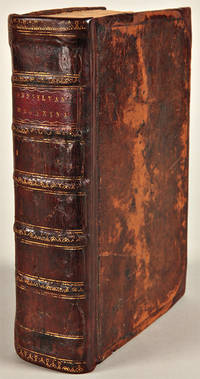
1775WRCAM46863Philadelphia: Robert Aitken 1775. Twelve issues and one supplement a complete run of the first year. 6255pp. including title signature and the supplement plus fifteen plates plate of Charlestown lacking half. Without a leaf numbered 285-286 but the text uninterrupted and evidently complete apparently a mis-pagination at the time of printing. Contemporary calf; rebacked preserving part of the original spine. Boards rubbed neatly repaired at corners "F. Bailey's" stamped in blind on each board. With the inscription in a neat contemporary hand "Ready money for clean Linen Rags By the Printer hereof" on the front flyleaf. Bookplate of the Library Company of Philadelphia with early discard stamp on front pastedown. Light foxing soiling and tanning to text. Half of the plan of Charlestown lacking. Overall almost very good. A run of the first twelve issues and the 1775 supplement of THE PENNSYLVANIA MAGAZINE. the only magazine issued in the American colonies for most of the crucial year of 1775. This copy belonged to Revolutionary- era printer Francis Bailey of Philadelphia and Lancaster Pennsylvania. In the latter location Bailey was the printer of the first edition of the Articles of Confederation. THE PENNSYLVANIA MAGAZINE is among the most important American Revolutionary-era publications for two primary reasons. First it was edited from February to July 1775 by the famous radical Thomas Paine and his regular occupation as he was developing COMMON SENSE was as its editor. Secondly it contains some of the most significant maps produced in America during the Revolution including battle plans that became prototypes for oft-reproduced illustrations. Only a small handful of similar maps were produced in America during the Revolution. Ristow describes three of the maps and plans numbers 8 9 and 10 below as "the earliest revolutionary war maps printed in America." The present collection contains the first twelve of the total nineteen issues of THE PENNSYLVANIA MAGAZINE a complete run for the year 1775. <br> <br> THE PENNSYLVANIA MAGAZINE was conceived and founded by the Revolutionary printer Robert Aitken best known for his work as a printer for the Continental Congress. Aitken launched the periodical himself but soon found it too much work and hired Paine as editor at £50 a year. Paine had only arrived in America a few months before in December 1774. He quickly became the major contributor as well as editor sometimes writing under the initials "A.B." and sometimes with no by-line. "These initials he affixed to descriptions of mechanical devices anecdotes Addisonian essays argumentative papers and poems in some variety.the most imaginative and literary of the pieces have never been reprinted. <br> <br> "Published on the eve of the American Revolution and edited by one of the leading Revolutionary publicists THE PENNSYLVANIA MAGAZINE is of course of paramount political interest.in December the magazine published 'Reflections on the Duty of Princes' in which sovereigns are sharply warned against the exercise of arbitrary power. This is signed 'A.' and is followed by an oratorical passage 'On Liberty' signed 'Philo-Libertas.' Both are in the accents of Paine." - Mott. Mott also particularly mentions Paine's famous "Liberty Tree" article in July 1775 Phillis Wheatley's verses to Washington of April 1776 and Paine's article on the abuse of texts in the supplementary number for 1775. Paine also contributed much that was not political and there are many articles on current events in that fast-moving period which may or may not come from his pen; however writing for this magazine often it was said under the influence of drink was Paine's primary work during this period and all told a substantial part of each issue sprang from his genius until his break with Aitken in July 1775. The magazine chronicles month by month Paine's sentiments before writing COMMON SENSE which was published in mid- January 1776. <br> <br> Many of the important maps and illustrations in THE PENNSYLVANIA MAGAZINE were engraved by the publisher Robert Aitken. The plates in the present volume are as follows: <br> <br> 1 "A New Electrical Machine" in the January 1775 issue. A detailed illustration of a European-invented device for studying electricity. <br> <br> 2 "Doctor Goldsmith" in the January 1775 issue. A portrait of Oliver Goldsmith. <br> <br> 3 "A New Threshing Instrument" in the February 1775 issue. <br> <br> 4 "General Wolfe. A new Song Engraved for the Pennsylvania Magazine" in the March 1775 issue. A folding plate of sheet music with lyrics on the death of Gen. Wolfe in the French and Indian War. <br> <br> 5 "A New Invented Machine for Spinning of Wool or Cotton" in the April 1775 issue. A quite detailed illustration drawn and engraved by C. Tully the inventor of the machine. The plate is torn in the lower margin with a small bit of loss. <br> <br> 6 "Front View of a Frame House resembling Brick" in the April 1775 issue. A fine early American architectural illustration. <br> <br> 7 "Description of a new invented Machine for deepning sic and cleansing Docks &c." in the May 1775 issue. This folding plate itself has no caption but is thus described in the text. An early Philadelphia invention of a dredger. The plate is torn in the upper right corner with loss of about one-sixth of the image supplied in expert facsimile. <br> <br> 8 "A New Plan of Boston Harbour from an Actual Survey" in the June 1775 issue. A fine detailed folding map of Boston harbor showing Boston Dorchester Charlestown Roxbury and other towns fortifications and the several islands that dotted the harbor. WHEAT & BRUN 239. PHILLIPS MAPS p.166. JOLLY MAPS OF AMERICA IN PERIODICALS BEFORE 1800 266. <br> <br> 9 "A New and Correct Plan of the Town of Boston and Provincial Camp" in the July 1775 issue. A fine and important folding plan showing the British battery on Boston Common and the fortification of Boston neck. Many streets are named and wharves identified. NEBENZAHL 2. WHEAT & BRUN 238. PHILLIPS MAPS p.149. JOLLY MAPS OF AMERICA IN PERIODICALS BEFORE 1800 267. RISTOW p.41. <br> <br> 10 "Exact Plan of General Gage's Lines on Boston Neck in America" in the August 1775 issue. This folding map is another important American-engraved battle plan. The accompanying text states that by using the map "it will be easy to form a perfect idea of the manner in which the General hath blockaded the entrances into Boston." Guardhouses fortifications batteries and more are shown. NEBENZAHL 5. WHEAT & BRUN 237. RISTOW p.41. PHILLIPS MAPS p.149. JOLLY MAPS OF AMERICA IN PERIODICALS BEFORE 1800 268. <br> <br> 11 "A Correct View of the Late Battle at Charlestown June 17th 1775" in the September 1775 issue. A view of the Battle of Bunker's Hill showing action on land and at sea and part of Boston in flames. Only the right half of the plate is present in this copy. RISTOW p.41. DEÃÂK PICTURING AMERICA 143. <br> <br> 12 "A Map of the Present Seat of War on the Borders of Canada" in the October 1775 issue. Folding map showing the area from the St. Lawrence River and Montreal in the north down the length of Lake Champlain to Crown Point in the south. WHEAT & BRUN 89. PHILLIPS MAPS p.193. JOLLY MAPS OF AMERICA IN PERIODICALS BEFORE 1800 269. <br> <br> 13 "Plan of the Town & Fortifications of Montreal or Ville Marie in Canada" in the November 1775 issue. A very detailed map of Montreal showing buildings streets squares gardens etc. This folding plan has a fine inset: "View of the Town &c. of Montreal." WHEAT & BRUN 91. PHILLIPS MAPS p.451.JOLLY MAPS OF AMERICA IN PERIODICALS BEFORE 1800 270. <br> <br> 14 "Description of a New Machine for enabling Persons to escape from the Windows of Houses on Fire" in the December 1775 issue. The plate has no caption and the description is taken from the text. An ingenious device involving a large basket and pulley system designed to help people escape from tall burning buildings. <br> <br> 15 "A Plan of Quebec Metropolis of Canada in North America" in the December 1775 issue. This detailed map is keyed to a table identifying seventeen important buildings citadels and batteries in the town. WHEAT & BRUN 90. PHILLIPS MAPS p.735. JOLLY MAPS OF AMERICA IN PERIODICALS BEFORE 1800 271. <br> <br> The provenance of this copy is of particular interest. The volume is blindstamped on the front and rear boards: "F. Bailey's." This is Francis Bailey who operated as a printer in Philadelphia until 1777 and then moved to Lancaster Pennsylvania. In the chaos that ensued after the English seized Philadelphia in the fall of 1777 and the Continental Congress retreated to York Pennsylvania Bailey became for a time the official printer to both the Congress and the government of Pennsylvania. As such he printed the first edition of the Articles of Confederation in Lancaster in November 1777 and a number of important Revolutionary decrees. <br> <br> Lengthy runs of THE PENNSYLVANIA MAGAZINE especially with the scarce illustrations and plans are virtually unknown in the marketplace. A major Thomas Paine piece and of great importance for his work and the American situation on the eve of the Revolution as well as for the graphics and maps bound in. MOTT AMERICAN MAGAZINES I pp.87-91. EVANS 14380. DEÃÂK PICTURING AMERICA 143. FOWBLE PRINTS AT WINTERTHUR 108. Robert Aitken hardcover books
193334571New York: Street & Smith Publications Inc. 1933-1949. Tanning to pages of all some minor losses throughout front and back covers present bindings are bright with the exception of volumes 10-13 which are quite faded. All issues trimmed for binding. Overall the magazines are very good to nearly fine. The complete list report upon request. Note for shipping extra funds required. 34571. Octavo thirty-two volumes pictorial wrappers uniformly bound in green cloth. A complete file of 181 issues in bound volumes. Doc Savage was a precursor to the modern super hero. Clark "Doc" Savage Jr. was trained from birth with a rigorous regimen resulting in extraordinary strength and intelligence. He never killed unless necessary he had scientific gadgets a headquarters and a secret base a fortress of solitude. The stories combined mystery adventure and some science fiction. He also had a team of five experts in various fields to assist in his adventures. His stories were extremely popular during the pulp era and then found a new audience in the 1960s-70s when the series was reprinted in paperback. The novels were written using the house pseudonym of Kenneth Robeson the main author was Lester Dent who wrote nearly 80% of the novels. Other author contributors as Robeson included William Bogart Alan Hathway Harold Davis Laurence Donovan and W. Ryerson Johnson. There were many excellent contributors to the short stories which rounded out the magazine with authors such as Steve Fisher E. Hoffman Price Q. Patrick John D. MacDonald Bruno Fischer Frank Herbert William Lindsay Gresham to name a few. Street and Smith publishing executive Henry Ralston and editor John Nanovic established the initial idea for Clark "Doc" Savage Jr. - .a brawny 'superman' a master of many fields-surgeon mineralogist engineer inventor linguist. His skin was a glowing bronze.his hair was a matching hue and so too his eyes resembling gold flake. He would be known as the Man of Bronze."- Server Encyclopedia of Pulp Fiction Writers p.81. "Doc Savage was intended to be an adventure character but under Lester Dent's imaginative manipulations he became something more - the first superhero and an inspiration for countless pulp comic-book and television characters." - Cook Mystery Detective and Espionage Magazines pp. 521-527. "The enormously wealthy Doc Savage – headquartered in a fantasticated New York with his five sidekicks who specialize in various crafts and sciences at the borderline of sf – devotes his life to combating criminal conspiracies almost all masterminded by the kind of charismatic villain later given definitive form by Ian Fleming in the James Bond books. Doc Savage himself clearly influenced the creation of Superman." - SFE online. A note on artists Walter Baumhofer contributed the initial look to the character with his striking cover painting through late 1936. Other artists include Robert George Harris Emery Clarke Modest Stein and George Rozen. An ideal collection for an institution. Reference: Tymm and Ashley Science Fiction Fantasy and Weird Fiction Magazines pp. 183-185. Street & Smith Publications, Inc. unknown
Iconic preview issue of Ms. signed and inscribed by its co-founder, Gloria Steinem, upon front cover. This landmark feminist publication was "written for all women, everywhere, in every occupation and profession - women with deep, diverse ambitions, and those who have not yet had a chance to formulate ambition - women who are wives, mothers, and grandmothers, or none of these - women who want to be fully a female person and proud of it. In brief, women who want to humanize politics, business, education, the arts and sciences... in the home, the community , and the nation." - p113. Cover art by Miriam Wosk [1947-2010] depicts frantic eight-armed pregnant woman struggling to satisfy the many demands of her work, marriage and motherhood. 128 pages including such articles as: De-Sexing the English Language; Men's Cycles (They Have Them Too, You Know); Down With Sexist Upbringing; We Have Had Abortions; Why Women Fear Success; My Mother, The Dentist; How To Write Your Own Marriage Contract; The Black Family and Feminism - A Conversation with Eleanor Holmes Norton; The Sexual Revolution Wasn't Our War; Can Women Love Women; The Birth of Individual Architecture; and more. Interesting ads. Complete and unmarked with average wear. Signature and inscription appear more clearly than is indicated in our photos. A very special piece of American feminist history. Book
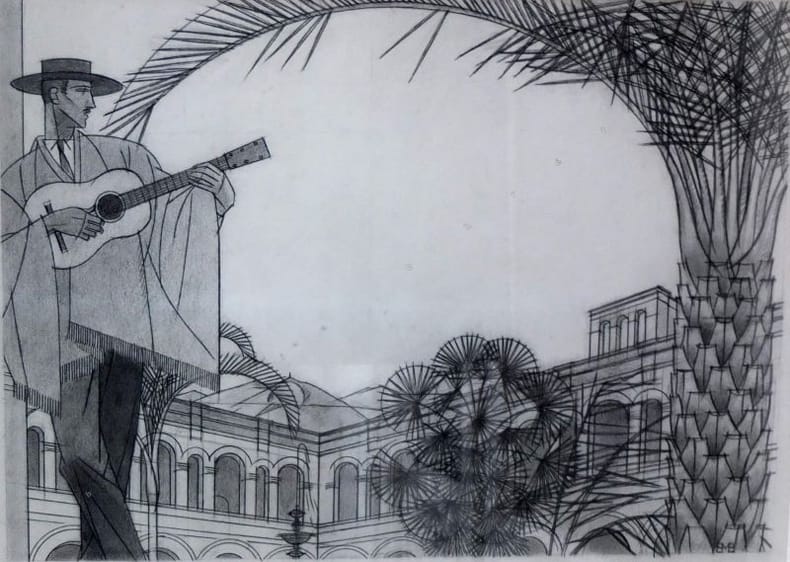
1930125381930 1 Mine de plomb signée du monogramme de l'artiste en bas à droite, 1930, 32 x 45 cm, encadrée.
188155698London 1881. Very good. Twelve monthly parts quarto 22 by 17.5 cm. 379 leaves 8 final blank. Original manuscript penned in several neat hands including 40 original illustrations mostly tipped-in on heavier paper. Title pages for vol. 1 January-June and vol. 2 July-December; index for vol. 1. Recent foliation in pencil; 75 pages with contemporary numeration in ink. Navy blue polished calf lettered and tooled in gilt marbled endleaves. Covers lightly chafed at extremities; occasional mild smudging else text about fine.<br /> <br /> Privately circulated magazine comprising essays often on historical subjects travel accounts short stories poetry riddles and puzzles along with some letters to the editor. This particular collection affords a unique perspective on a Victorian-era co-ed literary project born of youthful enthusiasm. Many of the pieces unfold serially across several issues. Floral themes depictions of girls and landscapes abound among the watercolor and ink illustrations most of which are on heavier paper and have been tipped-in. All but the last issue contain an opening illustration invoking the month. The illustrations and written pieces are pseudonymously signed by no fewer than sixteen contributors many of whom are women: Ad Lucem; Amicus; Beth; Constancy; Daphne; Elaine; Gh; Granta; Hope; Iris; Ivy; Mezereon a species of Daphne; M'one; M:zone; One of the Mob; Sinon the cousin of Odysseus who persuaded the Trojans to open the gate for the Trojan Horse; Viola. The editor's introduction and subsequent addresses attest to the ephemeral nature of the project including financial pressures. In the address to the members which appears at the opening of the second volume the editor raises the issue of increasing the subscription rate for 2 to 5 shillings per annum. <br /> <br /> "At a meeting of a few friends it was suggested that a publication of a Magazine to be circulated among the members only should be undertaken. Two members undertook to draw up a code of rules and issue a circular inviting members to join the Society the magazine of which was to be called 'The Folia Peripatetica.' The encouragement which the proposal received was quite equal to the anticipation of the promoters and many hailed with joy the advent of the Folia as a pastime and an occupation for the long winter evenings and sunny days of summer. All the contributors it is needless to say were born authors and though perhaps some were comparatively young in years yet their light was no longer to remain dimly burning under the bushel. Poets Musicians Novelists Historians all found here the medium they had long wished for. Joy joy unspeakable joy reigned supreme in the Editors office and for a season all went on as 'merry as a cricket.' But alas! vain are the hopes of man. Time was when lo a change came oer the spirit of my dream. Members finding they were after all condemned to 'blush unseen' and waste their fragrance on the limited circle of the Folia's members began to find that other and more important duties claimed their time. Some retired into distant parts of the country others went abroad or got married. In vain fresh nurses were called in and a change of Doctors -- I mean Editors -- effected Hope for a short while revived but this soon gave place to despondency. A change to Sidmouth and Plymouth only accelerated the malady. But the Folia was not to perish in this obscure way. Fate had ordained a fairer destiny. The two volumes now handsomely bound will remain for many a long year to come a fitting monument to the memory of the 'Folia Peripatetica'" editor's preface. vol. 1. <br /> <br /> "Granta" contributes several notable pieces: "University Degree Day" an eye-witness account of the 1877 ceremony where Charles Darwin received an honorary degree at Cambridge; "Jesuit Schools" prompted by the "advent of a colony of Jesuits in our secluded valley;" and "Capital Punishment" in which the author argues against "a practice entirely barbarous horrible in its details and brutalising in its effects." A piece on "Women's Rights" written under the pseudonym "Ad Lucem" is illustrated with pen drawings of butterflies. An account of Autumn maneuvers with the 20th Yorkshire Amateur Carabineers written by a participant is provided by Gh. "Hope" writes about "Shakespeare's Heroines" and "Viola" explores the lives of "Some of Our King's Wives." "One of the Mob" offers an account of "two bachelors of limited incomes" visiting Paris on the cheap. An anonymous writer compares "the translations of the old and revised versions of the New Testament" that appear in the Gospel of Matthew. "Music in Worship" by "Amicus" includes a score entitled "Augusta." An ultra-miniature 30 cm text penned within a circle and requiring magnification to read includes The Lord's Prayer a Creed and the Ten Commandments the final line noting "St. John's College Cambridge 1881."<br /> <br /> Provenance: Editorial note at close of first monthly issue noting that subscriptions for the current half year are now due and should be forwarded to No. 43 Oakley Street Chelsea.<br /> <br /> Binding: ticket of Macmichael. Stationer to the Queen. 207 Kings Road. Chelsea<br /> <br /> Watermark: Jordan Superfine. unknown
188716667SCRIBNER'S MAGAZINE 1887 THROUGH 1910 first edition 288 consecutive issues 2 issues missing front covers; 3 issues missing rear covers; December 1892 issue missing front cover as well as prelims else all others are just about vg to fine copies in original wraps. A marvelous and rare unbroken run with original contributions by such writers and artists Joel Chandler Harris William James Robert Louis Stevenson Sarah Orne Jewett Andrew Lang Bret Harte Edith Wharton among her first appearances in print Maxfield Parrish Jacob Riis and so many others as well as essays and divergent articles on such topics as Babylonian Seals Coast Guard Steamship Development Forests of North America Guatemala New Mexico French Revolution Russian Novels Socialism Modern Torpedoes Caves & Caverns Egypt Napolean etc. A literal window on the world of its time featuring both the written word as well as wonderful art illustration and photography. Scribner's / Scribners paperback
151969853Princeton:: Princeton Tiger 1915-1916. framed to an overall size of 15-1/4 x 18-1/4 inches. Very slightest of silvering to the outside areas of the image; otherwise very fine. . Image size 9-3/4 x 13 inches . The sitters are named by last name only on the verso in ms. Signed in the image by the photographer: initial illegible White N.Y." Princeton Tiger, unknown
- John Lane Company & Bell & Cockburn, New YorkToronto 1914-1915, 23,5x31,5cm, 2 volumes reliés. - Blast - Review of the Great English Vortex, n° 1 & 2 June 1914 &July 1915 John Lane Company & Bell & Cockburn | New York/Toronto 1914-1915| 23,5 x 31,5 cm | 2 volumes in Bradel binding First edition of this rare vorticist magazine which saw only two issues. Rare. Full red cloth Bradel binding, spine comprising the title and date in black, wrappers preserved. [FRENCH VERSION FOLLOWS] Édition originale de cette rare revue vorticiste qui ne connut que deux numéros. Reliures à la bradel en pleine percaline rouge, dos lisse comportant le titre et la date en noir, couvertures conservées. Rare.
193823436Valencia - Barcelona: Tip. Moderna y Tip. La Académica respectivamente 1937-1938.- 22 fascÃculos de unas 90 páginas cada uno: Viñetas; 4º 222 x 162 cm.- La revista se imprimió en Valencia desde enero a diciembre de 1937 y en Barcelona desde enero a octubre de 1938. IMPORTANTISIMA Y RARISIMA REVISTA EN MAGNIFICO ESTADO DE CONSERVACION. INTERVIENEN EN ELLA LAS MEJORES PLUMAS DE LA INTELECTUALIDAD ESPAÑOLA REPUBLICANA ENTRE LAS QUE SE ENCUENTRAN LOS POETAS DE LA GENERACION DEL 27. En excelente estado de conservación. Falta el Nº 23 último publicado. LITERATURA Y FILOSOFÃA ESPAÑOLAS DE LOS SIGLOS XIX-XXI Y SU HISTORIA EN GENERAL Libro en español Tip. Moderna y Tip. La Académica respectivamente paperback
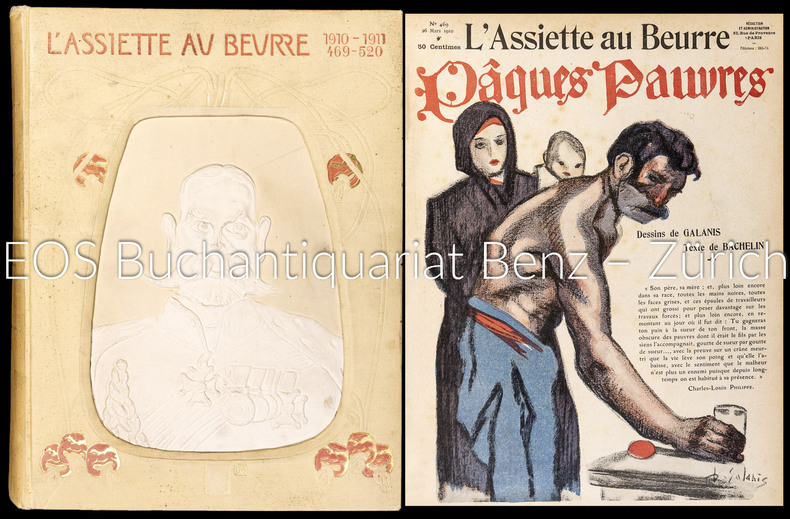
190131051ABParis, Schwarz, S., 1901-1912. 4° (33,5 x 25 cm). Mit über 9600 meist farbigen, teils ganzseitigen oder doppelblattgrossen Lithographien von Steinlen, Vallotton, F. Kupka, K. van Dongen, Gris, Cheret, Redon, Jossot Willette und vielen anderen Künstlern. Inkl. die Almanche für die Jahre 1907, 1908 sowie 3 Sonderhefte "Les Masques de l'Assiette au Beurre" und alle Nummern "hors série". Orginal Jugendstil-Verlegereinbanddecken mit verschiedenen reliefartig blindgeprägten Pappintarsien von V. Preissig. + Wichtig: Für unsere Kunden in der EU erfolgt der Versand alle 14 Tage verzollt ab Deutschland / Postbank-Konto in Deutschland vorhanden +, A 11 Bände, 3 Sonderhefte.
190131051AB11 Bände, 3 Sonderhefte. Paris, Schwarz, S. 1901-1912 4° (33,5 x 25 cm). Mit über 9600 meist farbigen, teils ganzseitigen oder doppelblattgrossen Lithographien von Steinlen, Vallotton, F. Kupka, K. van Dongen, Gris, Cheret, Redon, Jossot Willette und vielen anderen Künstlern. Inkl. die Almanche für die Jahre 1907, 1908 sowie 3 Sonderhefte "Les Masques de l'Assiette au Beurre" und alle Nummern "hors série". Orginal Jugendstil-Verlegereinbanddecken mit verschiedenen reliefartig blindgeprägten Pappintarsien von V. Preissig.
Lucky Strike cigarette ad on back cover provides a truly classic and timeless example of a mis-timed advertisement. Consider that the great Wall St. stock market crash of 1929 occurred mere days before this issue hit the newsstands. Beneath the caption "An Ancient Prejudice has been removed" appears a clenched fist labeled as "American Intelligence" breaking a heavy chain. Top left a paranoid miser stacks his gold by candlelight. Top right a wealthy couple visits their palatial bank. Text beneath miser reads "Hoarding gold with the fanatical zeal of the miser has vanished. American Intelligence sponsors thousands of banking institutions to which the individual (i.e. the wealthy couple) safely entrusts his wealth." The message is clear. Readers should put their trust (and money) in the banks, and shun gold. This issue was likely printed just as the Great Crash occurred, causing countless financial institutions to go under - and destroying even more individual fortunes. (The ad goes on to claim that cigarettes have similarly overcome the prejudice against them.) A truly stunning work which deserves to be preserved and reflected upon in this age of limitless fiat currency printing. Average wear with three-inch crease to lower corner of back cover. Suitably framed and mounted, this ad will make a superlative office display for any precious metals executive. Magazine
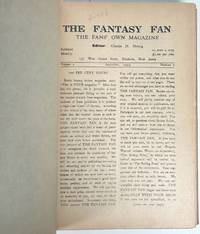
193334594Elizabeth New Jersey: Charles D. Hornig 1933-1935. Bound in brown buckram titled in gold on the front and spine panels with "F. Lee Baldwin" stamped on the upper cover retaining the original wrappers where so issued. Overall the issues are in excellent condition which is not usually the case as they tend to be quite fragile when encountering single issues. A unique set of this uncommon and important publication. Complete sets are rare. 34594. Octavo 18 issues printed or self wrappers bound in cloth. Label affixed to front paste down with a presentation inscription from editor Charles D. Hornig to noted fan and publisher Gerry de la Ree. A contributor's complete set of this amateur magazine the first important weird fiction fanzine and one of the most desirable of the fanzines of the thirties. This set belonged to F. Lee Baldwin whose name is stamped in gold on the upper cover of the binding. "Franklin Lee Baldwin 1913-1987 corresponded with H. P. Lovecraft 1933-1936. "Baldwin first wrote HPL in the fall of 1933 proposing to issue 'The Colour Out of Space' as a booklet. HPL revised the tale slightly for the prospective publication but the plan never materialized. In early 1934 HPL put Baldwin in touch with Duane W. Rimel who by coincidence lived in the same small town Asotin Washington. The two took turns reading HPL's letters to each of them. Baldwin wrote two columns of news notes for the FANTASY FAN: 'Side Glances' April May September 1934 and 'Within the Circle' June July August October November 1934 January February 1935 much of the information for which was derived from HPL's letters to him as was the significant early article 'H. P. Lovecraft: A Biographical Sketch' originally scheduled to appear in the FANTASY FAN but following the magazine's demise published in FANTASY MAGAZINE April 1935. Baldwin later revised the article as 'Some Lovecraft Sidelights' FANTASY COMMENTATOR Spring 1948" Joshi and Schultz An H. P. Lovecraft Encyclopedia pp. 14-15. In 1989 Baldwin's copy was presented to early fantastic fiction fan and publisher Gerry de la Ree by Charles D. Hornig the editor of THE FANTASY FAN.<br /> Stories first published in THE FANTASY FAN include H. P. Lovecraft's "The Other Gods" and "From Beyond" Clark Ashton Smith's "The Epiphany of Death" "The Ghoul" "The Kingdom of the Worm" and "The Primal City" as well as tales by Robert Bloch August Derleth Robert E. Howard David H. Keller and others. THE FANTASY FAN was "an interesting mix of news articles stories poems and miscellany. Hornig however made an error in initiating a column of controversy entitled 'The Boiling Point' which quickly led to acrimonious letter exchanges between Lovecraft Forrest J. Ackerman Clark Ashton Smith and numerous others; the column was terminated with the February 1934 issue. Perhaps Hornig's greatest accomplishment was the serialization of the revised version of Lovecraft's 'Supernatural Horror in Literature' October 1933-February 1935. However the serialization proceeded at such a slow pace that it had reached only the middle of Chapter VIII before the magazine folded. THE FANTASY FAN also saw the first publication of Lovecraft's stories. 'The Other Gods' November 1933 and 'From Beyond' June 1934 as well as reprints from amateur papers of 'Polaris' February 1934 and 'Beyond the Wall of Sleep' October 1934; it also published 'The Book' October 1934 'Pursuit' October 1934 'The Key' January 1935 and 'Homecoming' January 1935 from 'Fungi from Yuggoth.' Brief excerpts of Lovecraft's letters to Hornig appeared regularly in the magazine's letter column. The October 1934 issue was dedicated to Lovecraft. After the demise of THE FANTASY FAN numerous attempts were made to revive or succeed it but no magazine truly filled its place as a news organ a forum for the expression of fan's views and a venue for work by distinguished writers in the field" Joshi and Schultz An H. P. Lovecraft Encyclopedia pp. 90-91. "As a real help to the lover of weird and fantasy fiction Hornig's magazine reigned supreme in the field at that time . Almost every weirdist of importance in fandom was at one time or another represented in its pages. And as a love-feast for such fans it has never again been equaled" Moskowitz The Immortal Storm pp. 18-20. ". one of the legendary magazines of the 1930s . an extremely consistent and reliable magazine ." Tymn and Ashley eds. Science Fiction Fantasy and Weird Fiction Magazines pp. 822-23. According to Hornig writing in 1988 "THE FANTASY FAN was printed by Conrad Ruppett of Jamaica New York hand set. Julius Schwartz and I helped him collate and staple each copy every month for eighteen months. Except for the second issue 500 copies there were only 250 printed and the paid circulation never reached over 50. What happened to the residue Well I found someone to buy up most of the unsold copies and that was B. K. Gores of Austin Texas. I never heard from him before or since never knew him in fandom and don't know whatever happened to him. Somewhere there should be stacks of TFF unless they're destroyed." Reference: See Kenneth W. Faig Jr. ed. Within the Circle: In Memoriam F. Lee Baldwin Moshassuck Press 1988. Pavlat and Evans Fanzine Index 1965 p. 37. Charles D. Hornig unknown
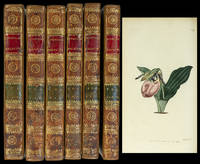
17934973DBVols. I to XII in six volumes. London, W. Curtis, 1793-1798. 8°. 1- 432 S., 12 title pages, 2 pages of Index.. With 432 coloured plates. Gilt contemporary calf with red spine labels.
17934973DB1793. Vols. I to XII in six volumes. London W. Curtis 1793-1798. 8°. 1- 432 S. 12 title pages 2 pages of Index. With 432 coloured plates. Gilt contemporary calf with red spine labels. Nissen 227 2350. Pritzel 74 2007. Blunt 183 I. First edition. Vols. I and XII of the first series conducted by William Curtis. "It has suggested but without any positive evidence that some of the earliest drawings in the Botanical Magazine were made by Curtis himself; but William Kilburn and James Sowerby joined the following year by Sydenham Edwards were responsible for almost the whole work of the first twenty-eight years - most of it being by Edwards with Sansom as engraver" Blunt. - With 6 mounted ex libris labels library of Mary Ferguson on the backside of the front covers. - Backs professionally restored. Flying leafs are slightly foxed. Otherwise a clean copy in very good condition. unknown
193331883Elizabeth New Jersey: Charles D. Hornig 1933-1935. Darkening to cheap paper but pages quite supple the full set is attractively bound a full leather binding with front and spine stamped in gold. Complete sets are rare. 31883. Octavo 18 issues printed or self wrappers. The first important weird fiction fanzine and one of the most desirable of the fanzines of the thirties. For two years it published news and fiction related to the genre.<br /> Stories first published in THE FANTASY FAN include H. P. Lovecraft's "The Other Gods" and "From Beyond" Clark Ashton Smith's "The Epiphany of Death" "The Ghoul" "The Kingdom of the Worm" and "The Primal City" as well as tales by Robert Bloch August Derleth Robert E. Howard David H. Keller and others. THE FANTASY FAN was "an interesting mix of news articles stories poems and miscellany. Hornig however made an error in initiating a column of controversy entitled 'The Boiling Point' which quickly led to acrimonious letter exchanges between Lovecraft Forrest J. Ackerman Clark Ashton Smith and numerous others; the column was terminated with the February 1934 issue. Perhaps Hornig's greatest accomplishment was the serialization of the revised version of Lovecraft's 'Supernatural Horror in Literature' October 1933-February 1935. However the serialization proceeded at such a slow pace that it had reached only the middle of Chapter VIII before the magazine folded. THE FANTASY FAN also saw the first publication of Lovecraft's stories. 'The Other Gods' November 1933 and 'From Beyond' June 1934 as well as reprints from amateur papers of 'Polaris' February 1934 and 'Beyond the Wall of Sleep' October 1934; it also published 'The Book' October 1934 'Pursuit' October 1934 'The Key' January 1935 and 'Homecoming' January 1935 from 'Fungi from Yuggoth.' Brief excerpts of Lovecraft's letters to Hornig appeared regularly in the magazine's letter column. The October 1934 issue was dedicated to Lovecraft. After the demise of THE FANTASY FAN numerous attempts were made to revive or succeed it but no magazine truly filled its place as a news organ a forum for the expression of fan's views and a venue for work by distinguished writers in the field" Joshi and Schultz An H. P. Lovecraft Encyclopedia pp. 90-91. "As a real help to the lover of weird and fantasy fiction Hornig's magazine reigned supreme in the field at that time . Almost every weirdist of importance in fandom was at one time or another represented in its pages. And as a love-feast for such fans it has never again been equaled" Moskowitz The Immortal Storm pp. 18-20. ". one of the legendary magazines of the 1930s . an extremely consistent and reliable magazine ." Tymn and Ashley eds. Science Fiction Fantasy and Weird Fiction Magazines pp. 822-23. According to Hornig writing in 1988 "THE FANTASY FAN was printed by Conrad Ruppett of Jamaica New York hand set. Julius Schwartz and I helped him collate and staple each copy every month for eighteen months. Except for the second issue 500 copies there were only 250 printed and the paid circulation never reached over 50. What happened to the residue Well I found someone to buy up most of the unsold copies and that was B. K. Gores of Austin Texas. I never heard from him before or since never knew him in fandom and don't know whatever happened to him. Somewhere there should be stacks of TFF unless they're destroyed."<br /> Reference: Joshi I-B-ii-232. Pavlat and Evans Fanzine Index 1965 p. 37. Charles D. Hornig unknown
1936ZB1309601Time Inc. 1936. Price HAS BEEN REDUCED by 10% until Monday June 29 SALE item A complete collection of all Life Magazine issues from the publication's first incarnation 1936-1972; NB: issues for the weeks of 12/24/71 1/7/72 and 12/22/72 were never published and this set lacks the two baseball cards; mostly bound with the original paper wrappers retained with some issues from 1958 & 1959 supplied in original unbound paper wrappers; very good. - If you are reading this this item is actually physically in our stock and ready for shipment once ordered. We are not bookjackers. Buyer is responsible for any additional duties taxes or fees required by recipient's country. Photos available upon request. Time, Inc. unknown
- 26 février 1955, 21,1x27cm et 14,5x11,2cm, 2 pages sur 2 feuillets, 4 pages sur 4 feuillets et une enveloppe. - Two complete, handwritten, signed manuscripts entitled "Magie quotidienne" First version with many crossing-outs and corrections, followed by the final version [with] envelope with handwritten notes 26 February 1955 | 21.1 x 27 cm and 14.5 x 11.2 cm, 2 pages on 2 leaves, 4 pages on 4 leaves and an envelope Complete handwritten, signed working manuscript entitled "Magie quotidienne", two pages written in fine handwriting in black ink on two leaves from the à l'étoile scellée gallery. Many crossing-outs and corrections. Complete signed final manuscript of the same article, four pages written in blue ink on four leaves. An envelope attached containing - in black ink - Breton's handwritten notes reused in his manuscript. Important and long manuscripts of this article which will be published in the first issue of La Tour Saint-Jacques in November 1955. "1955: with this text entitled "Magie quotidienne", Breton gives a distant echo to the beautiful phrase the "wonderful daily" which closed the first chapter of Le Paysan de Paris, in 1926. But far from Aragon passed to Stalinism, it is to the young Jean-Louis Bédouin that a text is dedicated, which may appear as one of the sketches of Breton's great project that year, a book dedicated to L'Art magique. For the time being, it is to the fascinating game of correspondence, formerly understood under the Hegelian category of objective chance, that these pages are devoted, which will appear, accompanied by a long letter from "G.D." (Georgina Dubreuil) in the first issue of La Tour Saint-Jacques, in November." (Breton Archives) This long manuscript, abundantly corrected and made up of six parts defined by dates - from 21 to 26 February 1955 -, takes the form of a diary recounting troubling coincidences encountered by the writer. [FRENCH VERSION FOLLOWS] 26 février 1955 | 21,1 x 27 cm et 14,5 x 11,2 cm | 2 pages sur 2 feuillets, 4 pages sur 4 feuillets & 1 enveloppe Manuscrit de travail autographe complet signé intitulé «?Magie quotidienne?», deux pages rédigées d'une écriture fine à l'encre noire sur deux feuillets de la galerie à l'Étoile Scellée. Nombreuses ratures et corrections. Manuscrit définitif autographe complet signé du même article, quatre pages rédigées à l'encre bleue sur quatre feuillets. On joint une enveloppe contenant des notes manuscrites de Breton à l'encre noire réutilisées dans son manuscrit. Importants et longs manuscrits de cet article qui paraîtra dans le premier numéro de La Tour Saint-Jacques en novembre 1955. «?1955?: avec ce texte intitulé «?Magie quotidienne?», Breton donne comme un écho lointain à cette belle formule du «?merveilleux quotidien?» qui fermait le premier chapitre du Paysan de Paris, en 1926. Mais, loin d'Aragon passé au stalinisme, c'est au jeune Jean-Louis Bédouin qu'est dédié un texte qui peut apparaître comme l'une des esquisses du grand projet de Breton cette année-là, un livre consacré à L'Art magique. Pour l'heure, c'est au jeu fascinant des correspondances, autrefois appréhendé sous la catégorie hégélienne du hasard objectif, que sont consacrées ces pages qui paraîtront, accompagnées d'une longue lettre de «?G. D.?» (Georgina Dubreuil) dans le premier numéro de La Tour Saint-Jacques, en novembre.?» (Archives Breton) Ce long manuscrit, abondamment corrigé et constitué de six parties délimitées par des dates - du 21 au 26 février 1955 - prend la forme d'un journal relatant des coïncidences troublantes vécues par l'écrivain.
199630117967386223University of Chicago Press 1996. Book. Acceptable. Paperback. POETRY MAGAZINE! You will receive a single issue of the POETRY MAGAZINE dated: June 1996. Some shelf wear and scuff marks to the covers. Former owner address sticker to the cover. The binding is good. The pages flow clearly. VINTAGE MAGAZINE TO TREASURE!. University of Chicago Press Paperback
198630117967386220University of Chicago Press 1986. Book. Acceptable. Paperback. POETRY MAGAZINE! You will receive a single issue of the POETRY MAGAZINE dated: Some shelf wear and scuff marks to the covers. Former owner address sticker to the cover. The binding is good. The pages flow clearly. VINTAGE MAGAZINE TO TREASURE!. University of Chicago Press Paperback
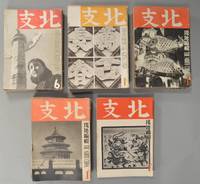
1939879721939. MAGAZINE KATÔ SHINKICHI editor. HOKUSHI THE NORTH CHINA Genchi Henshû Peiping Tokyo Osaka. Showa 14 - 18. 1939-1943. All 51 issues of this important record of the Japanese occupation of North China during the Pacific war in wrappers as they originaly appeared. As the subtitle indicates it was edited "onsite" in Peiping and then printed in Japan. At first intended for an international audience to illustrate the normality of life in North China under the Japanese by the early months of 1942 after war with the West was truly joined the English subtitle and occasional English captions were dropped. From beginning to end a remarkably well-crafted magazine from a graphic point of view with many wonderful photos printed on relatively good quality paper. By the final issues which appeared in 1943 the subjects became more and more military but until then one could scarcely have realized there was still a war on in China. the scenes of daily life were sunny and optimistic the faces smiling and content as people undertook the "reconstruction" of the North. An interesting example of wartime propaganda done with artistic flair and psychological skill. Quite unusual. Not present in the National Diet Library in Japan though Tokyo University seems to have a copy. There are a few institutions in the US that have incomplete runs LOC Harvard Cornell & Stanford plus it would appear that Yale has a full set. Good condition and complete. unknown books
1841214032London : Published at the Office 1841-1891 1841. First Edition. Hardback. Very good copies uniformly bound in contemporary gilt-blocked 1/2 leather over boards. Spine bands and panel edges somewhat dulled and rubbed as with age. Spine compartments uniformly tooled in gilt with raised bands. All edges marbled; marbled endpapers. Staining and rubbing evident in varying degrees to the spine covers. Text and plates are a very clean and sound condition throughout. This unique and highly collectible set remains particularly well-preserved overall; tight bright and strong. Provenance: From the library of Eric George Hatfield Moody with his bookplate to the front pastedown of each volume.; 8vo 8"" - 9"" tall; 1 pages; Description: 100v. in 25: illus ; 28cm. The first 100 volumes of Punch Magazine professionally bound in 25 books. Subjects: Punch magazine -- Satire -- British humour -- English wit and humor -- Periodicals. London : Published at the Office, 1841-1891 hardcover
2005mon0000057883Jet Magazine 2005T. single_issue_magazine. Very Good. in x in x in. Rosa Parks photo cover and feature story. Excelllent copy that looks unread but has mailing label on fc. Jet Magazine unknown
id3-016992Front of the Arts, edited by V.V. Mayakovsky. 1927. Contact us for details or to request photos of available books. Delivery of this book could take longer than normal due to additional handling time before shipping, and no rush delivery options are available. Please let us know if you have a specific date by which you need to receive your order. SKUid3-016992.