9 081 résultats
193334571New York: Street & Smith Publications Inc. 1933-1949. Tanning to pages of all some minor losses throughout front and back covers present bindings are bright with the exception of volumes 10-13 which are quite faded. All issues trimmed for binding. Overall the magazines are very good to nearly fine. The complete list report upon request. Note for shipping extra funds required. 34571. Octavo thirty-two volumes pictorial wrappers uniformly bound in green cloth. A complete file of 181 issues in bound volumes. Doc Savage was a precursor to the modern super hero. Clark "Doc" Savage Jr. was trained from birth with a rigorous regimen resulting in extraordinary strength and intelligence. He never killed unless necessary he had scientific gadgets a headquarters and a secret base a fortress of solitude. The stories combined mystery adventure and some science fiction. He also had a team of five experts in various fields to assist in his adventures. His stories were extremely popular during the pulp era and then found a new audience in the 1960s-70s when the series was reprinted in paperback. The novels were written using the house pseudonym of Kenneth Robeson the main author was Lester Dent who wrote nearly 80% of the novels. Other author contributors as Robeson included William Bogart Alan Hathway Harold Davis Laurence Donovan and W. Ryerson Johnson. There were many excellent contributors to the short stories which rounded out the magazine with authors such as Steve Fisher E. Hoffman Price Q. Patrick John D. MacDonald Bruno Fischer Frank Herbert William Lindsay Gresham to name a few. Street and Smith publishing executive Henry Ralston and editor John Nanovic established the initial idea for Clark "Doc" Savage Jr. - .a brawny 'superman' a master of many fields-surgeon mineralogist engineer inventor linguist. His skin was a glowing bronze.his hair was a matching hue and so too his eyes resembling gold flake. He would be known as the Man of Bronze."- Server Encyclopedia of Pulp Fiction Writers p.81. "Doc Savage was intended to be an adventure character but under Lester Dent's imaginative manipulations he became something more - the first superhero and an inspiration for countless pulp comic-book and television characters." - Cook Mystery Detective and Espionage Magazines pp. 521-527. "The enormously wealthy Doc Savage – headquartered in a fantasticated New York with his five sidekicks who specialize in various crafts and sciences at the borderline of sf – devotes his life to combating criminal conspiracies almost all masterminded by the kind of charismatic villain later given definitive form by Ian Fleming in the James Bond books. Doc Savage himself clearly influenced the creation of Superman." - SFE online. A note on artists Walter Baumhofer contributed the initial look to the character with his striking cover painting through late 1936. Other artists include Robert George Harris Emery Clarke Modest Stein and George Rozen. An ideal collection for an institution. Reference: Tymm and Ashley Science Fiction Fantasy and Weird Fiction Magazines pp. 183-185. Street & Smith Publications, Inc. unknown
188155698London 1881. Very good. Twelve monthly parts quarto 22 by 17.5 cm. 379 leaves 8 final blank. Original manuscript penned in several neat hands including 40 original illustrations mostly tipped-in on heavier paper. Title pages for vol. 1 January-June and vol. 2 July-December; index for vol. 1. Recent foliation in pencil; 75 pages with contemporary numeration in ink. Navy blue polished calf lettered and tooled in gilt marbled endleaves. Covers lightly chafed at extremities; occasional mild smudging else text about fine.<br /> <br /> Privately circulated magazine comprising essays often on historical subjects travel accounts short stories poetry riddles and puzzles along with some letters to the editor. This particular collection affords a unique perspective on a Victorian-era co-ed literary project born of youthful enthusiasm. Many of the pieces unfold serially across several issues. Floral themes depictions of girls and landscapes abound among the watercolor and ink illustrations most of which are on heavier paper and have been tipped-in. All but the last issue contain an opening illustration invoking the month. The illustrations and written pieces are pseudonymously signed by no fewer than sixteen contributors many of whom are women: Ad Lucem; Amicus; Beth; Constancy; Daphne; Elaine; Gh; Granta; Hope; Iris; Ivy; Mezereon a species of Daphne; M'one; M:zone; One of the Mob; Sinon the cousin of Odysseus who persuaded the Trojans to open the gate for the Trojan Horse; Viola. The editor's introduction and subsequent addresses attest to the ephemeral nature of the project including financial pressures. In the address to the members which appears at the opening of the second volume the editor raises the issue of increasing the subscription rate for 2 to 5 shillings per annum. <br /> <br /> "At a meeting of a few friends it was suggested that a publication of a Magazine to be circulated among the members only should be undertaken. Two members undertook to draw up a code of rules and issue a circular inviting members to join the Society the magazine of which was to be called 'The Folia Peripatetica.' The encouragement which the proposal received was quite equal to the anticipation of the promoters and many hailed with joy the advent of the Folia as a pastime and an occupation for the long winter evenings and sunny days of summer. All the contributors it is needless to say were born authors and though perhaps some were comparatively young in years yet their light was no longer to remain dimly burning under the bushel. Poets Musicians Novelists Historians all found here the medium they had long wished for. Joy joy unspeakable joy reigned supreme in the Editors office and for a season all went on as 'merry as a cricket.' But alas! vain are the hopes of man. Time was when lo a change came oer the spirit of my dream. Members finding they were after all condemned to 'blush unseen' and waste their fragrance on the limited circle of the Folia's members began to find that other and more important duties claimed their time. Some retired into distant parts of the country others went abroad or got married. In vain fresh nurses were called in and a change of Doctors -- I mean Editors -- effected Hope for a short while revived but this soon gave place to despondency. A change to Sidmouth and Plymouth only accelerated the malady. But the Folia was not to perish in this obscure way. Fate had ordained a fairer destiny. The two volumes now handsomely bound will remain for many a long year to come a fitting monument to the memory of the 'Folia Peripatetica'" editor's preface. vol. 1. <br /> <br /> "Granta" contributes several notable pieces: "University Degree Day" an eye-witness account of the 1877 ceremony where Charles Darwin received an honorary degree at Cambridge; "Jesuit Schools" prompted by the "advent of a colony of Jesuits in our secluded valley;" and "Capital Punishment" in which the author argues against "a practice entirely barbarous horrible in its details and brutalising in its effects." A piece on "Women's Rights" written under the pseudonym "Ad Lucem" is illustrated with pen drawings of butterflies. An account of Autumn maneuvers with the 20th Yorkshire Amateur Carabineers written by a participant is provided by Gh. "Hope" writes about "Shakespeare's Heroines" and "Viola" explores the lives of "Some of Our King's Wives." "One of the Mob" offers an account of "two bachelors of limited incomes" visiting Paris on the cheap. An anonymous writer compares "the translations of the old and revised versions of the New Testament" that appear in the Gospel of Matthew. "Music in Worship" by "Amicus" includes a score entitled "Augusta." An ultra-miniature 30 cm text penned within a circle and requiring magnification to read includes The Lord's Prayer a Creed and the Ten Commandments the final line noting "St. John's College Cambridge 1881."<br /> <br /> Provenance: Editorial note at close of first monthly issue noting that subscriptions for the current half year are now due and should be forwarded to No. 43 Oakley Street Chelsea.<br /> <br /> Binding: ticket of Macmichael. Stationer to the Queen. 207 Kings Road. Chelsea<br /> <br /> Watermark: Jordan Superfine. unknown
188716667SCRIBNER'S MAGAZINE 1887 THROUGH 1910 first edition 288 consecutive issues 2 issues missing front covers; 3 issues missing rear covers; December 1892 issue missing front cover as well as prelims else all others are just about vg to fine copies in original wraps. A marvelous and rare unbroken run with original contributions by such writers and artists Joel Chandler Harris William James Robert Louis Stevenson Sarah Orne Jewett Andrew Lang Bret Harte Edith Wharton among her first appearances in print Maxfield Parrish Jacob Riis and so many others as well as essays and divergent articles on such topics as Babylonian Seals Coast Guard Steamship Development Forests of North America Guatemala New Mexico French Revolution Russian Novels Socialism Modern Torpedoes Caves & Caverns Egypt Napolean etc. A literal window on the world of its time featuring both the written word as well as wonderful art illustration and photography. Scribner's / Scribners paperback
151969853Princeton:: Princeton Tiger 1915-1916. framed to an overall size of 15-1/4 x 18-1/4 inches. Very slightest of silvering to the outside areas of the image; otherwise very fine. . Image size 9-3/4 x 13 inches . The sitters are named by last name only on the verso in ms. Signed in the image by the photographer: initial illegible White N.Y." Princeton Tiger, unknown
193823436Valencia - Barcelona: Tip. Moderna y Tip. La Académica respectivamente 1937-1938.- 22 fascÃculos de unas 90 páginas cada uno: Viñetas; 4º 222 x 162 cm.- La revista se imprimió en Valencia desde enero a diciembre de 1937 y en Barcelona desde enero a octubre de 1938. IMPORTANTISIMA Y RARISIMA REVISTA EN MAGNIFICO ESTADO DE CONSERVACION. INTERVIENEN EN ELLA LAS MEJORES PLUMAS DE LA INTELECTUALIDAD ESPAÑOLA REPUBLICANA ENTRE LAS QUE SE ENCUENTRAN LOS POETAS DE LA GENERACION DEL 27. En excelente estado de conservación. Falta el Nº 23 último publicado. LITERATURA Y FILOSOFÃA ESPAÑOLAS DE LOS SIGLOS XIX-XXI Y SU HISTORIA EN GENERAL Libro en español Tip. Moderna y Tip. La Académica respectivamente paperback
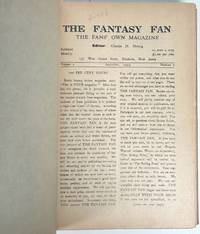
193334594Elizabeth New Jersey: Charles D. Hornig 1933-1935. Bound in brown buckram titled in gold on the front and spine panels with "F. Lee Baldwin" stamped on the upper cover retaining the original wrappers where so issued. Overall the issues are in excellent condition which is not usually the case as they tend to be quite fragile when encountering single issues. A unique set of this uncommon and important publication. Complete sets are rare. 34594. Octavo 18 issues printed or self wrappers bound in cloth. Label affixed to front paste down with a presentation inscription from editor Charles D. Hornig to noted fan and publisher Gerry de la Ree. A contributor's complete set of this amateur magazine the first important weird fiction fanzine and one of the most desirable of the fanzines of the thirties. This set belonged to F. Lee Baldwin whose name is stamped in gold on the upper cover of the binding. "Franklin Lee Baldwin 1913-1987 corresponded with H. P. Lovecraft 1933-1936. "Baldwin first wrote HPL in the fall of 1933 proposing to issue 'The Colour Out of Space' as a booklet. HPL revised the tale slightly for the prospective publication but the plan never materialized. In early 1934 HPL put Baldwin in touch with Duane W. Rimel who by coincidence lived in the same small town Asotin Washington. The two took turns reading HPL's letters to each of them. Baldwin wrote two columns of news notes for the FANTASY FAN: 'Side Glances' April May September 1934 and 'Within the Circle' June July August October November 1934 January February 1935 much of the information for which was derived from HPL's letters to him as was the significant early article 'H. P. Lovecraft: A Biographical Sketch' originally scheduled to appear in the FANTASY FAN but following the magazine's demise published in FANTASY MAGAZINE April 1935. Baldwin later revised the article as 'Some Lovecraft Sidelights' FANTASY COMMENTATOR Spring 1948" Joshi and Schultz An H. P. Lovecraft Encyclopedia pp. 14-15. In 1989 Baldwin's copy was presented to early fantastic fiction fan and publisher Gerry de la Ree by Charles D. Hornig the editor of THE FANTASY FAN.<br /> Stories first published in THE FANTASY FAN include H. P. Lovecraft's "The Other Gods" and "From Beyond" Clark Ashton Smith's "The Epiphany of Death" "The Ghoul" "The Kingdom of the Worm" and "The Primal City" as well as tales by Robert Bloch August Derleth Robert E. Howard David H. Keller and others. THE FANTASY FAN was "an interesting mix of news articles stories poems and miscellany. Hornig however made an error in initiating a column of controversy entitled 'The Boiling Point' which quickly led to acrimonious letter exchanges between Lovecraft Forrest J. Ackerman Clark Ashton Smith and numerous others; the column was terminated with the February 1934 issue. Perhaps Hornig's greatest accomplishment was the serialization of the revised version of Lovecraft's 'Supernatural Horror in Literature' October 1933-February 1935. However the serialization proceeded at such a slow pace that it had reached only the middle of Chapter VIII before the magazine folded. THE FANTASY FAN also saw the first publication of Lovecraft's stories. 'The Other Gods' November 1933 and 'From Beyond' June 1934 as well as reprints from amateur papers of 'Polaris' February 1934 and 'Beyond the Wall of Sleep' October 1934; it also published 'The Book' October 1934 'Pursuit' October 1934 'The Key' January 1935 and 'Homecoming' January 1935 from 'Fungi from Yuggoth.' Brief excerpts of Lovecraft's letters to Hornig appeared regularly in the magazine's letter column. The October 1934 issue was dedicated to Lovecraft. After the demise of THE FANTASY FAN numerous attempts were made to revive or succeed it but no magazine truly filled its place as a news organ a forum for the expression of fan's views and a venue for work by distinguished writers in the field" Joshi and Schultz An H. P. Lovecraft Encyclopedia pp. 90-91. "As a real help to the lover of weird and fantasy fiction Hornig's magazine reigned supreme in the field at that time . Almost every weirdist of importance in fandom was at one time or another represented in its pages. And as a love-feast for such fans it has never again been equaled" Moskowitz The Immortal Storm pp. 18-20. ". one of the legendary magazines of the 1930s . an extremely consistent and reliable magazine ." Tymn and Ashley eds. Science Fiction Fantasy and Weird Fiction Magazines pp. 822-23. According to Hornig writing in 1988 "THE FANTASY FAN was printed by Conrad Ruppett of Jamaica New York hand set. Julius Schwartz and I helped him collate and staple each copy every month for eighteen months. Except for the second issue 500 copies there were only 250 printed and the paid circulation never reached over 50. What happened to the residue Well I found someone to buy up most of the unsold copies and that was B. K. Gores of Austin Texas. I never heard from him before or since never knew him in fandom and don't know whatever happened to him. Somewhere there should be stacks of TFF unless they're destroyed." Reference: See Kenneth W. Faig Jr. ed. Within the Circle: In Memoriam F. Lee Baldwin Moshassuck Press 1988. Pavlat and Evans Fanzine Index 1965 p. 37. Charles D. Hornig unknown
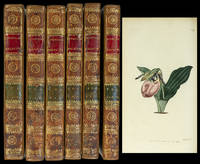
17934973DB1793. Vols. I to XII in six volumes. London W. Curtis 1793-1798. 8°. 1- 432 S. 12 title pages 2 pages of Index. With 432 coloured plates. Gilt contemporary calf with red spine labels. Nissen 227 2350. Pritzel 74 2007. Blunt 183 I. First edition. Vols. I and XII of the first series conducted by William Curtis. "It has suggested but without any positive evidence that some of the earliest drawings in the Botanical Magazine were made by Curtis himself; but William Kilburn and James Sowerby joined the following year by Sydenham Edwards were responsible for almost the whole work of the first twenty-eight years - most of it being by Edwards with Sansom as engraver" Blunt. - With 6 mounted ex libris labels library of Mary Ferguson on the backside of the front covers. - Backs professionally restored. Flying leafs are slightly foxed. Otherwise a clean copy in very good condition. unknown
193331883Elizabeth New Jersey: Charles D. Hornig 1933-1935. Darkening to cheap paper but pages quite supple the full set is attractively bound a full leather binding with front and spine stamped in gold. Complete sets are rare. 31883. Octavo 18 issues printed or self wrappers. The first important weird fiction fanzine and one of the most desirable of the fanzines of the thirties. For two years it published news and fiction related to the genre.<br /> Stories first published in THE FANTASY FAN include H. P. Lovecraft's "The Other Gods" and "From Beyond" Clark Ashton Smith's "The Epiphany of Death" "The Ghoul" "The Kingdom of the Worm" and "The Primal City" as well as tales by Robert Bloch August Derleth Robert E. Howard David H. Keller and others. THE FANTASY FAN was "an interesting mix of news articles stories poems and miscellany. Hornig however made an error in initiating a column of controversy entitled 'The Boiling Point' which quickly led to acrimonious letter exchanges between Lovecraft Forrest J. Ackerman Clark Ashton Smith and numerous others; the column was terminated with the February 1934 issue. Perhaps Hornig's greatest accomplishment was the serialization of the revised version of Lovecraft's 'Supernatural Horror in Literature' October 1933-February 1935. However the serialization proceeded at such a slow pace that it had reached only the middle of Chapter VIII before the magazine folded. THE FANTASY FAN also saw the first publication of Lovecraft's stories. 'The Other Gods' November 1933 and 'From Beyond' June 1934 as well as reprints from amateur papers of 'Polaris' February 1934 and 'Beyond the Wall of Sleep' October 1934; it also published 'The Book' October 1934 'Pursuit' October 1934 'The Key' January 1935 and 'Homecoming' January 1935 from 'Fungi from Yuggoth.' Brief excerpts of Lovecraft's letters to Hornig appeared regularly in the magazine's letter column. The October 1934 issue was dedicated to Lovecraft. After the demise of THE FANTASY FAN numerous attempts were made to revive or succeed it but no magazine truly filled its place as a news organ a forum for the expression of fan's views and a venue for work by distinguished writers in the field" Joshi and Schultz An H. P. Lovecraft Encyclopedia pp. 90-91. "As a real help to the lover of weird and fantasy fiction Hornig's magazine reigned supreme in the field at that time . Almost every weirdist of importance in fandom was at one time or another represented in its pages. And as a love-feast for such fans it has never again been equaled" Moskowitz The Immortal Storm pp. 18-20. ". one of the legendary magazines of the 1930s . an extremely consistent and reliable magazine ." Tymn and Ashley eds. Science Fiction Fantasy and Weird Fiction Magazines pp. 822-23. According to Hornig writing in 1988 "THE FANTASY FAN was printed by Conrad Ruppett of Jamaica New York hand set. Julius Schwartz and I helped him collate and staple each copy every month for eighteen months. Except for the second issue 500 copies there were only 250 printed and the paid circulation never reached over 50. What happened to the residue Well I found someone to buy up most of the unsold copies and that was B. K. Gores of Austin Texas. I never heard from him before or since never knew him in fandom and don't know whatever happened to him. Somewhere there should be stacks of TFF unless they're destroyed."<br /> Reference: Joshi I-B-ii-232. Pavlat and Evans Fanzine Index 1965 p. 37. Charles D. Hornig unknown
1936ZB1309601Time Inc. 1936. Price HAS BEEN REDUCED by 10% until Monday June 29 SALE item A complete collection of all Life Magazine issues from the publication's first incarnation 1936-1972; NB: issues for the weeks of 12/24/71 1/7/72 and 12/22/72 were never published and this set lacks the two baseball cards; mostly bound with the original paper wrappers retained with some issues from 1958 & 1959 supplied in original unbound paper wrappers; very good. - If you are reading this this item is actually physically in our stock and ready for shipment once ordered. We are not bookjackers. Buyer is responsible for any additional duties taxes or fees required by recipient's country. Photos available upon request. Time, Inc. unknown
199630117967386223University of Chicago Press 1996. Book. Acceptable. Paperback. POETRY MAGAZINE! You will receive a single issue of the POETRY MAGAZINE dated: June 1996. Some shelf wear and scuff marks to the covers. Former owner address sticker to the cover. The binding is good. The pages flow clearly. VINTAGE MAGAZINE TO TREASURE!. University of Chicago Press Paperback
198630117967386220University of Chicago Press 1986. Book. Acceptable. Paperback. POETRY MAGAZINE! You will receive a single issue of the POETRY MAGAZINE dated: Some shelf wear and scuff marks to the covers. Former owner address sticker to the cover. The binding is good. The pages flow clearly. VINTAGE MAGAZINE TO TREASURE!. University of Chicago Press Paperback
1841214032London : Published at the Office 1841-1891 1841. First Edition. Hardback. Very good copies uniformly bound in contemporary gilt-blocked 1/2 leather over boards. Spine bands and panel edges somewhat dulled and rubbed as with age. Spine compartments uniformly tooled in gilt with raised bands. All edges marbled; marbled endpapers. Staining and rubbing evident in varying degrees to the spine covers. Text and plates are a very clean and sound condition throughout. This unique and highly collectible set remains particularly well-preserved overall; tight bright and strong. Provenance: From the library of Eric George Hatfield Moody with his bookplate to the front pastedown of each volume.; 8vo 8"" - 9"" tall; 1 pages; Description: 100v. in 25: illus ; 28cm. The first 100 volumes of Punch Magazine professionally bound in 25 books. Subjects: Punch magazine -- Satire -- British humour -- English wit and humor -- Periodicals. London : Published at the Office, 1841-1891 hardcover
2005mon0000057883Jet Magazine 2005T. single_issue_magazine. Very Good. in x in x in. Rosa Parks photo cover and feature story. Excelllent copy that looks unread but has mailing label on fc. Jet Magazine unknown
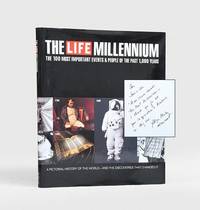
188391New York: Life Books 1998. Presented to Joan Didion First edition presentation copy inscribed by the photography editor for this title to Joan Didion and her husband on the front free endpaper "For Joan & John - as we slouch towards this next millennium - I thank you for all your inspiration & kindness in this one. Alison Morley Oct 22 1998". Didion had a column in Life starting in the late 60s and her daughter was a photo editor for Elle magazine who likely worked with Morley. The inscription references Didion's book Slouching Towards Bethlehem. Quarto. Colour illustrations throughout. Original black boards spine lettered in gilt. With dust jacket. Spine ends and head of rear cover just bumped; jacket unclipped minor creasing and one nick to edges: a near-fine copy in fine jacket. hardcover
185373896New York:: G. P. Putnam's & Co 1853-1856. First edition. 195y c. half morocco and marbled sides. Slight rubbing to the bindings; all volumes clean tight and sound. 8vo. Melville's contributions include: "Our Young Authors--Melville" "Israel Potter; or Fifty Years of Exile" Parts 1-2 "Piazza Tales" "I am My Chimney" "The Apple Tree Table" and "Bartleby the Scrivener." G. P. Putnam's & Co, unknown
19159356Madrid: Revista de Derecho Privado 1915-1974.- Tamaño 4º; Los 15 primeros años que ofrecemos están encuadernados en Media Piel.- Contiene además un índice sistemático de 1934 a 1946. La revista ha sido catalogada por mensualidades en vez de por números considerando el mes que se omita como número falto. DERECHO EN GENERAL Libro en español Revista de Derecho Privado hardcover
189931178Madrid: Imp. de A. Marco 1899.- 9 fascÃculos seguidos desde el 15 de mayo al 5 de agosto apareciendo los dÃas 5 15 y 25 de cada mes de unas 45 p. cada una llevando dos numeraciones por un lado la de la propia revista que es continuada en cada siguiente fascÃculo y por otro lado la de la novela por entregas que aparece en cada fascÃculo y también es continuada; 8º mayor 19 x 125 cm.; Papel algo quebradizo.- Todos los trabajos de la Revista Nueva son inéditos por lo que se convierten en primeras ediciones debidas a la pluma de insignes escritores del momento tales como Amado Nervo León Bloy Francisco Villaespesa Ramiro de Maeztu H. Ibsen B. G. Candamo PÃo Baroja Leopoldo Lugones PalmerÃn de Oliva Carlos Reyles Rubén darÃo F. A. de Icaza Jacinto Benavente Miguel de Unamuno Mariano de Cavia Benito Pérez Galdós Luis Zozaya José M. de Pereda Silverio Lanza Salvador Rueda J. M. Matheu J. Francos RodrÃguez E. Alonso y Orera entre otros mas. Es por lo que puede decirse que el valor literario de esta publicación es enorme no solo por la categorÃa de los intervinientes sino por la rareza de las obras que nos ofrecen. No se venden sueltos ya que son números seguidos y se ofrecen en conjunto. LITERATURA Y FILOSOFÃA ESPAÑOLAS DE LOS SIGLOS XIX-XXI Y SU HISTORIA EN GENERAL Libro en español Imp. de A. Marco paperback
179863098London Scatcherd & Whitaker; Parsons; Cawthorn 1793 - 1798. 8vo. Bound in 11 volumes. Volume 2 - 11 uniformly bound in contemporary half calfs. Volume 1 in half calf with later marbled paper covered boards. Bindings with wear and stains. Leather on spines cracked. Volume 1 with reinforced hinges a dampstain to first leaves. A few volumes with dampstain to first leaves but internally generally a nice and clean set. 616 4 pp. 2 frontispiece and 7 engraved plates; 4 480 pp. 7 plates Wolstieg only calling for 5; 4 450 4 pp. 7 engraved plates; 4 426 6 8 pp. 7 engraved plates Wolstieg only calling for 3; 2 436 pp. 6 engraved plates Wolstieg only calling for 2; 2 452 4 pp. 6 engraved plates Wolstieg only calling for 4; 6 438 4 pp. 8 engraved plates Wolstieg only calling for 6; 4 464 4 pp. 8 engraved plates Wolstieg only calling for 4; 6 506 pp. 9 engraved plates Wolstieg only calling for 4; 2 430 pp. 6 engraved plates Wolstieg only calling for 1; 2 IV 338 8 pp. 9 engraved plates Wolstieg only calling for 2. This set has a total of 79 engraved plates Wolfstieg only calls for 47 plates. <br/><br/><em>Rare complete run of the first English periodical dedicated to freemasonry “the archetype of later Masonic periodicals†Önnerfors The Freemasons’ Magazine 1793–1798 published at a crucial time in the history of European Freemasonry in the immediate aftermath of the French Revolution. It represents one of the first efforts by the fraternity to define consolidate and disseminate its intellectual and moral identity in public. Its contents - lodge proceedings philosophical essays antiquarian inquiries biographical notices poetry and finely executed symbolic engravings - reflect the full breadth of late Enlightenment Masonry. The importance of the work lies in its function as a precursor since it anticipates the Masonic journals in the 19th century and marks the transition of Freemasonry into a self-conscious print-based intellectual culture. â€The Freemasons’ Magazine represent a forceful statement of British Freemasonry concerning its vigour loyalty and societal engagement. During 1794 the journal for the first time served as a platform to refute anti-Masonic writings that circulated in the public. Important apologies such as Defence of masonry 1730 or Cousto’s spiced account of his treatment by the Portuguese inquisition were republished. Parts of Ramsay’s ‘Oration’ were republished not just once but twice. We can also witness how the Knights Templar called the ‘sublime degree of masonry’ entered the world of British Masonic imagination long after the continental development. Nevertheless at the very same time Freemasonry in Britain was also celebrating technological progress in industry agriculture and science which makes its relationship to modernity complex. The Freemasons’ Magazine managed to attract correspondents in different parts of the empire and even the USA. A particularly strong link throughout the first seven volumes was Edinburgh. In the last four volumes we find more material inserted from Ireland at exactly the time when political tensions there erupted into a full-scale rebellion. The political tense years of 1797 and 1798 offer an intriguing insight into the British psyche at the time. Under constant real and imagined threat of French invasion internally shaken by the Irish rebellion uprisings and repeated mutinies public opinion was fuelled with anti-Masonic ideas not at least by Robison’s book Proofs of a conspiracy. The Freemasons’ Magazine unfortunately did not survive 1798. Most importantly perhaps it can be regarded as the archetype of later Masonic periodicals developing into a archtype Masonic press by the middle of the nineteenth century with titles such as he Freemasons’ Quarterly Magazine and Review 1834–53 The Masonic observer 1856–9 he Freemason’s Magazine and Masonic mirror 1856–71 the Freemason 1869–1951 some of them surviving well into the twentieth century. Whereas Masonic periodicals during the first century of their existence tied into the ongoing debates and controversies surrounding Freemasonry in culture and society they developed more and more into purely internal membership magazines with little connection to the outside world.†Önnerfors The Freemasons’ Magazine 1793–1798. Wolfsteig 516 </em> hardcover
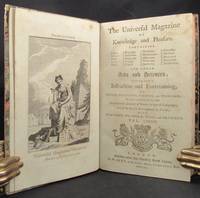
179031351London: W. Bent 1790. First Edition of the volume for January through June of 1790 including the supplements. Containing the stated FIRST PRINTING of the Addresses of the Mayor of Alexandria VA. to George Washington on his leaving his home in Mount Vernon to become President of the United States and of Washington's address to the people in reply. Most probably the first printing in book form of either of the addresses. No earlier printings in book form seem to exist and the Library of Congress shows only the manuscript copy in their holdings. Also containing one of the earliest reports of the mutiny onboard the H.M.S. 'Bounty' and an extensive essay on William Harvey as well as an essay by Mrs. Piozzi on the present King of Naples. Illustrated throughout. 8vo contemporary tan calf over marbled paper covered boards the spine with raised bands and a single red morocco label gilt tooled and lettered. 379 5 index pp. A very fresh and well preserved copy the text still quite clean and crisp only a hint of occasional spotting a few old marks by an early reader including the marking of one small section as "Not Fact". The binding has some rubbing at the tips and edges two joints starting but still a firm and solid binding in original state with no evidence of repair or restoration. THE UNIVERSAL MAGAZINE FOR THE FIRST HALF OF 1790; which with the stated first printing of the address to George Washington and his address to the Citizens of Alexandria also contains "Letters Debates Essays Tales Poetry History Biography Antiquities Voyages Travels Astronomy Geography Mathematics Mechanics Architecture Philosophy Medicine Chemistry Husbandry Gardening and other Arts and Sciences."<br> At 10:00am on the morning of April 16 1789 General George Washington left Mount Vernon for the journey north to New York where he would be inaugurated as the first President of the new United States. His first stop was in Alexandria with his former aide-de-camp Col. David Humphries and the Secretary of Congress Charles Thomson. At noon he arrived in Alexandria where he took an early dinner at Wise's Tavern with citizens of the town. The address by the Mayor celebrating Washington's service to and love of country was followed by Washington's own address concerning his considerations for his having accepted the honour to be bestowed upon him in New York. Washington had wanted to retire from public life but agreed to continue to serve the new nation upon the call of its citizenry.<br> Both addresses are moving tributes one to the man one to the new nation and its people. Humble in origin brilliant in effect they are. In the later afternoon hours General Washington was escorted by admirers up the Potomac to Georgetown where he was greeted by a large contingent of the citizenry of that town who escorted him up the Post Road towards Baltimore where he spent the night at Spurrier's Tavern. <br><br>George Washington's Address:<br> <br>To THE MAYOR CORPORATION AND CITIZENS OF ALEXANDRIA<br><br>Alexandria April 16 1789.<br><br>"Gentlemen: Although I ought not to conceal yet I cannot describe the painful emotions which I felt in being called upon to determine whether I would accept or refuse the Presidency of the United States.<br><br>The unanimity of the choice the opinion of my friends communicated from different parts of Europe as well as of America the apparent wish of those who were not altogether satisfied with the Constitution in its present form and an ardent desire on my own part to be instrumental in conciliating the good will of my countrymen towards each other have induced an acceptance.<br><br>Those who have known me best and you my fellow citizens are from your situation in that number know better than any others that my love of retirement is so great that no earthly consideration short of a conviction of duty could have prevailed upon me to depart from my resolution “ never more to take any share in transactions of a public nature .†For at my age and in my circumstances what possible advantages could I propose to myself from embarking again on the tempestuous and uncertain ocean of public-life<br><br>I do not feel myself under the necessity of making public declarations in order to convince you Gentlemen of my attachment to yourselves and regard for your interests. The whole tenor of my life has been open to your inspection; and my past actions rather than my present declarations must be the pledge of my future conduct.<br><br>In the mean time I thank you most sincerely for the expressions of kindness contained in your valedictory address. It is true just after having bade adieu to my domestic connexions this tender proof of your friendship is but too well calculated still farther to awaken my sensibility and encrease my regret at parting from the enjoyments of private life.<br><br>All that now remains for me is to commit myself and you to the protection of that beneficent Being who on a former occasion has happly brought us together after a long and distressing separation. Perhaps the same gracious Providence will again indulge us with the same heartfelt felicity. But words my fellow-citizens fail me: Unutterable sensations must then be left to more expressive silence: while from an aching heart I bid you all my affectionate friends and kind neighbours farewell! "<br><br> This volume also contains a series of Picturesque Scenes from Homer's Iliad with handsome engravings; Memoirs of the life and writings of the celebrated physician Dr. William Harvey; and a virtually countless array of stories and reports of "all things instructive and entertaining." W. Bent hardcover
17883741<p><strong>Harvard College -- "the earliest engraving of the College</strong><strong> which one may reasonably hope to obtain"</strong></p><p>This engraving entitled "View of the ancient Buildings belonging to Harvard College Cambridge New-England" appeared in the December 1788 issue of <em>The Columbian Magazine.</em> Bail notes that the view is based on the Burgis-Price print of 1743 which in turn was a slight modification of the Burgis view of 1726. The view taken from a point in front of the present Johnston Gate shows three College buildings in 1726 from left to right: the second Harvard College the first Stoughton Hall and the still-standing Massachusetts Hall. Although unsigned the engraving is undoubtedly the work of James Trenchard a co-owner of <em>The Columbian</em> <em>Magazine </em>and the engraver of nearly all the plates which appeared in it. <br /><br />Of the<em> Columbian</em> <em>Magazine</em> view Bail states: "In spite of the fact that the print is solely an adaptation it is important because of its early appearance and relative scarcity. This is the earliest engraving of the College which one may reasonably hope to obtain."</p><p>The engraving is accompanied by a disbound example of the December 1788 <em>Columbian Magazine</em> in which it appeared. It includes a 5-page "An Account of the ancient Colleges of Cambridge in New-England." Most of this is a republication of material from "a very scarce and valuable pamphlet" printed in London in 1642. In addition to a description of the College "The edifice is very fair and comely within and without." the rules and curriculum of the College are provided.</p><p>A very desirable engraving of Harvard with an example of the magazine in which it originally appeared.</p><p><strong>References:</strong> For the engraving: Bail <em>Views of Harvard</em>: 13; Plate XVII illustrated. Fielding <em>American Engravers upon Copper and Steel</em>: 1819. <br /><br /><strong>Condition: </strong>Image is age-toned with some generally light foxing. Darkening to margins outside of platemark where previously matted; remnant of strip of masking tape at upper margin on verso. The <em>Magazine</em> is complete and quite bright and clean although several pages are detached from the balance of the text.<br /><br />ICN 3431. <br /><br /><br /><br /></p> Printed for the Proprietors by W. Spotswood.
1953311614NP: WAYNE FELLOWS PRODUCTIONS/WARNER BROS. Near Fine. 1953. First Edition. Script. Final Script. Dated: May 1 1953. 90pp. Near fine in peach-colored studio covers with bradbound blue mechanically produced sheets. White revision sheets are present as well. Pencilled notes on blank reverse of a few pages Directed by John Farrow starring John Wayne in one of his signature roles as Calvary scout Hondo Lane with actress Geraldine Page in her supporting Oscar nominated debut performance. Also features Ward Bond in the memorable part of Buffalo Baker. Originally released in the 3-D process. O . WAYNE FELLOWS PRODUCTIONS/WARNER BROS. unknown
1950159166Hollywood: Seeger Publications 1950. Archive of photographs text copy cartoons letters story and photo submissions banking documents and other ephemera from the short-lived men's magazine "My Escort" published in Hollywood circa late 1950s.<br /> <br /> Not to be confused with the British men's magazine "Escort" which began publication in 1980. Detailed inventory available upon request.<br /> <br /> The majority of the archive dates from 1959 likely the only year "My Escort" was published as our research locates only three known published issues January/February March and May of 1959. An extensive archive comprised of over 100 photographs 46 with printing instructions written on the versos and on attached paper slips seven contact sheets twelve single panel adult comics two of which are original art and over 75 pages of copy stories limericks jokes and advice columns as well as advertising proofs notes financial documents and various documents relating to the publication. A selection of internal materials are housed in a folder with a pin-up girl illustration affixed to the front wrapper and a cartoon illustration on the verso with the thought bubble "The double minded person's short story book!!! Got any to add"<br /> <br /> The archive also includes over 30 letters including inquiries regarding photographers models and writers many in post-marked envelopes including four multiple-page story submissions six photograph submissions one color as well as a color slide and color negative submission.<br /> <br /> Included in the archive are photographs of models Doris Gohlke Jackie Miller June Wilkinson Bridgette Baum Shirley Quimby Mabel Rea Shellie St. Monte Joy Laine and Melody Ward and comics by Stanley Rayon. Among the banking documents is a canceled check for former pin-up model and photographer Bunny Yeager best known for her work with Bettie Page likely a contributing photographer for the magazine. <br /> <br /> Folder: 9.5 x 11.75 inches. Contents attached with a prong-binding at the top edge. Very Good plus with light splashing and rubbing overall.<br /> <br /> Photographs: 2.5 x 3 inches to 8 x 10 inches with the majority of the photographs being 8 x 10 inches. Very Good plus to Near Fine overall.<br /> <br /> Other documents: 2.75 x 3.75 to 8.5 x 11 inches. Very Good plus to Near Fine overall. Seeger Publications unknown
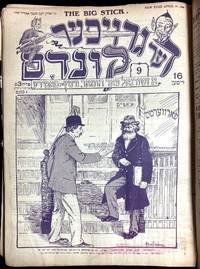
190942930New York: Ferlag "Kibets 1909. 1st Edition. Original publisher’s binding Folio newspaper. Complete first volume Starting with Vol I Nr 1 of “Der Kibitser†Dec. 15 1908 renamed and renumbered first as Vol I Nr 1 Jan 22 1909 of “Der Groyser Kibetser The big kibetzer†with the following issue of Feb 5 numbered as "3" to correctly follow from the first issue and then with Vol I Nr 6 March 19 1909 onward as “Der Groyser Kundes The Big Stick†or “The Big Prankster.†Incidentally the other set of this volume we examined also did not have a Nr 2 so we are confident this is complete as issued. <br> One centerfold cartoon by Zuni Maud see image features "Der Kaptialistisher Tayfel"--the Capitalist Devil–holding back a "mother" by the hair to stop her from interfering as "baby's milk-bottle" is drained off by the "milk-trust" cat. <br> The caption reads "The Capitalist Devil: - to the mother: Never mind madam all in English in Hebrew letters you go to the factory the milk-trust will take good care of your baby."<br> This cartoon-laden periodical was a New York City Yiddish language satirical bi- weekly which ran from 1908 until 1927.<br> The humor paper was issued biweekly this volume for its first 20 months and then weekly after that. OCLC also references another Vol I Nr 1 from April 15 1908 a special S´imhes` Toyreh Simchas Torah issue but this may have been a one-off. <br> Founded by the humorist Yosef Tunkel or Der Tunkeler his pen name meaning 'The Dark One' the paper was taken on by Jacob Marinoff when Tunkel left to work for an established paper in Warsaw. The paper consciously set itself up in opposition to the serious Yiddish-language press of the time such as the socialist Forverts.Naturally more traditional religious Judaism did not escape its satire: The later 1915 "Christmas" edition included a parodic conversation between Jesus and the prophet Elijah. <br> Despite its irreverent attitude to everything it also published poetry by Di Yunge "The Young Ones" poets such as Moyshe-Leyb Halpern and Zuni Maud. At its height it had a circulation of 35000 but folded in 1927 due to flagging sales. Der Groyer Kunds is highlighted in this recent talk by Yiddish comics scholar Eddie Portnoy on the reactions in the Yiddish press to restrictions on Jewish immigration to the US: https://www.yiddishbookcenter.org/collections/archival-recordings/recorded- programs/ybcr-nybc-ybcr-1048/door-slams-shut-reactions-yiddish-press-immigr ation .<br> SUBJECTS: Yiddish wit and humor -- Periodicals. OCLC: 28297536. Most holdings appear to be fragmentary and do not include these issues. Issue 18 with torn cover. In final issue the bottom margin suffers some loss to the final leaves none to the dramatic front cover though. Damaged boards are loose and most issues are coming loose though the quality paper used has remaind strong and bright much better than standard newsprint would have. Important graphic Yiddish humor from the great migration period. Dramatic and displayable! BK5 YID-43-9A-LEX. [New York]: Ferlag "Kibets unknown
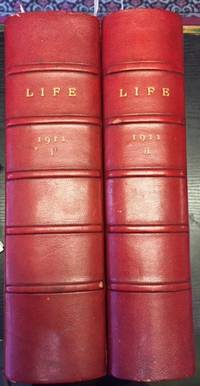
191049298New York: Life Magazine Office 1910 / 1911 / 1912. 4to.Magazine / Journal. Six bound volumes. Two volumes for each year from 1910 to 1912. Pagination varies but each volume contains c. 1200 - 1300 pages. Red half morocco over red cloth. All edges gilt. Marbled endpapers. Sturdily bound by Bumpus of Oxford Street London. Fading to spine of one volume. A few light marks to boards of some volumes. Handsome armorial bookplates to front pastedowns of 2 volumes. All full colour front covers present and bound in situ with each issue's contents. Lacks most rear covers although all present in one volume. Lacks 4 issues only of the three year run and the absence not very noticeable. Versos of all front covers have advertisements almost all in colour and several issues throughout the year have extra colour advertising leaves. Adverts throughout each issue. Illustrations cartoons and vignettes throughout each issue by many of the well known illustrators of the era. Numerous superb full-page adverts for autos including Packard Pierce-Arrow Franklin Oldsmobile Rambler Klaxon Firestone etc. etc. All volumes in Near Fine condition. This is a heavy set and may require additional postage if being shipped outside of Europe. . Near Fine. Half Morocco. 1910. Life Magazine Office 1910 / 1911 / 1912 unknown
194447394Madrid 1944 a 1950.- 6 Vols. que contienen 75 números seguidos de esta revista de unas 52 p. aprox. cada uno y siendo algunos fascÃculos de numeración doble: Profusión de ilustraciones en negro fotografÃas planos anuncios y con cubiertas ilustradas a pleno color. El nº 1 y tras la portadilla lleva el retrato de Franco con dedicatoria autógrafa a la revista firma y fecha las tres impresas; Folio 305 x 244 cm; Media Piel con cinco tejuelos en el lomo conservando las cubiertas anteriores originales de cada fascÃculo. Encuadernación ligeramente rozada pero buen aspecto. CRISTAL FORJADOS ORFEBRERÃA NUMISMÃTICA CURTIDOS TEJIDOS ARTES INDUSTRIALES ETC. Libro en español Sin editorial hardcover