(Jt) Abraham Wolf BinderMareMagnum

5 297 résultats
Original wraps. 4to. 31 pages. 26 cm. Third edition. Music and libretto by Abraham Wolf Binder, Judas Maccabeus, An Oratorio in Two Parts. Preface to Third Edition: When this oratorio was first performed by a group of young people at the Y. M. H. A. In 1917, music had just begin to play a part in Jewish education in this country. Since that time, it has found a definite place in the curricula of religious schools and other Jewish educational centers. The usefulness of this oratorio has grown from year to year, for it has been performed innumerable times from coast to coast in this country in a variety of ways, first as an oratorio, second, as an opereretta with costumes and scenery. A few years ago, it was presented as a 'Maccabean Pageant' in Los Angeles, with interspersed spoken dialogue. It has also been done in Hebrew. (Preface) Abraham Wolf Binder (18951966) was an American Jewish composer and scholar active in the intellectual and artistic Jewish music circles of early 20th-century New York. Revered alike as a composer, pedagogue, and writer, Binder also founded the Jewish Music Forum. ...As a composer, Binder is remembered chiefly for his numerous liturgical choral settings, which include many individual prayers as well as entire services. Some of his once-popular earlier works, such as his childrens oratorio Judas Maccabeus (1919) , are long forgotten, but many of his later prayer settings became part of the standard repertoire in Reform congregations and are sung to this day. He also wrote several classically oriented Hebrew and Yiddish art songs, which may be considered worthy components of the aggregate American Jewish lieder repertoire. (Milken Archive) Subjects: Oratorios. Hanukkah - Songs and music. OCLC lists 5 copies (HUC, Jtsa, Univ Arkansas, Carnegie Libr, Natl Libr Israel) . Heavy edge wear on wraps, with some damage. Internally clean and fresh. Good - condition. (MUSIC-3-53A) Xxxxxxxx
Later Cloth. 4to. 161 pages. 32 cm. First edition. In Hebrew (and transliterated Hebrew) . 'Synagogue Compositions'. Published by Yuval (Juwal) of Berlin and Tel Aviv. Elaborately designed title page. For Mixed Chorus with and without Cantor. Volume two was later published at Oxford in 1938. Printers errors page printed on last leaf. Samuel Alman (18771947) , composer of synagogue and secular music. Alman was born in Sobolevka, Podolia. From 1895 until 1903 he studied at the Odessa and Kishinev conservatories. While at Kishinev, he was strongly influenced by the cantor Razumni. After the Kishinev pogrom (1903) Alman went to London where he attended the Royal College of Music, and wrote a biblical opera King Ahaz (performed in 1912) . He served as choirmaster of various London synagogues (notably at Humpstead) and Jewish choral groups. Alman's style was deeply rooted in the Southern Russian cantorial tradition, and he owed much to the choral technique of the meshorerim ('choristers') , as heard in the compositions of N. Spivak. He solved the problem of modern harmonization by following (especially in his instrumental works) the impressionistic style of Debussy. Alman succeeded in preserving the melodic features and deep sentiments of the Eastern European Ashkenazi chant, often creating a mystical atmosphere. Among his published works are Shirei Beit ha-Knesset, 2 vols. (1925, 1938) , for cantor and choir; Psalm 15 (1915) for chorus and organ, and Psalm 133 (1934) for chorus and piano; 'Mi addir' and 'Sheva berakhot' (1930) for cantor and organ; Ethics of the Fathers (1928) ; many arrangements of Yiddish folk songs; and compositions for strings including the quartet suite Ebraica (1932) . In addition, he edited Shirei Rozumni (1930) and the supplement to F. L. Cohen's Voice of Prayer and Praise (1933) . - 2008 EJ. From the library of the famous Cantor Wolf Hecker, with his named embossed on front cover by his binder. Subjects: Synagogue music. Jewish chants. OCLC lists 11 copies. Institutional marks on backstrip and endpages, otherwise fresh and clean. Very good condition. (GER-44-11)
Frankfurt am Main, No Publisher. Cloth, 8vo, vi, 122 pages. 21 cm. In Hebrew & German, with added title page and table of contents in German as well. SUBJECT(S): Circumcision. OCLC lists 3 copies worldwide (Columbia, Harvard, Florida), none east of Florida. Rabbi Tzvi Binyomin Auerbach of Halberstadt was notorious for partially forging Sefer HaEshkol. Scarce. Lacks backstrip (spine covering), some foxing, paper and binding Good Condition. (rab-21-36)
Original Cloth. 8vo. 40 pages. 22 cm. First edition. An exhibition catalog. Jacobo and Asea Furman collection of Jewish ceremonial art. Detailed catalogue of 41 items put on exhibit from the Furman collection displayed at the Jewish Museum. With color illustrations of the items throughout. Subjects: Judaism - Liturgical objects - Exhibitions. Jewish art and symbolism - Exhibitions. Ceremonial objects - Private collections - Chile - Santiago - Exhibitions. Furman, Jacobo - Art collections - Exhibitions. Furman, Asea - Art collections - Exhibitions. Light wear to wraps, otherwise fresh. Very good condition. (ART-22-14)
Prague: Gottlieb Schmeltes, 1861. Small 8vo. 285, 55 pages. In German. Devotional book for Jewish families; homiletic considerations on the Haftarot and the five books of Moses; material for sermons to be used by rabbis and preachers. SUBJECT (S) : Haftarot -- Homiletical use. OCLC lists 4 copies worldwide (Harvard, Yale, NY Public Library, JNUL) . Usual age staining. Cover not present. First signature detached. Last four leaves in faxsimile. Text in good condition. (GER-9-22)
Berlin: Mayer und Müller, 1907. Cloth. 8vo. 192 pages. In German. Schriften der Lehranstalt für die Wissenschaft des Judenthums, Band 1, Heft 1.2. Ex-library with usual markings. Damp stains throughout. Gilt lettering on binding. Some chipping to edges. Otherwise in good condition (GERN-5-19) .
Original Cloth. O. 72, [3]; 73-135 pages. 27 cm. First edition. With transliterated Hebrew. Two volume set. Part 1. For Sabbath and festivals; Part 2. For New Year and Day of Atonement. Principally for chorus (SATB) . With pasted down front corrections list in each volume. With three laid in printed letters, two from Samuel Friedman, one from William Rosenau, expressing praise for the book. Samuel Freedman, Rabbi of Temple Ohev Shalom in Harrisburg, Pennsylvania, received his training at the Hanover Seminary in Germany, and at Jews College, London. Subjects: Synagogue music - United States. High Holidays Liturgy. OCLC lists 21 copies. Light wear to cloth, otherwise clean and fresh. Very good condition. (MUSIC-2-49)
Original Cloth. 4to. 130 pages. 29 cm. First edition. In Hebrew, with transliteration. For solo voice and choir. Israel Goldfarb (18791967) , Polish-born American rabbi, cantor, and influential composer. Receiving musical training at the Institute for Musical Arts, the forerunner of the famed Juilliard School, Goldfarb then began his service, his dual calling as rabbi and cantor of the Kane Street synagogue, which was founded in 1856 and is the oldest continuously operating synagogue in Brooklyn. Goldfarb was also among the founders of the Cantor's Institute at the Jewish Theological Seminary, where he taught for decades. (EJ 2008) Subjects: Synagogue music - Scores - Sabbath services. OCLC lists 13 copies. Light wear to edges of cloth, otherwise clean and fresh. Very good condition. (MUSIC-2-46) Xx
Original Cloth. 4to. 37, [60] pages. 29 cm. First edition. Sixty-one black-and-white and seven full-color plates illustrate some examples extant of the objects used by Jews in services at home and in the synagogue. With introductory text. Joseph Gutmann (19232004) , U. S. Art historian. Gutmann, who was born in Wuerzburg, Germany, immigrated to Philadelphia with his parents in 1936 after the rise of the Nazis. He served in the army as a chaplain and interpreter from 1943 to 1946. Gutmann earned a B. A. From Temple University and an M. A. From New York University's Institute of Fine Arts. At Hebrew Union College in Cincinnati he received a doctorate in Jewish history and a rabbinical degree. After teaching at Hebrew Union College and the University of Cincinnati, he was appointed professor of art history at Wayne State University, Detroit, in 1969. A pioneer in the field of Jewish art, he wrote or edited 19 books, including Images of the Jewish Past: An Introduction to Medieval Hebrew Miniatures (1965) , Beauty in Holiness: Studies in Jewish Customs and Ceremonial Art (1970) , and Hebrew Manuscript Painting (1978) . (EJ 2008) Subjects: Jewish art and symbolism. Light wear to jacket. Steinhardt Family Library stamp on endpage. Good + condition. (ART-22-17A)
Original Wraps. Folio. 5 pages. 34 cm. First edition. For (high) voice with piano. Romanized Hebrew words; Hebrew words also printed as text. Jibne Edition Jerusalem; Agency for the Diaspora in Berlin. Wraps printed in blue ink. Subjects: Sacred songs with piano. Psalms (Music) - 13th Psalm. OCLC lists 9 copies. Light wear to edges of wraps, otherwise clean. Good condition. (MUSIC-3-9)
Original Wraps. Folio. 117; 103 pages. 34 cm. Second edition. In Hebrew (transliterated Hebrew) with introduction in French. Liturgy for the Sabbath and High Holidays. Two Volumes: Chants liturgiques de Sabbath - Chants liturgiques des grandes fetes. Volume three (Chants religieux des Israe¨lites) absent, though normally issued with this edition. Samuel Naumbourg (18151880) , was a hazzan, composer, and writer. Born in Dennelohe, near Ansbach (Bavaria) , the descendant of almost ten generations of south German hazzanim, Naumbourg received his musical education at Munich and sang there in Maier Kohn 's synagogue choir. After an engagement as choirmaster in Strasbourg, he came to Paris in 1843. In 1845 he was appointed first hazzan at the synagogue in the Rue Notre-Dame-de-Nazareth, under the sponsorship of Jacques Fromental Halévy and with the government authorization to carry out his plans for a thorough reform of liturgic music (which had lapsed into disorder after the death of Israel Lovy in 1832) . In 1847 he published the first two volumes of his Zemirot Yisrael (vol. 1 for the Sabbath, vol. 2 for the High Holidays) , with vol. 3 Hymnes et Psaumes added when the work was reissued in 1864 (repr. 1874, 1954) . ... Naumbourg's Zemirot Yisrael achieved an influence comparable to the works of his senior Solomon Sulzer and his junior Louis Lewandowsky . The pieces are set for hazzan and 2- to 4-part choir, with some organ accompaniments and, apart from Naumbourg's own compositions and arrangements, include some melodies by Lovy and two works by Halévy and Meyerbeer . About half of the pieces are based on traditional material, mainly south German. The others reflect the various styles then current in the Parisian grand opera, which 'gave to Naumbourg's work some international features and helped it to become widely known, and much liked and used' (Idelsohn) . - EJ 2008. Subjects: Synagogue music. OCLC lists 12 copies of this edition. Spine rebacked. Light chipping to title page; light edge wear; overall fresh and clean. Good condition. (GER-44-13)
New York: Published by the author, 1902. Cloth; 8vo. 100 pages. One table for each year, plus blank pages at end to record births, marriages, and death. "In publishing this almanac, the compiler is only resuming the work so ably begun and carried on by his family for neaarly two centuries. The illustrious Haham David Nieto, being a profound astronomer, established the form of calendar now followed by Jews in all parts of the world. His calendar was published in 1718. Haham Isaac Nieto, his son and successor in office, published an almanac for 22 years-from 1740-1762. Phineas, son of the latter, published his almanac for 47 years-from 1791-1838. This was the famous Nieto's Almanac so much enquired for.....The good work is now resumed by one of the Nieto family, who publishes this almanac for 100 years-from New Year 1902-2002. 'Its usefulness is its best recommendation. '" (forward to the edition) SUBJECT(S) : Jewish almanacs. OCLC lists 16 copies worldwide. Ex-library with minimal markings. Usual age staining. Has been rebound. Some pages stuck together. Otherwise, very good condition. (AMR-1-20)
Original Cloth. 8vo. IX, 308 pages. 24 cm. First edition. Inscribed to Rabbi Israel Goldfarb from Reuben R. Rinder, on front free endpage. Composed, compiled and edited by Reuben R. Rinder. With index of composers, titles, authors and sources, and index of subjects at rear. Reuben Rinder served as the cantor of San Francisco's Congregation Emanu-El (1913-1959) and as its cantor emeritus (1959-1966) . He discovered and promoted musical prodigies and liturgical works, as well as composing his own music. He founded the Society for the Advancement of Synagogue Music. Subjects: Synagogue music. Jews Music. Lacks Jacket. Cloth soiled, otherwise clean and fresh. Good + condition. (MUSIC-2-7)
Original Wraps. 16mo. 208 pages. 15 cm. Second edition. In Hebrew. 'Songs of the Land of Israel'. Lyrics (romanized) -also printed as vocalized text in Hebrew script. Anthology of 230 zionist songs. Includes unacc. Melodies. Originally published by the Yudisher Ferlag of Berlin, under the auspices of Hechalutz and Maccabi World Union. This edition copyright Jewish Publishing House, Jerusalem, printed in Switzerland (Basel; Goldschmidt) . Second edition of Shire Erets Yisra'el by composer and music theorist Jakob Schönberg (1900-1956) . Subjects: Songs, Hebrew. Zionism - Songs and music. OCLC lists 22 copies of this edition. Light wear to wraps, light soiling to outer edges, some pages dogeared, otherwise clean. Good condition. (MUSIC-2-54)
Softbound. 8vo. 426, 28 pages. 25 cm. First Hebrew edition. In Hebrew, with English explanatory material and summary. Added title on cover: Miqraey qodesh. Book of Shelomo Rosovsky; Tora and its cantillation. Rosowskys seminal work, The Cantillation of the Bible: the Five Books of Moses, was published in 1957, providing an analytical theory of Biblical cantillation based on his research of the Lituanian-Israeli tradition. The massive work is broken up into three main sections: the first defines the basic functions of the 28 tropal signs, the second includes his field work results in musical notation, and the third delineates Rosowskys original theory of the Law of Assimilation (how tropes are joined) and an analysis of the scalar basis of Shabbat cantillation. (Jewish Music Research Centre) Subjects: Cantillation. Jewish chants. Judaism - Liturgy. Jews - Music. Jews - Music - History and criticism. OCLC lists 20 copies. Wraps rubbed, pages lightly aged, otherwise fresh and clean. Very good condition. (MUSIC-2-17)
Original Cloth. 4to. 300, [13] pages. 26 cm. First edition. Volume two only: For the High Holidays. Title page and preface in English and Hebrew; contents in Hebrew. Unaccompanied melodies; words chiefly in romanized Hebrew. Chassidic melodies (pages 267-300) . Contains advertisements at rear (for Yiddish and Hebrew music booklets) . Joshua Samuel Weisser was renowned in cantorial circles in America as a cantor, teacher, cantorial critic, and composer of traditional liturgical settings as well as recitatives for student cantors. Weisser immigrated to the United States in 1914, where he proceeded to serve several New York synagogues and to establish a coveted reputation as a teacher of cantorial artat a time when formal cantorial schools had yet to be established. Weisser served as general secretary and, eventually, as president of the Jewish Ministers Cantors Association (Hazzanim Farband) the principal cantorial association at that time in the greater New York area Weissers published recitatives and choral settings embrace virtually the entire liturgy of the annual cycle. He also notated Hassidic melodies, wrote original songs of Hassidic character, and composed Yiddish quasi-art songsmostly in the style of elevated folksongs. He contributed articles about hazzanut and other aspects of Jewish music to various journals and periodicals, delivered papers at cantorial meetings, and, in a number of articles in Di khazonim velt [Di shul un di khazonim velt ]an international cantorial newspaper published monthly in Warsaw from 1933 to 1939 but widely disseminated outside Polandhe reported on the state of cantorial art in America and on related professional matters and issues. (Milken Archive) Subjects: Synagogue music - Sabbath services. Synagogue music - High Holiday services. Hasidism Music. OCLC lists 19 copies. Light wear to cloth, otherwise clean and fresh. Very good condition. (MUSIC-2-13)
New York: Thalmessinger & Cahn, 1858. Modern Cloth, 12mo. Viii, 492 pages. Gilded, tooled boards, raised bands, all edges gilt. In German and Hebrew. This edition is a reissue of the Baltimore C. W. Schneidereith edition of 1858 [i. E. Earlier that year]. "Vorwort" signed "Dr. David Einhorn, Baltimore 25, Juni 1858." Einhorn is compiler and copywriter. "For sale at Thalmessinger & Cahn ... And at the Sexton's of the Congregation Adath Jeshurun, at their Temple in 39th St. , betw. 7th & 8th Aves, New York. " David Einhorn was a rabbi, preacher, and author; leader of the Reform Movement in the U. S. "Olat Tamid didn't just shorten the traditional service; it was a creative work expressing the Einhorn's Reform ideal of the universality of humanity with an anti-particularistic strain. In its modern approach to worship, it cut out Kol Nidrei; it utilized various Sephardic piyyutim (religious poems) ; it dropped the Musaf service entirely; it did not include blessings for the blowing of shofar or the lighting of Chanukah lights; it de-emphasized Israel as the Chosen People; and it removed all references to a personal Messiah, a return to Israel, or the resumption of the sacrificial cult. " (Jewish Virtual Library) Singerman 1534; Deinard 949. SUBJECT(S) : Judaism -- Liturgy and ritual. Jews -- Prayer-books and devotions -- Hebrew. Jews -- Prayer-books and devotions -- German. OCLC lists 4 copies worldwide of this edition (Denver, Yale, Cornell, UPenn). Edgewear to a few pages. Paper browning but solid. Attractively bound in modern black cloth with paper spine label. (SPEC-7-23)
Philadelphia: Haswell, Barrington, and Haswell, 1837 (5597) . 8vo. 121 pages. First edition. English and Hebrew on facing pages. Title in Hebrew on facing page [Sidur sifte tsadikim]. Second volume of a 6-volume set. Isaac Leeser was an American rabbi, educator, and author, founder of the Jewish press of America. "Leeser participated in all Jewish movements. He was the earnest promoter of all the national enterprises-the first congregational union, the first Hebrew day-schools, the first Hebrew college, the first Jewish publication society-and of numberless local undertakings. [His monthly magazine] "The "Occident" acquired a national and even an international reputation; the Maimonides' College, of which he was president, paved the way for future Jewish colleges in the United States; and his translation of the Bible became an authorized version for the Jews of America. " (JE) Singerman 0630; Rosenbach 411; Deinard 950. Judaism -- Liturgy. Prayers. OCLC lists 7 copies of this edition. Ex-library. Inscribed "Rachel Hays Myers March 1839." Mrs. Myers was the wife of Commander Joseph Myers. Lacks outer wrappers. Outer pages soiled; some warping to pages. Text in good condition. (leeser) MISSING PAGES 77-121--THE 2ND HALF OF THE BOOK. FRAGMENT
1st edition. Original Paper Wrappers, 4to, 76 pages. Singerman 4434. 31 cm. Primarily in Hebrew. For mixed chorus (SATB) and organ; chiefly romanized script. SUBJECT(S) : Synagogue music -- High Holiday services. Synagogue music -- Pilgrim festival services. Synagogue music -- United States. Choruses, Sacred (Mixed voices, 4 parts) with organ. Choruses, Sacred (Mixed voices, 4 parts) with organ. Synagogue music. Synagogue music -- High Holiday services. Synagogue music -- Pilgrim Festival services. OCLC lists 6 copies worldwide (JTS, Southern Baptist, HUC, Gratz, Marshall U, NLI) . Cover chipped at corners, otherwise Very Good Condition. (kh-2-19)
117831Augsbourg, Aux Dépens des Freres Klauber, Graveurs en Taille-douce 1781, 170x105mm, 144pages, relié de l’époque veau marbré avec titre, encadrements et fleurons dorés au dos à quatre nerfs. Toutes tranches rouge. Inscription manuscrite sur le haut de la page de garde supérieure. Intérieur propre. Bel exemplaire.
Parma, per Pietro Fiaccadori, 1840, in-32, mezza pergamena ed angoli, piatti marmorizzati, tagli spruzzati di rosso, pp. VIII, 184. Nota manoscritta coeva al foglio di guardia anteriore; posteriore asportato per metà. Blanda erosione ai piatti, ma buone condizioni. Il frate minore francescano Leonardo (al secolo Paolo Girolamo Casanova) originario di Porto Maurizio, fu proclamato santo da Pio IX solo nel 1867: l'editore infatti gli dà nell'avviso al lettore solo il titolo di "beato".
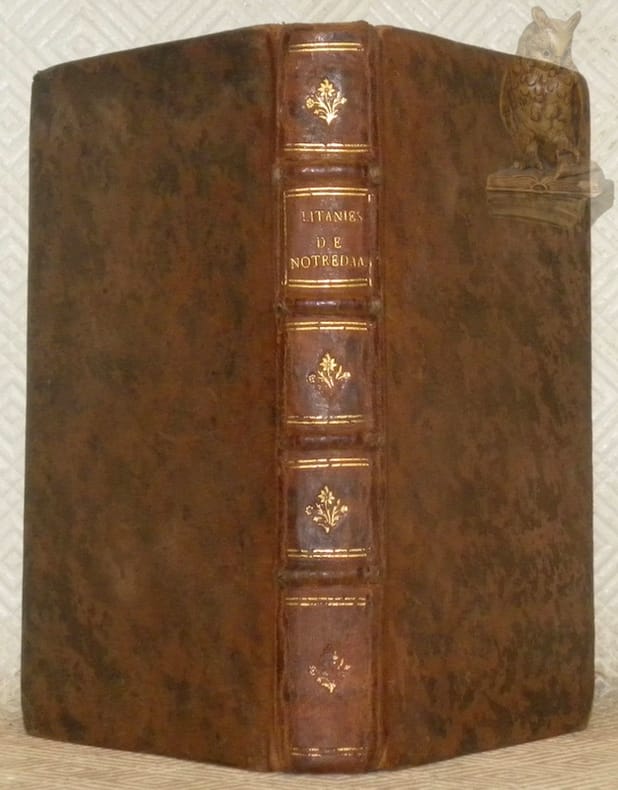
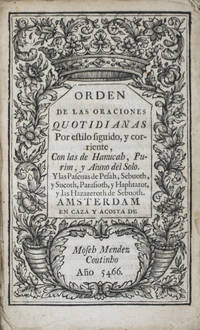
170643961Amsterdam: Moseh Mendez Coutinho 1706. Hardcover. poor to g. Duodecimo. 6.5x4.5". 8 347pp. 1 401-611pp. 8. Jewish year = 5466. Original dark brown pebbled leather boards. Gauffered and gilt edges. Title page illustrated with decorative woodblock floral motifs bordering the text. The publication is an early Spanish-language Jewish daily prayer book siddur which also includes prayers for various Jewish Holidays including the Sabbath Hannukah Purim and the Shalosh Regalim Three Pilgrimage Festivals: Passover Sukkot and Shavuot. Also included are the Torah portions Parshiot and Haftorot to be read on those occasions.<br /> <br /> This prayer book was published by Moseh Mendez Coutinho following a similar title and formatting to a number of other earlier editions dating back to the 1681 publication by David Tartas. Starting with Tartas' subsequent edition from 1690 these book also included the torah portions and haftorot. This and other publications of Jewish liturgy served members of the then sizable Sephardic Jewish community in Amsterdam. A significant portion of the community would have been ex-Marranos Jews who had outwardly converted to Catholicism during the inquisition in Spain who then immigrated and were able to reestablished their Jewish identity and thus were unable to read Hebrew hence the text's publication in Spanish. <br /> <br /> The first section contains a few prayers transliterated into Spanish from the Hebrew followed by daily prayers p.9-134 Sabbath prayers p.134-262 prayers for Rosh-Hodesh Celebration of the new month p.262-309 and Hanukkah Purim and others 309-347. Following an additional title page with decorative woodblock borders is a section containing prayers related to the three festivals Passover Shavuot and Sukkot respectively p.401-611. All text in Spanish. <br /> <br /> BOUND WITH<br /> The final unpaginated eight pages included a table of contents for the various prayers and a six-page Hebrew-Gregorian calendar with tables for tracking the new months festivals and fast days covering the years 1705-1716 including a title page decorated with a woodblock border. Some sections throughout the text with decorative initials. <br /> <br /> Binding with spine and some pieces of the leather on the covers missing. Rubbing scratches and chipping to extremities. Binding loose with starting at endpapers title page and a number of other pages throughout the text. Light sporadic water stains and foxing to some pages throughout. A few small holes on a few pages with minimal loss of text. Binding in poor interior in good condition overall. References: KAYSERLING 1890 p. 60gives 12° PALAU 1923 202353gives 16° SILVARO- SA 1933 48 corrects Kayserling PEETERS 1933 1028. Moseh Mendez Coutinho hardcover
(FT) Clothbound. 12mo. XXIV, 190 pages. 19 cm. First edition. In German. With gilt lettering on spine listing the title, place of publication and date published. Full title: Lehrbuch der Israelitischen Religion, zum Gebrauche der Synagogen und israelitischen Schulen im Königreich Württemberg: auf Veranstaltung der Königl, which translates as Textbook of Israelite Religion, for the use of Synagogues and Israelite schools in the Kingdom of Württemberg: of the Royal Meeting. This textbook, a reform work printed in German, is the product of an interesting time, when the Jews of Wurttemberg and Stuttgart had recently been near emancipated from most feudal restrictions and had obtained civil equality in Wurttemberg on April 25, 1828, with a central Jewish executive created in Stuttgart in 1831 that functioned under governmental supervision. Sermons printed in German by orthodox rabbis for a small community in a town of mostly liberal and secular Jews, under the auspice of the authority of the Kingdom. Subjects: Judaism - Study and teaching. Jews - Education - Germany. Jüdische Erziehung. OCLC lists 11 copies worldwide. Later cloth binding in near fine condition. Pages lightly foxed, clean. Very good + condition. (DREYFUS-5-1)
Later Cloth. 8vo. Vii, 309 pages. Illus. 22 cm. Subtitle: Being a necessary companion to the Holy Scriptures. Together with several remarkable events relative to the people of the Jews, from the most ancient records. Sticker on inside cover, Bound by the Crescent City Bookbindery, 142 Gravier St. , New Orleans. Ex-library with usual markings. Boards detached but present. Backstrip cracking and peeling. Light staining to first 50 pages, otherwise internal pages are nice and clean. Good condition. (DREYFUS-3-17)
1st edition. Original Cloth, 12mo, 108, 95 pages. The First Hebrew book published in Richmond. Edward Nathan Calisch (1865-1946) was a prominent American Reform Rabbi .in the second graduating class of Hebrew Union College. In 1887, Calisch accepted a pulpit in Peoria, Illinois. In 1891, he became rabbi of Congregation Beth Ahabah in Richmond, Virginia. In 1893, Calisch's congregation felt the need for a more modern prayer ritual. They authorized Calisch to revise a prayer-book. That prayer book was the first Hebrew book printed in Richmond .Calisch was a prominent figure in Richmond's civic life, where his talents as an orator were much in demand. In 1915 he gave an speech in support of women's suffrage from the steps of the state capitol. He was an executive member of the American Jewish Committee, the Jewish Welfare Board, the Joint Distribution Committee and the Virginia War History Commission (Wikipedia). SUBJECT(S) : Siddurim -- Texts. Reform Judaism -- Liturgy -- Texts. Judaism -- Liturgy Texts. Wear to boards, spine rebound in black cloth tape. Pages lightly tanned. OCLC: 49836012. OCLC lists only 5 copies worldwide (JTS, HUC, NYPL, Univ. Virginia, Point Loma Nazarene University) . Pages 33-34, 57-60 missing. Spine rebacked, some singnatures starting, otherwise Good condition copy of a rare and important Southern Reform prayerbook. (DREYFUS-4-1)