LUTHER, MartinBiblio.com
82 résultats
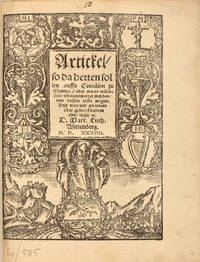
1538LCS-1864037<p><strong>The Smalkalde Articles written by Luther in 1536 in preparation for the Council of Mantua.</strong></p><p><strong>"<em>Schmalkaldic Articles</em></strong><em> <strong>are one of the confessions of faith of Lutheranism</strong></em><strong>".</strong></p><p>4to of 32 ll. Half-vellum flat spine brown morocco lettering piece. <em>20th century binding</em>.</p><p>191 x 151 mm.</p><p>Rare first edition of the "Articles of Smalkalde" written by Luther in 1536 and which offer a synthesis of his doctrine.</p><p>Graesse <em>Trésor de livres rares</em> 306.</p><p>Luther's attacks on the papacy were repeated and virulent. In 1535 Pope Paul III wearily proposed convening a council. The Protestants of the Smalkalde League meeting in assembly nevertheless made demands to take part. The council was convened in Mantua for May 1537. Immediately Luther compounded what would later be known as the Smalkalde articles in which he exhibited the essential points of his doctrine. The Council was postponed and did not take place until 1545 in the city of Trent.</p><p>" In 1534 Alessandro Farnese was elected as Pope Paul III with a clear message of internal church reform. To further this mission and to respond to the rise of Protestantism he called for an ecumenical church council to meet at the Italian city of Mantua in 1537. Given the importance of this council for Christian unity and the future of reformed forms of worship the elector of Saxony asked Luther to prepare an official statement of doctrine that would both represent his views and indicate where negociation might be possible. Luther agreed and with some imput from his Wittenberg colleagues carefully laid out what he saw as the central pillars of Christian teaching. Yet these doctrinal statements or articles were never presented at the council which was delayed a number of times finally meeting in Trent beginning in 1545. Instead they were discussed at a general meeting of the Protestant Schmalkaldic League although even here the collected princes and theologians declined to affirm them due mostly to concerns that they were too exclusionary and divisive especially the statements on the Eucharist and papacy. Luther then published the articles in 1538 adding a preface but leaving their structure and content otherwise intact. As these articles offered a clear and comprehensive summary of Luther's doctrine they would be extremely important as a Lutheran confession of faith and in 1580 would be incorporated into the authoritative collection of fundamental Lutheran documents known as the 'Book of Concord'" The Essential Luther 23.</p><p><strong>"Schmalkaldic Articles</strong> are one of the confessions of faith of Lutheranism written by Martin Luther in 1536. The articles were prepared as the result of a bull issued by Pope Paul III calling for a general council of the Roman Catholic Church to deal with the Reformation movement. The council was actually postponed several times until it met in Trent in 1545. John Frederick I Lutheran elector of Saxony wished to determine what issues could be negotiated with the Roman Catholics and what could not be compromised. He asked Luther to review earlier statements of faith by the reformers to determine what was absolutely essential to the faith. After Luther prepared the articles he invited several reformers to Wittenberg to discuss them and after some minor changes eight theologians signed them. They were then sent to the elector in January 1537.</p><p>In February 1537 the Protestant secular heads of state who were members of the Schmalkaldic League met with several theologians at Schmalkalden to decide how to deal with a council of the Roman Catholic Church. Luther became ill and could not attend but John Frederick I presented Luther's articles to the gathering. Because of Luther's somewhat controversial doctrine of the Lord's Supper Philipp Melanchthon urged that the Augsburg Confession and its Apology previously presented to Emperor Charles V adequately presented the reformer's faith and that additional statements should not be added. This decision was adopted and the Schmalkaldic Articles were not officially accepted. They were however circulated and read and 44 theologians signed them as an expression of their personal faith. Subsequently they were included in the <em>Book of Concord</em> 1580.</p><p>The Schmalkaldic Articles are divided into three sections. The first discusses the unity of God the Trinity the Incarnation and Christ and on these subjects Luther believed there was no real controversy between Roman Catholics and Protestants. The second section dealt with Christ and justification by faith. According to Luther "<em>On this article rests all that we teach and practice against the pope the devil and the world.</em>" This section also discusses the mass monastic orders and the papacy. The third section discusses 15 articles that could be considered by Roman Catholics and Protestants. It includes such subjects as sin the Law repentance the sacraments confession the ministry and a definition of the church".</p><p>FRANCAIS</p><p><strong>Les articles de Smalkalde rédigés par Luther en 1536 en vue du concile de Mantoue.</strong></p><p>In-4 de 32 ff. Demi-vélin dos lisse pièce de titre de maroquin brun en long. <em>Reliure du XXe siècle</em>.</p><p>191 x 151 mm.</p><p>Rare édition originale des " articles de Smalkalde " rédigés par Luther en 1536 et qui offrent une synthèse de sa doctrine.</p><p>Graesse <em>Trésor de livres rares</em> 306.</p><p>Les attaques de Luther contre la papauté sont réitérés et virulents. En 1535 de guerre lasse le pape Paul III propose de réunir un concile. Les protestants de la ligue de Smalkalde réunis en assemblée posent quand même des exigences pour y participer. Ce concile est convoqué à Mantoue pour le mois de mai 1537. Aussitôt Luther compose ce qu'on dénommera plus tard les articles de Smalkalde où il expose les points essentiels de sa doctrine. Le concile sera reporté et n'aura lieu qu'en 1545 dans la ville de Trente.</p> H. Lufft
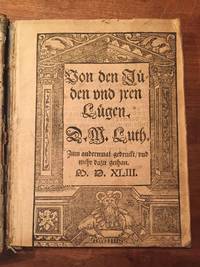
1543Boston2Von den Jüden und iren Lügen Zum andernmal Gedruckt vnd mehr dazu gethan.Wittemberg Lufft 1543. 128 pages. 18.5 cm. Bound in a 15th century leaf. 17th century inscription on the inside board. This is Panzer 3425.This work is printed in the same year as the first edition but enlarged as the title indicates. Title page lower margin cut. Else good. <br /> German religious reformer and founder of the Lutheranism movement Martin Luther grew increasingly hostile towards the Jews following their refusal to accept his religious reformations. <br /><br /> In the present work the most virulent of Luther's anti-Semitic attacks he subjects the Jews to a torrent of vile abuse. His practical suggestions range from forced labor to outright banishment: "First their synagogues should be set on fire and what ever does not burn up should be covered over with dirt so that no one may ever be ale to see a cinder or stone of it. Secondly their homes should likewise be broken down and destroyed.And this ought be done for the honour of God and of Christianity in order that God may see that we are Christians and that we have not wittingly tolerated or approved of such public lying cursing and blaspheming."<br /><br /> Due to Luther's vituperative anti-Jewish polemics the Lutheran church retained all the superstitious abhorrence of the Jews inherited from the medieval Catholic church.On Luther's conception of the Jews in this work see J. Trachtenberg The Devil and the Jews- The Medieval Conception of the Jew and its Relation to Modern Anti-Semitism 1983 p.183 et<br /><br /><br /><br /><br /><br />
15564183Wittenberg:: Georg Rhau 1542 1556. Octavo:. 15 x 10 cm. I. a-h8; A-Z8 Aa4 lacking blank Aa4. II. A-L8 with blank L8 Bound in contemporary alum-tawed pigskin over wooden boards one clasp defective binding soiled and mildly worn and with small defects. The boards are ruled and tooled in blind signed and dated “IPN 1556â€. The contents are in excellent crisp condition one leaf working loose marginal tear in margin of leaf E5 no loss. With a historiated woodcut title border to the “Apologiaâ€. Woodcut coat-of-arms to verso of final leaf of the “Confessio†and fine woodcut initials in the Saxon Confession. Text of second work in Latin and German. With 16th c. notes on the f.f.e.p. This is the authorized text of the Augsburg Confession 1st ed. 1531 approved by Luther edited by and with the "Apologia" of Philip Melanchthon. It was printed by Georg Rhau who also printed the first editions both in Latin and German of the “Confessio†and “Apologiaâ€. The “Apologia†of this 1556 edition is dated 1542 see VD 16 ZV 31340. This edition was printed in the wake of the agreement reached in 1555 between the Lutheran princes and Charles V known as the Peace of Augsburg which granted Lutheranism legal status within the Holy Roman Empire. Bound into this copy is the 1553 Leipzig edition of the Saxon Confession which was drawn up by Melanchthon and intended for presentation at the Council of Trent; it presented the doctrinal status of the Lutheran Church of Germany as of 1552 and was the basis for the signing of the Peace of Augsburg. The Augsburg Confession: "On January 21 1530 the Emperor Charles V issued letters from Bologna inviting the German diet to meet in Augsburg on April 8 for the purpose of discussing and deciding various important questions. The far-seeing Landgrave of Hesse hesitated to attend the diet but the Elector John of Saxony who received the writ March 11 directed Luther Jonas Bugenhagen and Melanchthon to meet in Torgau and present a summary of the Protestant faith to be laid before the Emperor at the diet. This summary has received the name of the "Torgau articles". On April 3 the Elector and the reformers started from Torgau and reached Coburg on April 23. There Luther was left behind. The rest reached Augsburg May 2. On the journey Melanchthon worked on an "Apology" using the Torgau articles and sent his draft to Luther at Coburg who approved it. "The Emperor had ordered the confession to be presented to him on June 24. The evangelical princes however declared that they would not part with the confession until its reading should be allowed. The 25th was then fixed for the day of its presentation. In order to exclude the people the little chapel of the Episcopal palace was appointed in place of the spacious city hall. The two Saxon chancellors Bruck and Beyer the one with the Latin copy the other with the German stepped into the middle of the assembly and against the wish of the Emperor the German text was read. "Although the emperor prohibited the printing of the evangelical confession without his special permission during the diet six German editions and one in Latin were published. Their inaccuracy and incorrectness induced Melanchthon to prepare an edition to which he added the Apology. Thus originated the so-called 'editio princeps' of the Augustana and the Apology which was published in the spring of 1531." Schaff-Herzog "Melanchthon drafted the ‘Confession’ in both German and Latin using the Torgau Schwabach and Marburg Articles. The intention of the German Protestants was to present a single creed. Since they could not all agree on one several versions were presented to the Diet meeting at Augsburg. Of these it is the ‘Augsburg Confession’ that is remembered today; the others have long been forgotten. The presentation of the ‘Augsburg Confession’ was probably Melanchthon’s finest hour as a theologian. He had written a theological document that presented a reasonable compromise in the ongoing religious disputes in Germany. Luther himself said that he could never have ‘trod so lightly’ in treating such matters. The ‘Confession’ has come to be the standard Lutheran statement of faith and was included in the ‘Book of Concord’ of 1580."Kessler I. VD 16 ZV 31340; II. VD 16 C 4807 Georg Rhau, 1542, unknown books
154538532(Leipzig, Nikolaus Wolrab), 1549 (im Kollophon: 1544 bzw. 1545). Fol. Titeln in Rot u. Schwarz m. Titelholzschnitt bzw. m. breiter figürl. Holzschn.-Bordüre. Mit zahlr. Textholzschnitten von Hans Brosamer. 4 Bll., 382 num., 10 Bll. (das letzte weiß); 1 nn., 69 num., 4 nn. Bll. (das letzte weiß); 6 nn., 281 num., 7 nn. Bll.; 6 nn., 88 num., 1 nn. Bll., Blindgepr. Schweinsldr.-Bde. d. Zt. über Holzdeckeln a. 4 Bünden m. goldgepr. Rückenschild sowie blindgepr. Deckeltitel (?Postil sumer teyl und fest? bzw. ?Postil winter Teill?, dat. ?1550?) u. 2 Schließen.
155660674Ihenae (Jena), Rhodius (Rödinger), 1556. 4to. In contemporary blindstamped pigskin over wooden boards with three raised bands and two clasps. Wear and soiling to extremities. Pigskin partly detached to upper part of boards. Previous two owner's names in contemporary hand to title-page. A few occassional underlignings and marginal annotations in contemporary hand throughout. Small worm-tract affecting last 20 leaves, internally generally fine. (10), 367 pp.
155660674Ihenae Jena Rhodius Rödinger 1556. 4to. In contemporary blindstamped pigskin over wooden boards with three raised bands and two clasps. Wear and soiling to extremities. Pigskin partly detached to upper part of boards. Previous two owner's names in contemporary hand to title-page. A few occassional underlignings and marginal annotations in contemporary hand throughout. Small worm-tract affecting last 20 leaves internally generally fine. 10 367 pp. <br/><br/><em>Rare first printing of Martin Luther's early letters from 1507 to 1522 spanning the years from the celebration of his first Mass to his removal to Wartburg Castle after the Diet of Worms. Among them is a notable letter Cardinal Albrecht Archbishop of Magdeberg and Mainz accompanying a copy of the 95 Theses composed on the very day October 31st 1517 when Luther affixed the Theses to the door of the church in Wittenberg and Luther's first letter to Erasmus penned on March 28th 1519. These letters provide a most interesting perspective into Martin Luther's personal and public reflections on crucial aspects of the early days of the Reformation. The collection encompasses correspondence with figures such as Emperor Charles V Pope Leo X King Henry VIII Georg Spalatin Philip Melanchthon Frederick Elector of Saxony Andreas Karlstadt Cardinal Tommaso de Vio Cajetan and many others. The present work was edited by Joannes Aurifaber 1519-1575 Luther’s private secretary who lived with Luther at the time of his death: “Joannes Vinariensis; 1519–1575 was born in the county of Mansfeldt in 1519. He studied at Wittenberg where he heard the lectures of Luther and afterwards became tutor to Count Mansfeldt. In the war of 1544–45 he accompanied the army as field-preacher and then lived with Luther as his famulus or private secretary being present at his death in 1546. In the following year he spent six months in prison with John Frederick elector of Saxony who had been captured by the emperor Charles V. He held for some years the office of court-preacher at Weimar but owing to theological disputes was compelled to resign this office in 1561. In 1566 he was appointed to the Lutheran church at Erfurt and there remained till his death in November 1575. Besides taking a share in the first collected or Jena edition of Luther’s works 1556 Aurifaber sought out and published at Eisleben in 1564–1565 several writings not included in that edition. He also published Luther’s Letters 1556 1565 and Table Talk 1566. This popular work which has given him most of his fame is unfortunately but a second or third hand compilation.†Encyclopedia Britannica. A second volume was published as “Secundus tomus epistolarum†in 1565. Adams L1805 BM STC German 1455-1600; p. 535 </em> hardcover
152033261-1160Wittenberg Melchior Lotter the younger 1520. Title within nice decorative woodcut border attributed to Lucas Cranach and woodcut initial on A3. 50 ff. Small 4to 212 x 157 mm. Late 19th century half cloth one corner bumped. Wittenberg Melchior Lotter the younger 1520. First printing of the editio definitiva Druck B of the appeal "To the Christian Nobility of the German Nation" addressed to the Emperor and the German nobility. Present here is for the first time the complete enlarged and finally text immediately issued after printing the forthy-eight-page template from Aug. 5 1520. Considered Martin Luther's 1483-1546 pivotal work this is the most influential and important of the first of his three primary treatises. It is Luther's answer to the "Bull of Excommunication" published in Rome in June 1520. A first and most important powerful call to action urging the nobility and leaders to participate actively in reforming the Church and society. Here Luther asserts the right of civil power to reform the spiritual and asks the government to exercise this right. He boldly identifies the pope as the Antichrist and goes on to attack the concept that the Church is superior to the State by his assertion that every baptized Christian is a priest. The new added chapter 26 on the false legal claims of the popes' claims to have taken over the Holy Roman Empire from Byzantine Emperors and brought it into the German nation. This gave the work additional explosive force. Luther then proposes drastic reforms against the authority of the Pope against a celibate priesthood and against corruption in the Church. It is interesting to note that Machiavelli and Morus both looked critically at political power and the behavior of rulers. So in summary these connections demonstrate that Luther's "An den Christlichen Adel deutscher Nation" is embedded within a broader philosopical context that also includes the works of Thomas Morus and Niccolò Machiavelli. Luther's book was in effect a call for the Reformation to begin and had a most profound influence on the history of Europe and later on large parts of the world over all centuries.- Nice copy of outmost and exceptionally rarity. - VD 16 L 3759; Benzing 684; cf. PMM 49; Stickelberger Coll. 407; Pflugk-Harttung 49; not in Adams nor Knaake or Kuczynski. REFORMATION ; GERMANY ; Wittenberg, Melchior Lotter, the younger hardcover