10 351 résultats
19022072<p>G. P. Putnam's Sons 1902. First edition iv 296p frontis. photo 38 plates with tissue-guards. Hardbound blue cloth with gilt lettering and elaborate decoration on spine and front board in good condition with moderate rubbing to spine lettering and decoration some wear at spine ends and edges wearing to board tips with some exposure to boards some rubbing to bottom of front and rear boards not severe but visible scratch near top of front board binding and hinges still firm wonderful illustrations interior clean and unmarked top edge gilt pages deckled edged.</p> G. P. Putnam's Sons hardcover
152033261-1160Wittenberg Melchior Lotter the younger 1520. Title within nice decorative woodcut border attributed to Lucas Cranach and woodcut initial on A3. 50 ff. Small 4to 212 x 157 mm. Late 19th century half cloth one corner bumped. Wittenberg Melchior Lotter the younger 1520. First printing of the editio definitiva Druck B of the appeal "To the Christian Nobility of the German Nation" addressed to the Emperor and the German nobility. Present here is for the first time the complete enlarged and finally text immediately issued after printing the forthy-eight-page template from Aug. 5 1520. Considered Martin Luther's 1483-1546 pivotal work this is the most influential and important of the first of his three primary treatises. It is Luther's answer to the "Bull of Excommunication" published in Rome in June 1520. A first and most important powerful call to action urging the nobility and leaders to participate actively in reforming the Church and society. Here Luther asserts the right of civil power to reform the spiritual and asks the government to exercise this right. He boldly identifies the pope as the Antichrist and goes on to attack the concept that the Church is superior to the State by his assertion that every baptized Christian is a priest. The new added chapter 26 on the false legal claims of the popes' claims to have taken over the Holy Roman Empire from Byzantine Emperors and brought it into the German nation. This gave the work additional explosive force. Luther then proposes drastic reforms against the authority of the Pope against a celibate priesthood and against corruption in the Church. It is interesting to note that Machiavelli and Morus both looked critically at political power and the behavior of rulers. So in summary these connections demonstrate that Luther's "An den Christlichen Adel deutscher Nation" is embedded within a broader philosopical context that also includes the works of Thomas Morus and Niccolò Machiavelli. Luther's book was in effect a call for the Reformation to begin and had a most profound influence on the history of Europe and later on large parts of the world over all centuries.- Nice copy of outmost and exceptionally rarity. - VD 16 L 3759; Benzing 684; cf. PMM 49; Stickelberger Coll. 407; Pflugk-Harttung 49; not in Adams nor Knaake or Kuczynski. REFORMATION ; GERMANY ; Wittenberg, Melchior Lotter, the younger hardcover
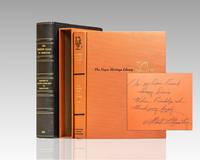
1965149476Yonkers: Educational Heritage Inc 1965. First edition of this comprehensive anthology that compiles historical documents speeches and firsthand accounts to trace the evolving struggle for African American freedom and equality. Quarto original publisher's orange cloth boards with black and white illustrations. Association copy inscribed by Martin Luther King Jr. to Sammy Davis Jr. on the front free endpaper "To my Dear Friend Sammy Davis Whose Friendship I Cherish very deeply Martin Luther King." Sammy Davis Jr. 1925–1990 was an American singer dancer and actor whose extraordinary versatility made him one of the most celebrated entertainers of the twentieth century. As the only Black member of the Rat Pack Davis broke racial barriers in entertainment while confronting segregation both on and off stage. His friendship with Dr. Martin Luther King Jr. began through Davis’s activism and fundraising for King’s civil-rights efforts and deepened during the Civil Rights Movement. Davis used his fame to raise awareness and funds for King’s initiatives performing at civil rights benefits and supporting the 1963 March on Washington. In near fine condition with a small loss to the crown of the spine. Edited by Alfred E. Cain. Illustrated by Horace Varela. Housed in the original orange cloth slipcase within a custom folding chemise within a custom half morocco slipcase with gilt titles to the spine. Martin Luther King Jr. was a Baptist minister and activist who became the most visible spokesperson and leader in the civil rights movement from 1954 through 1968. He is best known for his role in the advancement of civil rights using the tactics of nonviolence and civil disobedience based on his Christian beliefs and inspired by the nonviolent activism of Mahatma Gandhi. King led the 1955 Montgomery bus boycott and in 1957 became the first president of the Southern Christian Leadership Conference SCLC. With the SCLC he led an unsuccessful 1962 struggle against segregation in Albany Georgia and helped organize the nonviolent 1963 protests in Birmingham Alabama. He also helped organize the 1963 March on Washington where he delivered his famous "I Have a Dream" speech. On October 14 1964 King received the Nobel Peace Prize for combating racial inequality through nonviolent resistance. In 1965 he helped to organize the Selma to Montgomery marches and the following year he and the SCLC took the movement north to Chicago to work on segregated housing. In his final years he expanded his focus to include opposition towards poverty and the Vietnam War alienating many of his liberal allies with a 1967 speech titled "Beyond Vietnam". In 1968 King was planning a national occupation of Washington D.C. to be called the Poor People's Campaign when he was assassinated on April 4 in Memphis Tennessee. He was posthumously awarded the Presidential Medal of Freedom and the Congressional Gold Medal. Martin Luther King Jr. Day was established as a holiday in numerous cities and states beginning in 1971 and as a U.S. federal holiday in 1986. The Martin Luther King Jr. Memorial on the National Mall in Washington D.C. was dedicated in 2011. Educational Heritage, Inc hardcover
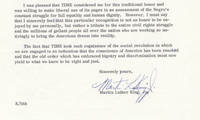
19643590625/03/1964. <blockquote><p>Among the finest MLK letters we have seen on the market</p><p> </p><p>He references “the Negro's constant struggle for full equality and human dignity†and sees with satisfaction the Civil Rights struggle as having made significant progress foreseeing its success</p><p> </p><p>The honor from Time was not his alone but “a tribute to the entire civil rights struggle and the millions of gallant people all over the nation who are working so untiringly to bring the American dream into realityâ€</p></blockquote><p><img class=""alignnone wp-image-35912 size-post-window"" src=""https://cdn.raabcollection.com/wp-content/uploads/20260309191039/MLK-March-25-1964-1-1600x484.jpg"" alt="""" width=""1600"" height=""484"" /></p><p>Time has become renowned for annually naming a ‘‘Man of the Year’’ doing so in the first issue of a new year and featuring and profiling a person group idea or object that ""for better or for worse…has done the most to influence the events†of the previous year. To receive the honor was more than prestigious; it drew broad attention to the winner’s work. The winners for 1961 and 1962 were President Kennedy and Pope John XXIII respectively.</p><p>1963 was a pivotal point for the Civil Rights Movement. It was a year of the outcry for equality of massive demonstrations of sit-ins and speeches and street confrontations of soul searching and psalm singing. Nineteen million Negro citizens and their allies forced the nation to take stock of itself—in the Congress and in the corporation in factory and field in restaurant and store in pulpit and playground in kitchen and classroom. At the head of this movement and its symbol was Martin Luther King Jr. and many saw him as a Moses sent to lead his people to the Promised Land of first-class citizenship. His speeches were models of inspiration that nourished hope and excoriated injustice.</p><p>On April 12 1963 Dr. King was arrested with Ralph Abernathy by Birmingham Police Commissioner ""Bull"" Connor for demonstrating without a permit. This launched the Birmingham campaign which would prove to be the turning point in the war to end segregation in the South. During the eleven days he spent in prison King wrote his famous Letter from Birmingham Jail. On May 10 the Birmingham agreement was announced whereunder the city’s stores restaurants and schools would be desegregated hiring of blacks implemented and charges against civil rights leaders dropped. On June 23 King lead over 200000 people on a Freedom Walk in Detroit. Then came the most famous moment in King’s long career and long struggle: The March on Washington for Jobs and Freedom which took place in Washington D.C. on August 28 1963. Attended by some 250000 people it was the largest demonstration ever seen in the nation's capital up to that time and one of the first to have extensive television coverage. During that march King delivered his “I_Have a Dreamâ€_speech which remains one of the most famous speeches in American history. He started with prepared remarks saying he was there to ""cash a check"" for ""Life Liberty and the pursuit of Happiness"" while advising fellow protesters that non-violence was key to the movement: â€We must rise to the majestic heights of meeting physical force with soul force."" But then he departed from his script shifting into the ""I have a dream"" theme speaking of an America where his children ""will not be judged by the color of their skin but by the content of their character."" He followed this with an exhortation to ""let freedom ring"" across the nation. The impact of all of this on the American people was enormous and you could see people’s perceptions changing. Now King’s agenda came to the front and center of the national consciousness.</p><p>Time magazine saw King as the personification of the Civil Rights Movement and in its January 4 1964 issue gave him Man of the Year honors for 1963. In that issue the cover featured a portrait of King by artist Robert Vickrey and a seven-page article that highlighted King’s leadership in the civil rights movement. It featured pictures of King during some of the most memorable moments of his civil rights career including a meeting with President Lyndon B. Johnson and King’s arrest in Birmingham Alabama. King received many congratulatory telegrams and letters. He wrote Time editor Henry Luce thanking him and saying that Times’s recent treatment of the achievements of black Americans ‘‘does much to help grind away the granite-like notions that have obtained for so long that the Negro is not able to take his place in all fields of endeavor.’’</p><p><img class=""alignnone wp-image-35913 size-post-window"" src=""https://cdn.raabcollection.com/wp-content/uploads/20260309191110/MLK-March-25-1964-2-1600x306.jpg"" alt="""" width=""1600"" height=""306"" /></p><p>King did not consider that the honor was his alone but rather as a tribute being paid to the civil rights movement. He also saw it as a sign that bigotry was waning in America and that justice was on the rise.</p><p><strong>Typed letter signed</strong> as President of the Southern Christian Leadership Conference SCLC and on its letterhead Atlanta Georgia March 25 1964 to Robert W. Fischer in Milan Italy enunciating his true feelings about the deeper meaning of the Time Magazine award the course of the entire Civil Rights struggle and the part he played in it. <em>“Please accept my deep appreciation for your kind letter in reference to my being chosen by TIME magazine as its Man of the Year. It was very thoughtful of you to take the time to write to me in this connection and I am deeply grateful for this expression of support.</em></p><p><em>“I was pleased that TIME considered me for this traditional honor and was willing to make liberal use of its pages in an assessment of the Negro's constant struggle for full equality and human dignity. However I must say that I sincerely feel that this particular recognition is not an honor to be enjoyed by me personally but rather a tribute to the entire civil rights struggle and the millions of gallant people all over the nation who are working so untiringly to bring the American dream into reality.</em></p><p><em>“The fact that TIME took such cognizance of the social revolution in which we are engaged is an indication that the conscience of America has been reached and that the old order which has embraced bigotry and discrimination must now yield to what we know to be right and just.""</em></p><p>King was right that “the conscience of America has been reached†and that the civil rights movement had made important gains that augured well for the future. He was perhaps too modest about the part he was playing in making equality a reality.</p><p><img class=""alignnone wp-image-25018 size-post-window"" src=""https://cdn.raabcollection.com/wp-content/uploads/20231204144051/Folder-site-11-1600x1327.jpg"" alt="""" width=""1600"" height=""1327"" /></p> unknown
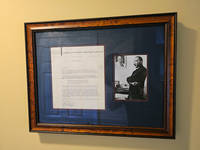
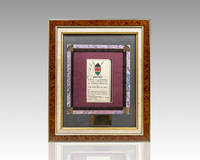
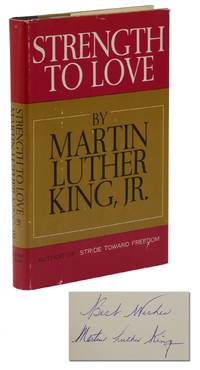
1963022128Atlanta 12 August 1963. Framed Letter. Near Fine and handsomely presented. Superb letter on Southern Christian Leadership Conference stationery dated 12 August 1963. "I want to personally thank you for the support which you have given to our nonviolent direct action movement to eliminate the immoral and shameful practice of racial discrimination and segregation from American life. I am particularly pleased that as part of your contribution to our work you have acquired a copy of my latest book STRENGTH TO LOVE. In the preface of this book I said: 'In these turbulent days of uncertainty the evils of war and of economic and racial injustice threaten the very survival of the human race.' These words are even more relevant to this current phase of the civil rights revolution than it was when the preface was printed. It has always been a source of inner strength to me and those of my associates in the Southern Christian Leadership Conference to be able to meet and overcome many of the indignities and humiliations of segregation in America with unswerving faith in the American dream of freedom for all men. I believe it can be said that the Strength To Love in the midst of adversities is one of the most significant features of the nonviolent direct action movement in our country today." SIGNED "Martin L. King Jr." Matted in deep blue and maroon with a casual photograph of King standing at his desk with a photo of Gandhi behind him. In an antique carved gilt frame 21-1/2" wide by 17" high. <br/><br/> unknown
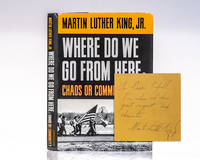
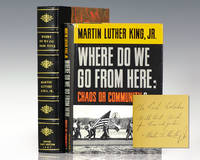
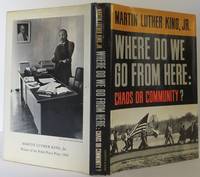
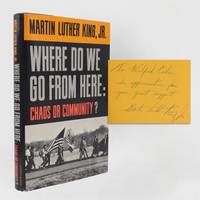
1967149391New York: Harper & Row Publishers 1967. First edition of King's "last grand expression of his vision" Cornel West. Octavo original half cloth illustrated with eight pages of black-and-white photogravures. Association copy warmly inscribed by the author on the front free endpaper "To Cass Canfield For whom I have great respect and admiration Martin Luther King Jr." The recipient Cass Canfield was the longtime President and Chairman of Harper & Brothers Publishers and profoundly shaped twentieth-century literary culture. After investing in the firm in 1924 and managing its London office he signed major authors such as James Thurber E. B. White and Julian Huxley. Rising through the company’s leadership—from president to board chairman—Canfield played a pivotal role in publishing influential works including John Updike’s first book in 1958 and authored seven nonfiction books of his own. Near fine in a near fine dust jacket. Jacket design by Ronald Clyne. Jacket photograph of Martin Luther King Jr. by Bob Fitch. Photograph of the Selma March to the front panel by Steve Schapiro. An exceptional association one of the finest we have seen. Where Do We Go from Here is Dr. King’s analysis of the state of American race relations and the movement after a decade of U.S. civil rights struggles. ‘‘With Selma and the Voting Rights Act one phase of development in the civil rights revolution came to an end’’ he observed King 3. King believed that the next phase in the movement would bring its own challenges as African Americans continued to make demands for better jobs higher wages decent housing an education equal to that of whites and a guarantee that the rights won in the Civil Rights Act of 1964 and the Voting Rights Act of 1965 would be enforced by the federal government. Harper & Row, Publishers hardcover
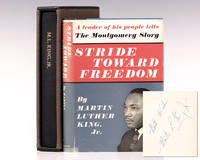
195817050New York: Harper & Brothers 1958. First Edition First Printing. Cloth. Near fine/very good. Signed first edition of Stride Toward Freedom: The Montgomery Story by Martin Luther King Jr. with an incredible collection of signatures including Martin Luther King Jr. Ralph Abernathy Jesse Jackson James Farmer Julian Bond and Shirley Chis. Octavo 230pp 2. Blue cloth covers title in silver on black spine. Stated "First Edition" on copyright page with publisher's "H-H" code. Solid text block rubbing to head and tail of spine otherwise fine condition. In the publisher's first state dust jacket $2.95 retail price on front flap lightly shelf worn. Small chips from edges of spine corners and hinge flaps with small piece of archival tape reinforcing spine on verso. Housed in a custom cloth clamshell title in gilt on black morocco label affixed to spine. Signed by the author on the front free endpaper: "Best Wishes / Martin Luther King Jr." Additionally inscribed by numerous members of the Civil Rights movement on the front endpapers. Signatures vary between small inscriptions autographs and clipped signatures pasted in. This work includes signatures from the following notable individuals: <br /> - "Best Wishes / Martin Luther King Jr."<br /> - "With best wishes / from your friends / Martin Luther King Jr. RDA / Ralph D. Abernathy" Ralph Abernathy 1926-1990 a founding member of the Southern Christian Leadership Conference.<br /> - Twice signed by Jesse Jackson: "4/28/88 Peace! Jesse Jackson" <br /> - James Farmer a fellow nonviolent protest supporter and initiator of the first Freedom Ride in 1961.<br /> - Shirley Chisholm the first Black woman to be elected to the U.S. Congress representing New York's 12th district 1968.<br /> - Julian Bond founding member of the Student Nonviolent Coordinating Committee served a total ten terms in the Georgia state legislature and was chairman of the NAACP from 1998-2010.<br /> - John Lewis clipped signature<br /> - Coretta Scott King clipped signature. Harper & Brothers unknown
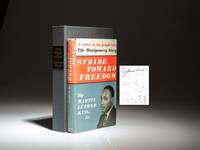
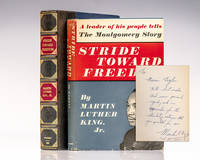
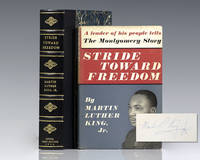
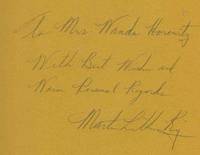
1958149819New York: Harper & Brothers Publishers 1958. First edition of Dr. Martin Luther King’s first book. Octavo original half cloth illustrated. Presentation copy lengthily inscribed by the author opposite the half-title page "To: Marian Taylor With best wishes and warm personal regards and in appreciation for the stimulating interview that you provided for me. Martin Luther King Sept. 17 1958." Taylor under the name Martha Dean hosted a series of interviews with King on CBS radio. He inscribed this copy shortly after completing a fifteen-minute interview with Taylor on 17 September 1958 which began at 9:45 as noted by Taylor on the front free endpaper in pencil. Near fine in a near fine dust jacket with paperclip marks to the rear free endpaper. Housed in a custom folding chemise and half morocco slipcase with gilt titles. Rare and desirable signed and with provenance. Stride Toward Freedom is Dr. Martin Luther King Jr.'s account of the first successful large-scale application of nonviolence resistance in America is comprehensive revelatory and intimate. King described his book as "the chronicle of fifty thousand Negroes who took to heart the principles of nonviolence who learned to fight for their rights with the weapon of love and who in the process acquired a new estimate of their own human worth.'' Harper & Brothers, Publishers hardcover
48870Jena Christian Rödinger Donatus Richtzenhain Thomas Rebart 1555-1562. 4°; Titelblätter jeweils in Rot und Schwarz m. Vignette in Holzschnitt zahlreiche 4- bis 7-zeilige Initialen u. einige Vignetten in Holzschnitt; Bd. 1: 11 Bl. 588 pag. Bl. 4 Bl. 2 Bl. m. je 1 Holzschnitt 2 Bl.; Bd. 2: 6 Bl. 523 pag. Bl. 2 Bl. 2 Bl. m. je 1 Holzschnitt; Bd. 3: 6 Bl.1 ganzseit. Holzschnitt 534 pag. Bl. m. 1 Abb. in Holzschnitt; Bd. 4: 4 Bl. m. 1 ganzseit. Holzschnitt 547 pag. Bl. m. 3 Holzschnitten 2 Bl.; Bd. 5: 7 Bl. 1 ganzseit. Holzschnitt 536 pag. Bl. 2 Bl.; Bd. 6: 7 Bl. 1 ganzseit. Holzschnitt 546 pag. Bl. 2 Bl.; Bd. 7: 5 Bl. 1 ganzseit. Holzschnitt 449 pag. Bl. 1 Bl.; Bd. 8: 5 Bl. 1 ganzseit. Holzschnitt 391 pag. Bl. 1 Bl. Pgt. Unterschiedlich gebräunt auf Holzdeckeln mit 9 von 16 metallenen Schliessen. Innen etw. stock-fleckig tlw. gebräunt einige Randverluste u. -risse zahlr. Marginalien u. Unterstreichungen in Tinte von alten Händen ebenso Notizen auf den Vs. gesamthaft gutes Exemplar. Komplettes und kollationiertes Exemplar der berühmten Jenaer Gesamtausgabe. Bde. 1 und 2 in erster Auflage. VD16/L 3323 L 3324 L 3348 L 3349 L 3350 L 3351 L 3353 L 3354. Alle Bände mit Titelholzschnitt Friedrich der Weise und Luther unter dem Kreuz knieend die Bde. 1 und 2 jeweils mit 2 Holzschnitten Luther und Melanchthon bzw. Georg III. Fürst von Anhalt-Dessau sowie dessen Wappenschild die Bde. 3 bis 8 jeweils mit einem Holzschnitt der Herzöge von Sachsen Joh. Friedrich II. Joh. Wilhelm I. und Joh. Friedrich III. auf Tafeln; im Bd. 3 zusätzlich 1 Holzschnitt Papstesel im Bd. 4 drei Holzschnitte davon 1 Karte im Text.Auf Veranlassung des Kurfürsten Johann Friedrich von Sachsen Ernestiner genannt «der Großmütige» 1503 - 1554 gaben Nikolaus von Amsdorf Georg Rörer Johannes Aurifaber u. a. diese Ausgabe als Konkurrenzausgabe zur Wittenberger Ausgabe heraus welche als teilweise verfälscht erachtet wurde.Luthers Privatsekretär und Vertrauter Georg Rörer 1492 - 1557 der bereits massgeblich am Zustandekommen der Wittenberger Ausgabe beteiligt war blieb bei der vorliegenden Ausgabe mehr auf die Funktion des Korrektors beschränkt und stand unter der Oberaufsicht der um Jahrzehnte jüngeren Hofprediger Aurifaber und Stoltz. Diese Jenaer Gesamtausgabe gilt der Wittenberger «auf Grund der wissenschaftlichen Editionsgrundsätze als überlegen» R. Jauernig. 010 Jena, Christian Rödinger, Donatus Richtzenhain, Thomas Rebart, 1555-1562 unknown
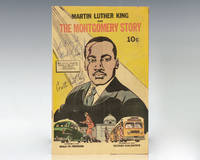
1957138337Nyack N.Y: The Fellowship of Reconciliation 1957. First and only edition of this highly influential and historic comic book used to teach the tactics and power of nonviolent resistance during the Civil Rights Movement. Quarto original pictorial wrappers the text is presented as a graphic novel illustrated in color. Boldly signed by Martin Luther King on the front panel "Best Wishes Martin L. King" and additionally signed by Coretta Scott King. With annotations in blue pen noting that King signed the book in 1958 and Coretta in 1985. Illustrated by Sy Barry text by John Duffy. In very good condition. Very rare. Copies of the original comic book are uncommon and mainly reside in institutions. Copies signed by Dr. King very rarely appear on the market and copies signed by both him and Coretta are exceptionally rare this possibly being a unique example. Published in December 1957 and written by Alfred Hassler executive secretary and director of publications for the pacifist and interfaith justice organization Fellowship of Reconciliation FoR and Benton Resnik Martin Luther King and the Montgomery Story chronicles the 13-month-long Montgomery Bus Boycott. This mass protest began with the arrest of Rosa Parks for refusing to give up her seat to a white man on December 1 1955 and ended over a year later on December 20 1956 with the Supreme Court ruling that ended segregation on public buses. The final pages include an account of "The Montgomery Method" of nonviolent resistance through the telling of its inspiration from the philosophy of nonviolence practiced by Mahatma Gandhi as well as a four-page primer on its practical application. The comic's formulation was initiated by Hassler and the Reverend Glenn Smiley FoR's field secretary both of whom were involved in the boycott and wanted its story to reach a wider audience. The use of a comic book format was a somewhat risky choice at the time as only three years before televised Senate hearings were held that investigated the connection between the consumption of comic books and juvenile delinquency and that led to backlash against the medium. Nonetheless Hasseler and the FoR understood that the comic format held the potential for their message of non-violence to reach the widest possible audience. Hassler and Resnik collaborated on the text and recruited The Phantom illustrator Sy Barry to create the art. When they completed their first draft they sent a copy to Dr. King for his input and he promptly replied with suggestions that were then incorporated into the final published work. Only a single printing of 250000 copies was made and they were distributed widely to schools churches and civil rights groups especially those who taught nonviolence workshops in the South where it proved incredibly influential to activists including future Congressman John Lewis. A Spanish language version of this comic book telling the same story but utilizing a different artist was published not long after this in an edition of 125000 for distribution in Latin America. Less than a year following the publication of this comic on September 17 1958 Dr. King published his acclaimed memoir of the Montgomery Bus Boycott Stride Toward Freedom: The Montgomery Story. The Fellowship of Reconciliation unknown
16101Dr. Martin Luther King Jr. "Crisis in America's Cities; An Analysis of Social Disorder and a Plan of Action Against Poverty Discrimination and Racism in Urban " First Edition unpublished mimeograph draft. 5 pages plus cover. King's nationwide call to action against urban poverty the most ambitious Civil Rights Campaign in the Northern United States culminating in the 1968 Fair Housing Act with significant differences from King's final speech. King authored this brief but influential treatise after riots spread through the urban north due to intense discrimination and poverty. "The white society did not move and Newark came after Watts and was followed by Detroit. We will have to make them move. We will have to remind them that in the 18th century Thomas Jefferson said 'I tremble for my country when I reflect that God is just.'" First Editions of the original speech made by King are extremely rare with only one known in the holdings of the King Center archives. This earlier draft held in the files of King's organization the SCLC is the only known draft of this speech in existence. <br/><br/> On August 15 King delivered what is probably the most fiery of his speeches entitled "The Crisis in American Cities." He pointed a finger at hypocrisy declaring "if the total slum violations of law by the white man over the years were calculated and compared with the lawbreaking of a few days of riots the hardened criminal would be the white man." The blame for the situation he placed upon "the policy makers of the white society.they created discrimination; they created slums; they perpetuate unemployment ignorance and poverty." With aching eloquence King declared that "Discrimination is the hellhound that gnaws at Negroes in every waking moment of their lives to remind them that the lie of their inferiority is accepted as truth in the society dominating them." His mission was to end the housing segregation that forced blacks into unsafe and unsanitary ghettos of the urban north. With tensions boiling over during the "long hot summer" of 1967 high unemployment discrimination and unsanitary an crowded living conditions led to riot after riot in cities across the urban north. King's message in "Crisis in America's Cities" was that love not hate was the answer to racial violence. <br/><br/>This speech was never formally published or collected but was released in small numbers of staple-bound 6 page copies with green covers and as a tri-fold printed pamphlet. The King Center Archives holds a single copy of the 6 page green variant. The copy here is an unknown earlier draft 5 pages plus a cover mimeographed all on yellow paper. This draft of "Crisis" is absent from institutional collections and auction records and it is possibly the only copy left in existence. While the theme and most content of this draft is the same as the final it is driven by emotion which is captured and organized by the time the speech reached its final form. Some cuts appear to be for clarity including a sentence on the first page which is lacking from the final draft and reads "After establishing the general cause of outbursts have an emotional content that is a reaction to the insults and depravity of the white backlash." Missing from this early draft is numbered list of points for introduction as well as numerous typos and typed over corrections which are visible through the mimeograph and differences in the distribution of paragraphs. <br/><br/>Period sources state King handwrote his speeches before handing them off to aides who would type a clean copy then mimeograph them for the press typically in a run of about 200 copies. Most if not all were distributed to the press and then lost. Today most documents from the SCLC files exist only in the collection of the King Center. Like those in the King Center this document escaped destruction because it were never distributed but rather remained as the personal copy of King or his top staffers. This can be proven by the fact that all press copies were carefully inscribed with a copyright symbol © while King's copy brought with him to the podium and other internal copies remained blank. This document spent decades in an SCLC filing cabinet where it was exposed to dampening on the left side but is otherwise untouched. It now presents in only fair condition with water staining and rust around the original staple which is still holding. Light grey water stains to left side of document and bottom left corner frayed. All text legible. The right side of the document was apparently more protected in its file and is in very good condition. It was gifted from the Estate of Thomas Offenburger to Stoney Cooks. Both Offenburger and Cooks worked with King at the SCLC with Offenburger as publicist and Cooks as a young Director of Student Affairs. King's mission was rewarded the year after "Crisis" by the passage of the Fair Housing Act of 1968 barring racial discrimination in real estate. Unfortunately King did not live to see it. King's indictment of government for causing urban suffering is extremely rare today with only one final draft Edition of "Crisis" in the King Center Archives and no copies of this early unpublished draft recorded anywhere. unknown books
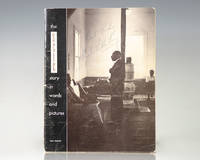
1964141073Atlanta Georgia: Southern Christian Leadership Conference 1964. First edition first printing of The SCLC Story containing one of the first appearances in print of Martin Luther King Jr.'s I Have a Dream Speech. Quarto original illustrated wrappers as issued illustrated with photographs including a full-page photograph of King photographs of the officers executive board regional and secretarial staffs of the SCLC. Signed by Martin Luther King Jr. on the front panel "Best Wishes Martin Luther King." With a letter of provenance that relays that the magazine was signed at an event where King spoke in Atlanta in 1964 and that it may have been first obtained when the Coliseum in Los Angeles hosted the Religious Witness for Human Dignity on May 31 1964. Dr. King gave a forty-minute speech at this event of which Pepperdine University Archives has a recording that can be hear online. In near fine condition. Very rare and desirable containing one of the earliest appearances of King's powerful and iconic I Have a Dream Speech. Baptist minister and activist Martin Luther King Jr. became the most visible spokesperson and leader in the civil rights movement from 1954 through 1968. He is best known for his role in the advancement of civil rights using the tactics of nonviolence and civil disobedience based on his Christian beliefs and inspired by the nonviolent activism of Mahatma Gandhi. King led the 1955 Montgomery bus boycott and in 1957 became the first president of the Southern Christian Leadership Conference SCLC. With the SCLC he led an unsuccessful 1962 struggle against segregation in Albany Georgia and helped organize the nonviolent 1963 protests in Birmingham Alabama. He also helped organize the 1963 March on Washington where he delivered his famous "I Have a Dream" speech. On October 14 1964 King received the Nobel Peace Prize for combating racial inequality through nonviolent resistance. In 1965 he helped to organize the Selma to Montgomery marches and the following year he and the SCLC took the movement north to Chicago to work on segregated housing. In his final years he expanded his focus to include opposition towards poverty and the Vietnam War alienating many of his liberal allies with a 1967 speech titled "Beyond Vietnam". In 1968 King was planning a national occupation of Washington D.C. to be called the Poor People's Campaign when he was assassinated on April 4 in Memphis Tennessee. He was posthumously awarded the Presidential Medal of Freedom and the Congressional Gold Medal. Martin Luther King Jr. Day was established as a holiday in numerous cities and states beginning in 1971 and as a U.S. federal holiday in 1986. The Martin Luther King Jr. Memorial on the National Mall in Washington D.C. was dedicated in 2011. Southern Christian Leadership Conference unknown
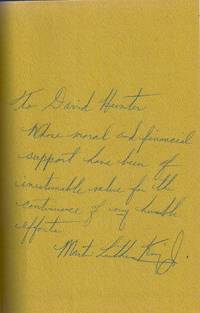
1967019026New York: Harper & Row 1967. First Edition. Hardcover. Two small scratches on the front of the dustwrapper that slightly affect the front cover of the book. About Fine in a close to Fine dustwrapper. A beautiful copy and outstanding inscription. INSCRIBED and SIGNED by the author filling most of the front free endpaper: "To David Hunter/Whose moral and financial/support have been of/inestimable value for the/continuance of my humble/efforts/Martin Luther King Jr." <br/><br/> Harper & Row hardcover
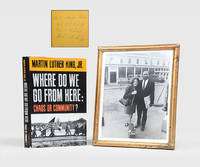
1967187244New York: Harper Row 1967. To the parents of a young volunteer First edition inscribed by the author on the front free endpaper "To Dr. & Mrs. Jesse Holland with best wishes for Peace and Brotherhood Martin Luther King Jr.". Included is a photograph of King with his arm around their daughter Jessica E. Holland - "a key member of Dr. Martin Luther King's staff at the Southern Christian Leadership Conference" Oral History Review. In 1968 Jessica paused her studies at Barnard College to volunteer with King and the Southern Christian Leadership Conference. Jessica likely arranged the inscription for her parents who lived in Far Rockaway Long Island although the family recalls that they were also donors to the SCLC. After King's assassination Jessica returned to Barnard and graduated in 1969. She later worked as a corporate oral historian including for the New York Stock Exchange McKinsey and Company Philip Morris and AT&T. Where Do We Go from Here was published after the 1965 Voting Rights Act and other civil rights milestones and reflected on the next steps for African Americans. The book sought to offer an alternative to the radicalism of the Black Power movement and instead advocate King's vision of peaceful and non-revolutionary change. Octavo. Original black quarter cloth spine lettered in gilt yellow paper sides. With dust jacket. Together with photograph in original frame with new window mount and conservation-standard acrylic frame size 20.5 x 25.5 cm. Minimal sunning at extremities; unclipped jacket with slight rubbing and nicking at extremities minor creasing: a near-fine copy in very good jacket. "Dedication: In Memory of Jessica E. Holland" in The Oral History Review Vol. 17 No. 1 Spring 1989. hardcover
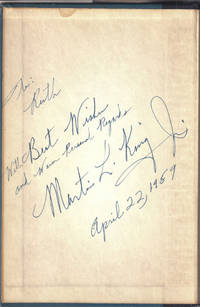
1958021985New York: Harper & Brothers 1958. First Edition. Hardcover. Chip to cloth at bottom of spine. Very Good in a Near Fine dustwrapper with typically sunned spine. Early but not first printing of Martin Luther King's first book. Illustrated with photographs. Boldly INSCRIBED and SIGNED by the author on the front pastedown: "To:/Ruth/With Best Wishes/and Warm Personal Regards/Martin L. King Jr./Aprill 22 1959." On the front endpaper are two further inscriptions one dated 21 February 1959 and SIGNED "M.G.G." and the other dated 14 June 1959 by Theodore E. Brown who at the time was the assistant director of the AFL-CIOs civil rights department: "To a stimulating person/May you grow in wisdom and intellect/May you achieve man's greatest/quest; peace of mind and spirit./Theodore E. Brown." Brown is thanked by King for his "significant suggestions and real encouragement" in the preface to this book. Brown was appointed secretary of the Negro American Labor Council in 1961. As president of the American Negro Leadership Conference on Africa 1962-1968 Brown campaigned to bar American warships from refueling at South African ports. He later worked for the U.S. Department of State and the Agency for International Development. Laid in are two programs from Temple Sharey Shalom in Springfield NJ presenting an Evening with Dr. Martin Luther King Jr. speaking on "Revolution in Religion." There is also a 11 September 1966 program from The Union Baptist Church in Montclair NJ when King gave a guest sermon following riots in Atlanta and the arrest of Stokely Carmichael the chairman of the Student Non-Violent Coordinating Committee. "We have made too much progress through nonviolence to turn now to violence" King told his audience of about 2000. "The old eye-for-an-eye philosophy leaves everybody blind." Along with a few newsclippings about local ministers. <br/><br/> Harper & Brothers hardcover
1964151903Stockholm 13 December 1964. Rare invitation to a celebration of the first anniversary of Kenyan Independence in Stockholm Sweden signed by Martin Luther King Jr. Coretta Scott King and Ralph Abernathy. The color-printed invitation to the event "Kenya Celebrates 1st Anniversary of Independence & Republic Day" held at the Hotel Malmen in Stockholm signed at the upper left in ink by both Martin Luther King Jr. and Coretta Scott King and by Ralph Abernathy at upper right although this signature faded. The card is numbered 803 and invites Anna Lisa Dahlback to the celebration. Three days after accepting the Nobel Peace Prize and giving a speech in Oslo Martin Luther King Jr. attended an event with his wife in Stockholm celebrating the 1st anniversary of Kenyan Independence. Dr. King was the second African American to receive the Nobel Peace Prize rendering this an important moment not only in American history but also for bringing the Civil Rights struggle to the world stage. In his speech upon receiving the award Dr. King remarked "I accept the Nobel Prize for Peace at a moment when 22 million Negroes of the United States of America are engaged in a creative battle to end the long night of racial injustice. I accept this award on behalf of a civil rights movement which is moving with determination and a majestic scorn for risk and danger to establish a reign of freedom and a rule of justice. I am mindful that only yesterday in Birmingham Alabama our children crying out for brotherhood were answered with fire hoses snarling dogs and even death. I am mindful that only yesterday in Philadelphia Mississippi young people seeking to secure the right to vote were brutalized and murdered. And only yesterday more than 40 houses of worship in the State of Mississippi alone were bombed or burned because they offered a sanctuary to those who would not accept segregation. I am mindful that debilitating and grinding poverty afflicts my people and chains them to the lowest rung of the economic ladder. Therefore I must ask why this prize is awarded to a movement which is beleaguered and committed to unrelenting struggle; to a movement which has not won the very peace and brotherhood which is the essence of the Nobel Prize. After contemplation I conclude that this award which I receive on behalf of that movement is a profound recognition that nonviolence is the answer to the crucial political and moral question of our time – the need for man to overcome oppression and violence without resorting to violence and oppression." In very good condition with the the Abernathy signature faded as noted. The invitation measures 6.25 inches by 3.5 inches. Double matted and framed. The entire piece measures 15.75 inches by 14.5 inches. Scarce. Signed items from King's time in Stockholm are scarce. We can trace only one other example of this signed invitation in the auction record without the signature of King's wife Coretta Scott. unknown
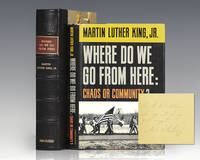
1967137331New York: Harper & Row Publishers 1967. First edition of King's "last grand expression of his vision" Cornel West. Octavo original half cloth illustrated with eight pages of black-and-white photogravures. Presentation copy inscribed by the author on the front free endpaper "To Carl Colodne With Best Wishes for Peace and Justice Martin Luther King Jr." Fine in a fine dust jacket small name. Jacket design by Ronald Clyne. Jacket photograph of Martin Luther King Jr. by Bob Fitch. Housed in a custom half morocco clamshell box. Where Do We Go from Here is Dr. King’s analysis of the state of American race relations and the movement after a decade of U.S. civil rights struggles. ‘‘With Selma and the Voting Rights Act one phase of development in the civil rights revolution came to an end’’ he observed King 3. King believed that the next phase in the movement would bring its own challenges as African Americans continued to make demands for better jobs higher wages decent housing an education equal to that of whites and a guarantee that the rights won in the Civil Rights Act of 1964 and the Voting Rights Act of 1965 would be enforced by the federal government. Harper & Row, Publishers hardcover
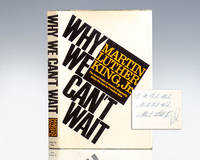
1964138556New York: Harper & Row Publishers 1964. First edition of Dr. King's third book including his reflections on his 1963 Birmingham campaign. Octavo original half cloth illustrated with eight pages of black-and-white photogravures. Presentation copy inscribed by the author on the front free endpaper "To Orlando Darden Jr. With Best Wishes Martin Luther King." Near fine in a near fine dust jacket. Housed in a custom clamshell box. Uncommon signed. Published the same year Martin Luther King Jr. won the Nobel Peace Prize Why We Can’t Wait was his response to the assassination of President Kennedy as well as his attempt to “place the events of 1963 in historical perspective relating the Negro’s own long search for freedom since the Emancipation Proclamation†Oates Let the Trumpet Sound. Includes King’s famous Letter from Birmingham Jail published here in full for the first time. Named by Modern Library as one of the 100 best non-fiction works of the twentieth century and on TIME Magazine's list of the 100 best non-fiction books from 1923-2005. Harper & Row, Publishers hardcover
19672202106New York: Harper & Row 1967. First. Hardcover. Very good/Very good. A very good first edition inscribed by Martin Luther King Jr.: "To my friends of Hyde Park Cooperative In appreciation for your great support. Martin Luther King Jr." This is an authentic inscription and signature by Dr. King not the common secretarial signature. In very good dust jacket with original price still on front flap. Housed in a custom-made fold-out slipcase. Laid in is an embossed card from publisher saying the book is presented "With the compliments of the author. Harper & Row hardcover
1967120468New York: Harper & Row Publishers 1967. First edition of King's "last grand expression of his vision" Cornel West. Octavo original half cloth illustrated with eight pages of black-and-white photogravures. Presentation copy inscribed by the author on the front free endpaper "To Mr. H.O. Wilson In appreciation for your great support Martin Luther King Jr." Fine in a near fine dust jacket. Jacket design by Ronald Clyne. Jacket photograph of Martin Luther King Jr. by Bob Fitch. Housed in a custom half morocco clamshell box. Where Do We Go from Here is Dr. King’s analysis of the state of American race relations and the movement after a decade of U.S. civil rights struggles. ‘‘With Selma and the Voting Rights Act one phase of development in the civil rights revolution came to an end’’ he observed King 3. King believed that the next phase in the movement would bring its own challenges as African Americans continued to make demands for better jobs higher wages decent housing an education equal to that of whites and a guarantee that the rights won in the Civil Rights Act of 1964 and the Voting Rights Act of 1965 would be enforced by the federal government. Harper & Row, Publishers hardcover
1964144190New York: Harper & Row Publishers 1964. First edition of Dr. King's third book including his reflections on his 1963 Birmingham campaign. Octavo original half cloth illustrated with eight pages of black-and-white photogravures. Presentation copy inscribed by the author on the front free endpaper "To Mr. Charles Martin With Best Wishes Martin Luther King Jr." Fine in a near fine dust jacket. Published the same year Martin Luther King Jr. won the Nobel Peace Prize Why We Can’t Wait was his response to the assassination of President Kennedy as well as his attempt to “place the events of 1963 in historical perspective relating the Negro’s own long search for freedom since the Emancipation Proclamation†Oates Let the Trumpet Sound. Includes King’s famous Letter from Birmingham Jail published here in full for the first time. Harper & Row Publishers hardcover
195182416Boston 1951. Typescript autograph letter signed by Dr. Martin Luther King Jr. requesting housing upon his acceptance to Boston University Graduate School. The letter dated June 15th 1951 and addressed to Dean Charles W. Alter Boston University Graduate School reads "Dear Dean Alter I have been accepted in Boston University Graduate School as a regular student and a candidate for the degree of Doctor of Philosophy in the field of Systematic Theology. I am now interested in finding living accommodations on the campus or at least very near by. A single room would be preferable. If such is possible I would appreciate having it reserved. I am also interested in applying for a graduate Fellowship. Please send me the necessary information at this point along with an application blank. Thanks in advance for your cooperation I am Sincerely yours Martin L. King Jr." King later recalled his experience with housing bias in 1951 Boston in an interview with the Boston Globe in 1965 "I remember very well trying to find a place to live. I went into place after place where there were signs that rooms were for rent. They were for rent until they found out I was a Negro and suddenly they had just been rented." Double matted and framed with a photograph of a young King. The entire piece measures 14 inches by 21.75 inches. This letter offers an extraordinary glimpse into the education of the great African-American Civil Rights leader exemplifying his own experiences with the systemic racism in 1950s American society. Martin Luther King Jr. first received recognition for his outstanding skills as a public speaker as a student at Booker T. Washington High School in Atlanta Georgia. He received early acceptance into the Liberal Arts program at the historically black Morehouse College at the age of 15 also in Atlanta and at age 18 decided to enter the ministry. After graduating from Morehouse in 1948 with a B.A. in Sociology King enrolled in Crozer Theological Seminary in Chester Pennsylvania where he graduated with a Bachelor's degree in Divinity in 1951. That same year he applied to Graduate School at Boston University where in June of 1955 he received his Ph.D. in Systematic Theology with a dissertation titled A Comparison of the Conceptions of God in the Thinking of Paul Tillich and Henry Nelson Wieman. While pursuing doctoral studies King worked as an assistant minister at Boston's historic Twelfth Baptist Church with Reverend William Hunter Hester a friend of King's father who became an important influence on King's later work. unknown books
16099Dr. Martin Luther King Jr. Important and rare Civil Rights document from the original files of the SCLC the Civil Rights organization King founded after the Montgomery Bus Boycotts. First Edition. Dated October 30 1967 the day of King's return to Birmingham the locus of one of his most triumphant campaigns and also where his volunteers endured some of the greatest persecution. 4 mimeograph pages stapled upper left. 8.5" x 11" inches. After 4 years of court battles King must turn himself over to Birmingham authorities to serve a jail sentence resulting from violating an illegal injunction during his 1963 non-violent demonstrations"We depart for jail in Birmingham convinced that our imprisonment is a small price to pay for the historic achievement which directly flowed from the convictions on the streets of Birmingham." One copy of this statement is held by the archives of the King Center; and no other copies among institutional holdings or auction records. <br/><br/>In this moving speech King reminds his followers how Birmingham in 1963 united the Civil Rights Movement "We recall with pride how thousands of Negro citizens facing dogs fire hoses mass arrests and other outrages against human dignity bore dramatic witness to the evils which pervaded the most segregated city in our nation. History has since recorded how these non-violent demonstrators led to the enactment of the Civil Rights Act of 1964 legislation which finally brought the end of legal segregation." Birmingham in 1967 now brings the opportunity to make them aware of a new foe the "X-party injunction sic--meaning ex parte injunction used by hostile local courts to frustrate and silence the vital First Amendment rights of all citizens." But while the battle for civil rights had found its way to the courtroom it was still very much in the streets as well "We are witnessing an escalating disregard for constitutional freedom. In the last two weeks U.S. Marshals state troopers and local police have clubbed demonstrators in Washington Berkeley and Madison Wis.; police have dragged girls by the hair in Brooklyn Tear gas has scattered and routed protestors in Washington Berkeley and Oberlin Ohio and even the odious fire hoses of Bull Connor were callously deployed against college students at Oberlin. Student arrests in this short period are beginning to reach levels unknown in this country since Selma." As King presents himself to Birmingham authorities he reminds his followers of the true meaning of civil disobedience "we will not appeal nor will we seek to flee the punishment. It is the heart of civil disobedience that one accepts the consequences willingly and openly." And through his sacrifice King reminds them that they too may be called as brave soldiers to the cause "As we leave for Birmingham Jail today we call out to America: "Take heed. Do not allow the Bill or sic Rights to become a prisoner of war." <br/><br/>Period sources state King handwrote his speeches before handing them off to aides who would type a clean copy then mimeograph them for the press typically in a run of about 200 copies. Most if not all were distributed to the press and then lost. Today the only other original copy of this document is in the collection of the King Center. Like those in the King Center this document escaped destruction because it were never distributed but rather remained as the personal copy of King or his top staffers. This can be proven by the fact that all press copies were carefully inscribed with a copyright symbol © while King's copy brought with him to the podium and other internal copies remained blank. This press release spent decades in an SCLC filing cabinet where it was exposed to dampening on the left side but is otherwise untouched. It now presents in only fair condition with water staining and rust around the original staple which is still holding. Mark from previous paper-clipping upper left. Light grey water stains to left side of document and bottom left corner frayed. All text legible. The right side of the document was apparently more protected in its file and is in very good condition. It was gifted from the Estate of Thomas Offenburger to Stoney Cooks. Both Offenburger and Cooks worked with King at the SCLC with Offenburger as publicist and Cooks as a young Director of Student Affairs. King's return to Birmingham is a stunning moment in Civil Rights history preserved through this historic document. unknown books
1958130938New York: Harper & Brothers Publishers 1958. First edition of Dr. Martin Luther King’s first book. Octavo original half cloth illustrated. Boldly signed by Martin Luther King Jr. on the front free endpaper. Near fine in a very good dust jacket with light rubbing name to the front pastedown. Housed in a custom half morocco clamshell. Stride Toward Freedom is Dr. Martin Luther King Jr.'s account of the first successful large-scale application of nonviolence resistance in America is comprehensive revelatory and intimate. King described his book as "the chronicle of fifty thousand Negroes who took to heart the principles of nonviolence who learned to fight for their rights with the weapon of love and who in the process acquired a new estimate of their own human worth.'' Harper & Brothers, Publishers hardcover
1958145065New York: Harper & Brothers Publishers 1958. First edition of Dr. Martin Luther King’s first book. Octavo original half cloth illustrated. Boldly signed by the author on the front free endpaper "Best Wishes Martin Luther King Jr." Fine in a near fine dust jacket. Housed in a custom slipcase. Rare and desirable signed. Stride Toward Freedom is Dr. Martin Luther King Jr.'s account of the first successful large-scale application of nonviolence resistance in America is comprehensive revelatory and intimate. King described his book as "the chronicle of fifty thousand Negroes who took to heart the principles of nonviolence who learned to fight for their rights with the weapon of love and who in the process acquired a new estimate of their own human worth.'' Harper & Brothers, Publishers hardcover