Bible PsalmsABAA

21 005 résultats
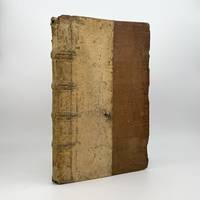
1480254000Ulm: Johann Zainer 1480. 293 of 296 leaves; lacking first 2 leaves of the Calendar and final blank. •6 ••8 a-x8 y12 z8 A-L8 M3. 1 vols. 8vo; 111 x 90 mm. Bound in 18th-century paper boards with remnant of morocco spine label edges stained red. Spine defective and covers rubbed but binding is sound; several leaves bear stubs at outer edge from former index tabs; first leaf of Psalter extended at inner margin; final two leaves slightly waterstained; some browning and occasional stains; text block seriously trimmed but never into text. Notes on front endpapers and a presentation inscription in 1826 from a member of the German Methodist Episcopal Church U.S. In a custom half-morocco slipcase and chemise. 293 of 296 leaves; lacking first 2 leaves of the Calendar and final blank. •6 ••8 a-x8 y12 z8 A-L8 M3. 1 vols. 8vo; 111 x 90 mm. An Incunable of the Utmost Rarity. Johann Zainer the Elder fl. 1472-93 established the first printing press at Ulm where his first book is dated 1473. This pocket psalter by Zainer is undated; the colophon gives only the printer's name and the city in which it was printed. ISTC gives a conjectural date of around 1480. <br/><br/>The book's handy but fragile format a thick octavo that would have been easily portable for late fifteenth-century users doubtless guaranteed a low survival rate. Indeed the few copies which have survived are often incomplete fragments or in poor condition.<br/><br/>ISTC gives the following locations: France: Strasbourg BNU imperfect wanting Commune sanctorum; Germany: Bamberg SB; Berlin SB; Fulda HLB; Leipzig DB/Buch fragment missing; München BSB 2 imperfect; Stuttgart WLB 3; U.S.A: Washington DC Washington Cathedral Library this copy<br/><br/>The present copy - the only copy in America - is complete save for the first two leaves of the Calendar and the blank leaf at the end. Goff Suppl. P1041a; H 13475; C 4927; GW M36206; ISTC No.: ip01041500 Johann Zainer unknown books
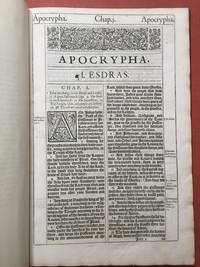
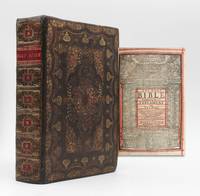
1611H2543London: Robert Barker 1611. First printing. Hardcover. Fine. First edition taken from the 'He' version of the entire APOCRYPHA Authorized Version known as the King James Bible 1611. Folio finely bound in full morocco gilt with printed title page and preface by the New York bookseller Charles Hamilton probably early 1960s where he attests that the text is from the 'He' version taken from an error in Ruth III.15 corrected to 'she' shortly after and thus much more desirable. Fine. 104 leaves 208 pp. from the most famous book in the English language. The 1611 King James Apocrypha contained the following books: 1 Esdras 2 Esdras Tobit Judith Additions to Esther Wisdom of Solomon Ecclesiasticus Baruch Letter of Jeremiah Prayer of Azariah Susanna Bel and the Dragon Prayer of Manasseh 1 Maccabees and 2 Maccabees. In 2016 a copy of the complete Bible sold at Sotheby's for $320000 plus the hammer: nearly $400000. Robert Barker hardcover
1913001619Leipzig: Insel Verlag 1913. Two volumes complete 1913-1914 - Volume I - 648p; Volume II - 632p. Publisher's blind stamped morocco by Riviere & Son raised bands spines in seven panels title in gilt to second volume number and date in gilt to fourth remaining panels with central floral spray and volute tools to side in blind. Covers with outer double panel joined by mitred corners with occasional flower heads and elongated volutes to margins again in blind title and original publisher to head and foot in gilt central panel with blind roll presumably showing Gutenberg's head with a central arabesque inner edges with blind roll combed and curled marbled endpapers a.e.g. Bright and clean. The first complete facsimile of the Gutenberg Bible reproduced from the richly illuminated copies in the Koniglichen Bibliothek Berlin and the Standischen Landesbibliothek Fulda and attractively produced and bound. First Thus. Hardback. Very Good. Elephant Folio. Facsimile. Insel Verlag Hardcover
165512173London Thomas Roycroft/Apparatus: Zürich Heinrich Bodmer 1657 colophon Vol.2: 1655 Vol.3: 1656/Apparatus: 1673. Biblia Sacra Polyglotta Complectentia Textus Originales Hebraicum cum Pentateucho Samaritano Chaldaicum Graecum. Versionumque antiquarum Samaritanae Graecae LXXII Interp. Chaldaicae Syriacae Arabicae Aethiopicae Persicae Vulg. Lat. Quicquid comparari poterat. Cum Textuum & Versionum Orientalium Translationibus Latinis. Ex Vetustissimis Mss. Undique Conquisitis optimiisque Exemplaribus impressis summâ fide collatis. Quae in prioribus Editionubus deerant suppleta. Multa antehac inedita de novo adjecta. Omnia eo ordine disposita ut Textus cum Versionibus uno intuitu conferri possint. Cum Apparatu Appendicibus Tabulis Variis Lectionibus Annotationibus Indicibus & c. Opus totum in sex Tomos tributum. Edidit Brianus Waltonus. WITH: Briani Waltoni Angli Viri Celeberrimi Biblicus Apparatus Chronologico- Topographico- Philologicus: Pront ille tomo praeliminari Operis eximii Polyglotti Londini Anno Christi MDCLVIII. editi continetur. Exhibens Tractatus varios eósque integros Diversorum Virorum doctissimorum & in omni Literatura exercitatissimorum de ratione Sacrorum Temporum Locorum ut Terrae promissae Templi Urbis Ierosolymitanae &c. Nummorum Mensuarum Ponderum nec non Idiotismorum Scripturae sacrae Linguarum & Versionum Orientalium. Adjiciuntur Johannis Drusii De Proverbiis sacris Classes duae. Nunc in gratiam omnium qui Musas has sanctissimas sanctè colunt seorsim excusi & Indicibus exornati. 6 volumes and 1 portrait frontispiece 14 865 889 1 29 1 447 1 389 1 227 1 149 1 87 1 3 1 128 23 1 20 159 1 390 983 1 2 72 56 98 80 196 140 24 58 36 36 96 =74 2 p. H. 46 x W. 295 cm. Contemporary Leather with 6 raised bands decorated with gilt large Folio Apparatus 6 570 6 p. later Vellum with 5 raised bands Folio. This is the last edition of the four great Polyglots following that of Alcalá 1514-1517 in four languages Antwerp 1569-1573 in five and Paris 1628-1645 in seven. It's the most extensive edition of the great Polyglot Bible the London Polyglot or the Walton Polyglot after the compiler Brian Walton 1600-1661. According to Brunet this edition ""is the most sought after being more complete and correct than the others and containing nine different languages"" with Ethiopian and Persian added to the seven languages of the Paris Polyglot. So it includes the text of the Bible in 9 different languages: Hebrew Samaritan Aramaic Greek Latin Ethiopic Syriac Arabic and Persian. All of the texts that are not in Latin are accompanied by Latin translations and all are arranged side by side or one over another on the two pages open before the reader. The first three volumes contain the Old Testament. They give the Hebrew text with the Samaritan Pentateuch the Latin Vulgate the Greek Septuagint the Aramaic Targum and the Syriac and Arabic paraphrases. The fourth part contains the Apocrypha and the Triplex Targum i.e. Targumim I and II of Jerusalem and the Persian version of Jacob ben Joseph Tawus. The fifth volume is devoted to the New Testament printed in Greek Latin Syriac Arabic and Ethiopian. Finally the last section contains the critical apparatus. Volume 1 is illustrated with multiple engravings in the text a portrait of Brian Walton a frontispiece 2 plans a map and 3 engravings all double-page except 1 plan. An extra volume by Brian Walton the Apparatus contains parts of the Polyglot such as codices chronologies proverbs and Holy Land details. Vol. 1 missing blank leaf after pp. 865. Spines restored portrait and title print frayed with creases some browning and staining. A copy of the second edition without the reference to Cromwell's protectorate in the preface. It does not contain the dedicated epistle to King Charles II but does contain the one mentioned by Brunet at the beginning of the first volume p. 48. From the library of the Scholasticate of Differt Belgium with a dry-stamp and stamp on the title. A firm and complete set of this influential work. Darlow T.H./Moule H.F. 1963. Historical Catalogue of the Printed Editions of Holy Scripture Vol.II 1 no. 1446 on p. 23-26 / Wing B2797 / Brunet I 852. London, Thomas Roycroft/Apparatus: Zürich, Heinrich Bodmer hardcover
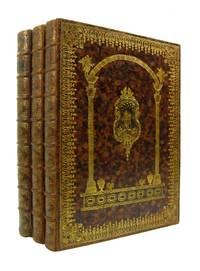
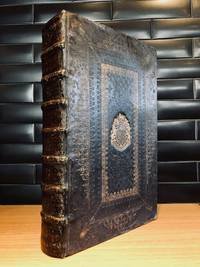
172812691s-Graavenhaage Pieter de Hondt 1728. Taferelen der Voornaamste Geschiedenissen van het Oude en Nieuwe Testament en andere boeken bij de Heilige Schrift gevoegt door de vermaarde Kunstenaars Hoet Houbraken en Picart Getekent en van de beste meesters in koper gesneden en met beschrijvingen uitgebreid. 3 delen titelprent 2 gegraveerde opdracht 148 72 2 2 149-280 14 71 titelprent 2 gegraveerde opdracht 160 70 p. Origineel Leer met ribben rijkelijk met goud bestempeld en goud op snede gebonden door de Van Damme Binderij in Amsterdam Folio H. 45 x L. 33 x B. 45-5 cm. Prentbijbel van Pieter de Hondt bestaande uit 212 gravures door Gerard Hoet Arnold Houbraken en Bernard Picart met bijgevoegde tekst van Jacques Saurin. 19 van de gravures zijn avant-la-lettre gedrukt dat wil zeggen dat het om de eerste proefdrukken gaat van de kopere platen op de rugschilden staat dan ook 'eerste drukken' boven de deelaanduiding. De randen om deze 19 prenten zijn op maat gemaakt voor het werk. Het geheel is gedrukt op super royaal papier en is ingebonden door de Van Damme Binderij in drie zeer fraaie stempelbanden. De Van Damme Binderij was werkzaam tussen 1750 en 1786 in de stad Amsterdam. De binderij heeft zijn naam te danken aan het feit dat zij werkzaam waren voor de bekende boekhandelaar Pieter van Damme. De banden die afkomstig zijn uit deze binderij behoren tot het beste dat in Amsterdam in de achttiende eeuw werd gemaakt. De stempels die gebruikt zijn voor deze banden zijn divers op het midden van de platten een zwart schild met een afbeelding van een engel gekroond met twee zegenende handen. Dit wordt omringd door een triomfboog met op de bovenste hoeken twee engelen die in spiegelbeeld van elkaar zijn gestempeld dit alles wordt omlijst door een brede decoratieve rand. De ruggen van de banden zijn bestempeld met op elk van de vlakken een engel omringd door een motief van ranken waarbij een vak is opengelaten voor de titel en de deelaanduiding. De Van Damme binderij stond er om bekend kleine en soms verborgen verwijzingen aan te brengen in de bestempeling die verwijzen naar de inhoud van het boek. De stempels die voor deze set zijn gebruikt zijn hier een voorbeeld van. Zo verwijzen de engelen en de zegenende handen naar de geestelijke inhoud van dit werk. De onder- en bovenkanten van de ruggen zijn plaatselijk wat ingescheurd. Zeer fraaie set van een zeldzame editie. 3 volumes frontispiece 2 engraved dedication 148 72 2 2 149-280 14 71 frontispiece 2 engraved dedication 160 70 p. Contemporary blind-stamped Leather with 8 raised bands richly decorated with gilt and gilt-edged text blocks bound by the Van Damme Bindery in Amsterdam Folio H. 45 x L. 33 x W. 45-5 cm. Print Bible of Pieter de Hondt containing 212 engravings by Gerard Hoet Arnold Houbraken and Bernard Picart with accompanying text by Jacques Saurin. 19 of the engravings are printed avant la lettre which means that they are the first test pressure of the copper plates; above the volume indication on the spine is gilded 'eerste drukken' which means first prints in English. The borders of these 19 engravings are custom-made to match the size of the other pages. The entire work is printed on extra-large paper and is bound by the Van Damme Bindery in three very beautiful blind-stamped bindings. The Van Damme Bindery was active from 1750 to 1786 in the city of Amsterdam. The bindery is so called because they worked for the well-known bookseller Pieter van Damme. The bindings made in this bindery belong to the best that was made in Amsterdam during the eighteenth century. The gilding used on the bindings is very diverse. In the middle of the covers a black central shield with the image of an angel crowned by blessing hands. Surrounded by a triumphal arch with a pair of angels stamped in each other's mirror image on top of it altogether framed by a broad ornamental border. The spines are decorated with an angel surrounded by tendrils between each raised band leaving some space for the title and volume indication. The Van Damme Bindery was known to place minor and sometimes almost hidden references in the gilding that point to the content of the book. The tooling used for this set is an example of this. The angels and the blessing hands refer to the religious content of this work. The spine ends are slightly split at some places. An excellent set of this rare edition. Literature: Poortman W.C. 1986. Bijbel en Prent. Deel II: Boekzaal van de Nederlandse Prentbijbels p. 137-145 / Storm van Leeuwen J. 1977. Enige ontwikkelingen in de stijl van platbestempeling bij Nederlandse boekbanden uit de achttiende eeuw. In Documentatieblad werkgroep Achttiende eeuw. Jaargang 1977 p. 16-19 / Storm van Leeuwen J. 2006. Dutch Decorated Bookbinding in the Eighteenth Century Volume I p. 460-496 s-Graavenhaage, Pieter de Hondt hardcover
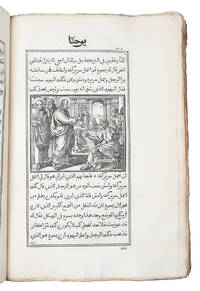
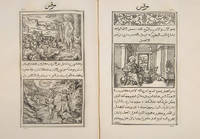
159062507Rome, Typographia Medicea, 1590 (-1591). Folio. Completely uncut in the original blank interim wrappers (with slight offsetting to verso of front wrapper). Newer paper backstrip matching the paper of the wrappers. Some leaves browned. Occasional brownspotting. An overall excellent copy. Housed in a old vellum chemise with ties and handwritten title (EVANGELIUM) to spine. Old, amorial, vague red stamp to title-page, colophon, and p. 97, from the Bibliotheque Impériale (now Bibliotheque Nationale), with a small deaccession-stamp to title-page. Magnificently illustrated with 149 large woodcut engravings in the text. 368 pp. Arabic text within double-frame border througout. Beautifully printed on very heavy paper.
159062507Rome Typographia Medicea 1590 -1591. Folio. Completely uncut in the original blank interim wrappers with slight offsetting to verso of front wrapper. Newer paper backstrip matching the paper of the wrappers. Some leaves browned. Occasional brownspotting. An overall excellent copy. Housed in a old vellum chemise with ties and handwritten title EVANGELIUM to spine. Old amorial vague red stamp to title-page colophon and p. 97 from the Bibliotheque Impériale now Bibliotheque Nationale with a small deaccession-stamp to title-page. Magnificently illustrated with 149 large woodcut engravings in the text. 368 pp. Arabic text within double-frame border througout. Beautifully printed on very heavy paper. <br/><br/><em>The scarce editio princeps of the Arabic translation of the New Testament magnificently printed in Granjon's famous font considered the first satisfactory Arabic printing type appearing here for the first time and beautifully illustrated with 149 woodcut illustrations in the text. This work constitutes the very first printing by the Typographia Medicea-press a printing-house set up by Pope Gregor XIII and Cardinal Ferdinando de Medici in order to promote and distribute Christian scriptures to the East. This splendid work is considered the first successful printing of Arabic. Apart from the Latin part of the title-page and the colophon the book is in Arabic throughout. Two issues of the work were printed almost simultaneously the Arabic-only text which has the year 1590 on the title-page and 1591 on the colophon and the interlenear Arabic-Latin edition which has 1591 on the title-page. The Arab-only edition with 1590 on the title-page is generally considered the first. "Its first great Arabic publication was this edition of the Gospels bearing the date 1590 on the title page and 1591 at the end. Two versions appeared one solely in Arabic and one with an interlinear Latin translation." Library of Congress.The work was edited by Giovanni Battista Raimondi 1536-1614 a renowned Orientalist and professor of mathematics at the College of the Sapienza in Rome. Raimondi had travelled extensively in the Middle East and had thorough knowledge of Arabic Armenian Syrian and Hebrew. He is however most famous for being the editor at the Typographia Medicea-press; together with French engraver Robert Granjon who also created the Arabic typography of the present work "bettered all previous attempts to print in Arabic in Europe and would remain unsurpassed long after the press had closed. Boogert "Medici Oriental Press Rome 1584-1614"."Antonio Tempesta the engraver cutter: Leonardo Parasole had studied under Santi di Tito and Joannes Stradanus at the Accademia del Disegno in Florence later working with Stradanus and Vasari on the interior decoration of the Palazzo Vecchio in Florence before travelling to Rome where he executed various commissions including frescos for Pope Gregory XIII in the Vatican and decorations for the Villa Farnese. Simultaneously with his frescos and panel paintings he executed a large number of engravings. The illustrations for the present work are remarkable examples of Tempesta's work noteworthy for their clear composition and narrative of the episodes depicted. Despite the extremely high quality of the prints the press never became an economic success and it went bankrupt in 1610. Scholars have noticed that presenting a work with beautiful scriptural illustrations as the present to Arabic-speaking Muslims when Islam forbids religious illustration showed little understanding of the culture and almost certainly hindered Pope Gregory XIII's missionary efforts."The press was not only an intellectual enterprise; it was also a commercial one. Raimondi clearly hoped to sell his books in the East rather than the West because the selection of the works he produced showed little consideration with the type of material European scholars in this period needed. While the works failed to sell in the Ottoman Empire however they did significantly stimulate the study of the Middle East in Europe.Ferdinando de' Medici had ordered Raimondi to print 'all available Arabic books on permissible human sciences which had no religious content in order to introduce the art of printing to the Mohamedan community.' Only more than a century after the Medici Press in Rome had closed did it finally have the envisaged impact in the Levant; Ibrahim Müteferrika the first Muslim printer referring to it in his plea to the sultan to allow him to open his own printing house at Istanbul which happened in 1729." Boogert "Medici Oriental Press Rome 1584-1614".The copy was previously in the Bibliothèque Nationale in Paris at the time when it was entitled "Bibliothèque Imperiale" which was its name inbetween from 1849 to 1871. Thus the book entered the library in Napoleonic times and was later deaccessioned. Brunet II 1122-23Schnurrer 318Adams: B:1822 </em> hardcover
1510371469Leipzig: Wolfgang Stockel 1510. Title in red and black. A-DⶠEâ´ F-JⶠKâ´ L-Mâ¶. 68 leaves. Extensive annotations throughout in Latin in a contemporary Germanic cursive comprising both interlinear notes and marginal gloss. 1 vols. Folio 12x8-1/2 inches. Early pigskin and oaken boards a remboitage from a thicker volume worn front hinge split between A2 and A3. Housed in a blue cloth slipcase. Provenance: Duplum Bibliothecae Regiae Monacensis pencil annotation; John Pintard inscription presenting the book to; General Theological Seminary bookplate and inked stamps. Title in red and black. A-DⶠEâ´ F-JⶠKâ´ L-Mâ¶. 68 leaves. Extensive annotations throughout in Latin in a contemporary Germanic cursive comprising both interlinear notes and marginal gloss. 1 vols. Folio 12x8-1/2 inches. Edited by Johann Kusthuert this printing of the Epistles of Paul was intended for the student market with the introduction addressed to studiosis sacarum litterarum tyronibus. In addition the colophon reads: Impressum ad altissimi Dei laudem ac studiosorum Sacre Scripture tyronum perfectum in officina libraria prouidi viri Vuolffgangi Stockel ciuis Liptzensis anno Domini 1510 quarto kalendis Septembris.<br /> <br /> The annotations and marginal gloss are impressive and very similar though in a different hand to the copy described by Rosenthal now at the Beinecke suggesting they are by a student at the same institution: "The present copy comes with a vast manuscript apparatus in Latin covering the entire text from St. Jerome's general preface to the last sentence of the last epistle. The annotation . is uniformly intense throughout. The script is a very small at times microscopic Germanic cursive and there is evidence of careful layout especially in the marginal gloss." Estimating the annotations to be approximately 80000 words Rosenthal describes the interlinear notes as "frequently far more than simole reading aids." He continues: "The marginal gloss includes an argumentum for each chapter and its subdivisions . There are also occasional citations from authorities such as St. Thomas and Ambrose."<br /> <br /> It is a handsomely printed volume with the title in large red letters above an 11-line subtitle in black. The verso of the title comprises a table of contents of the Pauline epistles and is followed by an introduction by Kusthuert.<br /> <br /> On the duplicates sold by the Munich royal library including the present volume see: Wagner Bettina. "'Duplum Bibliothecae Regiae Monacensis': The Munich Court Library and Its Book Auctions in the Nineteenth Century." The Papers of the Bibliographical Society of America vol. 111 no. 3 2017 pp. 345-77. Pintard 1759-1844 was a prominent New Yorker of Huguenot origin patron of education and one of the earliest and staunchest advocates for the preservation and study of the history of New York and the United States. Pintard began to work towards the establishment of a historical society in the city in early 1804 and he was the leader in the organization of the New-York Historical Society in November 1804. He was also a patron of the old French Huguenot Church of St. Esprit and the General Theological Seminary to whom he donated this volume in 1826.<br /> <br /> Scarce. OCLC locates three copies in Germany the aforementioned copy at Yale described by Rosenthal and the present example. Rosenthal B.M. Printed books with manuscript annotations 105 for a similarly annotated copy of the same edition; Panzer vii p. 169; VD16 B 4980. Not in BM STC Germany Adams or Darlow & Moule [Wolfgang Stockel] unknown
1655354139London: E.T. For a Society of Stationers 1655. WITH A CONTEMPORARY FORE-EDGE BY LEWIS of flowers centering on a quotation within a wreath "Blessed is he that word faded" and signed Lewis fecit 1656.". 12mo 169 x 115 mm. Contemporary black goatskin elaborately tooled in gilt small central oval onalys of calf at center of a large rectangular onlaid panel spine in 7 compartments with 6 raised bands red morocco lettering piece in one. Laid into full green pebbled morocco drop box. WITH A CONTEMPORARY FORE-EDGE BY LEWIS of flowers centering on a quotation within a wreath "Blessed is he that word faded" and signed Lewis fecit 1656.". 12mo 169 x 115 mm. With a most unusual contemporary watercolor painting on the fore edge of the book displaying a design of flower and acorns surrounding a central green wreath which encloses the following inscription: "March 13 1665 Martha White Order my Aedes in thy Word ps: 119 " According to Webber in 1001 Fore-edge Paintings p. 12 the earliest date on a fore-edge painting by Lewis is a 1651 Bible now in NYPL dated 1653 on fore-edge and similarily depicts flower animals and a motto. VERY EARLY AND RARE<br /> <br /> Signed by the London firm of Stephen and Thomas Lewis the earliest known bindery to paint both the firm's name and a year directly on the fore-edge paintings. Their fore-edges were typical of the time featuring elements from nature such as flowers animals or birds and they incorporated ofdten a wreath as here with a quote from Scriptures. This copy is additionally enhanced by its contemporary ownership by a woman reader. Provenance: contemporary ownership inscriptions of Martha Reyner "Martha Reyner her Booke with the price 0-18" front flyleaf and "Martha Thompson Her Book Ano Domini 1705 et Praetorum huius drawing of a bird." In a fleece-lined green morocco folding case. Rebacked with original spine laid down top headband partly frayed one nick to leather on front cover some slight fading of gilt E.T. For a Society of Stationers unknown
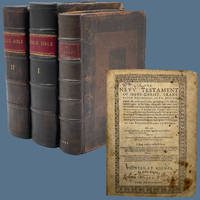
17177186Oxford: John Baskett 1717. First Edition Thus. Royal binding in full morocco. Very Good. John Sturt. Two volumes in one. Large stout folio. Double column with columns separated by double rule. Text ruled in red and title pages printed in red and black. Engraved vignette title pages for Old and New Testaments the latter dated 1716. With the engraved additional general title page by cartographer and renowned illustrator John Sturt 1658–1730. With striking copper-engraved vignette head- and tail-pieces and many engraved historiated initials. Complete with Apocrypha.<p>Marbled endpapers. All edges gilt. Bound in contemporary full black morocco rebacked with original elaborate gilt-tooled spine neatly laid-down gilt-tooled arms of King George II featuring the motto "Most Noble Order of the Garter" as centerpieces and his monogram in spine compartments raised bands and gilt-decorated borders. Only moderate wear to the splendidly complete royal binding. First edition of the monumental illustrated "Vinegar Bible" with additional title page engraved by John Sturt including the vignette of a church interior featuring the figures of Moses Aaron et al. per Darlow and Moule. According to the DNB Sturt "specialized in miniature work and it was said that he could engrave the creed on a silver penny but could also work on a large scale and in 1692 he produced a notable engraving of Britannia the royal first capital ship of England printed on four sheets". Presented in a handsome King George II armorial binding. Carter notes that " . Bibles with the royal arms may have come from one of the Royal Chapels - but they may equally have come from any loyal parish church" ABC p. 157. That said a limited print run coupled with the high cost of Baskett's elaborate opus would suggest the former.<p>In 1709 printer John Baskett secured the exclusive royal patent to print Bibles in England. Of those he and his family published this is the most magnificent being a triumph of legible elegant type that contributes to an easy readability accessible today. Alas a typographical error in the running head of Luke XX among other typos rendered the parable of the vineyard as the "parable of the vinegar" overshadowing Baskett's magnificent achievement.<p>A scarce and stately copy of a high spot in 18th-century printing. DARLOW & MOULE 736-B "the engravings differ considerably from those in A". John Baskett unknown
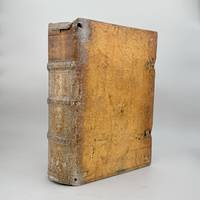
1483372104Venice: Johannes Herbort de Seligenstadt 1483. Text in two columns 56 lines per page. Initials mostly executed in red Psalms and a few other chapter headings with large color initial others empty. N.T. with printed marginal glosses. 398 leaves. 1 vols. Folio. Contemporary pigskin stamped in blind lower pastedown with manuscript waste re-inforcement. Binding worn and soiled spine darkened. Front pastedown with abundant annotations; flyleaf with tabulations of books of the Bible; occasional marginal annotations a bit more frequent in N.T. Pious abecedary poem in 23 lines in manuscript on blank verso of last leaf. Text in two columns 56 lines per page. Initials mostly executed in red Psalms and a few other chapter headings with large color initial others empty. N.T. with printed marginal glosses. 398 leaves. 1 vols. Folio. With additions by Franciscus Moneliensis and Quintius Aemilianus. This is grouped with the Fontibus ex Graecis editions of the corrected Latin text though this edition does not include the Latin verses.<br /> <br /> Leaf a1v prints a letter by Franciscus Moneliensis in which he praises the printer Johannes Herbort who got his start in Padua in the mid-1470s where he printed Avicenna's Canon medicinae. He came to Venice and worked with Jenson and others; he printed an edition of the Bible with Postilla of Nicolaus de Lyra in 1481; a quarto Bible was issued in 1484. Herbort produced some 50 works during his career. ISTC ib00579000; GW 4254; Goff B579; cf. Darlow & Moule 2:911 note. Provenance: W. A. Copinger bookplate; General Theological Seminary gift of Cornelius Vanderbilt and Dean Augustus Hoffman bookplates and blindstamps Johannes Herbort, de Seligenstadt unknown
1763306680Birmingham: John Baskerville Printer to the University 1763. The third variant of the Subscriber's list with the most names ending with that of the Hon. Charles York Esq Attorney General. 1146 pp. 1 vols. Folio. Bound in full dark blue straight-grained morocco covers tooled in gilt with wide Greek key and drawer handle border with floral cornerpieces narrow gilt filet-bordered rectangles tooled all over with drawer handle and sunburst tools and semé off small dots with central gilt-stamped L with crown spine with six double raised bands titled in one compartment stamped with owner's name "Frederic Powys" in another and the rest richly gilt a.e.g. pink endsheets by Staggemeier and Welcher with their circular pink paper label on front pastedown. Front joint and headcap with conservation repairs of the highest quality light foxing to text. The third variant of the Subscriber's list with the most names ending with that of the Hon. Charles York Esq Attorney General. 1146 pp. 1 vols. Folio. The 1763 edition of Baskerville's Bible has always been recognised as his masterpiece and is one of the high-points in the history of printing in Britain. This beautiful and monumental binding can be closely dated because Thomas Powys formerly MP for Northamptonshire was created Baron Lilford in 1797 and Staggemeier & Welcher are recorded in partnership on Villiers Street as of 1799. By 1810 Welcher was in business alone at that address. The Hon and Rev. Frederic Powys whose name appears on the spine was the third son of the first Lord Lilford; he married in 1807. Whether the binding was commissioned for his taking holy orders or on the occasion of his marriage can only be conjectured. A landmark of printing in a splendid binding. Nixon p. 184; Gaskell Bibliography of John Baskerville 26; Ramsden p. 135. Provenance: Frederic Powys his name tooled in gilt to spine Lilford Library booklabel John Baskerville, Printer to the University unknown
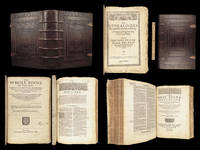
17631230541763. Cambridge: Printed by John Baskerville Printer to the University 1763. <br /> <br /> Royal folio 573 unnumbered leaves. A2 1 B-13D2 a-e2 f1. English binding of contemporary full blue-green morocco covers with elaborate gilt border backstrip richly gilt with red morocco lettering pieces stamped in gilt "HOLY BIBLE" and at the foot "BASKERVILLE" gilt edges marbled endpapers. Inevitable slight signs of wear on such a huge book but in all a very good unrestored copy internally flawless.<br /> <br /> § First edition of Baskerville's masterwork in a magnificent contemporary English binding. Third issue of the subscribers' list as usual. "John Baskerville was a monumental figure in the history of English bookbinding and printing with contemporary accounts of his work ethic revealing a man deeply engaged in virtually every aspect of book production. Yet for most of his life and indeed for many decades afterwards he was decried as a mere amateur. Still other sources show an individual with highly idiosyncratic and paradoxical habits -- he lived with Sarah Eaves for nearly two decades out of wedlock; a devout atheist who was buried in his own backyard without Christian ceremony; a man who 'had wit but always against religion and decency'" F.E. Pardoe in John Baskerville of Birmingham: Letter-Founder and Printer 1975. <br /> <br /> Paradoxically after taking the position of Printer to the University of Cambridge on 1 December 1758 Baskerville produced one of the few great Bibles. It is a true masterwork expertly printed with impeccable attention to ink type spacing paper quality and ease of use. Published on 4 July 1763 "the adjective that inevitably comes to mind is 'noble' and the volume warrants the word. It was conceived and executed on a grand scale. to show that he had now learnt his craft and was able to practice it in a masterly fashion. and the result shows again that Baskerville must be placed in the very top rank of book designers" Pardoe 87. Morison and Day The Typographic Book 1963 write that "Baskerville's folio English Bible printed for the University of Cambridge is the finest presentation of Holy Writ since Richelieu's Latin Vulgate printed at the Imprimerie Royal" 48. Gaskell 26. Herbert 1146. Morison & Day The Typographic Book 48. Huntington Library Great Books in Great Editions 7. Rothschild 2640. Rumball Petre 145. unknown
1582P02<p><strong>Summary:</strong> Rhemes and Doway: John Fogny and Laurence Kellam 1582 and 1610. 4to 8.25 x 6.25 in. A complete Douai Old Testament and Rheims New Testament Bible in contemporary calf. The first edition of the Roman Catholic Bible in English in near-matching bindings with arguments and annotations.</p><p><strong>Description:</strong> Text in single column Roman font with 41 lines to the column. Annotations follow each chapter of Bible text. NT: Fifteen preliminary leaves with title within narrow frame 1582. OT Volume 1: Ten preliminary leaves with title within narrow frame 1609. OT Volume 2: Title within narrow frame 1610 followed by <em>Approbatio </em>on verso. Ends with <em>An historical table of the times… of the Old Testament</em> 24 pp. <em>A particular table of the most principal thinges… </em>27 pp. <em>Censura</em> <em>Errata</em>.</p><p><strong>Collation:</strong> a-c4 d2 A-Z4 2A-2Z4 3A-3Z4 4A-4Z4 5A-5D4 5E2 NT; cross6 crosscross4 A-Z4 2A-2Z4 3A-3Z4 4A-4Z4 5A-5Z4 6A-6S4 6T6 OT Volume 1; A-Z4 2A-2Z4 3A-3Z4 4A-4Z4 5A-5Z4 6A-6W4 OT Volume 2. Bible text complete. Doway volume 1 <u>lacks</u> title page and volume 2 <u>lacks</u> six final leaves of <em>A Particular Table</em>.</p><p><strong>Binding:</strong> Rhemes New Testament bound in Cambridge paneled boards rebacked somewhat rubbed with corners worn. Spine with five raised blind-lined bands and a gilt-lined morocco label with the words "New Testament" in gilt and a date of "1582" to foot of spine. The Old Testament volumes bound in brown calf rebacked with matching spines corners worn. Spines with four blind-lined raised bands and red morocco labels with "Holie Bible" in gilt and "I" and "II" in compartment below in gilt. Plain endpapers.</p><p><strong>Condition:</strong> Rhemes New Testament: Title page 1582 with "Richard Gibson his book 1650" next to imprinted date; occasional staining some thumbsoiling heavier soiling to the first few leaves of <em>Tables</em>; f2-3 marginal loss to fore-edge; Nnn-Ooo marginal fore-edge stain impacting side notes and a few words of text on Ooo2-3. Doway volume 1: <u>lacks</u> title page; A1-3 stain to gutter; some underlining a few words on every other page; B-Kk light stain to upper margin; Iiii-Kkkk and Oooo-Pppp light stain to bottom fifth of page; Xxxxx-Zzzzz and Hhhhhh-Rrrrrr stain to upper fourth of page; Tttttt4 final leaf loss of bottom fifth of page no text loss. Doway volume 2: A1 title page triangular piece torn from foot reducing border and loss of printed date; title also with ex-libris stamp and taped tear; Aa-Cc stain to bottom margin and fore-edge occasionally entering a few words of text; Oo-Qq light minimal lower marginal stain; Rr1-4 remargined without loss; Tt3-Uu4 stain to 25 percent of page; Yy1-4 reinforced without loss; 10 percent loss to final extant leaf with ex-libris stamp; <u>lacks </u>6U3-6W4 final six leaves of Tables.</p><p><strong>Note:</strong> The <em>editio princeps</em> of the Catholic Bible in English translated primarily by Gregory Martin from the Vulgate. A great number of English Bibles and English versions were available by the end of the sixteenth century yet none were acceptable to Catholics. With priests hard to come by and many fellow Englishmen who knew their Bible well a need arose for an English Bible that would be acceptable to Rome and allow adherents to refute the errors around them. Gregory Martin an Oxford scholar began the work in 1578 and it would take him four years. He translated about two chapters per day from Latin into English leaving a heavily Latinized translation. His work was submitted for review to William Allen the first president of the college at Douai. The New Testament was printed in 1582 with the Old Testament delayed by financial reasons until 1609-10. The work was used by the translators of the King James Bible who borrowed quite freely from the Rheims New Testament.</p><p><strong>References:</strong> Herbert 177; STC 2884; ESTC S102419 Rhemes Herbert 300; STC 2207; ESTC S101944 Doway; PMM 114; Daniell David. "The Rheims New Testament 1582." <em>The Bible in English: Its History and Influence</em> Yale University Press New Haven CT 2005.</p> John Fogny, Rhemes [and] Laurence Kellam, Doway hardcover
16091291221609. First Edition. BIBLE. The Holie Bible Faithfully Translated into English out of the Authentical Latin Douai: Lawrence Kellam 1609-10. Two volumes. Quarto contemporary vellum rebacked in vellum at an early date early traces of ink writing on spines and front boards. Housed together in a custom slipcase and clamshell box. $25000.Scarce first edition of the first Roman Catholic translation of the Old Testament into English from the Latin Vulgate.""The Douai Bible is as it professes to be a literal translation of the Vulgate and in some places more accurately hands down the very words of the biblical writers than any English translation then existing"" Dore 316-17. ""This version of the Old Testament came from the same hands as the Rheims New Testament of 1582"" Darlow & Moule 129 translated by ""religious refugees who carried their faith and work abroad. Since the English Protestants used their vernacular translations not only as the foundation of their own faith but as siege artillery in the assault on Rome a Catholic translation became more and more necessary in order that the faithful could answer text for text against the 'intolerable ignorance and importunity of the heretics of this time.' The chief translator was Gregory Martin Technical words were transliterated rather than translated. Thus many new words came to birth Not only was Martin steeped in the Vulgate he was every day involved in the immortal liturgical Latin of his church. The resulting Latinisms added a majesty to his English prose and many a dignified or felicitous phrase was silently lifted by the editors of the King James Version and thus passed into the language"" Great Books and Book Collectors 108. Lack of funds and ""our poore estate in banishment"" prevented the publication of this two-volume Old Testament until 1609-1610. With ornamental woodcut title borders woodcut initials and ornamental head- and tail-pieces. The Bible 100 Landmarks 65 66. The Bible in the Lilly Library 39 40. Dore 291-98. Herbert 177 300. Darlow & Moule 231. Pierpont Morgan Library The Bible 112. Rumball-Petre 15. Rylands 95 96. STC 2884. Herbert 300. STC 2207. Pierpont Morgan Library The Bible 115. An early ink annotations to front endpapers of Volume II.Text just occasionally embrowned with infrequent light foxing; last 1-3 letters of bottom 19 lines supplied in an early pencil on page 1079 of the first volume; last 20 leaves of Volume II with expert cleaning later pastedowns with free endpapers restored and preserved. Expected light soiling to contemporary vellum. hardcover
1763306680Birmingham: John Baskerville Printer to the University 1763. The third variant of the Subscriber's list with the most names ending with that of the Hon. Charles York Esq Attorney General. 1146 pp. 1 vols. Folio. Bound in full dark blue straight-grained morocco covers tooled in gilt with wide Greek key and drawer handle border with floral cornerpieces narrow gilt filet-bordered rectangles tooled all over with drawer handle and sunburst tools and semé off small dots with central gilt-stamped L with crown spine with six double raised bands titled in one compartment stamped with owner's name "Frederic Powys" in another and the rest richly gilt a.e.g. pink endsheets by Staggemeier and Welcher with their circular pink paper label on front pastedown. Front joint and headcap with conservation repairs of the highest quality light foxing to text. The third variant of the Subscriber's list with the most names ending with that of the Hon. Charles York Esq Attorney General. 1146 pp. 1 vols. Folio. Baskerville's Masterpiece in Staggemeier & Welcher Binding. The 1763 edition of Baskerville's Bible has always been recognised as his masterpiece and is one of the high-points in the history of printing in Britain. This beautiful and monumental binding can be closely dated because Thomas Powys formerly MP for Northamptonshire was created Baron Lilford in 1797 and Staggemeier & Welcher are recorded in partnership on Villiers Street as of 1799. By 1810 Welcher was in business alone at that address. The Hon and Rev. Frederic Powys whose name appears on the spine was the third son of the first Lord Lilford; he married in 1807. Whether the binding was commissioned for his taking holy orders or on the occasion of his marriage can only be conjectured. A landmark of printing in a splendid binding. Nixon p. 184; Gaskell Bibliography of John Baskerville 26; Ramsden p. 135. Provenance: Frederic Powys his name tooled in gilt to spine Lilford Library booklabel John Baskerville, Printer to the University unknown books
123054Cambridge: Printed by John Baskerville Printer to the University 1763. Royal folio 573 unnumbered leaves. A2 1 B-13D2 a-e2 f1. English binding of contemporary full blue-green morocco covers with elaborate gilt border backstrip richly gilt with red morocco lettering pieces stamped in gilt "HOLY BIBLE" and at the foot "BASKERVILLE" gilt edges marbled endpapers. Inevitable slight signs of wear on such a huge book but in all a very good unrestored copy internally flawless. § First edition of Baskerville's masterwork in a magnificent contemporary English binding. Third issue of the subscribers' list as usual. "John Baskerville was a monumental figure in the history of English bookbinding and printing with contemporary accounts of his work ethic revealing a man deeply engaged in virtually every aspect of book production. Yet for most of his life and indeed for many decades afterwards he was decried as a mere amateur. Still other sources show an individual with highly idiosyncratic and paradoxical habits -- he lived with Sarah Eaves for nearly two decades out of wedlock; a devout atheist who was buried in his own backyard without Christian ceremony; a man who 'had wit but always against religion and decency'†F.E. Pardoe in John Baskerville of Birmingham: Letter-Founder and Printer 1975. Paradoxically after taking the position of Printer to the University of Cambridge on 1 December 1758 Baskerville produced one of the few great Bibles. It is a true masterwork expertly printed with impeccable attention to ink type spacing paper quality and ease of use. Published on 4 July 1763 “the adjective that inevitably comes to mind is ‘noble’ and the volume warrants the word. It was conceived and executed on a grand scale… to show that he had now learnt his craft and was able to practice it in a masterly fashion… and the result shows again that Baskerville must be placed in the very top rank of book designers†Pardoe 87. Morison and Day The Typographic Book 1963 write that “Baskerville’s folio English Bible printed for the University of Cambridge is the finest presentation of Holy Writ since Richelieu’s Latin Vulgate printed at the Imprimerie Royal†48. Gaskell 26. Herbert 1146. Morison & Day The Typographic Book 48. Huntington Library Great Books in Great Editions 7. Rothschild 2640. Rumball Petre 145. Printed by John Baskerville unknown books
161127347<p><strong>1611 King James Geneva Hybrid Bible 1st ed John SPEED New Testament Genealogy</strong></p><p>This Geneva KJV Hybrid Bible from 1611 to 1618 was printed in London by Robert Barker and associates during a transitional period in English Bible production. In the 16th and 17th centuries English Bibles printed by Barker were extremely popular and have maintained their value and desirability into the 21st century. However none are as historically sought-after as the famous 1611 King James Bible. This edition integrates the complete King James Old Testament and Apocrypha with a Geneva-style annotated New Testament. The New Testament title page is present and dated 1611. According to Darlow & Moule New Testament title pages dated "1611" appeared only in 1611 and 1612 issues; they also state that for editions appearing in 1613 a large portion of the content was probably printed in 1611. Ruth 3:15 reads "she went into the citie" identifying this copy with the second state of the 1611 King James Bible. Geneva woodcut illustrations reused from the 1580s to 1590s are found throughout the Book of Exodus.</p><p>The appended metrical Psalter is dated 1618 and printed by Felix Kingston for the Stationers' Company. It reflects a common practice in Barker's printshop of incorporating the standard Sternhold and Hopkins Psalms into folio Bibles of the period. The New Testament's formatting follows earlier Geneva conventions with double columns of Gothic script marginal cross-references and dense annotations attributed to Laurence Tomson Theodore Beza Pierre Villerius and Franciscus Junius. These marginalia provide variant readings from Greek and Latin sources and theological commentary especially in Revelation. Geneva-style artwork such as images of Tabernacle furnishings and priestly attire in Exodus appears throughout this edition and reflects its hybrid construction.</p><p>A rare and bibliographically significant early 17th-century folio Bible printed by Robert Barker ca. 1618 typifying the transitional hybrid editions issued in the wake of the 1611 King James Bible. This example presents a composite construction combining the newly authorized King James Version text for the Old Testament and Apocrypha with the enduring scholarly apparatus of the Geneva Bible's New Testament. The Old Testament includes the corrected reading "she" at Ruth 3:15 identifying the text with the second issue of the 1611 KJV. The formatting follows the 1611 layout with double-column black letter type chapter summaries and marginal references consistent with the design of the authorized version. By contrast the Geneva New Testament includes extensive annotations and preserved title language such as "Translated out of the Greeke by Theod. Beza Englished by L. Tomson with the annotations of Fr. Junius upon the Revelation of Saint John." Geneva-style woodcuts reused by Barker are rarely found in KJV volumes and their inclusion reflects the mixed-format nature of this edition. These composite Bibles emerged between 1613 and 1620 when Barker's shop continued to use Geneva blocks while transitioning fully to KJV texts. This copy complete with Psalter and annotated New Testament stands as a rare artifact from that bibliographic moment.<br /> </p><p>Item number: #27347</p><p>Price: $25000</p><p>Holy Bible</p><p><strong><em>The Bible : that is the Holy Scriptvres conteined in the Old and New Testament</em></strong></p><p>London: imprinted by R. Barker 1611-18.</p><p><u>Details</u>: </p><p><!-- if !supportLists-->· <!--endif-->Collation: <u>text of the Bible entirely complete</u></p><p><!-- if !supportLists-->o <!--endif-->Speed's "Genealogies" – 2 34 4 – <strong>complete!</strong></p><p><!-- if !supportLists-->§ <!--endif-->Wanting general title page and prelims prior to Genealogy</p><p><!-- if !supportLists-->§ <!--endif-->Fry's map from the Speed Genealogies from a later quarto edition – with shaded sea</p><p><!-- if !supportLists-->o <!--endif-->Old Testament / Apocrypha – 444 i.e. 452 leaves</p><p><!-- if !supportLists-->§ <!--endif-->Pagination errors expected – <strong>entirely complete!</strong></p><p><!-- if !supportLists-->o <!--endif-->New Testament – 135 leaves 14 </p><p><!-- if !supportLists-->§ <!--endif-->Pagination errors expected<strong> – entirely complete!</strong></p><p><!-- if !supportLists-->o <!--endif-->Psalmes – 2 106 i.e. 108</p><p><!-- if !supportLists-->§ <!--endif-->Pagination errors expected</p><p><!-- if !supportLists-->· <!--endif-->References: Darlow & Moule 312-353</p><p><!-- if !supportLists-->o <!--endif-->D&M 312 – suggests that the 1618 'Psalmes' is correct</p><p><!-- if !supportLists-->· <!--endif-->Edition points: </p><p><!-- if !supportLists-->o <!--endif--><strong><u>New Testament title page – dated 1611</u></strong></p><p><!-- if !supportLists-->o <!--endif-->Ruth 3:15 – has "she" instead of "he" – consistent with 1612 printings</p><p><!-- if !supportLists-->o <!--endif-->Features the complete Speed "Genealogies"</p><p><!-- if !supportLists-->o <!--endif-->Genesis 1 – includes "The Argument" first appearing in the 1616 small folio; however this leaf is significantly smaller than subsequent leaves suggesting it was added later</p><p><!-- if !supportLists-->· <!--endif-->Provenance: Handwritten – <em>John Tillman 1723</em></p><p><!-- if !supportLists-->· <!--endif-->Language: English</p><p><!-- if !supportLists-->· <!--endif-->Binding: Leather; tight and secure</p><p><!-- if !supportLists-->o <!--endif-->Includes two functional clasps</p><p><!-- if !supportLists-->· <!--endif-->Size: ~13.5in X 9.25in 34cm x 23.5cm</p><p>Our Guarantee:</p><p>Very Fast. Very Safe. Free Shipping Worldwide.</p><p>Customer satisfaction is our priority! Notify us with 7 days of receiving and we will offer a full refund without reservation!</p> R. Barker hardcover
171733327Oxford: John Baskett 1717. 2 volumes folio. 20 3/4 x 13 1/2 inches. Engraved frontispiece in vol. I engraved vignettes on general title and New Testament title engraved head- and tail-piece vignettes and engraved initials. Contemporary black panelled morocco gilt the covers with gilt roll-tooled borders around a series of concentric gilt panels with ornamental leafy sprays and corner-pieces central lozenge gilt composed of similar small tooling spines richly gilt in nine compartments morocco lettering piece in the second compartment gilt dentelles marbled endpapers and gilt edges discreet expert repairs at top and bottom of joints<br/> <br/>Provenance: Sir John Hynde Cotton armorial bookplate; William Charles Smith armorial bookplate; Maggs Bros. catalogue 1212 Bookbinding in the British Isles item 86<br/> <br/>First edition of the monumental splendidly illustrated "Vinegar Bible" -- a "magnificent edition" Darlow & Moule here ruled in red and handsomely bound.<br/> <br/>Commonly known as the "Vinegar Bible" from the misprint "the parable of the vinegar" for "vineyard" in the headline above Luke Chapter 20. While a contemporary lambasted Baskett for this and other typographical errors in the text calling it a "Baskett-ful of errors" Oxford historian of printing Harry Carter states that "only Baskerville's Bible is its equal among English Bibles for beauty of type impression and paper" The History of the Oxford University Press 1975 I p. 171 In 1709 John Baskett purchased the exclusive royal patent to print Bibles in England control of which his family retained until 1799. This magnificent edition of the Bible is among Baskett's most important works highly regarded for its large elegant type; its 60 striking copper-engraved vignette head- and tailpieces; and its many delicately engraved historiated initials. Two distinct varieties occur. This copy is Darlow & Moule's issue A with additional engraved general title page depicting Moses writing the first words of Genesis here bound as frontispiece; vignette view of Oxford on the general title page; and vignette title page for New Testament depicting the Annunciation dated 1716. The present example is noted for both its lovely contemporary black morocco gilt binding and for being ruled in red throughout. Similar bindings on this edition of the bible are noted in both the Wardington Collection and in Mirjam Foot's Studies in the History of Bookbinding p. 409.<br/> <br/>Darlow & Moule 735; Herbert 942. John Baskett unknown books
121922Rome Typographia Medicea 1590 1591. . First edition small folio 330 x 220 mm; printed entirely in Arabic with Latin text to title and colophon only 368pp. complete 149 large woodcut engravings in the text some leaves evenly age-toned some very slight occasional foxing overall very clean internal condition; housed in early 18th-century quarter vellum over pasteboards evidence of early worming to boards not affecting internal leaves 'Evangelia Arabic' ink inscription to spine edges speckled in red extremities a little bumped overall a presentable volume.<br /> The editio princeps of the Arabic translation of the New Testament widely accepted as being the first successful printing of any Arabic text using moveable type and the first book ever published by the Medici Press in Rome. <br /><br />The Typographia Medicea was a printing house in Rome established by Pope Gregor XIII and Cardinal Fernando de Medici 1549-1609 in 1584. The press was initially established to promote Christianity in the Near East so they focused on translations of Christian texts in Arabic and Syriac. This Bible translation was edited by the renowned orientalist Giovanni Battista Raimondi 1536-1614 whose extensive travels around the Middle East had given him a comprehensive knowledge of Arabic Armenian Syriac and Hebrew languages. He and the French engraver Robert Granjon who is responsible for the elegant Arabic typography of the press formed a formidable team and together created a method for publishing texts in Arabic that 'bettered all previous attempts to print in Arabic in Europe and would remain unsurpassed long after the press had closed' Boogert Medici Oriental Press Rome 1584-1614.<br /><br />Two varying editions of this work were published in very quick succession: there is the Arabic-only text which has some Latin on the title page and in the colophon only which bears the date 1590 on the title page and 1591 in the colophon and then there is an Arabic-Latin edition with interlinear translation to Latin throughout which was printed with the date 1591 on the title page. The work with the earlier date on the title and the text entirely in Arabic as seen in the present example is widely considered the true first edition of the work.<br /> Rome, Typographia Medicea, 1590 [1591]. hardcover
161367889The 1613 Folio Edition of the King James Bible BIBLE IN ENGLISH. The Holy Bible Conteyning the Old Testament and the New: Newly translated out of the Originall Tongues: and with the former Translations diligently compared and revised by his Maiesties speciall Commandement. Appointed to be read in Churches. London: Imprinted.by Robert Barker 1613. The 1613 folio edition of the King James Bible distinguishable from the ìHeî and ìSheî Bibles that precede it by its smaller type size making it double columns with seventy-two lines. The Authorised version.vWith the Apocrypha. Folio 15 3/4 x 10 1/2 inches; 398 x 265 mm. A4-B4 C6 D4 A6-C6 A6-4M6 4N4. 508 leaves. Issued with "The genealogies recorded in the Sacred Scriptures" by John Speed pages 2 34 pp. Without double-page engraved map before text which is often the case. Engraved general title representing the twelve tribes. At foot of title-page woodcut: "Cum priuilegio". Engraved New Testament title dated 1613. Black letter. With the "Calendar" which is printed in red and black. Decorative woodcut head- and tail-pieces and initials. Contemporary reversed paneled calf. Boards ruled in blind. Boards with a small amount of rubbing and chipping mainly along the edges. First title-page laid-down. Some loss to margins but not affecting the engraving. Leaves A2-A4 To The Reader bound on stubs and with lower marginal repairs. From the Calendar Leaf C2 with marginal repair and Leaves C3-C4 remargined. Leaf D1 with paper repair only affecting ruled border. Leaves X1-X2 with some tape repairs and a few holes with some loss of a few words. Leaves PP5-PP6 with some dampstaining. Leaves UUU3-UUU4 with bottom margin repaired not affecting text. Leaf ZZZ4 with a closed tear repaired but with some loss of text. Aside from these few mostly preliminary leaves overall this copy is internally very fresh and clean. A very good copy. ìThe true 1613 folio edition of King Jamesà Bible; easily distinguishable from the other large folio editions by its smaller type. The preliminary leaves are set up as in the other large folio editions but the text is printed in smaller type with 72 lines instead of 59 lines to the full column." Herbert 322. The Genealogies which accompany this book have a similar typographical history to that of the King James Bible itself. John Speed was granted a patent in 1610 for ten years to issue and insert his Genealogies and double-page general map engraved by Elstrack in every edition of this Bible. ìThe King James Bible or the Authorized Version as it is now commonly but not strictly accurately known was the outcome of the conference summoned at Hampton Court by the King in January 1604 in an attempt to settle the quarrels in the Church of England arising from the Puritan zeal of some of its members. It was the leader of the Puritan party John Reynolds the President of Corpus Christi College Oxford who first suggested the idea of a new translation.It has been described as ëthe only literary masterpiece ever to have been produced by a committeeà and was the work of nearly fifty translators organized in six groups.Being based on a wider range of classical and oriental scholarship than its predecessors the Authorized Version was a more learned text.No new English translation was produced until the Revised Version of 1881 and the influence of the Authorized Version may best be described in the words of G.M. Trevelyan. ëFor every Englishman who had read Sidney or Spenser or had seen Shakespeare acted at the Glove there were hundreds who had read or heard the Bible with close attention as the words of God. The effect of the continual domestic study of the book upon the national character imagination and intelligence for nearly three centuries to come was greater than that of any literary movement in our annals or any religious movement since the coming of St AugustineÃî Printing and the Mind of Man 114 describing the 1611 first edition. Darlow & Moule 249. Herbert 322. STC 2226. ESTC S122066. HBS 67889. $23500 Imprinted...by Robert Barker hardcover books
1592371810Rome: Ex Typographia Apostolica Vaticana 1592. First edition of the Clementine Bible. Edition of 500 copies. Engraved title page reading: Biblia sacra vulgatae editionis. Sixti Quinti Pont. Max. iussu recognita atque edita. Letterpress title page printed in red and black. Text in double columns. 12 1131 1 blank 23 1 blank pp. 1 vols. Folio 349 x 250 mm. Full reddish-orange levant morocco spine titled in gilt raised bands highlighted in black boards with single rule in black dated 1957 on turn-in. Fine. Leather-tipped slipcase. First edition of the Clementine Bible. Edition of 500 copies. Engraved title page reading: Biblia sacra vulgatae editionis. Sixti Quinti Pont. Max. iussu recognita atque edita. Letterpress title page printed in red and black. Text in double columns. 12 1131 1 blank 23 1 blank pp. 1 vols. Folio 349 x 250 mm. First edition of the official text of the Catholic Bible issued under sanction of Clement VIII and therefore known as the "Clementine Bible" and superseding the controversial and suppressed edition of Sixtus V of 1590. The text is preceded by Cardinal Bellarmino's preface the Decree of the Council of Trent on the canonical Scriptures and a brief by Clement VIII.<br /> <br /> "It is generally admitted that on the whole the Clementine text . is critically an improvement upon the Sixtine. . The Clementine Bible of 1592 remains to the present day the standard edition of the Roman Church" Darlow & Moule. <br /> <br /> Nice wide-margined copy of this notable edition. Brunet I 878; Darlow and Moule 6184; Adams B1101; P.M. Baumgarten Neue Kunde von alten Bibeln pp. 316-322. Provenance: W. A. Copinger bookplate; General Theological Seminary gift of Cornelius Vanderbilt and Dean Augustus Hoffman bookplates Ex Typographia Apostolica Vaticana unknown
158268152First Edition of the Roman Catholic Version of the Bible in English New Testament. BIBLE IN ENGLISH. New Testament. The New Testament of Jesus Christ Translated Faithfully into English out of the authentical Latin according to the best corrected copies of the same diligently conferred with the Greeke and other editions in divers languages: With Arguments of bookes and chapters Annotations. and other necessarie helpes for the better understanding of the text and specially for the discoverie of the Corruptions of divers late translations and for cleering the Controversies in religion of these daies: In the English College of Rhemes. Rheims: Printed.by John Fogny 1582. First edition of the Roman Catholic version of the New Testament in English. Small quarto 8 5/16 x 6 inches; 210 x 154 mm. 28 745 27 pp. Title within border of type ornaments decorative and historiated woodcut initials. Bound in 19th-century brown calf. Boards and spine ruled and stamped in blind. Spine with red morocco spine label lettered in gilt. Board edges and dentelles stamped in blind. All edges red. Marbled endpapers. Boards slightly rubbed. Four previous owner's bookplates on front pastedown. Front free endpaper with old ink notations quotation from Saint Augustine and small purple library stamp from the "Society of Jesus" in Milltown Park Ireland. The "Society of Jesus" is the Catholic group of which its members are the Jesuits. Title-page with cropped early annotation at top margin and same small "Society of Jesus" library stamp to lower corner. Some dampstaining and toning particularly to beginning. Some slight worming to fore-edge margin occasionally barely affecting text. Overall an excellent copy of the Rheims Bible. ìThe long title of The New Testament indicates at least in part the purpose which motivated William Allen and his small band of associates in the seminary of English Catholic refugees at Rheims. It was a losing battle for English Catholics merely to condemn the errors they claimed existed in other translations while declining to exhibit a translation which reflected their own critical principles.If the slow erosion of the Catholic faith in England was to be checked loyal Catholics would better withstand the taunts of Protestant Bible readers with the comfort and consolation drawn from a version of their own. As the title announces the translation was faithful to the Latin Vulgate but it also acknowledges careful comparison with the Greek. What the title does not specifically advertise is that Gregory Martin the chief translator borrowed freely from existing English versions. Close textual analysis has revealed many striking resemblances between the Rheims New Testament and CoverdaleÃs diglot of 1538. One new principle.was followed consistentlyótechnical words were transliterated in the text rather than translated the notes providing a clarification. Many of these words subsequently passed into the English language largely through the continuation of this practice by the revisers of the Authorized Version of 1611 who not only used these technical terms but also borrowed from Rheims many of its most felicitous and distinctive phrasesî In Remembrance of Creation 206. ìGregory Martin had originally translated the whole Bible into English but lack of funds permitted publication only of the New Testament in 1582. The long delay of twenty-seven years in completing the publication is underscored in the Preface of the Old Testament by reference to ëour poor estate in banishmentà In Remembrance of Creation 208. The annotations in the Old Testament are ascribed to Thomas Worthington who became President of the College at Douay in 1599. The ìApprobatioî is signed by three Professors at Douai. Darlow & Moule 231. Herbert 177. . In Remembrance of Creation 206. STC 2284. STC 2207. HBS 68152. $22500 Printed...by John Fogny hardcover books
19021322Hammersmith The Doves Press 1902-1904. Containing the Old Testament and the New Translated Out of the Original Tongues by Special Command of His Majesty James the First. Issued in 5 volumes. Folio. Bound by Doves Bindery in original limp vellum with gilt title on the spine. A perfect copy of one of the 500 on handmade paper only two were printed on vellum. This is the one of the most beautiful books ever published by a private press and one of the three most desirable the other two are the Kelmscott Chaucer and the Ashendene Dante. In addition there are 18 specimen proof pages and original leaves included. Franklin: pp.117-118 Cave p.148. Doves Press books
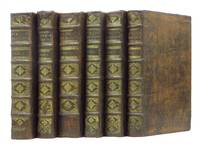
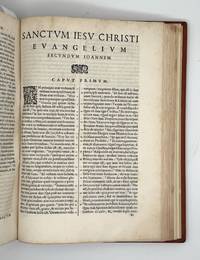
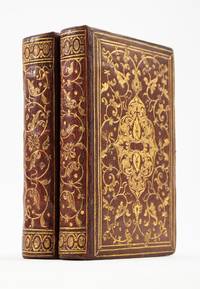
1568ST20921Lutetia Paris: Robert Estienne II 1568. 128 x 87 mm. 5 x 3 1/2". Two volumes. <br/> LOVELY CONTEMPORARY RED MOROCCO GILT covers with large central azured arabesque surrounded by curling vines with azured leaves smooth spines with similar vines head and foot of spines with egg-and-dart roll similar to one used by Claude de Picques second volume with faint blind lettering to spine all edges gilt perhaps with some minor early restorations but if so then done with such care as to preclude certainty. Housed in modern suede-lined calf-backed clamshell boxes with magnetic closures. Printer's device on titles and final page decorative initials and headpieces. Front pastedown of volume I with ex-libris of Georgios Arvanitidis. Renouard 171:1; Schreiber 239; Darlow & Moule 4633; Adams B-1670. See: Verron "Les Reliures de l'Entrée de Charles IX à Paris 1572 . . . réalisées par Claude Picques" in Bulletin du Bibliophile 2014 no. 2 pp. 282-98. Just a touch of rubbing to extremities front hinge of second volume open but everything quite tight text with occasional mild browning small spots trivial smudges or tiny worm trails but A BEAUTIFUL COPY clean and fresh internally and the bindings tight and lustrous with very bright gilt<br/> <br/> With exceptional visual appeal these two precious volumes shining with gilt and containing the Greek New Testament from the renowned Estienne family of printers are of special interest because of their typography their bindings and their provenance. With the expressed goal of printing Greek texts from manuscripts in the royal library at Fontainebleau François I established the post of royal printer in Greek in 1539 appointed Robert Estienne I 1503-59 to the position in 1542 and commissioned the renowned Claude Garamond to cut a new Greek font for this project. To design the type the King called on his own celebrated calligrapher Angelo Vergecio who produced in collaboration with Garamond three different sizes of what came to be called the Royal Types or "grecs du roi." According to Schreiber "These cursive Greek types are universally acknowledged as the finest ever cut." In 1548 and 1549 Robert Estienne issued the press' first Greek Testament known as the "O mirificam" edition for the opening of the dedication to the king in 16mo or "pocket" format using the smaller font of Garamond's "grecs du roi." In 1550 Robert a Protestant moved to Geneva while his son Robert II 1533-70 a Catholic remained in Paris and took over as the royal printer in Greek. Our 1568 Testament--the only one issued by the son--is a reprinting of the "O mirificam" edition but expanded with the critical apparatus from the 1550 folio edition issued by the father. Schreiber notes that our edition is interesting from a typographical point of view as it contains an even more minute version of the already small grecs du roi type for the Table of Chapters. The exceptionally pretty volumes are done in the style of royal binder Claude Picques fl. 1539-78 and employ a decorative roll very similar to one that appears on the spine of the vellum bindings Picques did for "L'Entrée de Charles IX à Paris" 1572. Our volumes once graced the library of Constantinople collector Georgios Arvanitidis 1876-1953 whose library included a number of Estienne Greek editions. They were later in the distinguished library of Frederick B. Adams 1910-2001 director of the Pierpont Morgan Library from 1948-69 and then president of the prestigious Association Internationale de Bibliophilie from 1974-83. And they were featured in the celebrated 1929 Gumuchian catalogue of 398 historically exceptional bindings as item #71. Robert Estienne II unknown