6 582 résultats
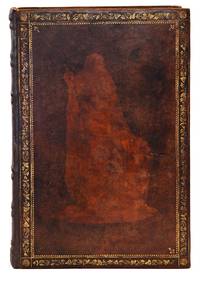
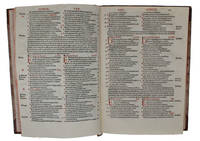
17854530Paris: François-Ambroise Didot 1785 1785. Two volumes. Large 4to. 310x230mm. pp. ix 1 596; 4 548. Handsomely bound in red morocco. Gilt borders spine lettered in gilt turn ins decorated in gilt. All edges gilt marbled endpapers. Pale blue silk ribbon in each volume. Slight bumping to bottom edges and rubbing to corners and to head and foot of spines but otherwise a lovely set in very good condition and internally excellent save for a little foxing in places and some minor staining in volume two. Beautifully printed in two columns by François-Ambroise Didot this Bible is part of the "Collection des auteurs classiques François et Latins" published by command of Louis XVI as works suitable for the education of the Dauphin. In fact this is the only work in Latin as the project was largely intended as a vehicle for the promotion of the classics of French literature including works by Racine Voltaire Corneille Rousseau Molière La Fontaine and La Rochefoucauld. The total set runs to thirty two volumes. François-Ambroise Didot was the second generation of the great printing dynasty inventing a new printing press and adapting the Fournier point system for typefaces. The Didot point is now the European standard typographical measure. La maison Didot entre l'élite et la foule: les vies matérielles du classique dans la France du premier XIXe siècle Stéphane Zékian Paris: François-Ambroise Didot 1785 unknown
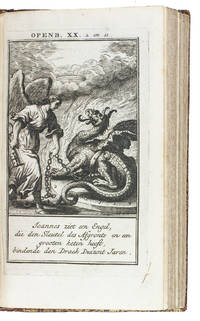
1752D59CBHLKTV6YAmsterdam 1752. 8vo. Otto van Grafhorst and Dirk onder de Linden Contemporary red morocco with richly gold-tooled sides and spine and gilt edges. With engraved title-page pasted on the 'Acte van Consent en Authorisatie' 42 engraved plates and diamond-head music for the psalms. With only the undated engraved general title-page and no separate title-page for the Old Testament but with separate title-pages for the New Testament and the psalms. 3 parts in 1 volume. 3 ll. 852; 234 pp. Very rare re-issue of the scarce States Translation of the Old and New Testament and also the psalmbook published at Utrecht by 'de Compagnie' booksellers in 1741. Unlike the first issue the Bible is here enlarged with a series of 42 unsigned engraved plates from an unidentified source all with 3- or 4-line captions apparently not the series after the illustrations of Jan Luyken also used by the same publisher. With only the undated engraved general title-page and no separate title-page for the Old Testament but with separate title-pages for the New Testament and the psalms. With only a few minor spots. Binding also in very good condition spine slightly worn. In very good condition.l Not in: Darlow & Moule; NCC; STCN; WorldCat; cf. Darlow & Moule 3348 1741 issue; Poortman Bijbel en Prent I p. 248; V. Eeghen & V.d. Kellen 441 similar plates by Luyken. ABE CAT Bibles Sermons & Psalmbooks unknown
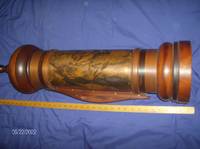
1992DEMO006065IStatesboro GA: The Boxwood Press 1992. First Limited edition. Hardcover. Fine. In a mahogany and copper scroll case with vertical slot and hidden crank handle; with a protective velvet cloth <br/><br/>Only 16cc.Remarkable bilingual presentation / re-interpretation of this Biblical work placing it in the the Reagan / Bush era. Illustrated with 16 color etchings by Bernard Solomon the translator and etcher. He realized there were remarkable parallels between the Biblical story of Esther and that of Anita Hill Clarence Thomas and the U.S. Senate Judiciary Committee. This interpretation unfolds sequentially as each leaf is unrolled from the 33 in. high scroll holder. The body of the scroll holder is one of the original copper plates used for the etchings which is why it is limited to an edition of only 16. The top and bottom of the handcrafted minaret-style case is finely shaped and polished mahogany by Anthony V. Mann. Designed with a hidden crank to rewind the scroll into the case. Altogether remarkable! The Boxwood Press hardcover
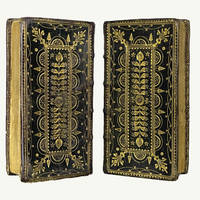
1719R08<p>Edinburgh: James Watson 1719. 12mo approx. 5 x 2.5 in. 2 vols. Double gilt-paneled boards with turnip tools with buds and a central daisy tool surrounded by a border of half-circles and corner fleurons. Spines with four raised bands with central alternating gilt saltires or floral design. All edges gilt. Marbled endpapers. Condition: Corners slightly bumped covers slightly bowed. Old ownership inscription effaced in first volume 19th century ink signature; a few pencil notes on endpapers. A fine example of a Scottish Herringbone design one of two distinctive national styles of Scottish bookbinding in the 18th century. Both styles the Herringbone and the Scottish Wheel are found primarily on Bibles. References: Herbert 950.</p> James Watson hardcover
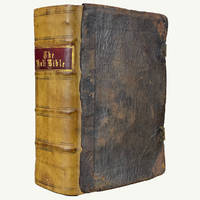
1569R53<p><strong>Description: </strong>Quarto approx. 7" x 5.5". Lacks all before Exodus 11:8. Text in two column black letter. Full-page woodcut of the Tabernacle F1 Table H3. Title before Joshua with large woodcut of Jugge's device. Full-page Map of Canaan Q1. Printed title to the Apocrypha. Map of the Holy Land before Matthew. 1 Corinthians 7 – Revelation 22 shorted and inserted from an octavo Geneva Bible.</p><p><strong>Collation:</strong> E-Z8 Aa-Kk6 A-X8 Y4 Aaa-Mmm8 Nnn6 A-K8 -A1. Begins at E1 Exodus 11:8 and ends at K8 Romans 15. <strong>Lacks</strong> title before Psalms and New Testament title. </p><p><strong>Binding:</strong> Rebacked brown calf. Boards with brown blind-paneled calf and corner fleurons. Two later working clasps. Spine with four blind-lined raised bands and a red gilt-lined morocco label with the words "The Holi Bible" and a date of 1569 lettered in gilt. </p><p><strong>Condition:</strong> Rubbed; intermittent staining; six ff. with marginal closed tears; T6 1 Sam 20 upper piece torn with six lines of text loss; Gg-Hh stain to half of text; D4 Ps 91 half of text torn away; A in NT with frayed edges; B6 lower corner loss of four lines of text. </p><p><strong>Provenance:</strong> Note to front pastedown reads "H.M. This is the 2nd edition of the Bible printed in 4to by R. Jugge the Queen's printer in 1569. This is the 2nd edition of Parker's Bible the 1st edition was a splendid folio in 1568. See Lewis' hist. of the Bible."</p><p><strong>Note:</strong> The first edition of the Bishops' Bible printed in quarto format. This smaller edition was printed just one year after the impressive first folio enabling the clergy to study from this version in their homes. The first quarto retains a few full-page woodcuts in the text. USTC records 13 copies in holdings.</p><p><strong>References:</strong> Herbert 126; STC 2105.</p> Richard Jugge hardcover
84083Berlenburg J. J. Haug 1726-42. Folio. 12 804; 8 880; 8 784; 6 858; 8 820; 8 792; 8 600; 4 556 44 pp. Some spotting and minor stains small paper repair in margins. Part 1-7 in four contemporary black full morocco spines with raised bands and beige labels finely gilt edges part 8 i somewhat worn contemporary full calf blindstamped spine with raised bands. Minor tear to tail of spine to part one. Five volumes. From the library of Ericsberg with its book plate. An engraved frontispiece sometimes present is not in this copy. Darlow and Moule 4239. The famous Berlenburg bible is a new German translation edited by the learned pietist Johann Friedrich Haug and other scholars with â€strong mystical symphaties†Darlow and Moule. Bad Berlenburg had thanks to Casimir Graf von Sayn-Wittgenstein-Berlenburg become a refuge center for radical pietists like the brothers Haug and thanks to them Berlenburg soon also became the publishing center for the so called â€German Philadelphian Movementâ€. One of the brothers Johann Jacob Haug was a publisher and printer and another Johann Friedrich was a theologist and orientalist. Their goal was to produce a Bible based on the original texts with explanatory notes and comments and for that reason Haug enlisted the support of academics in several European countries and he worked on the project for almost 20 years. The result become a monument of the German 'Philadelphian Movement' and the bible influenced radical pietist esoteric and others. The agent for its sale in America Christopher Sauer used the text as a model for the first German-American Bible 1743 when his supply was exhausted. hardcover
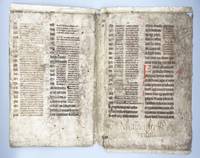
12378Paris 1200. <p> Compiled in the early 12th century at the cathedral school at Laon the Glossa ordinaria quickly became THE FOUNDATIONAL TEXT OF BIBLICAL EXEGESIS IN THE LATIN WEST: "by 1200 copies of the Gloss were in practically every library in Europe" De Hamel. This fragment includes portions of the gloss to 1 Kings Chapters 7 and 8 likely compiled by Gilbert the Universal d. 1134 who studied with Anselm of Laon d. 1117 before becoming bishop of London in 1128.<br /> The first leaf contains the text of 1 Kings 7: 23-25 written in a larger size and mostly squeezed into a narrow column to the left of both text blocks. The gloss two lines of which correspond to one line of the biblical text is in ten separate sections carefully distributed on the page so that they are adjacent to the scriptural passage commented upon. The two gloss sections that continue from recto to verso are marked with MATCHING TIE-MARKS TO AID THE READER. The gloss on the second leaf in five sections accompanies the text of 1 Kings 8: 65-66 on the recto. The text of 1 Kings 9: 1-9 follows extending from recto to verso without gloss.<br /> Some four centuries after its production this bifolium was removed from its codicological context folded inside out and wrapped around the boards of a German account book whose title is still visible on the recto of the second leaf: Urbarien über Bestreiten. The vellum portion once covering the spine bears the docketing numbers 40 and II suggesting the account book was part of a series.<br /> In nice condition the surface constituting the outer side of the binding worn and rubbed minor worm damage affecting a dozen letters.</p> unknown
1736elala1162<p>Oxford: Printed by John Baskett 1736-35. 1736. 2 Volumes in 1. undated engraved title by J.Sturt with imprint of Richard Ware. with Apocrypha & index. contemporary dark red morocco wide gilt tooled borders on covers incorporating crown & sceptre ornaments gilt tooled spine with 5 raised bands centre covers with black morocco onlay incorporating letters JHS & winged angel head ornaments within gilt flame border bit rubbed with minor stain on upper cover joints & spine ends repaired short splits in lower joints occasional light spotting. Provenance: Capt. William Wilkie of Montrose d. 1761 his spouse Mrs. Ann Napier d. 1779 William Petrie d. 1834. BOUND WITH: CHURCH OF ENGLAND. BOOK OF COMMON PRAYER. The Book of Common Prayer. 4to. undated engraved title by J.Sturt with imprint of Richard Ware. some marginal dampstaining to first few leaves a few leaves browned. Oxford: Printed by John Baskett 1736. BOUND WITH: DOWNAME John. A Brief Concordance. 4to. London: Printed for R.Ware 1732. BOUND WITH: BIBLE. ENGLISH. The Historical Part of the Holy Bible Or The Old and New Testament Exactly and Compleatly Describ’d in above Two Hundred Historys Curiously Engrav’d by J.Cole From Designs of ye best Masters. 4to. 51 engraved plates containing 204 illustrations. London: Sold by Richard Ware nd. BOUND WITH: SACRED GEOGRAPHY Contained In Six Maps. 4to. title in red & black. 6 folding double-page engraved maps some short map fold tears – no loss. London: Printed for Richard Ware 1725. A handsome copy of an interesting composite bible and prayer book. All of the plates and maps are bound at various intervals throughout the text. The maps depict 1 the situation of Paradise and the country inhabited by the Patriarchs 2 the peopling of the world by the sons of Noah and the Israelites journeying in the wilderness 3 a plan of the city of Jerusalem with a view of Solomon’s Temple and all the sacred utensils therein 4 the Holy Land divided into the Twelve Tribes of Israel in which are exactly traced our Saviour’s travels 5 the land of Canaan and 6 the travels of St. Paul and the rest of the Apostles. Herbert 1032. See Herbert 965 970 974 992 993 & 1116 for similar variously dated combined texts with engraved titles bearing Ware’s imprint as here. Hardcover. Very Good.</p> Oxford: Printed by John Baskett, 1736-35. hardcover
1819373865Lancaster Penn: Johann Bär 1819. Text in two columns. Engraved frontispieces to the OT and NT. 10 100 12 4 738 26 4 227 1 92pp. Folio. Contemporary calf covers bordered with gilt roll tools and cornerpieces covers with pictorial blocking press and stencil-masked sprinkled motif in relief Moses on the upper cover and Jesus on the lower cover spines with double-raised bands elaborately tooled in gilt with additional stencil-masked motifs in relief red morocco letter piece marbled endpaper gilt edges repair to upper joint and hinge original full calf slipcase. Text in two columns. Engraved frontispieces to the OT and NT. 10 100 12 4 738 26 4 227 1 92pp. Folio. The first German folio Bible printed in America in a very unusual and elaborate American binding and with a very early slipcase. Wright p. 139 Johann Bär unknown
1609371891Geneva: Pierre de la Rouière 1609. In two columns. 28 184 283 1 84 203 1; 8 186 2 134 2pp. Folio 15 x 9-1/2 inches. Contemporary pigskin covers blocked in gilt and blind remnants of paper label on the spine gauffered edges lacks bosses and hinges and clasps worn at extremities and bottom of spine. Provenance: Johann Georg Feuchter of Jura-Weickersroda inscription on pastedown that the bible was purchased at an August 6 1728 auction for 4 florins and 30 groschen; General Theological Seminary blindstamp. In two columns. 28 184 283 1 84 203 1; 8 186 2 134 2pp. Folio 15 x 9-1/2 inches. Edited with introduction by Benito Arias Montanus 1527-1598 Spanish orientalist and editor of the Antwerp Polyglot a reprint of Plantin's similar edition. Darlow & Moole 5113 OT and 4662 NT Pierre de la Rouière unknown
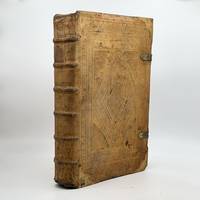
1557254216Basilaea Basel: Nicolaum Bryling Nicolaus Brylinger 1557. Woodcut border and printer's device on title. INCOMPLETE. 8 479 of 500 8 leaves. Lacking ff. 46-56 & 61-70. 1 vols. 8vo. Bound in contemporary blind panel-stamped pigskin over bevelled wooden boards clasps removed binding worn exposing boards on rear cover title page detached contemporary marginalia by Johannes Weneken throughout. Woodcut border and printer's device on title. INCOMPLETE. 8 479 of 500 8 leaves. Lacking ff. 46-56 & 61-70. 1 vols. 8vo. Brylinger published the only 16th century edition of Luther's Bible in Switzerland published one of the earliest Greek and Latin diglot Bibles and published a series of 8vo editions of the Bible with diglot and Greek-only text which was popular with students. Darlow & Moule makes no mention of this or any other Latin-only edition by Brylinger.<br /> Front paste-down endpaper and front free endpaper display extensive annotations in Greek and Latin presumably by Johannes Weneken. The marginal annotations provide a fascinating insight into how this book was used. Not in Darlow & Moule but cf. 4621; Adams 1056; OCLC: 46973017 6 copies only 3 of which in U.S. Nicolaum Bryling [Nicolaus Brylinger] unknown
152253365Mainz: J. Schöffer 1522. First Mainz edition. Octavo. 562 2: colophon blankpp. Collation: A-Z8 Mm8 chi2 O4/O5 reversed complete. Title within historiated woodcut border. Woodcut initials throughout. Text in italics. Printed side-glosses. Errata at final text leaf. Contemporary beveled wooden boards backed in tooled pigskin; spine with raised bands. Brass catch and clasp with expert restoration of leather thong. Contemporary manuscript musical scores used as pastedowns at front and back. Seven leather stubbs affixed at front edge as indexes. Occasional faint smudging mostly at margins else text crisp and fresh. A very good copy in a well-preserved sixteenth-century binding with a notable provenance.<br /> <br /> Scarce very early collective edition of the Latin "Paraphrases" of the Pauline Epistles prepared by the celebrated humanist scholar theologian and educational writer Desiderius Erasmus of Rotterdam 1466-1536. Preceded by the Froben collective editions of 1520 and 1521 this first and only edition of the Pauline Epistle Paraphrases to be printed at Mainz was issued by Schöffer in two parts each with full title and separate register and pagination; our volume contains the first part only: the Epistles to the Romans; Corinthians 2; Galatians; Ephesians; Philippians; Colossians; and Thessalonians 2.<br /> <br /> "In the vast and sustained labour he devoted to the New Testament Erasmus saw the culmination of his commitment to scholarship. and nothing else he wrote not even the Moriae encomium was to have so great an influence on posterity. The first edition of the New Testament appeared in 1516 and was followed in his lifetime by four more 1518/10 1522 1527 1535 each newly revised. Each consisted of the Greek text Erasmus' translation thereof and a copious apparatus of notes Annotations published as a separate volume. Beginning in 1517 he also published a Paraphrase of all parts of the New Testament save Revelation. Written in smooth and comprehensible Latin it was usually fuller than the original text. If offered his own interpretatiton but often avoided the provocative statements found in the Annotations. From the outset the translation the Annotations and to a lesser degree the Paraphrases drew criticism originally from conservative theologians who found heresies in his humanist philology but soon also from Lutherans and Catholics who denounced him for departures from their respective doctrines" Bietenholz. The Paraphrases were composed between May 1517 and January 1524. "Erasmus began with the Pauline Epistles. The paraphrase of Romans was published in quarto by Dirk Martens in Louvain in November 1517 and reprinted by Erasmus's friend Johann Froben in January of the following year; it sold well and was soon reprinted in octavo. Corinthians was published by Martens in February 1519 and reprinted in Basel by Froben in March; Galatians appeared later that year with editions from both publishers. The remaining Epistles followed in 1520 and 1521 the last to appear being Hebrews. In the autumn of 1521 Erasmus moved from Louvain to Basel and from that time Froben published the first editions of the remaining Paraphrases" Mynors. <br /> <br /> Our edition was printed by Johann Schöffer the son of Peter Schöffer who was the principal workman of Johannes Gutenberg. Apart from those of the Pauline Epistles the only other complete Paraphrase of Erasmus to be published by Schöffer was that on the Gospel of Matthew also in 1522. He did in 1521 however issue a series of four brief excerpts from the Paraphrases in German translation which appear to highlight provocative exegesis by the great scholar of Rotterdam concerning for example the hypocracy of the Pharisees Matthew 23 or the exhortation to "Take My yoke upon you and learn from Me" Matthew 11.29.<br /> <br /> Provenance and annotations: Contemporary manuscript entry at the title-page of the Benedictine monastery library at Amorbach; contemporary 50-word manuscript note in Latin at the free endleaf facing the title which discusses the present work. Early manuscript note in German at the final blank endleaf. Early leaves with light rubrication in red ink; about twenty leaves with contemporary annotations throughout. Later stamps of the Leiningen Palace Library at the bottom margin of the title and very faintly at the pigskin covers. Bookplate of United Theological Seminary Dayton Ohio noting the gift of Dr. Walter N. Roberts with their vertical entry stamp Mar 28 1963 at the dedication leaf lightly over the left-hand edge of the text but not impairing legibility. Full title and imprint: Paraphrases Eras. Rot. In omnes epistolas Pauli apostoli germanas : et in eam quae est ad Hebraeos incerti autoris cum ijs quae Canonicae uocantur diligenter recognitae excusaeque & ita binos in tomos digestae ut cuique secare in formam enchiridij siuelit liberum sit.<br /> <br /> References: P.G. Bietenholz Encounters with a Radical Erasmus Univ. Toronto 2009 p.13; R.A.B. Mynors "The Publication of the Latin Paraphrases" in: R.D. Sider ed. New Testament Scholarship: Paraphrases on Romans and Galatians University of Toronto Press 1984 pp. xx-xxix; USTC 682534; Vander Haeghen p.145: Paraphrases in omnes epistolas Pauli. Moguntiae Io. Schoeffer m. augusto 1522 octavo; VD16 E-3379 Berlin; Halle; Leipzig; Wittenberg; Wolfenbüttel. This first part not in Adams but cf. E-795 the second part 378pp. J. Schöffer unknown
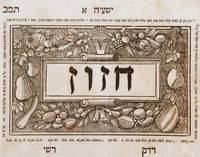
161952679Basel: Ludwig König 1619. First edition in part. Hardcover. Good. Eight parts in three volumes folio biblical texts and commentary in four parts continuously foliated; three supplemental sections each with separate foliation; Tiberias 1655 with separate pagination here bound after the Haftarot - Vol. 1: 6 title and prelims 1-228 1 sect. title 234-441 1 blank ff. Vol. 2: 1 sect. title 442-705 3 blank 707 sect. title-837 1 blank ff. Vol. 3: 839 half-title-881 1 blank 883-946; 8 Targum Yerushalmi; last leaf unfoliated; 67 Masorah 1 blank; 1 title 2-36 Haftarot ff.; 8 title and prelims 108pp. Despite the gap in foliation between the first and second parts and numerous errors in foliation throughout the Rabbinic Bible collates complete with all blanks noted in Prijs Die Basler hebräischen Drucke and the Haftarot bound at the end. Largely arranged in two columns of biblical texts in square font surrounded by commentaries in rabbinic Rashi font; biblical texts read from right to left. This copy with collective Hebrew title surrounded by biblical quotations in Hebrew set within elaborate woodcut architectural borders; brief preface in Hebrew by Abraham Braunschweig at the verso. Hebrew sectional titles set within the same woodcut borders for the three other biblical sections and the Haftarot with a plain letterpress half-title for the Five Megillot. Opening word of each biblical book set in large one-third to one-half page cartouche vignettes with elaborate woodcut borders and surrounding letterpress Hebrew text. Main title Jewish date chronogram = 5378 1618-1619. Near-contemporary half calf over speckled boards worn and rubbed; spines with raised bands gilt morocco lettering pieces and old paper labels heavily faded. About two-thirds of the text embrowned ranging from minimal to moderately heavy; worm tracing in a 1- by 2-inch section at leaves 541-553 affecting text. A good complete set notably containing the Ashkenazi Haftarot readings not found in all copies.<br /> <br /> Sixth Rabbinic Bible in Hebrew: Mikra'ot Gedolot edited by Johann Buxtorf I 1565-1629 professor of Hebrew at the University of Basel and the foremost Christian Hebraist of his era with the assistance of the Jewish scholars Abraham Braunschweig who served as the principal corrector and Mordechai Gumplin of Posen. This was "a truly audacious undertaking for his time" Burnett as no Christian scholar had yet attempted to edit the entire biblical corpus including the Aramaic versions Targumim and masoretic notes. Based mainly on the third Rabbinic Bible published by Daniel Bomberg at Venice in 1546-1548 the editor has carefully incorporated elements from two other Venetian editions. At the verso of the Latin title Buxtorf provides a detailed bibliographical excursus on the earlier Venetian editions and offers a tribute to Bomberg's industry by reprinting the colophon of the second Venetian Rabbinic Bible 1524-1525 at the conclusion of the masoretic appendix with text by the Hebrew grammarian and lexicographer Elijah Levita 1468 or 1469-1549 and a new introduction by Abraham Braunschweig. The design of the sectional titles and separate book title vignettes closely model those of the Venetian editions. "Buxtorf did not plan simply to reprint one of the existing Venice editions but rather to assemble the best features of them all into one work" and "to provide theologians with what he considered the most important tools for interpreting the Old Testament" Burnett. Buxtorf served in an official capacity as Basel's Hebrew censor charged with the oversight of all Jewish printing in the city and insuring that "no 'blasphemies' or slurs against Christians or Christianity appear in any book printed in Basel" Burnett. He carefully edited the Jewish commentaries in the Rabbinic Bible in accordance with this mandate "and removed many words and phrases which had escaped the attention of earlier censors" Burnett. <br /> <br /> The Rabbinic Bible contains the vocalized Masoretic text of the Hebrew Scriptures with accents and a vocalized Targum an Aramaic paraphrase of the biblical text: Onkelos for the Pentateuch; Jonathan b. Uzziel for the Prophets; and Targum Hagiographa for the Writings. The Hebrew and Aramaic versions are printed in square characters and presented in facing columns at the center of each page. The Jerusalem Targum of the Pentateuch appears as an appendix. In addition to the Aramaic paraphrases the Rabbinic Bible includes a massive scholarly apparatus of biblical commentaries by Rashi Ibn Ezra Baal ha-Turim Jacob b. Asher R. David Kimchi Radak R. Levi b. Gershon Ralbag Saadia Gaon and R. Isaiah along with the Masora a corpus of critical notes on the external form of the Biblical text compiled by Jewish scholars from late antiquity through the medieval era. As frequently occurs a copy of Buxtorf's work on the textual history of the Hebrew Bible Tiberias the 1655 revised edition is bound-in. This work was made possible by the publication in 1538 of Elijah Levita's Masoret ha-Masoret a commentary on the Masora which Buxtorf translated into Latin for his own private use in 1593. While "Buxtorf was concerned with the integrity of the consonantal text and the origin and integrity of the vowel points and accents of the Hebrew Bible from the very beginning of his scholarly career." While he had earlier published a long excursus on the age of the vowel points and accents in his 1609 Thesaurus Grammaticus "Tiberias is Buxtorf's fullest and most impressive work on the history of the biblical text" Burnett. Intended as a reference work for Christian students and scholars interested in studying the Masora Buxtorf was also keen to refute the view advanced by Levita that the Hebrew vowel points were early medieval innovations. Our folio version of Tiberias was intended to accompany the Rabbinic Bible and has the same architectural borders at the title. König also published a quarto edition in the same year but only the folio version includes a critical commentary on the Masora in which Buxtorf proposes various corrections to the Masoretic notes. <br /> <br /> As noted at the title Buxtorf's faithful study and tireless labor studio fido et labore indefesso yielded notably long-lasting results: "The Basel rabbinical Bible became a standard tool for research among Christian scholars and would remain so. until the end of the nineteenth century" Burnett. A vast array of early modern scholars including Protestants like Johannes Drusius and John Selden as well as Roman Catholics like Robert Bellarmine and Andreas Masius owned a copy or two of the Rabbinic Bible. "Johannes Buxtorf's thoroughly censored "Christian" version of the Rabbinic Bible Basel 1618-19 only made it easier for Hebraists to own copies of their own" Burnett Christian Hebraism in the Reformation Era p.163.<br /> <br /> A note on the date of publication: "The actual printing began between the mid-August and mid-September of 1618. According to the colophon production ended on the 24 of Ab 379 = August 4 1619 but since this date also appeared on the colophon of the Bomberg Biblia rabbinica edition of 1524-25 reprinted unchanged in the 1546-48 and 1568 editions it is suspect. Prijs suggested that the probable completion date was sometime during Ab of 379 between July 12 and August 10 of 1619" Burnett. References: Biblia Sacra: Burnett 7. Cowley 87. Darlow & Moule 5120 like our copy bound with the 1665 second edition of Tiberias cf. 5093. Davidson Otsar ha-shirah vol.1 p.406 no.8954. Prijs 219. Steinschneider 423 423b. VD17 23:675325G. S. Burnett Christian Hebraism in the Reformation Era Leiden: Brill 2012 p.163. Tiberias: Burnett 114. Prijs 272a. For detailed analyses of both works see: S. Burnett From Christian Hebraism to Jewish Studies Leiden: Brill 1996 pp.169-239 chaps. 6 & 7. Ludwig König hardcover
188650292Tokyo: Tokiwaya 1886. Very good. Scarce and exceptional first edition thus a light-hearted illustrated adaptation of the Creation and story of Adam and Eve from the Book of Genesis into Japanese. The story of Bible editions in Japan reflects the country's fraught history with Christianity; after the religion was banned in the early 17th century the portions printed by Catholic missionaries were lost. The ban on Christianity lifted only in the Meiji era first partially in 1873 then enshrined in the Constitution 1889 by means of an article on the freedom of religion. <br /> <br /> The post-Meiji Restoration translation effort of the Hebrew Bible began in 1882 and was finally completed in 1887. Books were completed and issued in parts with Genesis first issued in 1883. This heavily illustrated and lighthearted version of the two most famous stories from Genesis adapts the text to a well-established literary genre of Meiji Japan: KusazÅshi a forerunner of manga popular illustrated works in which the text weaves around the illustrations that dominate most spreads. Because they were meant for a popular audience the text is often primarily in hiragana or kanji with furigana; here the text is shown in three writing styles: kanji hiragana and romaji with furigana glosses. <br /> <br /> This presentation suggests how Christian mythology must have appeared to Japanese readers much as say Greek mythology seems to modern American readers of Homer. God is depicted as a mustachioed wise man while the serpent approaches Eve on legs. Most charmingly one spread depicts God spying on Adam and Eve with a pair of binoculars. <br /> <br /> While listed as the "first part" it is all published with no second volume ever appearing. We find only two copies at the National Diet Library and at Waseda University. 7.75'' x 5.25''. Original printed wrappers. Woodblock printed and illustrated including 16 double-page spreads. Title page matching illustrated cover printed on red metallic-speckled paper. 39 1 pages. Some staining and wear to wrappers with 2.5'' paper repair to rear wrapper verso. Black ink calligraphy to versos of both wrappers. Housed in custom blue cloth chemise. [Tokiwaya] unknown
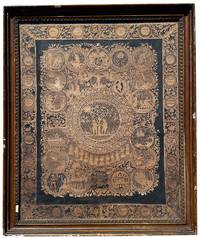
174131833Midhurst West Sussex England 1741. Very Good. Midhurst West Sussex England 1741. Original large example of "Scherenschnitte" or scissor art depicting scenes predominantly from the Old Testament 41x32cm.; mounted within a scherenschnitte paper frame 51x43cm. The entire display is laid down on black mat in a 19th-century frame not examined out of frame. <br /> <br /> Scherenschnitte is the folk art tradition of cutting paper designs often incorporating rotational symmetry and silhouettes. A treasured Chinese art dating back to the invention of paper the tradition was adopted in Europe in the 16th century before making its way to Colonial America primarily the Pennsylvania region two centuries later.<br /> <br /> This is a stunning English example in which the plethora of intricate detail can take some time to take in. The interior centerpiece depicts Adam and Eve under the forbidden apple tree. They and their furry friends are surrounded by an intricate floral border. Below: the twelve Apostles; above: Mary in the manger Christ on the cross and Jesus ascending to Heaven. <br /> <br /> Radiating outward lie what are to us the most impressive part of this piece - eighteen vignettes sixteen from the Old Testament each admirable for their skillful artistry and execution. Jonah and the Whale Cain slaying Abel Death and Time the Last Judgment and Hell are all depicted the latter in the form of a fire-breathing monster. Happily for the historian the British royal arms are depicted as well as a circular lozenge stating the date and a name: "January 1741" and "James Cox" presumably the artist.<br /> <br /> Around the whole is a splendid 4cm-wide border executed in eight scissor-cut strips glued together and each with two or three cut circles within which the artist has written the titles of each Bible scene. Each circle has its own surrounding design with only a couple examples repeated. Though we don't know when it arrived in America this piece was found in a Lancaster Pennsylvania house. A truly superb example of this traditional folk art and a lovely survival. . unknown
151359254Paris Henricus Stephanus 1513. Folio. Bound in a nice 18th century brown half calf with six raised bands to richly gilt spine. Corners slightly bumped and capitals worn especially the lower one where the capital band is showing and has loosened a bit. Inner hinge slightly weak. Front free end-paper with 18th century ink-annotation title year etc. A very light damp stain top the last portion of leaves a bit heavier to the last two leaves. Otherwise internally very nice and clean. All in all a very nice copy with only very light scattered brownspotting. Beautifully printed in two columns and in red and black throughout. Pp. 233-294. <br/><br/><em>Second edition following the original of 1509 of the final two parts of Estienne's typographic masterpiece "Quincuplex Psalterium" also known as the "First book of French Protestantism". These two final parts which make up complete works in themselves consist in the "Psalterium Vetus" - the Old Latin Psalter i.e. the version used by the churches before Jerome's revisions and the "Psaltarium Conciliatum" consisting in Lefevre's own version based on the Vulgate text corrected according to the Hebrew text and using the Aristarchian signs. This spledid publication had an immense impact upon protestantism early bible-scholarship and theology in general and is famed because of its beauty elegance and typographical excellence along with its immense importance historically speaking. "Lefèvre's epoch-making work was awaited impatiently by the learned world and is the topic of many a letter among the extant humanist correspondence of the period: thus Cardinal Ximeèz the future editor of the first polyglot Bible in a letter to Charles de Bovelles praises Lefèvre's scholarship and the usefulness of his "Psalterium". This famous volume is also Henri Estienne's typographical masterpiece and is commonly singled out as one of the outstanding monuments of early 16th-century French typography." Schreiber. "Lefèvre agreed with Erasmus that theology must be based on accurate texts and translations of the Scriptures; as the title of the volume indicates Lefèvre presents five different versions of the psalms" Schreiber. As described the present copy contains the final two. The three parts that were printed before those two were all printed in three columns and consisted in the three versions of St Jerome namely the "Psalterium Romanum" Jerome's first version of the Old Latin Psalter according to the Septuagint the "Psalterium Gallicum" Jerome's second revision first adopted by the churches of Gaul and the "Psalterium Hebraicum" Jerome's translation directly from the Hebrew. Schreiber nr. 8 1509 ed.; Renouard 1509 nr. 1.; Mortimer 1 nr. 62 present edition. </em> hardcover
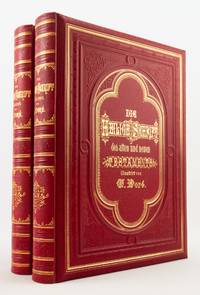
1877ST20670Stuttgart: Edward Hallberger ca. 1877. Fourth Edition. 430 x 315 mm. 16 3/4 x 12 1/4". Two volumes. Translated into German by Dr. Joseph Franz Allioli. <br/> PUBLISHER'S SPLENDID RED CLOTH VERY ELABORATELY STAMPED IN GILT AND BLIND covers with bevelled edges thick and thin gilt-rule border enclosing ornate blind-stamped frame large central oval containing a lobed gilt frame with gilt lettering inside spine divided into blind-stamped panels by decorative and plain gilt rules two large panels with gilt lettering and volume number original cloth hinges white moiré paper endpapers all edges gilt. IN THE ORIGINAL PRINTED GRAY DUST JACKETS jacket of second volume with small very expert repairs at bottom and the original black cardboard clamshell boxes solidly reinforced with black tape. WITH 230 DRAMATIC PLATES BY GUSTAVE DORÉ. Volume I with four leaves for recording family members marriages births and deaths each with a decorative frame all unused. Malan "Doré" p. 85. Isolated spots of minor foxing due to paper content one cover of the very rarely seen dust jackets with red offsetting from the frame on the cover but AN UNSURPASSABLE COPY--clean fresh and bright internally the bindings and jackets IN SPARKLING CONDITION.<br/> <br/> This is a time-capsule copy of perhaps the most popular illustrated Bible ever issued and one of the very few Bibles which has always been known by the name of its illustrator. According to his biographer the artist was excited by the "almost endless series of intensely dramatic events" he would get to portray; the results originally created for the 1866 Grand Bible of Tours are so evocative that the critic Bouchot called them "the terror of frail readers." Doré 1832-83 makes remarkable use of light shadow and composition to convey the full range of splendor horror pathos and ecstasy contained in the Scriptures. Because he was so prolific it is estimated that he made more than 100000 designs in his lifetime Doré inevitably had his detractors but Ray says simply that he was "one of the greatest of all illustrators." Taine says that "every imagination appeared languid in comparison with his. For energy force superabundance originality sparkle and gloomy grandeur I know of only one equal to his--that of Tintoretto." The Doré Bible was translated into at least 24 languages; ours is the German version by Catholic theologian Joseph Franz Allioli 1793-1873. According to Malan "The Roman Catholic Church has never diminished its praise of these illustrations." And these illustrations endured in many Catholic and Protestant Bibles especially during the last third of the 19th century but actually until the present. The Bible was such a cultural phenomenon that Mark Twain even mentioned it in “Tom Sawyer†as a motivating prize for students to learn Scripture. The Bible’s success prompted Doré to reinterpret his illustrations in huge paintings that were displayed at Doré Gallery in London. Malan says that the exhibition “was considered the greatest collection of religious paintings in the world." The boxes that were issued with our set have clearly weathered some blows over the years but they did their job perfectly as the volumes they protected hardly seem to have been opened in their lifetime and their dust jackets even considering the minor repair are also in a breathtaking state of preservation. Edward Hallberger unknown
1714E5PG4KRQ75WSDordrecht: Jacob and Pieter Keur; Amsterdam Pieter Rotterdam and Pieter Rotterdam the younger colophon: printed by Jacob and Pieter Keur Dordrecht 1714. Contemporary blind-tooled calf over wooden boards with brass clasps anchor and catch plates and corner pieces. Large folio 42.5 x 27.5 cm. With engraved general title-page letterpress title-pages for the New Testament and Apocrypha and half-title for the Prophets a series of 6 engraved double-page folding maps by Daniël Stoopendaal his larger set and a series of 24 of 25 engrave plates with 6 engraved Biblical scenes each by Dirk Jonkman. 3 parts in 1 volume. Beautifully illustrated large folio Dutch States Bible Statenbijbel with 6 six maps including a world map. They belong to the larger of two series by Daniël Stoopendaal first published in 1702 and revised in the plates for the present Bible. They were explicitly made for the Keur Bibles with for example Bible scenes rather than figures from classical mythology decorating the world map. The world map shows two hemispheres a copernican solar system in the upper and a ptolemaic in the lower smaller circle. The four continents are symbolically represented in the four corners. Some of the maps with some small tear along the folds and lacking one engraved plate; hinges damaged at the ends; generally in good condition.l Darlow & Moule 3337; Poortman & Augusteijn pp. 193-203 G II 2nd state maps 1-6; Poortman Bijbel en prent pp. 172-176. Jacob and Pieter Keur; Amsterdam, Pieter Rotterdam and Pieter Rotterdam the younger (colophon: printed by Jacob and Pieter Keur, hardcover
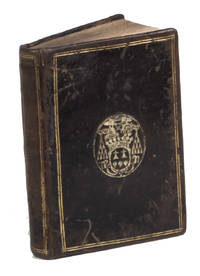
1584V6854Antwerp 1584. 16mo 118 x 8 cm. Christophe Plantin Late 17th-century dark brown calf with gold-stamped coat of arms of Pierre-Daniel Huet on both covers and gold-tooled dubbel-lined borders on covers and spine faded red speckled edges. With woodcut printer's device on the title page the text is partially printed in Greek. 267 13 pp. The text of this Book of Psalms is printed in Greek and Latin in parallel columns and on each page the inner column contains the text in Greek while the outer column contains the same in Latin. There are separate Greek and Latin indexes at the end of the work. This copy belonged to Pierre-Daniel Huet 1630-1721 a French clergyman and scholar. According to the title page this bilingual work was published by Plantin after the example of the Complutensian Polyglot Bible 1520. Plantin also issued a 24mo edition in the same year.The present copy is bound in dark brown leather with the coat of arms of Pierre-Daniel Huet stamped in gold on the front and back covers. Huet was the Bishop of Soissons and later Avranches. He was the cofounder of the Académie de Physique in Caen and in 1674 he became a member of the Académie française. He was one of the most learned men of his age; he studied Greek and Hebrew and he claimed to have read the Hebrew text of the Bible 24 times. The present volume also contains a few marginal corrections of the Greek text in a contemporary neat hand. Huet was known for his very fine and neat handwriting. As a linguist with an interest in Greek and Hebrew it is highly probable that Huet extensively used this copy and that he himself added the annotations. Despite his knowledge of Hebrew the partly obscure Hebrew annotations on the first endleaf "this book belongs to me Cardeliac" are probably not his. Although Huet was not a member of the Jesuit order he lived his final years in a Jesuit home in Paris. After his death he bequeathed his library to the Jesuits and upon the dissolution of the order in France in 1764 king Louis XV bought Huet's books and they are now part of the colleciton of the Bibliothèque Nationale de France. The bookplate on the front pastedown was made by the Jesuits to commemorate Huet's donation of his library.Covers show signs of wear spine has been expertly restored. With an ex libris-label of Pierre-Daniel Huet on the front pastedown: "Ex libris bibliothecae quam Illustrissimus Ecclesiae Princeps. D Petrus Daniel Huetius . 1692." an inscription in brown ink in Hebrew and several inscriptions in pencil all on the first fly leaf. With crossed out inscriptions except for "164" in the bottom left corner on the verso of the third fly leaf and at the head of the title-page with some annotations in dark brown ink in Greek throughout very slight foxing throughout a small water stain in the top margin of the second half of the book without affecting the text. On pp. 29-30 a small corrosion spot on p. 30 a marginal stain and a small hole in the text in p. 87 all very slightly affecting the text. This is a well preserved copy of a bilingual book of psalms with an interesting provenance.l BMC STC Dutch p. 26; Voet 671; Olivier 1684. cf. NBG XXV col. 381-385; Voet 672; Adams B-1390 "32mo". ABE CAT Bibles Sermons & Psalmbooks hardcover
1768ST12938Zurich: David Gessner 1768. 169 x 94 mm. 6 1/2 x 3 3/4". 272 64 214 of 215 pp. <br/> CONTEMPORARY PAINTED AND BLIND-TOOLED VELLUM DECORATED IN AN ELABORATE AND QUAINT STYLE covers with black and red starburst at center in a lobed red and green frame stamped with stars and tulips yellow cornerpieces stamped with a floral design smooth spine painted red and tooled in blind with flowers Dutch gilded endpapers all edges gilt. ◆Covers faintly soiled extremities lightly rubbed one leaf with two-inch portion torn away at fore margin costing small parts of five closely spaced staves of music occasional foxing of no great consequence; with some serious condition issues internally but an extremely pleasing example of a binding representing German folk art of the period.<br/> <br/> Although lacking the final leaf of text this volume is of considerable interest as an expertly made and decorated so-called "Peasant Binding" a colorful binding style that began in Hungary and spread through Germany the Netherlands and Scandinavia in the 18th century. The use of the word "peasant" in this context is a reference to the obvious influence of folk art on this decoration rather than to the clientele for which it was intended. Bibles prayer books and hymnals in the brightly painted and exuberantly decorated vellum bindings were popular wedding gifts among the bourgeoisie who were both literate and sufficiently affluent to afford such luxuries. David Gessner unknown
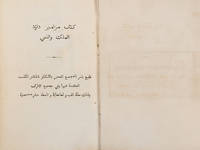
122142London British and Foreign Bible Society 1819. . First B.F.B.S. edition 12mo 155 x 100 mm; title-page and all text entirely type-set in Arabic some very slight finger-soiling otherwise internally clean and crisp ex-libris stamped in blind to the title bookplate to upper pastedown offset to facing endpaper overall clean internal condition housed in contemporary sheep extremities lightly rubbed a charming example.<br /> The first British and Foreign Bible Society Psalter in Arabic printed in London. According to Darlow and Moule the text in this edition is reproduced from the Aleppo Psalter of 1706 which was prepared by the Patriarch of Antioch see item 3 in this catalogue for more information. <br /><br />This 1819 edition along with subsequent B.F.B.S. editions were seen through the press by John David Macbride 1776-1868 Lord Almoner's Reader in Arabic at Oxford for more information see DM 1665.<br /> [London], British and Foreign Bible Society, 1819. unknown
186341855London: S.P.C.K. 1863. A Fine Copy. 8vo. ii381p. in the original blind panel decorated dark calf gilt spine title marbled endpapers and edges ~ No copies on WorldCat. Darlow and Moule 1399. The First New Testament printed in a language of the New Hebrides. Translated by J. Geddie and J Inglis. The translation was taken to England by Mr. and Mrs. Inglis who began the work of revision during the voyage and finished it in England with the help of Williamu a native of Aneiiyum. "Rev. John Geddie originally fom Nova Scotia and Rev. John Inglis from Scotland were Presbyterian missionaries sent to the New Hebrides specifically to Aneiteum now called Vanuatu to convert the natives to Christianity. The Bible was the first book published in the Aneiteum language. ~ New Hebrides is the colonial name for the island group in the South Pacific Ocean that is now Vanuatu. Native people had inhabited the islands for three thousand years. S.P.C.K. unknown
1653255179Londoni: Excudebat Rogerus Daniel: prostat autem venale apud Joannem Martin & Jacobum Allestrye sub signo Campanae in Cometerio D. Pauli 1653. The first edition of the Septuagint printed in England. 8 1279 1; 186 2 pp. plus terminal blank. 1 vols. 4to signed in 8's 195 x 143mm. Old vellum titled and dated in manuscript on the spine. Terminal leaves slightly soiled two ownership inscriptions on front endsheets and small Lincoln's Inn release/sale stamp vellum a bit handsoiled occasional modest foxing and dusting along upper margins but a very good copy. The first edition of the Septuagint printed in England. 8 1279 1; 186 2 pp. plus terminal blank. 1 vols. 4to signed in 8's 195 x 143mm. The first edition of the Septuagint printed in England with the Scholia the scarce printing in quarto format. The text is derived from the Sixtine text and edited by John Biddle 1615-1662 the Unitarian controversialist who was imprisoned by the Parliamentary Commissioners for his religious views. <br /> The SCHOLIA . has a separate title-leaf register and pagination. The same setting was imposed in both quarto and octavo formats the latter with rules separating the columns of text. In regard to institutional representation the edition in quarto is much more uncommon than that in octavo: ESTC locates 4 copies of the quarto printing in North America as opposed to 19 of the octavo printing. Occasionally Daniel's reprint of the New Testament is bound up with the octavo printings to form a complete Bible. Brunet cites that format but notes the sale of a copy on "Gr. Pap." presumably a copy in this format. Over the last 35 years ABPC records sale of one copy in quarto 1999 and four in octavo. ESTC R12599 & R236817; Wing B2718 octavo edition only; Darlow & Moule 4692; Brunet I:863 Excudebat Rogerus Daniel: prostat autem venale apud Joannem Martin & Jacobum Allestrye, sub signo Campanae in Cometerio D. Pauli unknown
1933ST15997Montgomeryshire Wales: Gregynog Press 1933. No. 37 OF 250 COPIES one of 110 in this binding accompanied by three additional plates on Japon EACH ONE OF 12 SIGNED BY THE ARTIST. 390 x 255 mm. 15 1/4 x 10". 15 leaves. <br/> Fine original dark slate blue Oasis morocco device in blind on front cover blind titling on front cover and spine. In the original paper slipcase somewhat worn and browned but sound. Wood engraved title with device and 21 wood engravings in the text five of them full-page chapter openings by Blair Hughes-Stanton and WITH THREE ORIGINAL SIGNED WOOD ENGRAVINGS ON JAPANESE VELLUM--"The Man Mourns I" 5/12 "The Man Mourns II" 4/12 and "Destruction" 5/12--attractively matted. Printed in blue and black on Japanese vellum; with an additional half-page engraving from chapter I laid in. Harrop 29; De Zilverdistel Cat. II 29; Hughes-Stanton 21. ◆A breath of fading to the spine negligible signs of wear to the binding but a fine copy with only trivial condition issues and the additional engravings pristine.<br/> <br/> This is in Harrop's words "one of the most spectacular books to come from this or any other press" our copy with the bonus of three limited edition wood engravings from the work signed by the artist. "Lamentations" was designed and illustrated by Blair Hughes-Stanton 1902-81 who studied at the school of Leon Underwood at Hammersmith and had a long and productive career producing sophisticated woodcuts as an avant-garde artist. Although he was encouraged to make his expressive sometimes even savage images look more like those of Eric Gill he resisted and successfully established his unique personal style as an illustrator. The three extra engravings here are excellent examples of his dramatic emotional technique; "The Man Mourns I and II" effectively convey overwhelming grief while "Destruction" inspires a feeling of impending doom. From 1930 through 1933 Hughes-Stanton worked for the Gregynog Press in Wales helping to design text layout providing woodcut illustrations and designing bindings. The press was founded in 1922 by two spinster sisters Gwendoline 1882-1951 and Margaret 1884-1963 Davies using a substantial inheritance from their industrialist grandfather; it produced 42 works between 1923 and 1942 eight of them in Welsh. Cave says that the books printed by the Gregynog Press "more than bear comparison with the work of any other private press" and "in the design and execution of bindings the Gregynog Press was far superior to any the Doves Press included.". Gregynog Press unknown
1962ST15876Frankfurt am Main: Ars Libri Verlag Gotthard de Beauclair 1962. No. 93 of 250 COPIES IN ENGLISH SIGNED by the illustrator and designer. 494 x 320 mm. 19 3/8 x 12 5/8". 40 pp. 2 leaves.Designed by Gotthard de Beauclair. <br/> FINE RED CRUSHED MOROCCO BY ROLAND MEUTER signed "R. Meuter Ascona" on rear turn-in upper cover with gilt lettering underlined with four gilt rules smooth spine with gilt titling leather hinges. In the original linen clamshell box backed with matching morocco. With 30 lithographs in the text by Gerhart Kraaz and one additional lithograph in a portfolio. ◆Slight discoloration from a bookmark in the lower gutter of colophon opening otherwise in perfect condition.<br/> <br/> Handsomely bound and beautifully designed and printed this very large folio first publication from the Ars Libri Press later called Ars Librorum exemplifies the kind of high quality work for which leading German publisher and book designer Gotthard de Beauclair was known. Beauclair 1907-92 began his career at Insel Verlag where he rose to art director and according to the Oxford Companion to the Book "turned inexpensive Insel books into collectors' items with excellent typography." He also founded three different publishing houses where he produced special limited editions that made full use of his excellent design and typographical skills. The present item is one such work recognized by the Association of German Book Artists as one of the most beautiful books of 1962. Gerhart Kraaz 1909-71 studied painting and worked as a graphic designer before becoming a serious book illustrator. The present title is considered his first major work in the realm of bibliophilic editions. His illustrations in charcoal are sensuous and shadowy capturing the romance and allure of the most beguiling Old Testament book. This edition in English appeared the same year as the German language edition but is much rarer--apparently the publisher cancelled a number of copies and very few ever made it to market. The binding characterized by an elegant simplicity is appropriate for the subject matter and for the stately large-format volume. Our binder Roland Meuter maintains an atelier in Ascona Switzerland where he continues to produce imaginatively designed bindings that attract considerable attention. Ars Libri Verlag, Gotthard de Beauclair unknown