(Bible in English)Biblio.com
6 582 résultats
1791373037Worcester: Isaiah Thomas 1791. First Edition. 48 engraved plates complete. 1310 2 89 3pp. Separate OT and NT titles. The family register between the Apocrypha and NT unaccomplished. Royal quarto. Contemporary calf covers ruled in gilt spine gilt with raised bands red morocco lettering piece marbled endpapers joints cracked but cords holding worn at extremities spine a bit abraded with some loss at top. Foxing a few leaves with short tears or small voids. Provenance: Ebenezer Byles signature on verso of the OT title. Housed in a blue cloth clamshell box. First Edition. 48 engraved plates complete. 1310 2 89 3pp. Separate OT and NT titles. The family register between the Apocrypha and NT unaccomplished. Royal quarto. Thomas' quarto bible was published in three distinct issues: with 2 copperplates only i.e. frontispieces to the Old and New Testaments; with two copperplates and John Brown's 89-page concordance in the rear; and the rarest and most deluxe form as here with 48 copperplates and the concordance. Of this last issue according to Thomas's catalogue the work was published "in elegant binding." The explanation for the work being complete with 48 plates rather than the 50 plates of the folio Thomas bible of the same year is easily explained: the frontispieces used for the folio bible plates I and XXXIII were too large for the quarto edition and thus were omitted with plates XXIX and XLVIII used as frontispieces of the quarto bible instead.<br /> <br /> A very difficult edition to find in a contemporary unsophisticated binding. Evans 23185; Hills 30; ESTC W4496 Isaiah Thomas unknown
1855313594New York: American Bible Society 1855. Royal 8vo. Bound in full contemporary morocco a.e.g. With "S. Augusta Brown" 1825-1909 stamped in gilt on the upper cover. With two examples of embroidered Berlin wool work laid in one with initals "SAB Oct. 29 1859" and the other an alter scene. Royal 8vo. The bible of Sophia Augusta Brown 1825-1909 wife of John Carter Brown herself an active bibliophile who helped her husband build his library and oversaw its stewardship after his death. Sophia Augusta was 34 and John Carter Brown 61 when they married after a brief courtship on June 23 1859. That event is recorded in the family record between the Old and New Testaments as are the births and marriages of the couple's three children--John Nicholas Brown Harold Brown and Sophia Augusta--the marriages of the two sons and the death of John Carter Brown "dearly loved Husband & Father" on June 10 1874. The younger Sophia Augusta Brown married banker and businessman William Watts Sherman 1842-1912 whose Newport RI house is an architectural landmark.<br /> <br /> The daughter of Patrick Browne an Anglo-Irish jurist and member of Her Majesty's Council of the Bahamas and Harriet Thayer of Providence a direct descendant of Roger Williams Sophia Augusta Brown was "an indomitable force in an era when women were discovering a role for themselves in the charitable sector . For Sophia Augusta perpetuating her husband's mission through the sound management and enhancement of his collection was her way of contributing to the advancement of knowledge and understanding among peoples . From her sons' earliest age Sophia Augusta ensured they would develop an appreciation for the care condition and housing of books . John Nicholas and Harold often accompanied their mother to booksellers and private collectors. At an early age they were shown priceless works: a Columbus letter the papers of Leonardo daVinci a note by Galileo . On his trips to Europe as an adult John Nicholas was expected to report back . with his assessment of the books he encountered . When he turned 22 in 1883 Sophia Augusta entrusted him with the care of the library" Sylvia Brown Grappling with Legacy: Rhode Island's Brown Family and the American Philanthropic Impulse 2017. While her husband was still alive Sophia Augusta oversaw the construction in 1862 of the fireproof library wing in the Nightingale-Brown House which remained the site of the library until it was relocated to its current home at Brown University at the impetus of John Nicholas Brown's will. American Bible Society unknown
169718733Regensburg: C. Weigel 1697. Hardcover. Very good-. Four volumes small quarto 19.7 by 14.8 cm. Captions in Latin biblical book and chapter and German biblical book chapter and verses with quote. Copperplate engravings throughout: 1 title 175 plates; 1 title 225 plates; 1 title 288 plates; 148 plates. Total = 836 unnumbered plates 3 engraved title pages. Uniformly bound in contemporary sheep with ruled borders; spines with raised bands blindstamped ornaments and letterpress titles on heavy paper labels. Lacks fourth volume title page. Covers rubbed/lightly worn at extremities; slight loss to labels; light almost exclusively marginal foxing throughout all volumes; dampstains in first volume affecting first seven plates and top margin through first third of the volume else a very good copy with clean plates.<br /> <br /> Second printing of this pictorial Bible Bilderbibel published by the engraver and art dealer Christoph Weigel 1654-1725. The grand biblical story from the Seven Days of Creation to the Vision of a New Jerusalem here unfolds in 836 beautifully engraved plates. The designs were chiefly drawn by Johann Jacob von Sandrart 1655-1698 and Georg Christoph Eimmart the Younger 1638-1705. The engravings were made by Elias Christian Heiss J. U. Kraus L. Heckenauer and Weigel himself among others. Weigel had earlier collaborated with J. J. von Sandrart on the Passio Domini Nostri Iesu Christi Neo-coelatis Iconibus Expressa Augsburg 1693 a pictorial Gospel harmony depicted in 100 engraved plates.<br /> <br /> Christoph Weigel first trained as a goldsmith and later apprenticed to his cousin Erhart Weigel a famous instrument maker in Jena. He journeyed to Augsburg in 1693 where he learned the art of engraving from Andreas Wolfgang and later from Matthäus Küsel. His published works tended to serve didactic and edification purposes including illustrated chronicles and a compendium of notable political events of the early eighteenth century. Among his notable cartographic works is the Descriptio orbis antiqui in XLIV tabulis exhibita A Description of the Ancient World in 44 Maps - Nürnberg 1720. <br /> <br /> The Biblia Ectypa was first published in a large folio format at Augsburg in 1695 with four engraved plates appearing on each leaf. In 1697 the plates were re-issued at Regensburg in two formats: a smaller oblong folio with two plates per leaf and a quarto with a single plate per leaf. Wildly successful the Biblia Ectypa enabled Weigel to establish his own print publishing company in Nürnberg where he was soon joined by his younger brother Johann Christoph Weigel and worked closely with the prominent map publisher Johann Baptist Homann.<br /> <br /> Annotations: Plates numbered by hand in black ink at top corner though sometimes slightly out of order with occasional corrrections in the first two volumes. An old German hand has noted a correct count for each volume at the rear endleaf e.g. Enthält 288 Küpfern.<br /> <br /> A notably complete set of this uncommon edition lacking only the fourth title page. The total count of 836 engraved illustrations is confirmed via the online catalogue Das Verzeichnis der im deutschen Sprachraum erschienenen Drucke des 17. Jahrhunderts VD17. References: Paul Johannes Rée "Weigel Christoph" in: Allgemeine Deutsche Biographie 41 1896 pp. 464-465 Online-Version; Thieme-Becker XXV 227-228; VD17 23:659088P vol. 1; 23:659089W vol. 2; 23:659091S vol. 3; 23:659092Z vol. 4. C. Weigel hardcover
1790H4975Philadelphia & Berwick: Printed by and for John Taylor 1790. Hardcover. fair. Despite the general title page and the NT title page being Berwick/John Taylor extremely likely the Philadelphia printing with a cancel title page the first folio Bible and first illustrated Bible printed in the US. The bibliography on this is complex: the earliest copies were issued with a Philadelphia title page but as this came out in subscribed parts over the course of two years 1788-1790 those sent out before late May of 1790 would likely have had a Philadelphia title page and those sold after that date would have a false UK title page as does our copy; the Congressional rule called for strict oversight of the printing of any Bible in the United States to get around this the publishers of this Bible substituted a phony UK title page. This conforms to Hills no 16 The English Bible in America by Margaret Hills; see also Sabin 12929. Measuring 16.5 x 10.5 in original leather binding with red morocco spine label fair condition at best binding heavily worn boards detached and worn along edges contents good: minor institutional marks include bookplate withdawal stamps embossed stamp of institution in four places text good to very good has 28 plates including frontispiece. Toning and minor stains to pages contents generally very good. A few plates have marginal spotting and stains the plate of the Crucifixion has 3 inch repaired tear extending down into the margin but not the image and the frontispiece has two marginal tears quite reparable. Large chunk from the last plate in Acts taking away the top two inches of the upper right corner of the image. Contents generally good to very good as are the plates. We've done absolutely no repairs or restoration in order to give buyers the opportunity to bind it as they see fit. Housed in specially sized cardboard clamshell box. One of the great rarities in US Bible printing and a high point in early American printing. Printed by and for John Taylor hardcover
193028076Lausanne: Gonin & Cie 1930. First edition. Schmied François-Louis. 9-3/4 in. x 7-1/2 in.; 248 mm x 192 mm. 60 pp. Designed and illustrated by Schmied engraved and printed by Philippe Gonin. Seven full-page woodcut illustrations; twelve smaller illustrations initials and bandeaux. Original wrappers in chemise and slipcase slight tanning to the front wrapper otherwise fine. Copy 4 of 175 copies signed by Gonin printed on Arches paper. This is from the tirage de tête of 25 copies which have an additional double suite of the llustrations black and colored. Nasti B18; Ritchie 34. Gonin & Cie unknown
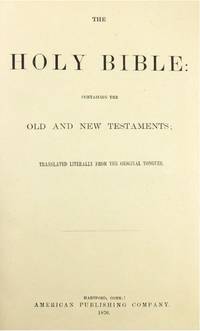
187642309Hartford Connecticut: American Publishing Company 1876. 4to. 9 1/2 x 6 1/4 inches. 2 892 pp. Old Testament; 276 pp. New Testament. Original publisher’s brown pebble-grain cloth blind stamped boards spine and upper cover lettered in gilt<br/> <br/> First edition of the first complete English Bible translated by a woman a touchstone of American printing feminism and religious scholarship in the original publisher's binding.<br/> <br/> Born in Glastonbury Connecticut in 1792 Julia Evelina Smith taught herself Latin Greek Hebrew and French while earning a living as a schoolteacher and later as an outspoken abolitionist and suffragist. In 1843 she began to test the English Bible against the originals and soon resolved as she writes in her preface "to put the same English word for the same Hebrew or Greek word everywhere.It may seem presumptuous for an ordinary woman with no particular advantages of education to translate and publish alone the most wonderful book that has ever appeared in the world.It took me about seven years to accomplish the five translations." Working verse by verse Smith produced five complete drafts twice from Greek twice from Hebrew once from Latin finishing in 1855. When commercial publishers declined to issue so unconventional a text she underwrote the project herself consigning it to Hartford's American Publishing Company in the nation's centennial year. The resulting volume is the first complete English Bible translated by a woman and remains the only one executed single-handedly without editorial committee or co-translator. Smith's method is uncompromisingly literal: Hebrew tense shifts and Greek word order are preserved even when the English prose becomes rugged. The translation therefore offers modern readers an unfiltered view of the underlying languages and stands in pointed contrast to the smoother interpretive revisions then underway in Britain and America. Earlier centuries had seen only partial female forays into Scripture such as Anne Locke's 1560 sonnet-cycle on Psalm 51 and the Countess of Pembroke's masterly completion of the Sidney Psalter after her brother's death but none covered the full canon. Smith's 1876 Bible stands today as both a landmark of American print culture and a quiet declaration of intellectual equality.<br/> <br/> Simms The Bible in America pp. 149-50; Stanton The Woman's Bible p. 151; Notable American Women 1607-1950: A Biographical Dictionary. Cambridge Mass.: Belknap Press of Harvard University Press 1971. American Publishing Company unknown
161117388London: Robert Barker 1611. First edition. Hardcover. Very good. Folio. The First and Second Books of Kings complete in 36 leaves. The first page is the final page of the previous book 2 Samuel; on the reverse begins 'The First Booke of the Kings commonly called The third Booke of the Kings'. 36pp. followed by 'The Second Booke of the Kings commonly called The fourth Booke of the Kings' 35pp. The final page ends II Kings and begins I Chronicles. Printed in black letter woodcut initials. Recent binding of quarter calf gilt titles Cockerell marbled paper boards. Some remargining no loss and old stains else a very good copy in a fine binding The binder's notes itemize the steps in rebinding including leaf disinfectant for the stains. Darlow & Moule 240. Robert Barker hardcover
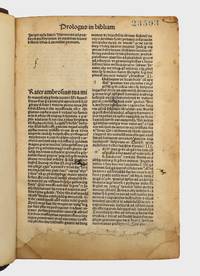
1486WB16618Nuremberg: Anton Koberger 1486. Hardcover. Very Good. 1486- 1487. Part 3 of 4. Chancery folio 305 x 205mm. Pagination: 348 leaves near contemporary foliation in red ink throughout though mispaginated at 188 with some worming towards end obscuring numbers. Collation: AA-GG10 HH12 II-MM10 NN12 OO8; PP-TT10 VV-XX6 YY10 ZZ10 AAA-FFF10 GGG8 HHH8 III-MMM10 NNN8. Contents of Part 3: Isaiah AA10-HH12 Jeremiah II10-NN12 Book of Lamentations Jeremiah OO8 Baruch PP-PP7r Ezekiel PP7v-YY4 Daniel YY5-BBB8 Hosea CCC-DDD3 Joel DDD4-DDD8 Amos DDD9-EEE6 Obadiah EEE7-EEE8r Jonah EEE8v-FFF1 Micah FFF1v-FFF6r Nahum FFF6v-FFF8r Habakkuk FFF8v-GGG3r Zephaniah GGG3v-GGG7r Haggai GGG7v-HHH2r Zechariah HHH2v-III6r Malachi III6v-III10r and the Book of Maccabees III10v-NNN8r Blank NNN8v. Double columns of 56 lines of text surrounded by 72-73-line commentary plus headlines. 16 woodcuts of which 3 full-page illustrating Ezekiels Vision full-page on PP10r of Christ enthroned above Evangelist Symbols and Heavenly Wheel diagrams of Solomons Temple and different views of gates and enclosures of the Temple as mostly column miniatures but some full-page on QQ6 TT6r TT6v TT7r TT9v-TT10r UU1v XX2r XX5r YY1 and a full-page genealogical diagram for the Kings of Syria in the Book of Daniel BBB2v and half-page diagram for kings of KKK1v. Rubricated throughout with blue and red Lombard initials mostly over printed guide letters extra flourished in red ink over the headlines foliation paragraph and signature marks. Gothic Types: 9:165G headlines and headings 7:83G text. Near contemporary blind-stamped pigskin tooled with devices of stags and roses and other floreate ornaments with original brass clasps and leather straps contemporary manuscript leaves reused <br />as binding waste visible in gutters; Front pastedown with added near contemporary manuscript index of 20 lines in Latin cursiva for contents books of prophets; small marginal tear on AA1-2 and with minor loss on HH7 occasional foxing not severe some intermittent marginal worming or browned leaves; pigskin rubbed and lacking bosses one leather strap torn but holding remnants of paper label on spine; otherwise a wonderful and solid incunable volume from an important set of glossed biblical commentaries. In the early 18th century this volume was in the collection of Gallus Winckelmann 16951757 a Benedictine monk and scholar active at Banz Abbey in Bavaria; his note on AA1: Coemit ad usum F. Gallus Winckellmann Professus Banthensis. The early-19th century signature of Daniel Kendig on front endpaper above perhaps an earlier inscription noting Lyras commentaries. Then in England the front pastedown with the mid-19th century bookplate of Joseph M. Lybrand rector of Saint Pauls Church Camden and America with the early-20th century labels of the Philadelphia Divinity School their bookplate and perforated stamp formerly collection number 4436. <br/><br/>This volume is part three of four in the second Koberger edition of the Bible printed in Nuremberg in 148687; parts one through three were undated with the fourth part dated 3 December 1487. This second edition was preceded by bible set printed by Anton Koberger in 1485. It was a monumental production incorporating the biblical commentary of medieval Franciscan scholar Nicholas de Lyra 12701349 with the <br />additions of Paul of Burgos ca. 13511435 and responses to the latter by Matthias Doering d. 1469 as well as the commentary of William the Breton ca. 11651225 on the Prologues of Jerome. Part 3 of the set contained the books of the Major and Minor Prophets along with the books of the Lamentations and Maccabees. Nicholas de Lyras biblical gloss or Postilla encouraged much scholarly discourse throughout the Middle Ages and was frequently reprinted into the 16th century. This edition includes the famous woodcut of Ezekiels Vision and the various views and implements of Solomons Temple which were first printed by Koberger in 1481 with the complete commentary. This copy in an early German binding has a monastic provenance at Banz Abbey. ISTC ib00614000. Anton Koberger hardcover
18009693London: Thomas Bensley for Thomas Macklin 1800. 7 volume set 48 cm Contemporary calf with decorative gilt stamped borders to boards with raised and gilt bands to backstrips. All edges gilt. Marbled endsheets and pastedowns. Some minor wear to corners. Some foxing to the plates. A few small dampstains. Some wear to backstrips and boards. The Macklin Bible is the largest Bible printed on a letterpress. Published serially between 1791 and 1800 in London this project was of one several ambitious projects that commissioned paintings of literary subjects exhibited them at their premises and sold engravings and/or editions of the relevant text including the engravings after the paintings by subscription. These 'literary galleries' sought to be both commercial printselling projects for the proprietors and to foster British history painting aligning with the ambitions of the Royal Academy to encourage a native school of painting in this genre. The foremost literary gallery was Boydell's Shakespeare Gallery which operated between 1789 and 1805.<br /> <br /> In addition to its 70 full-page plates the Bible includes head and tailpieces for each biblical book - 113 in total. All but two of the vignettes were designed by Philippe-Jacques de Loutherbourg who also painted 16 pictures for the full-page plates. The full-page plates and headpiece and tailpiece vignettes were published by Macklin and the text was printed for Macklin by Thomas Bensley. The type was cut by Joseph Jackson and Vincent Figgins Jackon's apprentice. The paper was made by Whatman. The instructions to the binder recommended binding the set in six volumes but this set like many others was bound in seven. Darlow & Moule 982. ESTC T123175. Herbert 1442. Thomas Bensley for Thomas Macklin unknown
1599146373London: Deputies of Christopher Barker 1599; London: Robert Barker 1636. Rare "Breeches" Bible printed by Christopher Barker with the fictitious 1599 publication date. "There are many editions bearing this date which while agreeing closely are yet distinct . the phenomena of the various editions described under the year 1599 and the very similar edition of 1633 constitute one of the most curious problems in the bibliography of the English Bible." Genesis 3:7 with "Then the eyes of them both were opened and they knew that they were naked and they sewed figge tree leaves together and made themselves breeches." Octavo two volumes bound into one in full paneled calf hand-embossing to the front and rear panels original silk and cloth ribbons woodcut title pages and initials. Bound with The Booke of Common Prayer and the Administration of the Sacraments and Other Rites and Ceremonies of the Church of England printed by Robert Barker in 1636. In good condition rebacked contemporary names and inscriptions to several pages. A very rare and desirable example of the Breeches Bible. Upon Queen Mary’s accession in 1553 “publication of the English Bible ceased in England. Many Protestants who fled to the Continent were attracted to Calvin’s Geneva. Among these exiles were eminent English Bible scholars who began work on a new translation†The Bible: 100 Landmarks 62. First published in 1560 the Geneva Bible—often called the “Breeches Bible†for its unique rendering of Genesis 3:7—was “more scholarly than any previous translation… It achieved immediate popularity and exerted an extremely powerful influence… The Geneva Version included prefaces maps and tables; and for the first time in an English Bible the verses were divided and numbered… It has been more properly called the Elizabethan family Bible since it was this version which was the first to enter the English home†PMM 83. “It became the textus receptus for the Puritan element in England. It was read by Shakespeare Bunyan and the soldiers of the Civil War and is thus of cardinal importance for its influence on the English language literature and thought†Great Books and Book Collectors 105-8. Deputies of Christopher Barker hardcover
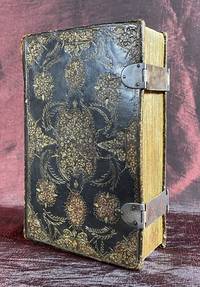
16631238London: Ad 1: John Bill and Christopher Barker; Ad 2: Printed for the Company of Stationers 1663. 8vo. Ad 1: Engraved title A-4K8 unpaginated. COMPLETE with OT ending on 3P2v and NT ending on 4K8v. Ad 2: 102 2 pp. A-F8 G4 apparently COMPLETE. Some foxing and blemishes throughout the text. Bound by "Owen" in contemporary full black morocco richly gilt all over with floral and leaf motifs onlaid red and citron morocco pieces to covers and spines a.e.g. fore-ege painted with flowers and "Search the Scriptures" two working silver clasps joints beautifully repaired fore-edge painting dulled and worn from clasps some foxing throughout. Preserved in a protective cloth case. Suitable for exhibition and study. OF SIGNAL IMPORTANCE IN THE HISTORY OF ENGLISH RESTORATION BOOKBINDING: AN UNRECORDED AND UNPUBLISHED BINDING BY "OWEN" WHOSE WORK IS KNOWN FROM ONLY ONE OTHER EXAMPLE. <br /> <br /> In terms of 17th-century English bindings this one in particular is of particular significance: the only other binding by "Owen" is in the Henry Davis Gift British Library. Howard Nixon English Restoration Bookbindings p. 37 and plate 78 describes it in some detail: "It has been stated earlier that signatures on painted fore-edges followed by the word 'fecit' in the seventeenth century are those of binders or booksellers for whom the books were bound. The book in the Henry Davis Gift with the edges signed 'Owen fecit' and dated 1672 is a possible exception to this rule as Owen cannot be traced. The tools used on this book have not however been identified elsewhere." Our binding is far more elaborate the that in the Henry Davis Gift as it features a total of 26 onlays red and citron all elaborately gilt. The Davis Gift example is bound in a single piece of black goatskin. Due to the extensive and complex gold tooling the present binding was not easily attributable to a known workshop but it is now clear that all four major tools on it are identical to those on the "Owen" binding in the Davis Gift see Mirjam Foot Henry Davis Gift vol. II no. 115 with full-page reproduction. While the fore-edge of our binding is worn the word "Search the Scriptures" is just visible alongside depictions of flowers. <br /> <br /> Provenance: inscribed on recto of third blank leaf "John Pounds Carter 1864 bequeathed to him by his aunt Phoebe who died July 14th 1852." This individual was almost certainly the same JPC who was born in Southwark London in 1821 and died in Lambeth London in 1896. Tipped onto the first blank is a small handwritten note which describes this as a "very fine binding by Samuel Mearne." <br /> <br /> References: Ad 1 Bible: Darlow/Moule 539 British and Foreign Bible Society copy lacks the Psalms altogether. Wing STC 2nd ed. B2267. Not in ESTC !. Ad 2 Psalms: ESTC R232588 recording one copy National Library of Wales containing an engraved plate but neither the Yale copy which is likewise bound with Bill and Barker's 1663 Bible nor this copy ever had such a plate bound in. <br /> <br /> We are grateful for the assistance of Philippa Marks British Library and for supplying rubbings of the tools on their Owen binding. Ad 1: John Bill and Christopher Barker; Ad 2: Printed for the Company of Stationers unknown
15847235Salamanca: Gasparem à Portonariis suis & Gulielmi Rouillii Benedictique Boierii expensis 1584. First Edition Primera edición. Hardcover Tapa dura. 297x210mm. 11¾x8¼". Salamanca Gasparem à Portonariis suis & Gulielmi Rouillij Benedictique Boierij expensis 1584-1585. 3 tomos en un volumen. En folio 297 x 210mm. 14 366 1 h.; 72 214 30 138 hojas 42 pp. Importante encuadernación mudéjar de época en piel sobre tabla planos ricamente gofrados lomera restaurada en cabeza y pie sin los broches. La Biblia de Salamanca con la traducción y notas de Francisco Vatablo publicada por primera vez en París en 1545 e impresa en España en 1554 con atribución a fray Domingo de Soto de la revisión del texto prohibida y mandada retirar por la Inquisición entre los años 1554 y 1559 pero que finalmente pudo ser publicada en Salamanca en 1584. Se conoce como <em>Biblia de Vatablo</em> a la edición preparada por Robert Estienne de la versión <em>Vulgata</em> de las Sagradas Escrituras junto con la traducción latina de Sanctes Pagnino y las anotaciones y correcciones de François Vatable profesor de hebreo del Collège de France; fue impresa en París en 1545. Se trata de una Biblia única ya que contiene 2 textos en latín de la Sagrada Escritura y no uno como es común. A la primera traducción se la denomina como la traducción vieja y se trata de la primera traducción de la Biblia realizada al latín desde el hebreo y griego llamada <em>Vulgata</em>; la segunda traducción se la denomina como traducción nueva y contiene las ideas renacentistas. Ambas traducciones confrontan el pensamiento de la <em>Vulgata</em> y las correcciones de ésta entre lo antiguo y lo nuevo. La primera impresión de la Biblia de Vatablo en España fue realizada en 1554 por Andrea de Portonaris en Salamanca; fue considerada ilegal un año más tarde y se dice de ella que no hay ejemplar conocido. Esta segunda impresión de 1584 la única que pudo ver la luz fue publicada después de ser cuidadosamente revisada y expurgada por la Inquisición y un grupo de teólogos de la universidad de Alcalá llamados los <em>hebraizantes</em> a los que le costó la cárcel y la muerte y entre los que se encontraba Fray Luis de León. Esta Biblia editada por Gaspar de Portonaris hermano del impresor de la primera y desconocida primera versión comenzó su andadura en 1569 en un proceso de más de 100 juntas reuniendo a gran número de teólogos y que se extendió por varios años. Contiene para el Antiguo Testamento la versión de San Jerónimo y Pagnini y para el Nuevo Testamento la versión de San Jerónimo y la traducción de Erasmo junco con ciertas revisiones de Teodoro de Beza. Durante los debates hubo momentos de mucha tensión. Especialmente furibundos fueron los enfrentamientos entre Fray Luis de León profesor de Teología Prima y León de Castro profesor de Griego experto acusador de judíos y judaizantes y abiertamente enemigo de todo aquello que tuviera que ver con los textos en hebreo donde las amenazas con denunciarse mutuamente ante el Tribunal del Santo Oficio fueron constantes durante estos años de deliberaciones. En las juntas se enfrentaron dos tendencias irreconciliables lo que iba a desencadenar las persecución de los hebraístas. Finalmente Fray Luis de León y sus otros compañeros hebraístas fueron llevados ante la Inquisición encarcelados y llevados a juicio. Es precisamente durante este largo cautiverio cuando Fray Luis realiza algunas traducciones de libros y escribe varias poesías y una de sus obras más significativas<em> De los nombres de Cristo</em>. Finalmente en 1575 el Tribunal reconociendo el valor y la energía impuesta por Fray Luis en su defensa oral le creyó exento de toda culpa y sospecha. Gasparem à Portonariis suis & Gulielmi Rouillii Benedictique Boierii expensis hardcover
1587ST14247Venetiis Venice: Hieronymus Polus 1587. 213 x 146 mm. 8 3/8 x 5 5/8". 12 p.l. 1126 pp. <br/> ESPECIALLY PLEASING CONTEMPORARY CALF covers with gilt French fillet frame and oval wreath of olive branches the center of the wreath in the shape of a cross flat spine ruled in gilt red morocco label. Title page with elaborate wood-engraved frame text profusely illustrated WITH 600 WOOD ENGRAVINGS depicting scenes from scripture after Holbein Bernard Salomon le Petit Bernard and others a handful of these a bit indistinct. Front pastedown with ex-libris of Leonis S. Olschki. Adams B-1093; STC Italian 93. Not in Darlow & Moule. ◆A little wear to joints and extremities spine a bit crackled separation at hinges but no looseness occasional minor browning or foxing otherwise in remarkably fine condition the text clean and crisp and in a still-lustrous entirely solid unsophisticated original binding.<br/> <br/> This is a very well-preserved handsomely bound and lavishly illustrated edition with distinguished provenance of the Louvain Bible first printed in Venice in 1578. Our edition contains 600 wood engravings illustrating the text ranging from portraits of prophets saints and evangelists to dramatic scenes from the histories of the Old Testament and the life of Christ and ending with an imaginative Apocalypse cycle. Many of these are the work of Lyonnaise artist Bernard Salomon 1506-61 known by the sobriquet "Le Petit Bernard" for his small engravings rich with detail. Others are based on the biblical woodcuts of Hans Holbein. The binding here is likely French; the flat spine with just one large gilt-framed panel and the olive branch decoration on the covers is characteristic of late 16th century and early 17th century French work. The exceptional condition here is typical of books from the collection of Leo Samuel Olschki 1861-1940 scion of a family of Prussian Jewish printers whose interest in printing history led to his becoming a celebrated antiquarian bookseller author founder of the journal "The Bibliophile" and publisher of works in the humanities. Hieronymus Polus unknown
15192682Lyon: Jacques I Mareschal for Simon Vincent 1519. <p>8vo 180 x 126 mm. 30 500 54 pp. with pagination errors. Title and first table printed in red and black text in two columns with printed marginalia indices and summary in 3 columns. Colophon on fol. RR4v. Publisher’s woodcut device Baudrier no. 2 on title and final verso full-page woodcut showing the six days of Creation within ornamental border historiated woodcut initials throughout; red paragraph marks to opening page and red highlighting to the facing woodcut. Mainly faint marginal dampstain in upper margins light discoloration to outer margins. Contemporary Flemish blind-tooled calf over wooden boards sides with leafy roll-tool border enclosing central panel with intersecting triple fillets forming a saltire design the compartments filled with a repeated foliate tool arranged symmetrically one of two fore-edge clasps two catches; many deckle edges preserved worn a few small chips to leather pastedown endpapers renewed. Provenance: early ownership inscriptions on title: Mrr Cornelius Adamus ter Borch; and Siba Lÿken; contemporary marginal notes and some text markings crosses in margins and underlinings in first few books Genesis-Deuteronomy; abundant 17th and/or 18th-century philological annotations in Genesis and Exodus and in the indices including full page of notes on blank page 2E5v.<br /> <br /> A complete portable Bible printed in very small types containing an ample scholarly apparatus and finding aids for the use of theology students and scholars; this copy with contemporary annotations and in a contemporary blind-tooled calf binding probably Flemish. This compact glossed Bible densely and economically printed with no break between the Old and New Testaments is enlivened by hundreds of historiated woodcut initials from woodcut alphabets designed by Guillaume Leroy who also designed the six-part full-page woodcut of the Creation. <br /> <br /> Mareschal’s useful “pocket†Bibles were bestsellers this being the fourth of six octavo editions from his press. They were among the first Bible editions to include a rhyming mnemonic Biblical summary by the minorite friar Franciscus Gothi in which each four-line verse summarizes a Biblical chapter. Occupying here the final two quires and called for in the colophon it is not recorded by Baudrier or Gültlingen. Possibly buyers had the choice of including it or not in their copies. Otherwise the text of Mareschal’s octavo Bibles follows that of the Bible printed in Basel in 1509 by Johann Petri and Froben using the text edited by the Dominican Alberto Castellano and supplying for the first time marginal notes citing canon law. The apparatus includes four tables and a glossary of Hebrew names. As in the Petri editions a six-line commendatory poem by Matthias Sambucellus is printed on the title here with the first word of the last line incorrectly given as “Omne†instead of “Omine.â€<br /> <br /> The publisher Simon Vincent belonged to Lyon’s powerful booksellers' guild the Compagnie des Libraires whose members helped Mareschal during his early years impressed by his skill conscientiousness and sobriety â€a rare trait among printers of this period†notes Baudrier qualities which contrasted markedly with those of the printer Michel Topie whose press Mareschal had acquired in 1512 Baudrier 11:383.<br /> <br /> USTC 145003; Adams B-997; Pettegree & Walsby French Vernacular Books III: 57271. Darlow & Moule II: 6093 note; Baudrier Bibliographie lyonnaise 11: 401 and pp. 380 397 & 448; Gültlingen Bibliographie des livres imprimés à Lyon 2:209 no. 56.</p> Jacques I Mareschal [for Simon Vincent] unknown
193178694Waltham Saint Lawrence:: Printed and Published at the Golden Cockerel Press 1931. First of this edition; No. 102 of 500 copies 488 on paper. publisher's half pigskin and tan buckram boards t.e.g. by Sangorski & Sutcliffe London. The tan cloth of the binding is foxed as usual with a few small stains; and the rounded back of the pigskin spine is irregularly tanned. The interior is very fine throughout. Folio. With Decorations by Eric Gill. Printed and Published at the Golden Cockerel Press, hardcover
1752ST19424Stockholm: Tryckt af Henrick Christoph Merckell 1724-28; Peter Jöranson Nyström 1752. 422 x 275 mm. 16 5/8 x 11". 30 p.l. 1 leaf section title 234 2 section title 235-604 2 section title 605-908 2 section title 909-1387 1 pp.; 4 p.l. 300 4 301-666 pp. <br/> STATELY CONTEMPORARY CALF INTRICATELY GILT IN THE FANFARE STYLE over bevelled wooden boards covers with strapwork frame containing lilies and floral garlands central panel with strapwork rows of floral crosses the spaces between with floral sprays emerging from urns very expertly rebacked preserving original backstrip raised bands spine compartments with flowers-and-pomegranate centerpieces floral cornerpieces gilt lettering two decorative brass clasps catch plates and original straps turn-ins with lattices and floral ornaments marbled endpapers edges gilt and delicately gauffered. Five section titles with engraved vignettes. With ink presentation inscription celebrating the baptism of Claës Georg Listromer on 20th November 1604 and expressing the hope the Book will bring him wisdom as he grows signed by Claës Lindman dated 17th September 1605. A 20th century Swedish inscription below tracing the book's descent through generations of the Listromer family into the 1920s. Darlow and Moule 8821 8826. Slight variations in color of the leather Ffff8 with lower corner torn away not affecting engraving occasional faint offsetting but AN EXTREMELY CLEAN FRESH COPY in a binding bright with gilt.<br/> <br/> This impressively bound Swedish Bible was a baptism gift that clearly would have outweighed its recipient as Swedish law at the time required an infant be baptized within the first eight days of life. Although hardly practical for personal devotion and study the majestic tome was a treasured heirloom passed down in the same family for 200 years. The beautiful fanfare style seen here emerged in France in the 16th century but remained very popular in Northern Europe into the 18th century particularly for large "lectern" Bibles like the present item. The text here is an extensively annotated edition of the 1618 Gustave II Adolf Bible prepared by a father and son both named Johannes Gezelius who served successively as Bishop of Åbo. The New Testament was first printed in that city in 1711-13 the Old Testament in Stockholm in 1724-28. In our copy the New Testament is a 1752 reprinting. Tryckt af Henrick Christoph Merckell, 1724-28; Peter Jöranson Nyström unknown
15866176Imprinted at London by Christopher Barker Printer to the Queene's Maiestie. 1586. 1586 8vo. Collates A - Xxxviii lacking Fffviii blank. Apocrypha ends at Fffvi followed by A perfite supputation of the yeeres and times from Adam unto Christ. NT begins at Gggi and the Second Table ends at Xxxviii. Unrecorded by ESTC and a completely different setting to Herbert 191 which ends at Qqq8. Despite Herbert stating that BL has a copy of Herbert 191 neither ESTC nor WorldCat can locate a copy. BOUND WITH The Whole Booke of Psalmes Collected into English Metre . At London Printed by John Daye dwelling ouer Alders-gate. 1584. ESTC S116211 Gv lacking a blank corner Gvi defective at the foot and lacking Gvii-viii. New period style calf panelled in blind. Spine with raised bands. Old endpapers preserved with an ornate full page calligraphic inscription Ann Kent Her Book April ye 27th An: Dni: 1696. Early notes on the title verso. Some headlines and signatures shaved by a previous binder but a clean sound copy of a rare octavo Geneva Bible. Imprinted at London by Christopher Barker, Printer to the Queene's Maiestie. hardcover
16118272Imprinted at London by Robert Barker printer to the Kings most excellent Maiestie 1611. 1611. 1611 4to. 2 226 231-434 434 misnumbered 435 4 441-554 82 leaves. Herbert 308. BOUND AFTER a defective Book of Common Prayer BOUND BEFORE STERNHOLD Thomas and HOPKINS John The whole booke of Pdalmes Printed by A.G. for the Company of Stationers 1635. 10 90 6 p. Lacking the final 6 pages. Contemporary blind panelled binding with brass corner fittings central lozenges and replacement clasps. Rebacked with most of the original spine re-laid. Trimmed close at the head occasionally cutting into headlines or foliatiion. Leaf Dd3 has small loss of text at the foot. Ee4 has slight loss to a sidenote and Ee5 has a little loss to the blank fore edge margin. The New Testament has a separate title page and is followed by Hervey's Concordances. Nnn2 has loss at the foot. A few light stains some turned corners and a few pen trials. A handsome Jacobean Bible. Imprinted at London by Robert Barker, printer to the Kings most excellent Maiestie, 1611. unknown
18381176E083Leipzig: Karl Tauchnitz 1838. 1st Edition . Hardback. Printed pages: 8vo. 4 620. Very Good Minus. 5.5 x 8.25 inches 13.5 x 21 cm. Later binding with paper covered boards. Fading and light marking to covers. Uncut pages with wide margins. Some creasing to first and last few pages light foxing to text small stamp to title page dated 13 May 1846. A rare early Russian language edition of the New Testament. The 1838 Leipzig edition published by Karl Tauchnitz - this unauthorised edition was the first Russian language edition of the New Testament to be published outside Russia. The Russian Bible Society had previously issued Russian language editions between 1822 and 1826 but no other edition was published in Russia until the Synod authorised edition of 1860. This 1838 edition had a print run of 2000 copies 500 of which were smuggled into Russia. A good solid example of a very rare item. Overall condition is Very Good Minus. Size: 5.5 x 8.25 inches 13.5 x 21 cm. Karl Tauchnitz hardcover
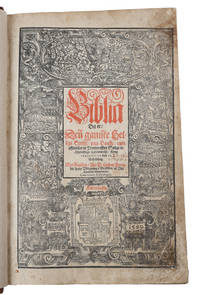
1567512128Gerwinum Calenium und die Erben etwan Johan Quentels Zu CölnGerivinum Calenium und die Erben etwan Johan Quentels Zu CölnGerivinum Calenium und die Erben etwan Johan Quentels 1567. Leather. VERY GOOD. 6 528 OT Apocrypha; 159 NT f. COMPLETE with first five leaves tipped in. General title printed in red and black with woodcut architectural border showing heavenly scene of the Trinity surrounded by angels at head four evangelists with their symbols to center and 12 apostles to the tail; NT title page with the same border. Illustrated with 134 woodcuts by Virgil Solis and others and woodcut dropcaps. NT leaf 82 mis-foliated as 86 Folio contemporary alum-tawed pigskin over bevelled boards elaborately tooled with double border of noble portraits on pedestals surrounding interior border of angelic figures framing center panel emblazoned with Jesuit 'IHS' insignia to front and Virgin with child to rear; in contemporary trim with dark blue edgestain; leather hasps perished but with all four brass fixtures intact hand-written title to upper spine panel both original headbands intact. Tidemark to upper and tail margins of Kings - Ezekiel and small dampstains to tail margin of most of the NT first four leaves tipped-in with some marginal tissue repair to the title page and second leaf; marginal gloss to 22b and a few marginal notes to the prelims text otherwise very clean and sharp with no tears and typical shelfwear to edges. Large color bookplate of Gottfried Ritter von Boehm. A very handsome and uncommonly clean and unrestored binding. Commonly known as the 'Anti-Luther Bibel' Dietenberger's translation was the standard Catholic German translation of the Counter-Reformation and well into the 17th century. 'Johannes Dietenberger ca. 1475–1537 native of Frankfurt am Main university-trained Doctor of Theology and Dominican friar served as prior in Frankfurt and Koblenz during the 1525 Urban Revolt of the German Peasants’ War and the early Protestant Reformation respectively. Like Martin Luther Dietenberger translated the Bible into the vernacular German after consulting recently published Greek and Hebrew biblical texts; however unlike Luther he produced a translation that remained true to the Latin Vulgate and the traditional teachings of the Catholic Church. Dietenberger aimed to counter those parts of Luther’s translation which contradicted Catholic tradition and at the same time to provide a translation whose language was less coarse and offensive.' Roman Fischer and Jourden Travis Moger 'Johannes Dietenberger and his Counter-Reformation German Bible' in Journal of the Bible and Its Reception Feb. 2017. Darlow & Moule 4211; VD16 B 2804. Gerwinum Calenium und die Erben etwan Johan Quentels, Zu CölnGerivinum Calenium und die Erben etwan Johan Quentels, Zu CölnGer unknown
1585372230London: Deputies of Christopher Barker 1585. Text in black letter in two columns. General title and calendar printed in red and black titles within woodblock frames woodcut map on leaf following NT NT-O3 woodcut initials. 17 536 137pp. New Testament title page present. Lacks preliminary blank lacks the general title with a 1588 title supplied in its place lacks NT leaf V1 Titus 2:12 through Hebrews 1:10 preliminaries bound out of order. Folio 15-5/8x10-1/2 inches. Nineteenth century dark purple morocco covers blocked in blind marbled endpapers red edges. Repairs to voids in preliminaries and several leaves in the beginning of Genesis general title supplied and mounted restoration to the terminal five leaves with some losses else scattered minor staining and edge tears. Scattered early marginalia including an early female ownership signature on page 536. Bookseller's label on front endpaper J. Whereat Weston Super Mare. Text in black letter in two columns. General title and calendar printed in red and black titles within woodblock frames woodcut map on leaf following NT NT-O3 woodcut initials. 17 536 137pp. New Testament title page present. Lacks preliminary blank lacks the general title with a 1588 title supplied in its place lacks NT leaf V1 Titus 2:12 through Hebrews 1:10 preliminaries bound out of order. Folio 15-5/8x10-1/2 inches. The Bishops' version the translation overseen by Matthew Parker. ESTC S156; Herbert 188; STC 2143. Provenance: General Theological Seminary bookplates Deputies of Christopher Barker unknown
1480376224Venice: Octavianus Scotus 1480. Text printed in double column 52 lines. Initials left blank. 460 leaves. 1 vols. Small 4to. Twentieth century brown morocco. Rebacked spine with traces of soiling and fire damage. Bound without a1 blank repair at foot of a1 and at corner of last leaf; cc14 mounted. Lacking H5-6 text supplied in near contemporary manuscript on 3 leaves. Text printed in double column 52 lines. Initials left blank. 460 leaves. 1 vols. Small 4to. Early work from the press of Scotus who became one of the most prolific Venetian publishers issuing numerous books until his death in 1498. Nice example of a smaller format bible. The text for the missing New Testament leaves omittted in binding at a very early stage Titus Philemon Hebrews 1-7 are supplied in a clear near contemporary hand. ISTC ib00570000; GW 4245. Provenance: General Theological Seminary gift of Cornelius Vanderbilt and Dean Augustus Hoffman bookplates and blindstamps Octavianus Scotus unknown
1763476151763. SAUR BIBLE. Biblia Das Ist: Die Heilige Schrift Ales Und Neues Testaments Nach Der Deutschen Uebersetzung D. Martin Luthers Mit Jedes Capitels Furtzen Summarien Auch Bengefugten Vielen Und Richtigen Parallelen. Germantown: Christoph Saur 1763. 49922773pp. printed in double columns. Quarto. Contemporary calf raised bands spine in six compartments. Calf lightly worn. Minor chipping to head and foot of spine. Lacking the metal clasps as usual. Light scattered foxing and browned throughout. Overall very good. SEIDENSTICKER p.61. ARNDT 269. O'CALLAGHAN P.25. EVANS 9343. HILDEBURN 1877. NAIP w018552. SABIN 5192.The second edition of the first European language Bible printed in America after the first of 1743. The text is based on Martin Luther's version by way of the thirty-fourth edition of the Halle Bible with books three and four Edras and three Maccabees supplied from the Berlenburg Bible. The present edition rumored to be issued in 2000 copies was printed by Christopher Saur II son of Christoph Saur the elder a native of Wittgenstein Germany. The elder Saur emigrated to Germantown Pennsylvania and practiced medicine before turning to printing. It was he who printed the 1743 first edition. A very nice copy of an important early American Bible. unknown
163257769Kiøbenhaffn Melchior Martzan og Salomon Sartor 1632- 1633. Folio. 375 x 245 cm. Nær samtidigt hellæderbind over svært træ. De ægte bind markeret i blindtryk på ryggen. Permerne er begge forsynet med talrige mindre stifter med store hoveder i messing til beskyttelse af permerne ved opslag. 2 lukkestroppe med blanke messingbeslag hvor den lille klo på det ene er bortslidt. Bindet er antageligt fra sidste halvdel af 1600-tallet og ganske velbevaret. Blokken er noget løs men heftesnorene som er intakte skal fastgøres på permernes inderside hvilket kræver noget lim og måske en fornyelse af forsatsbladene. Halvtitelblad 2 deltitelblade. Kobberstukket titelblad kobberstukket portræt af Christian IV. 24353226157 blade af 159 - sidste tekstblad og registerbladet mangler til Ny Testamente. Teksten med talrige træsnit. Halvtitelbladet som næsten altid mangler er løst og kantflosset. Et blad løs i heftningen. Enkelte blade i Fortalen med smårifter og lettere kantflossede. En del af de sidste blade i Ny Testamente med slid i ydre marginer. Enkelte blade kantforstærkede. Med talrige træsnit i teksten. <br/><br/><em>Originaltrykket af den sidste af de danske foliobibler trykt af den første kongelige bogtrykker Melchior Martzan og for 2. dels vedkommende af Salomon Sartor. De træskårne illustrationer er de samme som anvendtes i Frederik II's Bibel fra 1589. De 4 kobbere portrættet og de 3 titelblade er stukket af Simon de Pas.The scarce first edition og the last the third of the Danish folio-bibles known as "Christian IV's Bible" being a slightly revised edition of the Bible of 1589.Bibl. Dan.I9 - Thesaurus II 378. - Birkelund 41. - Darlow and Moule 3160. </em> unknown
158862732Kiøbenhaffn Matz Vingaard 1588-89. Folio c. 365 × 255 mm. Recently bound in a magnificent pastiche binding of full brown calf spine with five raised bands and blind-tooled ornamentation forming triangular compartments. Covers panelled with blind-tooled geometric framing gilt floral tools at the corners and a large central diamond-shaped lozenge. Double-ruled fillets to the borders of the boards. 22 353 i.e. 354 226 159 ff. Wanting two leaves: J f. 49 in the New Testament and Cc6 f. 156 in the Book of Revelation. Leaves 157–159 of the Book of Revelation erroneously bound between Dd2 and Dd3 in the First Book of Samuel.With three woodcut title-pages printed in black and red portrait and coat of arms. Outer and upper margins closely trimmed occasionally just touching text. The Old Testament and the Prophets with a few discreet marginal repairs and closed tears. The New Testament with more substantial repairs and occasional loss of text. Book of Revelation with leaves re-margined as usual. Some occasional small stains; larger inkstain on verso of B2 and recto of B3. Despite the two lacking leaves but with the often missing portrait and title-pages a good copy of a work often found in very worn condition owing to the poor quality of the paper. <br/><br/><em>The magnificent first printing of the second Danish–Norwegian Bible in folio - the celebrated Frederik II Bible - and one of the grandest monuments of sixteenth-century Danish printing. Issued by the command of Frederik II this monumental Bible represents the second complete Danish Bible in folio format and is notably the first Danish folio Bible printed by a Dane. It stands as the magnum opus of Mads Vingaard and “and the most extensive work of printing undertaken in Denmark during the sixteenth century. The book is profusely illustrated with woodcuts copied from a german Bible issued by Sigmund Feyerabend in Frankfurt a. M. 1560. The original woodcuts were made by the artist and craftsman Virgil Solis. Wide woodcut borders together with pictures using themes from the Scriptures surround the title pages and the illustrations. On the reverse of the first title page many copies have pasted in a portrait of Frederich II engraved by the Dutch artist Hendrick Goltzius. However this portrait may also be found on a separate leaf." Thesaurus I. A monumental production both typographically and artistically the Frederik II Bible marks the consolidation of Reformation scripture in Denmark-Norway and reflects the growing technical and artistic sophistication of the Copenhagen press. Its scale and royal patronage place it among the most important achievements of Scandinavian Renaissance book culture. Lauritz Nielsen 405. - Thesaurus I 129. - Birkelund 34. </em> hardcover