(BIBLE).Biblio.com
21 005 résultats
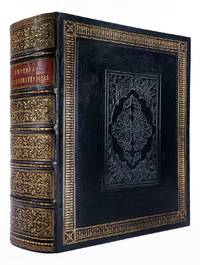
58936London: James S. Virtue c.1860. 2 volumes bound in one. Large folio 37x27x10 cm. Contemporary full black calf sides ruled with intricate gilt foliate borders and decorated with central gilt foliate design spine with raised bands and gilt-decorated compartments yellow-coated endpapers all edges gilt. 4 pages of partial used family register 41 steel engraved plates after John Martin et al. including 2 engraved titles 2 frontispieces and 2 hand-coloured maps. Occasional offsetting and light spotting some inevitable light shelfwear generally a most handsome and impressive Victorian Bible. An excellent example of a Victorian Bible this copy significantly larger and more impressive than usual. London: James S. Virtue, [c.1860]. hardcover
59110London Edinburgh and New York: A. Fullarton and Co. c.1860. Large thick folio 33x26x9 cm. Contemporary full black calf sides ruled with gilt-tooled border and stamped in blind spine with raised bands and richly gilt in compartments red morocco label marbled endpapers and edges. 1 leaf of used Family Register chromolithographed frontispiece 55 engraved plates. Light toning and occasional spotting mainly to plates binding rubbed and scuffed generally a very solid and attractive Victorian Bible. London, Edinburgh, and New York: A. Fullarton and Co. [c.1860]. hardcover
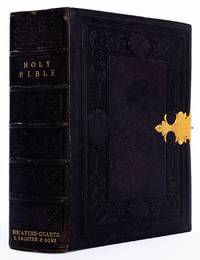
61071London: Samuel Bagster and Sons. c.1850-1860. 4to. 23.5 x 17.5 cm. pp. ii 50 2 1338 xxx 2. Contemporary full dark plum morocco with blind decoration and double blind fillet to boards spine with raised bands blindstamped in compartments lettered in gilt with brass clasp inner dentelles gilt all edges gilt. 13 engraved coloured maps 1 folding chronological chart. Minor rubbing to spine and corners contents clean and crisp. Generally an excellent example. London: Samuel Bagster and Sons. [c.1850-1860]. hardcover
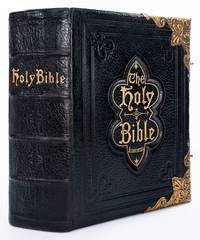
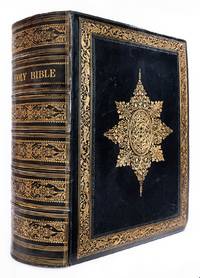
58356London c.1880. 4to. 32 x 24 cm. pp. 1216 34 60. Full contemporary black morocco upper cover decorated with recessed central title panel in gilt spine with raised bands gilt lettered title and blind stamped in compartments brass corners and clasps yellow-coated endpapers all edges gilt. Title-page printed in red and black. Bible followed by Biblical Cyclopaedia and Psalms of David. Chromolithographed title and four page register 31 additional full-page colour plates including coloured frontis. 6 maps and a chromolithograph of the Lord's Prayer. Light toning and occasional spotting throughout first blank slightly creased - generally a very good copy in a handsome binding. Rev. John Eadie: 1810-1876 [London, c.1880]. hardcover
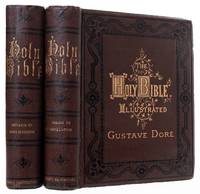
65840London Paris & New York: Cassell Petter & Galpin c.1875. 2 vols. Large 4to. 31 x 23.5 cm. Publisher's original decorative brown cloth gilt neatly rebacked preserving original spines renewed endpapers all edges gilt. Text in two columns. 220 full-page wood-engraved plates after Gustave Doré. Exteriors lightly rubbed corners a bit bruised some darkening to verso of frontispiece in each album final leaf of Vol.1 with restored partial loss to margin with some loss of text some occasional light spottinggenerally a very good set. "In the 1870s The Doré Bible was perhaps the most treasured and expensive book in the world" Malan 81. Certainly it proved a milestone in Doré's career. Doré's illustrations for the Bible first published in French in 1866 were a great success and in 1867 Doré had a major exhibition of his work in London which led to the founding of Doré Gallery in Bond Street London. Doré's "Bible was enthusiastically sponsored by one of the greatest French publishers of illustrated books of the day… Its original reception was truly remarkable… A second edition of the Bible was called for almost at once… Editions appeared in almost every European country… One of the first off the mark was an English edition from Cassell Petter and Galpin 1867. This caused an even greater sensation than the French edition and the demand among collectors for any and everything by Doré was clamorous" Muir 224. London, Paris & New York: Cassell, Petter & Galpin, [c.1875]. hardcover
1789101717Philadelphia: William Young 1790 i.e. 1789. First edition thus. 12mo. 816 pp. with separate New Testament title-page. Collation: A-2L¹². Contemporary sheep; covers worn with some loss to leather exposing boards front joint split and holding by one cord rear joint with old sewed repair contents toned and dust-soiled a few gatherings worn at fore-edge touching text U1 "Song of Solomon" torn and damaged with loss to text and old paper repairs FIRST EDITION OF THE SECOND ENGLISH BIBLE PRINTED IN THE UNITED STATES and the first English Bible printed after the adoption of the Constitution. It follows Robert Aitken's Bible published in Philadelphia 1781-2. Printing of Young's 12mo Bible which Hills states was advertised for use in schools was already underway when Aitken's 1789 application to Congress for an exclusive right to publish Bibles in America was rejected. Evans notes that "this edition was published in 1789 although dated 1790" and quotes from the publisher's advertisement: "this edition has two strong recommendations to preference it is cheaper than any imported edition; and it is composed entirely of American manufacture." Young followed with a 24mo edition with metrical psalms in 1790.Rare: ESTC locates three copiestwo at AAS NYPL. Complete and in its original binding.PROVENANCE: contemporary birth records on verso of New Testament title-page for Vannosdoll family; Catherine Pellar early ownership inscription on title-page REFERENCE: ESTC W4491; Evans 22345; Herbert 1348; Hills 25 24mo issue; Rumball-Petre America's First Bibles Appendix no. 13 "Second Protestant Bible in English"; Sabin 5168; not in Darlow and Moule William Young hardcover
1763306680Birmingham: John Baskerville Printer to the University 1763. The third variant of the Subscriber's list with the most names ending with that of the Hon. Charles York Esq Attorney General. 1146 pp. 1 vols. Folio. Bound in full dark blue straight-grained morocco covers tooled in gilt with wide Greek key and drawer handle border with floral cornerpieces narrow gilt filet-bordered rectangles tooled all over with drawer handle and sunburst tools and semé off small dots with central gilt-stamped L with crown spine with six double raised bands titled in one compartment stamped with owner's name "Frederic Powys" in another and the rest richly gilt a.e.g. pink endsheets by Staggemeier and Welcher with their circular pink paper label on front pastedown. Front joint and headcap with conservation repairs of the highest quality light foxing to text. The third variant of the Subscriber's list with the most names ending with that of the Hon. Charles York Esq Attorney General. 1146 pp. 1 vols. Folio. The 1763 edition of Baskerville's Bible has always been recognised as his masterpiece and is one of the high-points in the history of printing in Britain. This beautiful and monumental binding can be closely dated because Thomas Powys formerly MP for Northamptonshire was created Baron Lilford in 1797 and Staggemeier & Welcher are recorded in partnership on Villiers Street as of 1799. By 1810 Welcher was in business alone at that address. The Hon and Rev. Frederic Powys whose name appears on the spine was the third son of the first Lord Lilford; he married in 1807. Whether the binding was commissioned for his taking holy orders or on the occasion of his marriage can only be conjectured. A landmark of printing in a splendid binding. Nixon p. 184; Gaskell Bibliography of John Baskerville 26; Ramsden p. 135. Provenance: Frederic Powys his name tooled in gilt to spine Lilford Library booklabel John Baskerville, Printer to the University unknown
1724255482London O.T.; Oxford N.T.: Printed by John Baskett . 1724. Additional engraved title-page by Sturt with Imprint "Printed and Sold by Richard Ware at Ye Bible & Sun in Amen Corner"; 200 engravings on 50 plates engraved by J. Cole. 1 vols. 4to. Contemporary black gilt-panelled morocco Cambridge style. Covers worn and scuffed lower cover detached; text slightly darkened and well-thumbed but impressve and intact. Additional engraved title-page by Sturt with Imprint "Printed and Sold by Richard Ware at Ye Bible & Sun in Amen Corner"; 200 engravings on 50 plates engraved by J. Cole. 1 vols. 4to. Bound between THE BOOK OF COMMON PRAYER Baskett 1724 with engraved portrait of King George and additional engraved title-page of the series of 200 engravings by J. Cole and THE WHOLE BOOK OF PSALMS Baskett 1724. the latter water-stained toward the rear. Holy Bible: ESTC T89252 Herbert 970; The Historical Part of the Holy Bible: ESTC T94971; Book of Ccommon Prayer: ESTC N32783 Griffiths p.150; The Whole Book of Psalms: ESTC T89253 Printed by John Baskett .. unknown
185039772London: Eyre and Spottiswoode 1850. 2 vols. Thick 12mo 4-1/2 x 2-3/4 inches. Bound in full crimson red contemporary morocco heavily gilt all edges gilt. Fine in original full pebbled crimson morocco box. 2 vols. Thick 12mo 4-1/2 x 2-3/4 inches. The Book of Common Prayer is inscribed "Frances Mary Henrietta Hawkesworth from her affectionate Godfather Rich. S. Hawkesworth 27th August" 18 The year has been effaced. A beautiful set. Eyre and Spottiswoode unknown
197533966Stuttgart: Wurttembergische Bibelanstalt. Very Good. 1975. Second Revised Edition; First Printing. Hardcover. Very good with light spotting and wear to boards. Text in German. ; 8vo 8" - 9" tall; 1980 together pp . Wurttembergische Bibelanstalt hardcover
1788375629Worcester: Isaiah Thomas 1788. Numerous woodcut illustrations including full-page frontispiece. 144pp. 12mo. Modern calf red morocco lettering piece. Repair to final leaf affecting the final three lines frontispiece paper-backed with repaired tears and small area of loss in the image a few leaves likely supplied from another copy. Numerous woodcut illustrations including full-page frontispiece. 144pp. 12mo. A cornerstone for any collection of American children's books American illustration or American Bibles this classic children's book is an American reprinting of the edition first published by Hodgson in London in 1783. Containing nearly 500 illustrations it is the first Bible printed in the United States specifically for children. The rebus format of the small volume presents the young reader with famous Bible stories in an amusing format that encourages reading puzzle solving and Bible study.<br /> <br /> "A touchstone of eighteenth-century American book illustration this 'curious' children's Bible contains nearly five hundred woodcuts made by American artists. The most ambitious woodcut book produced in America up to that time it is one of the sixty-five children's book titles produced by the pioneer publisher of children's literature and preeminent early American printer Isaiah Thomas 1749-1831 who had learned the art of engraving while apprenticed in his youth to the Boston printer Zechariah Fowle" American Treasures of the Library of Congress online exhibition.<br /> <br /> Complete copies of the first hieroglyphic and children's Bible printed in America are very rare with even Brinley's copy lacking a leaf. This is a book that saw extremely heavy use and given its young audience inevitable if often loving misuse. Welch 510; Rosenbach 128; Evans 20961; O'Callaghan p.33; Hamilton 122; Rumball-Petre 167; Brinley 5805; Sabin 17990. Not in Hills Isaiah Thomas unknown
1557254216Basilaea Basel: Nicolaum Bryling Nicolaus Brylinger 1557. Woodcut border and printer's device on title. INCOMPLETE. 8 479 of 500 8 leaves. Lacking ff. 46-56 & 61-70. 1 vols. 8vo. Bound in contemporary blind panel-stamped pigskin over bevelled wooden boards clasps removed binding worn exposing boards on rear cover title page detached contemporary marginalia by Johannes Weneken throughout. Woodcut border and printer's device on title. INCOMPLETE. 8 479 of 500 8 leaves. Lacking ff. 46-56 & 61-70. 1 vols. 8vo. Brylinger published the only 16th century edition of Luther's Bible in Switzerland published one of the earliest Greek and Latin diglot Bibles and published a series of 8vo editions of the Bible with diglot and Greek-only text which was popular with students. Darlow & Moule makes no mention of this or any other Latin-only edition by Brylinger.<br /> Front paste-down endpaper and front free endpaper display extensive annotations in Greek and Latin presumably by Johannes Weneken. The marginal annotations provide a fascinating insight into how this book was used. Not in Darlow & Moule but cf. 4621; Adams 1056; OCLC: 46973017 6 copies only 3 of which in U.S. Nicolaum Bryling [Nicolaus Brylinger] unknown
1898301607Jelgawâ Mitau: J.W. Steffenhagena 1898. 16 frontispiece and family record pages vi 1120; iv 314 2 16 pp. 1 vols. 4to. Contemporary sheep cover with blind-ruled borders spine titled and decorated in gilt clasps. Covers rubbed gilt faded dampstain to lower margin of preliminaries paper toned and brittle with a some closed tears at margins. 16 frontispiece and family record pages vi 1120; iv 314 2 16 pp. 1 vols. 4to. OCLC: 1438105 1 copy Harvard University Divinity School; Darlow & Moule 6347 J.W. Steffenhagena unknown
1639255527Lugduni Batavorum i.e. Leiden: ex officina Elseviriorum 1639. First edition. 12 43 5 966 86 pp. Printer's device on title-page. Text in Greek and Latin. 1 vols. Folio. Contgemporary panelled calf skillfully rebacked preserving original backstrip later marbled endsheets corners restored rear joint cracked but sturdy minor staining to covers; internally apart from slight dampstaining to inner margins quite clean and crisp. First edition. 12 43 5 966 86 pp. Printer's device on title-page. Text in Greek and Latin. 1 vols. Folio. Heinsius' massive commentary on the New Testament and one of his major achievements. The second part Aristarchus Sacer is his commentary on the Gospel according to John first published by the Elzeviers in 1627 and here slightly revised and enlarged. ex officina Elseviriorum unknown
184233602Oxford: Oxford University Press 1842. 1 vols. Small 8vo 2 1/4" x 3 5/8" x 5/8". Full black pebbled morocco gilt lettered spine a.e.g. Signatures. Light rubbing to joints else fine. 1 vols. Small 8vo 2 1/4" x 3 5/8" x 5/8". <br/><br/> Oxford University Press unknown
1698255818Amsterdam: Ex Officina Westeniana 1698. 3rd Leusden edition. Additional engraved title-page and 2 folding engraved maps the Holy Land and the Mediterranean. 337 1. colophon; 142 1 pp. 8vo signatures alternating in 8s and 10s. 18th-century red morocco covers with gilt-rolled bordersgilt-tooled and -lettered spine multi-colored Dutch pastedowns without free endpapeers. a.e.g. Head of spine starting otherwise quite attractive. 3rd Leusden edition. Additional engraved title-page and 2 folding engraved maps the Holy Land and the Mediterranean. 337 1. colophon; 142 1 pp. 8vo signatures alternating in 8s and 10s. D & M doesn't mention the two fine engraved maps found in this copy; nor the separately printed COMPENDIOLUM 1699 with Leusden's useful concordance of all Greek words found in the New Testament. The Dutch Calvinist philologist Johann Leusden 1624 - 1699 was one of the foremost Biblical experts of his time. His edition of the Greek New Testament first appeared in 1675; this 1698 edition is quite scarce in the US and very rare with the Compendiolum. Darlow & Moule 4718a "Apparently the earlies Greek New Testament to bear the name of the publisher Henricus Wetstenius"; OCLC: 64158458 Ex Officina Westeniana unknown
1653255179Londoni: Excudebat Rogerus Daniel: prostat autem venale apud Joannem Martin & Jacobum Allestrye sub signo Campanae in Cometerio D. Pauli 1653. The first edition of the Septuagint printed in England. 8 1279 1; 186 2 pp. plus terminal blank. 1 vols. 4to signed in 8's 195 x 143mm. Old vellum titled and dated in manuscript on the spine. Terminal leaves slightly soiled two ownership inscriptions on front endsheets and small Lincoln's Inn release/sale stamp vellum a bit handsoiled occasional modest foxing and dusting along upper margins but a very good copy. The first edition of the Septuagint printed in England. 8 1279 1; 186 2 pp. plus terminal blank. 1 vols. 4to signed in 8's 195 x 143mm. The first edition of the Septuagint printed in England with the Scholia the scarce printing in quarto format. The text is derived from the Sixtine text and edited by John Biddle 1615-1662 the Unitarian controversialist who was imprisoned by the Parliamentary Commissioners for his religious views. <br /> The SCHOLIA . has a separate title-leaf register and pagination. The same setting was imposed in both quarto and octavo formats the latter with rules separating the columns of text. In regard to institutional representation the edition in quarto is much more uncommon than that in octavo: ESTC locates 4 copies of the quarto printing in North America as opposed to 19 of the octavo printing. Occasionally Daniel's reprint of the New Testament is bound up with the octavo printings to form a complete Bible. Brunet cites that format but notes the sale of a copy on "Gr. Pap." presumably a copy in this format. Over the last 35 years ABPC records sale of one copy in quarto 1999 and four in octavo. ESTC R12599 & R236817; Wing B2718 octavo edition only; Darlow & Moule 4692; Brunet I:863 Excudebat Rogerus Daniel: prostat autem venale apud Joannem Martin & Jacobum Allestrye, sub signo Campanae in Cometerio D. Pauli unknown
1480254000Ulm: Johann Zainer 1480. 293 of 296 leaves; lacking first 2 leaves of the Calendar and final blank. •6 ••8 a-x8 y12 z8 A-L8 M3. 1 vols. 8vo; 111 x 90 mm. Bound in 18th-century paper boards with remnant of morocco spine label edges stained red. Spine defective and covers rubbed but binding is sound; several leaves bear stubs at outer edge from former index tabs; first leaf of Psalter extended at inner margin; final two leaves slightly waterstained; some browning and occasional stains; text block seriously trimmed but never into text. Notes on front endpapers and a presentation inscription in 1826 from a member of the German Methodist Episcopal Church U.S. In a custom half-morocco slipcase and chemise. 293 of 296 leaves; lacking first 2 leaves of the Calendar and final blank. •6 ••8 a-x8 y12 z8 A-L8 M3. 1 vols. 8vo; 111 x 90 mm. Johann Zainer the Elder fl. 1472-93 established the first printing press at Ulm where his first book is dated 1473. This pocket psalter by Zainer is undated; the colophon gives only the printer's name and the city in which it was printed. ISTC gives a conjectural date of around 1480. <br /> <br /> The book's handy but fragile format a thick octavo that would have been easily portable for late fifteenth-century users doubtless guaranteed a low survival rate. Indeed the few copies which have survived are often incomplete fragments or in poor condition.<br /> <br /> ISTC gives the following locations: France: Strasbourg BNU imperfect wanting Commune sanctorum; Germany: Bamberg SB; Berlin SB; Fulda HLB; Leipzig DB/Buch fragment missing; München BSB 2 imperfect; Stuttgart WLB 3; U.S.A: Washington DC Washington Cathedral Library this copy<br /> <br /> The present copy - the only copy in America - is complete save for the first two leaves of the Calendar and the blank leaf at the end. Goff Suppl. P1041a; H 13475; C 4927; GW M36206; ISTC No.: ip01041500 Johann Zainer unknown
1802373649Boston: Printed by Thomas Fleet 1802. The tenth American thumb Bible. Separate title pages to each work. With three wood or metal cuts in N.T. 1013-160; vi 107 2 ii-iv iv pp. 1 vols. Miniature 2-1/16 x 3-1/4 inches in 12s. Dappled tan pastepaper over wooden boards. Leaf A1 in OT supplied and remargined. The tenth American thumb Bible. Separate title pages to each work. With three wood or metal cuts in N.T. 1013-160; vi 107 2 ii-iv iv pp. 1 vols. Miniature 2-1/16 x 3-1/4 inches in 12s. A splendid copy of the miniature Bible printed by Thomas Fleet in 1801-2 the tenth American thumb Bible. The text is a paraphrase of the Old and New Testaments by John Taylor 1578-1653 known as the Water Poet; the earliest surviving edition of which was printed in London in 1614. In America five editions were printed in the 1760s and four more between 1786 and 1799. All are rare and survive in just a few copies. After about 1810 the number of thumb Bibles and the variousness of their titles and imprints increased markedly.<br /> <br /> The Fleet thumb Bible is two volumes bound as one each with a separate dated title page. Following the New Testament are Prayers for Morning and Prayers for Evening.<br /> <br /> There are four other recorded copies of this book: at the Morgan Library PML81221 lacking all half title and titles and other leaves; at AAS the Welch Stone copy lacking the half title and six pages of the Old Testament; at the Boston Public library rebound; and at the Lilly Library bibliographer Ruth Adomeit's copy in the original binding lacking the first leaf.<br /> <br /> A gorgeous copy in original binding. Shaw & Shoemaker 1383; Welch 1293.10; Adomeit A10 Printed by Thomas Fleet unknown
135775aafLausanne, Chez Henri Vincent, M. DCC. XC., 1790, in-8vo, IV + 681 p., manuscrit sur p. de garde: „Ce Testament appartient à Louise Marguerite Cathrine Cornaz de Faoug. Dieu lui fasse la grace d’en faire un profit salutaire Amen. Fait ce 17e Décembre 1794“. reliure en plein-cuir, dos à nerfs avec pièce de titre, coiffe sup. touchée, traces d’usage.
169718733Regensburg: C. Weigel 1697. Hardcover. Very good-. Four volumes small quarto 19.7 by 14.8 cm. Captions in Latin biblical book and chapter and German biblical book chapter and verses with quote. Copperplate engravings throughout: 1 title 175 plates; 1 title 225 plates; 1 title 288 plates; 148 plates. Total = 836 unnumbered plates 3 engraved title pages. Uniformly bound in contemporary sheep with ruled borders; spines with raised bands blindstamped ornaments and letterpress titles on heavy paper labels. Lacks fourth volume title page. Covers rubbed/lightly worn at extremities; slight loss to labels; light almost exclusively marginal foxing throughout all volumes; dampstains in first volume affecting first seven plates and top margin through first third of the volume else a very good copy with clean plates.<br /> <br /> Second printing of this pictorial Bible Bilderbibel published by the engraver and art dealer Christoph Weigel 1654-1725. The grand biblical story from the Seven Days of Creation to the Vision of a New Jerusalem here unfolds in 836 beautifully engraved plates. The designs were chiefly drawn by Johann Jacob von Sandrart 1655-1698 and Georg Christoph Eimmart the Younger 1638-1705. The engravings were made by Elias Christian Heiss J. U. Kraus L. Heckenauer and Weigel himself among others. Weigel had earlier collaborated with J. J. von Sandrart on the Passio Domini Nostri Iesu Christi Neo-coelatis Iconibus Expressa Augsburg 1693 a pictorial Gospel harmony depicted in 100 engraved plates.<br /> <br /> Christoph Weigel first trained as a goldsmith and later apprenticed to his cousin Erhart Weigel a famous instrument maker in Jena. He journeyed to Augsburg in 1693 where he learned the art of engraving from Andreas Wolfgang and later from Matthäus Küsel. His published works tended to serve didactic and edification purposes including illustrated chronicles and a compendium of notable political events of the early eighteenth century. Among his notable cartographic works is the Descriptio orbis antiqui in XLIV tabulis exhibita A Description of the Ancient World in 44 Maps - Nürnberg 1720. <br /> <br /> The Biblia Ectypa was first published in a large folio format at Augsburg in 1695 with four engraved plates appearing on each leaf. In 1697 the plates were re-issued at Regensburg in two formats: a smaller oblong folio with two plates per leaf and a quarto with a single plate per leaf. Wildly successful the Biblia Ectypa enabled Weigel to establish his own print publishing company in Nürnberg where he was soon joined by his younger brother Johann Christoph Weigel and worked closely with the prominent map publisher Johann Baptist Homann.<br /> <br /> Annotations: Plates numbered by hand in black ink at top corner though sometimes slightly out of order with occasional corrrections in the first two volumes. An old German hand has noted a correct count for each volume at the rear endleaf e.g. Enthält 288 Küpfern.<br /> <br /> A notably complete set of this uncommon edition lacking only the fourth title page. The total count of 836 engraved illustrations is confirmed via the online catalogue Das Verzeichnis der im deutschen Sprachraum erschienenen Drucke des 17. Jahrhunderts VD17. References: Paul Johannes Rée "Weigel Christoph" in: Allgemeine Deutsche Biographie 41 1896 pp. 464-465 Online-Version; Thieme-Becker XXV 227-228; VD17 23:659088P vol. 1; 23:659089W vol. 2; 23:659091S vol. 3; 23:659092Z vol. 4. C. Weigel hardcover
162718927Frankfurt: Matthaeus Merian 1627. First edition. Hardcover. Very good. Matthaeus Merian. Oblong folio leaves: 20.6 by 31.2 cm; plates: 10 to 11.5 by 14.5 to 15.5 cm. Engraved titlepage borders without letterpress; 231 of 233 engraved plates printed on the rectos with no printed text depicting biblical scenes from the Old and New Testaments lacks Gen. XIX: Lot and his daughters after the destruction of Sodom and Gomorrah; Exod. VIII & IX: The plague of frogs. Recent marbled calf lightly rubbed at extremities bordered in blind; gilt-tooled spine with raised bands gilt lettering pieces. Occasional light stains and smudges especially at the outermost leaves and almost entirely restricted to the blank margins; old mostly marginal repairs and reinforcement of tears to about 30 leaves Matt. IV plate with loss of about 10 words of manuscript text. Protected by wide margins the plates are clean fresh and bright with relatively few minor blemishes. Housed and protected in a custom luxurious modern leather clamshell box.<br /> <br /> Rare suite of biblical illustrations printed before letter perhaps as proofs comprising 231 of 233 engraved plates from the Icones Biblicae of Matthaeus Merian the elder 1593-1650. The engravings are printed on large paper and lack any printed text. They are preceded by a leaf of the engraved title borders to the first part in which the central cartouche which would have contained a letterpress title and imprint is here blank. Neat manuscript annotations appear throughout: atop each engraving is a brief title along with a notation of the biblical book and chapters; beneath each engraving are six-lines of rhyming verse in German; at the top corners are leaf numbers in Arabic numerals. All are penned in black ink in the same old cursive German hand. The engraved title leaf is not included in the manuscript foliation. The first three leaf numbers and several others among the first 23 leaves are obscured by wear or later marginal repairs. The foliation ends at leaf 233 and is discontinuous where one would expect to find numbers 15 and 38 corresponding to the missing plates noted above. As noted by Wütrich only four of the 233 plates are signed by Merian all in the New Testament series. Each of these signed plates appears in our suite: Matthaei I. - page 7; Johannis VIII. - page 65; Matthaei XXVII. - page 101; Apocalyps. IX. - page 145 header titles and page numbers from the first edition.<br /> <br /> The first editions were published at Frankfurt in four parts between 1625 and 1627. The Pentateuch series was published in 1625. The second part illustrating the Old Testament books from Joshua to Kings appeared in 1626. These first two series were published under the name of Merian's father-in-law the printer and bookseller Johann Theodor de Bry 1561-1623 whose heirs retained title to the business. The third part illustrates the remainder of the Old Testament and Apocrypha; the fourth the New Testament. These last two parts were published in 1627 under the engravers's own name. Verses in Latin German and French accompany each plate in the three Old Testament series the French verses being omitted in the 1627 New Testament series.<br /> <br /> While the eminent Swiss draughtsman and engraver Matthaeus Merian is best known for his topographical depictions of the German speaking lands which appeared in the Theatrum Europaeum his novel selection of biblical stories and innovative stylistic approach revealed in the present series of plates proved highly influential ushering in a new age of copperplate engraving in Bible illustration. Merian broke with the century-long tradition of woodcuts which had accompanied countless editions of Luther's German Bible. Even as he drew on the Bible illustrations of Jost Amman Hans Holbein Virgil Solis and Tobias Stimmer Merian greatly expanded the traditional iconographic and compositional repertoire. The Old Testament alone contains 23 prints depicting stories that had never before been the subject of an engraver. While earlier New Testament woodcuts focused on the Book of Revelation Merian now provided a rich series of plates to illustrate the Gospels and Acts of the Apostles as well.<br /> <br /> Merian had an obvious preference for crowd scenes and battles along with some of the novelistic features of the Old Testament such as Jacob's lentil dish Solomon and Shulamit in the Song of Songs or the apocryphal story of the Dragon in Babylon. Merian sometimes provides local color from his home town of Basel as in his depiction of Solomon's Temple Consecration in which despite the baroque redesign the Basel Cathedral with the old choir is easily recognizable. The costumes and gestures of Merian's biblical characters display a baroque fantasy of the ancient Near East as reflected in the theater of his day; in depicting cities and buildings however Merian generally prefers to follow contemporary models. In individual cases such as Bathsheba's Bath he succumbed to the temptation as an engraver and artist to show off his skills in a magnificent fashionable palace and garden complex. All-in-all Merian's engravings initiated a development in Bible illustration "that led further and further away from the didactic Reformation purpose of Bible pictures to purely artistic-representational purposes and finally ended in the well-known pathos of the German Romantic Nazarenes" Schmidt.<br /> <br /> In the first few decades after their appearance these Bible plates were widely copied throughout Europe especially in the Netherlands and France Poortman. The first folio Bible to use Merian's copper plates to illustrate the text was published by the heirs of Lazarus Zetzner at Strasbourg in 1630. Subsequent editions of the "Merian Bible" were published at Frankfurt where Merian had taken over his father-in-law Johann de Bry's business. For over a century as Merian's heirs continued to publish new editions this would become "the most widespread German illustrated Bible in southern Germany Basel and Alsace primarily in wealthy households" Schmidt. After the demise of the Merian publishing house in 1727 the bookseller Philip Heinrich Hütter acquired the copper plates which he used to illustrate a Catholic Bible edition published at Frankfurt in 1740 Poortman.<br /> <br /> A very notable instance of transposing Merian's biblical engravings into another context occurs in the famous and oft-reprinted Amsterdam Haggadah the ritual for the Jewish Passover meal first published in 1695. The engravings were made by Abraham ben Jacob a former Protestant preacher who converted to Judaism. Introducing skills he had earlier acquired when working outside the Jewish community Abraham ben Jacob "widened the scope of Jewish book illustration" Rosenau and introduced new elements into the traditional iconography of the Haggadah. "He chose many of the same incidental scenes as had appeared in the Venice Haggadot 1599-1604 but he drew them afresh basing his work on the biblical pictures in the Icones Biblicae by Matthew Merian" EJ. Among them was the image of the Temple of Solomon in Jerusalem. As Merian used a wide variety of prototypes Rosenau suggests that the two free-standing columns Jachin and Boaz depicted at the front porch of the Temple in Merian's engraving and Abraham ben Jacob's adaptation may have ultimately been derived from the woodcuts which accompany Estienne's Bible Paris 1540 based upon the scholarship of Franciscus Vatablus.<br /> <br /> In Das druckgraphische Werk von Matthaeus Merian d. Ae. 1993 L. H. Wüthrich describes a "Spezialausgabe ohne Drucktext" complete with 233 biblical engravings located in Darmstadt at the Hessische Landesbibliothek 31/643. This "separate edition without text or a series of proofs" which he describes has three notable features: 1 an undated first edition title page of the second part Pars II of the Old Testament which has been "corrected. by crossing out or shaving" to read "Pars I"; 2 the first edition title page of the New Testament series dated 1627; 3 an engraving of the The Fall of Man probably after Johann Theodor de Bry which later appears in Gottfried's Chronicle part 1 1629/1630 but which differs from that found in most copies of the first edition Wütrich 1a. The copies containing this plate after de Bry Wütrich 1aa. were likely printed in 1626. Further research perhaps locates only one other suite of Merian plates without text at the Herzog August Bibliothek Wolfenbüttel catalogued under two call numbers: the Old Testament series dated 1626-1627 comprising 157 leaves including an engraved title A: 30.1 Geom. 2 "Ausg. ohne Text von Ps. 1 und 2." = VD17 23:289608V and the New Testament series dated 1627 comprising 78 leaves including an engraved title A: 30.1 Geom. 3 "Ausg. ohne Text" = VD17 23:655618H. The catalogue entry for the Old Testament series references Wütrich's "Spezialausgabe ohne Drucktext." Surprisingly the key images provided for this entry illustrate the same three notable features of the "Spezialiausgabe" which Wütrich located at Darmstadt !. Our suite of plates is provided with a single blank engraved title leaf the one used for the first series of the Old Testament plates which lacks any letterpress. The third plate which depicts the Fall of Man is here in Merian's style and is the image more commonly found in the first printings Wütrich 1a.<br /> <br /> In the first edition of the Icones Biblicae the title page notes "Mit Versen und Reymen in dreien Sprachen geziert und erkläret Durch Johann Ludwig Gottfried" decorated and described with verses and rhymes in three languages by Johann Ludwig Gottfried. In the first three parts of Icones Biblicae Gottfried's German verses are in four lines with a rhyme scheme of ABBA. In the fourth part the New Testament the German verses are modified to six lines with a rhyme scheme of AABCCB. The manuscript verses in German which accompany each of the 231 plates in our suite differ from both of these formats being composed in six lines of iambic hexameter with a rhyme scheme of ABABCC. To give a sense of how these versions differ the four lines of the German printed verses which accompany the first plate The Creation may be compared with the following transcript of the written verses which describe this scene in our set.<br /> <br /> in the first edition of Merian's Bilderbibel<br /> <br /> Im Anfang Gott Erschuff den Himmel und die Erden<br /> Die Wasser und das Meer das Liecht der Sternenschein<br /> Die Vögel Fisch Gewürm alle Thier groß und klein<br /> Warauß sein Gütigkeit und Kraft erkant mag werden.<br /> <br /> the hand of anonymous versifier<br /> <br /> Im Anfang schuff der Herr den Himmel und die Erden<br /> Das Licht die Sonn den Mond die Sternen und das Meer<br /> Gras Bäume Laub und Kraut und was genannt mag werden<br /> Von Thieren Vögel Fisch in ihrem grosen Heer<br /> Nur durch ein einig Wort: Ich kan hieraus erkennen<br /> O Gott! dein ew'ge Krafft und dich den Schöpffer nennen.<br /> <br /> Watermark: flambeau surrounded by garland<br /> <br /> Provenance: laid-in typed description on a half-sheet bearing the early twentieth-century letterhead of Harry A. Levinson Rare Books: "There appears to be no record of another such copy of proofs before letter." References: L. H. Wüthrich Das druckgraphische Werk von Mattaeus Merian d. Ae. Basel: Bärenreiter 1993 vol. 3 p.16: "Spezialausgabe ohne Drucktext;" Enc. Jud. 2nd ed. 8:215; W. C. Poortman Bijbel en Prent 's-Gravenhage 1986 2:56-59; H. Rosenau Vision of the Temple London: Oresko 1979 pp. 135; 146f. Ph. Schmidt Die Illustration der Lutherbibel Birsfelden/Basel 1977 pp. 304-329; VD17 23:289608V and 23:655618H. [Matthaeus Merian] hardcover
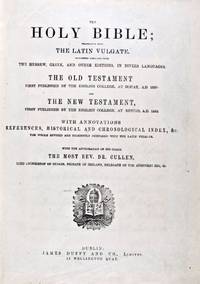
186530602Dublin: James Duffy & Co 1865. Later edition. Hardcover. g to g. Large quarto. 2 764 222pp. Finely gold-stamped and gold-tooled contemporary black leather. All gilt edges. Striking fore edge painting of landscape with antique church complex. Silk-moire endpapers. Handwritten family registry in front. Frontispiece of Old Testament reproduction of a painting in monochrome by W. & A. K. Johnston. Frontispiece engraving in New Testament. "This New Edition of the English Version of the Bible printed with our permission by James Duffy.carefully collated by our direction with the Clementine Vulgate; likewise with the Douay Version of the Old Testament of 1609 and with the Rhemisch Version of the New Testament of 1582 and with other approved English Versions." Illustrated with 12 full-page monochrome plates in sepia-tone 2 full-page engravings as well as many b/w in-text illustrations. Some age wear and staining on binding. Wear along front joints and corners. Gutters at front and rear endpapers reinforced with fine red cloth band. Inscription on blank leaf following front endpaper: "Gift from Stephanie to Tom on the eve of their marriage October 3rd 1983." Sporadic foxing throughout. Overall good condition. James Duffy & Co hardcover
172654199Berlenburg: n.p. 1726. First edition. Hardcover. Good. Six volumes of eight folio published between 1726 and 1737. All volumes with letterpress title page; sectional half titles; woodcut headpieces; engraved frontispiece often not present in first volume. Text in two columns. Contemporary mottled calf rubbed and chafed. Spines with raised bands elaborately tooled in gilt gilt morocco and vellum lettering pieces; edges tinted red; marbled endleaves. Spine ends worn. Occasional mild embrowning. A good sturdily bound set with clean crisp text.<br /> <br /> Vol. 1 1726: 12 804 pp; engraved frontispiece - Vol. 2 1728: 8 880 pp. - Vol. 3 1730: 8; 784 pp. - Vol. 4 1732: 6 858 pp. - Vol. 5 1735: 8 820 pp. - Vol. 6 1737: 8 792 pp. <br /> <br /> First edition of this rigorous revision of Luther's version in the spirit of mystical Pietism edited by Johann Heinrich Haug d. 1753 and other scholars as is reflected in the main title: Welchem allem noch untermängt Eine Erklärung die den inneren Zustand des geistlichen Lebens oder die Wege und Wirckungen Gottes in der Seelen zu deren Reinigung Erleuchtung und Vereinigung mit Ihm zu erkennen gibt. Underlying everything is an explanation that reveals the inner state of the spiritual life or the ways and effects of God in in souls for their purification enlightenment and union with Him. A theologian and orientalist Haug was expelled from Strasburg for holding an assembly of Philadelphians and other mystic Separatists. He fled to the castle of Casimir Graf von Sayn-Wittgenstein-Berlenburg which had become a refuge for radical pietiests. Remaining there until his death Haug directed a Philadelphian organization that extended throughout western Germany. "He is said to have been a man of great piety and charming personality and was regarded by Count Casimer as a prophet of God" Schaff-Herzog. <br /> <br /> "The new spirit of mystical Pietism. was fully revealed in the Marburg Bible 1712. The interpretation of type and prophecy in this follows the federal theology of Cocceius that of Canticles and Revelation Madame Guyon. It was the forerunner of a larger work in the same spirit the Berleburg Bible of 1726-42. projected and prepared chiefly by Johann Heinrich Haug. The text is a revision of Luther's with comparison of the English and French versions; the commentary reflects the views of the Philadelphian communities and quotes the mystical books current among them especially Madame Guyon's but its teaching goes back beyond Dippel and Petersen to Jakob Böhme or even to Origen in some points. It lacks unity of belief and of treatment; it is the work not of a single mystic giving voice to his inner convictions but of a propagandist sect with radical tendencies. It is not without value however from different points of view; it edifies by its continual application of Scriptural works to the spiritual life and it prepares the way for historical criticism by an appendix containing apocrypha Old and New Testament pseudepigrapha and postapostolic writings." Schaff-Herzog. Christopher Sauer the agent for the sale of the Berlenburg Bible in the United States used the text as a model for the first German-American Bible 1743.<br /> <br /> Provenance: Bookplates of Library of Union Biblical Seminary Bishop Mills Estate; entries at front endleaf "Bequeathed by Bishop J. S. Mills to Bonebrake Seminary. 1909." References: D&M 4239. Jackson S. M. ed. The New Schaff-Herzog Encyclopedia of Religious Knowledge 1908 vol. 2 p. 157; vol. 5 p. 170.<br /> <br /> Lacks Volume 7 Epistles to the Hebrews; Jacob; Peter 2; John 3; Judah; Revelation; Wisdom of Solomon; Jesus ben Sirach - Volume 8 Appendix Old and New Testament Apocrypha pseudepigrapha and post-apostolic writings.<br /> <br /> Main title and imprint vol. 1: Die Heilige Schrift Altes und Neues Testaments nach dem Grund-Text aufs neue übersehen und übersetzet: Nebst Einiger Erklärung des buchstäblichen Sinnes Wie auch der fürnehmsten Fürbildern und Weissagungen von Christo und seinem Reich und zugleich Einigen Lehren die auf den Zustand der Kirchen in unseren letzten Zeiten gerichtet sind; Welchem allem noch untermängt Eine Erklärung die den inneren Zustand des geistlichen Lebens oder die Wege und Wirckungen GOttes in der Seelen zu deren Reinigung Erleuchtung und Vereinigung mit Ihm zu erkennen gibt. Gedruckt zu Berlenburg im Jahr unsers Erlösers und Ursprungs der heiligen Schrifft JEsu Christi. [n.p.] hardcover
172654196Berlenburg: n.p. 1726. First edition. Hardcover. Good. Eight volumes bound in four folio published between 1726 and 1742. All volumes with letterpress title page; sectional half titles; woodcut headpieces. Vol. 1 engraved frontispiece often not present here precedes vol. 7; appropriate engraved title leaves have been supplied from another German bible edition and inserted in vols. 1 3 4 and 5. Text in two columns. Contemporary calf over beveled wooden boards ruled in blind; spines with raised bands gilt morocco lettering pieces paper labels; marbled edges. Catches and clasps perished. Slight remains of paper labels. One volume with vertical crack through center of upper board else covers sound worn at extremities especially spine ends. Text with variable mild embrowning and light foxing occasional mild dampstains but overall clean. A good set complete and sturdily bound.<br /> <br /> Vol. 1 1726: 12 804 pp. - Vol. 2 1728: 8 880 pp. - Vol. 3 1730: 8; 784 pp. - Vol. 4 1732: 6 858 pp. - Vol. 5 1735: 8 820 pp. - Vol. 6 1737: 8 792 - Vol. 7 1739: 8 600 pp. - Vol. 8 1742: 4 556 44 index pp. with letterpress half-title: Der Berlenburgischen Bible Achter und Letzter Theil.<br /> <br /> First edition of this rigorous revision of Luther's version in the spirit of mystical Pietism edited by Johann Heinrich Haug d. 1753 and other scholars as is reflected in the main title: Welchem allem noch untermängt Eine Erklärung die den inneren Zustand des geistlichen Lebens oder die Wege und Wirckungen Gottes in der Seelen zu deren Reinigung Erleuchtung und Vereinigung mit Ihm zu erkennen gibt. Underlying everything is an explanation that reveals the inner state of the spiritual life or the ways and effects of God in in souls for their purification enlightenment and union with Him. A theologian and orientalist Haug was expelled from Strasburg for holding an assembly of Philadelphians and other mystic Separatists. He fled to the castle of Casimir Graf von Sayn-Wittgenstein-Berlenburg which had become a refuge for radical pietiests. Remaining there until his death Haug directed a Philadelphian organization that extended throughout western Germany. "He is said to have been a man of great piety and charming personality and was regarded by Count Casimer as a prophet of God" Schaff-Herzog. <br /> <br /> "The new spirit of mystical Pietism. was fully revealed in the Marburg Bible 1712. The interpretation of type and prophecy in this follows the federal theology of Cocceius that of Canticles and Revelation Madame Guyon. It was the forerunner of a larger work in the same spirit the Berleburg Bible of 1726-42. projected and prepared chiefly by Johann Heinrich Haug. The text is a revision of Luther's with comparison of the English and French versions; the commentary reflects the views of the Philadelphian communities and quotes the mystical books current among them especially Madame Guyon's but its teaching goes back beyond Dippel and Petersen to Jakob Böhme or even to Origen in some points. It lacks unity of belief and of treatment; it is the work not of a single mystic giving voice to his inner convictions but of a propagandist sect with radical tendencies. It is not without value however from different points of view; it edifies by its continual application of Scriptural works to the spiritual life and it prepares the way for historical criticism by an appendix vol. 8 containing apocrypha Old and New Testament pseudepigrapha and postapostolic writings." Schaff-Herzog. Christopher Sauer the agent for the sale of the Berlenburg Bible in the United States used the text as a model for the first German-American Bible 1743.<br /> <br /> Provenance: Bookplates of United Brethren Historical Society Dayton Ohio. D&M 4239. Jackson S. M. ed. The New Schaff-Herzog Encyclopedia of Religious Knowledge 1908 vol. 2 p. 157; vol. 5 p. 170.<br /> <br /> Main title and imprint vol. 1: Die Heilige Schrift Altes und Neues Testaments nach dem Grund-Text aufs neue übersehen und übersetzet: Nebst Einiger Erklärung des buchstäblichen Sinnes Wie auch der fürnehmsten Fürbildern und Weissagungen von Christo und seinem Reich und zugleich Einigen Lehren die auf den Zustand der Kirchen in unseren letzten Zeiten gerichtet sind; Welchem allem noch untermängt Eine Erklärung die den inneren Zustand des geistlichen Lebens oder die Wege und Wirckungen GOttes in der Seelen zu deren Reinigung Erleuchtung und Vereinigung mit Ihm zu erkennen gibt. Gedruckt zu Berlenburg im Jahr unsers Erlösers und Ursprungs der heiligen Schrifft JEsu Christi. [n.p.] hardcover