GERNING, BARON JOHANN ISAAC VONBiblio.com

29 610 résultats
1820ST12078London: R. Ackermann 1820. First Edition in English First Issue. ONE OF 50 LARGE PAPER COPIES. 422 x 324 mm. 16 5/8 x 12 3/4". sheets 407 x 318 mm. 16 x 12 1/2". xiv ii 178 pp.Translated from the German by John Black. <br/> Excellent contemporary red half morocco over marbled boards by Charles Hering stamp-signed on verso of front free endpaper newly rebacked and recornered to style by Courtland Benson wide raised bands and panels attractively gilt in scrolling designs gilt titling all edges gilt. 24 HAND-COLORED PLATES OF THE RHINE plus one folding map taken from the drawings of Christian Georg Schütz and engraved by Sutherland Havell and Bartlett. A Large Paper Copy. Front pastedown with armorial bookplate of "R G V"; front free endpaper with evidence of bookplate removal. Abbey "Travel" I 217; Tooley 234. ◆Offsetting onto tissue guards indicating that they have done their job one tissue guard missing but no offsetting onto text in this case isolated trivial thumbing foxing or rust spots but A FINE AND ESPECIALLY DESIRABLE COPY the beautifully restored binding unworn the text and plates with only the most minor imperfections and the margins of this special copy remarkably broad.<br/> <br/> This is one of Ackermann's major color plate books and apparently the first in his "Picturesque Tours" series others of which explore the Seine the Ganges and the Thames. The book describes a trip down the Rhine on that part of the river generally considered most romantic and charming. The account contains not only topographical descriptions but considerable historical information and details of popular traditions. The tone is frankly advocative the book being written "with a view chiefly to the information of travellers of cultivated minds who may be induced to visit this interesting portion of Germany." The main appeal of the book for us today of course resides in its spacious and richly colored plates. The irresistibly scenic views seem to justify the book's claim that the region depicted is "a portion of heaven fallen down to earth." Our plates are early impressions and as in other contexts size matters here: the sheets in our volume are 407 mm. tall appreciably larger than most of the copies seen in auction records which measure on average approximately 330 mm. Abbey's untrimmed copy measured 425 mm. and a Large Paper Copy sold at Sotheby's in 2007 had sheets 402 mm. tall. As the limitation would indicate copies on Large Paper are very uncommonly seen and our copy is beautiful with especially well-preserved text and plates and an exceedingly handsome replica spine. R. Ackermann unknown
182729764Philadelphia: H.C. Carey & I. Lea 1827. Folio. Mounted on guards throughout. Letterpress title copyright notice on verso 1p. "Advertisement" to Third Edition dated "January 1827" verso blank 1p. "Contents" and "Index" verso blank plus forty-six double-page handcolored copper engraved maps most with descriptive letterpress in margins and many with supplementary text pages following; one double-page engraved plate of mountains uncolored; and one double-page colored plate of river lengths. Titlepage remargined minor foxing some faint staining along bottom edge. Later 19th-century three-quarter calf and original plain paper boards later gilt morocco label. Boards slightly rubbed.<br/> <br/>One of the most important early atlases printed in the United States: a handsome atlas of the Americas with individual colour maps of each state in the Union including a seminal map of the West by Stephen H. Long.<br/> <br/>At the time of publication this was the best and most detailed atlas to be produced in the United States. Fielding Lucas the major Baltimore printer was the principal engraver and substantial historical background text accompanies each map. Among the most noted maps in the atlas is Major Stephen H. Long's "Map of Arkansa and other Territories of the United States." That map which depicts the Missouri basin between Nashville in the east the Mandan villages in the north and the Rocky Mountains in the west was based on the surveys conducted by Long on his expeditions of 1819 and 1820. On this famous map is the printed legend which would perpetuate a myth for many years to come identifying the high plains as the "Great American Desert." The 1827 edition "Third edition Corrected and Improved" of Carey & Lea's historic atlas first published in 1822 includes much new material with all the maps and text updated except for the Washington D.C. and Michigan maps. This was the first American atlas that was modeled on Le Sage's plan of having explanatory text surrounding the maps. The maps for the most part by Fielding Lucas are beautifully drawn and colored.<br/> <br/>Howes C133 "aa"; Phillips 1373a; Sabin 15055; Wheat Transmississippi West 348 and 352. H.C. Carey & I. Lea unknown books
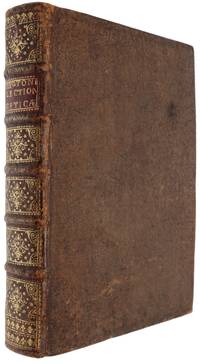
17296375London: William Innys for the Royal Society 1729. First edition. <p>First edition in the original Latin of Newton's Cambridge lectures on optics-his earliest systematic exposition of the mathematical theory of light and colour delivered as Lucasian Professor and published here for the first time from his manuscripts. These lectures form the foundation of Newton's later Opticks 1704 but include substantial mathematical content omitted from that more accessible English version. Notably they contain Newton's formulation of the compound nature of white light a cornerstone of modern optical theory.</p>. <p>EDITIO PRINCEPS OF NEWTON'S CAMBRIDGE LECTURES ON OPTICS</p> . <p>First edition of the complete text in the original Latin of Newton's inaugural lectures as the second Lucasian professor of mathematics at Cambridge and the first publication of his lectures on his new mathematical science of colour including his discovery of the compound nature of white light. It was from this material that Newton composed his Opticks of 1704 although in the Opticks he left out the specifically mathematical parts of the lectures which are included here. Newton "was obliged by the statutes of the post to lecture and to deposit the lectures in the University Library. For the period 1670-72 Newton lectured on optics and deposited the lectures in the ULC in October 1674. At one time Newton seemed to be contemplating publishing the lectures together with the mathematical work De methodis but by May 1672 he had decided otherwise and wrote to Collins: 'I have now determined otherwise of them; finding already by the little use I have made of the Presse that I shall not enjoy my former serene liberty till I have done with it' Correspondence I p 161. Consequently . the lectures remained unpublished until after his death as did the De methodis" Gjertsen pp. 409-410. Following Newton's death in March 1727 his followers decided to publish the lectures both in the original Latin and in English. In fact only Part I on the mathematical theory of reflection and refraction was translated and published in English in 1728; part II on colours was omitted. The present Latin edition which includes both parts is thus the editio princeps of the complete series of Newton's lectures including the first publication of his lectures on colours. Based on a copy belonging to David Gregory it was discovered during the printing that there were discrepancies between Gregory's copy and the copy deposited by Newton in the ULC which necessitated the inclusion of a five-page 'Addenda and Corrigenda'. "Today we can appreciate the Lectiones as an invaluable document of Newton's investigations of optics that reveals his ideas in the midst of his most productive period of research. In the inevitable comparison with the Opticks 1704 which recounts research for the most part carried out twenty to thirty years earlier and since refined - sometimes overrefined - the lectures must be judged neither as carefully developed nor as polished. But whatever polish it may lack is more than compensated for by its vitality as Newton boldly attempts in the following pages to create a new mathematical science of color" Shapiro p. 25. Since the Lectiones "was his first and most comprehensive account of his theory of color he naturally drew upon it in his later writings. It served as the immediate source for his 'New theory of light and colors' 1672 in the Philosophical Transactions his first public statement of his theory outside the Cambridge lecture halls. And twenty years later it remained the foundation for the 'definitive' statement of his theory in Book I of the Opticks" ibid. p. 1. This was the only separate edition of Newton's complete lectures: the text was published six more times in the eighteenth century in various collections of Newton's works.</p> <br /> <p>Provenance: 'Ex-libris Dutour' on front free endpaper followed by a price; some marginal notes in Latin.</p> <br /> <p>"Upon his appointment as Isaac Barrow's successor to the Lucasian chair in the late autumn of 1669 Newton was confronted with developing a series of lectures to begin the following January. In a natural extension to Barrow's prior series of optical lectures published as Lectiones XVIII 1669 he took the opportunity to make the first formal presentation of his new mathematical science of color. The Lucasian Professor was required to give one lecture for about one hour each week during the term and to submit annually not fewer than ten of those lectures to the Vice-Chancellor for deposit in the University Library for public use. Newton complied with this regulation somewhat tardily in October 1674 when he delivered to the Vice-Chancellor his Optica divided into two parts with a total of thirty-one lectures. According to the marginal annotations the first lecture of Part I was delivered in January 1670 at the beginning of Lent term and Lecture 9 of Part I and Lectures 4 and 14 of Part II opened the Michaelmas terms beginning in October of 1670 1671 and 1672" Shapiro p. 16.</p> <br /> <p>As noted above by the winter of 1671-2 Newton had decided to publish the Optica together with his mathematical treatise De methodis serierum et fluxionum the latter was not actually published until 1736. However following the publication of his 'New theory of light and colours' in the Philosophical Transactions a few months later Newton changed his mind: his 'New theory' had resulted in controversy which he was loathe to encourage by further publications. "In September 1672 Newton had decided to recast his theory in a more formal structure 'in imitation of the Method by wch Mathematicians are wont to prove their doctrines.' The next year in outlining his restructured theory for Christiaan Huygens he recognized that it needed a more rigorous proof . Instead Newton was planning a work very much like the later Opticks . In this newly projected work the sections of the Optica on color were to be extensively rewritten and its mathematical part omitted. There is no evidence that Newton wrote such a discourse during this period but when in the early 1690s he eventually composed the Opticks he in essence followed the plan he had proposed in the mid-1670s . When after still another postponement the Opticks was finally published in 1704 Newton felt it necessary to warn that 'If any other Papers writ on this Subject are got out of my Hands they are imperfect and were perhaps written before I had tried all the Experiments here set down and fully satisfied my self about the Laws of Refractions and Composition of Colours I have here Published what I think proper to come abroad.' He is here inter alia surely referring to his Optica deposited thirty years earlier in the Cambridge University Library . During his lifetime Newton's disavowal was respected by eager members of the Newtonian circle but an English translation of Part I appeared in 1728 the year after his death followed in the next year by the editio princeps of the complete Latin text of the Optica . The editor of the Latin edition emphasized the significance of the geometrical demonstrations and philosophical arguments in Part I because in the Opticks Newton 'seems to have been as careful as possible not to mix geometrical demonstrations with philosophical arguments and when it was necessary to set forth a mathematical proposition its demonstration scarcely ever occurs' . He also perceptively recognized that with respect to color 'many things are found in each with the same meaning but are explained in a different manner'" ibid. pp. 21-23.</p> <br /> <p>"After briefly paying tribute to Barrow and deriding efforts to improve refracting telescopes by the use of nonspherical lenses Newton devotes the first two lectures of Part I to laying the foundations for the whole of the Lectures: a demonstration that direct sunlight consists of rays that differ in their degree of refrangibility. Virtually the entire burden of his demonstration is borne by an analysis of the elongated spectrum formed by passing a narrow beam of sunlight through a prism. Newton's major insight and the key to his demonstration was to recognize that when a prism is placed symmetrically with respect to the incident and emergent beams or at minimum deviation the sun's image would be circular rather than elongated if all rays were refracted equally. An exact solution for the shape of the sun's image with monochromatic rays is exceedingly difficult involving a finite source and aperture and rays incident out of the principal plane; but he is able to demonstrate that under particular conditions such as with a point aperture the image is nearly circular. This was sufficient for his purpose for he had found the spectrum's length to be five times its breadth thus making small deviations from the assumed condition inconsequential.</p> <br /> <p>"Newton begins Lecture 2 by describing the shape of the spectrum to be an oblong bounded by straight edges and semicircular ends and he argues formed by innumerable overlapping circular images of the sun each consisting of rays of a different refrangibility . The thrust of the remainder of the lecture describes how to decrease the effective size of the source and thus the circular images and to approach the ideal spectrum - a straight line with no breadth - formed by a point source. By this mode of demonstration culminating in the observation of Venus's spectrum he makes the actually observed shape of the sun's spectrum inessential to his proof that its elongation is caused by unequal refrangibility ibid. pp. 26-27.</p> <br /> <p>"Newton begins his 'dissertation on the measure of refractions' which constitutes the next three lectures with an explanation of Descartes's sine law of refraction which he extends - without experimental demonstration - to rays of each color . Next in two lemmas he derives the equations for his preferred method to measure the index of refraction that of minimum deviation in prisms one of his most important contributions to quantitative experimental optics . Newton opens Lecture 10 by extending the method of minimum deviation to fluids with the use of a hollow prism with glass sides and he illustrates this method by a measurement of the mean index of refraction of water . He then advances to the next phase of his investigation of refraction: to determine the indices of refraction of the extreme rays or the chromatic dispersion . When the prism is placed at minimum deviation for the mean refrangible rays he measure the length of the spectrum and thereby determines the angular dispersion. He presents a simple measurement and calculation for the dispersion of glass .</p> <br /> <p>"Newton concludes his 'dissertation on the measures of refraction' in Lecture 11 by setting forth a dispersion law which serves as the foundation for the rest of the Lectures. He freely admits that it is a purely theoretical construct that he has not yet experimentally tested. Though he presents his dispersion law solely in mathematical terms without any mechanical interpretation it is evidently a modification of Descartes's projectile model for a single sort of ray extended to apply to polychromatic rays. It represents the very ideal of a rational optics for the indices of refraction of rays of every color in any medium can be determined with only a single measurement as Newton illustrates with water .</p> <br /> <p>"In Lectures 12 and 13 on refraction at a single plane surface Newton attempts to uncover the physical implications of the laws of refraction the sine law and his dispersion law by a thorough mathematical analysis. Since that dispersion law was so tenuously founded and is the starting point for much of his analysis these lectures are now as notable for their mathematical analyses as for their contributions to optics.</p> <br /> <p>"Lecture 12 is . devoted to the single problem in Proposition 3 of determining the position of a luminous point viewed obliquely across a plane reflecting surface. Newton's recognition here that there are two image points effectively begins the study of astigmatism . Lecture 13 . studies a natural extension of Proposition 3: to determine the shape of the extended image of a point source due to the varying index of refraction when the point is viewed across a plane surface. He elegantly demonstrates that the images of the point lie on a Dioclean cissoid .</p> <br /> <p>"In the next two pairs of Lectures 14 15 and 16 17 Newton continues his attempt to create a rational science of color by investigating the variation of angular dispersion as the index of refractions and hence the chromatic dispersion of the refracting media vary . The brief Lecture 18 treats refraction in prisms .</p> <br /> <p>"Section 4 on refraction at curved surfaces the conclusion of the mathematical part of the Optica is its highpoint an intimate blend of mathematics and physics consistently yielding novel interesting results . He effectively begins this section in Proposition 29 by determining the image point in a form equivalent to the Gaussian formula for paraxial rays incident upon a single spherical surface; and then in Proposition 30 he extends this result to any curved surface by substituting the center of curvature determined in Lemma 9 in the immediate neighborhood of the incident rays for the center of the spherical surface. In Proposition 31 Newton applies many of the newly wrought mathematical methods such as series expansions and the determination of extrema to find the longitudinal spherical aberration for rays incident on the plane face of a plano-convex lens and then the circle of least confusion. Because of its algebraic formulation this proposition is particularly accessible to the modern reader and provides a fine example of Newton's application of mathematics to physics. In the next proposition he elegantly derives the location of the primary image point or caustic locus for rays obliquely incident upon a spherical surface while also noting the existence and location of the secondary image point. Proposition 33 extends this result to any curved refracting surface. In Proposition 34 he presents his own solution to a problem posed and solved by Descartes: to find the aplanatic surface a Cartesian oval that refracts rays perfectly from a given point to a given point. Pursuing the Cartesian theme in Propositions 35 and 36 he derives the radii of the primary and secondary rainbows and then moving beyond all his contemporaries he generalizes his solution to bows of any order. And to conclude Newton in Proposition 37 calculates the chromatic aberration to show that it is much more enormous - some 1500 times greater - than spherical aberration and once again stresses the significance of his discovery of unequal refrangibility for practical optics" ibid. pp. 36-41.</p> <br /> <p>In Part II Newton begins the 'dissertation on colors' by reiterating his inaugural remarks on the defects of contemporary telescopes and the impediment presented by chromatic aberration and in prelude to his own theory he vigorously attacks both Aristotelian and more recent modification theories of colour. He then presents his theory in five propositions. The first proposition that to differently refrangible rays there correspond different colors had already been established in Part I. Its converse states that different colors are unequally refracted. "To demonstrate this he introduces his crossed-prism experiments where spectra cast on a second transverse prism become inclined to their original orientation because the blue end is always refracted more than the red. Initially he places the second prism transverse to the first one to minimize the unequal incidence arising from the refraction of the first prism; but by passing the refracted rays through two holes far apart so that they fall on the second prism at very nearly the same angle of incidence he eliminated the requirement for any particular orientation of the second prism and arrives at an experimental arrangement virtually identical to the experimentum crucis of the 'New theory' .</p> <br /> <p>"Proposition 2 on the immutability of monochromatic colors is established by first separating the spectral colors from one another and then demonstrating that the more completely they are separated the smaller are their changes after additional refractions. He first separates the colors with two parallel prisms and observes some color change because the adjacent colors are still intermingled but when he adds two more prisms he is unable to detect any further sensible change .</p> <br /> <p>"In Lectures 4-7 Newton carries out the first part of his demonstration of Proposition 3 that white light in particular sunlight is composed of rays of every color by showing five different ways to make white from a mixture of spectral colors: i colors from three prisms are cast onto a screen where they are mixed; ii one face of a prism is covered with an opaque paper with six slits each functioning as one of the prisms in the preceding experiment and then the colors from the various slits mix on a screen; iii light scattered from a screen on which a spectrum has been projected is received on a second screen where the scattered rays mix; iv the colors dispersed by a prism are transmitted through a lens and brought together at its focus; v in a variant of the preceding way a mirror is substituted for the lens. He also illustrates the compound nature of white by a mixture of colored powders and by a froth of soap bubbles .</p> <br /> <p>"Newton now applies himself to the second and more difficult part of his demonstration of Proposition 3 namely to show that the sun's direct light is compounded of colors even before they are apparent. He bases his demonstration on the phenomenon of total reflection for as he discovered the critical angle of reflection varies for each color. In the first and simplest experiment a beam of sunlight is partially reflected and partially refracted at the base of a prism. As the prism is rotated the colors are totally reflected in sequence and the reflected and transmitted beams change color until when the red rays are at last totally reflected and the transmitted beam vanishes the reflective beam is restored to white. Newton argues implicitly appealing to the emission theory of light that this reveals that the colors are in the rays as they arrive from the sun since they preserve and exhibit the same color whether they are reflected refracted. Furthermore this shows that reflected light is compound since white is restored when the last color red is totally reflected. To make this interpretation still more certain he introduces three variants of this basic experiment one of which is an exact analog of the experimentum crucis but with total reflection replacing the second refraction . Newton concludes the proof of Proposition 3 by briefly explaining why the sun's light is yellowish rather than white and then by showing that black is compounded from all colors grey from white and black and all other compound colors from the painter's primaries red yellow and blue. Despite the need for some restrictions and the brevity of its demonstration Proposition 4 that spectral colors can be compounded from their neighbouring colors is an important contribution to the theory of compound colors and displays Newton's keen experimental skill.</p> <br /> <p>"Newton now turns to his fifth and final proposition that natural bodies derive their color from the sort of rays they reflect most. By the principle of color immutability the color of a ray cannot be changed my reflection so that bodies can appear only the color of the rays illuminating them. To explain why all bodies are not therefore the same color in daylight as this principle alone would demand he adds that bodies reflect more of their own daylight color than others. After demonstrating this by illuminating various bodies with monochromatic light he moves beyond this phenomenological account and attributes two distinct powers to bodies: to reflect rays and to transmit them. These rays are complementary for the rays that are not reflected pass through the body and he illustrates this with the colors of such substances as gold leaf which reflects yellow light and transmits blue. Newton did recognize that most bodies are not of this sort but are the same color all around and to explain this he introduces a third power - and a new concept in optics - selective absorption .</p> <br /> <p>"In the concluding section of the Optica Newton considers the colors generated by refractions at curved surfaces namely lenses the eye and raindrops or the rainbow. He first describes the chromatic aberration of a plano-convex lens and gives a simple physical derivation and numerical estimate of its magnitude. Observing that the eye is a lens of sorts which should likewise suffer from chromatic aberration he presents a simple experimental demonstration of its existence. In the last article of Lecture 14 and in all of Lecture 15 Newton indulges in the sort of speculative or hypothetical natural philosophy that he frequently and vigorously decried yet could not always resist. Exhibiting a firm command of Cartesian natural philosophy he explains the cause of the colored circles or coronas that Descartes saw around a candle after he had pressed his eye shut for a long time. While Newton recognizes that an infinity of causes may be devised to explain these colored circles he ascribes them to refractions in wrinkles impressed on the cornea and invoking the principles of hydrostatics rejects Descartes's own suggestion that they are impressed on the crystalline lens. He concludes the Optica in Lecture 16 with a far more notable achievement an explanation of the dimensions and colors of the rainbow based on the mathematical results derived in Part I" ibid. pp. 28-36.</p> <br /> <p>Babson 155; Wallis 191; ESTC t18664. Gjertsen The Newton Handbook 1986. Shapiro ed. The Optical Papers of Isaac Newton Vol. 1 The Optical Lectures 1670-1672 1984.</p> <br/> <br/> 4to 221 x 165 mm pp xii 144 145-152 153-291 5 Addenda and corrigenda with 24 folding engraved plates some spotting scattered foxing. Contemporary marbled sheep spine gilt in compartments red morocco spine label marbled endpapers red edges a little rubbed minor abrasion to upper board. William Innys for the Royal Society unknown
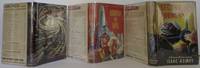
1951006743New York: Gnome Press 1951. Book. Illus. by David Kyle Edd Carter and Ric Binkley. Very Good. Cloth. SIGNED AND INSCRIBED BY AUTHOR. First Editions. 8vo - over 7¾" - 9¾" tall. An exceptional and RARE set all three books having been SIGNED AND INSCRIBED BY AUTHOR Isaac Asimov to the same lady in the most intriguing and charming manner - "Foundation" SIGNED AND INSCRIBED "For Laura Jean a passionate Southern gal Isaac Asimov" "Foundation and Empire" SIGNED AND INSCRIBED "For Laura Jean a persistent Southern gal Isaac Asimov" and "Second Foundation " SIGNED AND INSCRIBED "For Laura Jean a married Southern gal Isaac Asimov". Ah to have been a witness to THAT book signing where the sparks were obviously flying ! All three books stated Gnome Press First Editions "Foundation" in dark blue boards with red lettering at spine thinner and narrower paper and with dust jacket too large for this thinner book although stating First Edition 1951 on CP is actually the 1954 2nd Edition. Book is Very Good pages browning slight toning to edges of end pages top edge dusty in a Very Good dust jacket priced $2.75 front flap small chips at spine ends and flap fold tips. "Foundation and Empire" 1952 is First Edition First State in original red cloth in Second Issue dust jacket in blue tones. Book is Very Good pages uniformly browning. In Near Fine dust jacket small chips top and bottom edges rear panel at spine. "Second Foundation" 1953. is First Edition First State in original light blue boards spine stamped in brown Very Good cloth a bit rubbed at spine ends light toning to end pages at edges top edge soiled in a Very Good dust jacket 1/2" chip top edge front panel at spine light edge wear and soiling. Overall a Very Good set with unique Asimov inscriptions of this towering classic of the science fiction genre that continues to remain fresh and current. Gnome Press Hardcover
17521862Spain 1752. 18th-century manuscript. Text in Spanish. 24 handwritten pages in ink in three different hands. Later binding of blank paper using old material. Tiny wormholes at the lower edge of the pages on the first 7 leaves not affecting the legibility. Occasional foxing ink ghosting. Water stains on the last 2 leaves. Overall in fine condition. 18th-century manuscript. Text in Spanish. 24 handwritten pages in ink in three different hands. ff 12. <p><br /> 18th-Century Spanish manuscript about the Spanish involvement in the French Geodesic Mission of 1735 and the Ellipsoid Model of the Earth.<br /> <p><p><br /> The manuscript is an interesting collection of contemporary reports proving the importance of the Spanish role performed by Jorge Juan y Santacilia and Antonio de Ulloa in the so-called French Geodesic Mission 1735 with a particular focus on the polemic over the shape of the Earth. The quotations are conjugated with connecting texts by an anonymous author.<br /> <p><p><br /> One of the important scientific disputes of the late 17th early 18th century was the debate on the shape of the Earth. The assumption of the spherical shape was dominating until the late 17th century when Sir Isaac Newton determined that the Earth was oblate a spheroid stretched over the Equator however at the same time Giovanni Domenico Cassini and his son Jacques supposed that the Earth was prolate stretched along the poles. Eventually in 1735 two expeditions were sent by Louis XV and the French Academy to the Arctic Circle Lapland and to the Equator Ecuador and Peru to gain certainty by measuring the meridian arcs at polar and equatorial latitudes. The equatorial mission was accompanied by two Spanish geographers Jorge Juan y Santacilia and Antonio de Ulloa thus it became the first major international scientific expedition. The findings of the missions confirmed Newton’s hypothesis that the Earth was oblate a rotational ellipsoid.<br /> <p><p><br /> The first part of the manuscript is a lengthy citation of an early Spanish report on the equatorial mission published in the Mercurio histórico y político February 1745; pp. 99–107 which is followed by further references and quotations related to the geographer’s their work and the figure of the Earth such as Benito Jerónimo Feijóo y Montenegro’s Theatro critico universal 1751 Bernardo’s de Ulloa’s Antonio’s father Restablecimento de las fabricas y comercio español 1749 and articles from the Journal de Trévoux or the Gaceta de Zaragoza. The second part is Diego de Torres Villarroel’s 1693–1770 study Prevenciones in: Libros en que estan reatados. Vol. IV.; 1752 in which de Torres the almanac writer and professor of mathematics of a dubious repute opposes the findings of the missions and Newton’s hypothesis of the oblate Earth.<br /> <p><p><br /> Antonio de Ulloa 1716–1795 was a Spanish scientist and explorer the first Spanish governor of Louisiana who is also credited as the discoverer of the element platinum. De Ulloa was a Fellow of the Royal Society and a foreign member of the Royal Swedish Academy of Sciences. His associate Spanish scientist in the Geodesic Mission to Peru was Jorge Juan y Santacilia 1713–1773 who during the mission also measured the heights of the mountains of the Andes. Jorge Juan was the founder of the Real Observatorio de Madrid Royal Observatory of Madrid and he became a Fellow of the Royal Society too. Their co-written memoirs were published in Spanish from 1748 on and their books were very soon translated into French English and German.<br /> <p><p><br /> Literature: Lafuente A.; Mazuecos A.: Gentlemen of the Fixed Point: Science Politics and Adventure in the Geodesic Expedition to the Viceroyalty of Peru in the XVIII Century. pp. 171–203. Retrieved on July 8 2020 from Mayboudi L. S.: chapter 5.1 In: Geometry Creation and Import With COMSOL Multiphysics. Dulles VA USA: Mercury Learning & Information 2019.; Richardson D.; et al: The International Encyclopedia of Geography People the Earth Environment and Technology: Chichester UK; Hoboken NJ: John Wiley & Sons 2017.<br /> <p>. unknown
18201045181820. First Edition. ACKERMANN Rudolph GERNING Baron Johann Isaac von. A Picturesque Tour Along the Rhine from Mentz to Cologne. London: R. Ackermann 1820. Folio 11-1/2 by 13-1/2 inches period-style full green straight-grain morocco gilt-decorated spine and boards. $8800.First edition first issue of one of Ackermanns wonderful Picturesque Tours beautifully illustrated with 24 hand-colored folio aquatints and large folding map. A lovely copy beautifully bound to style.In the history of book production ""there is no more attractive figure than that of Rudolph Ackermann through whose extraordinary enterprise and spirit of adventure aquatint was successfully applied to the illustration of books"" Prideaux 120-23. One of Ackermann's most lucrative projects was his remarkable Picturesque Tours a series of seven books produced between 1820-28. This is his Tour Along the Rhine with beautifully hand-colored aquatints by Daniel Havell and Thomas Sutherland after paintings by Christian Georg Schutz depicting views of Mentz the Castle of Furstenberg the Church of Johannes Pfalz Castle and the town of Kaub the salmon fishery at Lurley Coblentz Bornhofen Cologne and other sites along the river. The plates were pulled and hand-colored in the Ackermann studio whose reputation for producing splendid illustrated publications and disseminating fine aquatint prints spanned over two centuries. The folding map shows the course of the Rhine from Mentz to Cologne. With accompanying text by Baron von Gerning describing the history and culture of the area first published in German in 1819 without illustrations. First issue without plate numbers in the top right corners. Tooley notes that plates 2 and 3 have variants dated either September or October; Abbey argues persuasively that to call either state an issue ""must remain doubtful"" particularly given that large-paper copies have also been seen with the two plates dated October. At any rate the quality of plates in either state are the same high standard; Abbey notes that ""there are definitely some later issues of the book and these can be recognized by having plate numbers at the top right-hand corner. The impressions in these plates are poor and the coloring less good"" Abbey 217. This copy has plates 2 and 3 dated October but most importantly none of the plates bear numbers in the upper right. Text watermarked 1817 and 1818; plates watermarked 1818 and 1819. Abbey Travel 217. Prideaux 337. Tooley 234. Title page neatly rehinged plates fine and fresh hand-coloring vivid. An excellent attractive copy of this beautifully illustrated work. hardcover
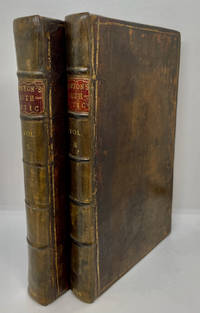
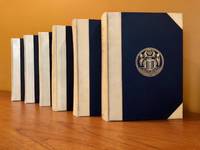
056522London: Excudebat Joannes Nichols. 1779-1785. Commentariis illustrabat Samuel Horsley. 5 volumes complete quarto format b/w illus. uniformly bound in early 19th-century full brown calf with gilt trim and spine lettering nicely marbled edges light foxing on the endpapers but the text paper is clean. Lacking the half-title pages which were not bound into this set. A former private bookplate and a former institutional bookplate inside the covers and a faint but very neat embossed blindstamp of the former institutional library on the bottom margin of the titlepages. Brunet IV 48. ESTC T18649. Contents: Vol.1 xxii 592 1p. with two double-folded tables. Vol. 2 xxviii 459 1p. Vol 3 437 48p. with 14 plates. Vol.4 617p. with 12 plates page 617 is misnumbered 609. Vol. 5 vii 550p. with 3 double-folded plates. This was the first collected edition of his Latin/English works. Excudebat Joannes Nichols unknown
17693016<p>1769. Hardcover. Very Good/No Dust Jacket. Printed for W. Johnston; London 1769; translated by Mr. Ralphson and Revised and Corrected by Mr. Cunn; to which is added a Treatise upon the Measures of Ratios by James Maguire the whole Illustrated and Explained in a series of Notes by the Rev. Theak</p> hardcover
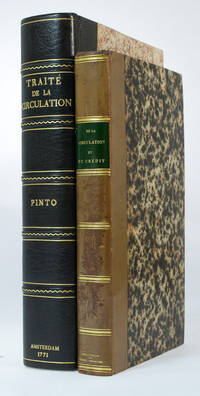
177166800The Very Scarce First Edition of "TraitÈ de la Circulation et du CrÈdit" PINTO Isaac De. TraitÈ de la Circulation et du CrÈdit. Contenant une Analyse raisonnÈe des Fonds d'Angleterre & de ce qu'on appelle Commerce ou Jeu d'Actions; un Examen critique de plusieurs TraitÈs sur les ImpÙts les Finances l'Agriculture la Population le Commerce &c. PrÈcÈdÈ de l'Extrait d'un Ouvrage initulÈ Bilan sur la Jalousie du Commerce o˘ l'on prouve que l'intÈrÃt des Puissances commerÃantes ne se croise point &c. avec un Tableau de ce qu'on appelle Commerce ou plutÙt Je d'Actions en Hollande. Par l'auteur de l'Essai sur le Luxe & de la Lettre sur le Jeu des Cartes qu'on a ajoutÈs ‡ la fin. Amsterdam: Chez Marc Michel Rey 1771. The very scarce first edition. xvi 368 with additional 8 pp. sheet H inserted before gathering I: entitled Etat des Finances en Angleterre a la fin de la session du Parlement en 1770. Nineteenth-century half calf over marbled boards spine ruled in gilt with green label and gilt lettering: at foot of spine in gilt lettering 'BibliothËque de Michel Chevalier' spine head slightly frayed. Occasional spotting and staining but a very good copy and with the bookplate of Michel Chevalier 1806-1879 follower of Saint-Simon author of the Cours d'…conomie Politique and co-architect of the Anglo-French 'Cobden-Chevalier' commercial treaty of 1860. Housed in a quarter brown morocco clamshell. "Economique. Sur le commerce l'agriculture les finances; passages pp. 70-72 sur la populatin anglaise; pp. 183-196 et 216-335 sur la population en France et en Angleterre. En particulier nÈcessitÈ d'augmenter Ègalement la population dans les villes et danse les campagnes pout Èviter les dÈsÈquilibres sociaux et Èconomiques. Analyse de plusieurs ouvrages dont un livre qualifiÈ de rare: 'Le dÈtail de la France' part Boisguilbert" INED. Pinto admired the Physiocrats but disagreed with them. "Pinto's TraitÈ is written from a national as well as an international perspective. Pinto's experience as a merchant and financier in the Republic along with his knowledge of French and English economic thought laid the foundations for his European economic model. Pinto wanted above all to convince his readers of hte soundness of the British system of public debt. With the adoption of improvements in the redemption policy proposed in his book the system would achieve a high degree of perfection. In France the physiocratic opinions of the elder Mirabeau in particular required Pinto to respond and in England the otherwise admiring Hume was in disagreement. By means of a critical discussion of the work of these and other authors Pinto propagated a financial policy that he thought would benefit both the State and the individual" I.J.A. Nijenhuis Een Joodse Philosophe. Isaac de Pinto 1717-1787 Amsterdam NEHA 1992. Goldsmiths' 10791. Higgs 5282. Kress 6811. Palgrave III pp. 109-110. HBS 66800. $8500 Chez Marc Michel Rey hardcover books
177166800Amsterdam: Chez Marc Michel Rey 1771. The very scarce first edition. xvi 368 with additional 8 pp. sheet H inserted before gathering I: entitled Etat des Finances en Angleterre a la fin de la session du Parlement en 1770.<br> <br> Nineteenth-century half calf over marbled boards spine ruled in gilt with green label and gilt lettering: at foot of spine in gilt lettering 'Bibliothèque de Michel Chevalier' spine head slightly frayed. Occasional spotting and staining but a very good copy and with the bookplate of Michel Chevalier 1806-1879 follower of Saint-Simon author of the Cours d'Économie Politique and co-architect of the Anglo-French 'Cobden-Chevalier' commercial treaty of 1860. Housed in a quarter brown morocco clamshell.<br> <br> "Economique. Sur le commerce l'agriculture les finances; passages pp. 70-72 sur la populatin anglaise; pp. 183-196 et 216-335 sur la population en France et en Angleterre. En particulier nécessité d'augmenter également la population dans les villes et danse les campagnes pout éviter les déséquilibres sociaux et économiques. Analyse de plusieurs ouvrages dont un livre qualifié de rare: 'Le détail de la France' part Boisguilbert" INED. Pinto admired the Physiocrats but disagreed with them. "Pinto's Traité is written from a national as well as an international perspective. Pinto's experience as a merchant and financier in the Republic along with his knowledge of French and English economic thought laid the foundations for his European economic model. Pinto wanted above all to convince his readers of hte soundness of the British system of public debt. With the adoption of improvements in the redemption policy proposed in his book the system would achieve a high degree of perfection. In France the physiocratic opinions of the elder Mirabeau in particular required Pinto to respond and in England the otherwise admiring Hume was in disagreement. By means of a critical discussion of the work of these and other authors Pinto propagated a financial policy that he thought would benefit both the State and the individual" I.J.A. Nijenhuis Een Joodse Philosophe. Isaac de Pinto 1717-1787 Amsterdam NEHA 1992.<br> <br> Goldsmiths' 10791. Higgs 5282. Kress 6811. Palgrave III pp. 109-110.<br> <br> HBS 66800.<br> <br> $8500. Chez Marc Michel Rey unknown
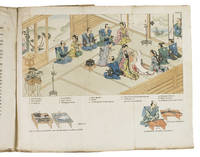
182418968The Hague 1824. 8vo. the widow of J. Allart Contemporary marbled boards with a paper title label on the spine. With 4 hand-coloured folding aquatint plates and a hand-coloured engraved vignette on the title page of each volume. 2 volumes. XVI 250; 1 1 blank 264 pp. First Dutch edition of a beautifully illustrated work on the Japanese festive ceremonies and customs. The work was written by Isaac Titsingh 1745-1812 then Head of the Dutch Factory at Decima the only place in Japan from where connections with the rest of the world were maintained until far into the 19th century. Titsingh was allowed to visit the Japanese court several times and is therefore one of the very few European observers and eye-witnesses of Japanese culture and customs in the 18th century.The first volume consists of essays on Japanese marriage and funeral ceremonies an account of "dosia" powder and some notes on the works of Confucius. It is concluded by a catalogue of books manuscript plans and artefacts collected by Titsingh. The second volume includes a series of anecdotes about the shoguns followed by several short essay amongst others on seppuku ritual suicide and Japanese poetry ending with explanations of the plans of the Dutch and Chinese factories at Nagasaki. The plates show a wedding ceremony a volcanic eruption of Mount Asama and the Dutch Factory at Decima.Titsingh was a diplomat historian and merchant who had a great interest in Japan. He moved to the East Indies in 1766 and stayed for most of his life. He spent a total of three years and eight months in Japan between 1778-1788 and amassed a large collection of authentic source materials on Japan during this time including printed books manuscripts prints maps city plans and coins. He came back to Holland in 1809 but quickly moved to Paris on account of the political situation. In Paris he began preparations for a monumental work on Japan based on the artefacts in his collection as well as his own notes but he died suddenly in 1812. When his son Willem went bankrupt he sold his father's collection which was then scattered all over Europe. Both a French and English publisher must have acquired some of the material as selections of it were printed in both countries. They were published in two volumes in Paris as Cérémonies usitées en Japon pour les mariages et les funérailles 1819 and Mémoires et anecdotes de la dynastie regnante des Djogouns 1820. The London edition Illustrations of Japan 1822 which was only printed in one volume was not a direct translation of the French works but clearly used the same source material. The present Dutch version is a translation of the English edition. Due to the impact of his collection and scholarly activities Titsingh can be seen as the founder of European Japanology.The boards of both volumes are somewhat scratched the spine of both volumes has cracked but the structural integrity of the binding is still intact. The first and last two leaves of each volume have browned around the edges likely from a past protective wrapper the work is slightly browned and foxed throughout the final quire and the two plates in volume 2 have detached but are still present annotations in pencil in the margins on some of the leaves. Otherwise in good condition.l Alt Japan Kat. 1520; Cordier Japonica col. 451; Landwehr Coloured plates 456; Tiele 1096. ABE CAT Anthropology & Ethnography hardcover
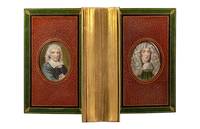
18086230London: Samuel Bagster 1808. First Bagster edition. Octavo 8 x 4 7/8 inches; 204 x 124 mm. iv vi vii-512 pp. Hand-colored frontispiece and nineteen engraved plates and two sheets of music. Ten of the plates are engraved by Audinet eight after Wale two after Samuel; two music plate; two plates of fishing tackle and flies. There are seventeen fine engravings of fish and two large woodcuts in the text. Extra-illustrated by the insertion of fifty-five engraved plates of which ten are hand-colored. Bound ca. 1925 by Bayntun stamp-signed in gilt "Bayntun. Binder. Bath. Eng." on front turn-in. Full green crushed levant morocco over beveled boards covers with elaborate gilt frames spine with five raised bands elaborately decorated and lettered in gilt in compartments gilt decorated board edges wide gilt turn-ins all edges gilt. Front doublure of brown morocco surrounded by a frame of inlaid maroon morocco. Set into the front doublure is a fine oval miniature painting of Isaac Walton under beveled glass within a double gilt frame. Set into the rear doublure is a fine oval miniature painting of Charles Cotton under beveled glass within a double gilt frame. Both miniatures measure 3 1/4 x 2 1/2 inches; 82 x 63 mm. Green watered silk end-leaves. Expertly and almost invisibly rebacked with the original spine laid down spine very slightly sunned otherwise a fine example housed in its original felt-lined green cloth clamshell case spine lettered in gilt.<br /> <br /> Walton's famous pastoral work on fishing The Compleat Angler is combined here with additions by Robert Venables and Charles Cotton on the art of fly fishing in particular. Walton the son of innkeepers moved to London to become an ironmonger but would spend the last forty years of his life collecting information and writing on fishing. The book was first published in 1653 but re-released in numerous editions both due to its popularity and Walton's propensity to revise and contribute more chapters to it. It has stayed in print since it was first published and is noted for its well observed descriptions of English country life. "The Compleat Angler has something in common with 'Lady Chatterley's Lover:' while many know the title few have actually read it. Yet it's the most frequently reprinted book in the English language after the Bible" The Guardian.<br /> <br /> George Bayntun 1873-1940 was the founder of Bayntun Bindery 1894 dedicated to using traditional hand-crafted techniques and high-quality materials. "The Riviere Bindery was one of the most notable and prolific shops in London's West End from about 1840 through 1939" Princeton. Bath-based Bayntun Bindery acquired the firm in 1939 transforming into the "Bayntun-Riviere bindery" which is still in existence and family owned. Although named after the English miniaturist Richard Cosway 1742-1821 the desirable "Cosway Binding" with its jewel-like portrait miniature set into a fine binding was first developed at the turn of the century by J.H. Stonehouse director of London's Henry Sotheran Booksellers. Their miniatures were painstakingly crafted by the talented painter Miss C. B. Currie 1849-1940. As the style grew in popularity other publishing houses quickly began to reproduce this technique-each developing their own desirable take on the aesthetic-referred to as "Cosway style." <br /> <br /> Coigney 18. Samuel Bagster unknown
182229763Philadelphia: H.C. Carey & I. Lea 1822. Folio. Mounted on guards throughout. Letterpress title copyright notice on verso 1p. 'Advertisement' dated 'June 21 1822' verso blank 1p. 'Contents' and 'Index' verso blank. 46 double-page hand-coloured engraved maps of America all but one with borders of letterpress descriptive text 1 uncoloured double-page engraved view showing the comparative heights of mountains throughout the world 1 hand-coloured double-page engraved table showing the comparative lengths of the principal rivers worldwide 5 letterpress tables 4 double-page 3 of these hand-coloured 18pp. of uncoloured letterpress text. Contemporary half black morocco over plain paper boards rebacked with original spine laid down and corners renewed. Housed in a cloth clamshell case leather label.<br/> <br/>First edition of one of the most important early atlases printed in the United States: a handsome atlas of the Americas with individual hand-coloured maps of each state in the Union including a seminal map of the West by Stephen H. Long.<br/> <br/>At the time of publication this was the best and most detailed atlas to be produced in the United States. Fielding Lucas the major Baltimore printer was the principal engraver and substantial historical background text accompanies each map. Among the most noted maps in the atlas is Major Stephen H. Long's "Map of Arkansa and other Territories of the United States." That map which depicts the Missouri basin between Nashville in the east the Mandan villages in the north and the Rocky Mountains in the west was based on the surveys conducted by Long on his expeditions of 1819 and 1820. The map published in Carey & Lea's atlas preceded the official account of that expedition by expedition botanist Edwin James which included a smaller map with similar detail titled "Country drained by the Mississippi Western Section". Carey and Lea's 1822 publication of James Account perhaps explains the prior inclusion of this map with Long expedition information in their atlas. On this famous map is the printed legend which would perpetuate a myth for many years to come identifying the high plains as the "Great American Desert." Carey and Lea's atlas was first issued as here in 1822; an 1823 second issue followed substantially the same as the first but with a new title and revised states of several maps and text leaves generally minor revisions including additional shading to maps and improved resetting of several text leaves.<br/> <br/>Phillips 1373a; Howes C133 "aa"; Sabin 15055; Wheat Transmississippi West 348 and 352. H.C. Carey & I. Lea unknown books
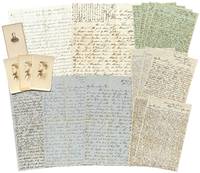
18674614261867. Unbound. Near Fine. A collection of 11 long letters written by a young paymaster’s clerk and officer in the U.S. Navy in which he gives detailed accounts of voyages to Central America China and South Africa in 1867-68. Also included is a gripping account of a terrific storm while crossing the Atlantic and of a dramatic rescue of sailors cast off their capsized ship off the coast of France. All 11 letters are densely written in Merrill’s neat small hand and are addressed to his parents at Bangor Maine. One letter has three or four small tears with partial loss to three or four words else near fine overall. Also included are six of the original mailing envelopes and four cabinet card portraits of Merrill: one of Merrill in uniform taken by “Pun-Lun†at Hong Kong and three duplicate portraits taken at Bangor Maine.<br /> <br /> Here is an excerpt from Merrill’s first seven-page letter written on board the storeship Brig Executive in January 1867 in which he describes his first voyage from Bangor to Cette France:<br /> <br /> “… Wednesday night – a gale commenced – and it was a screamer … day and night did every soul labor for dear life … we felt that our doom – by sinking – was sure … Buzzell and Chase and I worked with the rest – and by our aid the exhausted men were enabled to get a little sleep – until the forecastle was flooded and the galley stove in … we lived on raw meat for three days … Such mountainous waves! … they were as high as the upper-topsail yard – and often higher still – and when they would board us – and sweep over the decks – we all clinging to the main rigging … it seemed to us … that we should drown before it all passed over us … so long were we in the wave … During the whole gale … we sped onward in our course …â€<br /> <br /> They ran into another terrific storm off the coast of France near Montpelier where they encountered several ships in peril and participated along with soldiers on the shore in a dramatic rescue of two sailors and a pilot from their capsized boat one of whom later died. They went on to Paris and London where Merrill wrote his next two letters and returned home from Liverpool at the end of January.<br /> <br /> Merrill next writes at length about his voyage on board two Steamships Henry Chauncey and Sacramento and the storeship USS Supply. Setting off in November he sailed first to Aspinwall Colón on the Atlantic coast of Panama went across the isthmus by rail road to the City of Panama and then on to Acapulco and San Francisco. In two letters from November he gives descriptive accounts of Aspinwall including several disparaging remarks about the crowds of “natives and negroes along the plaza … the street was thronged with dusky vendors of fruit claret cakes &c. jabbering the virtues of their merchandise in the most conglomerate mixture of English Spanish and Samboish …†He also describes the structure of the “many isolated negro huts†along the 48-mile railroad trip to Panama City where they transfer their baggage etc. onto the Sacramento:<br /> <br /> “The sea has been as smooth as a pan of milk ever since we left Panama … Among the more noted of our passengers is Gen. Beuham of So. Carolina late of C.S. Army … Bishop Williams of the Episcopal Mission in China … and other missionaries of China … Spanish gentlemen and their families merchants of China & Japan … This morning early a poor fellow died in the Steerage of Panama fever. Another one is sick and will not live till evening … The sharks have followed our ship all the time from Panama … the surgeon said privately that there are other cases also …â€<br /> <br /> In a letter from December Merrill gives a long description of Acapulco: its harbor streets and street vendors the military fort and evidence of the French bombardment etc. In San Francisco his time in the city itself which he loves is curtailed by preparations on board Supply for the voyage to Japan and China. In a long six-page letter from February 1868 he describes various excursions in Canton and Hong Kong:<br /> <br /> “All of us officers went to Canton … and saw all the Elephants including the Temple of 500 Gods … Hong Kong has all the business that was formerly done in Canton … In some places where we went – but few Europeans had ever been and we were curious objects of interest to the population … One walled town we entered – contrary to the permission of the natives and there we met a ‘Sing-Song’ procession – marching about in fantastic costumes celebrating the advent of the Chinese New Year – and when they saw us you may believe there was a scattering and scampering! They perhaps thought that the ‘Fan-Kwei’ foreign devils as they call foreigners had come to kill and destroy … At one town which I entered alone the natives were much pleased to see a Fan-Kwei and they pressed me to take oranges paper cigarettes &c. ad libitum … We saw the forts ruins of at the Bocca Tigris and the Barrier Forts near Canton which were reduced by … the American & English fleet in the China Squabble of 1858-9 … Last Tuesday W. & Thursday were the Annual Races here in Hong Kong. All the fashionable of the Colony were there … We were invited to the whole course 3 days and had quarters in the booths of Russell & Co. and Oliphant & Co. … People and costumes of all nations mingled to make a dashing looking concourse …â€<br /> <br /> He concludes the letter with news about the Satsuma Samurai Rebellion of 1868: “You will probably hear about the outbreak and warfare in Japan … the Hartford and Aroostook are preparing to go there … the Prince of Satsuma … has landed ten thousand men below Osaka under the nose of one of the Tycoon’s frigates without molestation and marched them inland toward … the City of the Mikado or Spiritual ruler and had conflict with the Jap. national troops … the life of Sir Harry Parkes … has been attempted and one or two of our U.S. sailors … killed and it is reported that the Tycoon has taken refuge on the U.S.S. Iroquois …â€<br /> <br /> On the voyage back from China Merrill writes one letter in March from Java and two letters in April from South Africa in which he gives descriptions of Good Hope Cape Agulhas whaling grounds at Algoa Bay and of his excursion to Cape Town. He concludes his account of the voyage with a final letter written at Charlestown Massachusetts.<br /> <br /> A remarkable and historically important cache of letters all rich in content and deserving of further research. A list of the letters with a few quoted extracts is available. unknown
19287168New York: Robert H. Dodd 1928. First Edition. Hardcovers in slipcases with chemises. Fine/Very Good; Slipcases With Occasional Wear. Title continues: Compiled from Original Sources and Illustrated by Photo-Intaglio Reproductions of Important Maps Plans Views and Documents in Public and Private Collections.<p>Complete in six thick 4to volumes. Varying pagination. With maps documents photographs engravings and facsimiles of charters ordinances proclamations handbills broadsides surveys plans portraits and more. Many printed in color. The second volume is mostly concerned with Manhattan Island cartography including 96 plates some of which are double-page. The final volume contains an addendum an extensive bibliography by Victor H. Paltsits and an index to the entire work.<p>Top edges gilt others uncut. Publisher's half-vellum gilt lettering on spine over blue cloth boards with gilt device on front board. Housed in original dark blue chemises within slipcases. Chemises Good to Near Fine with slight darkening to spines; Vol. V chemise with a quarter-inch perforation on spine. Please see photo. Some slipcases with only occasional minor wear; the most egregious shown in photo with split starting and a slit at top edge. One of 360 copies printed on English handmade paper. Withal a superb set. With hundreds of maps views and architectural illustrations assembled from countless original sources Stokes' sweeping survey presents detailed chronologies and summaries of events and the personages involved up to 1909. A splendid set exceptional in the bright condition at-hand. HOWES S1026 "the most elaborate and comprehensive history of Manhattan". Robert H. Dodd hardcover
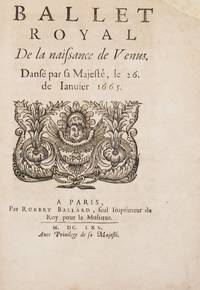
16653806A Paris: Par Robert Ballard seul Imprimeur du Roy pour la Musique 1665. First edition. Later green half morocco over marbled paper boards spine lettered in gilt. Italian provenance: early manuscript ownership inscription on the first leaf dated 30 Genn.o 1665 30 January 1665 partly torn and restored; later engraved armorial bookplate on the inner front panel. Paper tanned as usual; early folds and handling marks; otherwise clean and well preserved. First edition. Later green half morocco over marbled paper boards spine lettered in gilt. 52 2 p. <p><br /> Scarce first edition of the libretto of Lully's Naissance de Vénus a key work in the development of the French court-ballet tradition in a copy preserving a contemporary inscription dated only days after the premiere.<br /> <p><p><br /> First edition printed for the premiere of the libretto for the court ballet performed on 26 January 1665 at the Palais-Royal. The text was written by Isaac de Benserade and the music composed principally by Jean-Baptiste Lully at the request of Louis XIV and in honour of the king's sister-in-law Henrietta of England who appeared in the performance as Venus.<br /> <p><p><br /> The copy preserves an early Italian inscription dated 30 January 1665 only four days after the premiere suggesting that it may have been received in connection with the performance possibly by someone present at the court spectacle.<br /> <p><p><br /> The ballet belongs to the tradition of the French ballet de cour one of the principal ceremonial theatrical forms cultivated at the court of Louis XIV. The libretto presents a large mythological spectacle in two parts comprising twelve entrées. Conceived on an exceptional scale the production involved 96 performers representing 106 roles accompanied by 20 musicians and 14 singers with Louis XIV himself appearing in the final scene as Alexander the Great.<br /> <p><p><br /> Printed libretti of this type formed part of the broader genre of festival books ephemeral publications describing royal festivities and spectacles staged for political and ceremonial display. The present libretto is accordingly included in the Oxford "Early Modern Festival Books" collection which documents printed accounts of court celebrations and theatrical spectacles across Europe. <br /> <p><p><br /> A rare printed witness preserving a contemporary inscription to one of the most elaborate court ballets of Louis XIV's reign and an important document of early French operatic culture marking the culmination of the ballet tradition from which Lully would soon develop the tragédie en musique.<br /> <p><p><br /> LWV 27 <br /> <p>. Par Robert Ballard, seul Imprimeur du Roy pour la Musique unknown
19512210308New York: Gnome Press 1951. First issue First issue and second issue. hardcover. Fine/Fine. All three books in the trilogy each in fine condition. Books two and three are first trade editions and book one is stated First Edition has correct $2.75 price on front flap of jacket but is less thick than the true first edition so generally considered a second issue of the first edition. Books two and three are the correct first edition first issue thickness. Foundation Second Foundation and Foundation and Empire all in remarkable condition. <br /> In Second Foundation short piece of tape on inside of dj not visible from outside. In Foundation and Empire narrow crack in rear hinge. Gnome Press unknown
1991USINMYF00acmfNoonday Press 1991. Very Good. Singer Isaac Bashevis. In my Father's Court. NY: Noonday Press 1991. 307pp. 8vo. Paperback. Book condition: Very good with general rubbing and minor bumping. Panels smudged a bit. Former owner's name on last blank page. Noonday Press paperback
1950140946655New York: Gnome Press 1950. First Edition or Armed Services Edition. Near Fine. Though the publishing history is murky this is assumed to be either an example from the publisher's short foray into paperback publishing or an Armed Services edition. First edition wrappered issue according to Currey; though according to Chalker Gnome printed 5000 hardbound copies in 1950 and an additional 2500 were printed in 1951 as the trade paperback "Armed Forces Edition." Near Fine with light creases to wraps and light chipping at edges light foxing to textblock edge and contents heavily tanned. Exceedingly scarce in this format much more uncommon than the hardcover edition. Gnome Press unknown
04633London: Samuel Bagster 1808. A Superb Mid-Twenties Cosway-Style Binding by Bayntun of Bath with Two Fine Oval Miniatures<br/>Extra-Illustrated by the Insertion of Fifty-Five Engraved Plates of which Ten are Hand-Colored<br/><br/>COSWAY-STYLE BINDING. BAYNTUN binder. WALTON Isaac. The Complete Angler; or Contemplative Man's Recreation. Being a Discourse on Rivers Fish-Ponds and Fishing. In two parts: The first written by Mr. Isaac Walton; The second by Charles Cotton Esq. With the lives of the authors. by Sir John Hawkins. London: Printed for Samuel Bagster 1808.<br/><br/>First Bagster Edition.<br/><br/>Octavo 8 x 4 7/8 inches; 204 x 124 mm. iv vi vii-512 pp. Hand-colored frontispiece and nineteen engraved plates and two sheets of music. Ten of the plates are engraved by Audinet eight after Wale two after Samuel; two music plate; two plates of fishing tackle and flies. There are seventeen fine engravings of fish and two large woodcuts in the text. Extra-illustrated by the insertion of fifty-five engraved plates of which ten are hand-colored.<br/><br/>Bound ca. 1925 by Bayntun stamp-signed in gilt "Bayntun. Binder. Bath. Eng." on front turn-in. Full green crushed levant morocco over beveled boards covers with elaborate gilt frames spine with five raised bands elaborately decorated and lettered in gilt in compartments gilt decorated board edges wide gilt turn-ins all edges gilt. Front doublure of brown morocco surrounded by a frame of inlaid maroon morocco. Set into the front doublure is a fine oval miniature painting of Isaac Walton under beveled glass within a double gilt frame. Set into the rear doublure is a fine oval miniature painting of Charles Cotton under beveled glass within a double gilt frame. Both miniatures measure 3 1/4 x 2 1/2 inches; 82 x 63 mm. Green watered silk end-leaves. Tips of joints slightly split but absolutely sound spine slightly sunned otherwise a very fine example housed in its original felt-lined green cloth clamshell case spine lettered in gilt.<br/><br/>List of plates including the extra-illustrations which are marked with a 77 total 11 of which are in color<br/><br/>1. Frontis. Portrait of Izaak Walton Charles Cotton and Sir John Hawkins hand-colored<br/>2. Portrait of St. Francis Bacon<br/>3. Portrait of Bp. Ken<br/>4. Portrait of Hon. Robert Boyle<br/>5. Portrait of Dr. Robert Sanderson Mr. Richard Hooker Sir Henry Wolton Mr. George Herbert Dr. John Donne<br/>6. Portrait of Edward First Earl of Sandwich K.G.<br/>7. Robert Herrick<br/>8. Portrait of Sir Henry Wotton hand-colored<br/>9. Portrait of George Herbert<br/>10. Portrait of Edward Herbert Lord Herbert of Castle Island and Lord Herbert of Chierbery in England<br/>11. Portrait of Bp. Taylor<br/>12. Portrait of Arch Bishop Williams Lord Keeper<br/>13. Portrait of Thomas Hearn M.A. of Edmund Hall Oxon<br/>14. Portrait of Charlemagne<br/>15. Portrait of The Most Revd. Dr. Usher Late Lord Arch Bishop of Armagh<br/>16. Dovedale hand-colored<br/>17. Uske Monmouthshire<br/>18. Untitled B&W Illustration<br/>19. Fitchet and Martin<br/>20. The Wild Boar<br/>21. Portrait of Hierom of Prage<br/>22. Basking Shark<br/>23. Cuckoo and Wryneck<br/>24. Portrait of John Stow<br/>25. Portrait of Bp. Overall<br/>26. Bittern<br/>27. Untitled B&W Illustration<br/>28. Portrait of Seneca<br/>29. Portrait of Sir Walter Ralegh hand-colored<br/>30. Untitled B&W Illustration<br/>31. Untitled B&W Portrait<br/>32. Portrait of Erasmus<br/>33. Untitled B&W Illustration<br/>34. Arabian Camel<br/>35. Squirrels<br/>36. Partridges<br/>37. Golden Plover & Lapwing<br/>38. Portrait of Marcellus Malpighius M.D.F.R.S. hand-colored<br/>39. Page of Music<br/>40. Portrait of Tho. Cromwell Earl of Essex<br/>41. Lamprey & Salmon hand-colored<br/>42. Portrait of Ray<br/>43. Potrait of Michael Drayton<br/>44. Double Page Color Illustration. Illustrations of Marine Animals hand-colored<br/>45. Double Page B&W Illustration. Cyprinus. The Golden Tench. The Gudgeon. The Minnow<br/>46. Double Page B&W Illustration. Meleagris. The American Wild Turkey. The Common Domestic Turkey<br/>47. Coniston Water Head<br/>48. A View of Winander Mere a Lake in Westmoreland<br/>49. Portrait of Dr. Gilbert Sheldon Arch-Bishop of Canterbury<br/>50. Untitled B&W Illustration<br/>51. The Angler's Song<br/>52. Interior View of the Ruins of Ludlow Castle<br/>53. Portrait of Prince Rupert When Young hand-colored<br/>54. A View of Shrewsbury Shropshire<br/>55. Untitled B&W Illustration<br/>56. Tottenham Cross<br/>57. Untitled B&W Illustration<br/>58. Portrait of Cardinal Richelieu<br/>59. Untitled B&W Illustration of Fishing Tools<br/>60. Untitled B&W Illustration of Fishing Line<br/>61. Untitled B&W Illustration of Fishing Bait<br/>62. Portrait of Charles Cotton hand-colored<br/>63. Portrait of Edward Hyde Earl of Clarendon<br/>64. Portrait of Sir Kenelm Digby<br/>65. Ashbourne Derbyshire<br/>66. Chepstow Castle & Bridge Over the Wye hand-colored<br/>67. Matlock Bridge &c.<br/>68. Portrait of Mary I<br/>69. Untitled B&W Illustration<br/>70. Untitled B&W Illustration of Fishing Hooks<br/>71. Untitled B&W Illustration<br/>72. Untitled B&W Illustration<br/>73. Untitled B&W Illustration<br/>74. Portrait of Sr. Philip Sidney<br/>75. Portrait of Queen Elizabeth<br/>76. Portrait of John Selden hand-colored<br/>77. Woodcock<br/><br/>Coigney 18. London: Samuel Bagster, 1808 unknown books
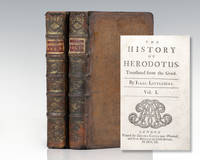
170996521London: Printed for Edward Castle and Sam Buckley 1709. First complete edition in English of Littlebury's translation of the histories of Herodotus also the first appearance in English since Thomas Marshe's 1584 incomplete translation of only the first two books. Octavo two volumes. Bound in full contemporary calf with gilt titles and tooling to the spine in six compartments within raised bands red morocco spine labels stamped ruling all edged speckled red woodcut ornaments to the title pages and colophon of volume II index. From the library of George Paterson of Castle Huntly with his armorial bookplates to the pastedowns. After amassing a large fortune with the East India Company Paterson purchased the famed Scottish Castle Huntly in 1770. In very good condition. Rare and with noted provenance. Herodotus is generally considered ‘the father of history’. Departing from the Homeric chronicle ‘he was the first to collect his materials systematically to test their accuracy as far as he could and arrange his story in such a way as to appeal to as well as inform his readers’ PMM. His main theme which is also the subject of the present work was the struggle between Persia and Greece. Printed for Edward Castle and Sam Buckley hardcover
170996521London: Printed for Edward Castle and Sam Buckley 1709. First complete edition in English of Littlebury's translation of the histories of Herodotus also the first appearance in English since Thomas Marshe's 1584 incomplete translation of only the first two books. Octavo two volumes. Bound in full contemporary calf with gilt titles and tooling to the spine in six compartments within raised bands red morocco spine labels stamped ruling all edged speckled red woodcut ornaments to the title pages and colophon of volume II index. From the library of George Paterson of Castle Huntly with his armorial bookplates to the pastedowns. After amassing a large fortune with the East India Company Paterson purchased the famed Scottish Castle Huntly in 1770. In very good condition. Rare and with noted provenance. Herodotus is generally considered 'the father of history'. Departing from the Homeric chronicle 'he was the first to collect his materials systematically to test their accuracy as far as he could and arrange his story in such a way as to appeal to as well as inform his readers' PMM. His main theme which is also the subject of the present work was the struggle between Persia and Greece. Printed for Edward Castle and Sam Buckley hardcover books
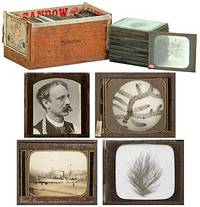
1897394021Bridgeport Connecticut 1897. Good. A unique collection of 87 glass lantern slides permanent positive images from the library of Isaac Holden an important Connecticut based phycologist and founding editor and contributor to the monumental: Phycotheca Boreali-Americana: A Collection of Dried Specimens of the Algae of North America. The collection consists of two sets totaling nearly 60 slides of images of dried marine algae specimens “Exsiccatae†and a set of about 25 slides taken in and around the town of St. John’s on the coast of Newfoundland. There are also a few slides of fauna insects and Holden as a dashing young man.<br /> <br /> The marine algae specimens were collected by Holden at Seaside Park along the Connecticut coast and Long Island Sound in the mid-1880s. About half of the species are identified in manuscript with the Latin name place date and Holden’s signature reproduced in the image. Three images have been dyed in red. It’s very likely that the unidentified specimens were collected by Holden and his close friend and colleague Frank Shipley Collins who co-edited and also contributed to the Phycotheca. Both sets of specimens include a few charts and figures.<br /> <br /> The set of Newfoundland views date from Holden’s 1897 trip to collect specimens of marine algae many of which were distributed in the Phycotheca. The views are of the rocky coastline and adjoining seascapes including a few snow-covered areas and several images of fishermen and other inhabitants at work in the harbor or in boats along the coast.<br /> <br /> The glass lantern slides measure 4†x 3¼†or 3¼†x 3¼†a subset of about 20 specimen slides consisting of the image plate and clear cover plate held together with plain paper folded over the edges. Many slides have glossy paper frames mounted in between the plates. The slides range in condition from fair to very good with scattered spotting and soiling. Several of the original paper edges are detached or missing a very few have been replaced with masking tape about 15 slides lack most or all of the original paper edges and are separated including a few lacking a cover plate. About five specimen slides are damaged with cracks to the glass and some deterioration to the image. About half are housed in a contemporary wooden box with chromolithographic labels from Bridgeport Connecticut.<br /> <br /> A unique and historically important research collection of early photographic images of marine algae and of the remote coastline of Newfoundland. The collection is divided into four sections:<br /> <br /> Set 1. 40 slides: North American Algae Specimens & Miscellaneous: Images of various types of seaweed and related algae.<br /> <br /> Set 2. 18 slides including three dyed in red: Seaweed and related algae signed and dated in the image: “Bridgeport Conn. 1885â€.<br /> <br /> Subset 3. 4 slides: Fauna/insects.<br /> <br /> Set 4. 25 slides: Views of Newfoundland: Images of St. Johns Newfoundland and vicinity: about half include local people. There are also five additional slides reproducing various maps. unknown
1220Twelve folding engraved plates. 4 p.l. 382 pp. one leaf of ads. 8vo cont. calf small portions of ends of spine & one corner carefully repaired spine gilt red morocco lettering piece on spine. London: W. Innys 1730. Fourth edition and the final edition to be revised by Newton of this great classic. It contains the complete set of 31 Queries which reveal some of Newton's most influential and speculative writing. Fine crisp copy. Contemporary armorial bookplate of Edward Powell. ❧ Babson 136. unknown books
176519374Cambridge: J. Bentham 1765. FIRST EDITION. The first ten pages contain a list of subscribers mainly from Oxford and Cambridge and a corrigenda. With12 folding plates. Bound in old boards rebacked a clean and crisp copy uncut. First edition of this rather rare series of excerpts from Newton’s Principia. “Although there is no mention of it in the book itself the annotators were John Jebb M.D. Rector of Ovington Robert Thorp Archdeacon of Northumberland and Francis Wollaston Rector of Chislehurt†Babson.<br /> <br /> In addition to the myriad of books explaining the mathematics of Newton’s masterpiece published in the hundred years following the first edition the public clamored for copies and excerpts from the book itself. Jebb 1736-1786 was a medical doctor and a Fellow of the Royal Society. Thorp 1783-1862 succeeded his father as rector of Chillingham and in 1792 was created archdeacon of Northumberland. In addition to this work he published a translation of the Principia in English Mathematical principles of natural philosophy London 1777. Wollaston 1738-1826 a mathematician and son of the astronomer Francis Wollaston was a Fellow of the Royal Society.<br /> <br /> Babson 15; Wallis 20. J. Bentham unknown