29 610 résultats
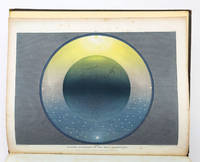
1846ST19286London: Printed by Catchpool & Trent for Simpkin Marshall & Co 1846. FIRST EDITION. 320 x 255 mm. 12 1/2 x 10". xiii 3 96 pp. <br/> Publisher's original blind-decorated dun-colored cloth gilt titling to upper cover smooth spine newer endpapers. WITH 11 COLOR ENGRAVINGS after Frost by W. P. Chubb & Son printed in oil colors by George Baxter all with original tissue guards. Front free endpaper with small ink signature of John Hill. See: Francis Reid "Isaac Frost's 'Two Systems of Astronomy' 1846: Plebeian Resistance and Scriptural Astronomy" in "The British Journal for the History of Science" Vol. 38 No. 2 Jun. 2005 pp. 161-177. Cloth rather spotted corners bumped but the binding solid with no wear to joints or hinges. A few spots of foxing to title page half of the tissue guards with overall very faint foxing/browning the illustrations with minor foxing at edges and in margins but the images themselves clean and bright and all in all a really excellent copy the text wide-margined and quite clean and fresh and the plates with rich coloring.<br/> <br/> Illustrated with beautiful color plates this anti-Newtonian work promotes a view of the universe based on the backward-looking beliefs professed by a Protestant sect known as the Muggletonians. Named after co-founder Lodowicke Muggleton the Muggletonians emerged in London in 1651 based on the claims of two tailors who professed to be the "Last Witnesses" described in the Book of Revelation. Rejecting the new directions in philosophical reason Muggletonians believed in a purely scriptural interpretation of the universe. According to E. P. Thompson's 1994 "Witness Against the Beast" the Muggletonians had curious notions quite contrary to other Protestant denominations: they believed that the soul is mortal that Jesus and God are one and the same that Heaven was left without divine supervision from Jesus' death until the day of judgment that Heaven resides six miles above the Earth that God stands between five and six feet tall and other unconventional things. Although the sect initially avoided both worship and evangelizing during the 19th century some followers became more outspoken about their beliefs and even published books appealing to the general public. Our author Isaac Frost 1793-1858 was a prominent Muggletonian and successful owner of a brass foundry who along with his brother Joseph invested large sums to promote their belief system--the present work being an especially notable example. Divided into two main sections the text first describes the Newtonian system of heliocentric astronomy and then turns to Frost's scriptural interpretation and geocentric views. As Reid tells us "According to Frost Scripture clearly states that the Sun the Moon and the Stars are embedded in a firmament made of congealed water and revolve around the Earth that Heaven has a physical reality above and beyond the stars and that the planets and the Moon do not reflect the Sun's rays but are themselves independent sources of light. Our book was apparently written as a reaction against the lecturers who expressed Newtonian astronomy--which was often for them and their audiences simply shorthand for heliocentrism." The 11 plates that illustrate these extraordinary ideas are the work of George Baxter a pioneering printer who revolutionized color printing techniques by combining metal engravings with woodblock printing using oil-based inks to produce high-quality affordable prints. The plates here are appropriately ethereal and otherworldly utilizing a beautiful palette with subtle gradations and esoteric figures to create memorable pseudo-scientific imagery. Although this work appears at auction with some regularity it is almost always incomplete no doubt because the attractiveness of its plates encourages harvesting. Useful price comparisons include a complete copy said to be in fine condition selling for £7500 in 2016 and six loose prints from the book fetching £6875 in 2015. [Printed by Catchpool & Trent for] Simpkin, Marshall, & Co unknown
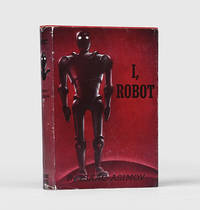
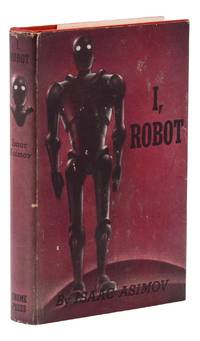
1950169250New York: Gnome Press Inc. 1950. A robot may not injure a human being or through inaction allow a human being to come to harm First edition of the author's landmark collection of science fiction short stories which includes "Runaround" in which Asimov sets out for the first time his Three Laws of Robotics. "Historically Asimov is undeniably important to the establishment of both the scientific and fictional realms of artificial intelligence. In May 1941 the word 'robotics' was first used in print by Asimov in his short story 'Liar!' published by Astounding Science Fiction OED. Upon realizing he had coined a new and lasting word Asimov recognized the uniquely profitable position he had created for himself and along with the successful prediction of space travel self-driving cars and war-computers among others would go on to position himself as a sort of friendly-but-rough-around-the-edges technological herald someone entertaining trustworthy and often right" Jung. Octavo. Original red cloth spine lettered in black robot design to front cover in black. With dust jacket. Housed in a custom red cloth folding box by the Chelsea Bindery. Ink ownership signature of one Ruth Rayson dated 1950 to front free endpaper and her blind stamp to title page. Spine ends lightly bumped; dust jacket price-clipped minimally rubbed slight sunning to spine as usual the fugitive red still bright just a few small creases to spine ends and one small chip: a near-fine copy in very good jacket. Gia Jung "Our AI Overlord: The Cultural Persistence of Isaac Asimov's Three Laws of Robotics in Understanding Artificial Intelligence" Emergence 5 June 2018. hardcover
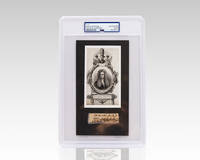
1700151722ca. 1700-1708. Autograph manuscript fragment on the Newton family lineage. England undated. A single leaf bearing autograph text in the hand of Sir Isaac Newton on both sides. 2.25 x 0.75 inches approx. 5.7 x 1.9 cm. Transcription recto: "Of the older family I am . whom I take to be my . of William Newton baptized 1541 whom ." Transcription verso: "for had by a . was next heir at law . infants and to that purpose . of her daughter with his ." A working genealogical note in Newton's hand evidently drawn from a longer document in which he traces a line of descent through one William Newton baptized 1541. The verso references questions of heirship and minor children suggesting the fragment formed part of Newton's private inquiry into the legal and lineal standing of the Newton family. Newton's documented genealogy situates him within the rural gentry of early modern England. He was born at Woolsthorpe Manor Lincolnshire to Isaac Newton a yeoman farmer who died before his son's birth and Hannah Ayscough daughter of a local clergyman. The paternal line can be traced to his grandfather Robert Newton also of Woolsthorpe indicating a family of modest landholding status. The maternal Ayscough line connected Newton to the educated clerical class a milieu that may have shaped his early intellectual formation. The present fragment though brief offers direct testimony of Newton's own engagement with the question of his ancestry and joins the small body of surviving manuscript material in which he records personal and familial concerns rather than scientific or theological matters. Condition: In good condition; minor wear consistent with age. The fragment has been archivally encapsulated by PSA/DNA together with a portrait of Newton and the corresponding authentication with the verso of the autograph remaining visible for examination. Authentication: PSA/DNA. Sir Isaac Newton 1642–1727 widely regarded as one of the most influential scientists in history established the foundational principles of classical mechanics in his Philosophiæ Naturalis Principia Mathematica wherein he articulated the three laws of motion and formulated the law of universal gravitation including the inverse-square relationship governing gravitational force. In addition to these achievements Newton independently developed the mathematical framework of calculus providing essential tools for the advancement of physics and mathematics. His extensive investigations into light and optics grounded in original experimentation significantly advanced contemporary understanding of the nature of light and color. Rejecting the long-standing authority of Aristotelian philosophy Newton instead championed an empirical experiment-based approach to scientific inquiry thereby helping to define the methodological foundations of modern science. unknown
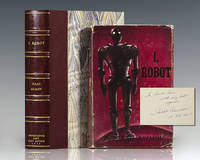
1950125007New York: Gnome Press Inc. Publishers 1950. First edition of this groundbreaking collection of stories. Octavo original cloth. Presentation copy inscribed by the author on the front free endpaper "To Bruce Lane with very best regards Isaac Asimov 26 Feb. 1951." Near fine in a very good dust jacket with a small chip to the spine. Housed in a custom half morocco clamshell box. Signed first editions are uncommon. In this collection one of the great classics of science fiction Asimov set out the principles of robot behavior that we know as the Three Laws of Robotics. Here are stories of robots gone mad mind-reading robots robots with a sense of humor robot politicians and robots who secretly run the world all told with Asimov's trademark dramatic blend of science fact and science fiction. It includes "The Evitable Conflict." in which machines that have made the world of the twenty-first century an economic utopia take control of Mankind's future moving it "toward an unknown and happy destiny" Berger Science Fiction and the New Dark Age. It is the basis for the 2004 film starring Bridget Moynahan Bruce Greenwood James Cromwell Chi McBride and Alan Tudyk. Gnome Press, Inc. Publishers hardcover books
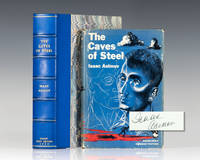
195439015Garden City NY: Doubleday & Company Inc 1954. First edition of the first work in Asimov's acclaimed Robot series. Octavo original blue boards red topstain. Signed by Isaac Asimov on the title page. Light wear to the cloth near fine in a very good dust jacket with some rubbing and wear to the extremities. Dust jacket design by Ruth Ray. Housed in a custom half morocco clamshell box. Rare and desirable signed. "One of the classic presentations of the womb-city metropolis as mother which has haunted imaginations ever since. The Caves of Steel and The Naked Sun are the best books Isaac Asimov ever wrote" The Guardian. In 2004 The Caves of Steel was nominated for a retroactive Hugo Award for Best Novel for 1954. A television adaptation was made by the BBC and shown in 1964: only a few short excerpts still exist. In 1989 the book was adapted by Bert Coules as a radio play for the BBC with Ed Bishop as Elijah Baley and Sam Dastor as R. Daneel Olivaw. Doubleday & Company, Inc hardcover books
1950140949001New York: Gnome Press 1950. First Edition. Near Fine/Near Fine. First edition first printing. 253 pp. Bound in publisher's red cloth stamped in black. Near Fine with light wear at spine ends slight lean to binding and light foxing to text block edges. In a Near Fine unclipped dust jacket with modest fading to spine panel light wear stray mark to front panel at right edge. Price crossed out with pen at front flap slight foxing to blindside. A superlative copy uncommon in such excellent shape. Asmiov's sci-fi classic that explores the ethics of artificial intelligence. Gnome Press unknown
195439015Garden City NY: Doubleday & Company Inc 1954. First edition of the first work in Asimov's acclaimed Robot series. Octavo original blue boards red topstain. Signed by Isaac Asimov on the title page. Light wear to the cloth near fine in a very good dust jacket with some rubbing and wear to the extremities. Dust jacket design by Ruth Ray. Housed in a custom half morocco clamshell box. Rare and desirable signed. One of the classic presentations of the womb-city metropolis as mother which has haunted imaginations ever since. The Caves of Steel and The Naked Sun are the best books Isaac Asimov ever wrote" The Guardian. In 2004 The Caves of Steel was nominated for a retroactive Hugo Award for Best Novel for 1954. A television adaptation was made by the BBC and shown in 1964: only a few short excerpts still exist. In 1989 the book was adapted by Bert Coules as a radio play for the BBC with Ed Bishop as Elijah Baley and Sam Dastor as R. Daneel Olivaw. Doubleday & Company, Inc hardcover
1957140942444Garden City New York: Doubleday & Company 1957. First edition. Near Fine/Near Fine. First edition first printing. Signed by Isaac Asimov and inscribed to a former owner on the title page. Bound in publisher's original yellow cloth with spine stamped in red. Near Fine with light lean to binding light toning to pages else very sharp and bright. In a Near Fine unclipped dust jacket with light edge wear light soiling and light fading to spine. Scarce. Doubleday & Company unknown
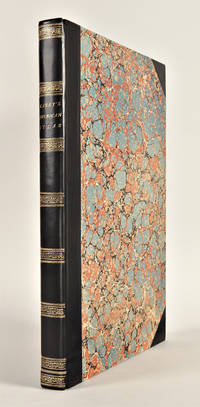
1823WRCAM43415APhiladelphia: H.C. Carey & I. Lea 1823. Letterpress title copyright notice on verso 1p. advertisement verso blank 1p. table of contents verso blank. Forty-six double-page handcolored engraved maps of the United States all but one with borders of letterpress descriptive text; uncolored double-page engraved view showing the comparative heights of mountains throughout the world; handcolored double-page engraved table showing the comparative lengths of the principal rivers worldwide; five letterpress tables four double-page three of these handcolored; 18pp. of letterpress text. Mounted on guards throughout. Modern half calf and marbled boards spine gilt leather label. Dampstaining along lower edge causing chipping to initial leaves. Closed tear in bottom margin of first map repaired with tissue. Very light offsetting from maps. Some dust soiling light tanning and foxing. Good plus. A handsome atlas of the Americas with individual color maps of each state in the Union including a seminal map of the West by Stephen H. Long. At the time of publication this was the best and most detailed atlas to be produced in the United States with substantial historical background text accompanying each map. Fielding Lucas the major Baltimore printer was the principal engraver. <br> <br> Among the most noted maps in the atlas is Major Stephen H. Long's "Map of Arkansa and other Territories of the United States." That map which depicts the Missouri basin between Nashville in the east the Mandan villages in the north and the Rocky Mountains in the west was based on the surveys conducted by Long on his expeditions of 1819 and 1820. The map published in Carey & Lea's atlas preceded the official account of that expedition by expedition botanist Edwin James which includes a smaller map with similar detail titled "Country drained by the Mississippi Western Section." Carey & Lea's 1823 publication of James' ACCOUNT perhaps explains the prior inclusion of this map with Long expedition information in their atlas. <br> <br> On this famous map is the printed legend which would perpetuate a myth for many years to come identifying the high plains as the "Great American Desert." Carey & Lea's atlas was first issued in 1822; this is the second issue with revised states of three maps Maine North Carolina and Louisiana with the same printing of the remaining maps and a cancel title. HOWES C133 "aa." PHILLIPS ATLASES 1373a. SABIN 15055. WHEAT TRANSMISSISSIPPI 348 352. H.C. Carey & I. Lea hardcover books
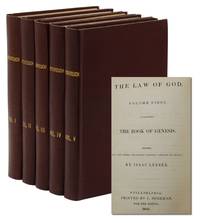
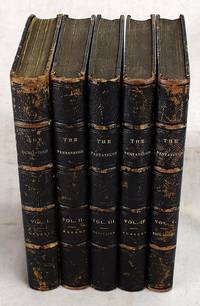
1845140942075Philadelphia: Printed by C. Sherman 1845. First American Edition. Near Fine. The first edition of the first English translation of any part the Hebrew Bible in America. Also referred to as the Pentatuech or the Five Books of Moses presented here in five volumes each containing one of the Books of Moses: Genesis Exodus Leviticus Numbers and Deuteronomy. Text in English and Hebrew. Bound in a simple yet elegant mid-19th century pebbled maroon cloth ruled in blind with titles lettered in gilt on the spines. Near Fine light rubbing to bindings pages toned. Slight lean to binding of Volume III. An important milestone of Judaism in the America. Leeser's Pentateuch remained the standard English version for American Jews until 1917 when the Jewish Publication Society translation appeared. Printed by C. Sherman unknown
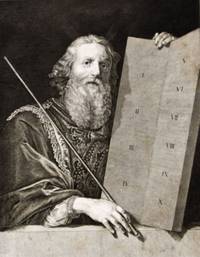
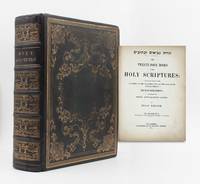
188034197Cincinnati: Published for the Rev. Abraham DeSola by The Bloch Publishing and Printing Company 1880. Third edition. Hardcover. vg. Large quarto. vii 1011 4pp. Custom period full brown pebbled leather biding with blind-stamped ruling and tooling. Gilt lettering including the owner's name on the front cover as well as on the spine. Raised bands. Dentelles. All edges of book block in red and gilt. Lustrous white silk textured endpapers. <br /> <br /> This incredibly rare and completely unrecorded third edition of the groundbreaking Leeser Bible was produced after Bloch had taken over the publishing rights sometime circa 1880. For this edition like the preceding Miller's Bible and Publishing House printing of 1878 5638 the publisher reverted to the large quarto size format and pagination of the original 1854 first edition. Additionally the preface includes the original text and September 20th 1853 date of first edition. The explanatory notes of the original edition at the bottom of each page removed in the smaller format starting with the 1857 second edition are here present again as well. Retained from those subsequent smaller format editions however is the "general remarks" section which follows the preface text. Added likely for the first time is a new table of contents directly preceding the main biblical text. Includes the traditional four blank leaves for the recording of marriages births and deaths at rear. <br /> <br /> When it was originally published in 1854 the Leeser Bible marked a major milestone in scripture translation as it is the first complete English translation of the Hebrew Bible Tanakh by a Jew. Indeed in the early 19th century most American Jews couldn't read the Bible in Hebrew and an adequate complete English translation didn't exist. Isaac Leeser's "The Twenty-Four Books of the Holy Scriptures" attempted to fill this need. Leeser spent 17 years on this landmark translation relying almost exclusively on Jewish scholarship. Soon after its publication this work became the standard for American Jews not conversant in Hebrew as well as an important contribution to Jewish American culture.<br /> <br /> This edition was issued for pioneering Canadian Rabbi Abraham De Sola 1825-1882 who was among the most prominent proponents of Orthodox Judaism in North America during the 19th century and close associate of Isaac Leeser. As the last pre-Bloch printing of the work produced for De Sola was known to have been issued in 1878 5638 our undated third edition has to have been published sometime between 1878 and De Sola's death in 1882.<br /> <br /> This unique copy of the Leeser Bible was beautifully custom bound for the owner Mathilda Friendly with 23 full-page illustrated plates which includes a half-title and frontispiece. The plates include many of the the same images which were incorporated into the Old Testament sections of similarly-illustrated Victorian-era family Bibles of the later half of the 19th century. They include finely rendered steel-plate engravings and reproductions after wood-engraved images from a number of acclaimed artists. The result is that this book ends up becoming a interesting and unique "Jewish version" of an Illustrated Family Bible of the same sort prevalent in that era.<br /> <br /> Like those Family Bibles the illustrated plates here include at least 10 reproductions after images by acclaimed French artist Gustave Dore 1832-1883 from his famous series of wood engravings originally created for the "La Grande Bible de Tours" 1866. These images include "The Deluge" "The Egyptians Drowned in the Red Sea" "Joshua Commanding the Sun to Stand Still" "David and Goliath" "Elijah Taken Up To Heaven in a Chariot of Fire" and "Esther Before the King" among others.<br /> <br /> Also present are beautifully rendered steel plate engravings. These include a gorgeous engraving of "Moses with the Ten Commandments" frontispiece by Edward Schuler 1806-1882 after the original painting by Philippe de Champaigne "Moses in the Bullrushes" half-title at the front after a lost painting by Paul Delaroche "Hagar and Ishmael" James Charles Armytage after Joseph Clark a gorgeous engraved image after the James Sant painting "The Infant Samuel" "Speak Lord for thy Servant Heareth" and "Happy Days of Job" by after a the painting by William Charles Thomas Dobson 1817-1898. Other images include work by British illustrator David Henry Friston 1820-1906 and Edouard Willmann 1820-1877 as well as engraved landscapes of Hebron Tabor and Petra. Many of the plates are protected with tissue guards.<br /> <br /> In comparing our copy with another found copy of this same scarce edition ours is extra-illustrated. It includes the steel-plate engravings not present in the other copy except for the Moses frontispiece found in both. Additionally it also contains many more of the reproduced wood-engraved plates.<br /> <br /> Binding professionally restored and re-backed retaining the original spine. Minor rubbing to extremities. Endpapers with some light stains and smudging particularly along the edges with light chipping to the edge of the rear endpaper. Interior with very sporadic minor to light foxing and stains to some of the text pages throughout. Images are mostly still very vibrant and mostly clean. Binding and interior in very good condition overall. Hebrew title: תורה × ×‘×™××™× ×•×›×ª×•×‘×™× <br /> <br /> This third edition is completely unrecorded anywhere. It is not in Singerman with no OCLC records.<br /> <br /> Bibliographic resources: Hills Margaret ed. The English Bible in America. 1962. p. 244.<br /> <br /> We are aware of copies of both the 1878 Miller printing and the scarce 1891 official fourth edition of the work with illustrated plates bound in. Published for the Rev. Abraham DeSola by The Bloch Publishing and Printing Company hardcover
366471Philadelphia: Published at 371 Walnut Street stereotyped by L. Johnson & Co. 5614. First edition. Text in two columns. iv 1011 1 blankpp. plus 4pp. family register in the rear accomplished in manuscript. 4to. Contemporary morocco gilt rebacked with the original spine laid down yellow endpapers gilt edges. Restoration at fore-edge margin of first few leaves without loss of text. Provenance: Benjamin F. Peixotto signature on front endpaper family register recording marriages and births of Peixotto and his descendants. First edition. Text in two columns. iv 1011 1 blankpp. plus 4pp. family register in the rear accomplished in manuscript. 4to. "Leeser's literary magnum opus and most lasting contribution to Judaism in America was an English translation of the Hebrew Bible 1853-54 complete with 'short explanatory notes' . Leeser's Bible as it has come to be known quickly became 'the standard bible for English speaking Jews especially in America.'" Sussman. <br /> <br /> Leeser's first biblical translation was his The Law of God published in five small-format volumes in 1845 with vocalized Hebrew text of each of the Five Books of Moses together with an English translation and notes as well as the haftarot. His larger-format Bible of 1853-54 comprised a new English translation of the full "Tanakh" revising his earlier translation of the Pentateuch and translating the remaining parts between April 1852 and September 1853. The first edition would be published shortly thereafter with a second edition in 1859 and subsequent quarto editions thereafter.<br /> <br /> This copy with esteemed early American Jewish provenance to Benjamin Franklin Peixotto 1834-1890 and his descendants. Peixotto was the grandson of Benjamin Mendes Seixas 1747-1817 one of the founders of the New York Stock Exchange the brother of hazzan Gershom Seixas and among the notable early members of Congregation Shearith Israel. Peixotte married Hannah Straus aka Strauss of Louisville Kentucky in 1858. He worked as a journalist in Cleveland Ohio and there founded the Hebrew Benevolent Society and a chapter of B'nai B'rith. In 1866 he moved with his family to New York working as a lawyer then in 1870 he became American consul first to Romania then in 1877 to Lyon France. The register records the marriages of his children and the births of his children and grandchildren through 1892. Singerman 1271; Goldman 12. J. D. Sarna and N. M. Sarna "Jewish Bible Scholarship and Translations in the United States" in The Bible and Bibles in America E. S. Freriches ed. 1998; Lance J. Sussman "Another Look at Isaac Leeser and the First Jewish Translation of the Bible in the United States" in Modern Judaism Vol. 5 No. 2 May 1985 pp. 159-190 Published at 371 Walnut Street [stereotyped by L. Johnson & Co.] unknown
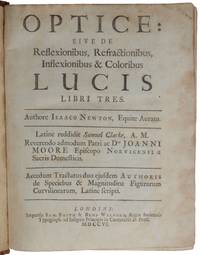
17066373London: Samuel Smith and Benjamin Walford 1706. First edition. <p>First Latin edition of the Opticks the extremely rare first issue with Ss1 in its original state. "Newton's Opticks did for light what his Principia had done for gravitation namely placed it on a scientific basis" Babson. This Latin edition is important for the seven new Queries it contains. In one of these Newton wrote that space is the 'Sensorium of God'. He later changed his mind cancelling the relevant leaf Ss1 in almost all copies although a copy in its uncancelled state found its way to Leibniz who ridiculed Newton's rash statement.</p>. <p>THE VERY RARE FIRST ISSUE WITH THE 'MISSING TANQUAM'</p> . <p>First Latin edition of the Opticks the extremely rare first issue with Ss1 in its original state cancelled in almost all copies. Of Newton's three greatest contributions to science - his theory of gravity his theories of light and colour and the invention of calculus - the first was published for the first time in the Principia 1687 and the other two in the Opticks 1704 "one of the supreme productions of the human mind" Andrade. "Newton's Opticks did for light what his Principia had done for gravitation namely placed it on a scientific basis" Babson p. 66."One of the supreme productions of the human mind" Andrade "All previous philosophers and mathematicians had been sure that white light is pure and simple regarding colors as modifications or qualifications of the white. Newton showed that the opposite is true . Natural white light far from being simple is a compound of many pure elementary colors which can be separated and recombined at will" PMM. The Optice contains translations not only of the Opticks itself but also of the two appended mathematical tracts Tractatus de quadratura curvarum and Enumeratio linearum tertii ordinis. The former is Newton's first publication of his method of fluxions or calculus which he developed in terms of 'prime and ultimate ratios' an early version of the theory of limits; it includes the first published statement of the general binomial theorem and of 'Taylor's theorem' on series expansions. The real importance of this Latin edition is the seven new 'Queries' it contains: "The Queries contain some of Newton's most influential and speculative writing" Gjertsen p. 519. The purpose of the original 16 queries in the Opticks was principally to compensate for the many years' delay between the writing of Opticks and its publication during which many discoveries had been made by Newton and others. Each of the new Queries with one exception is longer than the original 16 taken together. "In the new Queries Newton expressed fundamental views on the nature of light on the nature of bodies on the relation of God to the physical universe and on the presence in nature of a whole range of forces which furnish the activity necessary for the operation of the world and for its permanence. At the last moment he dared even a bit more and inserted three further speculative passages in the Addenda to the volume. The new Queries were the most informative of the speculations that Newton ever published." Westfall p. 644. "This edition is known in two states. In query 20 Newton had written of space: 'Annon spatium universuum sensorium est entis incorporei viventis et intelligentis' Is not infinite space the sensorium of a Being incorporeal living and intelligent. It must have struck Newton that to call space 'the sensorium of God' without any qualification was too bold a claim. Consequently he chose to substitute for page 315 a cancel in which he spoke of infinite space 'spatio infinito' as 'tanquam sensorio suo' which is as it were his sensorium. He failed however to modify the whole edition and copies with the missing tanquam been found in the Babson collection the Bodleian library and Cambridge University Library. But worse from Newton's point of view an uncancelled copy found its way to Leibniz who lost no time in accusing Newton of claiming that space is an organ of God" Gjertsen p. 413. Some of the other added Queries contain remarkably prescient speculations. Query 23 "was an extended version of the speculations on forces that Newton had once planned to insert in the Principia. Heavily indeed overwhelmingly chemical in content it was arguably the most advanced product of seventeenth-century chemistry" Westfall p. 644. "In a remarkable paragraph in Query 22 pp. 320-321 which did not survive into subsequent English editions he compared the force of attraction in proportion to size in particles of light and gross bodies by comparing velocities and radii of curvature of rays of light and projectiles. He concluded that the force of attraction in particles of light is more powerful by a factor of 1015 that is the short-range forces are immensely more powerful than gravity" ibid. p. 646.</p> <br /> <p>"Newton wrote most of the Opticks between 1687 and early 1692. He wrote Book I Parts I and II expounding his new theory of light and colour in 1687. He then appears to have set aside the Opticks for about three years but by the late summer or autumn of 1691 he had considered it - at least for a few months - to be complete. It is most likely that he carried out new research and wrote the remainder of the Opticks - that is Books II and III - in the winter or spring of 1692 or perhaps six months earlier. At some time between late August 1691 and late February 1692 Newton decided to revise the draft significantly. After this effort he brought it close to its published form except for the brief last book on diffraction which Newton called 'inflexion' and the queries which were not prepared for publication until shortly before publication in 1704.</p> <br /> <p>"The composition of Book II in 1690 or 1691 at first went very quickly. Newton made so few changes in the text that he was able to mark up the manuscript of the 'Discourse of Observations' from 1675 for his amanuensis to copy for the Opticks. This formed Parts I and II and much of Part III . After revising the 'Observations' Newton was confronted with a decision on how to end his book. At first he planned to follow this material with a new fourth book or part on diffraction but he was also toying with the idea of a speculative 'Fourth Book'. Newton soon reined in his more speculative tendencies and turned to more empirical optical investigations. He continued experiments on diffraction and also discovered an entirely new phenomenon: coloured rings produced in transparent thick plates. By the autumn of 1691 Newton had completed and written up his investigations of thick plates as Book IV Part I which together with his research on diffraction Book IV Part II was to form the concluding book of the Opticks.</p> <br /> <p>"Between late August 1691 and late February 1692 Newton removed the two parts of the new Book IV from the manuscript and set about revising them. The part on diffraction was troublesome and remained incomplete until shortly before publication. Within six months however he revised the part on the colours of thick plates incorporated it into Book III because of their affinity to those of thin films and essentially put it into its published state. During this revision Newton also introduced his theory of fits - an immaterial vibration to explain the physical cause of periodicity in light that replaced his earlier aetherial and corpuscular vibrations" Shapiro pp. 187-188. </p> <br /> <p>On 15 November 1702 according to a memorandum by the Scottish mathematician and Oxford Professor of Astronomy David Gregory Newton "promised Mr Roberts Mr Fatio Capt. Hally & me to publish his Quadratures his treatise of Light & his treatise of the Curves of the 2d Genre" i.e. cubic curves. The book appeared by 16 February 1704 when Newton presented a copy to the Royal Society" ibid. p. 196.</p> <br /> <p>In the published work "Newton presented his main discoveries and theories concerning light and color in logical order beginning with eight definitions and eight axioms . Eight propositions follow the first stating that 'Lights which differ in Colour differ also in Degrees of Refrangibility.' In appended experiments Newton discussed the appearance of a paper colored half red and half blue when viewed through a prism and showed that a given lens produces red and blue images respectively at different distances. The second proposition incorporates a variety of prism experiments as proof that 'The Light of the Sun consists of Rays differently refrangible.'</p> <br /> <p>"The figure given with experiment 10 of this series illustrates 'two Prisms tied together in the form of a Parallelopiped'. Under specified conditions sunlight entering a darkened room through a small hole F in the shutter would not be refracted by the parallelopiped and would emerge parallel to the incident beam from which it would pass by refraction through a third prism which would by refraction 'cast the usual Colours of the Prism upon the opposite Wall.' Turning the parallelopiped about its axis Newton found that the rays producing the several colors were successively 'taken out of the transmitted Light' by 'total Reflexion'; first 'the Rays which in the third Prism had suffered the greatest Refraction and painted the wall with violet and blew were . taken out of the transmitted Light the rest remaining' then the rays producing green yellow orange and red were 'taken out' as the parallelopiped was rotated yet further. Newton thus experimentally confirmed the 'experimentum crucis' showing that the light emerging from the two prisms 'is compounded of Rays differently Refrangible seeing that the more Refrangible Rays may be taken out while the less Refrangible remain' . In proposition 6 Newton showed that contrary to the opinions of previous writers the sine law of refraction actually holds for each single color. The first part of book I ends with Newton's remarks on the impossibility of improving telescopes by the use of color corrected lenses and his discussion of his consequent invention of the reflecting telescope.</p> <br /> <p>"In the second part of book I Newton dealt with colors produced by reflection and refraction or transmission and with the appearance of colored objects in relation to the color of the light illuminating them. He discussed colored pigments and their mixture and geometrically constructed a color wheel drawing an analogy between the primary colors in a compound color and the "seven Musical Tones or Intervals of the eight Sounds Sol la fa sol la mi fa sol."</p> <br /> <p>"Proposition 9 'Prob. IV. By the discovered Properties of Light to explain the Colours of the Rain-bow' is devoted to the theory of the rainbow. Descartes had developed a geometrical theory but had used a single index of refraction in his computation of the path of light through each raindrop. Newton's discovery of the difference in refrangibility of the different colors composing white light and their separation or dispersion as a consequence of refraction on the other hand permitted him to compute the radii of the bows for the separate colors. He used 108:81 as the index of refraction for red and 109:81 for violet and further took into consideration that the light of the sun does not proceed from a single point. He determined the widths of the primary and secondary bows to be 2°15' and 3°40' respectively and gave a formula for computing the radii of bows of any order n and hence for orders of the rainbow greater than 2 for any given index of refraction .</p> <br /> <p>"Book II which constitutes approximately one third of the Opticks is devoted largely to what would later be called interference effects growing out of the topics Newton first published in his 1675 letter to the Royal Society. Newton's discoveries in this regard would seem to have had their origin in the first experiment that he describes Book II Part 1 Observation 1; he had he reported compressed 'two Prisms hard together that their sides which by chance were a very little convex might somewhere touch one another' as in the figure provided for Experiment 10 of Book I Part 1. He found 'the place in which they touched' to be 'absolutely transparent' as if there had been one 'continued piece of Glass' even though there was total reflection from the rest of the surface; but 'it appeared like a black or dark spot by reason that little or no sensible light was reflected from thence as from other places' . Rotating the two prisms around their common axis Observation 2 produced 'many slender Arcs of Colours' which the prisms being rotated further 'were compleated into Circles or Rings.' In Observation 4 Newton wrote that 'To observe more nicely the order of the Colours . I took two Object-glasses the one a Plano-convex for a fourteen Foot Telescope and the other a large double Convex for one of about fifty Foot; and upon this laying the other with its plane side downwards I pressed them slowly together to make the Colours successively emerge in the middle of the Circles and then slowly lifted the upper Glass from the lower to make them successively vanish again in the same place.' It was thus evident that there was a direct correlation between particular colors of rings and the thickness of the layer of the entrapped air . Furthermore as he noted in Observation 13 'the Circles which the red Light made' were 'manifestly bigger than those which were made by the blue and violet' . He concluded that the rings visible in white light represented a superimposition of the rings of the several colors and that the alternation of light and dark rings for each color must indicate a succession of regions of reflection and transmission of light produced by the thin layer of air between the two glasses . </p> <br /> <p>"Book II Part 2 of the Opticks has a nomogram in which Newton summarized his measures and computations and demonstrated the agreement of his analysis of the ring phenomenon with his earlier conclusions drawn from his prism experiments - 'that whiteness is a dissimilar mixture of all Colours and that Light is a mixture of Rays endued with all those Colours.' The experiments of Book II further confirmed Newton's earlier findings 'that every Ray have its proper and constant degree of Refrangibility connate with it according to which its refraction is ever justly and regularly perform'd' from which he argued that 'it follows that the colorifick Dispositions of Rays are also connate with them and immutable.' The colors of the physical universe are thus derived 'only from the various Mixtures or Separations of Rays by virtue of their different Refrangibility or Reflexibility'; the study of color thus becomes 'a Speculation as truly mathematical as any other part of Opticks.' </p> <br /> <p>"In Part 3 of Book II Newton analyzed 'the permanent Colours of natural Bodies and the Analogy between them and the Colours of thin transparent Plates.' He concluded that the smallest possible subdivisions of matter must be transparent and their dimensions optically determinable. A table accompanying Proposition 10 gives the refractive powers of a variety of substances 'in respect of . Densities.' Proposition 12 contains Newton's conception of 'fits': 'Every Ray of Light in its passage through any refracting Surface is put into a certain transient Constitution or State which in the progress of the Ray returns at equal Intervals and disposes the Ray at every return to be easily transmitted through the next refracting Surface and between the returns to be easily reflected by it.' The succeeding definition is more specific: 'The returns of the disposition of any Ray to be reflected I will call its Fits of easy Reflection and those of its disposition to be transmitted its Fits of easy Transmission and the space it passes between every return and the next return the Interval of its Fits.' The 'fits' of easy reflection and of easy refraction could thus be described as a numerical sequence; if reflection occurs at distances 0 2 4 6 8 . from some central point then refraction or transmission must occur at distances 1 3 5 7 9 . Newton did not attempt to explain this periodicity stating that 'I do not here enquire' into the question of 'what kind of action or disposition this is' . Newton thus integrated the periodicity of light into his theoretical work . His work was moreover based upon extraordinarily accurate measurements - so much so that when Thomas Young 1773-1829 devised an explanation of Newton's rings based on the revived wave theory of light and the new principle of interference he used Newton's own data to compute the wavelengths and wave numbers of the principal colors in the visible spectrum and attained results that are in close agreement with those generally accepted today.</p> <br /> <p>"In Part 4 of Book II Newton addressed himself to 'the Reflexions and Colours of thick transparent polish'd Plates.' This book ends with an analysis of halos around the sun and moon and the computation of their size based on the assumption that they are produced by clouds of water or by hail. This led him to the series of eleven observations that begin the third and final book 'concerning the Inflexions of the Rays of Light and the Colours made thereby' in which Newton took up the class of optical phenomena previously studied by Grimaldi in which 'fringes' are produced at the edges of the shadows of objects illuminated by light 'let into a dark Room through a very small hole.' Newton discussed such fringes surrounding the projected shadows of a hair the edge of a knife and a narrow slit" DSB.</p> <br /> <p>"Since Newton published the Opticks without a complete investigation into diffraction which he had hoped would support a corpuscular theory of light in which light corpuscles were acted on by short-range forces of matter" Shapiro p. 196 "Newton concluded the first edition of the Opticks with a set of sixteen queries introduced 'in order to a further search to be made by others.' He had at one time hoped he might carry the investigations further but was 'interrupted' and wrote that he could not 'now think of taking these things into farther Consideration.' In the eighteenth century and after these queries were considered the most important feature of the Opticks . The original sixteen queries at once go beyond mere experiments on diffraction phenomena. In Query 1 Newton suggested that bodies act on light at a distance to bend the rays; and in Queries 2 and 3 he attempted to link differences in refrangibility with differences in 'flexibility' and the bending that may produce color fringes. In Query 4 he inquired into a single principle that by 'acting variously in various Circumstances' may produce reflection refraction and inflection suggesting that the bending in reflection and refraction begins before the rays 'arrive at the Bodies.' Query 5 concerns the mutual interaction of bodies and light the heat of bodies being said to consist of having 'their parts put into a vibrating motion'; while in Query 6 Newton proposed a reason why black bodies 'conceive heat more easily from Light than those of other Colours.' He then discussed the action between light and 'sulphureous' bodies the causes of heat in friction percussion putrefaction and so forth and defined fire in Query 9 and flame in Query 10 discussing various chemical operations. In Query 11 he extended his speculations on heat and vapors to sun and stars. The last four queries 12 to 16 of the original set deal with vision associated with 'Vibrations' excited by 'the Rays of Light' which cause sight by 'being propagated along the solid Fibres of the optick Nerves into the Brain.' In Query 13 specific wavelengths are associated with each of several colors. In Query 15 Newton discussed binocular vision along with other aspects of seeing while in Query 16 he took up the phenomenon of persistence of vision" DSB.</p> <br /> <p>Newton appended to the Opticks two mathematical tracts of which the first Tractatus de quadratura curvarum is Newton's first published account of the calculus of fluxions. In Newton's time finding the 'quadrature' of a curve meant finding the area enclosed or subtended by it which for us is a problem of integral calculus and for Newton one of the 'inverse method of fluxions'. Newton wrote three extended treatises on fluxions. The first of these 'De analysi per aequationes numero terminorum infinitas' was composed in 1669 and treats Newton's general methods of infinite series. It was not published until 1711 when William Jones included it along with a number of other tracts in his Analysis per quantitatum series. In 'De analysi' however Newton "did not explicitly make use of the fluxionary notation or idea. Instead he used the infinitely small both geometrically and analytically in a manner similar to that found in Barrow and Fermat and extended its applicability by the use of the binomial theorem" Boyer The Concept of Calculus p. 191. It was in the second of Newton's calculus treatises 'De methodus fluxionum' composed in 1671 but not published until 1736 that he first "introduced his characteristic notation and conceptions. Here he regarded his variable quantities as generated by the continuous motion of points lines and planes rather than as aggregates of infinitesimal elements the view which had appeared in 'De analysi'. . In the 'Methodus fluxionum' Newton stated clearly the fundamental problem of the calculus: the relation of quantities being given to find the relation of the fluxions of these; and conversely" ibid. pp. 192-3 i.e. the processes that we call differentiation and integration.</p> <br /> <p>De quadratura was the first of Newton's treatises on fluxions to be published but the last to be composed so that it represents his most mature view of the subject. It was prompted by a letter from David Gregory on 7 November 1691 sending Newton "my method of squaring figures published three years ago but now clarified by examples. If only I might be allowed to know your method too which as I have subsequently gathered differs little from mine." "De quadratura contained the first published statement of the binomial theorem discovered by Newton some forty years before. The text of De quadratura in its published form is in two parts. In the first part Newton in the manner of De analysi demonstrated how infinite series could be deployed to determine the quadrature and rectification of curves. In the second part he returned to the topic of fluxions discussed at greater length in his then unpublished De methodis eventually published as The method of fluxions and infinite series in 1736" Gjertsen p. 579. But perhaps "Newton's most important achievement in his 'De quadratura' was the first explicit enunciation of the Taylor expansion of a general function - Newton deduced the particular 'Maclaurin' form in his Corollary 3 by successive differentiation it would seem and then passed to the general theorem in his Corollary 4" Papers VII pp. 18-19. The expansion was rediscovered by Brook Taylor in 1715.</p> <br /> <p>The second appended mathematical treatise Enumeratio linearum tertii ordinis was composed in summer 1695 although it was based on researches carried out intermittently over the previous three decades. "In some ways the Enumeratio is the most original of Newton's mathematical works. It had no predecessors met with no rivals claiming to have anticipated the results or few even who acknowledged its results" Gjertsen p. 187. Since the inception of analytic geometry - most notably with Descartes's Géométrie 1637 which Newton carefully studied in its Latin translation 1659-61 - European mathematicians became interested in the algebraic representation of plane curves. As Descartes showed and John Wallis further developed conic sections can be represented by second-degree polynomial equations in two variables in Cartesian coordinates as we would say nowadays and they can be divided into circle parabola ellipse and hyperbola. The question naturally arises of how to move a step further and study the graphs of third-degree polynomials. In the Enumeratio Newton gave a classification of cubic curves analogous to the classification of conic sections. He identified 72 species of cubic curves mostly classified in terms of the properties of their diameters and asymptotes. There are in fact 78 species: four were added by James Stirling in his Lineae tertii ordinis Newtonianae 1717 and the remaining two by François Nicole and Nicolas I Bernoulli in the 1730s. Newton uses oblique Cartesian axes something Descartes did not do and has no qualms in using negative coordinates a novelty at the time. Newton also demonstrates deep geometrical insights stating a general theorem according to which all cubic curves can be obtained by centrally projecting the five 'divergent parabolas' very much as all conics can be obtained by projecting the circle; this was proved by Nicole and Alexis-Claude Clairaut in 1731. In the final section of the work Newton shows how the real roots of polynomial equations of degree up to 9 can be found from the points of intersection of cubic curves with lines conics or other cubic curves. Newton gave almost no proofs of his claims but Stirling revealed the methods Newton had used: algebra and infinite series. Newton's published treatise is "a marvellous epitome of results whose subtleties were only just becoming to be understood by mathematicians in the last decade of Newton's life half a century after their initial discovery" Papers VII p. 588 n1.</p> <br /> <p>Gjertsen p. 520 summarizes the content of the seven new Queries added to the Optice as follows:</p> <br /> <br /> 17-18: Double refraction<br /> 19: The 'Phenomena of Light' are not to be explained by 'new Modifications of the Rays'<br /> 20: Objections to wave theory of light and to a dense fluid medium; rejection of hypotheses in natural philosophy; limits of mechanism and a list of fundamental questions; space is the Sensorium of God<br /> 21: Rays of light are 'very small Bodies emitted from Shining substances' a view which allows many of the properties of light to be explained<br /> 22: Bodies and light are interconvertible<br /> 23: Small particles of bodies capable of acting at a distance as can be seen in a number of chemical and physical processes; evidence for the view that 'All Bodies seem to be composed of hard Particles'; Hauksbee's experiments; motion and its need of certain active principles; matter also made in the beginning by God from 'solid massy hard impenetrable moveable Particles' in need of 'certain active Principles'; examples of the divine providence in the universe.<br /> <br /> <p>In Query 20 "the refutation of wave theories of light led Newton into an argument against the possibility of a dense Cartesian ether filling the heavens and thence into an explication of his ultimate objection against conventional mechanical philosophies their tendency to make nature self-sufficient and thus to dispense with God. Some ancient philosophers he argued took atoms the void and the gravity of atoms as the first principles of their philosophy and attributed gravity to some other cause than matter.</p> <br /> <p>'Latter Philosophers banish the Consideration of such a Cause out of natural Philosophy feigning Hypotheses for explaining all things mechanically and referring other Causes to Metaphysicks: Whereas the main Business of natural Philosophy is to argue from Phenomena without feigning Hypotheses and to deduce Causes from Effects till we come to the very first Cause which certainly is not mechanical; and not only to unfold the Mechanism of the World but chiefly to resolve these and such like Questions. What is there in places empty of Matter and whence is it that the Sun and Planets gravitate towards one another without dense Matter between them Whence is it that Nature doth nothing in vain; and whence arises all that Order and Beauty which we see in the World . . . How do the Motions of the Body follow from the Will and whence is the Instinct in Animals Is not infinite Space the Sensorium of a Being Annon Spatium Universum Sensorium est Entis incorporeal living and intelligent who sees the things themselves intimately and thoroughly perceives them and comprehends them wholly by their immediate presence to himself .'</p> <br /> <p>"David Gregory who held an extensive discussion of the new Queries with Newton on 21 December 1705 recorded the interpretation of this passage in a memorandum.</p> <br /> <p>'His Doubt was whether he should put the last Quaere thus. What the space that is empty of body is filled with. The plain truth is that he believes God to be omnipresent in the literal sense; And that as we are sensible of Objects when their Images are brought home within the brain so God must be sensible of every thing being intimately present with every thing: for he supposes that as God is present in space where there is no body he is present in space where a body is also present. But if this way of proposing this his notion be too bold he thinks of doing it thus. What Cause did the Ancients assign of Gravity. He believes that they reckoned God the Cause of it nothing els that is no body being the cause; since every body is heavy.'</p> <br /> <p>"At the last moment after the last moment really Newton decided that he had indeed been too bold. He tried to recall the whole edition; and from all the copies he could lay his hands on he cut out the relevant page and pasted in a new one which asserted not that infinite space is the sensorium of God but that 'there is a Being incorporeal living intelligent omnipresent who in infinite Space as it were in his Sensory tanquam Sensorio suo sees the things themselves intimately .' Alas he failed to alter every copy and one of the originals made its way to Leibniz who did not fail to hold up to ridicule the concept of space as the sensorium of God. In its initial form the passage recalled 'De gravitatione' the beginning of Newton's rebellion against Cartesian philosophy because of its atheistical tendencies. Following the implications of the rebellion he had traveled far. In the Latin edition of the Opticks he gave the fullest exposition of his own conception of nature he would ever put in print before in his old age he tried to placate critics by seeming retreats to more conventional positions.</p> <br /> <p>"In addition to its importance for Newton's philosophy the Latin edition of the Opticks also provided the occasion for a graceful personal relation. Abraham De Moivre saw it through the press. Every evening according to the story Newton would wait for him in a coffeehouse where De Moivre would go as soon as he finished the mathematical lessons with which he supported himself. Newton would take him home and the two would spend the evening in philosophical discussion. De Moivre was one of the young men in London disciples really with whom Newton found companionship possible in a way it had never been in Cambridge. Another young disciple Samuel Clarke translated the Opticks into Latin and received £500 for his pains: £100 for each of his five children" Westfall pp. 646-8.</p> <br /> <p>Babson 137; Honeyman 2326; Poggendorff II 277; Wallis 179. Gjertsen The Newton Handbook 1986. Shapiro 'Newton's Optics' pp. 165-198 in: The Oxford Handbook of the History of Physics Buchwald & Fox eds. 2013. Westfall Never at Rest 1980.</p> <br/> <br/> 4to mm pp. xiv 348 2 24 2 43 recte 47 with 19 engraved plates. Contemporary calf. Samuel Smith and Benjamin Walford unknown
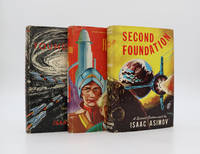
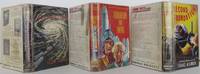
29796New York: Gnome Press. 1951 1952 1953. First edition first printing. First edition first printing. Three volumes. Publisher's original first state navy blue Foundation red Foundation and Empire and blue Second Foundation cloth with red black and brown titles to the spine in the David Kyle Edd Cartier and Ric Binkley illustrated dustwrappers. A better than very good set. The bindings square and firm with just a little bumping to the spine tips and rubbing to the extremities the cloth bright and fresh. The contents are clean throughout and without inscriptions or stamps. 'Second Foundation' is a little spotted to the prelims and closed text-block edge. Complete with the uniformly bright lightly rubbed and nicked first state dustwrappers each with a few closed tears. 'Foundation and Empire' is price-clipped and with a small chip to the bottom edge of the lower panel. 'Foundation' and 'Second Foundation' with just a touch of fading to the red lettering on the spine are correctly priced $2.75 to the front flap. All three volumes are housed in a bespoke quarter morocco folding case with titles in gilt to the spine. An attractive set in entirely original condition. Isaac Asimov's magnum opus and a classic of the science fiction genre a trilogy about the political struggles of a far-future galactic empire as it teeters on the brink of demise. Winner of the one-time Hugo Award for 'Best All-Time Series' in 1966 beating J. R. R. Tolkien's 'The Lord of the Rings' to the surprise of Asimov himself. Originally published as a series of short stories and novellas in Astounding Magazine from 1942-1950 it appears here in book form for the first time. Asimov later added four further novels to the series two sequels 'Foundation's Edge' 1982 and 'Foundation and Earth 1986 and two prequels 'Prelude to Foundation' 1988 and 'Forward to Foundation' 1993. L. W. Currey: Science Fiction And Fantasy Authors A Bibliography Of Their First Printings. Further details and images for any of the items listed are available on request. Lucius Books welcomes direct contact with our customers. New York: Gnome Press. 1951, 1952, 1953 hardcover
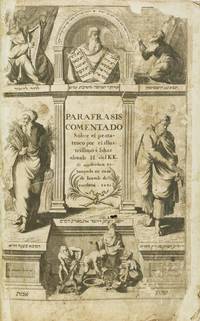
55265Amsterdam: Estampado en caza de Iaacob de Cordova 5441. First edition. Hardcover. g to vg-. Large quarto. 5 634pp. Re-backed in modern spine with raised bands blind-stamped tooling and the original gilt-stamped leather label pasted on. Retains original leather boards. Edges of the book block in red. Engraved title page. Text throughout printed in a two-column format with decorative woodcut initials and tailpieces.<br /> <br /> This work is a paraphrased translation of the Pentateuch the Five Books of Moses into Spanish by Rabbi Isaac Aboab da Fonseca 1605-1693 seamlessly incorporating and utilizing past rabbinic commentary and midrash into the text. The previous commentaries referenced by Aboab throughout are usually attributed to the views of "sages" or "theologians" without specifically citing the individual source. The book was important for the ex-converso Sephardic Jewish community of Amsterdam as many of these Jews who had in more recent years reconnected with there Jewish heritage after a period of more than one hundred years living as Catholics on the Iberian peninsula could not read Hebrew. This publication is one of a large number of works of Judaica including bibles and prayer books published from the 16th - early 18th centuries which catered to that community. The author a respected scholar and prominent member of the Sephardic community was himself from a Portuguese Jewish family which had previously been forcibly converted to Christianity. The work is considered to be Aboab's magnum opus and was the standard by which all other similar works of the period were judged.<br /> <br /> The engravings which surround the text on the title page by Jan van den Aveele c. 1650 - 1727 depict a number of biblical scenes and figures and contain some Hebrew text. The prologue contains approbations including some Hebrew text from three other prominent religious figures in the community: Jacob ben Aaron Sasportas 1610 – 1698 Immanuel Abenatar Melo and Selomoh de Oliveira.<br /> <br /> Text throughout in Spanish.<br /> <br /> Binding with some light rubbing to the extremities and some period abrasions to the covers. Interior with some light water staining to the interior covers and free endpapers. Text pages throughout with some sporadic minor to light foxing and water stains with a few small instances of worming or other holes. Title page with a small hole at the center and a closed tear at the bottom. The initial 7 printed leaves have been repaired and/or reinforced to one degree or another mostly in the margins. In the case of the title page laid down this has resulted in some minor loss of image to the edges of the leaf and some loss of text along the left margin of the prologue leaf and on p.1 and 3. Pages throughout on the whole in good shape. Binding in very good- interior in good condition overall. About the author:<br /> Isaac Aboab da Fonseca 1605-1693 was a leading Rabbi and scholar of the Portuguese Jewish community of Amsterdam in the 17th century. He was born in the Portuguese town of Castro Daire as Simão da Fonseca and was a member of the large and prominent Aboab family which was comprised of many noted rabbis scholars physicians and merchants over the centuries. He was born into a family of conversos but still constant anti-Semitic persecution caused the family to immigrate to Amsterdam when Isaac was seven years old. There they reestablished their Jewish roots. From 1642-1654 he was appointed to be the head of the Jewish community in Recife Brazil during the brief period of Dutch control. He served as Rabbi of the Kahal Zur Israel Synagogue the first synagogue in the Americas. Upon the retaking of the colony by the Portuguese Aboab came back to Amsterdam and in 1656 he was one of several prominent religious leaders of the Portuguese-Jewish community of Amsterdam to excommunicate the famed philosopher Baruch Spinoza.<br /> <br /> Reference: Darlow and Moule #8481. Estampado en caza de Iaacob de Cordova hardcover
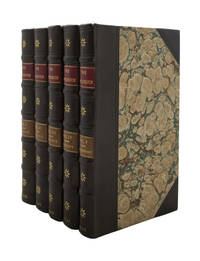
1803327150London: Symonds 1803. hardcover. near fine. 3 volumes. 55 folding copper engravings and small engravings throughout the text frontispiece copperplate portrait of Isaac Newton in volume 1. 8vo handsomely rebound in full dark brown calf with blind-stamped design on covers and spine black leather spine labels. Some scattered age toning and spotting; neat small ownership name at top of title pages and half titles. London: H. D. Symonds 1803. A scarce set in a handsome binding.<br/> <br/> Symonds unknown
184568182The First English Translation of the Pentateuch in America LEESER Isaac translator editor. BIBLE IN HEBREW. The Law of God. In Five Volumes. The Pentateuch Philadelphia: C. Sherman 1845. First edition of the first English translation of any part of the Hebrew Bible in America the Pentateuch. The Pentateuch means the first five books of the Bible. These books comprise Genesis Exodus Leviticus Numbers and Deuteronomy. Complete with five octavo volumes 7 1/2 x 4 5/8 inches; 189 x 118 mm. With text in Hebrew and the corresponding English on the facing page. Generally the Hebrew is on the recto English on the verso. Modern half calf over marbled boards. Calf ruled in blind. Spines with red and brown calf spine labels lettered in gilt. Spines stamped in gilt. Some unobtrusive creasing to upper corner of final three leaves of volume I. A tiny dampstain to top of text block of volume I not affecting leaves. Edges very slightly trimmed as shown by remnants of gilt but still with large margins. Some minor foxing and toning mainly to preliminary leaves most of text is very clean. Overall a near fine copy. "Leeser's career as a translator also began in Philadelphia in 1830 with the publication of his rendering from German of J. Johlson's Instruction in the Mosaic Religion. Leeser as part of his ongoing efforts to contribute to the development of Jewish education and culture in America translated a number of important works into English from German Spanish French and Hebrew. Among his most important translations were Moses Mendelssohn's Jerusalem Joseph Schwartz' Descriptive Geography and Brief Historical Sketch of Palestine as well as his renowned Bible translations first of the Pentateuch and later of the entire Hebrew Bible. Leeser continued to play an unceasing role in creating the cultural foundations of Jewish life in Philadelphia and throughout North America. In 1845 Leeser founded the first American Jewish Publication Society and in the same year published his translation of the Pentateuch entitled The Law of God a bi-lingual edition which included the unpointed unvocalized Hebrew text. " Penn Libraries; Biographical Sketch of Isaac Leeserby Arthur Kiron Schottenstein-Jesselson Curator of Judaica Collections. "The translator of the first American Jewish Bible Isaac Leeser 1806-68 was a modern Orthodox German Jew who immigrated to America in 1822. Leeser 'was the most important Jewish religious leader in the United States during the Ante-bellum Period.' In 1830 Leeser published an English translation of Johlson's catechism Instructions in the Mosaic Religion in Philadelphia another English edition appeared in 1867. However his major work was a Bible translation for American Jews the authoritative English translation until the first Jewish Publication Society translation appeared in 1917." A History of German Jewish Bible Translation Abigail Gillman pg 126. "The translation of the Bible was Leeser's great literary achievement and represented many years of patient labor and devotion to a task which he considered sacred. Leeser was not fully equipped for this work for he was no specialist in Hebrew philology nor a master if Jewish learning in general and he was quite conscious of his shortcomings but he was inspired. He says in his preface: 'I thought in all due humility that I might safely go to task confidently relying upon that superior aid which is never withheld from the inquirer after truth.' He made good use of the various German translations by Jews of the collective commentary known as the Biur vol. III sec. 81 and of other Jewish exegetic works. As a result his translation though based in style upon the King James version can be considered an independent work for the changes he produced are numerous and great. His prime consern was to supply the traditional interpretation when necessary and the retention of the Jewish spirit at times even at the expense of beauty of style. The translation went through numerous editions and until the new Jewish Publication Society version was issued in 1917 it was the only source from which many Jews not conversant with Hebrew derived their knowledge of the Bible in accordance with Jewish tradition" Waxman History of Jewish Literature 1090. HBS 68182. $11500 C. Sherman hardcover books
18452109210003Philadelphia : Printed by C. Sherman for the editor 5605 1845. First Edition. Hardcover. Very Good. First Jewish Translation of the Pentateuch into English: The Standard American Jewish Bible during the 19th Century 5 volume set; 20 cm. Bound in contemporary tooled calf. Good bindings and covers. Minor shelf wear rubbing but sound. Marbled end sheets. Added title page in Hebrew. Text is printed in Hebrew and English on facing pages. Clean unmarked pages. p. 22 in Leviticus is creased. Early inscription from 1881 to "Mosley from Brother Abraham 1881 Cincinnati." v.2 lacks the blank end pages. Contents: v.1. The book of Genesis.; v. 2. The book of Exodus.; v. 3. The book of Leviticus.; v. 4. The book of Numbers.; v.5. Deuteronomy. <br> Leeser's was the first English translation of the Torah by a Jewish translator. Prior to its publications English Jews used the King James translation. Isaac Lesser 1806-1868 was a Jewish-American newspaper editor The Occident religious leader Congregation Mikveh Israel in Philadelpha publisher and scholar. Born in Germany Leeser studied Latin German and Hebrew under the chief rabbi of Munster. Leeser helped found the Jewish press of America. His work laid the foundations for Modern Orthodox and Conservative Judaism. Leeser doubted that "the precious word of God ever appeared among us in a more beautiful form than the volumes in which I am now engaged." Leeser avoided reliance on earlier English translations though he made some use of German translations and noted that "the arrangement is strictly Jewish. My intention was to furnish a book for the service of the Synagogue both German and Portuguese." References: Goldman 7; Hills 1273; Rosenbach 569. Philadelphia : Printed by C. Sherman, for the editor, 5605 hardcover
173943292London: printed for John Wilcox 1739. First edition 12mo pp. xii 88; 5 engraved folding plates of diagrams; contemporary parchment-backed marbled boards manuscript titling on spine; very good and sound. With the South Library bookplate Earls of Macclesfield and 3 small Macclesfield pressure stamps in the preliminaries. In a new maroon cloth clamshell box. This is apparently the first of two issues without the canceled title page. Both are very rare ESTC locating only one copy of each at the Bodleian and the British Library respectively. OCLC adds LC Berkeley and University of Leiden. <br/><br/> printed for John Wilcox hardcover books
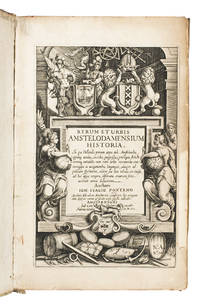
161121770Amsterdam: Jodocus Hondius 1611. Contemporary limp vellum sewn on 4 supports laced through the joints with the manuscript title and author on the spine. Folio. With an engraved title 7 engraved maps and plates 5 folding 2 double-page and 50 engraved maps and views in the text. First edition of the first objective description of Amsterdam and its history with extensive accounts of Dutch East India Company's VOC maritime trade exploration and navigation. It contains the report of Willem Barentsz' voyages to the Arctic region in search of a North-East passage to Asia 1594-1597 the accounts of the two first Dutch voyages to the East Indies including the voyage of Cornelis de Houtman 1595-1597 and the account of the Dutch exploration of Greenland 1594-1596. The work is also important as an Americanum as it gives the results of Henry Hudsons first two voyages to the Arctic 1607-1608 for the Muscovy Company of London. These reports are beautifully illustrated by large maps and views including a famous map of the North Pole region.Johannes Isaac Pontanus 1571-1639 was a physician and historian who was a professor at the University of Harderwijk for most of his life. He wrote several important historical works such as the history of Denmark of the Duchy of Gelre and of Amsterdam. His work on Amsterdam far exceeds the limits of the usual town descriptions elaborately incorporating the history of the voyages of exploration and commerce undertaken by the enterprising citizens of Amsterdam. Pontanus also describes in detail the activities on the Amsterdam stock and commodity markets which were among the earliest of the world and at the time the most important. The extent of the citys trading activities by this time is shown by illustrations of scenes from Indonesia and India to the Arctic.The binding is somewhat stained and soiled with a restoration at the foot of the spine and along the fore and foot edge of the back board. The work is lightly browned and foxed throughout a faint water stain in the margin of the last 11 leaves. Otherwise in good condition.l Alden & Landis II 611/91; V. Gestel-Van het Schip Maps in books of Russia and Poland 218; JCB II p. 78; JFB p. 369; Nijhoff & V. Hattum 252; Sabin 64002; STCN 850336392 19 copies; Tiele Bibl. 876. Jodocus Hondius, hardcover
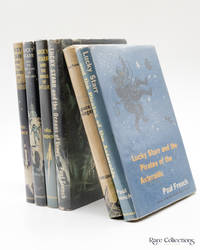
8012Garden City: Doubleday & Company. Hardcover. Signed by Author. A rare complete set of the six Lucky Starr novels by Isaac Asimov written under the pseudonym Paul French. The first 4 titles are all inscribed and signed by Asimov to Stephen Landan with the final two novels signed via stickers / bookplate. These books are rare on the market with several having no copies available with DJ signed or unsigned. Signed copies are particularly rare and I have found no history of a complete set being available for sale. David Starr is NF book in green boards peach topstain and some normal toning internally but otherwise fine. Inscribed on title page. NF unclipped DJ showing some toning to white pages very minor edgewear and now in brodart jacket. Lucky Starr and the Pirates VG book general wear and fading to boards. Blue topstain with possible dampstain. Internally in fine condition but with toning on endpapers. Inscribed on title page. VG DJ showing dampstain along spine visible inside and on edge and bottom of the back panel and backflap. Unclipped with some edgewear and small closed tear on the bottom back. Now with brodart cover. Oceans of Venus about NF minor wear to the boards crips black lettering on spine. Internally fine and inscribed on the title page. VG DJ showing some chipping mostly on top and bottom of spine unclipped and now with brodart jacket. Big Sun of Mercury NF or better book. Crisp boards and lettering some toning to end papers and old dogear fold visible on page 45. Inscribed by Asimov on front endpaper. VG unclipped jacket some minor edgewear and chipping. Small closed tear and fold on back panel ow with brodart jacket. Moons of Jupiter beautiful copy Fine condition signed on inserted sticker / bookplate in front endpaper. Fine DJ unclipped slight fading to the spine and now in brodart. Rings of Saturn NF or better book small abrasion on spine but otherwise in fine condition signed via inserted sticker / bookplate. NF unclipped DJ some abrasion to the front cover but otherwise in fine condition. An exceptional set and I believe each copy individually just about the best copy available at time of listing. For more information and detailed photos please feel free to get in touch. Doubleday & Company hardcover
175646122London.: Printed for T. Osborne and J. Shipton . &c. 1756. Contemporary mottled calf. 2 vols. Folio. 412 x 258 mm. Engraved frontispiece printed title in red and black with engraved vignette preface list of plates contents and Ware's text in ten books illustrated with 114 engraved plates 14 folding with irregular numbering in first state with the numbers within the platemark and plate 70 / 71 titled 'Warwick Shire' final eaves with index. PROVENANCE: Ownership signature of John Ingilby to title likely Sir John Ingilby 1705 - 1772 or his illegitimate son also SIr John Ingilby 1758 - 1815; ownership signature of W. B. Colthunt and date '27 Oct. 1919' to front free endpaper. The first edition of Isaac Ware's practical and comprehensive manual of architecture.Isaac Ware 1704 - 1766 the associate of Lord Burlington member of the St. Martin's Lane Academy and member of the 'Board of Works' was already associated with a number of important architecture books 'The Designs of Inigo Jones . &c.' of 1731 the 'Plans . of Houghton' of 1735 'The Four Books of Architecture of Andrea Palladio' of 1738 and the translation of Sirigatti of 1756 before he issued this his massive magnum opus. A follower but not a slavish one of Palladio and Vitruvius Ware offers the two as the pinnacles and authorities for all of architecture but cautions against blind acceptance. Of major importance to English Palladianism Ware's Georgian legacy is also relevant and his 'Complete Body' was of such interest to his contemporaries that a second edition was published a short time after his death in 1766.'Like Vitruvius and Alberti before him Ware arranged his treatise in ten books. Having defined the most commonly used architectural terms he devotes the rest of book one to a discussion of materials. Book two is divided into five sections: the first on location; the second on the functional parts of a building and the third fourth and fifth on the orders. Book three begins the practical advice on house construction. Books four five and six deal with doors windows and interior ornament book seven with exterior ornament and garden buildings book eight with bridges. Book nine consists of an interesting return to what Ware calls 'the construction of elevations upon the true principles of architecture' . It is in the nature of an appendix to the whole and allows Ware to write cuttingly of modern practices. Book ten is a brief introduction to mathematics and mensuration . '. Millard.'There was a copy of either the 1756 or 1767 edition in Jefferson's private library at the time of his death . The copy Jefferson ordered for the University in the section on 'Architecture' of the want list can be identified as either of these two editions from the title but there is no record of the library's ever having received it.' Jefferson's Fine Arts Library pg. 374.Park 84; Fowler 436; Millard 87; Jefferson's Fine Arts Library 126a. Printed for T. Osborne and J. Shipton ... &c. unknown
177153117Amsterdam: Marc Michel Rey 1771. First Edition. Very Good. Octavo. xvi 128 8: "Etat des Finances en Angleterre" 129-384 2: errata; blankpp. Woodcut ornaments; 4 half-titles. Collation: 8 A-H8 H4 I-Z8 Aa8 chi1 = 205 leaves. Contemporary marbled calf lightly rubbed at extremities gilt-tooled spine with raised bands gilt morocco lettering piece; edges stained red; marbled endleaves. Small patch of marginal damp staining to bottom corner of first 15 and final 10 leaves; signature Aa mildly embrowned else text crisp and clean throughout. Overall a very good copy.<br /> <br /> Rare complete first edition of "one of the great documents in the history of political economy" EJ. In addition to the brief discursus on English finances inserted between the second and third parts of the main treatise our copy includes the usually missing supplement pp. 369-384 "Addition au Traité de la Circulation et du Crédit. Mémoire pour la suppression du Belasting" along with the concluding errata leaf.<br /> <br /> The present Treatise is a refutation of the physiocrats who had advocated a primarily agricultural economy. Arguing against Hume de Pinto seeks to defend the economically productive role of the national debt which he sees exemplified in the current British system. While Marx notoriously described de Pinto as "the Pindar of the Amsterdam stock exchange" for his advocacy of speculation Werner Sombart regarded him as the "beginner of the modern age of economics and the first to understand the growth of credit" EJ. De Pinto's other works include Essai sur le luxe and Du jeu de cartes both reprinted in the present work and the later Precis de arguments contre les matérialistes The Hague 1774.<br /> <br /> The main treatise is divided into four parts followed by six brief works: 1. Lettre sur la jalousie du commerce Letter on the Jealousy of Commerce; 2. Tableau ou Exposé de ce qu'on appelle le Commerce ou plutôt le Jeu d'Actions en Hollande A Presentation of What is Called Commerce or the Game of Actions in Holland; 3. Methode dont on se sert en Hollande pour faire la perceptions des taxes & des impôts sur les biens fonds; & comment on en verse le provenu dans la Caisse de l'Etat The Method Used in Holland to Collect Duties and Real Estate Taxes and How the Proceeds Are Payed into the State Treasury; 4. Essai sur le luxe An Essay on Luxury first printed at Amsterdam 1762; 5. Lettre de l'autheur à Mr. D. sur le jeu des cartes The Author's Letter to Mr. Diderot on Card Playing first printed at London 1768; 6. Mémoire pour la suppression du Belasting ou Impôt sur les Actions de Compagnie des Indes Orientales A Memorandum for the Suppression of the "Belasting" or Tax on the East India Company Shares. The final opuscule which appears in relatively few copies of the Traité is published here for the first time.<br /> <br /> Isaac de Pinto 1717-1787 was the scion of a wealthy Sephardic family which traced their origins back to Portugal and had emigrated to the Dutch Republic. "He had a broad education and had mastered many languages in which he corresponded with famous philosophers and maintained contact with the European elite of his day including the court of the Dutch stadholder. In 1748 he helped to finance Stadholder William IV's war against France" Bernfeld & Wallet. "For his services in arranging favorable terms for English trade in India at the Treaty of Paris which ended the Seven Years' War 1756-63 Pinto was lavishly rewarded by the East India Company a few years later 1767" EJ. His correspondents included David Hume and Denis Diderot. De Pinto made a name for himself when he responded to Voltaire's mocking article on the Jews which appeared in the latter's Dictionnaire Philosophique with his Apologie pour la nation juive Amsterdam 1762. Presenting himself as a proud Portuguese he argued that "Voltaire had neglected to draw a distinction between the often wealthy Sephardim with their refined manners and the Ashkenazim whom he regarded as far poorer and sometimes unprincipled as a result of persecution and economic misery" Bernfeld & Wallet. Barbier 4: 752; T. L. Bernfeld & B. Wallet Jews in the Netherlands: A Short History Amsterdam Univ. Press 2023 p. 89; Enc. Jud. 13: 553-554; Goldsmiths' 10792; Kress 6812.<br /> <br /> Full title and Imprint: Traité de la Circulation et du Crédit. Contenant une Analyse raisonnée des Fonds d'Angleterre & de ce qu'on appelle Commerce ou Jeu d'Actions ; un Examen critique de plusieurs Traités sur les Impôts les Finances l'Agriculture la Population le Commerce &c. précédé de l'Extrait d'un Ouvrage intitulé Bilan général & raisonné de l'Angleterre depuis 1600 jusqu'en 1761 ; & Suivi d'une Lettre sur la Jalousie du Commerce où l'on prouve que l'intérêt des Puissances commerçantes ne se croise point &c. avec un Tableau de ce qu'on appelle Commerce ou plutôt Jeu d'Actions en Hollande. Par l'auteur de l'Essai sur le Luxe & de la Lettre sur le Jeu des Cartes qu'on a ajoutés à la fin. A Amsterdam chez Marc Michel Rey. MDCCLXXI. Marc Michel Rey unknown
169555736Amsterdam: Be-veit ha-meshutafim Asher Anshil ben Eliezer ve-Yisakhar Ber ben Avraham Eliezer/ Moses Wiesel 1695. First edition. Hardcover. g to near fine. Small folio 30 by 18.8 cm. Collation: aleph-vav4 zayin2 = 26 numbered leaves. Full period brown paper boards re-backed with a brown leather spine with raised bands.<br /> <br /> Letterpress title-page with ornate floral woodcut device; additional engraved title-page mounted depicting Moses and Aaron along with six small biblical scenes within round borders all against an architectural background. Engraved folding map at rear mounted; main title with woodcut vignette; 14 half-page engraved illustrations in the text.<br /> <br /> This gorgeously illustrated work is the first edition of the famous and highly influential Passover Haggadah printed in Amsterdam in 1695. Simply known as the Amsterdam Haggadah this edition stands as among the most imitated and copied haggadahs in history and was the first to be illustrated with copperplate engravings. Previous illustrated haggadahs had used woodcuts. The popularity of these illustrations can be attested by the huge numbers of reprint editions over the centuries. There are 14 finely printed large in-text engravings plus the full page engraved title page showing Moses Aaron and Adam in the Garden of Eden. Some of these images illustrate the traditional content of the Passover seder and/or the exodus story while some are other biblical stories less directly related. Images include: the Rabbis of Bene Brak discussing the Passover story the four sons Abraham smashing the idols of his father Abraham welcoming the three angels Moses slaying the Egyptian overseer the rescuing Moses from the river Moses and Aaron coming to Pharaoh w/ staves turning to snakes the ten plagues the Egyptian army drowning in the Red Sea the Exodus the receiving of the Ten Commandments at Mt. Sinai the eating of the Pascal Lamb King David composing his psalms and finally an exterior view of the Holy Temple with the cityscape of Jerusalem in the background. All images are captioned underneath with relevant passages in Hebrew. The engravings were all created by Abraham ben Jacob a German convert to Judaism who had moved to Amsterdam although some sources over the years misattributed them to financier Moses Wiesel 6 of which were adaptations and/or modifications of previous images by Swiss artist Matthäus Merian 1593-1650 from his original work "Icones Biblicae" 1625-30.<br /> <br /> In addition to the in text engravings there is famously a phenomenal fold-out engraved biblical map of the holy land. Measuring a total of 19.5x11.5" the map shows the land of Israel the Sinai desert and Egypt in landscape orientation looking eastward towards the top of the map. It traces the journey of the Israelites starting with the Exodus from Egypt through the desert and into the Land of Israel. The map is detailed showing the areas of the twelve tribes important locations and cities as well as geographic features including the Red Sea Mount Sinai the Dead Sea the Sea of Galilee and many others. The map is decorated with additional illustrations near the bottom and includes a key. This beautiful work also by Abraham ben Jacob is considered among the earliest if not the first map of its kind to be printed within a Hebrew publication. It is now known to have been heavily based on the previously printed 1620 map in Hebrew by Jacob ben Abraham Zaddiq and Abraham Goos 1590 - ca. 1643 which itself was based on the map of 1590 by Christian Kruik van Adrichom Adrichem printed in Latin.<br /> <br /> Text throughout is printed in Hebrew with smaller text in Rashi script underneath containing famous commentary on the Passover Haggadah by acclaimed Portuguese Rabbi and scholar Isaac ben Judah Abarbanel 1437-1508. The verso of the title page contains the order of the Passover seder with brief instructions in both Ladino Judeo-Spanish and Yiddish Judeo-German a nod to the subtitle of Haggadah which references the both Ashkenazi and Sephardic traditions.<br /> <br /> This copy with binding in beautiful condition with being professionally restored includining spine re-backed to style. Book block tight. Interior with some staining to pages throughout from use. Binding in very good to near fine inteiror in good condition overall. Hebrew title: סדר הגדה של פסח ×›×ž× ×”×’ ××©×›× ×– וספרד <br /> Alternate transliterations: Seder Hagadah shel Pesah Seder Hagadah sel Pesah<br /> <br /> References: Friedberg 278 Fuks HTN II 521; Yudlov Haggadah 93; Vinograd Amsterdam 627; Ya'ari no. 59; Laor 876 Map; Nebenzahl pp.138-1389 Map; Yerushalmi plate 59-62; Rosenau "Vision of the Temple" p.135 146-7. Be-veit ha-meshutafim [Asher Anshil ben Eliezer ve-Yisakhar Ber ben Avraham Eliezer]/ Moses Wiesel hardcover
19512003008New York: Gnome Press 1951. First editions. hardcover. Very good./Very good. Very good in very good dust jackets. First edition stated on each title page. The Empire has evidence of tape on the back panel of the jacket. Housed in a custom-made clamshell case with leather spine with gold lettering. Gnome Press unknown books