26 496 résultats
1700000819Boston Massachusetts MA 1700. On offer is a superb and important piece of Americana specifically a handwritten deed concerning the very important geographic area of Fort Warren which defends the harbor in Boston Massachusetts and has done so from 1861 through the end of World War II. To buffs of the Civil War it was also the location where the famous Union marching anthem 'John Brown' was written using a tune from an old Methodist camp song 'Glory Glory Hallelujah!' and signed by Isaac Addington who served on the Salem Witch Trial Grand Jury and Adam Winthrop the son of John Winthrop First Governor of Massachusetts. John Winthrop 1588-1649 is perhaps best remembered for the famous sermon in which he likened the Massachusetts Bay Colony to a 'city upon a hill' a model to the world of social and religious order." Ref: Wikipedia. This manuscript document is dated Boston 27 Dec 1700. Folded into thirds Calligraphic initials. SIGNED BY ADAM WINTHROP son of John Winthrop First Governor of Massachusetts and ISAAC ADDINGTON clerk of the Grand Jury during the Salem Witch Trials. This is the original deed referenced by Holmes Abiel 1763-1837. Cambridge : Hilliard and Brown 1829. from the Coll. Mass. HiM. Soc. iii. 299. which states: "In 1700 Adam conveyed the island to his son-in-law and daughter to be transmitted to their descendants. The Indenture handsomely written on parchment is now before me. It covenants and grants the island to "John Wainwright and to Ann his wife during the term of their natural lives and afterward to the use and behoof of the heires of their two body. begotten or to be begotten forever." The island was next owned by their son John Winthrop Professor of Mathematics and Natural Philosophy In Harvard College; and next by his sons Hines and William of Cambridge lately deceased. James purchased of William his share and a few years since sold to the United States about five acres in two parcels at the east and west end of the island with a passage way rota the one to the other for the purpose of fortifications. On the west end has been erected Fort Warren which defends the entrance of the harbour." CONDITION: signatures are strong and legible majority of the deed legible though with age-wear sometimes serious rubbing and fading discoloration some holes; certainly not in the presumed fine condition when Abiel Holmes held the document in 1829 but certainly very presentable with the red wax seal still intact. This document is a wonderful tapestry comprised of the strands of early Colonial history. Inherited by his son Adam it links the famous Winthrop name from his namesake Grandfather Adam Winthrop 1548-1623 an English lawyer and famous Puritan reformer in the Elizabethan and Jacobean periods through his great grandson Professor John Winthrop who was intimately connected to Harvard University's early history. The document is also witnessed and signed by Isaac Addington the first Secretary of the Mass. Bay Colony from 1692 to 1714 who additionally served on the grand jury in the Salem witch trials. The trials famously resulted in the executions of 20 people 14 women 6 men. PROVENANCE: Most recently from a private collector the present condition suggests this deed has long been in private hands and not an institutional archive. While in the 1820s the deed was possibly present in the archives of the Mass Historical Society it did not remain in the archives long thereafter and entered less protected private circulation. That stated Mr. Jeremy B. Dibbell of the Massachusetts Historical Society has kindly confirmed that this document like others that have entered private hands is not the property of the Massachusetts Historical Society. . Good. Atlas Folio - over 23" - 25" tall. Manuscript. unknown
H872Leipzig Grosse & Gleditsch 1697. Acta Eruditorum Anno MDCXCVII. 4to. 594 . mit 4 von 8 Tafeln vorhanden Tafeln 1468. Text komplett S.135/136 in der Paginierung ¸bersprungen - so komplett!. Die wichtigestn Schriften und Beitr‰ge von Leibniz Bernoulli und Newton sind vorhanden: Leibniz G.W.: Communicatio suae pariter duarumque alienarum ad edendum sibi a Dn. Jo. Bernoulli . Solutio problematum a Jo. Bernoullio geometris publice propositorum. S. 201-205 mit 1 gefalt. Tafel;. Leibniz G.W.: Epistola ad Actorum horum Collectores. S.254-256. Bernoulli Johann: Problemapure gemometricum Eruditis propositum. S.95-96. Bernoulli Johann: De Conoidibus et Sphaeroidibus Quedam et c. S.113-118. Bernoulli Johann: Principia Calculi exponentialium seu percurrentium. S. 125-132. Bernoulli Johann: Curvatura radii in Diaphanis non uniformibus solutioque Problematis a se in Actis 1696 . S. 206-211. Bernoulli Jacob: Solutio Problematum fraternorum pecultiari Programmate Cal.Jan. 1697 . S. 211-214. Bernoulli Jacob: Solutio Difficultatis cujusdam circa naturam Flexus contrarii . S.410-412. Bernoulli Jacob: Addenda ad constructionem Problematis Beauniani. S.412-413. Newton Isaack: Excerpta eTransactionibus Philos.Anglig. Jan.1697: Epistola missa ad praenobilem virum d. Carolum Montague Armigerum . Solutio duorum problematum Mathematicorum a Jo. Bernoullio prpositorum. S. 223-224. Weitere Beitr‰ge von Marchio Hospitalius. S.217-218. Erstes Erscheinen der ber¸hmten Ausgabe von Acta Eruditorum in der die vier Lˆsungen der vier damals bedeutendsten Mathematiker zusammen gedruckt wurden. Es gab insgesamt f¸nf Lˆsungen f¸r das gestellte Problem und Newtons Lˆsung wurde erstmals in den Philosophical Transactions Januar 1697 abgedruckt und hier nachgedruckt. Die von L'Hopital vorgeschlagene hier nicht abgedruckte Lˆsung wurde erst 1988 verˆffentlicht. Das Brachistochrone-Problem wurde von Johann Bernoulli in Acta Eruditorum im Juni 1696 gestellt. Er f¸hrte das Problem wie folgt ein: "Ich Johann Bernoulli spreche den brillantesten an." Nichts ist f¸r intelligente Menschen attraktiver als ein ehrliches herausforderndes Problem dessen mˆgliche Lˆsung Ruhm verleihen und als bleibendes Denkmal bleiben wird. Ich hoffe die Dankbarkeit zu gewinnen der gesamten wissenschaftlichen Gemeinschaft indem ich den besten Mathematikern unserer Zeit ein Problem vorlege das ihre Methoden und die St‰rke ihres Intellekts auf die Probe stellt. Wenn mir jemand die Lˆsung des vorgeschlagenen Problems mitteilt werde ich ihn ˆffentlich f¸r lobenswert erkl‰ren. Johann Bernoulli und Leibniz haben Newton mit diesem Problem bewusst in Versuchung gef¸hrt. Angesichts des Streits um die Infinitesimalrechnung ist es nicht verwunderlich dass Johann Bernoulli diese Worte in seine Herausforderung aufgenommen hat: "Es gibt weniger die unsere hervorragenden Probleme lˆsen kˆnnen ja weniger selbst unter den Mathematikern die sich r¸hmen dass Sie haben ihre Grenzen wunderbar erweitert und zwar mithilfe der goldenen Theoreme die ihrer Meinung nach niemandem bekannt waren die aber tats‰chlich schon lange zuvor von anderen verˆffentlicht worden waren. "Laut Newtons Biograph Conduitt lˆste er das Problem auf einem Abend nach der Heimkehr von der Royal Mint. Newton: . "Inmitten der Hektik der groflen Neupr‰gung kam er erst um vier Uhr nachmittags sehr m¸de vom Turm nach Hause schlief aber nicht bis er das Problem gelˆswas um vier Uhr morgens geschah." Newton. Seine Lˆsung schickte er an seinen Freund Charles Montague und Montague verˆffentlichte ihn anonym in den Transaktionen. Auch Newtons Lˆsung die hier in der Acta vorgestellt wird ist anonym. Die Episode gefiel Newton nicht wie er sp‰ter schrieb: "Ich mag es nicht von Ausl‰ndern ¸ber mathematische Dinge bel‰stigt und geh‰nselt zu werden." Nach dem Wettbewerb sagte Johann Bernoulli: "Mein ‰lterer Bruder stellte den vierten von ihnen zusammen nach Leibniz ihm selbst und Newton dass die drei groflen Nationen Deutschland England und Frankreich jede f¸r sich sich mit mir in einer solchen vereinigen." schˆne Suche alle finden die gleiche Wahrheit."Struik Hrsg. "A Source Book in Mathematics 1200-1800 S. 391 ff. unknown
169555262Amsterdam: Be-veit ha-meshutafim Asher Anshil ben Eliezer ve-Yisakhar Ber ben Avraham Eliezer/ Moses Wiesel 1695. First edition. Hardcover. fair. Small folio 29 by 18.5 cm. Collation: aleph-vav4 zayin2 = 26 numbered leaves. Additional engraved title page engraved folding map at rear; main title with woodcut vignette; 14 half-page engraved illustrations in the text. Contemporary quarter calf over dark brown pastepaper boards skilfully rebacked. Images of Moses and Aaron at engraved title excised the seven small engraved vignettes along with letterpress text of engraved title and imprint mounted on old paper. Old marginal repairs at main title resulting in slight loss of initial letters along right margin and several leaves; slight strictly marginal worming and occasional tears. Stained throughout sometimes heavily though not impairing legibility. Map mounted to reinforce tears with virtually no loss of text or engraved imagery apart from printed border at right side. A fair copy at best; despite all defects the half-page engraved illustrations have survived intact with minimal staining. Housed in new maroon buckram slipcase.<br /> <br /> First edition of this gorgeously illustrated work now referred to simply as the Amsterdam Haggadah. The first such work to be illustrated with copperplate engravings it ranks among the most imitated of the Jewish manuals for the Passover seder. The popularity of these illustrations can be attested by the huge number of reprint editions over the centuries. Fourteen finely printed half-page engravings appear throughout the text. Some of these images illustrate the traditional content of the Passover seder or the Exodus story while others reference other biblical tales. Images include: the Rabbis of Bene Brak discussing the Passover story the four sons Abraham smashing the idols of his father Abraham welcoming the three angels Moses slaying the Egyptian overseer the rescuing Moses from the river Moses and Aaron coming to Pharaoh w/ staves turning to snakes the ten plagues the Egyptian army drowning in the Red Sea the Exodus the receiving of the Ten Commandments at Mt. Sinai the eating of the Pascal Lamb King David composing his psalms and finally an exterior view of the Jewish Temple with the cityscape of Jerusalem in the background. All images are captioned with relevant passages in Hebrew. The engravings were all created by Abraham ben Jacob a German convert to Judaism who had moved to Amsterdam although some sources over the years misattributed them to financier Moses Wiesel 6 of which were adaptations and/or modifications of previous images by Swiss artist Matthäus Merian 1593-1650 from his original work "Icones Biblicae" 1625-30.<br /> <br /> In addition to the in text engravings there is famously fold-out engraved biblical map of the Holy Land in a notable format. Measuring a total of 19.5 by 11.5" the map shows the land of Israel the Wilderness of Sinai and Egypt in landscape orientation looking eastward towards the top of the map. It traces the journey of the Israelites starting with the Exodus from Egypt through the Sinai and into the Land of Israel. The map is detailed showing the areas of the twelve tribes important locations and cities as well as geographic features including the Red Sea Mount Sinai the Dead Sea the Sea of Galilee and many others. Additional illustrations appear near the bottom along with a legend. This beautiful work also by Abraham ben Jacob is considered among the earliest if not the first map of its kind to be printed within a Hebrew publication. It is now known to have been heavily based on the previously printed 1620 map in Hebrew by Jacob ben Abraham Zaddiq and Abraham Goos 1590 - ca. 1643 which itself was based on the map of 1590 by Christian Kruik van Adrichom Adrichem printed in Latin.<br /> <br /> Text throughout is printed in Hebrew with smaller text in Rashi script underneath containing famous commentary on the Passover Haggadah by acclaimed Portuguese Rabbi and scholar Isaac ben Judah Abarbanel 1437-1508. The verso of the title page contains the order of the Passover seder with brief instructions in both Ladino Judeo-Spanish and Yiddish Judeo-German a nod to the subtitle which references both the Ashkenazi and Sephardi traditions.<br /> <br /> Provenance and annotations: Full page of text appx. 1500 words in neat Hebrew cursive at front endleaf which discusses aspects of the Haggadah text; inscription in German at front endleaf by Isidor Adler who mentions his friend Hermann Mechlenburg dated March 1906; old annotations throughout in at least two hands. In one notable instance the Hebrew phrase l'shana ha-ba'ah be-hamburg next year in Hamburg! has been added in fine block characters above the traditional phrase l'shana ha-ba'ah bi-yerushalayim next year in Jerusalem. Hebrew title: סדר הגדה של פסח ×›×ž× ×”×’ ××©×›× ×– וספרד <br /> Alternate transliterations: Seder Hagadah shel Pesah Seder Hagadah sel Pesah<br /> <br /> References: Friedberg 278 Fuks HTN II 521; Yudlov Haggadah 93; Vinograd Amsterdam 627; Ya'ari no. 59; Laor 876 Map; Nebenzahl pp.138-1389 Map; Yerushalmi plate 59-62; Rosenau "Vision of the Temple" p.135 146-7. Be-veit ha-meshutafim [Asher Anshil ben Eliezer ve-Yisakhar Ber ben Avraham Eliezer]/ Moses Wiesel hardcover
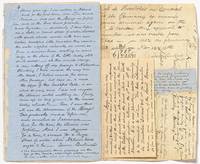
1860601691Salem Massachusetts 1860. Unbound. Very Good. A collection of autobiographical writings retained by two prominent seamen father and son from Salem Massachusetts. The archive was compiled by the son Isaac Bullock 1800-70: a self-taught scholar and artist who first went to sea aboard fishing vessels and later as chief mate aboard ships owned by the famous Salem merchant Joseph Peabody. As he recounts in a manuscript note on his father's 1799 Seaman's Protection Certificate: his father "died of yellow fever July 1800 in his 25th year on a voyage to Havana - when I was about 3 months old." The Certificate issued to protect American sailors from the British practice of impressment is signed by Benjamin Lincoln: a famous Major General during the Revolutionary War as George Washington's second in command he formally accepted the British surrender at Yorktown and the first United States Secretary of War.<br /> <br /> Also included is the elder Isaac Bullock's shipboard account of a meteor shower written in manuscript on a quarto sheet titled: "Some particular remarks of the appearance of the sky on the 12 November 1799 at sea - in Latt. of 49:20 North & Longt. of 22:00 West." This was the first recorded meteor shower in North America by American astronomer Andrew Ellicot who had witnessed it from a ship off the Florida Keys. Bullock witnessed it "on the Brig Helen Andrew Haraden Master - from Boston bound to London": "At 4 am being my watch on deck . I saw with astonishment the stars shooting or otherwise falling repeatedly from the sky down to the horizon as if they were compelled to leave their native abodes and dwell in the lore lower world. Some leaving after them a stream of fire which continued in the sky for the space of a minute . These continued shooting or otherwise falling till day light . we could see their blaze shooting in every direction till almost sun rise. What it is foreboding we cannot tell . ." Tipped onto the 1799 quarto manuscript sheet are several smaller sheets of appended manuscript notes and comments by Bullock's son dating from the early 1850s including a pencil sketch portrait of the great German naturalist Alexander von Humboldt who had observed the meteor shower from Central America.<br /> <br /> The rest of the archive consists of five gatherings of miscellaneous autobiographical writings and musings compiled by the son Isaac Bullock in which he relates various notable voyages including being pursued by an armed pirate ship "off the double headed shot Keys Cay Sal Bank" and barely surviving a shipwreck in the English Channel. <br /> <br /> Also included are accounts of two trips to California he twice spent time prospecting and mining on the South Fork of the American River first in 1850 at Salmon Falls and then in 1852 at Mormon Island: ". in 1849 the gold Crusade to California enticed me to try if Fortune would smile on me as a Miner. I shipped as 2d mate of ship Nestor of Salem for San Francisco and started from Boston in the autumn of '49 with a large number of passengers bound to See the Elephant! - I saw him! and have survived the sight! . A year of privation and excessive labour broke me down in a long fever and in partial recovery I started for home - Returned through the Nicaraguan route and escaping its perils and privations I once more reached home .". Soon thereafter he decides to try his luck in the mines again: "hoping for better success . I landed in Aspinwall traveled on foot through the dense tropic forest to Panama losing all my baggage by robbers . At last I reached San Francisco again . ."<br /> <br /> Most if not all of Bullock's reminiscences and musings were written and compiled upon his return from California: one manuscript is dated 1853 and another 1862. He was well read in classical literature and ancient history and comments on Alexander von Humboldt and Hester Thrale in the manuscripts. When not abroad he lived in Salem where some his other papers are held at the Peabody Essex Museum.<br /> <br /> An entertaining and historically important collection of writings documenting the lives of two prominent seamen who sailed out of Salem when it was among the most significant seaports in America. A detailed list of the manuscripts with selected excerpts is available. unknown
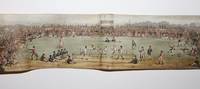
181919883London: Sherwood Neely & Jones 1819. First Edition. Scroll with wooden exterior base crown sides. Housed in a modern clamshell box quarter morocco cloth boards felt cushioning. Isaac Cruikshank. Most unusual and uncommon sporting/processional scroll with its narrow width of only 60 mm and its length of slightly over 3800 mm which depicts four different scenes in its 42 numbered and conjoined separate pieces. The first which accounts for over half of its length is the parade to an outdoor boxing match. This is actually a few distinct scenes with clear breaks between them but since they are all depicting a parade one can virtually see them as a single unbroken parade as we have chosen to do for purposes of this description and also to treat them as we believe most people would take them in. Then there is the match held on an expansive river-side meadow. In this second scene is shown the final stage of the procession to the grounds when the spectators and their vehicles had to cross the Thames all in long rowboats. The third scene is of a man being thrown from a bull. This we believe was a sideshow to the main event. The last scene is of the more respectable element probably the end of the day. In the first stretch of the scroll we see coaches and other horse-drawn vehicles some of which are rather eccentric and perhaps improvisational men atop the coaches men on horseback and on foot a man pedalling an early bicycle. All kinds of street life and local color enliven the proceeding and distinguish this one from so many that are simply a stilted parade. Accidents and mishaps punctuate the event. Horses are spooked and kick up the dirt as they suddenly race. There are the high jinx of children. As fitting the march to a boxing match there is a brawling incident. And there are spectators and bystanders that pull in a broad spectrum of London street life and do so without making an express statement about it as would a formal costume book of the day. The second panorama of the scroll the boxing match scene is teeming with people and activity the boxing match here is at the center but almost overshadowed by the fights erupting in the audience and other shenanigans. The bull fight is also teeming with movement and life. Only the fourth scene is somewhat staid an intentional anti-climax perhaps and certainly a deliberate contrast to the two middle scenes. The scroll is housed in a wooden drum with a boxing scene and the title on a paper pastedown attached to its side wall. The drum itself is a lovely piece of treen in and of itself with its crown turning pin a fine piece of wood turned work. The drum is about 10 cm tall and with the turning pin about 12 cm tall and it is about 5 cm in diameter. The paper pastedown illustration on the drum wall is very darkened obscuring in particular the print at its base but one can still with effort make out the words and the same with the illustration of the boxing match. The wooden pull pin that was at the end of the scroll is now detached along with a tiny amount of the paper part of the scroll -- this part is cloth backed the cloth surely added later. The scroll itself is heavily darkened at the outer end gradually lightening until the third conjoined panel at which the issue has gone away. Similarly at the pull's end there are a number of closed tears vertical cracks along the edge some paper repairs of these visible on the pictorial side and also some staining especially along the upper edge. This issue or these issues recedes but doesn't entirely disappear by the third panel. The paper is such that it was susceptible to what we are describing as cracking by way of explanation. Notwithstanding all the detailing of issues we are comfortable describing the original object as Very Good with the clear understanding that this is also in relation to other copies one might encounter. The modern clamshell box was very well constructed and it remains in Fine condition. Sherwood, Neely & Jones unknown
199746690HEYNE WILHELM 1997. 1. hardcover. Roboter-Foundation Limitierte Sonderausgabe! FOUNDATION EDITION HEYNE, WILHELM hardcover
199746675HEYNE WILHELM 1997. 1. hardcover. Roboter-Foundation Limitierte Sonderausgabe! Maloftege! FOUNDATION EDITION HEYNE, WILHELM hardcover
199746678HEYNE WILHELM 1997. 1. hardcover. Roboter-Foundation Elias Lije Baley & R. Daneel Olivaw Limitierte Sonderausgabe! FOUNDATION EDITION HEYNE, WILHELM hardcover
199746696HEYNE WILHELM 1997. 1. hardcover. Roboter-Foundation Limitierte Sonderausgabe! FOUNDATION EDITION HEYNE, WILHELM hardcover
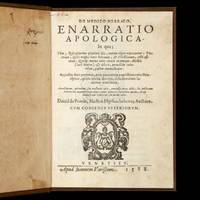
43448Venice : Apud Ioannem Variscum Giovanni Varisco 1588. First and only edition. Octavo 190 x 140 mm modern brown cloth over boards; faint trace of stamp tp front free endpaper original first blank with early ownership signature to verso browned clipped at upper corner title-page with vignette woodcut printer's device and with coat of arms to verso; pp. 7 Dedication to Francesco Maria II della Rovere Duke of Urbino 1 foreword by Paulus Manutius 2 foreword by Judah Alchalay 4 index 1-127; decorative woodcut initials; sidenotes; first few leaves with a mild horizontal crease at centre some occasional and very light foxing otherwise clean and crisp throughout; a very good copy in a modern binding. David de' Pomis 1525-1593 was a physician philosopher and linguist born in Spoleto to a Jewish family of bankers. He commenced medical studies in Todi under two of his uncles both rabbis and continued them at Perugia where he received his doctorate in 1551. He was then for a brief period rabbi and physician at Magliano in Tuscany. However there followed a number of years of insecurity during which successive papal edicts withdrew and restored the right of Jewish physicians to attend Christians; de' Pomis found himself forced to keep moving from town to town in Italy finally settling in Venice in 1569. It was here that he published most of his works. His tract De Medico Hebraeo Enarratio Apologica Venice 1588 is a refutation of aspects of a bull of 1581 issued by Gregory XIII 1572-85 which brought various charges against Jews - and more specifically Jewish physicians. De' Pomis argues that in accordance with the teachings of the Bible as well as the Talmud a Jewish physician is morally obligated to attempt to alleviate the suffering of every patient. He also cites numerous cases in the historical record to illustrate the fact that Jewish doctors can and have distinguished themselves by their medical prowess and civic-mindedness. The last section comprises a selection of Talmudic rules translated into Latin presented as a form of collective argument to counter the charge that the Talmud is to be despised for its moral character. The writings of the learned De’ Pomis were wide-ranging. He is now perhaps best known for his trilingual Hebrew Latin and Italian dictionary the Ẓemaḥ David Venice 1587 which he dedicated to Pope Sixtus V - although this work is more than a straightforward dictionary since it also contains disquisitions on scientific and historical subjects. He also wrote a philosophical essay on human suffering Discorso intorno a l'humana miseria e sopra il modo di fuggirla Venice 1572 a treatise on the plague Venice 1577 and another on geriatric conditions Venice 1588. Very rare. No sale record traced on Rare Book Hub. hardcover
199746703HEYNE WILHELM 1997. 1. hardcover. Roboter-Foundation Limitierte Sonderausgabe! FOUNDATION EDITION HEYNE, WILHELM hardcover
198817892DAS BESTE 1988. 1. hardcover. Roboter-Foundation DAS BESTE hardcover
199746701HEYNE WILHELM 1997. 1. hardcover. Roboter-Foundation Limitierte Sonderausgabe! FOUNDATION EDITION HEYNE, WILHELM hardcover
199746695HEYNE WILHELM 1997. 1. hardcover. Roboter-Foundation Limitierte Sonderausgabe! FOUNDATION EDITION HEYNE, WILHELM hardcover
199746682HEYNE WILHELM 1997. 1. hardcover. Roboter-Foundation Elias Lije Baley & R. Daneel Olivaw Limitierte Sonderausgabe! FOUNDATION EDITION HEYNE, WILHELM hardcover
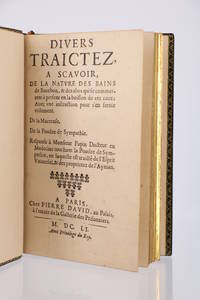
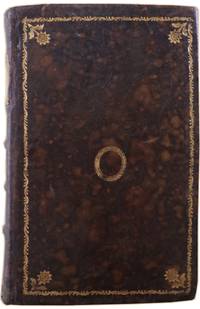
165189641Paris: Pierre DAVID 1651. Fine. Pierre DAVID Paris 1651 10.6 x 16.8 cm 4 volumes reliés en 1 Second edition. Full forest-green morocco binding spine with five raised bands framed with gilt dotted lines and decorated with double gilt panels gilt rolls at head and tail triple gilt fillets bordering the covers marbled paper endpapers and doublures gilt dentelle frame on the inside covers all edges gilt double gilt fillets along the edges an elegant binding signed by Krafft. Bound following it are: - Nicolas Papins De pulvere sympathico dissertatio printed in Paris by Siméon Piget in 1650 8 unnumbered leaves the last blank and 40 pp. - By the same author La poudre de sympathie deffendue contre les objections de Mr. Cattier médecin du Roy printed in Paris by Siméon Piget in 1651 4 unnumbered leaves and 56 pp. - Isaac Cattiers Response à Monsieur Papin Docteur en Medecine touchant la poudre de sympathie printed in Paris by Edme Martin in 1651 87 pp. A fine copy beautifully preserved in a splendid binding signed by Krafft. The treatise on the Scoter occupies pp. 119 of the second part. This exquisite duck has been the subject of numerous and lengthy controversies The history of the scoter deserves our attention as it holds both gastronomic and theological interest. Because of the peculiar beliefs surrounding their origin these birds were considered lean meat and therefore permitted during Lent. This curious privilege arose from the fact that they appeared suddenly in countless flocks upon the waters surface and aided by a taste for the marvellous people imagined that they were born from seaweed decayed wood or shells. The poet Du Bartas echoed this notion in his Création du Monde when he celebrated this strange creature: Ainsi le vieil fragment d'une barque se change En des canards volants ô changement étrange Même corps fut jadis arbre verd puis vaisseau Naguère champignon et maintenant oyseau! It is easy to see how such a belief could reassure the most timid consciences; it thus required Pope Innocent III to issue an explicit prohibition placing the flesh of the scoter among forbidden meats. In vain did he launch his prohibitions for enthusiasts continued to eat them; and when the truth about these birds became known thanks to Graindorge and the accounts of navigators other pretexts were sought to preserve the old regulations. It was suggested that the scoters blood was cold even claimed that its fat resembled fish oil and the custom which lasted into the nineteenth century of eating scoters during Lent was extended to other waterfowl such as brant geese coots and teal which were conveniently confused with the species sanctioned by the councils. Cf. G. Oberlé Les Fastes de Bacchus et de Comus no. 869 concerning Graindorges Traité de lorigine des macreuses 1680. Pierre DAVID hardcover
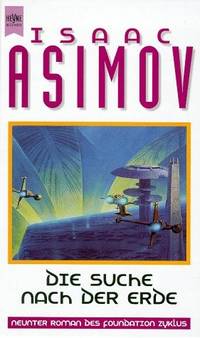
198745776HEYNE WILHELM 1987. 1. softcover. Roboter-Foundation Deutsche Erstausgabe! Der Welterfolg! HEYNE, WILHELM paperback
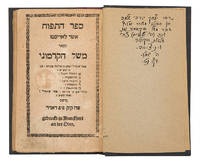
122188Frankfurt an der Oder Elsner 1800. . 8vo 18 x 11 cm; modern black cloth with Hebrew hand-written title to spine; 80 woodcut illustrations some browning to pages some staining to title; bookplate to front inner cover; 72 81-84 65-68 91-100 ll. misfoliated.<br /> Although the fable of Sefer HaTapuach is attributed to Aristotle there are claims that it is in fact a medieval Neo-platonic Arabic work of unknown authorship.<br /><br />Sefer Meshal HaKadmoni is considered to be the first fully illustrated printed book in Hebrew the first edition of which was printed circa 1491 in Brescia by the Soncino family printers with different illustrations.<br /><br />It is a collection of moral fables and animal stories by Isaac ben Solomon ibn Abi Sahula in rhyming prose interspersed with verse. Ibn Sahula who was both a scholar and a physician was born in 1244 in Guadalajara Castile and was a wanderer for much of his life. He was a student under the Kabbalist R. Moses of Bugros and wrote secular poetry until around 1281 when his outlook changed. It was then that he began to write Meshal Ha-Kadmoni.<br /><br />Ibn Sahula writes that his material is original but based on the Talmud and Midrashim and that in style he has followed the example of the prophets who presented moral lessons in allegorical form. He also sets out to demonstrate that Hebrew is as suitable a vehicle for conveying moral lessons as Arabic. The stories show both Kabbalistic and Indian influences.<br /><br />The use of animal characters is not typical in Jewish writing but Ibn Sahula employs this device in order to deliver the tale's moral in the clearest way possible. While animals in Christian fables were usually characterised by a single dominant characteristic the cowardly rabbit the cunning fox Ibn Sahula gave the animals in his fables complex characters and highly specific religious tendencies: the birds pray in a 'minyan' in a synagogue; the deer prays three times a day; and the lion dreams of making a pilgrimage to the Holy Land.<br /><br />Some eighty woodcut illustrations grace the 64 leaves of this book with one or two captioned woodcuts to a page. Though the illustrations resemble those of incunabula editions Meir Parenzo the printer of this edition commissioned an entire new series of woodcuts providing more detail and artistic sophistication. The illustrations were prepared by three different hands. <br /><br />The first edition of this work was printed circa 1491 in Brescia by the Soncino family printers with different illustrations.<br /> Vinograd Frankfurt 479. Frankfurt an der Oder, Elsner, 1800. hardcover
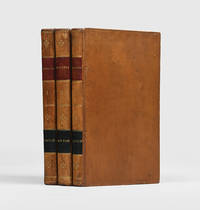
1819183664London: Printed for Sherwood Neely and Jones; and Davis and Dickson 1819. The Newtonian ascendancy A handsomely bound edition bringing together Newton's masterpiece with several works refining Newtonian theory and an early draft of the Principia itself. This translation of the Principia together with the Laws of the Moon's Motion by John Machin c. 1686-1751 is drawn from the first edition in English published in 1729. William Davis 1771-1807 originally brought out the three-volume edition in 1803 revising and extending Motte's translation to cover the remaining third of Newton's text. This is thus only the second edition of a complete translation of the Principia into English. No further edition was published until the "modernized" version brought out by the University of California Press in 1934 and no entirely new translation was made until 1999. This edition pairs these works with the Short Comment on and Defence of The Principia 1770 by William Emerson 1701-1782 and Newton's own System of the World written 1685. By the turn of the 19th century the Principia's theory of gravity had become widely accepted in scientific circles and Davis's edition "made this available to a number of generations of nineteenth-century students" ODNB. 3 vols octavo 212 x 127 mm. Engraved portrait frontispiece and 56 plates 8 of which folding. Extensive tables and formulae in the text. Contemporary calf spines lettered decorated and ruled in gilt and with red and black morocco labels covers panelled in blind light brown coated endpapers edges sprinkled brown. Spine ends restored. Light bumping and wear minor browning and offsetting to contents: a very good copy. Babson 22; Grey 25; Wallis 25. unknown
19562267AWA 1956. 1. hardcover. Roboter-Foundation Elias Lije Baley & R. Daneel Olivaw Sirmkovrilo! AWA hardcover
196417194GOLDMANN WILHELM 1964. 2. softcover. Roboter-Foundation Falsa Numero! Maloftege! GOLDMANN, WILHELM paperback
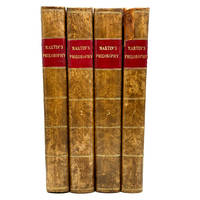
17715136166113<p><strong>NEWTON MARTIN Benjamin</strong><strong>.</strong> <em>Philosophia Britannica: Or A New and Comprehensive System of the Newtonian Philosophy Astronomy and Geography; In a Course of Twelve Lectures; With Notes; Containing the Physical Mechanical Geometrical and Experimental Proofs and Illustrations of All the Principal Propositions in Every Branch of Natural Science: Also a Particular Account of the Invention Structure Improvement and Uses of All the Considerable Instruments Engines and Machines; With New Calculations Relating to Their Nature Power and Operation.</em></p><p>London: Printed for W. Strahan; J. & F. Rivington; W. Johnston; Hawes & Co.; T. Carnan and F. Newbery; B. Collins; W. Frederick; and sold by the Author at his House in Fleet-Street 1771. Third edition. Complete in four volumes. Three text volumes plus a separate atlas volume of plates. Quarto. Approximately 8.5" x 5.5". Vol. I: xxx 333pp 3 ads; Vol. II: xiv 390pp 2 ads; Vol. III: x 405pp index. Atlas volume with 81 engraved copperplates the majority folding. Contemporary or near-contemporary half marbled calf over marbled boards with one repair to the upper spine of Vol. IV. Bindings sound and well-aligned. Engraved plates clean and strong with no losses; folds supple and correctly opening. Text generally clean throughout with manuscript annotations on the versos of the plates linking them to the relevant portions of text. Overall Very Good to Very Good.</p><p>Third and expanded edition of Benjamin Martin's monumental exposition of Newtonian natural philosophy combining physics astronomy geography mechanics and experimental science into a single unified system. The work includes extensive treatment of optics celestial motion gravitation hydrostatics pneumatics electricity and the mechanical powers alongside detailed explanations of contemporary scientific instruments and experimental apparatus. The separate atlas volume contains 81 finely engraved plates illustrating astronomical systems orreries telescopes microscopes air pumps electrical machines engines survey instruments and mechanical demonstrations.</p><p>This third edition represents the fully mature state of Martin's project as a practical synthesis of Newtonian science for broad professional use in the later eighteenth century. Unlike earlier editions which often survive without the full engraved apparatus this issue consolidates the theoretical text and the mechanical-visual program into a coherent instructional system. The separate atlas format allows for larger clearer mechanical and astronomical engravings than the inline plates of earlier printings making this edition particularly well suited for institutional reference in the history of science technology and scientific pedagogy.</p> Printed for W. Strahan; J. & F. Rivington; W. Johnston; Hawes & Co.; T. Carnan and F. Newbery; B. Collins; W. Frederick hardcover
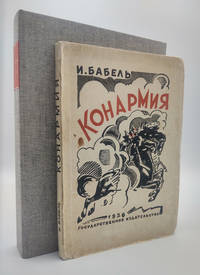
1926279<p>First edition of Isaac Babel's <em>Red Cavalry</em> transliterated as Konarmiya or Konarmiia. First printing. Original wraps. Octavo with deckle edges. Margins lightly yellowed; occasional light soiling; some pencil underlining. Original illustrated wrappers printed in red and black. Rebacked with small repairs and spine title apparently refreshed. Corners rounded with two small areas reinforced to reverse of covers. In custom grey cloth clamshell case.</p><p>True first edition in the original Russian of Babel's masterpiece frequently cited as the greatest literary work of the Russian Revolution and a high spot of both Russian and European Jewish modernism. Few copies extant having needed to survive the chaos of the early Soviet Union; the destruction of copies following Babel's banning purge and eventual murder under Stalin; the burning of copies by the Nazi regime where it appeared on the "combustion lists"; the massive widespread destruction of the Second World War; and the chaos at the end of the Soviet Union.</p> Gosudrastvennoe Izdatel'stvo paperback
1404JC028<p><strong>SIVE DE Reflexionibus Refractionibus Inflexionibus & Coloribus LUCIS </strong>LIBRI TRES. Authore Isaaco Newton Equite Aurio. Latine reddidit Samuel Clarke. S. T. P. Editio Secunda auctior. LONDINI. Impensis Gul. & Joh. Innys Regiae Societatis Typographorum ad Insignia Principis in Areâ Occidentali D. Pauli. MDCCIXI 1719.</p>_x000d_<p>In 4º de 195x12 cm com ix 415 págs. Encadernação da época inteira de pele com ferros a ouro na lombada e ferros a ouro rolados com motivos florais nas esquadrias das pastas e nos super-libris. Corte das folhas marmoreado. Acondicionado em estojo de pele.</p>_x000d_<p>Ilustrado com 12 gravuras desdobráveis abertas em chapa de metal com todas as figuras geométricas do estudo da reflexão da refracção e do estudo do arco-íris e das cores.</p>_x000d_<p>Exemplar com título de posse manuscrito e rasurado no pé da folha de rosto.</p>_x000d_<p>Segunda edição deste tratado um dos grandes livros da história da ciência.</p>_x000d_<p>Newton produziu muitas explicações para os mais variados problemas. Este livro Óptica de Newton fez pela Luz e pela Óptica o que o seu Principia tinha feito pela Gravidade ou seja colocou a Luz numa base científica diz E. W. Brown. Contém uma acumulação de fenômenos ópticos desde o seu primeiro trabalho uma pequena memória sobre Transação Filosófica 1672 até este livro editado 33 anos mais tarde.</p>_x000d_<p>EN In 4º 195x12 cm. ix 415 pags.</p>_x000d_<p>Contemporary full calf binding gilt at spine and gilt tooled at boards in floral frames. Marbled edges. Packed in case in the style of a tobacco case finished in full calf.</p>_x000d_<p>Illustrated with 12 folding plates containing the graphics from the study of the light reflection and refraction and the explanation of the rainbow.</p>_x000d_<p>Copy with ownership title erased at bottom of title page.</p>_x000d_<p>2nd Latin edition of Newton's 'Optics: or a Treatise of the Reflections Refractions Inflections and Colours of Light. London 1704'. One of the greatest books in the history of science.</p>_x000d_<p>Newton found out many explanations to many problems. This book Newtons Optics did for Optics and Light what his Principia did for Gravitation namely it gave Light a scientific basis says E.W. Brown. It contains an accumulation of optical phenomena from his first paper a short memoir in Philosophical Transaction 1672 to the above book Optics 33 years later.</p>_x000d_<p>Referências/References: </p>_x000d_<p>Gray 180; Babson 138; Wallis 180; British Lybrary: General Reference Collection 59.g.19</p> M-11-C-11 hardcover
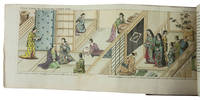
1822H61BFWWJLAPYParis 1822. 18mo. Nepveu back of half-title: printed by dHautel Late 19th-century gold-tooled brown half morocco chemical-marbled sides marbled endpapers peacock pattern gilt edges. With 23 of 24 etched plates including 3 as frontispieces and 17 folding all but one in contemporary hand-colouring. 3 volumes. XXX IV 127 1 blank; 4 139 1 blank; 4 206 pp. The Dutch scholar Isaac Titsingh 1745-1812 was head of the Dutch trading post at Dejima and spent in total some 44 months in Japan in the years 1779-1780 1781-1783 and 1784. He collected material for a monumental work on Japan but published only several brief essays during his lifetime. The Paris-based publisher Nepveu posthumously issued two volumes of selections from Titsingh's papers translated into French: Cérémonies usitées en Japon pour les mariages et les funérailles 1819 and Mémoires et anecdotes de la dynastie regnante des Djogouns 1820. The present second edition combines these two works leaving out some short essays.The first volume consists of essays on Japanese marriage ceremonies the second is devoted to funeral ceremonies and some other feasts and includes an account of "dosia" a powdered recreational and medicinal drug while the final volume consists of a series of anecdotes about the shoguns.In very good condition with some plates slightly tattered at the edges. The bindings show some light wear.l Cordier Japonica col. 449; Landwehr & V.d. Krogt VOC 536; Tiele Bibl. 1096 note. unknown