Asimov, IsaacBiblio.com

26 496 résultats
1950140946409Garden City New York: Doubleday & Company Inc 1950. First Edition. Very Good/Very Good. First edition first printing of Isaac Asimov's first novel. Signed by Asimov on the title page and inscribed "To Don Sterling best wishes 13 March 1981." Bound in publisher's original gray cloth lettered in orange on the spine. Very Good with lean to binding light wear at extremities and scattered foxing to cloth. Minor offsetting to ensheets. In a Very Good unclipped dust jacket with fading moderate wear and small damp stain to foot of spine; toning and tape repairs to verso. Signed first editions are scarce. Doubleday & Company, Inc unknown
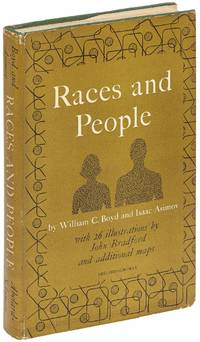
1955468623New York: Abelard-Schuman 1955. Hardcover. Fine/Near Fine. First edition. With 26 illustrations by John Bradford with additional maps. Octavo. 189pp. Light dampstaining on the boards very good in price-clipped very good dust jacket with a corresponding light stain mostly on the rear panel and with small internal repairs at the spine ends. Exploration of race by two white academic writers aimed at young adult readers Asimov's second book for the YA market.<br /> <br /> Inscribed by Asimov to a fellow science fiction legend: "For John Campbell who may disagree with everything. Isaac." Campbell was the influential editor of Astounding Science Fiction later renamed as Analog Science Fiction and Fact and wrote his own science fiction titles most notably Who Goes There which was adapted into several film versions as The Thing. Asimov's inscription is prescient and recognizes the contrarian nature of Campbell who Asimov fell out with not long afterwards because of Campbell's obsession with pseudoscience. Campbell’s essays in support of segregation and comments about slavery and race alienated him from many in the sci-fi community. An uncommon title with a poignant and important association. Abelard-Schuman hardcover
182219114Glasgow: Andreae et Joannis M. Duncan 1822. FIRST GLASGOW EDITION. Numerous text diagrams and illustrations. Contemporary calf all covers with blind-stamped floral border within gilt floral borders within gilt-lined borders spines in compartments with gilt decoration spine labels; first few leaves of each volume spotted otherwise an excellent set. First Glasgow reprint of the first Jesuit edition printed in Geneva from 1739-1742. This edition of Newton’s Principia was edited by John Martin Frederick Wright of Trinity College who contributed additional commentary. Babson notes that Glasgow’s printing of this edition of the complete text was a great credit to the university whereas Cambridge was “satisfied with reprints of the first three sections of the first book.â€<br /> <br /> Babson 32; Gray 17; Wallis 17. Andreae et Joannis M. Duncan unknown
04274London: Allen & Co. 1807. A Study the Inhabitants of the Roundhouse and the Regular Attendants at the Police-Court"<br /> A Journey in Caricature through Early Nineteenth Century England.<br /> <br /> WOODWARD. George Moutard. Eccentric Excursions or Literary & Pictorial Sketches of Countenance Character & Country in different parts of England & South Wales. Interspersed with Curious Anecdotes Embellished with upwards of One Hundred Characteristic & Illustrative Prints. London: Allen & Co. 1807 but ca. 1813. <br /> <br /> Later issue first published in 1796. Quarto 10 3/16 x 8 3/8 in; 259 x 213 mm. iv v 6-217 1 list of plates pp. Engraved title-page included in pagination Hand colored frontispiece and 100 hand-colored etched plates on ninety-nine leaves by Isaac Cruikshank after Woodward including three folding plates Plates 1 2 and 3. The text is watermarked "W. Balston 1813". <br /> <br /> Bound by Rivière & Son stamp-signed on verso of front endpaper ca. 1890. Full maroon morocco covers with double-gilt borders spine with five raised bands decoratively tooled and lettered in gilt in compartments gilt ruled board-edges decorative gilt turn-ins marbled end-papers top edge gilt others uncut. Occasional toning or foxing a few leaves with neatly repaired or strengthened edges. Overall an excellent copy of this journey in caricature through early nineteenth century England. <br /> <br /> Originally published in 1796 with subsequent issues in 1797 1798 1799 1801 1807. 1814 1815 1816 1818 Eccentric Excursions is quite rare in all yet curiously is rarer still in the later issues.<br /> <br /> This satire amongst Moutard's earliest work enthusiastically depicts all types: high- and low-born rural and urban lawyers and peddlers coaching scenes misadventures on ice-skates Oxford dons gypsies etc.<br /> <br /> "The first and most celebrated of Woodward's books. The text describes an idiosyncratic ramble around the counties of England and Wales." Gordon p. 15.<br /> <br /> George Moutard Woodward 1760-1809 was "prolific and popular designer of social caricature much in the style of Banbury etched chiefly by Thomas Rowlandson and Isaac Cruikshank.his caricatures display a wealth of imagination and insight into character.extremely entertaining" DNB.<br /> <br /> "Another popular caricaturist of the day was George Moutard Woodward commonly called 'Mustard George.' Woodward according to his friend Henry Angelo was the son of a land agent and spent his youth in a country town where nothing was less known than everything pertaining to the arts. 'A caricaturist in a country town' said Mustard George 'like a bull in a china shop cannot live without noise; so having made a little noise in my native place I persuaded my father to let me seek my fortune in town.' Thanks to a small allowance from his father supplemented by his own earnings George was able to enjoy life in his own Bohemian fashion and ultimately took up his quarters at the 'Brown Bear' Bow Street where he was able to study the inhabitants of the roundhouse and the regular attendants at the police-court. At the 'Brown Bear' he died suddenly departing in character with a glass of brandy in his hand and was long mourned by his tavern associates. In his Eccentric Excursions which appeared in volume form in 1796 the designs engraved by Isaac Cruikshank there are several domestic subjects such as The Polite Congregation Showing Family Pictures and The Formal Introduction. Among other popular designs by Woodward are Raffling for a Coffin The Club of Quidnuncs Babes in the Wood A Goldfinch and his Mistress.and a series called Six Ways of Carrying a Stick. The majority are marred by extravagant hideousness but Angelo was of opinion that 'had this low humourist studied drawing and been temperate in his habits such was the fecundity of his imagination and perception of character that he might rivalled even Hogarth" Paston Social Caricature in the Eighteenth Century pp. 137-138.<br /> <br /> Gordon BC-26; Widener 207; Not in Abbey or Tooley. London: Allen & Co., 1807 unknown
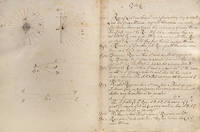
115619England late 18th century. . 100-leaf manuscript rectos and most versos filled wax seal remnants to front pastedown leaves wavy at the edges some spotting and marks to contents; contemporary calf-backed blue paper boards gilt floral tools to spine compartments binding marked and worn with spine cords partially exposed and loss of the blue paper morocco label lacking naphthalene smell good condition housed in a black cloth folding case.<br /> An unusual late 18th century manuscript on classical physics that cites Isaac Newton Blaise Pascal William Harvey Henry Power and others.<br /><br />The text approximately 200 pages presents an ordered and detailed account of a number of related topics: optics; hydrostatics and pneumatics; mechanics including simple machines such as the lever and screw the behaviour of descending bodies and pendulums; phosphorus and its chemical transformations; and fortifications and architecture. The notes are dense but generally neat and legible with carefully prepared diagrams so this seems to be a fair copy rather than a working notebook. <br /><br />Newton is cited in the section on light and colour: 'What Sir I.N. has said by way of in the last edit of his Opticks will appear to be an established truth from most if not all the following examples some of which he mentions himself". And Harvey in a short section on chemical transformations: "Harvey had says he the opportunity as well as the curiosity upon several occasions to examine the weight of when some of them taken up in places very distant from one another.'.<br /><br />The origin of much of the material is unclear though the long section on hydrostaticks was taken from Hydrostatical and Pneumatical Lectures by Roger Cotes 1682-1716 originally published privately in 1738 and with a second edition at Cambridge in 1747. <br /><br />Cotes was 'probably the most talented British mathematician of the generation after Newton'. He was nominated as the first Plumian professor of astronomy at Cambridge in 1706 and 'his appointment was favoured by his influential mentor Richard Bentley master of Trinity; by Newton's successor as Lucasian professor William Whiston who claimed to be in mathematics "a child to Mr Cotes" Whiston 133; and by Newton himself. In 1709 Cotes became heavily involved in the work for which he is best remembered namely the revisions for the second edition of Newton's Philosophia naturalis principia mathematica the first being out of print' Oxford Dictionary of National Biography. Cotes died young and Newton was reported to have said that 'if he had lived we might have known something'. A number of Cotes's lectures and mathematical analyses were published posthumously by his executor Robert Smith the Hydrostatical and Pneumatical Lectures being one of them. It is tempting to question whether other portions of the present manuscript are also based on Cotes's work and further academic scrutiny might be fruitful.<br /> England, late 18th century. hardcover
023366West Bloomfield: Phantasia Press 1985 A deluxe limited edition of only 35 lettered and signed copies; this being the letter K. Signed by Isaac Asimov directly on the colophon page. Bound in full black morocco with leather appliqués on the front cover depicting the sun and the heads of two robots. Silver lettering on spine. A trace of rubbing to bottom edge else book in fine as new condition. Phantasia Press hardcover
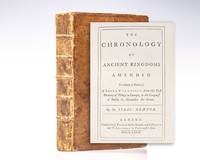
1728149863London: Printed for J. Tonson in the Strand and J. Osborn and T. Longman in Pater-noster Row 1728. First edition of Newton's ambitious attempt to reconstruct and rationalize the timelines of ancient history. Quarto bound in full contemporary Cambridge calf ruled and tooled in blind with speckled panels gilt turn-ins ordinary paper issue illustrated with 3 folding engravings. From the library of Harvard University professor Owen Gingerich. Owen Gingerich 1930–2023 was an American astronomer and historian of science renowned for his scholarship on early modern astronomy particularly his meticulous census of De revolutionibus that illuminated how Copernicus’s work was read and received in the sixteenth century. A longtime professor at Harvard and a senior astronomer at the Smithsonian Astrophysical Observatory Gingerich helped bridge scientific and humanistic inquiry demonstrating how historical context shapes the development and interpretation of scientific ideas. In very good condition. The Chronology of Ancient Kingdoms Amended published posthumously in 1728 was Isaac Newton’s ambitious attempt to reorganize and compress the timelines of ancient history by applying critical philology comparative mythology and astronomical calculation. Seeking to reconcile classical sources with biblical chronology Newton argued that the conventional dating of Egyptian Greek and Near Eastern kingdoms was excessively long and he used evidence such as eclipse records regnal lists and mythic genealogies to propose a shorter more unified ancient past. Although modern historians largely rejected Newton’s revised dates the work was significant for revealing the breadth of his intellectual pursuits beyond physics and mathematics and for illustrating how early Enlightenment thinkers employed scientific reasoning to interrogate historical and scriptural authority. Printed for J. Tonson in the Strand, and J. Osborn and T. Longman in Pater-noster Row unknown
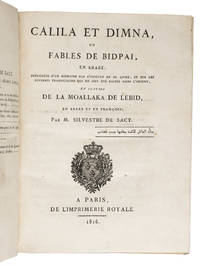
1816ABC_50110Paris 1816. 4to. Imprimerie Royale 19th-century purple-ish cloth with the title lettered in gold on the spine. The cloth around the spine is faded and browned. 2 parts in 1 volume. 2 VIII 140; 8 315 1 pp. The complete text of the Arabic version by Ibn al Muqaffa of this collection of animal fables with didactic overtones designed to illustrate wise conduct printed in the beautiful types of the "Imprimerie Royale" with an introduction and critical notes in French. The typeface based on Arab or Turkish specimens of calligraphy and cut in Rome in the early 17th century for Savary "was the mainstay of Arabic typography in France until the late 19th century; it also provided a model for others" Roper p. 145.The spine is sunned occasional browning and foxing. Otherwise in good condition.l Blois "Kalila wa-Dimna" in: Meisami & Starkey Enyclopedia of Arabic literature pp. 423-425; Chauvin II p. 11f. no. 17; Keith-Falconer Kalilah and Dimnah pp. xvi-xvii; cf. G. Roper Early Arabic Printing in Europe in: Middle Eastern Languages and the Print Revolution. A Cross-Cultural Encounter Westhofen 2002 pp. 129-150. hardcover
1679032848<p>A Paris: De L'Imprimerie Royale 1679 A fair copy of the 1st edition of the Description de la Grotte de Versailles bound with a very good copy of the 2nd edition of Labyrinte de Versailles in contemporary elephant folio full leather binding. La Grotte has had 5 of the 20 plates cut out but Labyrinte is complete. The binding is sound with raised bands and title label to spine. It is very worn with a lot of wear to corners with leather loss and to spine joints spine ends and edges. The surface of the boards is a little rough. All page edges red. There is an old bookplate to the front pastedown endpaper - Earl Vane from the Library of the Rev. John Vane. Contents: 3 blanks; title 1679; blank verso; Description pp 1-11; Imprimerie to verso p 11; plates 13 single and 2 double; title to Labyrinte 1697; blank verso; Description pp 3-34; blank recto with Explication du Plan du Labyrinte to verso; plate 1; fables quatrains by Isaac Benserade and plates Sebastien Leclerc on opposing pages - 78 pp 39 plates; table 3 pp with L'Imprimerie to verso final leaf; 4 x final blanks. The binding is 50 cm x 35 cms; the page size in Labyrinte matches that of the Grotte but the actual text and plate size is 15.8 x 10.2 cm. Contents are in very good clean condition. Please enquire if you would like to see further images.</p> De L'Imprimerie Royale hardcover
57598London: R. Ackermann 1820. FIRST EDITION. Folio 33.5 x 28 cm. Title verso blank; Dedication 1 leaf; List of Subscribers pages v to viii; Preface by the Translator pages ix to xii; Preface of the Author pages xiii and xiv; Contents 1 leaf verso with List of Plates; Text pp. 1-178. Period style half red morocco over marbled boards spine with raised bands and intricate gilt tooling all edges gilt. 24 aquatinted plates D. Havell and T. Sutherland after C.G. Schutz with original hand-colouring engraved folding map with colour highlights at rear entitled "Map of the Course of the Rhine from Mentz to Cologne; And of the Course of the Maine and the Lahn". Minor scattered spotting slight offsetting to map generally an excellent copy. One of Ackermann's major colour plate books and apparently the first in his "Picturesque Tours" series others of which explore the Seine the Ganges and the Thames. The book describes a trip down the Rhine on that part of the river generally considered most romantic and charming "from Mentz to Cologne and of the Bathing-Places of Wiesbaden and Embs". The account contains not only topographical descriptions but considerable historical information and details of popular traditions the book being written "with a view chiefly to the information of travellers of cultivated minds who may be induced to visit this interesting portion of Germany Preface of the Author". The original German edition was published in Wiesbaden in 1819 as Die Rheingegenden von Mainz bis Cölln without illustrations. The third issue with the plates numbered in top right corner. Abbey Travel 217; Tooley 234. London: R. Ackermann, 1820. hardcover
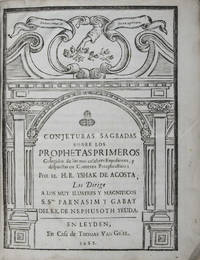
43872Leyden Leiden: Thomas van Ge'el 5482. First edition. Hardcover. f to vg. Quarto 9 3/4 x 8". 8 426 1 blank leaf 1 leaf Second title 427-906pp. Contemporary full calf with gold lettering and tooling to spine. Raised bands. Contemporary previous owner's inscription on front free endpaper: "Ce livre appartient à moi Isaac de Mozes. Celui qui le trouvera aura à bonté de moi le . en lui donnant une pièce de six sols pour la peine. Le 4 février 1730." Signed Eliez de Mozes. This book belongs to me Isaac de Mozes. The one who finds it and returns it to me will be given a coin of six sols. Dated February 4 1730. Illustrated titles within woodcut order. Decorative head- tailpieces and initials. <br /> <br /> Published by Isaac de Acosta "Conjecturas Sagradas sobre los Profetos primeros" Sacred Conjectures on the First Prophets is a commentary in Spanish on the Early Prophets based on the classical Hebrew commentators and the Midrash. It contains a new translation and a paraphrase of Joshua Judges Samuel and Kings.<br /> <br /> Binding heavily rubbed with tail of spine missing. Sporadic clear water staining at upper margin of a few pages never affecting lettering. Some minor worming along inner margin of pages 635 on not affecting lettering. Fly leaf at rear partly disbound. Text in Spanish. Binding in overall poor to fair interior in good to very good condition. About the author: Isaac Yhsak de Acosta - d. 1728 was a French Sephardi rabbi. Probably a native of Amsterdam Acosta became hazzan of the Jewish community of Peyrehorade near Bayonne formed by Marrano fugitives from the Iberian Peninsula. His "Historia Sacra Real" 1691 dedicated to the wardens of the community is one of the earliest manifestations of Judaism in this place. Later apparently after an interlude in Biarritz he succeeded R. Hayyim de Mercado as hakham at Bayonne where he composed his handbook for the administration of the last rites to the dying "Via de Salvacion" 1709; reprinted by M. Kaplan Bayonne 1874 and his major work "Conjeturas Sagradas" Leyden 1722 a commentary in Spanish on the Early Prophets based on the classical Hebrew commentators and the Midrash. Thomas van Ge'el hardcover
195025105New York: Gnome Press 1950. Cloth. Near Fine. An unusually bright well-preserved copy of the 1950 stated 1st edition of Isaac Asimov's 2nd published work preceded only by "Pebble in the Sky" also published in 1950. Clean and Near Fine in its dark-red cloth with no writing or markings of any kind internally. Lacking its original dustjacket but still truly a collector's copy in such superb condition. Gnome Press unknown
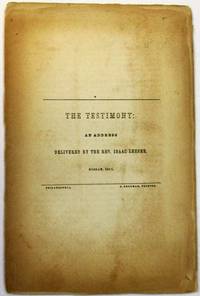
185136329Philadelphia: C. Sherman Printer 1851. Original front title wrapper stitched. 2 19 1 blank pp lacking the rear wrapper. Toned some shallow blank edge chipping and light wear. Good with some Hebrew printing in text. The caption title reads: 'An Address Delivered at the Schoolhouse of the Hebrew Education Society of Philadelphia at the First Opening of Their School on Sunday the 4th of Nissan 5611 April 6th 1851 by Isaac Leeser.'<br /> <br /> "This address celebrated the opening of the day school launched by the Hebrew Education Society of Philadelphia the first of its kind in the city" Swann Catalog September 2019 Lot 120.<br /> "Leeser was the driving force behind the founding in 1846 of the Hebrew Education Society of Philadelphia chartered for 'the establishment of a school or schools within . Philadelphia in which are to be taught the elementary branches of education together with the sciences and modern and ancient languages always in combination with instruction in Hebrew language literature and religion.' In his address at its official opening delivered at the Society's schoolhouse on Sunday the 4th of Nissan 5611 April 6th 1851 Leeser expressed great hopes for the new Philadelphia Day School. 'We propose to combine elementary and afterwards scientific education with a gradual and progressive acquirement of Hebrew Hebrew literature and religion. It is not to be as in other schools a secondary matter whether the children learn Hebrew and religion or not but they are to acquire these even if nothing else can be imparted' p. 12." Sotheby catalog 2014 09239-20. <br /> Singerman 1195. Not in Goldman. OCLC 21968696 5- JTS U PA AJHS Hebrew Union College 1340131282 1- Princeton as of August 2023. C. Sherman, Printer unknown
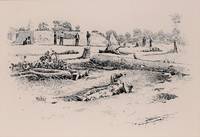
1884W2434New York: The Century Co. 1884. The image is 4 5/8 inches by 7 1/4 inches on artist board measuring 14 1/2 inches by 12 1/4 inches. Original ink drawing by Walton Taber 1857-1933 after a post-battle photograph. The scene shows dead Confederate soldiers in front of Battery Robinette on October 5 1862 the morning after the battle at Corinth Mississippi. Civil War historians J. Matthew Gallman and Gary W. Gallagher attributed the photograph to Ohio born and Corinth based photographer George Washington Armistead . However the Library of Congress has a virtually identical photographic negative that is attributed to Nicholas D. Brown. Although the photographer's identity remains uncertain it is clear that the drawing is by Walton Taber and is signed by him in the lower left corner of the image. Taber did the drawing for the Century Company who published it on page 751 of volume 2 of Battles and Leaders of the Civil War. This drawing along with others by Taber that were included in the Century Collection of Civil War Art was auctioned by Christie's in New York in 1988. Born in New Bedford Massachusetts Taber was one of the most important American illustrators during the late nineteenth and early twentieth centuries. His pen and ink drawings provided the Century Company almost 250 illustrations for Battles and Leaders. The drawing offered here is in near fine condition: clean and bright on artist board that is lightly and uniformly toned on the recto; there is some minor soiling on the verso along with notations made by Century editors and a later framer. The drawing is now archivally matted and ready for a 16" by 16" frame. SIGNED. Original. Single Sheet. Near Fine. Illus. by Isaac Walton Taber. 4 5/8" by 7 1/4". Fine Art Print. The Century Co.
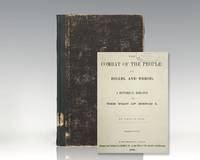
185982600Cincinnati: Bloch & Co 1859. First edition of American Reform Rabbi Isaac Mayer Wise's historical account of the era of Herod I. Octavo contemporary cloth over boards lacking the front free endpaper library bookplate to the front pastedown later collector's stamps to the title page with some rubbing and wear to the extremities. In good condition. Rare. American reform rabbi editor and author Isaac Mayer Wise established the first synagogue in the United States to include a mixed-gender choir family pews and count women in forming a quorum. Published in 1847 his Manhag American prayer-book was adopted and became the standard prayer book in most congregations throughout the Western and Southern states. He additionally published over two dozen works on the history of Judaism and Christianity including The Martyrdom of Jesus of Nazareth Judaism and Christianity: Their Agreements and Disagreements and The Cosmic God. Bloch & Co hardcover
174039297Paris De Bure 1740. 4to. Contemporary half calf raised bands richly gilt spine and and red speckled edges. Leather title-label to spine. Corners neatly repaired. Title in red/black. 2 III-XXX 2 Errata 148 pp. many diagrams. The "Preface" and the first 18 leaves of the text with a foxing to lower margin and right corners. The "Preface" is an historical account of Newton's method "la sublime méthode" written by Buffon. Without the leaf "Extrait des Registres". <br/><br/><em>The influential first French edition of Newton's important work which constitutes the most extensive description of the mathematical method he used in his famous "Principia" the method of infinitesimals which was already written about 1671 but not published until 1736 i.e. posthumously with the title "Method of Fluxions and Infinite Series.". In this work "Newton stated clearly the fundamental problem of the calculus: the relation of quantities being given to find the relation of the fluxions of these and conversely. In conformity with this problem and the new notation Newton then gave examples of his method.In this book Newton introduced his characteristic notation and conceptions. He regarded his variable quantities as generated by the continuous motion of points lines and planes rather than as aggregates of infinitesimal elements the view which had appeared in "De analysi".The rate of generation Newton called a "fluxion" designating it by means of a letter with a dot over it a "pricked letter" the quantity generates he called a "fluent". Boyer The History of the Calculus.Colson in his preface to the first edition from 1736 says: "I gladly embraced the opportunity that was put into my hands of publishing this posthumous work because I found it had been composed with that view and design. And that my own Country-men might first enjoy the benefit of this publication I resolved upon giving it an English translation with some additional remarks of my own I thought it highly injurious to the memory and reputation of the real Author as well as invidious to the glory of our own Nation that so curious and useful a piece should be any longer suppress'd and confined to a few private hands which ought to be communicated to all the learned World for general Instruction.It was through the French translations of his works that Newton came to play the seminal role as the most important of mathematicians that he did in France and particularly the years around 1740 when the present work appeared in French for the first time were seminal to the scientific development in France where the likes of Voltaire had only just made the nation acquinted with the work of the great mathematician. Gray No 236. Babson No 173. </em> hardcover
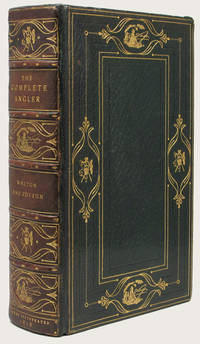
180833788London: for Samuel Bagster In the Strand 1808. THE FIRST BAGSTER EDITION RARE LARGE PAPER COPY AND A UNIQUE HEAVILY EXTRA ILLUSTRATED COPY. Vignette half-title engraved portrait frontispiece two plates of music 17 illustrations of fish within the text AND A TOTAL OF AN ADDITIONAL 84 PLATES IN ALL. A UNIQUE COPY HEAVILY EXTRA ILLUSTRATED MANY TINTED OR COLOURED BY HAND. Royal thick 8vo superbly bound by Bayntun of Bath England in very fine full crushed dark green crushed morocco the spine with raised bands separating the compartments the bands gilt stopped the compartments with full gilt panels incorporating fine tooling in a very pleasing pattern the centers of the panels with fishing motifs in gilt the covers elaborately decorated in gilt iin all over designs incorporating multi-ruled and multi-layered panels both gilt ruled and blind ruled and with fine gilt fishing motifs at the four extremities of each cover board edges gilt ruled turnovers with triple gilt fillet rules marbled endleaves all edges gilt. vi 512 pp. A very handsome copy the binding and text-block and plates all beautifully preserved some mild rubbing to the corners the binding is strong the gilt work and presentation are all very pleasing an especially fine example. VERY RARE EXTRA ILLUSTRATED COPY OF THE FIRST BAGSTER EDITION. THE ADDITIONAL PLATES ARE OF SCENERY FAUNA FLORAFISHES AND TINTED OR COLOURED BY HAND. The Bagster printing of 1808 was the first to try an exact reprinting of the 1653 first edition.<br> A beloved classic of the English language and what many call the finest "How-To" book ever written; Walton's ANGLER has been described as "full of wisdom kindly humour and charity; it is one of the most delightful and care-dispelling books in the language." "More than most authors he lives in his writings which are the pure expression of a kind humorous and pious soul in love with nature while the expression itself is unique for apparent simplicity which is really elaborately studied art" DNB. for Samuel Bagster, In the Strand hardcover
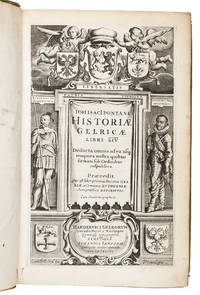
16394113Harderwijk and Amsterdam: Nicolaes van Wieringen and Johannes Janssonius 1639. Contemporary blind-tooled vellum with the manuscript author and title on the spine a lozenge-shaped ornament on both boards surrounded by a single and a double fillet border remnants of two leather closing ties densely red sprinkled edges. Folio. With a richly engraved title a full-page engraved portrait of the author by J. van Velde 5 double-page engraved maps of Gelderland 4 double-page engraved plans of Nijmegen Arnhem Zutphen and Harderwijk all with a view in profile at the top and 3 full-page engraved portraits of Arnold van Egmond Karel van Egmond and Maarten van Rossem by H.L. Roghman and Retter. First edition of the first extensive history of the duchy of Gelre present day Gelderland in the Netherlands beautifully illustrated with large maps and plans. The work consists of fourteen books. The first contains a historical-topographical description of the region while the other thirteen tell the history of Gelre in chronological order from the time of the Batavi until 1581 when the Plakkaat van Verlatinghe Act of Abjuration was signed. The maps shows various parts of Gelre in detail and the plans depict the four main towns: Nijmegen Arnhem Zutphen and Harderwijk.Johannes Isaac Pontanus 1571-1639 a historian and medical doctor from Harderwijk was commissioned to write the history of Gelre in 1621. The local government het Hof van Gelre and Zutphen had already asked for this history in 1597 but the other historians they had commissioned Paulus Merula 1558-1607 and Johannes Lontius -1621 had both passed away before they were able to complete the work. Pontanus used their notes for his history together with various other manuscripts and finished it shortly before his own death. The work was translated into Dutch by Arend van Slichtenhorst in 1653 using the same maps and plans but in a reduced size.With a later manuscript index on the second free flyleaf and a contemporary inscription on the back pastedown. The edges and corners of the boards are slightly scuffed the vellum is slightly rubbed with a brown ink stain on the front. The work is lightly browned and finger soiled throughout with an occasional small tear of water stain in the margins. Otherwise in good condition.l Bodel Nijenhuis 581; Nijhoff-Van Hattum 254; STCN 830964118 22 copies of which 5 incomplete; Wittop Koning p.78. Nicolaes van Wieringen and Johannes Janssonius, hardcover
1815275647New York: New-York Courier 1815. First. pamphlet. 21 pages printed with text in double columns. Original pamphlet sewn dampstain at upper corner and rough at edges but well inside the ample margins; some pages still un-opened. New York: At the Office of the New-York Courier 1815. First edition. A very good copy of this exceedingly scarce pamphlet. OCLC lists only 13 copies including those at Columbia Cornell Yale Harvard and the New York Historical Society.<br/> <br/> Attributed to Isaac Bronson by F. Redlich in "The Molding of American Banking" 1868 volume 1 page 308. "Isaac Bronson was a highly successful financier of the Jacksonian era who was also one of the period's most original and influential banking theorists. Bronson accumulated his very considerable fortune in New York primarily by judicious personal money-lending operations on long-term bonds and mortgages at a cautious 7 per cent annual return supplemented by successful ventures in land speculation. In addition to wealth he had by the 1830's acquired a weighty reputation for sober financial conservatism and was regarded as an authoritative exponent of sound banking principles. Prominent in the financial community he had long thrown his weight as a sound banking theorist against the "wild-cat" practices of the then rampant state banks." --Venit A. 1945. The Journal of Economic History<br/> <br/> New-York Courier unknown
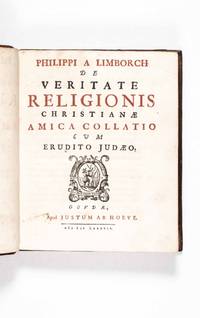
168748832Gouda: Justus van der Hoeve 1687. First edition. Hardcover. Fine. Three parts quarto. asterisk-2 asterisk4 A-3A4 3B = 197 leaves; K2 signed H2. 16 364 14 indexpp. Title in red and black printed marginalia woodcut tailpieces. Contemporary paneled calf expertly rebacked to style gilt lettering piece. Occasional touch of mild foxing else a fine crisp amply-margined copy. <br /> <br /> First edition of this remarkable collection modeled on a work of Hugo Grotius with the same title including the transcription of an epistolary debate between the Dutch theologian Phillip van Limborch 1633-1712 and the Jewish scholar Isaac Orobio de Castro ca.1617-1687. Jonathan Israel views the work as "a key exemplum of the new 'enlightened' method of upholding Christianity." Limborch was a leading Dutch theologian aligned with the Arminians and professor in the Seminary of the Remonstrants at Amsterdam. Orobio de Castro had been Professor of Theology at Salamanca who was imprisoned by the Inquisition on account of his sympathy with the Jews of Spain. He fled the country going first to France and then to Holland where he abjured Christianity and became deeply involved in the philosophico-religious controversies in the Low Countries. In the present work Limborch publishes three letters written by Orobio de Castro along with his own detailed responses. In arguing against the "truth" of the Christian religion "Orobio retorted that the advent of Christ has done nothing to render mankind less sinful or to lessen suffering that the rise of Christianity far from being unparalleled was surpassed by the expansion of Islam. and that far from being unchallengeable Christ's miracles had not been performed publicly like the miracle at Mount Sinai but virtually in secret a circumstance which renders them entirely dubious. These responses and his further claims that the New Testament is unreliable providing no basis for trust in Christ's miracles since the text exists only in Greek a language neither Jesus nor the Apostles had the slightest knowledge of. made no impact on Limborch Le Clerc or Locke who were convinced of their triumph over Orobio. Nevertheless Orobio's arguments were fully and objectively reported in the text and subsequently widely read across Europe and some of those who read it were not so sure that Orobio was 'vanquished'. Boulainvilliers who meticulously examined the text concluded that Limborch's arguments were less securely grounded on reason than he and his allies supposed and that even without their realizing it it was Orobio who won the contest a verdict echoed in other anti-Christian clandestine philosophical literature of the early eighteenth century" Israel.<br /> <br /> Edited from a manuscript formerly in the possession of the Leiden professor of theology Simon Episcopius and now in the University Library Amsterdam the Exemplar Humanae Vitae is the autobiography of the Portuguese Jew Uriel da Costa ca.1585-1640 who was excommunicated from the Sephardi Jewish community of Hamburg in 1618 after addressing a polemical broadside to the leaders of the Sephardi congregation of Venice in which he criticized rabbinic Judaism as incompatible with the Torah. He later settled in Amsterdam where he submitted to a public recantation of his views before the Portuguese Jewish congregation and committed suicide shortly thereafter. A radical freethinker who here makes an imposing plea against dogmatics da Costa may be viewed as a forerunner of Spinoza. An English translation was published at London in 1740; a complete edition of his few works was edited in 1922 by Carl Gebhardt Schriften des Uriel da Costa and published as the second volume of the Bibliotheca Spinozana. At the conclusion Limborch offers his refutation of da Costa's challenge to revealed religion. References: Bamberger no. 67. Fürst 1:17. De Graaf Cat. 70: Spiritualists Nonconformists & Dissenters no. 360. J. Israel Radical Enlightenment OUP 2001 esp. pp. 464-466. Oscott Catalogues: Recusant Books part 2 no. 2286; The Old Library part 2: Bible Collections no. 895. For Da Costa's Exemplar cf. Roth B18.30 citing the English version of 1740. The work was already scarce and much sought after in the early modern era as evidenced by: DeBure Theology no. 583: “ouvrage estime & recherche les exemplaires en sont peu communs†and Osmont Dictionnaire vol. 1 p.406: “rare et estimé.†In his 1694 catalogue of Christian Hebraic works Bibliotheca Latino-Hebraica Carlo Imbonati offers a surprisingly long discussion of De Veritate on pp. 201-209. Justus van der Hoeve hardcover
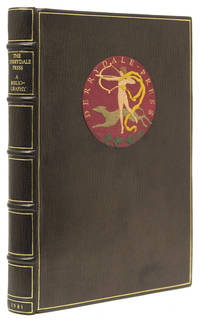
309874Goshen CT: The Angler's & Shooter's Press 1981. Letter S of 26 copies of the Large Paper De Luxe Edition on handmade Crown & Sceptre paper. With photoengraved frontispiece and an additional engraved title page specially produced by Richard Benson with calligraphy by Stephen Harvard and illustrations printed by The Meriden Gravure Company. 1 vols. 8vo. Original full black morocco with a six-color morocco onlay on upper cover panelled spine with gilt title t.e.g. others uncut by Gray Parrot with his label on rear pastedown. Very fine in original morocco-backed folding case. Letter S of 26 copies of the Large Paper De Luxe Edition on handmade Crown & Sceptre paper. With photoengraved frontispiece and an additional engraved title page specially produced by Richard Benson with calligraphy by Stephen Harvard and illustrations printed by The Meriden Gravure Company. 1 vols. 8vo. The beautiful deluxe issue of the standard essential bibliography. The Angler's & Shooter's Press unknown
1953283970gnome press 1953 first edition. near fine book near fine jacket blue boards lettered in brown tiny name written on the ep tiny top of the spine and corner chips hard to see.some rub marks top of the boards. gnome press hardcover
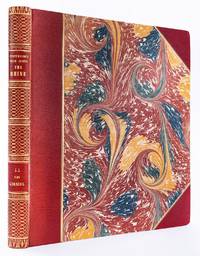
1820136164London: R. Ackermann 1820. First illustrated edition First illustrated edition with plates watermarked 1816-20. By 1820 Rudolph Ackermann 1764-1834 had established himself as one of the premium publishers of colour plate books in Britain largely thanks to a number of works on English topography starting with The Microcosm of London in 1808. A Picturesque Tour Along the Rhine was the first title in Ackermann's "Picturesque Tour" series and was issued in six monthly parts. While Gerning's text was originally published in German in 1819 the introduction makes it clear that Ackermann was already working on his illustrated edition. Abbey suggests that "that the text was commissioned by Ackermann as were the views for the plates". Quarto 343 x 280 mm. With 24 hand-coloured aquatints and one large folding map with colour highlights. Includes the list of subscribers. Finely bound by Sangorski & Sutcliffe in dark green half morocco green buckram boards raised bands spine lettered in gilt compartments and boards ruled in single gilt fillets top edge gilt pale green endpapers. Spine slightly sunned boards a touch scuffed and rubbed minor offsetting from plates occasional light spotting a couple of creases to the Bornhofen plate and a small repair to the margin on the Biebrich plate. Overall a very good copy. Abbey Travel 217; Tooley 234. hardcover
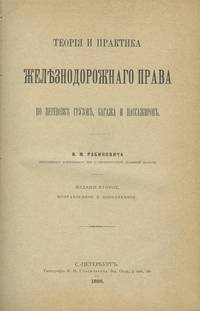
3549917Short description: In Russian. Rabinovich Isaac Moiseevich. Theory and Practice of Railway Law on Cargo Luggage and Passenger Transport. St. Petersburg: Type. M.M. Stasyulevich 1898. The image is provided for reference only. It may reflect condition of one of the available copies or only help in identifying the edition. Please feel free to contact us for a detailed description of the copies available. SKU3549917 unknown
195114715spectacular association copy THE STARS LIKE DUST Doubleday 1951 first edition a few minor spots to the fore edge some age toning to the page edges else a near fine copy in a bright vg or better dust-wrapper save for a tiny chip missing from the base of the dust-wrapper spine and a printed slip from the Dirk Wylie Literary Agency unceremoniously taped to the front dust-wrapper panel. A reveiw copy with accompanying review slip laid in. Very scarce thus. Formerly the copy of Fred Pohl with his ownership signature on the front end-paper. It was Pohl who while acting as Asimov's literary agent at the time sold this book to Doubleday. A spectacular association copy between two very close and very old friends not to mention two Super Nova's of the genre. Doubleday unknown