29 610 résultats
309871Goshen CT: The Angler's & Shooter's Press 1981. No. 2 of 5 Out-of-Series Copies of the Large Paper De Luxe Edition on handmade Crown & Sceptre paper. With photoengraved frontispiece and an additional engraved title page specially produced by Richard Benson with calligraphy by Stephen Harvard and illustrations printed by The Meriden Gravure Company. 1 vols. 8vo. Original full red morocco with a six-color morocco onlay on upper cover panelled spine with gilt title t.e.g. others uncut by Gray Parrot with his label on rear pastedown. Very fine in original morocco-backed folding case. No. 2 of 5 Out-of-Series Copies of the Large Paper De Luxe Edition on handmade Crown & Sceptre paper. With photoengraved frontispiece and an additional engraved title page specially produced by Richard Benson with calligraphy by Stephen Harvard and illustrations printed by The Meriden Gravure Company. 1 vols. 8vo. In addition to the regular edition of 1250 numbered copies of this bibliography now recognized as a landmark volume in the history of American sporting publications there was a large paper state comprising the De Luxe edition of 26 lettered copies bound in black morocco and then five copies bound in red morocco out of series for the authors. Provenance: Harry Marschalk's copy signed by him with a note about the five special copies The Angler's & Shooter's Press unknown
1957155198Garden City: Doubleday & Company 1957. Octavo cloth. First edition. The second novel featuring detective Elijah Bailey and his robot partner R. Daneel Olivaw by "the writer who virtually invented the science fiction mystery. In his novels THE CAVES OF STEEL 1954 and THE NAKED SUN 1957 and in the stories collected as ASIMOV'S MYSTERIES 1968 he masterfully bridged the gap between the two genres and proved that genuine detective fiction could be set in the future as well as in the present or past." - Pronzini and Muller 1001 Midnights p. 29. The human/robot detective team solve another murder this one committed on Solaris an Outer World with a robot-run economy where the twenty thousand Solarians thinly spread out over the surface of the planet live in near total isolation from each other and the presence or touch of another Solarian produces incapacitating physical repugnance. Bailey from an underground Earth city must overcome his fear of open spaces to solve the crime. "In its setting it's a sort of inversion of THE CAVES OF STEEL and it's equally cleverly plotted." - Pringle The Ultimate Guide to Science Fiction second edition 1995 p. 249. Anatomy of Wonder 2004 II-42. Survey of Science Fiction Literature III pp. 1476-9. A fine copy in nearly fine dust jacket with light wear and rubbing to spine ends mild rubbing to upper right front corner and a little dust soiling. #155198 Doubleday & Company unknown books
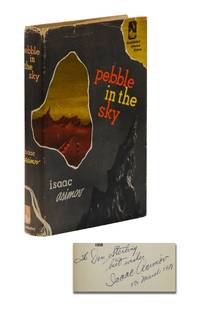
1950140946409Garden City New York: Doubleday & Company Inc 1950. First Edition. Very Good/Very Good. First edition first printing of Isaac Asimov's first novel. Signed by Asimov on the title page and inscribed "To Don Sterling best wishes 13 March 1981." Bound in publisher's original gray cloth lettered in orange on the spine. Very Good with lean to binding light wear at extremities and scattered foxing to cloth. Minor offsetting to ensheets. In a Very Good unclipped dust jacket with fading moderate wear and small damp stain to foot of spine; toning and tape repairs to verso. Signed first editions are scarce. Doubleday & Company, Inc unknown
1674000030London: William Godbid 1674. 3rd Printing. 1/2 Vellum. Very Good. 1st Edition 3rd Issue. 4to 19.6 x 15.9 cm. 2 Volumes in one. Bound in later half vellum on early marble boards. Collation: Vol. 1 - vi 127 15 folding engraved plates; Vol 2- viii 151 14 12 folding engraved plates. Plate 13 is duplicated. There are 3 leaves preceding the second part that are misplaced and should be at the front of the first section after the title page. This rebound copy has original marble boards and later vellum. The title page is reduced along the fore edge by 1.1 cm not affecting printed area. Text and plates in very good condition with only occasional minor spotting and dusting. This is a complete copy despite the misplaced pages during rebinding. <br/><br/>This first edition of Barrow's lectures on geometry and optics were given at Cambridge where he was Lucasian professor of mathematics. Newton was one of his students and "is known to have helped in preparing Barrow's Lectiones XVIII 1669 and Lectiones geometricae 1670 for publication and even to have added one or two small improvements. As a mathematician Barrow is well-known as a pioneer in the development of calculusÂ…Barrow also presented although in geometrical form the fundamental theorem of the calculus in which integration and differentiation are shown to be inverse operations. His preferenceÂ…for geometrical proofs over algebraic manipulationsÂ…could well have had some influence on the young Newton who later expressed his own distaste for the new techniques introduced into mathematics by Descartes and his followers." Gjertsen p. 55. Babson 249; Graesse I p. 299; Wallis 358.4; Wing B945 William Godbid hardcover books
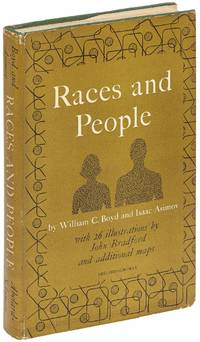
1955468623New York: Abelard-Schuman 1955. Hardcover. Fine/Near Fine. First edition. With 26 illustrations by John Bradford with additional maps. Octavo. 189pp. Light dampstaining on the boards very good in price-clipped very good dust jacket with a corresponding light stain mostly on the rear panel and with small internal repairs at the spine ends. Exploration of race by two white academic writers aimed at young adult readers Asimov's second book for the YA market.<br /> <br /> Inscribed by Asimov to a fellow science fiction legend: "For John Campbell who may disagree with everything. Isaac." Campbell was the influential editor of Astounding Science Fiction later renamed as Analog Science Fiction and Fact and wrote his own science fiction titles most notably Who Goes There which was adapted into several film versions as The Thing. Asimov's inscription is prescient and recognizes the contrarian nature of Campbell who Asimov fell out with not long afterwards because of Campbell's obsession with pseudoscience. Campbell’s essays in support of segregation and comments about slavery and race alienated him from many in the sci-fi community. An uncommon title with a poignant and important association. Abelard-Schuman hardcover
174492332Lausanne and Geneva: Aoud Marcum-Michaelem Bousquet & Socios 1744. First edition of the first collected edition of <span class="match">Newton</span>'s writings which has been hailed as "a fine piece of bookmaking" Babson. Quarto bound in contemporary velum contains 64 folding engraved plates; 2 folding letterpress tables. In very good condition wide margins. Rare in contemporary binding. English mathematician astronomer theologian author and physicist Sir Isaac Newton is widely considered one of the most influential scientists of all time and a key figure in the scientific revolution. In one of his most important works Philosophiae Naturalis Principia Mathematica Newton formulated the the laws of motion and universal gravitation that formed the dominant scientific viewpoint until being superseded by the theory of relativity. Aoud Marcum-Michaelem Bousquet & Socios unknown books
182219114Glasgow: Andreae et Joannis M. Duncan 1822. FIRST GLASGOW EDITION. Numerous text diagrams and illustrations. Contemporary calf all covers with blind-stamped floral border within gilt floral borders within gilt-lined borders spines in compartments with gilt decoration spine labels; first few leaves of each volume spotted otherwise an excellent set. First Glasgow reprint of the first Jesuit edition printed in Geneva from 1739-1742. This edition of Newton’s Principia was edited by John Martin Frederick Wright of Trinity College who contributed additional commentary. Babson notes that Glasgow’s printing of this edition of the complete text was a great credit to the university whereas Cambridge was “satisfied with reprints of the first three sections of the first book.â€<br /> <br /> Babson 32; Gray 17; Wallis 17. Andreae et Joannis M. Duncan unknown
04274London: Allen & Co. 1807. A Study the Inhabitants of the Roundhouse and the Regular Attendants at the Police-Court"<br/>A Journey in Caricature through Early Nineteenth Century England.<br/><br/>WOODWARD. George Moutard. Eccentric Excursions or Literary & Pictorial Sketches of Countenance Character & Country in different parts of England & South Wales. Interspersed with Curious Anecdotes Embellished with upwards of One Hundred Characteristic & Illustrative Prints. London: Allen & Co. 1807 but ca. 1813. <br/><br/>Later issue first published in 1796. Quarto 10 3/16 x 8 3/8 in; 259 x 213 mm. iv v 6-217 1 list of plates pp. Engraved title-page included in pagination Hand colored frontispiece and 100 hand-colored etched plates on ninety-nine leaves by Isaac Cruikshank after Woodward including three folding plates Plates 1 2 and 3. The text is watermarked "W. Balston 1813". <br/><br/>Bound by Rivière & Son stamp-signed on verso of front endpaper ca. 1890. Full maroon morocco covers with double-gilt borders spine with five raised bands decoratively tooled and lettered in gilt in compartments gilt ruled board-edges decorative gilt turn-ins marbled end-papers top edge gilt others uncut. Occasional toning or foxing a few leaves with neatly repaired or strengthened edges. Overall an excellent copy of this journey in caricature through early nineteenth century England. <br/><br/>Originally published in 1796 with subsequent issues in 1797 1798 1799 1801 1807. 1814 1815 1816 1818 Eccentric Excursions is quite rare in all yet curiously is rarer still in the later issues.<br/><br/>This satire amongst Moutard's earliest work enthusiastically depicts all types: high- and low-born rural and urban lawyers and peddlers coaching scenes misadventures on ice-skates Oxford dons gypsies etc.<br/><br/>"The first and most celebrated of Woodward's books. The text describes an idiosyncratic ramble around the counties of England and Wales." Gordon p. 15.<br/><br/>George Moutard Woodward 1760-1809 was "prolific and popular designer of social caricature much in the style of Banbury etched chiefly by Thomas Rowlandson and Isaac Cruikshank.his caricatures display a wealth of imagination and insight into character.extremely entertaining" DNB.<br/><br/>"Another popular caricaturist of the day was George Moutard Woodward commonly called ‘Mustard George.' Woodward according to his friend Henry Angelo was the son of a land agent and spent his youth in a country town where nothing was less known than everything pertaining to the arts. ‘A caricaturist in a country town' said Mustard George ‘like a bull in a china shop cannot live without noise; so having made a little noise in my native place I persuaded my father to let me seek my fortune in town.' Thanks to a small allowance from his father supplemented by his own earnings George was able to enjoy life in his own Bohemian fashion and ultimately took up his quarters at the ‘Brown Bear' Bow Street where he was able to study the inhabitants of the roundhouse and the regular attendants at the police-court. At the ‘Brown Bear' he died suddenly departing in character with a glass of brandy in his hand and was long mourned by his tavern associates. In his Eccentric Excursions which appeared in volume form in 1796 the designs engraved by Isaac Cruikshank there are several domestic subjects such as The Polite Congregation Showing Family Pictures and The Formal Introduction. Among other popular designs by Woodward are Raffling for a Coffin The Club of Quidnuncs Babes in the Wood A Goldfinch and his Mistress.and a series called Six Ways of Carrying a Stick. The majority are marred by extravagant hideousness but Angelo was of opinion that ‘had this low humourist studied drawing and been temperate in his habits such was the fecundity of his imagination and perception of character that he might rivalled even Hogarth" Paston Social Caricature in the Eighteenth Century pp. 137-138.<br/><br/>Gordon BC-26; Widener 207; Not in Abbey or Tooley. London: Allen & Co., 1807 unknown books
04274London: Allen & Co. 1807. A Study the Inhabitants of the Roundhouse and the Regular Attendants at the Police-Court"<br /> A Journey in Caricature through Early Nineteenth Century England.<br /> <br /> WOODWARD. George Moutard. Eccentric Excursions or Literary & Pictorial Sketches of Countenance Character & Country in different parts of England & South Wales. Interspersed with Curious Anecdotes Embellished with upwards of One Hundred Characteristic & Illustrative Prints. London: Allen & Co. 1807 but ca. 1813. <br /> <br /> Later issue first published in 1796. Quarto 10 3/16 x 8 3/8 in; 259 x 213 mm. iv v 6-217 1 list of plates pp. Engraved title-page included in pagination Hand colored frontispiece and 100 hand-colored etched plates on ninety-nine leaves by Isaac Cruikshank after Woodward including three folding plates Plates 1 2 and 3. The text is watermarked "W. Balston 1813". <br /> <br /> Bound by Rivière & Son stamp-signed on verso of front endpaper ca. 1890. Full maroon morocco covers with double-gilt borders spine with five raised bands decoratively tooled and lettered in gilt in compartments gilt ruled board-edges decorative gilt turn-ins marbled end-papers top edge gilt others uncut. Occasional toning or foxing a few leaves with neatly repaired or strengthened edges. Overall an excellent copy of this journey in caricature through early nineteenth century England. <br /> <br /> Originally published in 1796 with subsequent issues in 1797 1798 1799 1801 1807. 1814 1815 1816 1818 Eccentric Excursions is quite rare in all yet curiously is rarer still in the later issues.<br /> <br /> This satire amongst Moutard's earliest work enthusiastically depicts all types: high- and low-born rural and urban lawyers and peddlers coaching scenes misadventures on ice-skates Oxford dons gypsies etc.<br /> <br /> "The first and most celebrated of Woodward's books. The text describes an idiosyncratic ramble around the counties of England and Wales." Gordon p. 15.<br /> <br /> George Moutard Woodward 1760-1809 was "prolific and popular designer of social caricature much in the style of Banbury etched chiefly by Thomas Rowlandson and Isaac Cruikshank.his caricatures display a wealth of imagination and insight into character.extremely entertaining" DNB.<br /> <br /> "Another popular caricaturist of the day was George Moutard Woodward commonly called 'Mustard George.' Woodward according to his friend Henry Angelo was the son of a land agent and spent his youth in a country town where nothing was less known than everything pertaining to the arts. 'A caricaturist in a country town' said Mustard George 'like a bull in a china shop cannot live without noise; so having made a little noise in my native place I persuaded my father to let me seek my fortune in town.' Thanks to a small allowance from his father supplemented by his own earnings George was able to enjoy life in his own Bohemian fashion and ultimately took up his quarters at the 'Brown Bear' Bow Street where he was able to study the inhabitants of the roundhouse and the regular attendants at the police-court. At the 'Brown Bear' he died suddenly departing in character with a glass of brandy in his hand and was long mourned by his tavern associates. In his Eccentric Excursions which appeared in volume form in 1796 the designs engraved by Isaac Cruikshank there are several domestic subjects such as The Polite Congregation Showing Family Pictures and The Formal Introduction. Among other popular designs by Woodward are Raffling for a Coffin The Club of Quidnuncs Babes in the Wood A Goldfinch and his Mistress.and a series called Six Ways of Carrying a Stick. The majority are marred by extravagant hideousness but Angelo was of opinion that 'had this low humourist studied drawing and been temperate in his habits such was the fecundity of his imagination and perception of character that he might rivalled even Hogarth" Paston Social Caricature in the Eighteenth Century pp. 137-138.<br /> <br /> Gordon BC-26; Widener 207; Not in Abbey or Tooley. London: Allen & Co., 1807 unknown
177114425A Amsterdam, chez Marc Michel Rey, 1771. In-8 de XVI-368-(9) pp., veau marbré, dos orné à nerfs, pièce de titre en maroquin rouge, tranches rouges (reliure de l'époque).
1756140742London, T.Osborne and J. Shifton, 1756. Engraved frontispiece, title in red and black with engraved vignette, 8 leaves, 748 pp. with engraved head-piece, 2 leaves (index), 114 plates, of which 14 folding. / Mit gest. Frontispiz, Titelblatt in Rotschwarz-Druck mit gest. Vignette, 8 Bll., 748 S. Mit 1 breiten gestochenen Kopfleiste, 2 Bll. Index, 114 Kupfertafeln, davon 14 gefaltet. Folio, full contemporary calf, gilt spine, six raised bands.
115619England late 18th century. . 100-leaf manuscript rectos and most versos filled wax seal remnants to front pastedown leaves wavy at the edges some spotting and marks to contents; contemporary calf-backed blue paper boards gilt floral tools to spine compartments binding marked and worn with spine cords partially exposed and loss of the blue paper morocco label lacking naphthalene smell good condition housed in a black cloth folding case.<br /> An unusual late 18th century manuscript on classical physics that cites Isaac Newton Blaise Pascal William Harvey Henry Power and others.<br /><br />The text approximately 200 pages presents an ordered and detailed account of a number of related topics: optics; hydrostatics and pneumatics; mechanics including simple machines such as the lever and screw the behaviour of descending bodies and pendulums; phosphorus and its chemical transformations; and fortifications and architecture. The notes are dense but generally neat and legible with carefully prepared diagrams so this seems to be a fair copy rather than a working notebook. <br /><br />Newton is cited in the section on light and colour: 'What Sir I.N. has said by way of in the last edit of his Opticks will appear to be an established truth from most if not all the following examples some of which he mentions himself". And Harvey in a short section on chemical transformations: "Harvey had says he the opportunity as well as the curiosity upon several occasions to examine the weight of when some of them taken up in places very distant from one another.'.<br /><br />The origin of much of the material is unclear though the long section on hydrostaticks was taken from Hydrostatical and Pneumatical Lectures by Roger Cotes 1682-1716 originally published privately in 1738 and with a second edition at Cambridge in 1747. <br /><br />Cotes was 'probably the most talented British mathematician of the generation after Newton'. He was nominated as the first Plumian professor of astronomy at Cambridge in 1706 and 'his appointment was favoured by his influential mentor Richard Bentley master of Trinity; by Newton's successor as Lucasian professor William Whiston who claimed to be in mathematics "a child to Mr Cotes" Whiston 133; and by Newton himself. In 1709 Cotes became heavily involved in the work for which he is best remembered namely the revisions for the second edition of Newton's Philosophia naturalis principia mathematica the first being out of print' Oxford Dictionary of National Biography. Cotes died young and Newton was reported to have said that 'if he had lived we might have known something'. A number of Cotes's lectures and mathematical analyses were published posthumously by his executor Robert Smith the Hydrostatical and Pneumatical Lectures being one of them. It is tempting to question whether other portions of the present manuscript are also based on Cotes's work and further academic scrutiny might be fruitful.<br /> England, late 18th century. hardcover
023366West Bloomfield: Phantasia Press 1985 A deluxe limited edition of only 35 lettered and signed copies; this being the letter K. Signed by Isaac Asimov directly on the colophon page. Bound in full black morocco with leather appliqués on the front cover depicting the sun and the heads of two robots. Silver lettering on spine. A trace of rubbing to bottom edge else book in fine as new condition. Phantasia Press hardcover
16962447Leipzig: Gross & Fritsch 1696. First edition. vellum marbled boards. Very Good. FIRST PRINTINGS OF THE PAPERS DOCUMENTING THE PROPOSAL AND SOLUTION OF THE "BRACHISTOCHRONE PROBLEM" ONE OF THE MOST FAMOUS MATHEMATICAL CHALLENGES AND ONE OF THE EARLIEST PROBLEMS POSED IN THE CALCULATION OF VARIATIONS. The challenge of the brachistochrone "began in June of 1696 when Johann Bernoulli published a challenge problem in Leibniz's journal Acta Eruditorum. Obviously a legacy of public challenge remained from the days of Fior and Tartaglia. Although contests were now conducted in the sedate pages of scholarly journals they retained their power to make or break reputations as Johann himself observed:<br /> <br /> '. it is known with certainty that there is scarcely anything which more greatly excites noble and ingenious spirits to labors which lead to the increase of knowledge than to propose difficult and at the same time useful problems through the solution of which as by no other means they may attain to fame and build for themselves eternal monuments among posterity.'<br /> <br /> "Johann's particular challenge was a good one. He imagined points A and B at different heights above the ground and not lying one directly above the other. There is certainly an infinitude of different curves connecting these two points from a straight line to an arc of a circle to any number of other wavy undulating paths. Now imagine a ball rolling from A down to B along such a curve. The time it take to complete the trip depends of course on the curve's shape. Bernoulli challenged the mathematical world to find that one particular curve AMB along which the ball will roll the shortest time. He called this curve the 'brachistochrone' from the Greek words for 'shortest' and 'time'.<br /> <br /> "An obvious first guess is to take AMB as the straight line joining A and B. But Johann cautioned against this simplistic approach:<br /> <br /> '. to forestall hasty judgment although the straight line AB is indeed the shortest between the points A and B it nevertheless is not the path traversed in the shortest time. However the curve AMB whose name I shall give if no one else discovered it before the end of this year is one well-known to geometers.'<br /> <br /> "Johann gave the mathematical world until January 1 1697 to come up with a solution. However when his deadline arrived he had received but one solution from the 'celebrated Leibniz' who:<br /> <br /> 'has courteously asked me to extend the time limit to next Easter in order than in the interim the problem might be made public . that no one might have cause to complain of the shortness of the time allotted. I have not only agreed to this commendable request but I have decided to announce myself the prolongation and shall now see who attacks this excellent and difficult question and after so long a time finally masters it.'"<br /> <br /> At this point Johann and others were surprised and perhaps a little delighted that they had not received a solution from their English rival Sir Isaac Newton. Wondering if Newton has not noticed the challenge Johann sent Newton directly a personal letter outlining the problem. When Newton received the letter he did not disappoint. As Newton's niece Catherine Conduitt explained:<br /> <br /> "When the problem in 1697 was sent by Bernoulli - Sir I.N. was in the midst of the hurry of the great recoinage and did not come home till four from the Tower very much tired but did not sleep till he had solved it which was by four in the morning."<br /> <br /> "Even late in life and tired from a hectic day's work Isaac Newton triumphed where most of Europe had failed! It was a remarkable display of the powers of the great British genius. He had clearly felt his reputation and honor were on the line; after all both Bernoulli and Leibniz were waiting in the wings to publish their own solutions. So Newton rose to the occasion and solved the problem in a matter of hours. Somewhat exasperated he is reported at one point to have said 'I do not love . to be . teezed by foreigners about Mathematical things.'<br /> <br /> "Back in Europe as Easter neared a few solutions came into the hands of Johann Bernoulli. The curve that everyone was seeking - one that 'is well-known to geometers' - was none other than an upside-down cycloid. This important curve was studied by Pascal and Huygens but neither of these mathematicians had realized that it would also serve as the curve of quickest descent. Johann wrote with characteristic hyperbole '. you will be petrified with astonishment when I say that precisely this cycloid . of Huygens is our required brachistochrone.'<br /> <br /> "On Easter the challenge period had expired. All together Johann had received five solutions. There was his own and the one from Leibniz. His brother Jakob came through perhaps to Johann's dismay with a third and the Marquis de l'Hospital added a fourth. Finally there was a submission bearing an English postmark. Opening it Johann found the solution correct although anonymous. He clearly had met his match in the person of Isaac Newton. Although unsigned the solution bore the unmistakable signs of supreme genius.<br /> <br /> "There is a legend - probably of dubious authenticity but nonetheless of great charm - that Johann partially chastened partially in awe put down the unsigned document and knowingly remarked 'I recognize the lion by his claw.'" Quoted from William Dunham Journey Through Genius: The Great Theorems of Mathematics Wiley 1990 page 199-202.<br /> <br /> The Brachistochrone Papers - the proposal and the solutions included:<br /> <br /> Johann: Supplementum defectus geometria cartesianae circa inventionem locorum; 2. Leibniz: Communicatio suae pariter duarumque alienarum ad edendum sibi primum a Dn. Joh. Bernoullio; 3. Johann: Curvatura radii in diaphanis non uniformibus . ; 4. Jakob: Solutio problematum fraternorum . ; 5. L'Hospital: Solutio problematis de linea celerrimi descensus; 6. Tschirnhaus: De methodo universalia theoremata eruendi . ; 7. Newton: Epistola missa ad praenobilem virum D. Carolum Mountague .<br /> <br /> Note: Newton's solution original appeared in the Philosophical Transactions.

<br /> <br /> Provenance With stamps and withdrawal markings 7-3-1984 from the famous John Crerar Library Chicago. <br /> <br /> In: Acta Eruditorum vol. 15 and 16: no.1 in 15:264-69 1 plate; no. 2 in 16:201-5 1 plate; no. 3 in 16: 206-11; no. 4 in 16:211-17; no. 5 in 16: 217-20; no. 6 in 16: 220-23; no. 7 in 16: 223-24. Leipzig: Gross & Fritsch 1696-1697. The two entire volumes offered. Quarto 208x170 mm. Two volumes in uniform contemporary three-quarter vellum over marbled boards. pp 2 604 and 9 plates; 8 594 and 8 plates. Some heavy worming to pp 324-42 and plate vi of volume 15 which is not part of any of the above mentioned articles. 1697 volume with repaired gutter tear to plate 8; reinforcement to p.449/50 and minor restoration to binding. Some toning throughout as usual with the Acta. In all a very good set. Gross & Fritsch unknown books
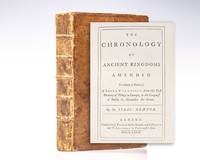
1728149863London: Printed for J. Tonson in the Strand and J. Osborn and T. Longman in Pater-noster Row 1728. First edition of Newton's ambitious attempt to reconstruct and rationalize the timelines of ancient history. Quarto bound in full contemporary Cambridge calf ruled and tooled in blind with speckled panels gilt turn-ins ordinary paper issue illustrated with 3 folding engravings. From the library of Harvard University professor Owen Gingerich. Owen Gingerich 1930–2023 was an American astronomer and historian of science renowned for his scholarship on early modern astronomy particularly his meticulous census of De revolutionibus that illuminated how Copernicus’s work was read and received in the sixteenth century. A longtime professor at Harvard and a senior astronomer at the Smithsonian Astrophysical Observatory Gingerich helped bridge scientific and humanistic inquiry demonstrating how historical context shapes the development and interpretation of scientific ideas. In very good condition. The Chronology of Ancient Kingdoms Amended published posthumously in 1728 was Isaac Newton’s ambitious attempt to reorganize and compress the timelines of ancient history by applying critical philology comparative mythology and astronomical calculation. Seeking to reconcile classical sources with biblical chronology Newton argued that the conventional dating of Egyptian Greek and Near Eastern kingdoms was excessively long and he used evidence such as eclipse records regnal lists and mythic genealogies to propose a shorter more unified ancient past. Although modern historians largely rejected Newton’s revised dates the work was significant for revealing the breadth of his intellectual pursuits beyond physics and mathematics and for illustrating how early Enlightenment thinkers employed scientific reasoning to interrogate historical and scriptural authority. Printed for J. Tonson in the Strand, and J. Osborn and T. Longman in Pater-noster Row unknown
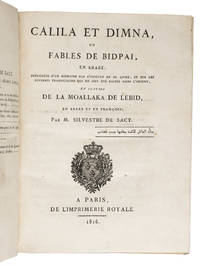
1816ABC_50110Paris 1816. 4to. Imprimerie Royale 19th-century purple-ish cloth with the title lettered in gold on the spine. The cloth around the spine is faded and browned. 2 parts in 1 volume. 2 VIII 140; 8 315 1 pp. The complete text of the Arabic version by Ibn al Muqaffa of this collection of animal fables with didactic overtones designed to illustrate wise conduct printed in the beautiful types of the "Imprimerie Royale" with an introduction and critical notes in French. The typeface based on Arab or Turkish specimens of calligraphy and cut in Rome in the early 17th century for Savary "was the mainstay of Arabic typography in France until the late 19th century; it also provided a model for others" Roper p. 145.The spine is sunned occasional browning and foxing. Otherwise in good condition.l Blois "Kalila wa-Dimna" in: Meisami & Starkey Enyclopedia of Arabic literature pp. 423-425; Chauvin II p. 11f. no. 17; Keith-Falconer Kalilah and Dimnah pp. xvi-xvii; cf. G. Roper Early Arabic Printing in Europe in: Middle Eastern Languages and the Print Revolution. A Cross-Cultural Encounter Westhofen 2002 pp. 129-150. hardcover
17348863Amsterdam, J. Frédéric Bernard, 1734-1739. 2 volumes in-8 (196 x 242 mm), 2 ff. n. ch., LXXVI pp., 594 pp. ; VIII pp., XXXIV pp., 806 pp. Maroquin rouge, triple filet d'encadrement avec fers, dos à nerfs orné, pièce de titre en maroquin citron, filet sur les coupes et les coiffes, roulette intérieure, tranches dorées sur marbrure, rares rousseurs (reliure de l'époque).
1740102648?Paris, Debure?, 1740, in-4, XXX-[2]-148-[2] pp, Veau havane marbrée, dos à nerfs orné de caissons dorés, pièce de titre rouge, tranches rouges, Édition originale de la traduction française par Buffon dont le nom n'est mentionné que dans les Extraits des registres de l'Académie royale des sciences, in fine. Elle est traduite sur la traduction anglaise de John Colson parue en 1736 (sans son commentaire), elle-même traduite sur l'édition originale en latin de Newton qui ne fut jamais publiée. Elle est illustrée de figures en noir dans le texte. Dans sa longue préface, il explique vouloir donner un "Newton clair, plus traitable, & à la portée du commun des géomètres", donne une courte notice historique des mathématiques pré-newtoniennes, critique sévèrement ses rivaux, notamment lorsqu'il évoque la controverse avec Liebniz et expose la méthode de calcul de Newton. Dans cet ouvrage le célèbre physicien anglais expose sa méthode de calcul infinitésimal dans sa première partie, lui donne une notation propre et propose ses applications dans la seconde. Bien que cet ouvrage fut relativement confidentiel lors de sa rédaction et sa première circulation via manuscrits, il est aujourd'hui reconnu comme fondamental dans l'histoire des mathématiques. Petits manques et épidermures, quelques taches. Complet de son errata. Gray, 236; Babson, 173. Couverture rigide
1679032848<p>A Paris: De L'Imprimerie Royale 1679 A fair copy of the 1st edition of the Description de la Grotte de Versailles bound with a very good copy of the 2nd edition of Labyrinte de Versailles in contemporary elephant folio full leather binding. La Grotte has had 5 of the 20 plates cut out but Labyrinte is complete. The binding is sound with raised bands and title label to spine. It is very worn with a lot of wear to corners with leather loss and to spine joints spine ends and edges. The surface of the boards is a little rough. All page edges red. There is an old bookplate to the front pastedown endpaper - Earl Vane from the Library of the Rev. John Vane. Contents: 3 blanks; title 1679; blank verso; Description pp 1-11; Imprimerie to verso p 11; plates 13 single and 2 double; title to Labyrinte 1697; blank verso; Description pp 3-34; blank recto with Explication du Plan du Labyrinte to verso; plate 1; fables quatrains by Isaac Benserade and plates Sebastien Leclerc on opposing pages - 78 pp 39 plates; table 3 pp with L'Imprimerie to verso final leaf; 4 x final blanks. The binding is 50 cm x 35 cms; the page size in Labyrinte matches that of the Grotte but the actual text and plate size is 15.8 x 10.2 cm. Contents are in very good clean condition. Please enquire if you would like to see further images.</p> De L'Imprimerie Royale hardcover
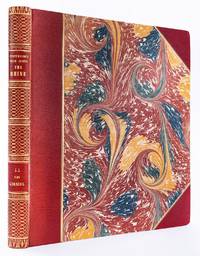
57598London: R. Ackermann 1820. FIRST EDITION. Folio 33.5 x 28 cm. Title verso blank; Dedication 1 leaf; List of Subscribers pages v to viii; Preface by the Translator pages ix to xii; Preface of the Author pages xiii and xiv; Contents 1 leaf verso with List of Plates; Text pp. 1-178. Period style half red morocco over marbled boards spine with raised bands and intricate gilt tooling all edges gilt. 24 aquatinted plates D. Havell and T. Sutherland after C.G. Schutz with original hand-colouring engraved folding map with colour highlights at rear entitled "Map of the Course of the Rhine from Mentz to Cologne; And of the Course of the Maine and the Lahn". Minor scattered spotting slight offsetting to map generally an excellent copy. One of Ackermann's major colour plate books and apparently the first in his "Picturesque Tours" series others of which explore the Seine the Ganges and the Thames. The book describes a trip down the Rhine on that part of the river generally considered most romantic and charming "from Mentz to Cologne and of the Bathing-Places of Wiesbaden and Embs". The account contains not only topographical descriptions but considerable historical information and details of popular traditions the book being written "with a view chiefly to the information of travellers of cultivated minds who may be induced to visit this interesting portion of Germany Preface of the Author". The original German edition was published in Wiesbaden in 1819 as Die Rheingegenden von Mainz bis Cölln without illustrations. The third issue with the plates numbered in top right corner. Abbey Travel 217; Tooley 234. London: R. Ackermann, 1820. hardcover
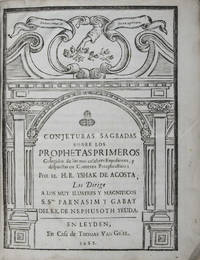
43872Leyden Leiden: Thomas van Ge'el 5482. First edition. Hardcover. f to vg. Quarto 9 3/4 x 8". 8 426 1 blank leaf 1 leaf Second title 427-906pp. Contemporary full calf with gold lettering and tooling to spine. Raised bands. Contemporary previous owner's inscription on front free endpaper: "Ce livre appartient à moi Isaac de Mozes. Celui qui le trouvera aura à bonté de moi le . en lui donnant une pièce de six sols pour la peine. Le 4 février 1730." Signed Eliez de Mozes. This book belongs to me Isaac de Mozes. The one who finds it and returns it to me will be given a coin of six sols. Dated February 4 1730. Illustrated titles within woodcut order. Decorative head- tailpieces and initials. <br /> <br /> Published by Isaac de Acosta "Conjecturas Sagradas sobre los Profetos primeros" Sacred Conjectures on the First Prophets is a commentary in Spanish on the Early Prophets based on the classical Hebrew commentators and the Midrash. It contains a new translation and a paraphrase of Joshua Judges Samuel and Kings.<br /> <br /> Binding heavily rubbed with tail of spine missing. Sporadic clear water staining at upper margin of a few pages never affecting lettering. Some minor worming along inner margin of pages 635 on not affecting lettering. Fly leaf at rear partly disbound. Text in Spanish. Binding in overall poor to fair interior in good to very good condition. About the author: Isaac Yhsak de Acosta - d. 1728 was a French Sephardi rabbi. Probably a native of Amsterdam Acosta became hazzan of the Jewish community of Peyrehorade near Bayonne formed by Marrano fugitives from the Iberian Peninsula. His "Historia Sacra Real" 1691 dedicated to the wardens of the community is one of the earliest manifestations of Judaism in this place. Later apparently after an interlude in Biarritz he succeeded R. Hayyim de Mercado as hakham at Bayonne where he composed his handbook for the administration of the last rites to the dying "Via de Salvacion" 1709; reprinted by M. Kaplan Bayonne 1874 and his major work "Conjeturas Sagradas" Leyden 1722 a commentary in Spanish on the Early Prophets based on the classical Hebrew commentators and the Midrash. Thomas van Ge'el hardcover
195025105New York: Gnome Press 1950. Cloth. Near Fine. An unusually bright well-preserved copy of the 1950 stated 1st edition of Isaac Asimov's 2nd published work preceded only by "Pebble in the Sky" also published in 1950. Clean and Near Fine in its dark-red cloth with no writing or markings of any kind internally. Lacking its original dustjacket but still truly a collector's copy in such superb condition. Gnome Press unknown
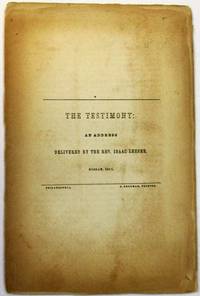
185136329Philadelphia: C. Sherman Printer 1851. Original front title wrapper stitched. 2 19 1 blank pp lacking the rear wrapper. Toned some shallow blank edge chipping and light wear. Good with some Hebrew printing in text. The caption title reads: 'An Address Delivered at the Schoolhouse of the Hebrew Education Society of Philadelphia at the First Opening of Their School on Sunday the 4th of Nissan 5611 April 6th 1851 by Isaac Leeser.'<br/><br/> "This address celebrated the opening of the day school launched by the Hebrew Education Society of Philadelphia the first of its kind in the city. 'It has always been to me a subject of profound astonishment and deep regret that there was not a single school all over the country until very lately where a Jewish child could obtain any information on his religion' Swann Catalog September 2019 Lot 120.<br/> "Leeser was the driving force behind the founding in 1846 of the Hebrew Education Society of Philadelphia chartered for 'the establishment of a school or schools within . Philadelphia in which are to be taught the elementary branches of education together with the sciences and modern and ancient languages always in combination with instruction in Hebrew language literature and religion.' In his address at its official opening delivered at the Society's schoolhouse on Sunday the 4th of Nissan 5611 April 6th 1851 Leeser expressed great hopes for the new Philadelphia Day School. 'We propose to combine elementary and afterwards scientific education with a gradual and progressive acquirement of Hebrew Hebrew literature and religion. It is not to be as in other schools a secondary matter whether the children learn Hebrew and religion or not but they are to acquire these even if nothing else can be imparted' p. 12." Sotheby catalog 2014 09239-20. <br/>Singerman 1195. Not in Goldman. OCLC 21968696 5- JTS U PA AJHS Hebrew Union College Princeton as of October 2019. C. Sherman, Printer unknown books
185136329Philadelphia: C. Sherman Printer 1851. Original front title wrapper stitched. 2 19 1 blank pp lacking the rear wrapper. Toned some shallow blank edge chipping and light wear. Good with some Hebrew printing in text. The caption title reads: 'An Address Delivered at the Schoolhouse of the Hebrew Education Society of Philadelphia at the First Opening of Their School on Sunday the 4th of Nissan 5611 April 6th 1851 by Isaac Leeser.'<br /> <br /> "This address celebrated the opening of the day school launched by the Hebrew Education Society of Philadelphia the first of its kind in the city" Swann Catalog September 2019 Lot 120.<br /> "Leeser was the driving force behind the founding in 1846 of the Hebrew Education Society of Philadelphia chartered for 'the establishment of a school or schools within . Philadelphia in which are to be taught the elementary branches of education together with the sciences and modern and ancient languages always in combination with instruction in Hebrew language literature and religion.' In his address at its official opening delivered at the Society's schoolhouse on Sunday the 4th of Nissan 5611 April 6th 1851 Leeser expressed great hopes for the new Philadelphia Day School. 'We propose to combine elementary and afterwards scientific education with a gradual and progressive acquirement of Hebrew Hebrew literature and religion. It is not to be as in other schools a secondary matter whether the children learn Hebrew and religion or not but they are to acquire these even if nothing else can be imparted' p. 12." Sotheby catalog 2014 09239-20. <br /> Singerman 1195. Not in Goldman. OCLC 21968696 5- JTS U PA AJHS Hebrew Union College 1340131282 1- Princeton as of August 2023. C. Sherman, Printer unknown
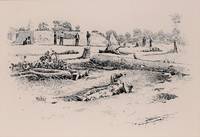
1884W2434New York: The Century Co. 1884. The image is 4 5/8 inches by 7 1/4 inches on artist board measuring 14 1/2 inches by 12 1/4 inches. Original ink drawing by Walton Taber 1857-1933 after a post-battle photograph. The scene shows dead Confederate soldiers in front of Battery Robinette on October 5 1862 the morning after the battle at Corinth Mississippi. Civil War historians J. Matthew Gallman and Gary W. Gallagher attributed the photograph to Ohio born and Corinth based photographer George Washington Armistead . However the Library of Congress has a virtually identical photographic negative that is attributed to Nicholas D. Brown. Although the photographer's identity remains uncertain it is clear that the drawing is by Walton Taber and is signed by him in the lower left corner of the image. Taber did the drawing for the Century Company who published it on page 751 of volume 2 of Battles and Leaders of the Civil War. This drawing along with others by Taber that were included in the Century Collection of Civil War Art was auctioned by Christie's in New York in 1988. Born in New Bedford Massachusetts Taber was one of the most important American illustrators during the late nineteenth and early twentieth centuries. His pen and ink drawings provided the Century Company almost 250 illustrations for Battles and Leaders. The drawing offered here is in near fine condition: clean and bright on artist board that is lightly and uniformly toned on the recto; there is some minor soiling on the verso along with notations made by Century editors and a later framer. The drawing is now archivally matted and ready for a 16" by 16" frame. SIGNED. Original. Single Sheet. Near Fine. Illus. by Isaac Walton Taber. 4 5/8" by 7 1/4". Fine Art Print. The Century Co.