QUETIF (Jacobi / Jacob / Jacques).Livre Rare Book

262 résultats
167422867Parisiis [Paris], apud N. Pepingué, 1674. Un fort vol. au format in-12 (154 x 91 mm) de 11 ff. n.fol., 298 pp. ; 1 f. n.fol., clix pp., 53 ff. n.fol. et 1 f. bl. Reliure de l'époque de plein veau glacé et marbré havane, plats jansénistes, dos à nerfs orné de filets gras à froid, caissons d'encadrement dorés, fleurons dorés, titre doré, palette dorée en queue, roulette dorée sur les coupes, tranhes jaunes et mouchetées.
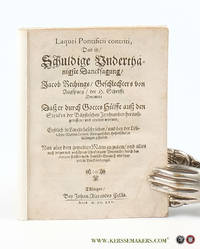
162153528Tübingen: Bey Johan-Alexandro Cellio 1621. Small 4to 19x15 cm. Blind wrappers of 18th century handmade paper. viii54ii:blank pp. waterstain in lower outer corner; seriously browned in places. - "In 1622 durch die Glaubenskongregation auf den Index gesetzt". - Printed in 'Fraktur' caracters Bey Johan-Alexandro Cellio unknown
1681180631Paris: Chez Lavrent d'Hovry sur le Quay des Augustins à l'Image saint Iean 1681. Hardcover. As is needs rebound age toning to block and pages as expected with age but text and illustrations are otherwise clear. Missing covers marble illustrated end pages two volumes/parts in one. Volume 1 has a bw illustrated title page 22 257 pp. with several bw illustrations. Volume 2 has a bw illustrated title page 259 pp illustrated throughout in bw. Text is in French. Both parts are bound together with their own title pages. The beginning unnumbered pages include a preface a table of contents for part one and a table of contents for part two. Part one was published in 1681 part two in 1677. Title translates to: Iconology: or New explanation of several images emblems & other hyerogliphic figures of virtues vices arts sciences natural causes different moods human passions & c. Divided into two parts. Taken from research and figures of Cesar Ripa moralized by J. Baudouin of the Académie Francoise. Chez Lavrent d'Hovry, sur le Quay des Augustins, à l'Image saint Iean hardcover books
1699ABC_46554Leiden 1699. Folio. Peter van der Aa Contemporary sprinkled quarter calf sewn on 8 supports with the corresponding raised bands on the spine a red morocco title label on the spine lettered in gold sprinkled paper sides red and blue sprinkled edges. With an engraved frontispiece to part 1 2 engraved title vignettes 2 full-page engraved dedicatory plates 1 engraved headpiece vol. 1 with 211 engravings 4 folding maps 1 folding plan 14 folding plates and 192 views in the text; vol. 2 with 1 folding map and 7 engraved illustrations in the text. 2 parts in 1 volume. 6 143 4 108 ll. Enlarged edition of a famous and extensively illustrated work on the duchy of Brabant including Louvain Brussels Antwerp and 's-Hertogenbosch and their surroundings by the historiographer Jacob le Roy 1633-1719. This rare work contains maps plans and fine views of the castles and county seats of the nobility of Brabant including their parks and gardens as well as the main monasteries and abbeys.The engravings are excecuted by several artists such as Jacob Harrewijn 1660-1727 a student of Romeyn de Hooghe Lucas Vorsterman II 1595-1675 who worked with Peter Paul Rubens and Robert Whitehand. Amongst the castles and houses depicted are views of Bonlez Beersel Bois-Seigneur-Isaac Corroy-le-Château Vilvoorde Cleydael Berchem and many others as well as views of monasteries and cloisters such as St Michael's Abbey Corsendonck and the Groenendael Priory. Other than castles and monasteries the work also contains a large view of the city of Turnhout and a folding plate of the St. Rumbold's Tower at Mechelen.It is bound as usual with Le Roy's L'erection de toutes les terres giving extracts of letters of Charles V Phillippe II Charles II and other emperors and kings on conference about titles of barons viscounts and counts and the setting up of lands in baronies marquisates and principalities. It contains a large double-page map of Brabant and 7 engraved illustrations of Héverlé Hoogstraten Walhain Grobbendonck Trazegnies Grimberghen and Westerloo identical to the map and engravings of these country houses in the first work.With the bookplate of Ivan Plissart late 19th-early to mid-20th century mounted on the front pastedown and a round shelfmark label mounted on the back board. The boards and spine are somewhat rubbed the edges and corners of the boards are scuffed the spine ends are slightly worn. The map of Tongerlo is somewhat browned but otherwise internally very clean. Overall in good condition.l Bibl. Belg. III pp. 852-854; Hollstein VII pp. 221; Hollstein LII pp. 56-63; Ad 1: STCN 832271780 6 copies; USTC 1841122 4 copies; ad 2: STCN 832271861 4 copies; USTC 1841121 4 copies. hardcover
1633E4IGP2PR2ETVAmsterdam 1633. 4to. Broer Jansz. Contemporary vellum. With woodcut illustration on title-page and 35 woodcut illustrations in text several full-page. 8 pp. 9-"74" =70 4 ll. Rare sixth edition of the Dutch translation of Jacob Rüff's classic and well-illustrated book on the conception generation and birth of the child the duties of the midwife the attendant diseases of child-bearing etc. Translated into Dutch by Marten Everart. Rüff's work is an improved version of Rosslin's Der Swangern frawen and contained the first true anatomical pictures in an obstetrics book.It was originally published in 1554 as Ein schön lustig Trostbüchli von den empfengknussen und geburten der Menschen translated into Latin in the same year as De conceptu et generatione hominis. insuper. The first of the many Dutch editions appeared in 1591 all early editions are very rare. The present edition contains the preface by Sigmund Feyerabend who published the Latin edition of 1580.Bookblock nearly detached first few leaves with restored corners title-page worn a few pages lightly browned and some occasional minor stains. Reasonable copy.l Bibl. Belg. IV p. 928; Krivatsy 10016; STCN 2 copies. hardcover
167219314Nuremburg: Johann Daniel Tauber 1672. Enlarged edition. Hardcover. Later quarter vellum and boards. Very good. 30.5 x 21 cm. 312 22 a-d6 B-P6Q4. Full page engraving of ship at sea by Boner frontispiece portrait of Saar title page in black and red one leaf with two engravings 12 engravings in the text floriated chapter head designs. First published 1662 this an enlarged edition. Saar was employed as a mercenary for the East India Company spending 15 years in South East Asia including Indonesia and Ceylon. He died at age 38 in the battle of Mogersdorf. Most of Saar's descriptions relate to Ceylon. The publisher also added other contemporary accounts to help authenticate Saar's accounts. Scattered text toning ex-library stamp effaced from head of title page title page slightly chipped fore-edge and foot dampstain lower corners M-M4. Johann Daniel Tauber hardcover books
1662ABC_49406Nuremberg: printed by Wolfgang Eberhard Felssecker and sold by Johann Tauber 1662. Contemporary vellum with the manuscript title and author on the spine modern mint green closing ties red sprinkled edges. Oblong 8vo. With an engraved title page of a ship engaged in a sea battle an engraved portrait of the author and 15 engraved plates. Further with woodcut tailpieces woodcut decorated initials 2 gothic and 1 roman series and headpieces built up from typographic ornaments. Set in fraktur type with incidental schwabacher roman and italic. First edition of Johann Saar's extensive account of his travels from 1644 to 1659 in the Dutch East Indies the Moluccas and Ceylon present-day Sri Lanka. This account with beautiful plates depicting various aspects of the East Indies Ceylon and their cultures including rare eye-witness depictions of native elephant hunting is a great source of information for the 17th-century exploration of the East Indies and especially Ceylon. The first edition is quite rare as we have only been able to trace two other copies in sales records of the past hundred years.Johann Jacob Saar 1625-1664 was a German seaman. After working in the service of the Dutch East Indian army in Bantam Batavia and the Moluccas Saar moved to Ceylon in 1647 which he describes most extensively though he also covers Java Batavia the Banda islands etc. He describes Ceylons trees and fruits wild animals including the hunting of crocodiles depicted in 1 plate. He also gives more cultural-anthropological and historical information such as how the natives treat their sick and dead people how the king of Ceylon wanted peace with the Dutch and he comprehensively describes the local practice of elephant hunting which is beautifully illustrated in three plates. These illustrations like the others underline the diversity of the narrative. He and his crew then sailed from Ceylon to the coast of Goa. He describes how the Portuguese tried to capture a silver-fleet from the Japanese but he also describes a sea battle off the coast of Goa between the Dutch and the Portuguese. On their way home Saar visited and described Cape Town too including Table Mountain depicted in one of the plates. The vellum is somewhat soiled with brown stains on the front and back the ties and flyleaves have recently been replaced. The work is somewhat foxed throughout with annotations in some of the margins. Otherwise in good condition.l Cat. NHSM p. 174; Landwehr VOC 308; Tiele 952; USTC 2567770 9 copies; VD 17 23:253491D. printed by Wolfgang Eberhard Felssecker and sold by Johann Tauber, hardcover
167219314Nuremburg: Johann Daniel Tauber 1672. Enlarged edition. Hardcover. Later quarter vellum and boards. Very good. 30.5 x 21 cm. 312 22 a-d6 B-P6Q4. Full page engraving of ship at sea by Boner frontispiece portrait of Saar title page in black and red one leaf with two engravings 12 engravings in the text floriated chapter head designs. First published 1662 this an enlarged edition. Saar was employed as a mercenary for the East India Company spending 15 years in South East Asia including Indonesia and Ceylon. He died at age 38 in the battle of Mogersdorf. Most of Saar's descriptions relate to Ceylon. The publisher also added other contemporary accounts to help authenticate Saar's accounts. Scattered text toning ex-library stamp effaced from head of title page title page slightly chipped fore-edge and foot dampstain lower corners M-M4. Johann Daniel Tauber hardcover
1665D7162Francofurti & Lipsiae: Esaiae Fellgibelii 1665. Hardcover. Good. Period paper-covered boards; 16mo 93 x 160 mm; pp. 44 962 2 plus 10 engraved plates 7 of them folding. Title-page printed in red and black. Lacking the frontispiece. Backstrip torn and binding broken. Contemporary notation inked discreetly on title-p. and some underlining here and there; but text block and plates in particular are overall nice and clean. Sold as is. An important early work on crustaceans. <br/><br/> Esaiae Fellgibelii hardcover
1665D7162Francofurti & Lipsiae: Esaiae Fellgibelii 1665. Hardcover. Good. Period paper-covered boards; 16mo 93 x 160 mm; pp. 44 962 2 plus 10 engraved plates 7 of them folding. Title-page printed in red and black. Lacking the frontispiece. Backstrip torn and binding broken. Contemporary notation inked discreetly on title-p. and some underlining here and there; but text block and plates in particular are overall nice and clean. Sold as is. An important early work on crustaceans. <br/><br/> Esaiae Fellgibelii hardcover books
167512522Nuremburg: J. von Sandart 1675. Copper engraving with early colour. Printed on laid paper. Title in manuscript ink on verso of sheet. Cleveland Historical Society collection stamp on verso of sheet. Numerous tears and creases in outside margins which have been expertly repaired. Center fold has been strengthened. An early map of Africa by the great mapmaker Jacob von Sandrart engraved by Homann.<br/> <br/>Sandrart's stunning map of Africa is a close copy of Fredrik de Wit's map 'Nova Africa Descriptio' published in 1660. With the prime meridian running through Ferro Island the map is typical of late seventeenth century maps of Africa. Like other maps of the period Sandrart has included a highly decorative and informative cartouche in the lower left corner of the sheet. Homann's continental cartouches aspired to convey the natural history as well as the costume and manner of life of the human inhabitants. Here while a woman peacefully nurses her baby in a hammock a native chief stares out at the viewer from under the shade of a large umbrella. On the right side of the vignette two riders on horseback one with a cutlass and one with a decaptitated head ride by a river where one man is attacking another with his sword. Among the humans are a lion a snake a reptile of some sort and another fox-like animal. Although the map repeats De Wit's decorations it relies on Ptolemy for its description of the Nile basin. It is to some degree remarkable that seventeenth century maps of the interior of Africa were filled with geographical features and named locations since there had been very little European exploration of the interior at this date. European trade took place at specific locations along the coast and almost nothing was known about the interior of the dark continent except through rumor. This is a fascinating map by Sandrart and one of only two maps engraved by Homann before 1690. Born at Frankfurt-on-Main Jacob von Sandrart was one of the most esteemed mapmakers in Nuremberg at the close of the seventeenth century. He learned his trade from his uncle Joachim von Sandrart and from Cornelius Danckerts. As with this impressive map all of Sandrart's charts are filled with a wealth of decorative details and highly ornate cartouches. J. von Sandart unknown books
167512522Nuremburg: J. von Sandart 1675. Copper engraving with early colour. Printed on laid paper. Title in manuscript ink on verso of sheet. Cleveland Historical Society collection stamp on verso of sheet. Numerous tears and creases in outside margins which have been expertly repaired. Center fold has been strengthened. An early map of Africa by the great mapmaker Jacob von Sandrart engraved by Homann.<br/> <br/> Sandrart's stunning map of Africa is a close copy of Fredrik de Wit's map 'Nova Africa Descriptio' published in 1660. With the prime meridian running through Ferro Island the map is typical of late seventeenth century maps of Africa. Like other maps of the period Sandrart has included a highly decorative and informative cartouche in the lower left corner of the sheet. Homann's continental cartouches aspired to convey the natural history as well as the costume and manner of life of the human inhabitants. Here while a woman peacefully nurses her baby in a hammock a native chief stares out at the viewer from under the shade of a large umbrella. On the right side of the vignette two riders on horseback one with a cutlass and one with a decaptitated head ride by a river where one man is attacking another with his sword. Among the humans are a lion a snake a reptile of some sort and another fox-like animal. Although the map repeats De Wit's decorations it relies on Ptolemy for its description of the Nile basin. It is to some degree remarkable that seventeenth century maps of the interior of Africa were filled with geographical features and named locations since there had been very little European exploration of the interior at this date. European trade took place at specific locations along the coast and almost nothing was known about the interior of the dark continent except through rumor. This is a fascinating map by Sandrart and one of only two maps engraved by Homann before 1690. Born at Frankfurt-on-Main Jacob von Sandrart was one of the most esteemed mapmakers in Nuremberg at the close of the seventeenth century. He learned his trade from his uncle Joachim von Sandrart and from Cornelius Danckerts. As with this impressive map all of Sandrart's charts are filled with a wealth of decorative details and highly ornate cartouches. J. von Sandart unknown
1603376588Innsbruck: Daniel Baur 1603. First edition in German after the Latin edition published in 1601. With frontispiece engraved portrait of Archduke Ferdinand II privilege on verso title page two preliminary leaves and 121 of 125 elaborate engraved portraits each with facing biographical notice printed within woodcut border. Lacking 4 leaves portraits 3 24 64 71. Two preliminary leaves printed for William Sterling Maxwell his extensive bibliographical note and index of portraits; a facsimile folding view of Innsbruck inserted after title. Full dark brown morocco spine titled in gilt upper board with Sterling Maxwell arms in gilt a.e.g. by XXXX. Sterling Maxwell's largest bookplate on front pastedown. A few portraits possibly in old facsimile or restrike. 11 leaves loose or slightly sprung a few marginal paper flaws one portrait poorly inked. First edition in German after the Latin edition published in 1601. With frontispiece engraved portrait of Archduke Ferdinand II privilege on verso title page two preliminary leaves and 121 of 125 elaborate engraved portraits each with facing biographical notice printed within woodcut border. Lacking 4 leaves portraits 3 24 64 71. Two preliminary leaves printed for William Sterling Maxwell his extensive bibliographical note and index of portraits; a facsimile folding view of Innsbruck inserted after title. The celebrated portrait gallery of the Archduke Ferdinand II of Austria with portraits of emperors kings nobles and war heroes in historic suits of armor in the Archduke's collection at Schloß Ambras. Compiled by the Archduke's secretary Schrenck von Notzing and translated into German by J.E. Noyse van Campenhouten. With an interesting full page printed bibliographical notice by Sterling Maxwell dated 1870 printed within facimile borders matching the text pages of the portraits. Colas 2691; Brunet V 224; Vinet 2046; Grässe VI 317; Lipperheide 499 Daniel Baur unknown
1603100584Innsbruck: Daniel Baur 1603. First edition in German after the Latin edition published in 1601. With frontispiece engraved portrait of Archduke Ferdinand II privilege on verso title page two preliminary leaves and 121 of 125 elaborate engraved portraits each with facing biographical notice printed within woodcut border. Lacking 4 leaves portraits 3 24 64 71. Two preliminary leaves printed for William Sterling Maxwell his extensive bibliographical note and index of portraits; a facsimile folding view of Innsbruck inserted after title. Full dark brown morocco spine titled in gilt upper board with Sterling Maxwell arms in gilt a.e.g. by XXXX. Sterling Maxwell's largest bookplate on front pastedown. A few portraits possibly in old facsimile or restrike. 11 leaves loose or slightly sprung a few marginal paper flaws one portrait poorly inked. First edition in German after the Latin edition published in 1601. With frontispiece engraved portrait of Archduke Ferdinand II privilege on verso title page two preliminary leaves and 121 of 125 elaborate engraved portraits each with facing biographical notice printed within woodcut border. Lacking 4 leaves portraits 3 24 64 71. Two preliminary leaves printed for William Sterling Maxwell his extensive bibliographical note and index of portraits; a facsimile folding view of Innsbruck inserted after title. The celebrated portrait gallery of the Archduke Ferdinand II of Austria with portraits of emperors kings nobles and war heroes in historic suits of armor in the Archduke's collection at Schloß Ambras. Compiled by the Archduke's secretary Schrenck von Notzing and translated into German by J.E. Noyse van Campenhouten. With an interesting full page printed bibliographical notice by Sterling Maxwell dated 1870 printed within facimile borders matching the text pages of the portraits. Colas 2691; Brunet V 224; Vinet 2046; Grässe VI 317; Lipperheide 499 Daniel Baur unknown books
1690265353Frankfurt: Zunner 1690. hardcover. very good. 2 volumes Pars Generalis & pars Specialis bound together in 1. Illustrated with 2 copper-engraved allegorical frontispieces rubricated title pages with engraved vignettes. xii 23 engraved sheets with 1780 figures of of heraldic shields 368 38 page index; 2 index sheets torn with significant loss; viii 778 35 engraved sheets with 397 larger heraldic shields 32 page index. A few pages have minor soiling including the first frontispiece. Thick tall folio full velum somewhat stained but very sound and attractive with manuscript spine title; red edges. Frankfurt John David Zunner 1680. A very good copy. -- Brunet V 486; Graesse VI 464.<br/><br/> Zunner unknown books
1690265353Frankfurt: Zunner 1690. hardcover. very good. 2 volumes Pars Generalis & pars Specialis bound together in 1. Illustrated with 2 copper-engraved allegorical frontispieces rubricated title pages with engraved vignettes. xii 23 engraved sheets with 1780 figures of of heraldic shields 368 38 page index; 2 index sheets torn with significant loss; viii 778 35 engraved sheets with 397 larger heraldic shields 32 page index. A few pages have minor soiling including the first frontispiece. Thick tall folio full velum somewhat stained but very sound and attractive with manuscript spine title; red edges. Frankfurt John David Zunner 1680. A very good copy. -- Brunet V 486; Graesse VI 464.<br/> <br/> Zunner unknown
1621B86DJ001U79OAmsterdam 1621. Oblong 4to 17.5 x 23 cm. Johannes Janssonius printed by Izaak Elzevier Modern vellum sewn on 4 vellum tapes with gold double fillets on the boards gold lettering on the spine gilt edges green cloth ties. With 24 of 25 engraved plates with maps plans views and battle-scenes including 5 double-page and 10 larger folding the large map of the Malayan archipelago with an inset-map of the Strait of Boeton 32 x 45.5 cm. 4 172 pp. First and only edition of the French translation of one of the bestsellers of illustrated 17th-century travel literature describing one of the most famous early voyages around the world by Joris van Spilbergen 1568-1620 a veteran Dutch East Indies naval officer-turned-pirate undertaken from 1614 to 1618. A short survey of another of the most important early voyages around the world by Schouten and Le Maire in the years 1615 to 1617 is added at the end pp. 117-172 with drop-title "Navigationes Australes". It reports Le Maire's proof that Tierra del Fuego is an island and his discovery of what is still called the Strait of Le Maire an alternative route to the Pacific. Rich in ethnographic detail the numerous illustrations in the Miroir include oversized penguins llamas and an Andean condor with a nine-foot wing span. Naval battles beleaguered Spanish settlements and newly discovered islands are also depicted in detail making the work a valuable compendium of adventure on the high seas during the Age of Discovery.With several owner's inscriptions. With a few manuscript annotations in the margin. Lacking the world map. Washed with a brush leaving light brown steaks on most leaves and further with an occasional leaf foxed or smudged and an occasional minor tear. Otherwise a good copy of an extraordinary journal.l Borba de Moraes p. 826 "This French edition is much sought after"; Landwehr & V.d. Krogt VOC 362; Sabin 89451; Tiele Bibl. 1030. hardcover
1619WRCAM54737Leiden: Nicolaus a Geelkercken 1619. 1751pp. lacking blank leaf P4 which divides the two narratives but was mistakenly included as pp.119-120 in the continuous pagination; including large engraved vignette on title with twenty-five engraved plates five folding double-page and two large folding maps. Oblong quarto. Contemporary Dutch vellum. Old stains and soiling to boards manuscript "33" in ink on spine edges rubbed boards slightly bowed. Modern bookplate on front pastedown. Minor toning and foxing tiny reinforcement at mounting stub on verso of each large folding map some offsetting. Overall very good. In a blue cloth box gilt leather label. Scarce first Latin edition of one of the bestsellers of illustrated 17th-century travel literature which reports Le Maire's critical DISCOVERY OF TIERRA DEL FUEGO an alternate route to the Pacific and also recounts the Pacific pillaging of the veteran East Indies sailor-turned-pirate Joris van Spilbergen. In addition the work includes valuable early information on ports along the Pacific coast of the Americas and is also of interest for the 17th-century Dutch presence in Brazil. Rich in ethnographic detail the numerous illustrations in the SPECULUM ORIENTALIS. include images of oversized penguins llamas and an Andean condor with a nine-foot wing span. Naval battles beleaguered Spanish settlements and newly discovered islands are also depicted in detail making this a valuable compendium of adventure on the high seas during the Age of Discovery. <br> <br> In 1614 the VOC commissioned Spilbergen to sail to the Moluccas with nearly 700 men. Despite the ostensible commercial nature of his expedition Spilbergen's six vessels were heavily armed anticipating encounters with silver-laden Spanish vessels. Spilbergen spent two years calling at various Spanish and Portuguese ports along both coasts of South America failing to capture any great amounts of silver or silk from Manila but burning several settlements and emerging triumphant from a naval skirmish just south of Lima. <br> <br> By contrast Le Maire's less mercenary expedition resulted in important discoveries; his exploration of Tierra del Fuego and the Tuamotou Archipelago called into doubt the existence of a massive southern continent providing a catalyst for Tasman's discovery of New Zealand and Australia. The two expeditions crossed paths in the Dutch East Indies in 1616. <br> <br> Spilbergen's fleet of six ships was fitted out and armed to combat the Spanish colonies attacking Spanish settlements and shipping along their route. They sailed to Brazil then through the Straits of Magellan and north along the coast of America as far as California. After sailing east to the Philippines they went on to Batavia in search of a Spanish fleet reportedly planning to attack Dutch settlements in the Moluccas but they never found a fleet. On his arrival at Batavia Spilbergen encountered Le Maire and Schouten whose voyage for the newly-formed Compagnie Australe had embarked in 1615 a year after Spilbergen's. Le Maire and Schouten traveled via the newly-discovered Le Maire Strait but on their arrival at Batavia they were arrested for breaching the monopoly granted to the Dutch East India Company of the Strait of Magellan. Spilbergen took Le Maire Schouten and their crews on board and escorted them back to the Netherlands virtually as prisoners. Le Maire grew ill and died en route. <br> <br> This work is remarkable as an early document on Dutch navigation to the Brazilian coasts. Its great value lies in Spilbergen's detailed account of their stay in the Ilha Grande from October 1614 to January 1615 and in São Vicente in 1615. Plate 2 depicting the disordered landing of Dutch vessels in São Vicente clearly documents the way of life of the indigenous peoples under Portuguese occupancy. Colonial religious structures appear alongside typical Native American hammocks and traditional Brazilian costumes and methods of animal husbandry are evident. This illustration with its explanatory text is particularly important as 17th-century ethnographic documents about the future São Paulo are very rare. <br> <br> One of the large folding maps remains important for illustrating Le Maire and Schouten's route across the Pacific. Other maps show the Straits of Magellan and Manila the Moluccas and various ports on the Pacific coast of America. <br> <br> The SPECULUM ORIENTALIS. was originally published in Dutch the same year as this Latin edition with identical plates. Translations in other languages followed rapidly: German in 1620 Frankfurt and French in 1621 Amsterdam. The work was not translated into English until the 1906 Hakluyt Society edition with the title THE EAST AND WEST INDIAN MIRROR. LANDWEHR VOC 361 mistaking the first edition of the Dutch: it is 1619 as his excellent collation obviously attests not 1617. BORBA DE MORAES II:276. HOWGEGO S159. W. Klooster THE DUTCH IN THE AMERICAS 1600- 1800 cat. 24 p.12. BLAIR-ROBERTSON XV pp.328-30; illustrated XVIII p.224. LeCLERC 1994. SABIN 2288. RODRIGUEZ 2288. EUROPEAN AMERICANA 619/133. J. de Villiers THE EAST AND WEST INDIAN MIRROR Hakluyt Society 1906. JCB II:143. Lach ASIA IN THE MAKING OF EUROPE III pp.445-48. Schilder AUSTRALIA UNVEILED Ch. V pp.32-37. TIELE 66. Nicolaus a Geelkercken hardcover books
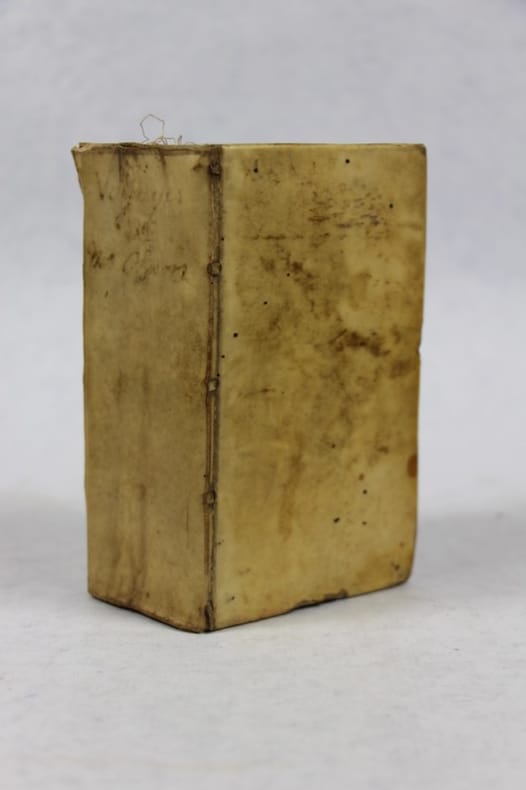
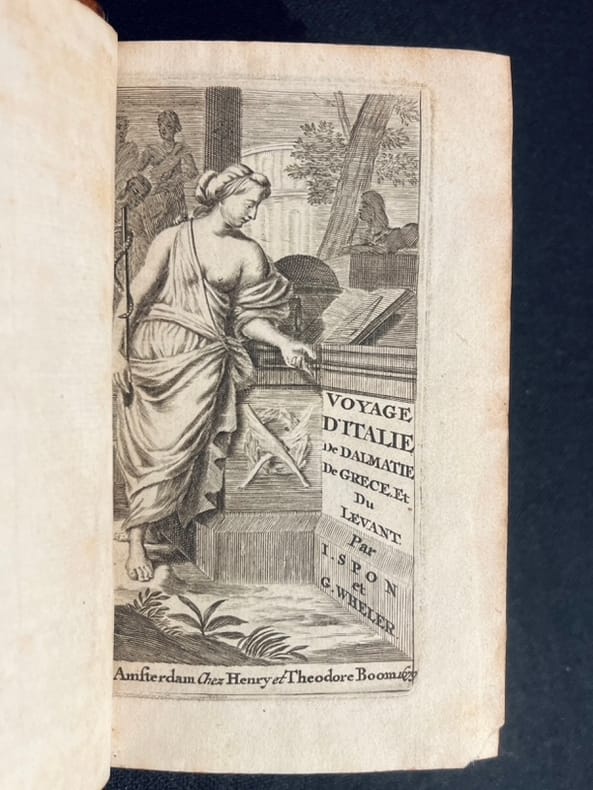
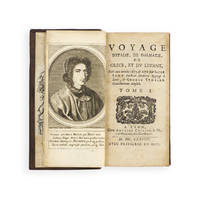
1679130712Amsterdam ; Henry & Théodore Boom 1679 2 tomes en 1 vol. in-16 136 x 75 mm., plein vélin muet, .18- 456- 489 pp. Les 2 derniers ff. restaurés avec accroc du texte. Portrait frontispice, titre et 30 planches gravés. Quelques attaques de vers. Brunissures au portrait et au titre gravéSeconde édition de cet important récit de voyage au Levant.centré sur l'étude des traces de l'antiquité : épigraphie, architecture, glyptique, numismatique.
167921803A Amsterdam, chez Henry & Theodore Boom, 1679. 2 volumes in-12 de [24]-456 et 322-[14] pages puis de 323 à 489.*12; A-T; A-X12. Pleine basane marron, dos à nerfs ornés de filets et fleurons dorés.
168715216London:: for Bernard White 1687. First edition in English. contemporary calf. Joints starting at head and tail of spine but still quite sound; minor rubing to boards; otherwise a clean very attractive copy. Folio. With 5 plates one folding. Cox I p. 111. Wing S5017. Hans Sloane's copy with his bookplate. for Bernard White, hardcover
168560617Utrecht François Halma 1685. 12mo. In contemporary full calf with four raised bands and richly gilt spine. Light wear to extremities some of gilting to spine worn off. Lower left corner of the large folded cityscape of Geneva torn off but laid in othewise internally fine. 22 435 9 413-522 17 pp frontispiece 2 fold-out Geneva cityscapes and 4 plates. <br/><br/><em>Third edition revised and corrected of this extensive history of Geneva. </em> hardcover
16859392Utrecht: Francois Halma 1685. 8vo contemporary calf gilt and morocco spine label spine in six compartments with gilt bands 24 435 9 413-522 18 pp lacking frontispiece and illustration plates. A history of the city of Geneva Switzerland. Front cover detached covers worn toning to pages owner inscriptions to front endpaper name excised from title page. Francois Halma unknown
1687TK0098London:: Printed for Bernard White 1687. 1687. 4to. iv 250 6 pp. 5 plates including: engraved frontispiece "Old Geneva" p.9 City Stamps plate p. 107 folding engr. plate of the surrounding regions of Geneva city of Geneva p. 148. Ancient Inscriptions which are to be seen at Geneva p. 193; faint waterstain viewable on the outer margins rear. NOTE: A2 final leaf of Preface trimmed on the right margin replaced with similarly toned paper however with some minor loss of a few letters neatly repaired; some waterstaining. Modern half calf raised bands gilt-stamping red gilt-stamped spine label marbled boards. Ownership signature of the British politician Somerset Davies 1754-1817 of Croft Castle. Bookplate of Robert J. Hayhurst. Handsome copy. First edition in English. Jacob Spon was born into a Calvinist family of German origin in Lyon in 1647. He became a doctor and archeologist traveler and wrote respected studies of Greece. "After a period in Geneva he published Histoire de la ville et de l'Estat de Geneve 1680 a compilation of ancient chronicles of the city state". – Irini Apostolou "Jacob Spon" in: Christian-Muslim Relations 1500 - 1900 vol. 9 Western and Southern Europe 1600-1700 General Editors: David Thomas John Chesworth Brill 2017 pp. 406-412. / With the large folding plate of Geneva and the surrounding area showing Lac Leman / Lake Geneva and all the small municipalities that dot the region such as Eyvan = Evian Morges the mountainous terrain there are even a few cows shown in the plate. The city view of Geneva p. 148 shows the original wall at the city entrance. Spon was a numismatist thus his interest is shown p. 107 with a plate devoted to early coinage of the city. The frontispiece features a view of Geneva with Saint Pierre Cathedral as a focal point. That cathedral dates from 1150 and was founded in the 4th century. / With this text one learns of the origin of the name for the city of Geneva derived from the Latin word for the Juniper shrub which populated the hilly regions there. PROVENANCE: 1 Ownership signature of the British politician Somerset Davies 1754-1817 of Croft Castle; 2 Robert John Hayhurst 1929-2016 inherited and improved a successful group of retail pharmacies John Hayhurst & Son based in Nelson Lancashire. He was a keen collector of naval history and of eighteenth-century literature in contemporary bindings. Printed for Bernard White, 1687. hardcover
1678T5108<p><strong>Very rare first edition of 'one of the most important accounts of travels in the Levant and the first description of Athens which was systematic detailed and trustworthy' Blackmer. </strong></p><p>'Spon and Wheler met in Italy in 1675; they travelled together with Francis Vernon to Zakynthos where the two groups separated. Spon and Wheler continued by sea to Constantinople and Vernon travelled overland. The great merit of Spon's work is due to its combination of a careful and knowledgeable interest in classical antiquity with an accurate observation of men manners and topography in modern Greece. The whole of vol. II is devoted to Greece and includes a glossary of Modern Greek words and phrases with instruction on pronunciation. Spon's interest in Greece was longstanding. He had already published Babin's description of Athens which had been communicated to him by the Abbé Pecoil of Lyon with his own notes and preface' <em>ibid.</em>.</p><p>From Venice Spon and Wheler's itinerary took them along the Dalmatian coast and the Ionian islands. They set anchor at Zakynthos and later Cythera visited Delos and eventually reached Istanbul where they visited the French ambassador Charles-François Olier Marquis de Nointel who had already visited Athens and was able to give them valuable information about the city. They also visited Bursa and Thyateira in Asia Minor and stayed in Izmir for some time. On their return journey they crossed over to Patras from Zakynthos visited Delphi travelled to Athens and toured the region of Attica.</p><p>Jacob Spon 1647–1685 physician archaeologist and collector was the archetypal French 'curieux' like his father before him. He collected medals manuscripts and inscriptions with immense enthusiasm acquiring an entire coin hoard of seven hundred pieces found at Lyons. George Wheler 1652–1724 who published his own account of their travels in 1682 'was a man of many interests and practical skills. As a boy he had amused himself with woodwork constructing a birdcage and a small harpsichord and had taken an interest in plants; the latter he maintained in Oxford by frequent visits to the physic garden … On his travels he displayed keen curiosity and took the opportunity to collect plant specimens … He gave to his Oxford college more than thirty Greek manuscripts acquired mainly in Athens and Constantinople; they included a priceless illuminated typicon the foundation charter of a convent established in Constantinople about 1300. His plant specimens were given to the Oxford Physic Garden. Wheler occupies a significant position in the history of botany since he introduced to Britain some plants hitherto unknown including St John's wort' ODNB.</p><p><em>Provenance</em>: John Hay second Marquess of Tweeddale 1645–1713 MP and Lord Chancellor of Scotland in 1704-5 with his bookplates Franks 14192/566. The purchase note on the front flyleaf of vol. I 'payd for thes 3 volums 0–12–00' <em>i.e</em>. 12 shillings is probably his.</p><p><em>Physical description:</em><br />Three vols 12mo pp. I: xxiv 405 3 blank II: 417 13 2 blank III: 204 '226' <em>recte </em>228 with a copper-engraved frontispiece portrait in vol. I 30 plates many folding and two folding maps; paperflaws in outer margin of two leaves vol. I C10 and R6 no loss of text some occasional very pale marginal foxing but an excellent set; in contemporary British speckled calf double fillet frames ruled in blind on covers and in compartments of spines small blind-stamped floral tool in corners of covers board-edges ruled in gilt edges speckled red; lightly rubbed one corner bumped headcap of vol. I very slightly chipped.</p><p><em>References:</em><br />Weber 405. Blackmer 1586 records the second edition.</p> Antoine Cellier