262 résultats
165832984-176Lutetia i.e. Ulm n.pr. 1658. Engr. title printed title. 2 unn. leaves 297 =295 pp. 1 blank p. 2 leaves "Clavis" name keys. 8vo. Contemporary half calf. sm. library stamp on title. Lutetia i.e. Ulm n.pr. 1658. Bound with: GRIMM Hans Rudolf. Kleine Schweitzer Cronica Oder Geschicht=Buch.Erstlich woher der Nahmen Schweitzer komme.Benebst auch ein Beschreibung der Natur=Wunder dess Schweitzer=lands. 4 unn. leaves 204 pp. 12 unn. pp. index. Burgdorf 1723. Ad I: First edition of this interesting work of baroque literature. "In the year 1658 a script was published with the purported place of publication Lutetia Paris that caused a most disagreeable sensation: Heutelia Anagram for Helvetia . It contains the following fiction: A Palatine nobleman and a jurist from Wurttemberg both Protestants flee from the Thirty Years War to Switzerland and making ironical comments as they travel from place to place . The tone is unrestrained satirical and sometimes cynical especially when the status of women is concerned. A lot of brutianism is involved. Behind that facade however there is a scientific seriousness that gets to the bottom of things . The intention was always to uncover the oddities of Switzerland." transl. from Feller/Bonjour. Politically the travellers represent the aristocracy and take a firm stand against democracy. Zurich comes away relatively lightly whereas Bale does not. Of Bern however an unsparing social picture is outlined that led to a storm of protest and the "Gnadigen Herren" tried to surpress the book by all means. "Heutelia" was already identified in the 18th c. as a "liber satyricus rarissimus". Haller talks of a rare work and names as authors Jakob Graviseth or Gravisset Herr zu Liebenegg and Landvogt von Oron. More recent research especially by Walter Weigum declares the "Heutelia" to have been written by Hans Franz Veiras 1577-1672 the secretary of the Palatine Elector and Bohemian King Friedrich V who had fled to Zurich. Graviseth maybe translated and reworked the "Heutelia" from Latin giving it a Swissgerman interpretation. At the end the key to the names is found for example: Guretum=Zurich Sebilacopolis=Bale Rusinopolis=Bern Bonzus Corvinus=Jesuit Druida=Pastor Muftus=Messpriest etc. Ad II: First edition of the historic work by the Burgdorf councilman H.R. Grimm 1665-1749 who participated in the 2nd Villmerger War in 1712. Although this popular writing has many misrepresentations and mistakes it is characterized by its lively descriptions. The work also contains popular descriptions of the mountains rivers and natural wonders of Switzerland. Nice copy of two rare works. _ - Ad I: Paisey H 1019; VD17 23:299560W; Weller Druckorte I p. 30; Hayn/Gotendorf VII 257; Haller V 1195; Barth 2193; Faber du Faur 448; Jantz 2571; Kosch II 969; Feller/Bonjour 405f.; cf. Baechtold 473f.; not in Bircher/Bürger. Ad II: Haller IV 470; HBLS III 747; not in Barth; cf. Simmen René. Vom grossen Misch-Masch 1965. LITERATURE: GERMAN ; HELVETICA: ALLGEMEIN ; yes ; Lutetia (i.e. Ulm), n.pr. unknown
165832984-310Lutetia i.e. Ulm n. pr. 1658. With engr. title. Printed title 2 unn. leaves 297 pp. =295 pp. 1 blank p. 4 unn. pp. last blank "Clavis Heutelia" keys for the numerous anagrams and acyrogolia. 8vo. 18th century half calf. Sm. monastic libr. stamp on title. Lutetia i.e. Ulm n. pr. 1658. Bound with: GRIMM Hans Rudolf. Kleine Schweitzer Cronica Oder Geschicht=Buch.Erstlich woher der Nahmen Schweitzer komme.Benebst auch ein Beschreibung der Natur=Wunder dess Schweitzer=lands. 4 unn. 204 12 unn. pp. index Burgdorf 1723. Ad I: First edition of a notable work of baroque literature Heutelia is one of the few literary products of Switzerland in this time and one of the wittiest. This is a journey description based on satire and utopia. Written by Veiras former advisor of the Winter King i.e. Frederick V Elector of the Palatine and King of Bohemia and by Gravisseth who was Bailiff of Oron it is a critical account on the social conditions in 17th century Switzerland. The title "Heutelia" is an anagram of "Helvetia" the Latin name of Switzerland. "Die Absicht war durchaus die Schäden und Verkehrtheiten der Schweiz aufzudecken" Feller/Bonjour. Politically the travelers represent the aristocracy and take a sharp stand against democratic Switzerland. Ad II: First edition. Although this popular writing contains numerous disortions and errors it is also characterized by lively and interesting descriptions of the mountains rivers and natural wonders of Switzerland.- Nice copy with two rare works bound together. _ - Ad I: Paisey H 1019; VD17 23:299560W; Weller Druckorte I p. 30; Hayn/Gotendorf VII 257; Haller V 1195 under Gravisset;; Barth 2193; Faber du Faur 448; Jantz 2571; Kosch II 969; Feller/Bonjour 405ff.; cf. Baechtold 473f.; not in Bircher/Bürger. Ad II: Haller IV 470; not in VD18 nor in Barth; HBLS III 747; cf. Simmen René. Vom grossen Misch-Masch 1965. LITERATURE: GERMAN ; HELVETICA: ALLGEMEIN ; yes ; Lutetia (i.e. Ulm), n. pr. unknown
16364833Amsterdam 1636. 4to. Joan Blaeu Contemporary vellum with the manuscript author and title on the spine sewn on 4 supports laced through the joints. With a woodcut printer's device on the title page of each work an engraved portrait of Pieter Dirkszoon Hasselaer in the text and 30 engraved emblems by Christoffel le Blon in ad 1 a full-page engraved portrait of Hendrik de Grote in ad 2 and several decorated woodcut initials head- and tailpieces in both works. 2 works in 1 volume. 2 blank 6 "464" = 460; 8 203 5 pp. First edition of the collected poems plays sonnets and songs of the most famous Dutch poet of the 17th century Pieter Corneliszoon Hooft 1581-1647. It was also the only edition of his collected poems published during his lifetime. The work was intended to show his literary abilities and to serve as an example for later authors. It opens with a dramatic play followed by emblemata songs love and wedding poetry and ends with psalms highlighting Hooft's complete skillset in the literary realm. The second work in the present binding is the third enlarged edition of Hooft's first historical biography on the life of the king of France Henry IV a work that would later grant him the title of knight.The collection was edited by Hooft's close friend the scholar statesman and poet Jacob van der Burgh 1600-1659 who dedicated this edition to Constantijn Huygens. The collection contains the plays Granida Geeraert van Velzen Baeto and Paris oordeel. His Emblemata here with the title Minnezinne-beelden are illustrated with 30 charming half-page emblems engraved by Christoffel le Blon or Pieter Serwouters printed from the same plates as used in the original edition of the Emblemata in 1611 each with a Dutch Latin and French motto repeated below the engraving followed by distichs in the same three languages. The Latin verses are by C.G. Plemp the French by R.J. de Nérée.The portrait of Pieter Dirkszoon Hasselaer who was a lay judge and member of the Amsterdam counsel has here been reduced in size; it was first published in Hooft's Lijkklaght over Pieter Dircxz. Hasselaer 1617. Also included are Hooft's sonnets songs miscellaneous poems and wedding poems on the two weddings of P.C. Hooft: with Christina van Erp in 1610 and Heleonora Hellemans in 1627 by C.G. Plemp Laurens Reael W. de Groot Constantijn Huygens and Caspar Barlaeus. The work closes with psalms.With the label of Henri Dircx mounted on the front pastedown. The vellum is slightly soiled. The leaves are somewhat browned and foxed especially in ad 2 a water stain in the outer margin of the first 100 pages of ad 1 and another in the lower margin nearly throughout the lower corner of page 37 of ad 1 has torn off. Otherwise in good condition.l Ad 1: Landwehr Emblem and Fable Books 322; Leendertz 117; Scheurleer Liedboeken p. 140; STCN 852658524; USTC 1032392; ad 2: STCN 851961835; USTC 1031841. hardcover
1633E4IGP2PR2ETVAmsterdam 1633. 4to. Broer Jansz. Contemporary vellum. With woodcut illustration on title-page and 35 woodcut illustrations in text several full-page. 8 pp. 9-"74" =70 4 ll. Rare sixth edition of the Dutch translation of Jacob Rüff's classic and well-illustrated book on the conception generation and birth of the child the duties of the midwife the attendant diseases of child-bearing etc. Translated into Dutch by Marten Everart. Rüff's work is an improved version of Rosslin's Der Swangern frawen and contained the first true anatomical pictures in an obstetrics book.It was originally published in 1554 as Ein schön lustig Trostbüchli von den empfengknussen und geburten der Menschen translated into Latin in the same year as De conceptu et generatione hominis. insuper. The first of the many Dutch editions appeared in 1591 all early editions are very rare. The present edition contains the preface by Sigmund Feyerabend who published the Latin edition of 1580.Bookblock nearly detached first few leaves with restored corners title-page worn a few pages lightly browned and some occasional minor stains. Reasonable copy.l Bibl. Belg. IV p. 928; Krivatsy 10016; STCN 2 copies. hardcover
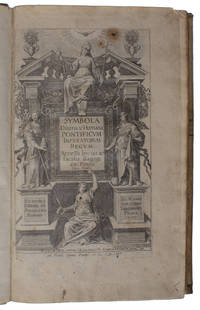
165260208Frankfurt, G. Schönwetter, 1652. Folio (335 x 203 mm). Three volumes bound in one contemporary full vellum bindings with title in contemporary hand to spine. Binding with some miscolouring and a bit of wear. Title-page with a few dots and light soiling, otherwise a fine and clean copy. 141, (7), (4), 183, (7), 176, (3) pp. 151 engraved plates included in the pagination. Pp. 171-172 in vol. 2 copied in contemporary hand.
165260208Frankfurt G. Schönwetter 1652. Folio 335 x 203 mm. Three volumes bound in one contemporary full vellum bindings with title in contemporary hand to spine. Binding with some miscolouring and a bit of wear. Title-page with a few dots and light soiling otherwise a fine and clean copy. 141 7 4 183 7 176 3 pp. 151 engraved plates included in the pagination. Pp. 171-172 in vol. 2 copied in contemporary hand. <br/><br/><em>Later edition of Typot’s famous and beautifully illustrated work on emblems. The designs of the emblems were compiled by Ottavio Strada antiquarian to Emperor Rudolf III and were reproduced by the engraver Aegidius Sadeler - Typot wrote the Latin commentaries. The extensive work covers a broad array of subjects such as popes emperors kings and The Santa Eucharista. </em> hardcover
1658383431658. Das ist: Beschreibung einer Reiss so zwee Exulanten durch Heuteliam gethan Eine Satyre auf Helvtien die Schweiz von anno dazumal schon damals geprägt durch Korruption und Vetternwirtschaft. Pagination fehlerhaft wie bei allen Ausgaben S.235 236 übersprungen. Kleine Fehlerstelle im Papier des Titelblattes. Handgeschriebenes Gloss auf den Nachsatzseiten. Alter Besitzerstempel u. Medaillons Haller V 1195. - Barth 2193 Kl.-8°. Pbd. Helvetica unknown
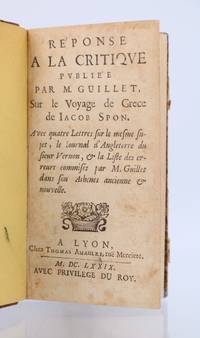
167989345Thomas Amaury | Lyon 1679 | 8.5 x 15 cm | Relié
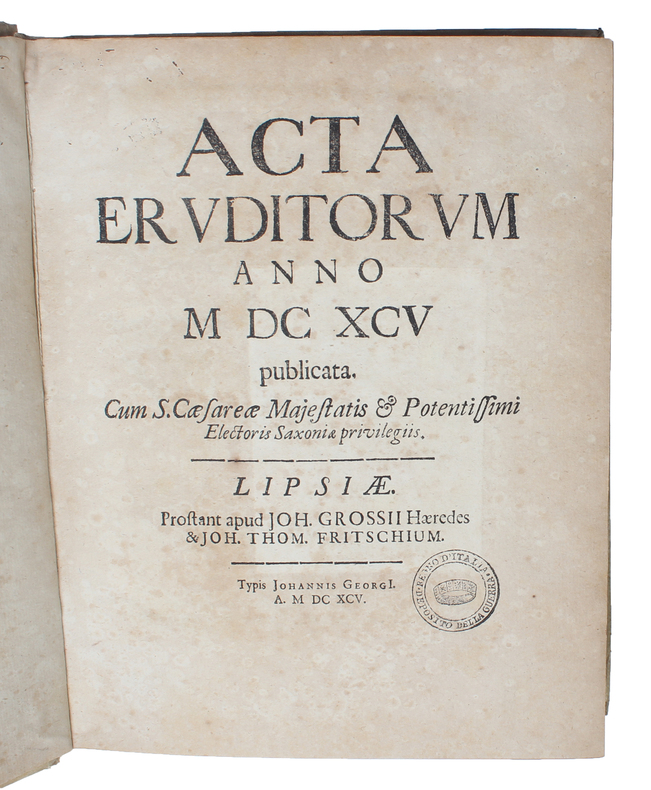
169542860Leipzig, Grosse & Gleditsch, 1695. 4to. Contemp. full vellum. Faint handwritten title on spine. A small stamp on titlepage and pasted library label to pasted down front free end-paper. In: ""Acta Eruditorum Anno MDCXCV"". (2), 560, (52) pp. + 10 plates. As usual with various browning to leaves and plates. The entire volume offered. Leibniz's papers: pp. 145-57" 184-185 310-316 369-372 493-495. Jacob Bernoulli's paper: pp. 537-553 + one folding table 65-66. Johann Bernoulli's: pp. 59-65" 374-376.
169542860Leipzig Grosse & Gleditsch 1695. 4to. Contemp. full vellum. Faint handwritten title on spine. A small stamp on titlepage and pasted library label to pasted down front free end-paper. In: "Acta Eruditorum Anno MDCXCV". 2 560 52 pp. 10 plates. As usual with various browning to leaves and plates. The entire volume offered. Leibniz's papers: pp. 145-57; 184-185; 310-316; 369-372; 493-495. Jacob Bernoulli's paper: pp. 537-553 one folding table; 65-66. Johann Bernoulli's: pp. 59-65; 374-376. <br/><br/><em>First printing of a series of influential papers by Leibniz Jacob Bernoulli and Johann Bernoulli.First publication of Jakob Bernoulli's famous and influential "Bernoulli Equation". In "Notatiuncula Constructiones Lineae" Bernoulli proposed a solution to non linear equations which today is one of the most common used solutions of the general fluid. Bernoulli equations are significant because they are nonlinear differential equations with known exact solutions. In the "Specimen dynamicum" Leibniz presents a conception of body and force which distinct between primitive and derivative forces and between active and passive forces. This article is regarded as being the clearest exposition of Leibniz' dynamics. DSB VII 151b."The first attempt at a detailed account of the dynamics was a long dialogue the "Phoranomus seu de potentia et legibus naturae" written in July 1689 while Leibniz was in Rome. This was quickly followed be the composition of the massive Dynamica de potential et legibus naturae corporeae 1689-90 . Though it was written with the intention of publication and though Leibniz work at publishing it he never considered it entirely finished and it remained unpublished during his lifetime.The later . he finally revealed some of the metaphysical foundations of the project in an essay the present paper." Garber Daniel. Leibniz: body substance monad. 2009. 132 p."Its title suggests a summary of or a selection from the earlier work . However it actually contains something in a way rather more interesting: a careful exposition of the metaphysical foundations of the new science something that is hard to find in the old Dynamica or any of the more Technical pieces." Garber Daniel. Leibniz: Body Substance Monad. 2009. 133 p. </em> hardcover
1685D7313Amsterdam / Utrecht: chez Jean Wolters et Ysbrand Haring / Frans Halma 1686 / 1685. Hardcover. Very Good. 12mo 155 x 88 mm. 432pp. 7. Full-page engraved portrait of Chardin above his heraldry bearing arms of two rosettes chevron and bird additional engraved title 16 engraved plates including two chapter headpieces 12 folding are maps city panoramas or charts. The first English edition appeared in 1686 in London by Moses Pitt of 1686; Chardin having settled in England after his travels and was knighted there by Charles II. The title was reprinted twice in Amsterdam in the original French at different locations. First at Abraham Wolfgang and then at Wolters and Haring as in this copy. Contemporary vellum ms. title on spine with foldover edges speckled edges; light soiling and few small stains few minor tears on engraved title or marginal wear to plates. A very nice copy with plates in excellent shape. Bound after: SPON Jacob 1647-1685. Histoire de la Ville Et de l'Estat de Genève. Utrecht: Frans Halma 1685. 522pp. 16 of table. Woodcut printers device of Halma with motto Vivitur ingenio one lives on in spirit to title additional engraved title 6 plates of which 3 are folding among which the view of the Geneva region with placenames highlighted in yellow woodcut headpieces and decorative initials; one small fold-tear to Geneva plate. Formerly in the collection of famed bibliophile Henri Burton of Geneva his morocco bookplate neatly to front endpaper. <br/><br/>French sammelband of the Travels of Sir Jean Chardin; one of the finest works of early Western scholarship on Persia and India and Spons History of Geneva from the collection of Henri Burton. A great deal of European travel writing details the history of Europes relationship to the Orient a place highly exoticized by western observers. Jean Chardin was a trader and the son of a jeweler who first went to the Levant in 1665 to purchase gems. He made a second journey in 1671 in the company of the artist Guillaume Grelot whom he met in Istanbul and whose drawings inspired the engravings in the present work. This edition comprises the first volume of the authors manuscript dealing with the period 1671-1673 and is all that was published until 1711. His work is divided into four parts: the first recounts his journey from Paris to Ispahan 1671-77 the second describes Persia and Ispahan the third the ruins of Persepolis and the fourth gives a history of Persia based on Persian writers. /// Spon 1647-1685 was a doctor and pioneering archaeologist of Greek antiquities. After the revocation of the Edict of Nantes he fled France for Switzerland dying not long after in Geneva. His history of Geneva first published in 1680 was translated into English in 1687. Chardin an experienced trader is in a position to give detailed accounts of trade-routes prices articles bought and sold customs problems and so on whereas Spon is primarily interested in Antiquity concentrating on giving the exact wording of inscriptions illustrations of medals and ancient buildings and the comparison of towns and landscapes with the descriptions which appear in Classical texts. A fine sammelband neat and sturdy contained two important travel texts printed within just one year of each other. chez Jean Wolters et Ysbrand Haring / Frans Halma hardcover books
167989345Lyon: Thomas Amaury 1679. Fine. Thomas Amaury Lyon 1679 8.5 x 15 cm Relié Very rare first edition. Some light foxing. Contemporary 19th-century modest half-grained cloth binding spine faded marbled paper boards with surface abrasions yellow endpapers and pastedowns marbled edges. Sole edition uncommon of this vindication by Jacob Spon 1647-1685 concerning his major travel account of the Levant Voyage d'Italie de Dalmatie de Grèce et du Levant fait aux années 1675 & 1676 published in 1678. Georges Guillet de Saint-Georges 1624 or 1625-1705 had a little earlier 1675 produced a description of the contemporary state of the city and monuments of Athens which Spon disputed in his own narrative even going so far as to question whether Guillet had ever travelled in Greece at all. Hence a quarrel of the kind scholars delight in: sharp and somewhat futile. Bookplate of a Greek educational institution affixed to a pastedown. Thomas Amaury hardcover
1700BB1034T'Amsterdam / T'Utrecht: Daniel van den Dalen. François Halma. De wed. van A. van Someren / J. en Wilhelm vande Water. Boekverkopers 1700. Early Reprint. Vellum. Fine. Profusely illustrated edition of Cats's complete collected works first published in 1655. Two folio volumes bound in one each separately paged and signed and each with additional engraved title page bearing a portrait of the author as well as sectional title pages with engraved vignettes. 28666 i.e. 662: 183-184 repeated and 343-348 omitted10; 183906393-608611 pp with full-page portraits of the author and of Anna Maria Schurman three double-page plates and more than 400 superb copper-engraved half- and quarter-page plates most from the original designs of Adrian van de Venne numerous tailpieces of bouquets and historiated initials. Recent period-style full vellum binding by Fitterer mustard lettering piece decorated and lettered in gilt end papers renewed. An exemplary example in a magnificent vellum binding occasional spotting and minor marginal browning else fresh and bright with rich impressions of type and plates. Cats was a Dutch statesman and writer of emblem books a type of popular seventeenth-century literature consisting of woodcuts or engravings accompanied by didactic verses pointing a moral or presenting an ethical concern often related to love and marriage. Dutch artists of the Golden Age including Vermeer used such books as inspiration for motifs in their paintings and prints. The sources upon which Cats draws for this combination of emblem literature and love poetry are chiefly the Bible and the classics and occasionally Boccaccio and Cervantes. His first book Sinne-en minnebeelden "Portraits of Morality and Love" contained 96 emblematic engravings with text in Dutch Latin and French each emblem with a threefold interpretation expressing what were for Cats the three elements of human life: love society and religion. Perhaps his most famous emblem book written in a more homely style than his earlier works is Spiegel van den ouden en nieuwen tyt "Mirror of Old and New Times" with 128 emblematical engravings accompanied by quotations many of which have become household sayings. Two other works—Houwelyk 'Marriage' and Trou-ringh 'Wedding Ring' with 59 plates—are rhymed dissertations on marriage and conjugal fidelity. Finally in one of his last books Ouderdom buyten-leven en hof-gedachten "Old Age Country Life and Garden Thoughts" with 27 plates Cats writes movingly about his declining years. Adapted from the Encyclopedia Britannica N. B. With few exceptions always identified we only stock books in exceptional condition. All orders are packaged with care and posted promptly. Satisfaction guaranteed. Fine Editions Ltd is a member of the Independent Online Booksellers Association and we subscribe to its codes of ethics. Daniel van den Dalen. François Halma. De wed. van A. van Someren / J. en Wilhelm vande Water. Boekverkopers unknown
166555379Leiden: J. van Meurs 1665. First edition. Hardcover. Very good condition. Folio. 6 10 290 1 134 1pp. 35 plates including engraved half-title and frontispiece. Bound in three-quarter brown leather over brown textured paper-covered boards. Half-title engraving. Frontispiece engraving. Missing China folding map. The title page printed in red and black with framed engraved vignette. Historiated and decorative initials head- and endpieces. All but one folding plate engraving Ceremonies du Marriage are double-paged and bound in butterfly style. In addition the volume is profusely illustrated with 110 in-text engravings 4 1/4 x 6 1/8" placed at the top of pages. Part II is an illustrated general description of the Chinese Empire. <br /> <br /> Account of the first Dutch embassy from 1655-1657 by Messrs. Pierre de Goyer and Jacob de Keyser. It is illustrated with a highly accurate description of China and enriched with outstanding copperplate engravings. Compiled by Jean Nieuhoff steward of the embassy translated into French embellished and supplemented with a wealth of fascinating details by Jean le Carpentier historiographer. The goal was to establish a trade agreement on behalf of the Dutch East India Company providing a very accurate description of the cities towns villages seaports and other notable places in China.<br /> <br /> Text in French. Binding with some wear along edges more pronounced at tail of spine and along half of bottom edge of front cover. Very lightly starting at half-title engraving. Few minor notations in margins. Plate bound in between pp 98/99 with 4 1/4 x 1 3/4 chip at lower foredge not affecting image. Block very lightly age-toned. Binding in fair condition. J. van Meurs hardcover
167763401677 Zurich, Johann Wilhelm, Simler, 1677-1678. In-16: 10 x 15.5 cm, 1f. de titre illustré, 1f. faux-titre, 1f. avertissement, 1f. frontispice grav. 2 ff. préface, 4 ff. de tables, 174 pp. de texte, 1 carte grav. de Jérusalem, 2 pl. grav. en taille douce. Première édition collective de ces textes et édition originale de trois d'entre eux, seul le récit de Hans Jacod Amman avait déjà été publié en 1618 et 1630. Ouvrage rare et recherché contenant quatre récits de voyages réalisés par des Zurichois: 1. en Terre-Sainte; 2. en Jamaïque; 3. aux Caraïbes et en Nouvelle Angleterre; 4. sur la Côte de l'or de l'Afrique de l'ouest. Reliure postérieure (fin 18e - début 19e) en demi-basane à petits coins. Dos lisse à filets dorés avec pièce de titre de maroquin rouge. Plats marbrés. Quelques légères rousseurs, sans défaut. Reliure en parfait état.
1695621831695. Halae : Typis Christophori Salfeldi 1695 Kl.4° 16 6 pp. marmor. Broschur; feines Expl. Sehr Selten - Erste Ausgabe! Die hier vorliegenden "Disputatio de passionibus animi" "Über den mannigfaltigen Einfluß von Gemütsbewegungen auf den menschlichen Körper" zeigt daß es Stahl schon zum Beginn seines Wirkens in Halle seit 1694 also um das Problem der psychophysischen Wechselwirkung gegangen ist. Er hat seine Bedeutung seine Auswirkung in der Praxis beobachtet. Man findet hier die Grundlagen der medizinischen Psychologie. Es werden Beispiele für den Einfluß seelischer Erregungen auf den menschlichen Organismus angeführt. In der Einleitung wird hervor gehoben: "So leiten sich von den Leidenschaften des Gemütes in ihrer vielfältigen Bestimmung Leitung oder Änderungen der Bewegungen des menschlichen Körpers auch viele Krankheitsanzeichen her." Die Mehrschichtigkeit seelischer Alterationsstufen das Unverlierbare besonders tiefe Eindrücke wird in der Vorahnung späterer Erkenntnisse Freudausgesprochen: Zugegeben sei "daß der im Erbgang geprägte Prototyp der Leidenschaften und Neigungen des Gemüthes in gewohnheitsmäßiger Festigung nicht ganz umgekehrt werden kann" so vermag doch "die domminierendende Leidenschaft durch eine ihr entgegengesetzte Gewohnheit an die zweite oder gar dritte Stelle verdrängt werden wo sie zwar noch innerhalb der Ordnungen steht gleichwohl ihre Rangstufe wechselt." Es liegt dem in nuce die Idee von der Verdrängung zugrunde. Es wird schließlich empfohlen die psychologischen Beobachtungen bei der Behandlung der Patienten nützlich anzuwenden und zu verwerten indem man den Kranken "viele Ausbrüche des Erschreckens der Furcht des Zornes anhebender Ängstlichkeit durch guten Zuspruch und durch vertrauenserweckende Sicherheit" benimmt. So zieht die Arbeit die Folgerung: "Seelenleiden die von Verletzungen des Körpers herrühren sind oft mit schwerwiegenden und dauernden Folgen verbunden. Doch sie sind zu vertreiben mit der Heilung der Körperschäden." Die Lehre von den symptomatischen Psychosen wird im Ansatz vorweggenommen wenn auch die Terminologie auf einen noch neuen Begriffsterain vortastet. Es sind Gehversuche auf einem noch dunklem Gebiet in der ärztlichen Praxis. Man kann die "Disputatio" als eine frühe Arbeit bezeichnen die sich aus der Sicht des Arztes mit dem Problem psychisch verursachter Störungen von Krankheitsabläufen beschäftigt. Es handelt sich hierbei nicht um Geisteskrankheiten. Es geht vor allem um die körperlichen Einflüsse transitorischer Seelenzustände die man heute in der Lehre von den Neurosen und ihren verschiedenen Erscheinungsformen zusammenfassen würde. Die seit der Antike beknatte Verbindung zwischen Knostitution und Charakter wird auch nach der therapeutischen Seite hin erwogen und berücksichtigt. Es ist der Geist einer naturwissenschaftlichen Betrachtungsweise der sich durch diese Arbeit hindurchzieht. Es zeigt wie vorbeitreffend die Annahme war den STAHL'schen Animismus nur religiös zu interpretieren." "In dem an zweiter Stelle stehenden "Propempticon inaugurale" - es ist eine dem Doktoranden JOHANN JACOB REICH gewidmete Abschiedsrede STAHLS mit angeschlossener Vita REICHS - nimmt STAHL zu dem Thema "De synergeia naturae in medendo" Stellung. Man findet hier alle Merkmale des STAHLschen Systems und erkennt wie sehr der aus der Erfahrung schöpfende Psychologe den Vorrang gehabt hat. So wird eine tiefe Kenntnis des Eigenrhythmus biologischer Abläufe in dem Gedanken ausgesprochen: "Die Natur hat ihr eigenes Zeitmaß und verwendet dieses bei den rhythmischen Vorgängen des Lebens von längerer Zeitdauer so bei der Embryonalentwicklung bei der Geburt Zahnung Pubertät". Die Synergie der Organe unter der Direktion der Lebenskraft enthält im Krankheitsfalle das ärztliche Problem die nützlichen Bewegungen der Naturheilkraft von den eigentlichen Krankheitsbewegungen zu unterscheiden. Der Arzt muß vor allem die Bewegungen erkennen die auf einen nützlichen Zweck abzielen. Theoretische Fragen werden aus dieser Sicht kurzerhand beiseite geschoben und in der für STAHL typischen Art das Leib-Seele-Problem zu einem biologischen Postulat'gemacht : "Es handelt sich nicht um eine Annahme sondern wir beweisen a priori mit der Vernunft daß im Menschen von einer einzigen Seele alle diese Akte und Bewegungen vollzogen werden können. Erfahrung und Vernunft zeigen a posteriori daß diese Zusammenhänge zwischen Leib und Seele in der Tat vorliegen." In diesem Problem sieht STAHL den Inhalt seiner Lebensarbeit: "Darauf werfe ich mich mit ganzer Seele. Dem gilt meine ganze Arbeit. Weder Mühe noch Neid können mich dabei verdrießlich machen. Ich hoffe vielmehr mit dem Problem in würdiger Weise fertig zu werden. Möge die Medizin dann wieder auf ihr rechtes Fundament gestellt sein"!" Diese beiden Texte "vermitteln so ein interessantes Bild der ärztlichen Persönlichkeit STAHLS ihres Temperamentes und ihrer Suche nach den biologischen und psychologischen Gesetzen einer wirksamen Therapie. Er gibt sich mit der Vorstellung einer nur mechanistischen Arzneiwirkung nicht zufrieden. Er nennt die besondere "Chronometrie" biologischer Abläufe das Gesetz der Ganzheit den Begriff des allen Einzelerscheinungen übergeordneten Organismus den Einfluß seelischer Erregungen auf die Vitalbewegungen desselben. Die psychophysische Wechselwirkung wird dem Arzt als praktisch wichtiges Problem gestellt. Jedenfalls hat STAHL bereits im Jahre 1695 alle wesentlichen Gedanken seines medizinischen Systems dargelegt. Die Ansicht er habe erst durch CHRISTIAN WOLF gewichtige Anregungen erhalten ist nicht mehr haltbar. Bereits 12 Jahre vor dem Erscheinen seiner "Theoria medica vera" hat die Forschungsrichtung STAHLS ihr wesentliches Ziel gehabt. Wenn man die Geschichte der medizinischen Psychologie überdenkt so wird man GEORG ERNST STAHL auf Grund der Einsichten in die ärztliche Bedeutung des Psychischen wie schon KORNFELD mit Recht ausgeführt hat an den Anfang einer Erschließung dieses Fachgebietes stellen dürfen. Die Leitsätze am Schluß der "Disputatio" enthalten das historische Fundament dieser neuen erst in unserer Zeit zur Anerkennung gekommenen Wissenschaft." B.J. Gottlieb G.E.Stahl Sudhoffs Klassiker der Medizin pp.18-21 23-47 unknown
16606191660. With 47 full-page engraved maps and 3 full-page plates with portraits. 2 Blank pages / 4 Pages / 14 NNP / 223 Pages / 2 NNP / 3 Blank pages / 47 Maps / 3 Engraved Plates This book can only be viewed by appointment. Binding: Contemporary Full Leather Octavo 8vo Height cm: 22 CM Width cm: 29 CM Thickness cm: 4 CM hardcover
165140032London: John Macock for Giles Calvert 1651. 4to. 7 1/8 x 5 3/8 inches. 8 224 pp. Bound to style in half calf marble paper boards spine with raised bands in six compartments with ruled lines and center tool red lettering piece in second compartment.<br/> <br/> Rare first English edition of Jacob Böhme's a groundbreaking work of Christian mysticism translated by J. Ellistone which reveals the hidden connections between the material and spiritual worlds through its exploration of the signatures imprinted on all of creation.<br/> <br/> At once leatherworker mystic and founder of modern theosophy Böhme published little in his lifetime and what was published brought him endless trouble with the Church. Despite this Böhme had a profound influence on later philosophical movements such as German Idealism and German Romanticism with Hegel describing him as "the first German philosopher". Böhme was born in Alt Seidenberg now in present-day Poland. Deemed too weak for husbandry Böhme was sent to Seidenberg as an apprentice to become a shoemaker. While he lived with a family who was not Christian Böhme regularly prayed and read the Bible and consumed the works of visionaries such as Paracelsus Weigel and Schwenckfeld. After leaving his apprenticeship Böhme travelled as far as Görlitz before returning as a master craftsman to set up his own workshop and started a family. Böhme later joined the "Conventicle of God's Real Servants" - a parochial study group organized by poet and mystic Martin Moller. Since his youth Böhme often had spiritual experiences including one that occurred while he was travelling for business where as he later recalled was "surrounded with a divine light and stood in the highest contemplation and kingdom of joys." This title The Signature of All Things written in High Dutch in 1622 following a series of Böhme's mystic experiences appears here in the first English edition. In it Böhme explains systematically the cosmology that lies at the heart of his whole mystical approach and experience revealing his mystical pantheism and his dialectical conception of God in which good and evil are rooted in one and the same being. The book is a highly symbolic work that deals with the nature of God creation and the relationship between the spiritual and physical worlds. In brief Böhme's thesis can be summarised thus: everything in the material world bears the imprint or "signature" of its spiritual counterpart and that by understanding these signatures one can gain insight into the divine. The present work is the title for which Böhme is most famous and it is invoked by James Joyce in the Proteus episode in Ulysses "Ineluctable modality of the visible." Bohme's ideas had a significant influence on later mystics philosophers and theologians including Goethe Nietzsche and Jung. Signatura Rerum remains a classic work of Christian mysticism and esoteric philosophy and is still studied and debated by scholars and practitioners today.<br/> <br/> Wing B3419; Bach "Jacob Boehme" in Protestants and Mysticism in Reformation Europe; Hartman The Life and the Doctrines of Jacob Boehme the God-Taught Philosopher. John Macock for Giles Calvert unknown
167219314Nuremburg: Johann Daniel Tauber 1672. Enlarged edition. Hardcover. Later quarter vellum and boards. Very good. 30.5 x 21 cm. 312 22 a-d6 B-P6Q4. Full page engraving of ship at sea by Boner frontispiece portrait of Saar title page in black and red one leaf with two engravings 12 engravings in the text floriated chapter head designs. First published 1662 this an enlarged edition. Saar was employed as a mercenary for the East India Company spending 15 years in South East Asia including Indonesia and Ceylon. He died at age 38 in the battle of Mogersdorf. Most of Saar's descriptions relate to Ceylon. The publisher also added other contemporary accounts to help authenticate Saar's accounts. Scattered text toning ex-library stamp effaced from head of title page title page slightly chipped fore-edge and foot dampstain lower corners M-M4. Johann Daniel Tauber hardcover books
167219314Nuremburg: Johann Daniel Tauber 1672. Enlarged edition. Hardcover. Later quarter vellum and boards. Very good. 30.5 x 21 cm. 312 22 a-d6 B-P6Q4. Full page engraving of ship at sea by Boner frontispiece portrait of Saar title page in black and red one leaf with two engravings 12 engravings in the text floriated chapter head designs. First published 1662 this an enlarged edition. Saar was employed as a mercenary for the East India Company spending 15 years in South East Asia including Indonesia and Ceylon. He died at age 38 in the battle of Mogersdorf. Most of Saar's descriptions relate to Ceylon. The publisher also added other contemporary accounts to help authenticate Saar's accounts. Scattered text toning ex-library stamp effaced from head of title page title page slightly chipped fore-edge and foot dampstain lower corners M-M4. Johann Daniel Tauber hardcover
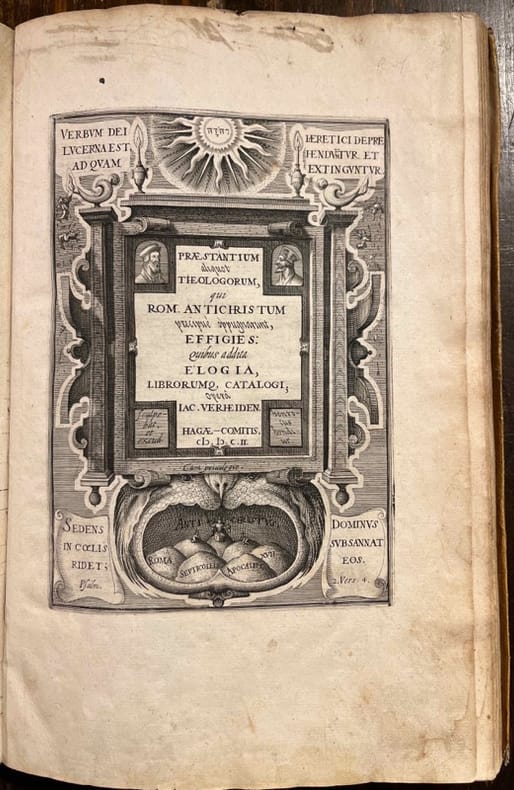
160216378Hagae Comitis [La Haye], Ex officina Bucoldi Cornelii Nieulandii, 1602. In-folio de [12]-226 pages [*6; A-Z4;Aa-Cc4; Dd6-Ee3], plein vélin à rabats, étiquette de titre manuscrite (en vélin), traces d'attaches. Ex-libris JFC, inscription ancienne au verso du titre.
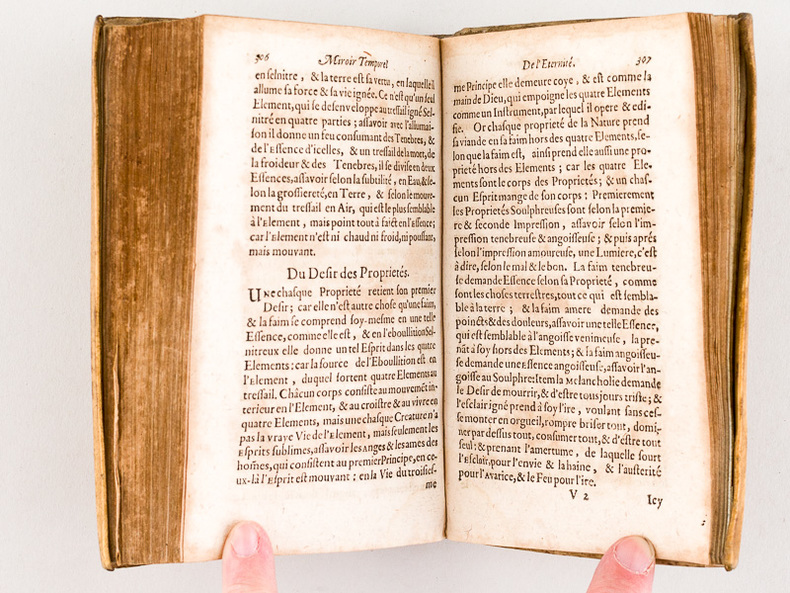
166458245Escrit par Iacob Boehm, nomae Philosophiis Teutonicus, et traduit de l'Allemand en François par le Sr: Jean Maclé, Docteur & Medecin tres-celebre, 1 vol. petit in-8 reliure de l'époque plein velin à recouvrement partiel, mis en lumière par C: le Blon à Ffort au Main [ Francfort ], 1664, 1 f. (titre gravé), 359 pp., 2 ff. blancs. Rappel du titre complet : De Signaturarerum c'est à dire De la Signature de Toutes Choses, comment l'intérieur est marqué par l'Extérieur. Vray Miroir Temporel de l'Eternité [ De Signatura Rerum ] Miroir Temporel de L'Eternité : Auquel est représenté Comment toutes choses sont marquées exterieurement selon leur forme interieure : Comment ce Monde visible, qui comprend kes Astres, les Animaux, Vegetaux & Mineraux, nous conduit en celuy qui est invisible : Comment le sublime procés Philosophal nous descouvre notre Regeneration
169141859Leipzig, Grosse & Gleditsch, 1691. 4to. Contemp. full vellum. Faint handwritten title on spine. a small stamp on titlepage. In: ""Acta Eruditorum Anno MDCLXXXXI"". (8),590,(6) pp. and 13 (of 15) folded engraved plates. The 2 first plates lacks, but they do not belong to the papers listed.Leibniz' papers: pp.277-281 a. 1 plate, pp. 435-439. Johann Bernoulli: pp. 274-276 a. 1 plate. Huygens: pp. 281-282. - Jacob Bernoulli: pp. 282-290 a. 1 plate.
169141859Leipzig Grosse & Gleditsch 1691. 4to. Contemp. full vellum. Faint handwritten title on spine. a small stamp on titlepage. In: "Acta Eruditorum Anno MDCLXXXXI". 85906 pp. and 13 of 15 folded engraved plates. The 2 first plates lacks but they do not belong to the papers listed.Leibniz' papers: pp.277-281 a. 1 plate pp. 435-439. Johann Bernoulli: pp. 274-276 a. 1 plate. Huygens: pp. 281-282. - Jacob Bernoulli: pp. 282-290 a. 1 plate. <br/><br/><em>All papers first apperance. All 5 of extreme importence in the development of the Calculus. Leibniz' 2 papers on the catenary curve paper 1-2 offered here was written at the instigation of Jacques Bernoulli. Following the example of Blaise Pascal who had initiated in 1658 a contest for the construction of the cycloid Leibniz also provoked the geometers of his time by challenging them to submit at the fixed date of mid-1691 their geometric method for the construction of the catenary curve. Leibniz later provided the answer followed by Johann Bernoulli and Huygens.'These two papers are a historical account of the origin of the study of this transcendental curve and at the same time the first physical-geometric construction showing the species-relationship between the catenary and the logarithmic curves as two companion curves; one arithmetic the other geometric. All of the differentials of the catenary curve are arithmetic means of corresponding differentials of the logarithmic curve; and all of the differentials of the logarithmic curve are geometric means of the catenary.'"The Catenary is the form of a hanging fully flexible rope or chain the name comes from "catena" which means 'chain' suspended on two points. The interest in this curve originated with Galileo who thought that is was a parabola. Young Christiaan Huygens proved in 1646 that this cannot be the case. What the actual form was remained an open question till 1691 when Leibniz Johann Bernoulli and the then much older Huygens sent solutions to the problem to the "Acta" Jakob Bernoulli 1690 Johann Bernoulli 1691 Huygens 1691 and Leibniz 1691 - these 4 1691-papers offered here - in which the previous year Jakob Bernoulli had challenged mathematicians to solve it. As published the solutions did not reveal the methods but through later publications of manuscripts these methods have been known. Huygens applied with great paper 4 virtuosity the by then classical methods of 17th century infinitesimal mathematics and he needed all his ingenuity to reach a satisfactory solution. Leibniz the papers 1-2 and Bernoulli paper 3 applying the new Calculus found the solutions in a much direct way. In fact the catenary was a test-case between the old and the new style in the study of curves and only because the champion of the old style was a giant like Huygens the test-case can formally be considered as ending in a draw." Grattan-Guiness in "From the Calculus to Set Theory 1630-1910.".The paper by JACOB BERNOULLI no. 5 offered here is a milestone papers as it marks the invention of the "SYSTEM OF POLAR COORDINATES" with points located by reference to a fixed point and a line through that point. Although newton had earlier also devised such a coordinate system in 1671 his work was not known so that the credit for the discovery generally goes to Bernoulli. Parkinson Breakthroughs 1691.Further papers contained in this volume of Acta Eruditorum:DENYS PAPIN: Mecanicorum de Viribus Motricibus sententia asserta a D. Papino adversius C.G.G. L. Leibniz objectiones. pp. 6-13. The plate lacks. - and Dion. Papini Observationes quaedam circa materias ad Hydraulicam spectantes. Pp. 208-213 a. 1 plate. This importent paper is part of the LEIBNIZ-PAPIN-CONTROVERSY.JACOB BERNOULLI: Specimen Calculi Differentialis in dimensione Parabolæ helicoidis ubi de flexuris curvarum in genere carundem evolutionibus. Pp. 13-22. The plate lacks. - and J.B. Demonstratio Centri Oscillationis ex Natura Vectis reperta occassione eorum quæ super hac materia in Historia Literaria Roterodamensi recensentur articulo.Pp.317-321.LEIBNIZ: O.V.E. Additio ad Schediasma de Medii Resistentia publicatum in Actis mensis Febr. 1889. Pp. 177-178. and O.V.E. Quadratura Arithmetica Communis Sectionum Conicarum quæ centrum babent.Pp. 178-182 a. 1 plate.TSCHIRNHAUS: Singularia Effecta Vitri Caustici bipedalis quod omnia magno sumtu hactenus constructa specula ustoria virtute superat per D.T. Pp. 517-520 </em> hardcover
1679291101Paris: Chez Estienne Michallet 1679. Hardcover. Near Fine. First edition. Small octavo. 288pp. Folding map. Rebound in lovely 19th Century green morocco gilt with elaborately decorated dentelles. One ink letter on a preliminary leaf and ink correction in errata else very near fine. Guillet's response to Spon's criticism of his brother-in-law's book on Greece. OCLC locates three copies only one in the U.S. and none in France. Chez Estienne Michallet hardcover