123 résultats
1794667471794. London : printed for T. Evans Paternoster Row and J. Stead at the Naval and Military Printing-Office Gosport 1794 8° 8 XX 170 pp. Halbledereinband d.Zt.; Rücken erneuert. Rare First Edition! "A treatise on the blood or general arrangement of many important facts relative to the vital fluid. With some cursory observations on the theory of animal heat. Interspersed with pathological and physiological remarks from the inductions of modern chemistry. By Hugh Moises surgeon of the Western Regiment of Middlesex Militia and Late Senior Pupil to the General Hospital Nottingham." "With the general acceptance of the Lavoisier-Crawford theory of animal heat as a resultant of respiration or slow combustion much of the subsequent search for the site of body heat production revolved about two questions. What happens to the inspired oxygen Or alternately where in the body was the carbonic acid first formed A subsidiary and often perplexing question asked at what temperatures the products of combustion carbonic acid and water actually could be formed The last question is of particular interest because the heats of combustion of carbon and hydrogen were utilized in the early nineteenth century attempts to establish the respiration theory of animal heat. Séguin citing Priestley and Bertholet had argued that these combustions could occur at ordinary body temperature. Hugh Moises in his Treatise on the Blod 1794 was equally emphatic : We know of no experiment which might authorize us to suppose that carbon can unite with oxygene in a temperature of 97°-99° or that hydrogene and oxygene air combine and form water in so low a temperature." "The early studies of this limited problem suggested solutions based on the ability of the different gases to cause the color changes observed in blood. Both Girtanner and Hassenfratz had attempted to show that venous blood became bright red upon the absorption of oxygen and thereby demonstrated their contention that the blood took up oxygen in the lungs. Another line of experimentation attempted to recover gases from the blood. Hugh Moises for instance confined arterial blood in bottles with gases containing no oxygen and claimed to find oxygen in the residue." Everett Mendelsohn: The Controversy over the Site of Heat Production in the Body. Proceedings of the American Philosophical Society 105/4 1961 pp. 412-420 Hugh Moises M.D. "Surgeon of the Western Regiment of Middlesex Militia.- An Inquiry into the Abuses of the Medical Department of the Militia. Lond. 1794 8vo.- A Treatise on the Blood; or General Arrangement of many important Facts relative to the Vital Fluid . Lond. 1794 8vo. 5s. - An Appendix to the Toilet; or an Essay on the Management of the Teeth. Loud. 1799 8vo. 2s. 6d." R. Watt: Bibliotheca Britannica. 4. V. 1824 unknown
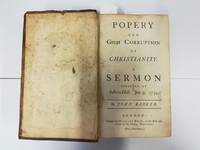
1735002177London: Printed for Richard Hett 1735. 1st Edition . Hardcover. Fair/No Jacket. 8vo - over 7¾ - 9¾" tall. 17 Sermons and a Conference bound together followed by contemporary hand written list of contents; full calf Cambridge binding with raised bands etc. Worn; scuffed; hinges/joints broken; ffep absent; pp. 848. Contents: 1 Popery; The Great Corruption of Christianity Barker 1735 pp. 34. 2 The Notes of the Church Considered 2nd ed. Chandler1735 pp. 57. 3 A Second Treatise on the Notes of the Church Chandler 1735 pp. 60. 4 The Supremacy of St Peter and the Bishops of Rome his Successors 2nd ed. Neal 1735 pp. 40. 5 The Church of Rome's Claim of Authority and Infallibility Examined Smyth 1735 pp. 71. 6 Scripture and Tradition Considered Wright 1735 pp. 54. 7 A discourse Concerning Transubstantiation: In jWhich the Words of the Institution of the Lord's Supper are Particularly Considered. Harris 1735 pp. 46. 8 A Second Discourse Concernign Tansubstantiation; in Which the Sixth Chapter of St John's Gospel is Particularly Considered. Harris 1735 pp. 38. 9 The Veneration of Saints and Images as Taught and Practis'd in the Church of Rome Examined. Hughes 1735 pp. 58. 10 The Sources of Corrupting both Natural and Revealed Religion Exemplified in the Romish Doctrine of Penance and Pilgrimages. Hunt 1735 pp. 40. 11 The Church of Rome's Doctrine and Practise with Relation to the Worship of God in an Unknown Tongue examin'd. Bayes 1735 pp. 48. 12 The Popish Doctrine of Auricular Confession and Priestly Absolution Considered. Burroughs 1735 pp. 48. 13 The Popish Doctrine of Merit and Justification Considered Newman 1735 pp. 48. 14 The Popish Doctrine of Purgatory Repugnant to the Scripture account of Remission through the Blood of Christ. Earle 1735 pp. 52. 15 The Principles of Popery Schismatical. Lowman 2nd ed. 1735 pp. 48. 16 Persecution and Cruelty in the Principles Practices and Spirit of the Romish Church Grosvenor 2nd ed. 1735 pp. 39. 17 The Reasons and Necessity of the Reformation Leavesly 1735 pp. 40. 18 Two Conferences.at the Bell Tavern.Between two Romish Priests a Divine fo the Church of England and Mr. Chandler and Dr. Hunt Dissenting Divines on the following Subjects. the Blashemy of many Popish Writers.Transubstantiation; Praying to Saints and Angels. 1735 pp. 28. 19 Pp. 2 hand written list of sermons. Rather a lovely volume if worn. <br/> <br/> Printed for Richard Hett hardcover
17970009109NEW FRANKFURT HARRISON CO. WEST VIRGINIA 1797. On offer is are two lovely and fascinating letters from a father and mother to their daughter detailing their situation mere weeks after moving to New Frankford Virginia. The letter is signed Moses Starr and Elizabeth Starr and addressed to their Dear Daughter. The first letter is dated November 17th 1797 and the second is dated December 23 1797. In the letters they describe their journey to their new home in West Virginia their home and their farm. They now live in New Frankfurt in Harrison County Simpsons Creek Eight Miles From Clarkburg. The first letter begins Dear Daughter we embrace this opportunity to wright to you informing thee that we are all in great haealth at present thanks bea to God for his tender Merceys to us ward from time to time. They write that they have we have had no letters from thee this two years.and have had no opertunity to send any. We long to see thee and hear from thee if thou art single write whether thou would incline to come upon and live with us we think of comeing Down within two years more; like wise let us know how our Relations are in them parts.The back of the letter is a short sermon like passage stating Dear child strive to ear and Love God who is able to Love the utmost oall that come to him through Jesus Christ the Redeeme of lost Man. The next letter begins with them writing that they have received her last letter which gave us some cause to rejoice of hearing from our relations in general but gave us concern of mind for the loss of Nelly Starr and the disolate state of Uncle Joseph. They then remark on the their life in what is now West Virginia. Thy mother was braught to be of a daughter the Eleventh of last month wich we call Polly. They speak of their journey to Virginia taking two weeks from when they left their home. The farming has been good a well reaping 200 bushals of Sound Corn and 150 bushals of Oats with a trifel of buck wheat. I have 20 acres of wheat and Ry in the ground this fall. The letter ends with the usual pleasantries and again is signed by Moses and Elizabeth Starr. The two letters are in fair shape both having a fair share of rips tears and discoloration. The first letter has some moth damage that affects the readability of a sentence or two. The second letter has its tears along the creases and edges but it does not affect the content at all. Neither does the discoloration on either letter though it is very noticeable it does not block out any words. The ink on both letters has faded the first more than the second but both letters are fairly easy to read throughout. These letters are an interesting little snapshot of a family life in 1790s Virginia representing a change in a brand new America and hope for a new setting in this burgeoning nation. Good. 4to - over 9¾" - 12" tall. Manuscript. unknown
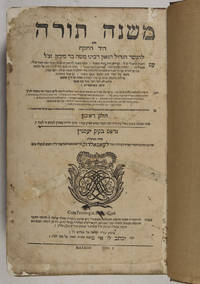
173927896Jessnitz Saxony-Anhalt: Bi-defus Yisrael bar Avraham 1739. Hardcover. Good. Four volumes folio published between 1739 and 1742. Woodcut printer's device at titles; woodcut endpieces in first volume. Hebrew text opens from right to left; leaf numbers in Hebrew characters. Hebrew chronograms yield Jewish dates of publication 5499-5502. Brown library buckram scuffed at extremities spines lettered in gilt. Endleaves renewed. A good set. See foliation and condition notes for each volume below.<br /> <br /> Scarce eighteenth-century edition of this seminal compendium of Jewish law halakhah. Compiled between 1170 and 1180 while Maimonides was living in Egypt the Mishneh Torah is regarded as the author's magnum opus. It is the only Medieval-era work that surveys the full panoply of Jewish observance including those laws that are only applicable when the Jerusalem Temple is in existence. The present edition is the first to contain Judah Rosanes' commentary Mishneh le-melekh. "Mishneh Torah" The Repetition of the Law is an appellation originally applied to the biblical book of Deuteronomy; the subtitle "ha-Yad ha-Hazakah" The Book of the Strong Hand plays on its subdivision into fourteen books: the numerical value fourteen is represented in Hebrew letters as Yud 10 Dalet 4 which forms the word "yad" hand. Maimonides sought to provide a complete statement of the Oral Law so that a person who mastered first the Written Torah and then the Mishneh Torah would be in no need of any other book. Contemporary reaction was mixed with strong and immediate opposition focusing on the absence of sources and the belief that the work appeared to be intended to supersede study of the Talmud itself. Maimonides responded to these criticisms and the Mishneh Torah endures as an influential work in Jewish religious thought. According to several authorities a decision may not be rendered in opposition to a view of Maimonides even where he apparently militated against the sense of a Talmudic passage for in such cases the presumption was that the words of the Talmud were incorrectly interpreted. Likewise: One must follow Maimonides even when the latter opposed his teachers since he surely knew their views and if he decided against them he must have disapproved their interpretation.<br /> <br /> Vol. 1: 1 title 8 234 102 3 ff. Repairs at title page with very slight loss of text at verso following leaf and the final leaf. Text embrowned often heavily in first half with some light marginal dampstains throughout. Old manuscript entries in Hebrew at title in at least three hands.<br /> <br /> Vol. 2: 1 title 148 112 2 ff. Marginal repairs to first and last two leaves no loss of text. Moderately dampstained throughout with some mild embrowning. Old manuscript entries in Hebrew at title in at least two hands; three old stamps at title including at least one censor's approbation.<br /> <br /> Vol. 3: 1 title 221 169 ff. Repairs at bottom margin to title with loss of some text below imprint and at final lines of rabbinic approbations at verso and at bottom margin following leaf with some text loss and obscuration by translucent paper tape. Small marginal repair at final leaf. Light dampstaining in first half; remaining text with mild embrowning. Old manuscript entries in Hebrew at title in at least two hands; two old stamps at title including at least one censor's approbation.<br /> <br /> Vol. 4: 1 title 135 138-154 157 1 ff. Marginal repairs to title and final leaf no loss of text. Sporadic light embrowning and marginal stains. Old manuscript entry in Hebrew at title.<br /> <br /> A complete set with only minimal text loss in a few places -- a very usable scholar's copy. References: Vinograd Jessnitz 46; Fürst 2: p. 295; Zenker p. 583<br /> <br /> Title in Hebrew: ×ž×©× ×” תורה ×”×•× ×”×™×“ ×”×—×–×§×” ×œ×”× ×©×¨ הגדול ×”×’×ון ×¨×‘×™× ×• משה בר מימון זצ׳׳ל ×¢× ×”×©×’×ª הר×ב׳׳ד זצ׳׳ל ופירוש הרב מגיד ×ž×©× ×” וכסף ×ž×©× ×” להג×ון המשביר ×¨×‘×™× ×• יוסף ×§×רו זצ׳׳ל ומגדל עוז והגהות ×ž×™×ž×•× ×™×™×•×ª ופירוש ×¨×‘×™× ×• עובדי והרב המוסמך מדר׳׳ל ן׳ חביב על הלכות קידוש החדש ×¢× ×›×œ הצורות השייכות להלכות ×לו ולהלכות שבת וסוכה ×•×¢× ×ž×•×¨×” ×ž×§×•× ×¢×œ דברי הרב המגיד וכסף ×ž×©× ×” ×’× ×©×ª×™ מפתחות גדולות ורחבות ×חת על סדר ×”×¤×¨×§×™× ×•×חת על דרך ××œ×¤× ×‘×™×ª×” ×œ× ×—×¡×¨ דבר מכל כפי ×שר × ×“×¤×¡ ב×משטרד×<br /> <br /> Rabbi Moses Maimonides the Rambam was a 12th century Jewish philosopher and halachic legal scholar. A highly controversial figure both during his lifetime and after his death he is generally acknowledged as the preeminent Jewish thinker of the Middle Ages. He was born in Córdoba Spain but fled as a child from the Almohad persecution. He eventually settled in Egypt where he served as a rabbi physician and philosopher. His fourteen-volume Mishneh Torah his only work not in Arabic still carries canonical authority particularly within the Yemenite Jewish community as the codification of Talmudic law. His other works include "Kitab al-Siraj" a commentary on the Mishnah "Kitab al-Fara'I" a book on precepts and the celebrated philosophical work "Dalalat al-Ha'irin" known in Hebrew as the "Moreh Nevukhim" The Guide to the Perplexed. In this latter work Maimonides attempted a philosophical/theological reconciliation of the Hebrew Bible and Greek knowledge. This work came to play a central role in all subsequent major controversies over philosophy within the Jewish community during the Middle Ages. Bi-defus Yisrael bar Avraham hardcover
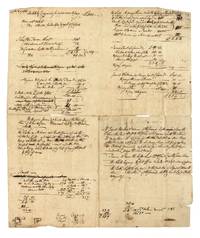
178655770Providence 1786. Folio sheet approx. 15" x 12" docketed on the verso; previous folds with splits no loss; overall toning; good. Brigadier General James Angell 1723-1785 descendant of one of the first settlers of Providence died February 2 1785. This inventory was taken by Moses Brown 1736-1838 executor of the will and both a friend and relative. The Angell's daughter Abigail married a Goddard relatives of the Brown family. Among assets listed are Angell's Johnston farm lot 160 acres of Vermont land a third of an acre lot in North Providence; "we to give James and Jacob a Deed of the Whole of remd of Johnston farm & North Providence lott." James Angell was town clerk of Providence until 1775 and Theodore Foster said of him "I became intimately acquainted with the said James Angell and many of his Family Connexions among whom was the Honorable Stephen Hopkins Esq. whose Sister married the said James Angell." Documentary History of R.I. Angell was also appointed chairman of the committee to revise laws of the state. <br/><br/> unknown books
178655770Providence 1786. Folio sheet approx. 15" x 12" docketed on the verso; previous folds with splits no loss; overall toning; good. Brigadier General James Angell 1723-1785 descendant of one of the first settlers of Providence died February 2 1785. This inventory was taken by Moses Brown 1736-1838 executor of the will and both a friend and relative. The Angell's daughter Abigail married a Goddard relatives of the Brown family. Among assets listed are Angell's Johnston farm lot 160 acres of Vermont land a third of an acre lot in North Providence; "we to give James and Jacob a Deed of the Whole of remd of Johnston farm & North Providence lott." James Angell was town clerk of Providence until 1775 and Theodore Foster said of him "I became intimately acquainted with the said James Angell and many of his Family Connexions among whom was the Honorable Stephen Hopkins Esq. whose Sister married the said James Angell." Documentary History of R.I. Angell was also appointed chairman of the committee to revise laws of the state. unknown
17360001326MARLBOROUGH MASSACHUSETTS MASS MA 1736. On offer is a charming relic of Marlborough Massachusetts ephemera being a manuscript dated 1736 detailing the specifics of a new road in the town. "A way laid out beginning near the dwelling house of Jeremiah Barstow & so running along between the land of Col Thomas How & the land of Simon Gates & is bounded by said Gates land by boundry mark't trees & it is Eight rods wide until it comes to that which is called the Indian land & then running across the County road along by the house of Zachariah Maynard four rods wide & still extends four rod wide along between land of Daniel Rice & land of Eliazer Rice & along through the land of Thomas Martin down where the path now goeth. Down that which is called Sandy Hill & then it is tow rods wide & then turning & then running through the land of Joshua Rice through a corner of Rice's land and then through Daniel Rice's land & the land of Thomas Martin down to that which is called the new Bridge over Fort Meadow Crook. between the meadow of Daniel Rice and the Meadows of Simon Gates & it is two rod wide to the lot granted to Abraham How as the way is mark't on the west side by markt trees & then running on westerly end of said lot granted to Said How four rods wide & so running a long through the lot of Hezekiah Bush & so running along over Sto. Low Bridge markt with trees on the east side of sd way running along the way which runs along by the Dwelling house of Peter How near Alfabeth sp River." This was accepted by the town March 3d 1729: "A True Coppy Attest Moses sp WoodsTown Ca. Marlboro Feb 27 1736." The paper document measures 9 7/8 x 6 inches and overall is G. Autograph. Manuscript. Good. 8vo - over 7¾" - 9¾" tall. Paperback
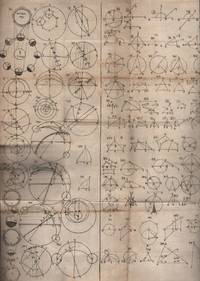
1786336Berlin: Bi-defus Ḥevrat ḥinukh neʻarim; Jüdischen Freyschule 1786. First edition. After leaf 10 numbering reverts to 1 and the text of Maimonides' Hilkhot Ḳidush Ha-Hodesh begins; Naṿeh Kodesh continues as a commentary to it. In contemporary half cloth. Binding rubbed and bumped light foxing throughout. Ink stain on title page. Overall a good copy. First edition. After leaf 10 numbering reverts to 1 and the text of Maimonides' Hilkhot Ḳidush Ha-Hodesh begins; Naṿeh Kodesh continues as a commentary to it. In contemporary half cloth. 4°; 2 1041 leaves and one folded engraved page of geometric diagrams. Waltsch’s work on geometry trigonometry and astronomy woth his commentary to Maimonides’ Sanctification of the Month. Bi-defus Ḥevrat ḥinukh neʻarim; Jüdischen Freyschule unknown
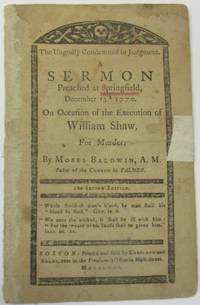
177139601Boston: Printed and Sold by Kneeland and Adams next to the Treasurer's Office in Milk-Street 1771. 24pp but lacking the half title. Death's Head ornamentation on title page. Disbound and uniformly toned. Closed tear to title leaf no loss repaired; evidence of repair at outer margin. Inner margin of title page and page 24 with old wrapper remnants. Good.<br /> <br /> Shaw bludgeoned Edward East to death while both were inmates of the Springfield prison. This is the second of three editions of this title all issuing in 1771; AAS does not own our edition. Reverend Baldwin scolds Mr. Shaw "for the sin of intemperance. Have you not hereby dishonoured God and abused his bounty and goodness; wronged your own soul and body; wasted your substance; brought your self and family to poverty and distress. . . You are verily guilty of the crying sin of MURDER."<br /> Evans 11974. ESTC W1508.5- Yale NYHS Boston Public Williams Peabody-Essex. Printed and Sold by Kneeland and Adams, next to the Treasurer's Office in Milk-Street unknown
17712004280011Philadelphia : William & Thomas Bradford 1771. First Edition. Hardcover. Acceptable. Early American Science: Governor Simon Snyder's copy interesting Pennsylvania Provenance Quarto. Bound in early American 1/4 calf over marbled boards. Rebacked with modern leather spine original spine label conserved. Snyder's leather name plate on front cover but chipped at the end. xxii 3 xxiv-xxviii xix 1 116 72 1 118-340 pages. Defective copy. Illustrated with only 3 of 7 engraved plates lacking plates 3-5 7. Preliminary pages have old dampstaining including title and laws of the society. Includes a list of members and subscribers. Founded by Benjamin Franklin the American Philosophical Society was one of the first scientific societies in America. <br> Provenance: Simon Snyder 1759-1819 was the third Governor of Pennsylvania. This volume includes his morocco book plate on the front and his signature is on the title page. Snyder led the Commonwealth during the War of 1812. <br> Evans 11959; Sabin 1181. <br> Contents in this volume: A Description of an Orrery executed on a new plan finished by David Rittenhouse; Calculations of the Transit of Venus; Cultivations of the vine and the making and preserving of wine.suitable to North America by Edward Antill. Philadelphia : William & Thomas Bradford hardcover
17732007280082London : Printed for T. Cadell in the Strand M. DCC. LXXIII 1773. 3rd. Hardcover. Good. Interesting Early Massachusetts / Revolutionary War Provenance: General Gridley's Copy Bound in contemporary polished calf. Good binding. Small chip from head of spine but sound. lii 386 2 p. ESTC T116279. Signed on title page by Richard Gridley. Gridley 1710-1796 was a soldier and engineer in the French and Indian Wars and in the American Revolution. He served as a the Chief Engineer for artillery in George Washington's Continental Army. He directed fortifications on Dorchester Heights and fought in the battle of Bunker Hill. Gridley is considered by the US Army Corps of Engineers to be America's First Chief Engineer. Later this book was owned by the Rev. Joseph Grafton 1757-1836 founder of Newton Theological Institution. Grafton served as a Baptist pastor in Newton for more than 48 years. Newton Theological Seminary stamp. Includes related ephemera about Gen. Gridley. London : Printed for T. Cadell, in the Strand, M. DCC. LXXIII hardcover
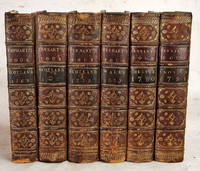
17762307070032London: Printed for Benjamin White; John Monk; Henry Hughes; 1776 - 1782 1776. Hardcover. Very Good. An Illustrated Tour of 18th century Britain 6 volume set. Quartos 24 x 18 cm. Handsomely bound in uniform contemporary polished calf. 6 gilt spine compartments. Minor cracks to joints. Includes fold out map and illustrations. Detailed list of Contents: v.1. A Tour in Scotland. 1769 B. White 1776. Folding engraved map at front engraved title with vignette 42 engraved plates. 4th ed; v.2. A Tour in Scotland. 1772 B. White 1776. Folding engraved map at front engraved title with vignette 47 engraved plates; v.3. A Tour in Scotland and Voyage to the Hebrides. John Monk 1774. Engraved title with vignette 44 engraved plates; v.4. A Tour in Wales. 1773 H. Hughes 1778. Engraved title with vignette 26 engraved plates; v.5. Touring to Snowdon. H. Hughes 1781. Engraved title with vignette 36 engraved plates 2 engraved vignettes in text; v.6. Touring from Chester to London. B. White 1782. Engraved title with vignette 22 engraved plates. <br> Thomas Pennant 1726-1798 was a Welsh naturalist traveler zoologist and antiquarian. Pennant is most known for his works on British Zoology and the History of Quadrupeds. For his contributions to natural science he was admitted to the Royal Society. His travel books predated Samuel Johnson's and influenced his writing. Significantly Pennant's travels helped popularize Scotland to British travelers and provide a valuable insight into the land during this period. <br> "Pennant's travels and natural history are distinguished by his personal energy a keen observational sense and by methodological organization and attention to facts. In such ways and in his friendship and widespread correspondence with others of like interests throughout Britain and Europe he may be said to exemplify those gentleman scholars of nature in the later eighteenth century whose interests in natural knowledge aimed at national improvement through intellectual enquiry." - DNB. In 1771 Pennant published his 'Tour in Scotland' describing the journey made by him in 1769. He says he had 'the hardihood to venture on a journey to the remotest part of North Britain' of which he brought home an account so favourable that 'it has ever since been inondee with southern visitors'. Starting from Chester on 26 June 1769 Pennant visited the Fern Islands off the Northumbrian coast and noted many species of sea-fowl that resorted thither. He made nearly the circuit of the mainland of Scotland observing manners and customs and natural history. On this occasion as on all subsequent tours he journeyed on horseback and kept an elaborate journal. The success of the 'Tour in Scotland' led to his undertaking a second Scottish journey beginning on 18 May 1772. He visited the English lakes proceeded to the Hebrides and was presented with the freedom of Edinburgh. Moses Griffith q. v. the Welsh artist attended him on this journey as also on his later tours making sketches and drawings afterwards reproduced in Pennant's published 'Tours.' Pennant made tours in various parts of England including Northamptonshire 1774 Warwickshire 1776 Kent 1777 Cornwall 1787. As the outcome of several journeys in Wales he published his 'Tour in Wales' the first volume appearing in 1778." - Warwick William Wroth DNB v.44 p. 320-322. London: Printed for Benjamin White; John Monk; Henry Hughes; 1776 - 1782 hardcover
1765N4664Frankfurt & Berlin: J.J. Speier 1765. First Edition . Half Leather. Very Good. 4to. 1. Theil und 2. Theil bound together. 124pp123pp.First part called "'Ir Heshbon" on Arithmetic and Algebra; the second part : "Berure Middot" on Geometry. MODERN HALF LEATHER BINDING WITH MARBLED BOARDS. Title page with stamp some old handwriting and markings. Upper corner of title page some 3 cm missing and replaced with old repair. Pages with some browning and occasional minor soiling. First pages of the second part trimmrd to text. Last page of the second part with repair to edges End papers with some old writing and minor soiling . OTHERWISE VERY GOOD.AN EXTREMELY RARE AND INTERESTING WORK of MATHEMATICS in HEBREW. this work is mentioned in Zeitlkin Bibliotheca Hebraica.- Elijah ben Moses Gershon Zahalon was a Jewish Talmudist mathematician and physician living in Pinczcow Russian Poland. <br/> <br/> J.J. Speier hardcover
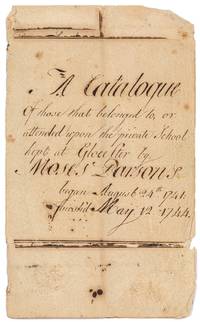
1741560322Gloucester Massachusetts 1741. Softcover. Very Good. Manuscript. 24mo. Three quarter leaves pinned inside two outer full leaves measuring about 3 ½†x 6â€. One quarter leaf is loose laid-in. The full front cover leaf titled in manuscript is trimmed above the title and has one horizontal cut below the title very good. The three-quarter leaves list the names of students 75 boys and 13 girls in ink on the rectos and versos. Born in Gloucester Massachusetts in 1716 Moses Parsons graduated from Harvard in 1736 and while pursuing his theological studies he taught a private school in his native town as noted in the catalogue from 1741-44. In 1744 he accepted a call to Byfield Parish where he was distinguished as a preacher until his death in 1783 having seen the Church through the Great Awakening led by George Whitefield and through the Revolutionary War. At his school Parsons taught a veritable Who’s Who of early Gloucester residents – individual and family names such as Winthrop Sargent whose son was a prominent patriot and Governor of the Mississippi Territory William Ellery Nathaniel Haraden whose son served as the Sailing Master of the U.S.S. Constitution and many others. In addition to his pastoral responsibilities at Byfield Parsons was instrumental in founding Governor Dummer Academy now known as The Governor’s Academy. During his tenure at his private school Parson’s calculates that he taught 75 boys and 28 girls quite a few of whom would go on to be immortalized by Gloucester historians John Babson and James Pringle. An important early manuscript documenting an overlooked piece of Gloucester’s local history.<br /> <br /> Reference: William Cutter. Genealogical and Personal Memoirs Relating to the Families of the State of Massachusetts. unknown
179553585Erlangen: Printed by Christian Karl Gottlieb Kunstmann 1795. First edition. Hardcover. Very good condition. Elephant Folio. Unpaginated 10pp. Bound in dark half leather over light brown leather with gilt lettering and ruling on spine. Title page with engraved vignette. Engraved headpieces for both first pages in Hebrew and German. Engraved endpieces as above. Text printed in Hebrew and German throughout on facing pages.<br /> <br /> The hymn praises peace and the treaty alongwith the prudence of King Friedrich Wilhelm was sung by Moses Hochheimer Rabbi in Ansbach. It was printed by Christian Karl Gottlieb in Erlangen. This peace treaty between France and Prussia was rectified on April 5 1795 in Basel and was the first of three treaties that established France as the dominant power in Europe in effect breaking up the First Coalition. France was represented by François de Barthélemy Prussia by Karl August von Hardenberg. Minor wear to binding. Pages somewhat age-toned with some creasing small chips along edges and some light foxing. Printed by Christian Karl Gottlieb Kunstmann hardcover
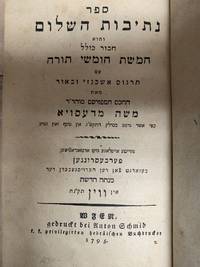
1795RB007Vienna: Anton Schmid 1795. Second. Good. 1795 rare copy of Netivot Ha-shalom The Paths of Peace. A German translation in the Hebrew alphabet of the book of Genesis by Moses Mendelssohn 1729-1786. It includes the Hebrew text of the Bible and a commentary by Mendelssohn. The last 200 pages of the book is the Aramaic text of Onkelos commentary of Rashi and the Haftaroth. This book is a former synagogue copy and in great shape for a book 230 years old. Binding still tight. Although there is wear on the pages it is very readable. Inside front and back covers are 3 off-white blank rectangular stickers one has been torn off leaving residue Markings on both sides of the page preceding the title page. Purple synagogue stamp at top of page prior to the text. That page has a 1-inch tear at the top middle edge. There is another stamp on the bottom right corner of pages 81b and 88b. Light penciled lines about one inch long on 5 pages of the introduction at least one other page of the book has similar marks. About 20 pages with the reverse page's text legible but still readable. Lh Anton Schmid unknown
1782395221782 In-12 (162 x 95 mm), demi-basane brune à petits coins, dos lisse orné dune roulette dorée en place des nerfs, titre doré, tranches mouchetées (reliure de lépoque), xii, 255 pages, (2) feuillets derrata. Dessau, dans la librairie des auteurs et des artistes [colophon: à Hale, de l'Imprimerie de Chr. Gottl. Taeubel], 1782.
1782PHO-1140Dessau, Librairie des auteurs et des artistes, 1782, XII-255pp.-2ff, relié demi basane postérieure, dos à nerfs avec auteur, titre et date en pied.
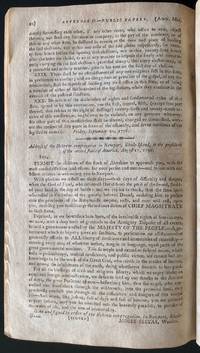
179143202Philadelphia: Mathew Carey; Carey Stewart and Co. No. 188 Market-street 1791. Original Sewn Binding without outer wrappers or boards 8vo pages 285-344 1-48 1-40 1-48 total 196 pages with different sections correctly paginated for this issue.<br> With Moses Seixas’ famous letter to President George Washington<br> Seixas wrote to President Washington on behalf of the Newport congregation whose home is the Touro Synagogue the oldest synagogue still standing in America. This letter which appears on p 40 of Appendix II and Washington's reply comprise one of the most famous statements on religious freedom of this period. <br> Here published in America’s first literary magazine George Washington’s famous phrase describing a government that "gives to bigotry no sanction and to persecution no assistance" was originally coined by Seixas in this very letter. It is a moving Biblically toned greeting to the president and was repeated by Washington in his reply assuring it a place among the most cherished in the American historical vocabulary.<br> George Washington's visit to Newport Rhode Island August 17-18 1790 ranks among the seminal episodes in the history of American Jewish religious liberty. Washington left Rhode Island off his travel itinerary the previous year in response to the state's failure to ratify the Constitution. By 1790 after becoming the last state to ratify Washington visited Newport along with members of his administration including Thomas Jefferson. <br> Moses Seixas 1744-1809 a Newport merchant warden of Kaal Kadosh Yeshuat Israel Newport Hebrew Congregation and a prominent Mason was one of the civic leaders who met with Washington. Seixas had a long history as a revolutionary patriot: he remained in the city after it was occupied by the British during the war and signed a document during the occupation pledging loyalty to the patriotic cause. <br> Additionally his brother Rabbi Gershon Mendes Seixas minister of New York's Shearith Israel Congregation known as the "patriot rabbi" was one of fourteen clerygymen officiating at Washington's 1789 Presidential inauguration. <br> Finally as a fellow Mason he and Washington would have had a natural connection. Seixas' eloquent message reads in part: <br> "Deprived as we heretofore have been of the invaluable rights of free Citizens we now with a deep sense of gratitude to the Almighty Disposer of all events behold a Government erected by the MAJESTY OF THE PEOPLE – a Government which to bigotry gives no sanction to persecution no assistance – but generously affording to ALL Liberty of conscience and immunities of Citizenship: – deeming every one of whatever Nation tongue or language equal parts of the great governmental Machine: – This so ample and extensive Federal Union whose basis is Philanthropy Mutual confidence and Public Virtue we cannot but acknowledge to be the work of the Great God who ruleth in the Armies of Heaven and among the Inhabitants of the Earth doing whatever seemeth him good." <br> Grounding religious freedom in natural rights and echoing Seixas' words Washington later replied with an echo of Seixas' language regarding religious freedom: <br> "The Citizens of the United States of America have a right to applaud themselves for having given to mankind examples of an enlarged and liberal policy: a policy worthy of imitation. All possess alike liberty of conscience and immunities of citizenship. It is now no more that toleration is spoken of as if it was by the indulgence of one class of people that another enjoyed the exercise of their inherent natural rights. For happily the Government of the United States which gives to bigotry no sanction to persecution no assistance requires only that they who live under its protection should demean themselves as good citizens in giving it on all occasions their effectual support."<br> See JE Vol. IX pp. 294-295; EJ. Vol. XIV p. 1117; J.L. Blau and S.W. Baron The Jews of the United States 1790-1840 A Documentary History Vol. 1 1963 pp. 8-10.<br> Other pieces of interest include notes on the slave trade by Benjamin Franklin and notes on the Revolutionary War. <br> “The American Museum or Repository of Ancient and Modern Fugutive Pieces &c. Prose and Poetical “title changed to “The American Museum or Universal Magazine†in January 1790 was America's first literary magazine featuring early printings of the US Constitution the Bill of Rights various State constitutions Alexander Hamilton's Report on Manufactures and parts of the Federalist Papers. <br> Complete issue in original sewn binding. Overall condition is very good with scattered darkening and foxing though paper and binding remain nice and strong with clean crisp edges including the notable page containing the address to Washington<br> A Cornerstone of American Judaica. BAMR-69-7A. Philadelphia: Mathew Carey; Carey, Stewart, and Co. No. 188 Market-street unknown
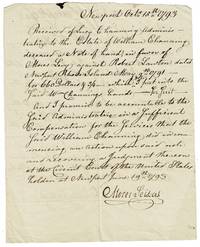
179355221Newport: Oct. 15 1793. One-page octavo document approx. 8" x 6¼"; previous fold else near fine. Lucy Ellery Channing's father was William Ellery signer of the Declaration of Independence from Rhode Island. "For 660 dollars & 3/4 which note I put into the said Mr. William Channings hands - for suit - and I promised to be accountable to the said administratrix in a sufficient compensation for the services that the said William Channing did in commencing an action upon said note and recovering a judgment thereon at the Circuit Court of the United States holden at Newport June 19 1793." Signed by Moses Seixas and docketed on the verso. Moses Sexias was Moses Levy's grandson. Moses Levy had died a year earlier. Moses Seixas 1744-1809 was a "first generation Jewish-American whose parents migrated from Lisbon Portugal to Newport. Seixas rose to prominence as warden of Newport's Touro Synagogue of Congregation Jeshuat Israel Grand Master of the Grand Lodge of Free and Accepted Masons of Rhode Island and co-founder of the Bank of Rhode Island. Seixas is best remembered for the congratulatory letter he penned on behalf of his congregation to then recently inaugurated President George Washington in 1790. Written just months after Rhode Island became the last state to ratify the United States Constitution Seixas sought assurances that the enumerated rights of freedom of religion and enfranchisement would apply to American Jews in the new republic" MountVernon.org. <br/><br/> Oct. 15 unknown books
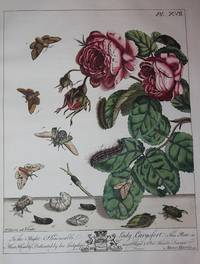
1778006437London: J. Robson 1778. Second edition. Full Morocco. Near Fine. One of the true milestones of entomological literature with truly magnificent and sublime color plates. Folio 37 by 29 cm. Copper engraved frontis xv 1 90 pp. and one anatomical plate plus 44 magnificent hand-colored copper engraved plates. Text in English and French with the two languages side by side on each page. Moses Harris 1730-1785 was both an entomologist and engraver and artist. Modern full burgundy morocco with gilt floral centerpiece and spine decoration. Endpapers are modern and somewhat odd looking more like wrapping paper than a proper endpaper. Usual offsetting. Very occasional light fox mark. Overall a beautiful fresh copy with all plates sharp and bright. <br /><br /> J. Robson books
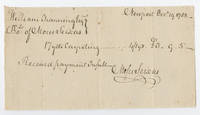
178825418<p>Seixas' 1790 letter of welcome elicited the first president's most compelling statement on religious liberty "to bigotry no sanction." In this 1788 receipt Seixas signs a receipt documenting payment for carpet by William Channing the state's new attorney general.</p><p><strong>MOSES SEIXAS.</strong> Manuscript Document Signed to William Channing December 18 1788. Receipt for carpeting. 1 p. 7¼ x 4 in.</p><p><strong>Complete Transcript</strong></p><p><em>Newport Dec<u>r</u> 19 1788</em></p><p><em>William Channing Esq</em></p><p><em>Bo<u>t</u></em> Bought <em>of Moses Seixas / 17 yds Carpeting . . . . . . . . . . .4/1 yd. £3.9. 5.</em></p><p><em>Received payment In full /</em></p><p><em>Moses Seixas</em></p><p>Docketing on verso in another hand: <em>Moses Seixas</em></p><p><strong>Moses Mendes Seixas</strong> 1744-1809 was born in New York into a Jewish family. His father immigrated from Portugal to New York about 1730 and became a merchant. The family moved to Newport Rhode Island in 1765. Moses Seixas married Jochebed Levy in 1770 and they had eight children. He was one of the organizers and first cashier of the Bank of Rhode Island which conducted business in his house until 1818. After the British occupied Newport during the Revolutionary War Seixas remained in Newport but was among the signers of a document supporting the patriot cause. In 1790 he was the president of the Congregation Yeshuat Israel later Touro Synagogue in Newport. He was also a charter member and first grand master of St. John's Lodge of Free and Accepted Masons in Newport.</p><p><strong>William Channing</strong> 1751-1793 was born in Newport Rhode Island and graduated from the College of New Jersey Princeton in 1769. In 1773 he married Lucy Ellery daughter of William Ellery a Newport lawyer who signed the Declaration of Independence and they had nine children. Channing was elected Attorney General of Rhode Island in 1777 and when Rhode Island ratified the U.S. Constitution in 1790 Channing became the first federal District Attorney. One of his sons was the famous Unitarian preacher William Ellery Channing 1780-1742.</p><p><strong>Historical Background</strong></p><p>From 15 Sephardic families who arrived in 1658 Newport Rhode Island's Jewish community grew to be the largest in the colonies. Many Jews left during the Revolutionary War when Newport was occupied by the British. A significant number returned when the British left in 1779. By the time Rhode Island became a state there were approximately 300 Jews in the thriving Newport community.</p><p>Starting while on his way to New York to assume the presidency in April of 1789 George Washington received many messages from civic fraternal and religious organizations offering congratulations praise of his deeds in war peace and politics prayers on behalf of congregations or constituents. Washington's replies justly count among his most famous pronouncements setting a boldly inclusive tone that helped our new nation survive and expand.</p><p>After the first session of the first Congress Washington set out on a tour of the New England states except for Rhode Island which had yet to ratify the Constitution. It finally did so in May of 1790 and three days after the second session of Congress adjourned Washington Jefferson and others set out to visit Newport. On August 18 Washington and his entourage were greeted with four addresses written as open letters and read in a public ceremony. First the town then from all the Christian clergy then the Masonic order and finally from the Hebrew Congregation.</p><p>Moses Seixas on behalf of the Congregation Kahal Kadosh Yeshuat Israel congratulated Washington on his ascendancy to the Presidency. He invoked the language of the Revolution in arguing that Jews should be entitled to the same privileges as an American of any other religious denomination. Having been previously "deprived…of the invaluable rights of free Citizens" Seixas expressed his hopes for the success of the new "government erected by the majesty of the people a government which to bigotry gives no sanction—to persecution no assistance; but generously affording to all liberty of conscience."</p><p>Seixas' letter moved President Washington who echoed Seixas' words and built on them to make his most celebrated statement on religious freedom. He responded as soon as he returned to the capital New York assuring the Hebrew congregation that "happily the Government of the United States which gives to bigotry no sanction to persecution no assistance requires only that they who live under its protection should demean themselves as good citizens in giving it on all occasions their effectual support. It would be inconsistent with the frankness of my character not to avow that I am pleased with your favorable opinion of my Administration and fervent wishes for my felicity. May the Children of the Stock of Abraham who dwell in this land continue to merit and enjoy the good will of the other Inhabitants; while every one shall sit in safety under his own vine and fig tree and there shall be none to make him afraid."</p><p>Washington's addresses responding to religious congregations included those of Baptist Congregational Dutch Reformed Episcopalian German Lutheran German Reformed Jewish Protestant Presbyterian Quaker Roman Catholic and other denominations.</p><p>Today we understand that Washington and his fellow Founding Fathers were oblivious to the realities of other kinds of oppression. Knowing what we know now how can we still value these slave-owners' declamations on freedom While acknowledging Washington's ownership of his full share of the universal biases of his age we can and should still treasure his "to bigotry no sanction" letter as a powerful testament to the promise of America. In the 218 years since Washington responded to Seixas' address has anyone come up with a better definition of the benefits and responsibilities of American citizenship</p><p>Washington's original letter was acquired by the Morris Morgenstern Foundation in 1948 and is on long-term loan to the National Museum of American Jewish History in Philadelphia. Seixas' letter to Washington is in the Library of Congress and Seixas' retained copy was acquired by the Morgenstern Foundation in 1949 and is with Washington's letter.</p><p><strong>Condition</strong></p><p>Fine condition with intersecting folds and slight bit of foxing.</p>
178825418<p>Seixas' 1790 letter of welcome elicited the first president's most compelling statement on religious liberty "to bigotry no sanction." In this 1788 receipt Seixas signs a receipt documenting payment for carpet by William Channing the state's new attorney general.</p> <b>MOSES SEIXAS.</b>Manuscript Document Signed to William Channing December 18 1788. Receipt for carpeting. 1 p. 7¼ x 4 in.<p><b><br /></b></p><p><b>Complete Transcript</b></p><p> <i>Newport Dec<u>r</u> 19 1788</i></p><p><i>William Channing Esq</i></p><p><i>Bo<u>t</u></i> Bought <i>of Moses Seixas / 17 yds Carpeting . . . . . . . . . . .4/1 yd. £3.9. 5.</i></p><p><i>Received payment In full /</i></p><p> <i>Moses Seixas</i></p><p>Docketing on verso in another hand: <i>Moses Seixas</i></p><p><b>Moses Mendes Seixas</b> 1744-1809 was born in New York into a Jewish family. His father immigrated from Portugal to New York about 1730 and became a merchant. The family moved to Newport Rhode Island in 1765. Moses Seixas married Jochebed Levy in 1770 and they had eight children. He was one of the organizers and first cashier of the Bank of Rhode Island which conducted business in his house until 1818. After the British occupied Newport during the Revolutionary War Seixas remained in Newport but was among the signers of a document supporting the patriot cause. In 1790 he was the president of the Congregation Yeshuat Israel later Touro Synagogue in Newport. He was also a charter member and first grand master of St. John's Lodge of Free and Accepted Masons in Newport.</p><p><b>William Channing</b> 1751-1793 was born in Newport Rhode Island and graduated from the College of New Jersey Princeton in 1769. In 1773 he married Lucy Ellery daughter of William Ellery a Newport lawyer who signed the Declaration of Independence and they had nine children. Channing was elected Attorney General of Rhode Island in 1777 and when Rhode Island ratified the U.S. Constitution in 1790 Channing became the first federal District Attorney. One of his sons was the famous Unitarian preacher William Ellery Channing 1780-1742.</p><p><b>Historical Background</b></p><p>From 15 Sephardic families who arrived in 1658 Newport Rhode Island's Jewish community grew to be the largest in the colonies. Many Jews left during the Revolutionary War when Newport was occupied by the British. A significant number returned when the British left in 1779. By the time Rhode Island became a state there were approximately 300 Jews in the thriving Newport community.</p><p>Starting while on his way to New York to assume the presidency in April of 1789 George Washington received many messages from civic fraternal and religious organizations offering congratulations praise of his deeds in war peace and politics prayers on behalf of congregations or constituents. Washington's replies justly count among his most famous pronouncements setting a boldly inclusive tone that helped our new nation survive and expand.</p><p>After the first session of the first Congress Washington set out on a tour of the New England states except for Rhode Island which had yet to ratify the Constitution. It finally did so in May of 1790 and three days after the second session of Congress adjourned Washington Jefferson and others set out to visit Newport. On August 18 Washington and his entourage were greeted with four addresses written as open letters and read in a public ceremony. First the town then from all the Christian clergy then the Masonic order and finally from the Hebrew Congregation.</p><p>Moses Seixas on behalf of the Congregation Kahal Kadosh Yeshuat Israel congratulated Washington on his ascendancy to the Presidency. He invoked the language of the Revolution in arguing that Jews should be entitled to the same privileges as an American of any other religious denomination. Having been previously "deprived…of the invaluable rights of free Citizens" Seixas expressed his hopes for the success of the new "government erected by the majesty of the people a government which to bigotry gives no sanction—to persecution no assistance; but generously affording to all liberty of conscience."</p><p>Seixas' letter moved President Washington who echoed Seixas' words and built on them to make his most celebrated statement on religious freedom. He responded as soon as he returned to the capital New York assuring the Hebrew congregation that "happily the Government of the United States which gives to bigotry no sanction to persecution no assistance requires only that they who live under its protection should demean themselves as good citizens in giving it on all occasions their effectual support. It would be inconsistent with the frankness of my character not to avow that I am pleased with your favorable opinion of my Administration and fervent wishes for my felicity. May the Children of the Stock of Abraham who dwell in this land continue to merit and enjoy the good will of the other Inhabitants; while every one shall sit in safety under his own vine and fig tree and there shall be none to make him afraid."</p><p>Washington's addresses responding to religious congregations included those of Baptist Congregational Dutch Reformed Episcopalian German Lutheran German Reformed Jewish Protestant Presbyterian Quaker Roman Catholic and other denominations.</p><p>Today we understand that Washington and his fellow Founding Fathers were oblivious to the realities of other kinds of oppression. Knowing what we know now how can we still value these slave-owners' declamations on freedom While acknowledging Washington's ownership of his full share of the universal biases of his age we can and should still treasure his "to bigotry no sanction" letter as a powerful testament to the promise of America. In the 218 years since Washington responded to Seixas' address has anyone come up with a better definition of the benefits and responsibilities of American citizenship</p><p>Washington's original letter was acquired by the Morris Morgenstern Foundation in 1948 and is on long-term loan to the National Museum of American Jewish History in Philadelphia. Seixas' letter to Washington is in the Library of Congress and Seixas' retained copy was acquired by the Morgenstern Foundation in 1949 and is with Washington's letter.</p><p><b>Condition</b></p><p>Fine condition with intersecting folds and slight bit of foxing.</p> books