Bagby, George W [Moses Adams]Biblio.com
10 440 résultats
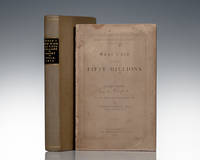
1874147740Philadelphia: J.B. Lippincott & Co 1874. Rare first edition of this satirical novel from popular Virginia physician essayist and author George W. Bagby. Sextodecimo original wrappers. In very good condition. Toning to the wrappers with rubbing to the extremities small losses to the bottom right corner of the front wrapper losses to the spine. Ownership signature and annotation to the front wrapper of P.V. Daniel Jr. son of the Virginia jurist and cousin of John M. Daniel who is the subject of a Bagby essay. Housed in a custom folding chemise and cloth slipcase. George W. Bagby was an American writer humorist and physician best known for his satirical works and his contributions to 19th-century American literature. Born in Virginia Bagby practiced medicine but became more widely recognized for his wit and humor which he often incorporated into his literary output. His most famous work What I Did with My Fifty Millions humorously critiques the nature of sudden wealth and the moral dilemmas associated with it. In addition to his novels Bagby wrote numerous essays short stories and columns often focusing on social and cultural issues of the time. His style is characterized by light-hearted satire and a keen eye for the absurdities of contemporary life. J.B. Lippincott & Co hardcover
1840D17813New York: M. M. Noah & A. S. Gould 1840. First Edition. Hardcover. Good. In his preface Noah discusses the rather mysterious origins of The Book of Jasher. Original cloth worn. In plain modern slipcase. <br/><br/> M. M. Noah & A. S. Gould hardcover books
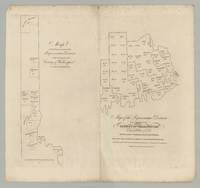
6460Portland ca 1832. Engraving 13.5†x 14.5†sheet size. <p>Previously unrecorded map by Moses Greenleaf of Washington County Maine intended for a never-realized second volume of his Survey of the State of Maine.</p> <br /> <br /> <p>The map is stripped to its essentials showing Washington County and its state-representative districts in outline presumably based on reapportionment following the Census of 1830. The voting population for each town and unincorporated “plantation†is given though only in the northern part of the county at left are their boundaries delineated. Given the map’s purely political purpose Greenleaf has entirely eschewed the topographical detail of his earlier maps of the state. The map’s unfinished appearance suggests it might be an early proof particularly when it is compared with a companion map of York County also produced by Greenleaf at the time and presently known in a single example discussed below.<br /> <br /> <p>Moses Greenleaf</p> <br /> <br /> <p>Greenleaf was a towering figure in the mapping of the state of Maine devoting his life to ever-improved mapping of the region. The pinnacle of his career came in 1829 when he published his new and substantially updated wall map of Maine. This was complemented by a text volume A Survey of the State of Maine and accompanying atlas the first atlas of the state and the third of any state of the Union.</p> <br /> <br /> <p>The map is a remarkable achievement widely heralded but the Survey of the State of Maine is also of the first importance a wide-ranging summation of the present state of Maine particularly valuable for commercial and economic data. Greenleaf however ever the perfectionist acknowledged the deficiencies of the work and announced his intention of issuing a second volume:<br /> “…it was intended to devote some portion of the work to a distinct consideration of the absolute and relative wealth of the State and its different component parts – value and importance of its lands – facilities for – kinds extent and expediency of internal improvements and its general resources; but the time when the publication must be completed was limited and an important part of the materials for these subjects could not be obtained until after this time. It was thought better therefore to omit their introduction altogether for the present; in the hope that circumstances will permit at a future time a more extended notice of them and under greater advantages for useful results than was possible at present.†Preface to A Survey of the State of Maine<br /> <br /> <p>The largest single handicap to Greenleaf’s career was simply that the market for high-quality maps of Maine was too small for his projects to be commercially viable. Consider for example the 1829 wall map text volume and atlas which had cost him six years of his time and more than $12000 out of pocket for surveys engraving printing &c. He had 565 sets printed and offered by advance subscription at $16 a set but by early 1830 barely 100 of these had been sold. At this point though only after much debate the State rescued him by stepping in and purchased 400 sets at the full subscription price.<br /> <br /> <p>Seemingly undeterred by the parlous financial prospects of the project and by the number of sets still in circulation Greenleaf continued to work on improving his materials. In 1832 he republished the wall-map of Maine but very few examples of that printing can be traced. In parallel our map and the companion map of York County mentioned earlier are the only known evidence that Greenleaf started work on his projected second volume of the Survey of the State of Maine Although there might be reference amongst the papers in the Moses Greenleaf archive in the Maine State Archives. Unfortunately the volume was never completed – and it may not even have advanced very far – possibly due to Greenleaf’s financial struggles but certainly ending with Greenleaf’s death on March 20 1834 aged fifty-six.<br /> <br /> <p>Rarity and references</p> <br /> <br /> <p>We are aware of an example recently acquired by the Osher Map Library but the map is absolutely unrecorded in the general bibliographic literature the specialized biographical and bibliographical literature on Greenleaf and the mapping of Maine and the standard databases for the antiquarian market. It must be noted however that we acquired five examples in a large lot of Greenleaf material purchased by a third party at a Vermont auction in 2020.</p> <br /> <br /> <p>Not in OCLC; Phillips Maps of America; Walter Macdougall Settling the Maine Wilderness Wilderness – Moses Greenleaf His Maps and His Household of Faith 1777-1834 2006; Edgar Crosby Smith Moses Greenleaf Maine’s first map-maker a biography … also a bibliography of the maps of Maine 1903; Edward Thompson Important Maine Maps Books Prints and Ephemera 2003; or Thompson Printed Maps of the District and State of Maine 1793-1860 2010. Neither Antique Map Price Record nor Rare Book Hub show any record of the map having appeared on the antiquarian market. Macdougall Smith and Thompson all provided useful background on Greenleaf and his work.</p> <br /> <br /> <p>It is also worth noting that Greenleaf’s companion map of the representative districts of York County see Thompson Printed Maps of the District and State of Maine p.96 is recorded in but a single example in the Benton L. Hatch Collection in the University of Maine’s Fogler Library Special Collections See Thompson Printed Maps of the District and State of Maine pp. 96-97. Hatch was Associate Librarian for Special Collections at the University of Massachusetts who built a substantial collection of material on the history of Maine and Massachusetts. In view of his lifetime interest it seems likely that given the opportunity he would have acquired any others of the series he encountered.</p> <br /> <br /> <p>Appendix: An accounting of Greenleaf’s 1829 project</p> <br /> <br /> <p>A rough balance sheet for the 1829 publications can be reconstructed from contemporary documents. The wall-map and text volume with atlas were offered by advance subscription at $16 a set. A report of proceedings in the state legislature recorded that “It appears that Mr. G. was induced by encouragement from the Legislature to extend his original plan and incur great additional expense in order to present a work more valuable to the state. The engraving printing &c. cost $8351 81 surveys &c. about 4000 and Mr. G has devoted more than 6 years of his time to the work. The Legislature of 1828 granted $1000 to aid him in his labors. 565 copies were printed of which 458 remain unsold.†Hallowell American Advocate February 27 1830.</p> <br /> <br /> <p>A second report estimated that Greenleaf’s personal contribution be valued at $9000 Portland Christian Monitor February 25 1830. This gives as a rough guide income of $2700 against an actual cost of $12350 or a notional cost of $21350. In view of the scale of the loss Greenleaf made an appeal for relief submitting a lengthy memorial in January 1830 Maine State Archives. After much debate in the legislature it was agreed that the state would purchase 400 sets at the subscription price of $16 and the state would give Greenleaf a “a notice for $2000 redeemable in no longer time than 15 years and to be paid out of the proceeds of the Public Lands†Portland Eastern Argus February 26 1830. While the Maine government acted partly out of realization of a debt of honor to Greenleaf there was also a general feeling that the success of Greenleaf’s mapping project would bring all manner of benefits not least in driving land sales by the state. However the state also ended up with more copies than it could use so there was a heavy drive to sell sets to the school districts in particular and offices and officers of state at Washington Hallowell American Advocate January 21 1832 but also to gift sets to to Maine’s representatives in Congress to all the other states and so on.</p> <br /> <br /> <p>CONDITION: Very good light foxing and creasing small hole in maring at top of vertical fold.</p> <br /> <br /> <p>Offered in partnership with Boston Rare Maps.</p> [Portland, ca 1832] unknown
179553585Erlangen: Printed by Christian Karl Gottlieb Kunstmann 1795. First edition. Hardcover. Very good condition. Elephant Folio. Unpaginated 10pp. Bound in dark half leather over light brown leather with gilt lettering and ruling on spine. Title page with engraved vignette. Engraved headpieces for both first pages in Hebrew and German. Engraved endpieces as above. Text printed in Hebrew and German throughout on facing pages.<br /> <br /> The hymn praises peace and the treaty alongwith the prudence of King Friedrich Wilhelm was sung by Moses Hochheimer Rabbi in Ansbach. It was printed by Christian Karl Gottlieb in Erlangen. This peace treaty between France and Prussia was rectified on April 5 1795 in Basel and was the first of three treaties that established France as the dominant power in Europe in effect breaking up the First Coalition. France was represented by François de Barthélemy Prussia by Karl August von Hardenberg. Minor wear to binding. Pages somewhat age-toned with some creasing small chips along edges and some light foxing. Printed by Christian Karl Gottlieb Kunstmann hardcover
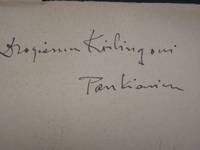
193629494Warszawie Warsaw: M. Arct 1936. Fine. M. Arct Warszawie Warsaw 1936 18 x 25.50 cm broché M. Arct Warszawie 1936 18 x 255 cm in original wrappers First edition. Rare handwritten inscription from Josef Pankiewicz to Moïse Kisling. Illustrations. Three light minor snags at the top of the spine tiny marginal tears without pieces missing at the top of the first board otherwise pleasant copy. In 1906 Pankiewicz was appointed professor at the Academy of Fine Arts in Krakow. Notably one of his pupils was Moïse Kisling whom he encouraged to abandon sculpture in favor of painting. He introduced the young man to French painting and more specifically Cézanne and Renoir. In 1910 on the advice of his mentor Kisling aged nineteen years old left Poland for Paris where he quickly became a significant figure of Parisian artistic life. M. Arct unknown
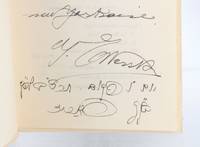
193289945Paris: Georges Crès coll. ""Les oeuvres représentatives"" 1932. Fine. Georges Crès coll. ""Les oeuvres représentatives"" Paris 1932 12 x 19 cm Broché First edition one of 50 numbered copies on alfa only deluxe copies. Some light foxing mainly on the endpapers. Rare signed presentation copy in French: To my friend René Jasinski in token of gratitude and friendship these few scenes of Jewish life in New York. T. Twersky with a sentence in Hebrew translated by the author in French on a laid-in leaf: Translation of the Hebrew inscription: sixth day of the week Pekoudè year 5692 since the creation of the world in the holy community of Paris Friday 4 March 1932 according to our calculation. Twersky was the main informant of the Tharaud brothers unknowingly and much to his dismay becoming the source of the Jewish information channel filon juif exploited by the two writers who transformed the picturesque recollections of this son of a Ukrainian rabbi into the raw material for their antisemitic narratives. Born in Ukraine around 1880 Moïse Twersky was the son of a Hasidic rabbi of the Tzadik line miracle-working rabbis who exercised spiritual and judicial authority over vast Jewish communities in Eastern Europe. His father regarded as a descendant of King David owned a silver throne and presided every Sabbath over banquets of 250 guests. Unwilling to follow in his fathers footsteps the young Moïse developed a passion for forbidden books and discovered modern science. Rejecting what he came to see as an exploitation of popular credulity he resolved to become a chemist. At sixteen he was married without his consent according to tradition to a thirteen-year-old daughter of a Romanian rabbi. Against all odds he fell in love with her and was forcibly separated from her when his in-laws discovered his heretical readings. Twersky studied chemistry in Brussels then emigrated to the United States where he lived in dire poverty. He worked for a time in a canning factory where he burned his hands from the salt from the intestines he handled daily. The circumstances of his return to Europe remain obscure. Inspired by his American experience Israël à New York offers a rare and valuable record of his life in America and of the living conditions of Jewish immigrants. Upon his arrival in Paris he befriended the Tharaud brothers and through his erudition and generous sharing of the folklore of his origins became the unwitting instrument of their antisemitic propaganda - on which he cast both a critical and affectionate gaze. In 1940 devastated by the victory of Nazi Germany and on the very day the Germans entered Paris Moïse Twersky took his own life in his apartment on rue Oudry. The recipient of Israël à New York the literary historian René Jasinski was a Polish immigrant who had fled the repression following the Springtime of Nations"" and had become professor at the Sorbonne. He did not make the same tragic choice as his friend. He again chose to resist the oppressor fighting with the FFI during the Liberation of Paris. In 1953 he was appointed to Harvard University and returned to the United States and spent the rest of his life in Cambridge. A highly desirable deluxe presentation copy of this rare philosemitic work from the interwar period by a colourful author who might have stepped straight out of an Albert Cohen novel. Almost no documentation survives about this Solal son of a Mangeclou unknowingly at the heart of the literary stigmatization of French Jews before becoming one of the first victims of Nazi Occupation. Georges Crès, coll. ""Les oeuvres représentatives"" unknown
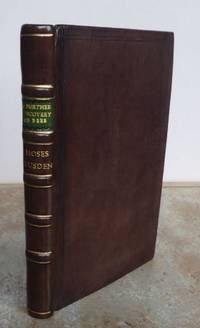
167952434<p>London printed for the author and are to be sold at his house next the sign of the Kings Arms in the Bowling-Alley near the Abby in Westminster: and by Henry Million bookseller at the Bible in the Old-Bayley 1679. TITLE CONTINUED: Also proper directions to all such as keep bees as well to prevent their robbing in straw-hives as their killing in the colonies. By Moses Rusden an apothecary; bee-master to the Kings most excellent Majesty. Published by His Majesties especial command and approved by the Royal Society at Gresham Coll. FIRST EDITION 1679. Small 8vo approximately 170 x 95 mm 6½ x 4 inches engraved frontispiece by Henry Million 3 folding plates pages: 24 1-144 last page blank rebound in full modern calf gilt lettered green label author's gilt name and gilt rules to spine between raised bands new brown endpapers. Neat vertical repair to inner margin on blank side of frontispiece with pale browning to foot title page and frontispiece lightly dusty old ink name to top of title page 2 outer margins neatly replaced 1 outer margin slightly trimmed varying pale brown staining some with tide mark to lower part of pages 81-100 all text legible see attached images 1 corner neatly repaired pale age-browning to margins a few margins lightly soiled not affecting text old ink stain to first pastedown and small ink splash to last free endpaper 2 leaves lightly dusty. A good copy with some minor repairs and staining. Moses Rusden was appointed Beemaster to the King at the instigation of John Evelyn who had a copy of this title in his library. Rusden firmly believed that a hive was led by a King and not a Queen. In 1679 Rusden improved Geddie's hive and put a frame in it for the bees to fasten their combs upon. See: British Bee Books A Bibliography 1500-1976 page 61 No. 55; Walker Catalogue of Bee Books page 61; Geoffrey Keynes John Evelyn A Study in Bibliophily page 300 No. 83; ESTC R11920. MORE IMAGES ATTACHED TO THIS LISTING ALL ZOOMABLE FURTHER IMAGES ON REQUEST. POSTAGE AT COST.</p> London, printed for the author, and are to be sold at his house next the sign of the Kings Arms in the Bowling-Alley, near the hardcover
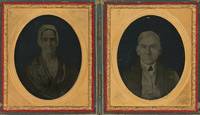
1854List1708Philadelphia 1854. Ninth plate ambrotypes in a union case measuring 2 ½ x 2 ⅛ inches visible in larger case. With the identification of Isaac Rehn with his imprint and “Patented July 4 & 11 1854†imprinted on the case. A fine pair. A striking pair of ambrotypes of Mary and Moses Pennock who were members of the Kennett Square Underground Railroad network as well as active members of the Kennett Square abolitionist and Quaker community. Moses was one of the founders of the Longwood Progressive Meeting. In R.C. Smedley’s History of the Underground Railroad in Chester and Neighboring Counties of Pennsylvania Lancaster Office of the Journal 1883 the Pennocks are mentioned on p. 301 as working as part of the network surrounding Isaac and Thamazine Meredity. Their son Samuel who would go on to secure important agricultural patents is also mentioned twice. <br /> <br /> The images are notable from a photographic history perspective as well as being early examples of the ambrotype process that had been patented in part by fellow Quaker and spiritualist Isaac Rehn. Rehn held a partial patent on ambrotypes along with James Ambrose Cutting of Boston and became unpopular among other photographers for his efforts to extend his patent. He later practiced spiritual photography and was a Professor of Chemistry at Pennsylvania Medical University in Philadelphia. Rehn was also involved in radical politics as a founder and leader of the Philadelphia section of the International Workingmen’s Association which was later disenfranchised by Karl Marx along with several other American sections. Examples of Rehn’s work are held at the National Gallery of Art the Library Company of Philadelphia and Yale’s Sterling Memorial Library. <br /> <br /> Overall a very fine and significant pair of images. unknown
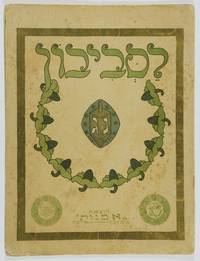
192052932Moscow/Odessa: Omanut 1920. First edition. Softcover. g- to vg. Large quarto. Unpaginated 8 double-sided leaves front and back wrappers printed on both sides. Stiff tan paper wrappers with beautiful chromolithographic illustrations in hues of green blue red and gold. Issued by the pioneering Hebrew-language published house Omanut.<br /> <br /> This lavishly illustrated work contains the Hanukkah poem "For the Dreidel" written by acclaimed Hebrew-language poet Zalman Shneour 1887-1959 although the author is uncredited here. The text is accompanied throughout by 8 large and vibrant chromolithographic images including the front and back wrappers many with over-painting in lustrous metallic hues of silver and gold. Whenever the Dreidel appears it is in silver. The illustrations are credited collectively to "Havurat Tsayarim" The Group of Painters a group of four young artists from the Odessa Art Academy who illustrated works for Omanut during the period comprised of Yakov Apter 1899-1941 Moses Mutselmakher 1900-1961 Aaron Keravatsov 1896-1942 and Efim Khiger 1899-1955.<br /> <br /> This work is part of the Gamliel Library series of beautiful picture books for children introduced by Omanut co-founder Shoshana Zlatopolsky Persitz and named after her son Gamliel. Persitz took inspiration from the rich tradition of Russian children's literature lavishly illustrated in chromolithographs produced by the likes of Ivan Bilibin and the publishing house of Iosif Knebel to create some of the earliest examples of comparable works in Hebrew. No publication date is given but the fact that this is one of a smaller number of earlier titles issued before the move of the publisher Omanut to Frankfurt points to the fact it could not have been published after 1921.<br /> <br /> Text throughout in Hebrew.<br /> <br /> Front wrapper foxed and lightly water-stained with some additional minor staining to the back wrappers. Light rubbing chipping and/or creasing to extremities. Leaves disbound. Interior images and text overall still quite clean and vibrant with a few minor to light stains and/or smudges along the bottom margins of a few leaves. Ex-library ink stamps at the bottom of the first and last text pages as well as the back wrapper. Wrappers in good- interior in very good condition overall. Hebrew title: לסביבון <br /> Author/contributors: חבורת-×¦×™×¨×™× ×פטר מוצלמכר קרבצוב חגר זלמן ×©× ×™×ור<br /> Publication: מוסקבה-×ודיסה הוצ×ת ××ž× ×•×ª<br /> Series title: ספריה גמלי×ל<br /> Alternate transliteration: L'Sevivon<br /> <br /> This first edition is quite scarce with OCLC listing only two holdings worldwide. A slightly more common second edition of the work was published in 1922 after Omanut had moved to Frankfurt.<br /> <br /> Bibliographic reference: Ayala Gordon Hebrew Illustrations 2005 p.89-116. Omanut unknown
1765N4664Frankfurt & Berlin: J.J. Speier 1765. First Edition . Half Leather. Very Good. 4to. 1. Theil und 2. Theil bound together. 124pp123pp.First part called "'Ir Heshbon" on Arithmetic and Algebra; the second part : "Berure Middot" on Geometry. MODERN HALF LEATHER BINDING WITH MARBLED BOARDS. Title page with stamp some old handwriting and markings. Upper corner of title page some 3 cm missing and replaced with old repair. Pages with some browning and occasional minor soiling. First pages of the second part trimmrd to text. Last page of the second part with repair to edges End papers with some old writing and minor soiling . OTHERWISE VERY GOOD.AN EXTREMELY RARE AND INTERESTING WORK of MATHEMATICS in HEBREW. this work is mentioned in Zeitlkin Bibliotheca Hebraica.- Elijah ben Moses Gershon Zahalon was a Jewish Talmudist mathematician and physician living in Pinczcow Russian Poland. <br/> <br/> J.J. Speier hardcover
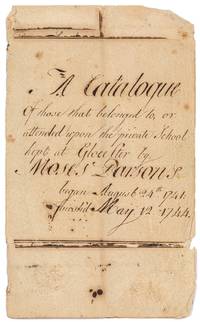
1741560322Gloucester Massachusetts 1741. Softcover. Very Good. Manuscript. 24mo. Three quarter leaves pinned inside two outer full leaves measuring about 3 ½†x 6â€. One quarter leaf is loose laid-in. The full front cover leaf titled in manuscript is trimmed above the title and has one horizontal cut below the title very good. The three-quarter leaves list the names of students 75 boys and 13 girls in ink on the rectos and versos. Born in Gloucester Massachusetts in 1716 Moses Parsons graduated from Harvard in 1736 and while pursuing his theological studies he taught a private school in his native town as noted in the catalogue from 1741-44. In 1744 he accepted a call to Byfield Parish where he was distinguished as a preacher until his death in 1783 having seen the Church through the Great Awakening led by George Whitefield and through the Revolutionary War. At his school Parsons taught a veritable Who’s Who of early Gloucester residents – individual and family names such as Winthrop Sargent whose son was a prominent patriot and Governor of the Mississippi Territory William Ellery Nathaniel Haraden whose son served as the Sailing Master of the U.S.S. Constitution and many others. In addition to his pastoral responsibilities at Byfield Parsons was instrumental in founding Governor Dummer Academy now known as The Governor’s Academy. During his tenure at his private school Parson’s calculates that he taught 75 boys and 28 girls quite a few of whom would go on to be immortalized by Gloucester historians John Babson and James Pringle. An important early manuscript documenting an overlooked piece of Gloucester’s local history.<br /> <br /> Reference: William Cutter. Genealogical and Personal Memoirs Relating to the Families of the State of Massachusetts. unknown
1830elala1667London: 1830. 1830. oblong folio. 6 aquatint plates. original wrs. front wr. with engraved title some soiling & creases to wrs. short tears at spine edge some light foxing. First Edition. Experimental squadrons were trials conducted of the sea-worthiness and performance of sailing vessels in various types of seas and winds which often led to improvements or alterations in ship design. The Columbine an 18-gun corvette constructed by Sir William Symonds 1782-1856 by the end of 1825 "proved a decided success during the experimental cruise of 1827" DNB. As surveyor of the navy from 1832 to 1847 Symonds built over 200 ships and introduced important innovations in ship design including elliptical sterns. In 1836 he was knighted for his services. 1st Edition. [London: 1830]. unknown
1825000613Tompkins Delaware DE. Good in Fair dust jacket. 1825. Full-Leather. On offer is a remarkable historical journal with many dates the earliest of which is 1825. It begins with the heading: "A bill of the Delawrae River" and lists what research suggests to be stops and business along the the Delaware River waterway. There are hundreds of names with the dates and amounts collected from each individual. Some coded references. There are also mentions of loans the nature of the loans and when satisfied. Though a primitive work there are numerous references to Moses L. Ogden as his family was prominent to the Delaware area from pre-Revolutionary times. We believe besides some mentions of the lumber purchases and sales that Mr. Ogden collected taxes. Delaware historians will have a grand time completing the research on this journal. Book measures 4" x 6.5" is leatherbound very dry and the inner pages are linen. Overall condition is good. Most of the 34 leaves are clean and clear some age-toning. ; Manuscript; 24mo - over 5" - 5¾" tall; HANDWRITTEN MANUSCRIPT DOCUMENT LETTER AUTOGRAPH DIARY JOURNAL LOG KEEPSAKE WRITER HAND WRITTEN DOCUMENTS SIGNED LETTERS MANUSCRIPTS HISTORICAL HOLOGRAPH WRITERS DIARIES JOURNALS LOGS AUTOGRAPHS PERSONAL MEMOIR MEMORIAL PERSONAL HISTORY AMERICANA CANALS CANAL LIFTS LOCKS NAVAL WATER RIVERS PORTS BOATING TIDES MARYLAND DELAWARE RIVER DE MD TAXES LEDGER . hardcover
1973C84794Harry N. Abrams Inc. As New. 1973. Hardcover. 0810901668 . FREE UPGRADE to Courier/Priority Shipping Upon Request - IN STOCK AND IMMEDIATELY AVAILABLE FOR SHIPMENT - AS NEW THE TEXT BLOCK IS PRISTINE CLEAN UNMARKED AND IN EXCELLENT CONDITION - - 357 pages 253 illustrations; 4to oblong. Anna Mary Robertson Moses Catalogue Raisonne Catalog Raisonné Complete Works Life and Work Raisonnee -- with a bonus offer-- - May be EITHER: out of print OOP and extremely rare in this pristine condition; signed by author or contributor; or a first or special edition; inquire for details . Harry N. Abrams, Inc. hardcover
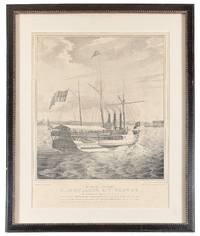
182842606Boston: Pendleton's Lithography 1828. Uncoloured lithograph. Framed size: 19 1/4 x 15 5/8 inches. An early American marine lithograph depicting the steam packet Chancellor Livingston entering Newport Harbor issued at the outset of steam navigation on the New England coast.<br/> <br/> Published in Boston by Pendleton's Lithography after a design by Moses Swett this print presents the Chancellor Livingston under way as it enters Newport Harbor with passengers visible along the decks and flags flying from the rigging. The composition combines a detailed vessel portrait with a wider harbour view situating the steamer within a recognizable coastal setting and emphasizing both its scale and activity. The vessel itself held a prominent place in early American steam navigation. Originally associated with Robert Fulton's Hudson River operations the Chancellor Livingston was rebuilt in 1827 for service between New York and Providence. The lithograph records this later phase of its career when coastal steam travel was expanding rapidly and such vessels were becoming a familiar presence along the northeastern seaboard. The printed text beneath the image reinforces the promotional aspect of the print listing the vessel's dimensions horsepower boilers and fittings as well as its passenger capacity and accommodations. This combination of technical specification and visual representation places the image at the intersection of ship portraiture and commercial advertisement reflecting the contemporary interest in steam technology and its practical advantages. As a product of Pendleton's Lithography the print also belongs to the earliest phase of lithographic production in the United States. Established in Boston in the 1820s the firm was among the first to adopt the medium on a sustained basis and works such as this illustrate both the technical possibilities of lithography and its application to subjects of current interest. The present impression reflects that early moment when lithography was emerging as a flexible and effective means of producing images of modern life and technology. Pendleton's Lithography unknown
193629494M. Arct | Warszawie 1936 | 18 x 25.50 cm | broché
193289945Georges Crès, coll. "Les oeuvres représentatives" | Paris 1932 | 12 x 19 cm | Broché
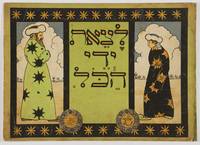
192052940Moscow/Odessa: Omanut 1920. First edition. Softcover. g- to g. Oblong octavo. Unpaginated 8 double-sided leaves front and back wrappers printed on both sides. Stiff tan paper wrappers with beautiful chromolithographic illustrations in hues of green blue black and brown. Issued by the pioneering Hebrew-language published house Omanut.<br /> <br /> This lavishly illustrated work is a version of the Aesop's fable often known as "The Miller His Son and the Donkey" in a version said to have been adapted by Leo Tolstoy with Hebrew translation attributed to the acclaimed Hebrew-language writer and essayist Ahad Ha-Am Asher Zvi Ginsberg 1856-1957 although the work is completely uncredited. Here the work's title has been humorously translated into Hebrew as "To Please Everyone". The text is accompanied throughout by 8 large and vibrant chromolithographic images including the front and back wrappers. The illustrations are credited collectively to "Havurat Tsayarim" The Group of Painters a group of four young artists from the Odessa Art Academy who illustrated works for Omanut during the period comprised of Yakov Apter 1899-1941 Moses Mutselmakher 1900-1961 Aaron Keravatsov 1896-1942 and Efim Khiger 1899-1955.<br /> <br /> This work is part of the Gamliel Library series of beautiful picture books for children introduced by Omanut co-founder Shoshana Zlatopolsky Persitz and named after her son Gamliel. Persitz took inspiration from the rich tradition of Russian children's literature lavishly illustrated in chromolithographs produced by the likes of Ivan Bilibin and the publishing house of Iosif Knebel to create some of the earliest examples of comparable works in Hebrew. No publication date is given but the fact that this is one of a smaller number of earlier titles issued before the move of the publisher Omanut to Frankfurt points to the fact it could not have been published after 1921.<br /> <br /> Text throughout in Hebrew.<br /> <br /> Wrappers with some foxing and staining. Some rubbing and creasing to extremities. Back cover lightly soiled with a light vertical crease in the center. The binding has been re-cased with a sting-binding along the spine to secure the book block. Water staining and light foxing to pages throughout predominantly in the margins. Images still vibrant. Wrappers in good- interior in good condition overall. Quite scarce. Hebrew title: ‌לצ×ת ידי הכל<br /> Author/contributors: חבורת-×¦×™×¨×™× ×פטר מוצלמכר קרבצוב חגר ×יזופוס לב טולסטוי ×חד ×”×¢×<br /> Publication: מוסקבה-×ודיסה הוצ×ת ××ž× ×•×ª<br /> Series title: ספריה גמלי×ל<br /> Alternate transliteration: La'tset Yede Ha'kol. Omanut unknown
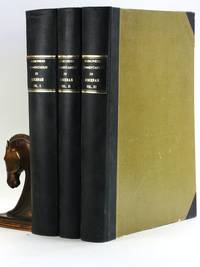
19567237Ejnar Munksgaard 1956. Leather. VERY GOOD. Complete facsimile of the autograph original in three volumes: v. 1 Introductio. Zeraim et Moed v.2. Naschim et Zeziqim pars I v.3. Neziqim pars II et Qodaschim. Vol. 1: 56 pp. LXI plates from left 416 pp. from right; Vol. 2 380 pp. from right; Vol 3: 29 2 XVII plates from left 2 381-784 pp from right. Folio half black calf over olive green finished paper over boards black calf labels with gilt lettered and ruled titles tan endpapers sepia tone plates. Publisher's reinforced binding. Some rubbing to covers text very clean and sharp binding tight. The magnum opus of the preeminent scholar in post-Talmudic Judaism. The survival of Maimonides autograph original in the Cairo Geniza is one of the great wonders of intellectual and religious history. "No praise can be too high for the outer form of his works both in language and logical method. The Mishneh Torah was the only work which he wrote in Hebrew and the language is superb clear and succinct. . The Mishneh Torah is a model of logical sequence and studied method each chapter and each paragraph coming in natural sequence to its preceeding one." In 14 subdivisions Maimonides classifies "by subject matter the entire talmudic and post-talmudic halakhic literature in a systematic manner never before attempted in the history of Judaism." While ostensibly a strictly halakhic compendium the work allows for natural excurses on the many facets of Maimonides's broad learning including Medicine Philosophy Civil Law and refutations of Islamic and Christian theology. The very splendor of this work was itself the main concern of its critics who worried that "the architectural beauty of its structure its logical arrangement and ready-reference nature . would turn students away from the study of the Talmud and commentaries." Encyclopedia Judaica. Ejnar Munksgaard unknown
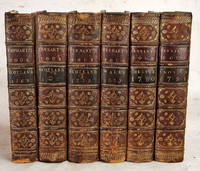
17762307070032London: Printed for Benjamin White; John Monk; Henry Hughes; 1776 - 1782 1776. Hardcover. Very Good. An Illustrated Tour of 18th century Britain 6 volume set. Quartos 24 x 18 cm. Handsomely bound in uniform contemporary polished calf. 6 gilt spine compartments. Minor cracks to joints. Includes fold out map and illustrations. Detailed list of Contents: v.1. A Tour in Scotland. 1769 B. White 1776. Folding engraved map at front engraved title with vignette 42 engraved plates. 4th ed; v.2. A Tour in Scotland. 1772 B. White 1776. Folding engraved map at front engraved title with vignette 47 engraved plates; v.3. A Tour in Scotland and Voyage to the Hebrides. John Monk 1774. Engraved title with vignette 44 engraved plates; v.4. A Tour in Wales. 1773 H. Hughes 1778. Engraved title with vignette 26 engraved plates; v.5. Touring to Snowdon. H. Hughes 1781. Engraved title with vignette 36 engraved plates 2 engraved vignettes in text; v.6. Touring from Chester to London. B. White 1782. Engraved title with vignette 22 engraved plates. <br> Thomas Pennant 1726-1798 was a Welsh naturalist traveler zoologist and antiquarian. Pennant is most known for his works on British Zoology and the History of Quadrupeds. For his contributions to natural science he was admitted to the Royal Society. His travel books predated Samuel Johnson's and influenced his writing. Significantly Pennant's travels helped popularize Scotland to British travelers and provide a valuable insight into the land during this period. <br> "Pennant's travels and natural history are distinguished by his personal energy a keen observational sense and by methodological organization and attention to facts. In such ways and in his friendship and widespread correspondence with others of like interests throughout Britain and Europe he may be said to exemplify those gentleman scholars of nature in the later eighteenth century whose interests in natural knowledge aimed at national improvement through intellectual enquiry." - DNB. In 1771 Pennant published his 'Tour in Scotland' describing the journey made by him in 1769. He says he had 'the hardihood to venture on a journey to the remotest part of North Britain' of which he brought home an account so favourable that 'it has ever since been inondee with southern visitors'. Starting from Chester on 26 June 1769 Pennant visited the Fern Islands off the Northumbrian coast and noted many species of sea-fowl that resorted thither. He made nearly the circuit of the mainland of Scotland observing manners and customs and natural history. On this occasion as on all subsequent tours he journeyed on horseback and kept an elaborate journal. The success of the 'Tour in Scotland' led to his undertaking a second Scottish journey beginning on 18 May 1772. He visited the English lakes proceeded to the Hebrides and was presented with the freedom of Edinburgh. Moses Griffith q. v. the Welsh artist attended him on this journey as also on his later tours making sketches and drawings afterwards reproduced in Pennant's published 'Tours.' Pennant made tours in various parts of England including Northamptonshire 1774 Warwickshire 1776 Kent 1777 Cornwall 1787. As the outcome of several journeys in Wales he published his 'Tour in Wales' the first volume appearing in 1778." - Warwick William Wroth DNB v.44 p. 320-322. London: Printed for Benjamin White; John Monk; Henry Hughes; 1776 - 1782 hardcover
1661116711Leiden: Jean Elsevier 1661. Iron Arm First edition of the first significant - and conspicuously scarce - biography of the "Huguenot paladin" François de La Noue 1531-1591 one of the great Protestant captains of the 16th-century Wars of Religion; an attractive copy with an appealing naval provenance. The distinguished American historian John Lothrop Motley described La Noue as "not only one of the most experienced soldiers but one of the most accomplished writers of his age" Motley p. 480. At the siege of Fontenay in 1570 his left arm was shattered by a bullet and a mechanic fitted an iron limb that earned him the sobriquet of "Bras-de-fer" - "Iron Arm". He was a correspondent of Sir Philip Sidney and acknowledged by Montaigne in the Essais "for his goodness gentleness of manner and scrupulous courtesy. He is an important figure with regard to his political and religious affiliations as well as with regard to his Discours politiques et militaires 1587" Heitsch p. 134. The author Moïse Amyraut 1596-1664 was one of the leading French Protestant theologians of his day who numbered William Penn among his many students. The book is decidedly uncommon commercially and thinly represented institutionally: Library Hub cites 10 copies in British and Irish institutional libraries we have also located a copy at the Royal Collection; WorldCat locates no copies outside of European libraries. Provenance: armorial Elden Hall bookplate of Augustus Viscount Keppel 1725-1786 naval officer and politician: "a sailor from the age of 10 Keppel served actively throughout the Seven Years War 1756-63. In 1762 he served under Admiral Sir George Pocock in the British expedition that took Havana and he received £25000 in prize money as a result. He became a rear admiral in 1762 and vice admiral in 1770" Encyclopaedia Britannica online. ODNB describes him as an "outstanding" naval officer "especially in combined operations". Also with the 20th-century bookplate of Robert J. Hayhurst Lancashire retail chemist and bibliophile whose main library of naval history was complemented by a subsidiary collection of 18th-century literature in well-preserved contemporary bindings. Small quarto 190 x 144 mm. With 2 folding genealogical tables; Elsevir's device on title page. Early 18th-century English speckled calf decorative gilt spine with red morocco label red speckled edges. Head of spine chipped front joint split but sound corners a little worn one or two slight scrapes or abrasions. A very good copy. STC French A426. Dorothea B. Heitsch Practising Reform in Montaigne's Essais 2000; John Lothrop Motley The Rise of the Dutch Republic vol. III 1855. unknown
186436882np 1864. 4to. Written in ink and signed at the end by Royce on the verso of a single leaf. Several small holes text unaffected a few closed tears two archival tape repairs. Very Good. <br /> <br /> This unusual insightful document illuminates the laws of war applicable to the Civil War. Royce's Petition seeks justice for Confederate Captain Frank R. Gurley. Royce sent it to the Confederate Commission of Exchange. Its author Confederate Captain Moses Strong Royce was captured in Tennessee and imprisoned at Nashville. Gurley Royce's cell-mate had killed Union General Robert McCook of Ohio near Huntsville Alabama in August 1862. <br /> In October 1863 Union forces captured Gurley and charged him with murdering McCook. Gurley Union officials claimed was a guerrilla who shot McCook while the General was lying in an ambulance. Southerners claimed that Gurley was not a guerrilla but a regular soldier in the Confederacy's 4th Alabama Cavalry; and that he killed McCook according to the laws of war. <br /> Harper's Weekly and Frank Leslie's Illustrated Newspaper fanned the flames claiming that lawless Confederate guerrillas murdered the general; feelings ran high. "US General Grant wrote CS General Hardee in December of 1863 and said that although Gurley was a member of the Confederate army that did not preclude him from being tried for having committed a foul murder" online Huntsville-Madison County Public Library essay 'Frank B. Gurley's 1866 Diary'.<br /> Having escaped from prison in March 1864 Royce pleads Gurley's case. "He was confined in a cell for sixty-eight days and allowed only about one hour a day for exercise and was put upon trial for the killing of Genl. McCook. He was obliged to employ counsel to defend himself at an expense of 2500 dollars in greenbacks. The evidence produced completely exonerated him of anything like murder and the argument of his counsel was a complete vindication of his right as a soldier and an officer to do all that he did in bringing Genl. McCook to his death. <br /> "When the trial was nearly ended four communications by flag of truce were sent to the court and were there read - one from Lt. Col. Hambrick one from Genl. Forrest one from Genl. Hardee and one from Genl. Johnston" assuring that Gurley was not a guerrilla but a duly enrolled member of the Confederate military forces. Nevertheless Gurley was found guilty and sentenced to death.<br /> "The undersigned believes that if an effort were to be made by the Confederate Commission of Exchange to have Capt. Gurley exchanged the Federal authorities would immediately send him forward for that purpose and as a friend of Capt. Gurley the undersigned respectfully requests General Johnston to use his influence in procuring the exchange of Capt. Gurley. Respectfully submitted M. S. Royce." <br /> Even after War's end the dispute continued. Gurley having been released from prison in an administrative snafu was re-arrested charged but finally released and placed on parole in April 1866. unknown
SAV153Hardcover. Good. Italy possibly Piedmont 17th century. 181 leaves 96 x 140mm. A pocket-sized copybook written in a uniform italic script in brown ink recto only on laid paper. Each page with double ruled border framing Latin verse lines from De rebus gestis Alexandri Magni The Life and Exploits of Alexander the Great by Quintus Curtius Rufus with Italian translation and proverbial sayings in Italian on miscellaneous subjects signed intermittently Il Zangrandi or Gioseppe Zangrandi. Oblong contemporary sheep over pasteboard; some slight worming mostly at beginning and end some minor chips on spine and back cover otherwise good. Ownership signature of Moses Baruch Carvaglio on the last leaf in Italian Io Moise filgiolo sic di Jacob di Josef Baruch Carvaglio under an anecdotal note in his hand about an incident of extreme cold which froze over the lagoon and parts of the Venetian canal in 1708. <br/><br/>An interesting 17th-century calligraphic copybook of excerpts from the great Roman history of Alexander the Great and with popular sayings written in Italian and Latin once owned by important Venetian Jewish coral merchant Moses Baruch Carvaglio. The regal Alexandrian history "De rebus gestis Alexandri Magni" by Roman historian Quintus Curtius Rufus was much appreciated in Italy during the early modern period. Adaptations for Alexander romances and an incunable tradition was in place from at least the 1470s. The name Il Zangrandi seemingly the writer of this collected verse could be Virgilio Giangrandi 1589-1630 a Piemontese typographer active in Savigliano at the turn of the seventeenth century. References to this printer under the name Il Zangrandi and working with works in Latin verse do exist if only fragmentary. We do know that along with his brother Giovanni Virgilio Giangrandi moved from Milan to Asti in 1588 and their printing company remained in operation until at least 1691. The Zangrandi press was also known to produce religious and biographical works. It is possible Virgilio or an apprentice was in part responsible for creating this eclectic copybook which celebrates portions of the Roman Alexandrian epic and intersperses sayings from his native Italian. An interesting layer to the history of this manuscript is the eighteenth century ownership inscription of Moses Baruch Carvaglio a successful merchant and Jewish man based in Venice. In the 1730s along with his father and brother Moses operated a well-known trade business in coral beads. The Carvaglio family would have been tied to profitable Venetian mercantilism for most of the eighteenth century. The scribal beginnings of this copybook remain mysterious nevertheless two plausible figures from early modern Italy contributed to its creation and care. hardcover books
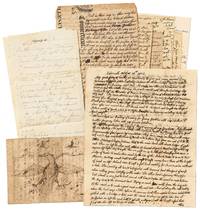
1834436962Connecticut New York Ohio 1834. Very Good. A small archive consisting of one two-page narrative letter and 10 loose sheets about 20 holograph pages of miscellaneous writings by Moses Kimball including one page with pen and ink illustrations. Modest toning and a few tiny tears three manuscript sheets are partially split at the folds including one with a neat Japanese paper tape repair about very good overall.<br /> <br /> Born in Connecticut in 1741 Moses Kimball served in the Revolutionary War as a soldier under Brigadier General Samuel McClellan 1781-82. A devout Universalist he taught navigation and civil engineering and was a prosperous land owner in Norwich Connecticut. The letter and miscellaneous writings of poetry and short sermons retained here date from the last two years of his life when he left Connecticut to live with a grandson in Norwalk Ohio.<br /> <br /> In the letter written to a friend in Connecticut Kimball describes in detail his 15-day journey undertaken in May 1835 from Poquetanuck to Norwalk: He left via sloop for Albany then traveled along the Erie Canal and completed the last leg of the trip by steamer on Lake Erie. In his verse and short sermons he lays out his strong Universalist beliefs and philosophy of life. He died happy at the age of 93 in December 1835 just a few weeks after his arrival in Norwalk.<br /> <br /> A few extracts from the letter together with a sample of his verse follows:<br /> <br /> 1. ALS. 2pp. Small quarto. Norwalk October 14th 1835. Addressed to John Harkness at Preston Connecticut:<br /> <br /> “My good friend having an opportunity to give you some account of my journey to this place I gladly embrace it. It is a beautiful country suitable for farming a rich soil … We have an academy of learning for young gentlemen with 108 scholars and another for young ladies with 98 female scholars . We left Poquetanuck the 11 day of May & arrived at my Grandson Moses Kimball’s the 25 of May. We went in a sloop … to Albany there I saw great improvements … They have made an Island in the river half a mile long … forming a basin between that & the main land with draw bridges at each end. There we left the sloop and entered on board a canal boat and past on our way drawn by horses day and night. Thus we past on up to Little Falls … and so on to Fort Stanwix … there at the height of land we left the Mohawk River and past a flat level country for 60 or 70 miles without a lock. The country all low and intersected with drowned land … and all along this wet country where the land rose a little … there would be some inhabitants settled with a bridge or two over the canal … when we got to Lake Erie at Buffalo we left the canal boat and got into a steam boat the largest vessel that I ever saw … this boat that cost thirty-five thousand dollars my grandson Moses owns one-tenth part … When we came over the lake … there were seven hundred passengers in her … So you see it is no wonder she earns money … .â€<br /> <br /> 2. Miscellaneous Verses and Short Sermons 1834-35:<br /> 10 octavo sheets/about 20 holograph pages including one page with pen and ink illustrations. The following is quoted from a poem written by Kimball on his ninety-third birthday “May 17 A.D. 1834â€:<br /> <br /> This day my years are Ninety-three<br /> The time is past & gone from me<br /> Brought into being here to stay<br /> To wait for time to pass away<br /> … <br /> And when my earthly body dies<br /> To God my spirit will arise<br /> And live with him and there remain<br /> Till Souls to bodies join again …<br /> <br /> A compelling and historically important small archive of writings that also serve as a testament to Kimball’s remarkable physical health and mental acuity. unknown
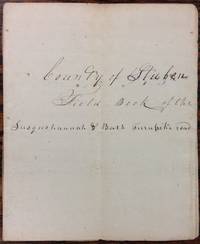
1805BOOKS288628--/No Dustjacket. 1805. 8vo. self wraps 6 leaves. A survey beginning at an oak tree on the line of Tioga County. This is for mile 82 going west to mile 104 and to a post in Morris Street in Bath. The ink records on 6 pages show Bearings Distance and Remarks. Most of the remarks are from trees. This is certified by Moses Van Campen and T. N. Miller Commissioners on August 30th. 1805. . paperback