MOSES SEIXASABAA
372 résultats
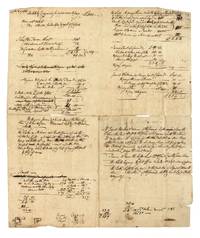
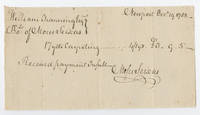
178825418<p>Seixas' 1790 letter of welcome elicited the first president's most compelling statement on religious liberty "to bigotry no sanction." In this 1788 receipt Seixas signs a receipt documenting payment for carpet by William Channing the state's new attorney general.</p> <b>MOSES SEIXAS.</b>Manuscript Document Signed to William Channing December 18 1788. Receipt for carpeting. 1 p. 7¼ x 4 in.<p><b><br /></b></p><p><b>Complete Transcript</b></p><p> <i>Newport Dec<u>r</u> 19 1788</i></p><p><i>William Channing Esq</i></p><p><i>Bo<u>t</u></i> Bought <i>of Moses Seixas / 17 yds Carpeting . . . . . . . . . . .4/1 yd. £3.9. 5.</i></p><p><i>Received payment In full /</i></p><p> <i>Moses Seixas</i></p><p>Docketing on verso in another hand: <i>Moses Seixas</i></p><p><b>Moses Mendes Seixas</b> 1744-1809 was born in New York into a Jewish family. His father immigrated from Portugal to New York about 1730 and became a merchant. The family moved to Newport Rhode Island in 1765. Moses Seixas married Jochebed Levy in 1770 and they had eight children. He was one of the organizers and first cashier of the Bank of Rhode Island which conducted business in his house until 1818. After the British occupied Newport during the Revolutionary War Seixas remained in Newport but was among the signers of a document supporting the patriot cause. In 1790 he was the president of the Congregation Yeshuat Israel later Touro Synagogue in Newport. He was also a charter member and first grand master of St. John's Lodge of Free and Accepted Masons in Newport.</p><p><b>William Channing</b> 1751-1793 was born in Newport Rhode Island and graduated from the College of New Jersey Princeton in 1769. In 1773 he married Lucy Ellery daughter of William Ellery a Newport lawyer who signed the Declaration of Independence and they had nine children. Channing was elected Attorney General of Rhode Island in 1777 and when Rhode Island ratified the U.S. Constitution in 1790 Channing became the first federal District Attorney. One of his sons was the famous Unitarian preacher William Ellery Channing 1780-1742.</p><p><b>Historical Background</b></p><p>From 15 Sephardic families who arrived in 1658 Newport Rhode Island's Jewish community grew to be the largest in the colonies. Many Jews left during the Revolutionary War when Newport was occupied by the British. A significant number returned when the British left in 1779. By the time Rhode Island became a state there were approximately 300 Jews in the thriving Newport community.</p><p>Starting while on his way to New York to assume the presidency in April of 1789 George Washington received many messages from civic fraternal and religious organizations offering congratulations praise of his deeds in war peace and politics prayers on behalf of congregations or constituents. Washington's replies justly count among his most famous pronouncements setting a boldly inclusive tone that helped our new nation survive and expand.</p><p>After the first session of the first Congress Washington set out on a tour of the New England states except for Rhode Island which had yet to ratify the Constitution. It finally did so in May of 1790 and three days after the second session of Congress adjourned Washington Jefferson and others set out to visit Newport. On August 18 Washington and his entourage were greeted with four addresses written as open letters and read in a public ceremony. First the town then from all the Christian clergy then the Masonic order and finally from the Hebrew Congregation.</p><p>Moses Seixas on behalf of the Congregation Kahal Kadosh Yeshuat Israel congratulated Washington on his ascendancy to the Presidency. He invoked the language of the Revolution in arguing that Jews should be entitled to the same privileges as an American of any other religious denomination. Having been previously "deprived…of the invaluable rights of free Citizens" Seixas expressed his hopes for the success of the new "government erected by the majesty of the people a government which to bigotry gives no sanction—to persecution no assistance; but generously affording to all liberty of conscience."</p><p>Seixas' letter moved President Washington who echoed Seixas' words and built on them to make his most celebrated statement on religious freedom. He responded as soon as he returned to the capital New York assuring the Hebrew congregation that "happily the Government of the United States which gives to bigotry no sanction to persecution no assistance requires only that they who live under its protection should demean themselves as good citizens in giving it on all occasions their effectual support. It would be inconsistent with the frankness of my character not to avow that I am pleased with your favorable opinion of my Administration and fervent wishes for my felicity. May the Children of the Stock of Abraham who dwell in this land continue to merit and enjoy the good will of the other Inhabitants; while every one shall sit in safety under his own vine and fig tree and there shall be none to make him afraid."</p><p>Washington's addresses responding to religious congregations included those of Baptist Congregational Dutch Reformed Episcopalian German Lutheran German Reformed Jewish Protestant Presbyterian Quaker Roman Catholic and other denominations.</p><p>Today we understand that Washington and his fellow Founding Fathers were oblivious to the realities of other kinds of oppression. Knowing what we know now how can we still value these slave-owners' declamations on freedom While acknowledging Washington's ownership of his full share of the universal biases of his age we can and should still treasure his "to bigotry no sanction" letter as a powerful testament to the promise of America. In the 218 years since Washington responded to Seixas' address has anyone come up with a better definition of the benefits and responsibilities of American citizenship</p><p>Washington's original letter was acquired by the Morris Morgenstern Foundation in 1948 and is on long-term loan to the National Museum of American Jewish History in Philadelphia. Seixas' letter to Washington is in the Library of Congress and Seixas' retained copy was acquired by the Morgenstern Foundation in 1949 and is with Washington's letter.</p><p><b>Condition</b></p><p>Fine condition with intersecting folds and slight bit of foxing.</p> books
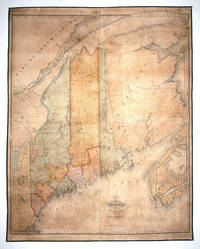
18298887Portland 1829. No Binding. Very Good. 50 ¾ x 40 ¼ inches. Steel engraving. Original wash color refreshed; expertly conserved re-mounted on new linen; a few cracks & marginal mends but fine for this kind. The very rare three copies cited in OCLC first edition of this excellent map of Maine by the state's first mapmaker. An exceptionally well-preserved example. Unlike many early American state maps that struggled to get completed Greenleaf's received a warm commendation from the state legislature even before it was published and the mapmaker was granted $1000 to aid him in finishing the map. Greenleaf later received $640 from the legislature for 40 copies of the map that were obtained for state use a remarkable $16 per copy. Perhaps the large number of copies sold for official rather than private use helps account for the map's present rarity. The map was originally intended to accompany an atlas and survey of the state that Greenleaf published the same year but very few complete sets of the three items are known to have survived. Greenleaf appears to have taken special care in the production of this map. Although published in Portland Maine Greenleaf employed as engravers for this work the estimable J. H. Young and F. Dankworth both of whom produced major works for the firms of S. A. Mitchell and others. This precisely detailed map which shows ten counties in different colors provides state county town and township boundary lines. The state's many rivers lakes ponds and even falls are shown as are roads and elevations. The map was re-published in 1844 by Greenleaf's son and namesake from the same plates but with emendations and several times thereafter. Greenleaf published two earlier maps of the state in 1815 and 1820 but the present work was by far his finest. Ristow W. American Maps and Mapmakers pp. 95-96; Catalogue Raisonne Important Maine Maps. Auction Catalogue for Thompson Collection Auction Robert E. Croul 2003 lot 119. unknown books
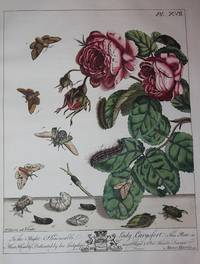
1778006437London: J. Robson 1778. Second edition. Full Morocco. Near Fine. One of the true milestones of entomological literature with truly magnificent and sublime color plates. Folio 37 by 29 cm. Copper engraved frontis xv 1 90 pp. and one anatomical plate plus 44 magnificent hand-colored copper engraved plates. Text in English and French with the two languages side by side on each page. Moses Harris 1730-1785 was both an entomologist and engraver and artist. Modern full burgundy morocco with gilt floral centerpiece and spine decoration. Endpapers are modern and somewhat odd looking more like wrapping paper than a proper endpaper. Usual offsetting. Very occasional light fox mark. Overall a beautiful fresh copy with all plates sharp and bright. <br /><br /> J. Robson books
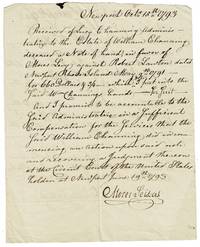
179355221Newport: Oct. 15 1793. One-page octavo document approx. 8" x 6¼"; previous fold else near fine. Lucy Ellery Channing's father was William Ellery signer of the Declaration of Independence from Rhode Island. "For 660 dollars & 3/4 which note I put into the said Mr. William Channings hands - for suit - and I promised to be accountable to the said administratrix in a sufficient compensation for the services that the said William Channing did in commencing an action upon said note and recovering a judgment thereon at the Circuit Court of the United States holden at Newport June 19 1793." Signed by Moses Seixas and docketed on the verso. Moses Sexias was Moses Levy's grandson. Moses Levy had died a year earlier. Moses Seixas 1744-1809 was a "first generation Jewish-American whose parents migrated from Lisbon Portugal to Newport. Seixas rose to prominence as warden of Newport's Touro Synagogue of Congregation Jeshuat Israel Grand Master of the Grand Lodge of Free and Accepted Masons of Rhode Island and co-founder of the Bank of Rhode Island. Seixas is best remembered for the congratulatory letter he penned on behalf of his congregation to then recently inaugurated President George Washington in 1790. Written just months after Rhode Island became the last state to ratify the United States Constitution Seixas sought assurances that the enumerated rights of freedom of religion and enfranchisement would apply to American Jews in the new republic" MountVernon.org. <br/><br/> Oct. 15 unknown books
4772MOSES AUSTIN 1761-1821. Austin lived in Missouri until 1820 when he left for Texas. He received a grant to bring 300 colonists to Texas and returned to Missouri for this enterprise. He died while in Missouri but requested his son Stephen carry out his plans for Texas. ANS. 1pg. 7 ¾†x 3 ¾â€. August 15 1812. No place Missouri. An autograph note signed “Moses Austin†to Mr. Buyler: “I will thank you to send by my Negro Boy as much meal as he can bring also be so good as to send me 50 pounds of flower in one end of one of the bags…â€. In 2015 Heritage Auctions sold for $4000 an 1827 document by Elias Bates the nephew of Moses Austin liberating one of his former slaves several years after Austin died. The auction house erroneously stated that “This may be the only extant document associating Austin with the ownership of one of his slaves.†Obviously this statement is not true because of the existence of this Austin document. The document is tanned and light in spots and somewhat brittle. unknown books
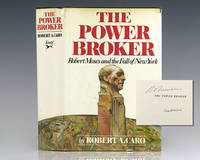
1974124810New York: Alfred A. Knopf 1974. First edition of the author's Pulitzer-Prize winning work on Robert Moses. Thick octavo original black cloth cartographic <span class="glossaryQtip qTip">endpapers.</span> Signed by the author on the half-title page Robert Caro and additionally signed by the subject Robert Moses. Near fine in a near fine dust jacket. Jacket design by Paul Bacon. Exceptionally rare and desirable signed by Caro and Moses. One of the most acclaimed books of our time winner of both the Pulitzer and the Francis Parkman prizes the Power Broker tells the hidden story behind the shaping and mis-shaping of twentieth-century New York and makes public what few have known: that Robert Moses was for almost half a century the single most powerful man of our time in New York the shaper not only of the city's politics but of its physical structure and the problems of urban decline that plague us today. "Surely the greatest book ever written about a city" David Halberstam. Theodore H. White called it "A masterpiece of American reporting. It's more than the story of a tragic figure or the exploration of the unknown politics of our time. It's an elegantly written and enthralling work of art." Named by Modern Library as one of the 100 greatest non-fiction books of the twentieth century. Alfred A. Knopf hardcover books
1852266899Boston 1852. unbound. Partial unsigned manuscript consisting of four pages 9.75 x 7.75 inches labeled "2" through "5" of a more extensive document all in the hand of Moses G. Farmer from 1852-1853 discussing the earliest trial-runs of the first ever Electric Fire Alarm System implemented in Boston. Though placed into service on April 28th 1852 Farmer's notes in diary form start on June 21st assessing the system while constantly citing ways to improve his new invention in very small part: ".Wednesday June 23 an alarm at 2:15.could not be easily read and caused a delay of 8 or 10 minutes.Saturday July 9th the circuit wheel of the key board needed repairs - the connector melted off by strong battery. July 10th Great Fire in Fort Hill. Alarm first came from Lower Boston plain. They tried to give it from Fort Hill & Persshar St. but both turned together turned too fast while ringing for So. Boston alarm came from Broad St. a delay in the time alarm of about 7 minutes.Friday Aug 6th Wanted! A Battery! Easy of manipulation. Constant & enduring in its operation. Powerful & certain in its effects & of small.cost! Sunday Aug 8th An alarm from D-7 at 12M. The operator did not understand it being the first one from that box & did not strike till the alarm came from I-4 at 12:15 P.M.Says he will recognize it next time. Oct 17th tried to raise an alarm from D-3 - S-3 4 & 5 but could not the lightning assertors were the cause of the difficulty.Friday Oct. 29th Put my newly invented battery on the South Boston signal circuit first time. Nov. 22nd Proceeded to try experiments on the velocity of sound for Captain C Wilkes.put my new battery on all signal circuit. Monday Dec. 20th Bad luck within two days at Three alarms. At one alarm the operator forgot to connect the South circuit. At Another the South end bells struck all sorts of ways on account of the key board running too fast. Atmospheric electricity probably had something to do with raising a false alarm at South End yesterday. Note: this is possibly the earliest recorded false alarm! Jan 11th 1853 Patent for my battery granted today. Sat. Jan. 15th 1853 Key board out of order. Made a substitute & had I repaired. Monday Jan. 17th Found wire broken at So. Williams St. did not intercept the circuit." This item has natural folds but is still in near fine condition.<br/><br/> American electrical engineer and inventor of the Electric Fire Alarm System and several forms of the Incandescent Electric Light. He also patented an early light bulb which was later bought by Thomas Edison. Though a true pioneer of many aspects of 19th century electrical invention he and his wife were Spiritualists and felt that their talents were God-given and that they shouldn't take credit for any of his inventions. As a result he failed to carry his ideas to commercial success.<br/><br/> unknown books
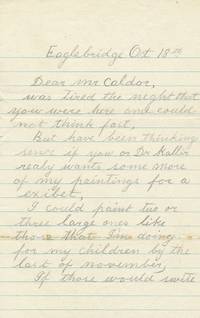
1917Using simple lined paper Grandma Moses writes to her earliest supporter and longtime art dealer Louis J. Caldor. Her misspellings retained: "Dear Mr. Caldor was tired the night that you were here and could not think fast. But have been thinking sence if you.realy wants some more of my paintings for a exibet I could paint two or three large ones like those that I'm doing for my children.I would do them on hard board and fram them.So sorry that you and your frinds had to come in the rain." Signed "Grandma Moses." Long considered a foremost Amercan folk artist her works are included in Outsider Art exhibitions and fairs. unknown books
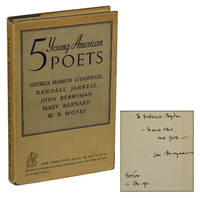
1940180216005New York: New Directions 1940. First Edition. Hardcover. Very Good. First edition. Inscribed by John Berryman on front paste down to novelist Frederick Boyden "so much skill much faith - signed John Berryman Boston 16 Dec 1941." 221 pp. Blue cloth with gilt lettering. Near Fine in Very Good price-clipped dust jacket that is rubbed along edges slightly chipped at head and tail closed tear along front flap fold a few faint stains. The very first book appearance of John Berryman and quite rare signed by him as well as poet/ novelist/essayist Randall Jarrell and poet/translator of Sappho Mary Barnard. New Directions hardcover books
1840D17813New York: M. M. Noah & A. S. Gould 1840. First Edition. Hardcover. Good. In his preface Noah discusses the rather mysterious origins of The Book of Jasher. Original cloth worn. In plain modern slipcase. <br/><br/> M. M. Noah & A. S. Gould hardcover books
SAV153Hardcover. Good. Italy possibly Piedmont 17th century. 181 leaves 96 x 140mm. A pocket-sized copybook written in a uniform italic script in brown ink recto only on laid paper. Each page with double ruled border framing Latin verse lines from De rebus gestis Alexandri Magni The Life and Exploits of Alexander the Great by Quintus Curtius Rufus with Italian translation and proverbial sayings in Italian on miscellaneous subjects signed intermittently Il Zangrandi or Gioseppe Zangrandi. Oblong contemporary sheep over pasteboard; some slight worming mostly at beginning and end some minor chips on spine and back cover otherwise good. Ownership signature of Moses Baruch Carvaglio on the last leaf in Italian Io Moise filgiolo sic di Jacob di Josef Baruch Carvaglio under an anecdotal note in his hand about an incident of extreme cold which froze over the lagoon and parts of the Venetian canal in 1708. <br/><br/>An interesting 17th-century calligraphic copybook of excerpts from the great Roman history of Alexander the Great and with popular sayings written in Italian and Latin once owned by important Venetian Jewish coral merchant Moses Baruch Carvaglio. The regal Alexandrian history "De rebus gestis Alexandri Magni" by Roman historian Quintus Curtius Rufus was much appreciated in Italy during the early modern period. Adaptations for Alexander romances and an incunable tradition was in place from at least the 1470s. The name Il Zangrandi seemingly the writer of this collected verse could be Virgilio Giangrandi 1589-1630 a Piemontese typographer active in Savigliano at the turn of the seventeenth century. References to this printer under the name Il Zangrandi and working with works in Latin verse do exist if only fragmentary. We do know that along with his brother Giovanni Virgilio Giangrandi moved from Milan to Asti in 1588 and their printing company remained in operation until at least 1691. The Zangrandi press was also known to produce religious and biographical works. It is possible Virgilio or an apprentice was in part responsible for creating this eclectic copybook which celebrates portions of the Roman Alexandrian epic and intersperses sayings from his native Italian. An interesting layer to the history of this manuscript is the eighteenth century ownership inscription of Moses Baruch Carvaglio a successful merchant and Jewish man based in Venice. In the 1730s along with his father and brother Moses operated a well-known trade business in coral beads. The Carvaglio family would have been tied to profitable Venetian mercantilism for most of the eighteenth century. The scribal beginnings of this copybook remain mysterious nevertheless two plausible figures from early modern Italy contributed to its creation and care. hardcover books
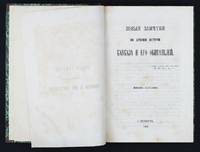
P6189St. Petersburg: Tipografiia N. Tiblena i komp. 1866. Octavo 22.5 Ã 15.5 cm. Contemporary quarter-calf over marbled boards with gilt tooling and title to spine; 501 1 pp. Title page lightly toned; boards rubbed still about very good. First edition. An early ethnographic linguistic and historical study of the Caucasus by a Russian ethnographer and statesman of French origin Ivan Ivanovich Shopen 1798-1870. Shopen began gathering materials on the region as part of his military appointment in 1829 creating a record of Armenia then a new territory of the Russian Empire. In 1840 when his first study of Armenia was published Shopen was appointed a member of the statistics committee of the Ministry of the Interior. Shopen was fascinated by the Caucasus and continued his scholarly work publishing several more books on the subject. This book is his last and contains a historical and philological analysis of ancient Armenian and Georgian literary works and historical sources as well as commentary on existing theories of the etymological origins of the words Kavkaz Caucasus and Kazbek. Among the works treated are the Armenian writings of Movses Khorenatsi Movses of Kaghankatuk Kagkantovathsi and the Georgian history of King Vakhtang of Kartli. This edition of these works became foundational for the study of the region in the Russian Empire. KVK OCLC show copies at Harvard NYPL Princeton and Yale. hardcover books
1904266665New York: Moses King 1904. First. paperback. good. 325 photo Illus. 72pp. Folio original printed wrappers spine ends worn small area of wear to middle of spine wrappers lightly soiled corners of wrappers chipped front wrapper lightly dampstained near edges. New York: Moses King 1904. First Edition<br/><br/> Views include multi-story commercial buildings bridges banks municipal buildings private residences schools churches and hospitals. Internally a very good copy with bright illustrations.<br/><br/> Moses King unknown books
1898253334New York: Moses King 1898. First. hardcover. good. Numerous photo Illus. 96pp. Folio original green cloth with original wrappers bound in spine ends worn edges of corners lightly worn some pages lightly dampstained in bottom margins front and back covers with small areas of light soiling bound in wrappers are chipped in margins. New York: Moses King 1898. First Edition.<br/><br/> Contains over 400 portraits of Wall Street brokers and prominent men of finance and 65 photo illustrations of the New York Stock Exchange and nearby architecture.<br/><br/> Moses King unknown books
178655770Providence 1786. Folio sheet approx. 15" x 12" docketed on the verso; previous folds with splits no loss; overall toning; good. Brigadier General James Angell 1723-1785 descendant of one of the first settlers of Providence died February 2 1785. This inventory was taken by Moses Brown 1736-1838 executor of the will and both a friend and relative. The Angell's daughter Abigail married a Goddard relatives of the Brown family. Among assets listed are Angell's Johnston farm lot 160 acres of Vermont land a third of an acre lot in North Providence; "we to give James and Jacob a Deed of the Whole of remd of Johnston farm & North Providence lott." James Angell was town clerk of Providence until 1775 and Theodore Foster said of him "I became intimately acquainted with the said James Angell and many of his Family Connexions among whom was the Honorable Stephen Hopkins Esq. whose Sister married the said James Angell." Documentary History of R.I. Angell was also appointed chairman of the committee to revise laws of the state. <br/><br/> unknown books
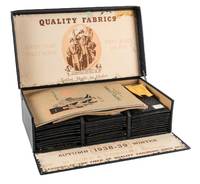
19385983405Chicago: M.Born 1938. Very good. Spectacular tailoring sample counter display for 1930s mens suits and overcoats for Fall & Winter. Price list fall and winter 1938-39; Order Book and Salesman sample counter display case for woolen and wool blend weaves. Sample case. 20x11x5". Containing 33 thick cards w/ gilt stamping on black 6 x 10¾" with 237 woolen worsted wool silk blend cheviot gabardine tweed and hopsock blends all mounted on cards; sample case w/ original pebbled black cloth over boards divided into 3 compartments nickel plate slider hinges printed advertising on inner lid and drop front. Catalogue: Folio. 22 leaves printed on thick glossy paper stock color illustrations throughout 4 fabric samples mounted on rear inner cover art deco styling & lettering on front cover spiral bound. Kling Bros. order book still intact with 30 order sheets text diagrams red cloth backed softcovers. Rare with Price list. 8vo. 4 pp. printed on thick yellow card stock. TLS on Born Company letterhead announcing Topcoat and overcoat sale folded. Sold Out notice with penciled notations on M. Born & Company stationery. The catalogue included with this case offers invaluable illustrated historical reference for the colors styles and fabrics during the era of fashion influenced by the elegance and glamor of Hollywood films and film noir at the time. <br /><br /> M.Born hardcover books
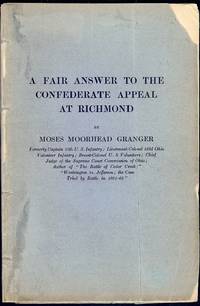
190746511907. Granger Moses Moorhead. A FAIR ANSWER TO THE CONFEDERATE APPEAL AT RICHMOND. Self-published 1907. 12mo. printed blue wraps; 32 pages. First- and only- edition. A treatise debunking many claims made by Southern states and politicians that led to the Civil War. "Richmond" in the title refers to the unveiling of a statue of Jefferson Davis on June 3 1907 in that city and speeches at the time stating that Davis and the Southern states will eventually be vindicated for their actions leading to and during the Civil War. Granger 1831-1913 was born and also died in Zanesville Ohio where he was a lawyer and a judge. He served with Company S of the 122nd Regiment of the Ohio Volunteer Infantry during the Civil War where he earned the ranks of Lt. Colonel and Colonel. With an autograph note signed by Granger inside the front cover discussing some copyright confusion over the book's publication and with a "Publisher's Weekly" ink stamp on the same page. With another lengthy autograph note on the last page by Granger discussing the politics and various historic events that led to the war mentioning The Missouri Compromise The Nebraska Bill etc. Very rare with the only copies I have been able to locate in institutional libraries. Good condition some chipping covers but contents clean & tight; some repair to covers spine & inside front cover with clear archival tape. $1250.00. <br/><br/> paperback books
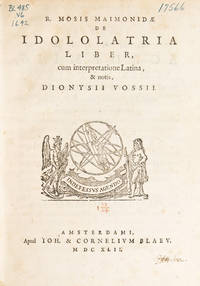
1642254936Amsterdam: Jioh & Corneium Blaeu 1642. Second edition of each title. Publisher's device on title pages; woodcut tailpieces ornamental initials. Maimonides text in Hebrew with facing Latin translation by Vossius. 12 1-174. 2; 12 304; xvii 19 305-732 x 30. 1 vols. 4to. Contemporary vellum with ms. spine title covers slightly soiled upper joint cracked. Institutional shelfmark in ink on title-page ; bookplae of HENRY FERGUSON of Stamford Connecticut "Henry Ferguson from the Library of Rev. FREDERIC GARDINER" and signed by Gardiner on the front pastedown "Leipzig 1854. Second edition of each title. Publisher's device on title pages; woodcut tailpieces ornamental initials. Maimonides text in Hebrew with facing Latin translation by Vossius. 12 1-174. 2; 12 304; xvii 19 305-732 x 30. 1 vols. 4to. Scarce second edition of Maimonides' tract on idolatry with an important new foreword "to the Reader" by Isaac Vossius brother of the recently deceased translator Dionysius Vossius 1612-1642 as well as a new dedicatory poem by Caspar Barlaeus. Maimonides' text is usually accompanied as it is here by the massive commentary by Gerardus Vossius father of Isaac and Dionysius DE THEOLOGIA GENTILI . a book said to have been an iinfluence on Isaac Newton; his library contained an "extensively dog-eared" copy of the book John Harrison THE LIBRARY OF ISAAC NEWTON Cambridge University Press p. 258.<br/><br/>This particular copy has a very distinguished provenance. Dr. Frederic Gardiner was an Episcopal clergyman Biblican scholar founder of the American Exegetical Society and author of several books including a Harmony of the Gospels. Henry Ferguson of Stamford Ct. "studied theology in the Berkeley Divinity School. In 1872 he was made rector of Christ Church in Exeter N. H. and in 1878 rector of Trinity Church Claremont in the same state. In 1883 he became professor of history and political economy in Trinity College a position he filled with distinguished credit until commencement in 1906 when he resigned to become rector of St. Paul's School Concord N. H. In 1873 he married Emma J. Gardiner daughter of Professor Gardiner of the Berkeley Divinity School . His original specialty was Hebrew." Norris Galpin Osborn ed. MEN OF MARK IN CONNECTICUT Vol I p. 132. OCLC: 37317703 one copy in US; Vossius: Brunet V col. 1373 for editions of 1641 and 1668 Jioh, & Corneium Blaeu unknown books
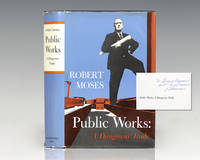
1970111421New York: McGraw-Hill 1970. First edition of this work by the legendary urban planner. Octavo original cloth illustrated. Presentation copy inscribed by the author "To Leyland Hayward with high regard Robert Moses." The recipient Leyland Hayward was a theatrical and Hollywood producer most notably of South Pacific and The Sound of Music. Fine in a very good dust jacket. Robert Moses was a public official who worked mainly in the New York metropolitan area. Known as the "master builder" of mid-20th century New York City Long Island Rockland County and Westchester County he is sometimes compared to Baron Haussmann of Second Empire Paris and was one of the most polarizing figures in the history of urban development in the United States. His decisions favoring highways over public transit helped create the modern suburbs of Long Island and influenced a generation of engineers architects and urban planners who spread his philosophies across the nation despite his not having been trained in those professions. Moses would call himself a "coordinator" and was referred to in the media as a "master builder". McGraw-Hill hardcover books
168338984Londini: Milonis Flesher pr. for the author sold by Pitt & Aylmer 1683. 4to 23 cm 9.1". 16 450 2 blank pp. Pp. 223/24 Ff3 lacking. <br><br>First edition: erudite translations of eight treatises. Born Jewish the French scholar Louis de Compiègne de Veil studied theology at the Sorbonne after converting to Christianity and set out to translate the whole of Maimonides' Yad ha-Chazakah from Hebrew into Latin. The present work encompasses the Sefer ha-Korbanot the section on sacrifices along with the portion on consecration of new moons and intercalations and Isaac Abravanel's preface to his commentary on Leviticus; the latter gives the => Hebrew and Latin texts on facing pages. Each section has a divisional title-page with continuous pagination. <br>Â Â Â Â <br>Â Â Â Â ESTC R25499; Wing rev. ed. M2854. Contemporary mottled calf framed and panelled in blind with blind-tooled corner fleurons; refurbished and nicely rebacked with speckled calf spine with blind-ruled raised bands and gilt-stamped leather title-label original leather pitted and worn. All page edges speckled red. Front fly-leaf title-page and one other institutionally rubber-stamped; Ff3 either a sectional title or a blank leaf lacking. Pages gently age-toned and cockled with a few corners bumped; small ink smudge in upper outer portions of two facing pages. "Exordium" with intermittent pencilled underlining and two marginal annotations pencilled in English. => Interesting 17th-century Judaica in a strong and decent copy. Milonis Flesher (pr. for the author, sold by Pitt & Aylmer) hardcover books
190317370New York: Moses King 1903. Cloth. Very Good. A very important Association copy -- and a significant piece of turn-of-the-century New York history. INSCRIBED BY MOSES KING in February 1904 TO ADOLPH S. OCHS THE PUBLISHER AND OWNER OF THE NEW YORK TIMES 1896-1935 AND A MAJOR FORCE IN THE GROWTH OF NEW YORK AS A WORLD-CLASS CITY. A solid very presentable copy to boot of the 1903 installation of this photographic tribute to New York both overseen and published by the powerful Moses King himself a formidable figure in the world of New York movers and shakers. This copy is solid and VG to VG in its tan cloth with bright gilt-titling to the front panel. Light wear at the spine ends and the tips mild rubbing along the front panel's bottom-edge and very light soiling to the rear panel. Folio hundreds of crisp black-and-white plates glorifying the city's architectural acheivements. Laid-into this copy is a hand-sewn uncommon 1933 booklet called "Adolph S. Ochs at Seventy-Five" which pays tribute to the publisher's accomplishments from the perspective of Jewish theology and ideals. <br/><br/> Moses King hardcover books
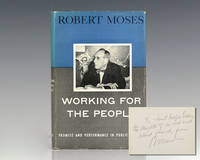
1956124814New York: Harper & Brothers 1956. First edition of this work by the legendary Robert Moses. Octavo original cloth. Presentation copy inscribed by the author on the front free endpaper "To Janet Hooper Ostahn the daughter of an old and valued friend from Robert <span class="il">Moses</span>." Near fine in a near fine dust jacket. Foreword by Herbert Bayard Swope. Books signed by Moses are uncommon. Robert Moses was a public official who worked mainly in the New York metropolitan area. Known as the "master builder" of mid-20th century New York City Long Island Rockland County and Westchester County he is sometimes compared to Baron Haussmann of Second Empire Paris and was one of the most polarizing figures in the history of United States urban development. His decisions favoring highways over public transit helped create the modern suburbs of Long Island. Although he was not a trained civil engineera Moses's programs and designs influenced a generation of engineers architects and urban planners nationwide. Moses held up to 12 official titles simultaneously including New York City Parks Commissioner and Chairman of the Long Island State Park Commission but was never elected to any public office. He ran only once as the Republican nominee for Governor of New York in 1934 and lost in a landslide. Nevertheless he created and led numerous semi-autonomous public authorities through which he controlled millions of dollars in revenue and directly issued bonds to fund new ventures with little or no input or oversight. As a result of Moses's work New York has the United States' greatest proportion of public benefit corporations which remain the primary driver of infrastructure building and maintenance and account for most of the state's debt. Moses's projects were considered economically necessary by many contemporaries after the Great Depression. Moses led the construction of New York campuses for the 1939 and 1964 World's Fairs and helped persuade the United Nations to locate its headquarters in Manhattan instead of Philadelphia. Harper & Brothers hardcover books
19191003928vo original cloth 260 pp. Backstrip somewhat faded and lettering on front cover is rubbed paper a bit aged but only slightly. Very good overall. Bishop William Moses was known as the "Baptist Garvey" and was actually a close friend of Marcus Garvey. He stood by Garvey when he was under attack and indicted for mail fraud and continued to speak out in his behalf. Unfortunately he was also involved with Garvey in a disastrous attempt to negotiate an agreement with the Ku Klux Klan. Garvey lost a lot of supporters because of this and Moses pastor of the Philadelphia Zion Baptist Church was asked to leave the church by the elders. This work focuses on the subjugation of the dark races by whites. Moses' goes through history to make his point and much of the discussion is on the international community. His solution for black advancement seems to be "black evangelism" or an active role of the church in the social and political development of the dark races. Lisle Carey Press hardcover books
029644folio 4 pages the manuscript is undated but is written on laid paper watermarked 1811 and mentions troubles caused on July 12 1813 “Orangemen’s Day” and clearly dates from his days in Belfast Ireland. Dawson touches on sectarian strife and speaks highly critically and in his typically combative style of the chief magistrate responsible for the expulsion of seven thousand Catholics from county Armagh and for those responsible for continuing the strife in the present case in Belfast. The manuscript is identified as being “The handwriting of Moses Dawson biographer of Harrison” on the last page. Comparison with other letters by Dawson bears this out. The manuscript is headed: “The particular attention of the members of the Established church of the Parish of Belfast is particularly requested to the report of the Trial of Dr. Tennent at the quarter sessions last week – and in order to place the evidence given on that trial in as clear a point of view as possible particularly that part of it which went to convict the Doctor and that which was given in exculpation – it shall be given under particular heads as D. & C. “ Dawson relates an account of the trial for the course of 2 ½ pages before heading into a second section of a page and a half which begins “Now my friends here is a fair and impartial statement of this account laid before you…” Dawson continues: “… there is one item on the debit side for which there is no credit given on the other – namely that part of Mr. Verner’s evidence where he says a great crowd followed to the office hoping and hooting – this however I am sure many of you can balance in your own minds by matter fact as it must be known to many of you that no such circumstance took place but that the indignation of the people was expressed by silent astonishment at seeing a respectable useful and inoffensive inhabitant dragged like a felon to the Black hole. You must be sensible from the evidence of those respectable and worthy men who were called on the defence that the most simple assault was not intended – that no disrespect was meant to the judges of the Land and that so far from Dr. Tennet setting himself in opposition to the constitution of his country he was endevouring by Constitutional means to prevent the recurrence of murder in our streets – Who can be considered the best friend to the constitution of his country the man who would abet a lawless Banditti in murder in raiping and House burning or the man who would by every legal means endeavour to put a stop to such scenes – the question answers itself – “the notorious Verner and “the lamb of grace” aided by the infamous bench who presided at Antrim sessions are the real enemies of the Constitution and not the peaceable inhabitants of Belfast who wished to put an end to such disgraceful scenes as those of 12 July 1813. Fellow Christians only think of the miserable situation you are reduced to – on the one hand a chief Magistrate whose youthful days have been passed in the raiping burning and murder of the unfortunate Catholics of Armagh and who is now come to spend his more mature years in promoting the same system in Belfast – and who has added perjury to the other list of crimes of which he has been … guilty – and on the other a Pastor who from infancy has been innured to all the crimes committed in an infamous gaming house – who was begotten in adultery and nurtured in villainy – who has long since robbed the gallows of its dues – and whose ears for this last act of his richly deserves to be nailed to the Pillory – How can you without horror view these men in their respective situations in the church – how can you without abhorrence view such a man as Verner in the seat of justice with all his emblems about him – or how can you look upon him without picturing in your imagination the flames of the cabin and the shrieks of women and children – and lastly what you must thin unknown books
1785JC14379Wien: Sebastian Hartl 1785. First Edition. Hardcover. Very Good . 12mo. 79 pp. Contemporary half leather spine gilt; red label. Binding a bit rubbed but nevertheless a charming period binding with decorative floral endpapers. <br/><br/>Rare first edition of this work by the German Jewish philosopher Moses Mendelssohn 1729-1786. It was next published in Berlin in 1796. Sebastian Hartl hardcover books