Mendelssohn, MosesAntiquariat.de

112 résultats
177732265Berlin, bey Christian Friedrich Voß 1777. XXIV, 278 Seiten, 283 Seiten, Kl8° gebundene Ausgabe, Halbleder, Bibliotheksstempel auf Titelblatt, Rückenleder oben mit Fehlstück, sonst Exemplar in gutem Erhaltungszustand
17672202030016London : Printed for Richardson and Urquhart 1767. Hardcover. Good. Rebound in modern cloth. Hardcover. Good binding and cover. 8 320 pages. London : Printed for Richardson and Urquhart hardcover
1767183112London: Richardson & Urquhart. Fair with no dust jacket. 1767. First Edition. Hardcover. Full calf rebacked; damp-stain marginal corner through more than half of book. There is not a frontpiece opposite the title page. . Richardson & Urquhart hardcover
1794667471794. London : printed for T. Evans Paternoster Row and J. Stead at the Naval and Military Printing-Office Gosport 1794 8° 8 XX 170 pp. Halbledereinband d.Zt.; Rücken erneuert. Rare First Edition! "A treatise on the blood or general arrangement of many important facts relative to the vital fluid. With some cursory observations on the theory of animal heat. Interspersed with pathological and physiological remarks from the inductions of modern chemistry. By Hugh Moises surgeon of the Western Regiment of Middlesex Militia and Late Senior Pupil to the General Hospital Nottingham." "With the general acceptance of the Lavoisier-Crawford theory of animal heat as a resultant of respiration or slow combustion much of the subsequent search for the site of body heat production revolved about two questions. What happens to the inspired oxygen Or alternately where in the body was the carbonic acid first formed A subsidiary and often perplexing question asked at what temperatures the products of combustion carbonic acid and water actually could be formed The last question is of particular interest because the heats of combustion of carbon and hydrogen were utilized in the early nineteenth century attempts to establish the respiration theory of animal heat. Séguin citing Priestley and Bertholet had argued that these combustions could occur at ordinary body temperature. Hugh Moises in his Treatise on the Blod 1794 was equally emphatic : We know of no experiment which might authorize us to suppose that carbon can unite with oxygene in a temperature of 97°-99° or that hydrogene and oxygene air combine and form water in so low a temperature." "The early studies of this limited problem suggested solutions based on the ability of the different gases to cause the color changes observed in blood. Both Girtanner and Hassenfratz had attempted to show that venous blood became bright red upon the absorption of oxygen and thereby demonstrated their contention that the blood took up oxygen in the lungs. Another line of experimentation attempted to recover gases from the blood. Hugh Moises for instance confined arterial blood in bottles with gases containing no oxygen and claimed to find oxygen in the residue." Everett Mendelsohn: The Controversy over the Site of Heat Production in the Body. Proceedings of the American Philosophical Society 105/4 1961 pp. 412-420 Hugh Moises M.D. "Surgeon of the Western Regiment of Middlesex Militia.- An Inquiry into the Abuses of the Medical Department of the Militia. Lond. 1794 8vo.- A Treatise on the Blood; or General Arrangement of many important Facts relative to the Vital Fluid . Lond. 1794 8vo. 5s. - An Appendix to the Toilet; or an Essay on the Management of the Teeth. Loud. 1799 8vo. 2s. 6d." R. Watt: Bibliotheca Britannica. 4. V. 1824 unknown
179729346V.p.: v.i. 1797. Very Good. V.p.: v.i. 1797-1799. Six volumes bound in one; octavo; contemporary limp blue paste-paper boards. Boards a bit rubbed most notably along spine textblock uniformly toned binding a bit tight with text along gutter edges of some leaves just barely visible else a Very Good sound copy all contents collated complete. Contemporary ownership signature in pencil on rear pastedown of a Mary Hawthorne Bunker. Contents as follows: <br /> <br /> 1. Moses Adams. "A Sermon Delivered at the Ordination of the Rev. Thomas Noyes to the Pastoral Care of the Second Church in Needham July 10 1799." Printed at the Minerva Press in Dedham by Herman Mann 1799. 271pp. EVANS 35076.<br /> <br /> 2. Stephen Palmer. "A Sermon Delivered at Rowley Second Parish July 7 1797. At the Ordination of the Rev. Isaac Braman to the Pastoral Care of the Second Church and Society in that town." Dedham: Nathaniel and Benjamin Heaton 1797. 351pp. ESTC W003029; EVANS 32636; SABIN 58373.<br /> <br /> 3. Nathaniel Sermon. "A Sermon Preached at the Installation of the Reverend William Emerson to the Pastoral Care of the First Church in Boston on the 16th of October 1799." Boston: Samuel Hall 1799. 302pp. ESTC W29258; EVANS 36409.<br /> <br /> 4. Abel Holmes. "A Sermon Preached at the Ordination of the Rev. Jonathan Whitaker to the Pastoral Care of the Church and Society in Sharon Massachusetts February 27 1799." Dedham: Herman Mann 1799. 493pp. EVANS 36530.<br /> <br /> 5. Ezra Ripley. "A Sermon Delivered at York October 10 1798 at the Ordination of the Rev. Rosewell Messinger Pastoral Charge of the First Church as Colleague Pastor with the Rev. Isaac Lyman." Portsmouth NH: Printed by Charles Peirce at the Oracle-Press No. 5. Daniel-Street 1798. 24pp. EVANS 34471; SABIN 71513<br /> <br /> 6. Enos Hitchcock. "A Sermon Delivered at Wrentham at the Ordination of the Rev. Elisha Fisk June the 12th 1799." Providence: Bennett Wheeler 1799. 28pp. ALDEN 1620; EVANS 35624; SABIN 32257. v.i. unknown
17970009109NEW FRANKFURT HARRISON CO. WEST VIRGINIA 1797. On offer is are two lovely and fascinating letters from a father and mother to their daughter detailing their situation mere weeks after moving to New Frankford Virginia. The letter is signed Moses Starr and Elizabeth Starr and addressed to their Dear Daughter. The first letter is dated November 17th 1797 and the second is dated December 23 1797. In the letters they describe their journey to their new home in West Virginia their home and their farm. They now live in New Frankfurt in Harrison County Simpsons Creek Eight Miles From Clarkburg. The first letter begins Dear Daughter we embrace this opportunity to wright to you informing thee that we are all in great haealth at present thanks bea to God for his tender Merceys to us ward from time to time. They write that they have we have had no letters from thee this two years.and have had no opertunity to send any. We long to see thee and hear from thee if thou art single write whether thou would incline to come upon and live with us we think of comeing Down within two years more; like wise let us know how our Relations are in them parts.The back of the letter is a short sermon like passage stating Dear child strive to ear and Love God who is able to Love the utmost oall that come to him through Jesus Christ the Redeeme of lost Man. The next letter begins with them writing that they have received her last letter which gave us some cause to rejoice of hearing from our relations in general but gave us concern of mind for the loss of Nelly Starr and the disolate state of Uncle Joseph. They then remark on the their life in what is now West Virginia. Thy mother was braught to be of a daughter the Eleventh of last month wich we call Polly. They speak of their journey to Virginia taking two weeks from when they left their home. The farming has been good a well reaping 200 bushals of Sound Corn and 150 bushals of Oats with a trifel of buck wheat. I have 20 acres of wheat and Ry in the ground this fall. The letter ends with the usual pleasantries and again is signed by Moses and Elizabeth Starr. The two letters are in fair shape both having a fair share of rips tears and discoloration. The first letter has some moth damage that affects the readability of a sentence or two. The second letter has its tears along the creases and edges but it does not affect the content at all. Neither does the discoloration on either letter though it is very noticeable it does not block out any words. The ink on both letters has faded the first more than the second but both letters are fairly easy to read throughout. These letters are an interesting little snapshot of a family life in 1790s Virginia representing a change in a brand new America and hope for a new setting in this burgeoning nation. Good. 4to - over 9¾" - 12" tall. Manuscript. unknown
17731696536London: E. & C. Dilly 1773. Hardcover. Used-Very Good. Later 19th C. brown cloth with gilt titles. Engr. frontis. xl 136 pp. A little wear to spine extremities. Internally very good. Bookplates of two prev. owners on f.p.e.p. E. & C. Dilly hardcover
17106365Amsterdam: Pieter Mortier 1710. Hardback. Fair/No Jacket. 2188 4to. Italian title "Il Grande Dittionario Hollandese et Italiano come pure Hollandese et Italiano". This is Volume 2 Dutch-Italian only. Leather binding spine in 6 compartments with 5 raised bands red and black title page engraved frontispiece opposite 860 pages. Condition notes: Front board detached front free end paper sticking to front paste down leather much scuffed. Text block sound ink smudging to earliest pages but the dictionary pages are clean and unmarked; age toning to paper. Pieter Mortier hardcover
17732007280082London : Printed for T. Cadell in the Strand M. DCC. LXXIII 1773. 3rd. Hardcover. Good. Interesting Early Massachusetts / Revolutionary War Provenance: General Gridley's Copy Bound in contemporary polished calf. Good binding. Small chip from head of spine but sound. lii 386 2 p. ESTC T116279. Signed on title page by Richard Gridley. Gridley 1710-1796 was a soldier and engineer in the French and Indian Wars and in the American Revolution. He served as a the Chief Engineer for artillery in George Washington's Continental Army. He directed fortifications on Dorchester Heights and fought in the battle of Bunker Hill. Gridley is considered by the US Army Corps of Engineers to be America's First Chief Engineer. Later this book was owned by the Rev. Joseph Grafton 1757-1836 founder of Newton Theological Institution. Grafton served as a Baptist pastor in Newton for more than 48 years. Newton Theological Seminary stamp. Includes related ephemera about Gen. Gridley. London : Printed for T. Cadell, in the Strand, M. DCC. LXXIII hardcover
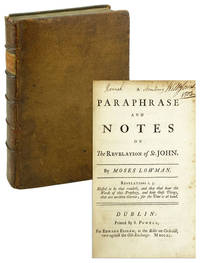
174025748Dublin: Printed by S. Powell for Edward Exshaw 1740. Very Good. Dublin: Printed by S. Powell for Edward Exshaw at the Bible on Cork-hill over-against the Old-Exchange 1740. First Dublin Edition. Octavo; full contemporary calf gilt-lettered spine in six compartments; xxxvi241-3526pp. A3 B-2X4 2Y2 2Z2 collated complete despite error in pagination. Minor scuffing to leather extremities with a few tiny chips endpapers foxed at extremities contemporary ownership signature of a Hannah Armstrong at head of title page along with that of a Will Jones dated 1803. A Very Good sound copy overall.<br /> <br /> Extensive Biblical annotations by the English nonconformist minister Moses Lowman 1680-1752. Includes the list of subscribers on pp. xxxvii-xxxviii. The previous owner Hannah Armstrong does not appear on the list of subscribers though if she had she would have been one of just two women. The latter half of p. xxxviii is devoted to the publisher's advertisements which ran from sermons to histories and something called "The Tales of the Faries" by the Countess d'Anoise in three volumes. <br /> <br /> ESTC T170485. Printed by S. Powell, for Edward Exshaw unknown
1776000046Frankfurt Und Leipzig: 1776 1776 224pp.original cover wrapped.1 illustration at the beginning.foxed. Frankfurt Und Leipzig: , 1776 hardcover
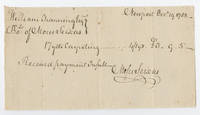
178825418<p>Seixas' 1790 letter of welcome elicited the first president's most compelling statement on religious liberty "to bigotry no sanction." In this 1788 receipt Seixas signs a receipt documenting payment for carpet by William Channing the state's new attorney general.</p><p><strong>MOSES SEIXAS.</strong> Manuscript Document Signed to William Channing December 18 1788. Receipt for carpeting. 1 p. 7¼ x 4 in.</p><p><strong>Complete Transcript</strong></p><p><em>Newport Dec<u>r</u> 19 1788</em></p><p><em>William Channing Esq</em></p><p><em>Bo<u>t</u></em> Bought <em>of Moses Seixas / 17 yds Carpeting . . . . . . . . . . .4/1 yd. £3.9. 5.</em></p><p><em>Received payment In full /</em></p><p><em>Moses Seixas</em></p><p>Docketing on verso in another hand: <em>Moses Seixas</em></p><p><strong>Moses Mendes Seixas</strong> 1744-1809 was born in New York into a Jewish family. His father immigrated from Portugal to New York about 1730 and became a merchant. The family moved to Newport Rhode Island in 1765. Moses Seixas married Jochebed Levy in 1770 and they had eight children. He was one of the organizers and first cashier of the Bank of Rhode Island which conducted business in his house until 1818. After the British occupied Newport during the Revolutionary War Seixas remained in Newport but was among the signers of a document supporting the patriot cause. In 1790 he was the president of the Congregation Yeshuat Israel later Touro Synagogue in Newport. He was also a charter member and first grand master of St. John's Lodge of Free and Accepted Masons in Newport.</p><p><strong>William Channing</strong> 1751-1793 was born in Newport Rhode Island and graduated from the College of New Jersey Princeton in 1769. In 1773 he married Lucy Ellery daughter of William Ellery a Newport lawyer who signed the Declaration of Independence and they had nine children. Channing was elected Attorney General of Rhode Island in 1777 and when Rhode Island ratified the U.S. Constitution in 1790 Channing became the first federal District Attorney. One of his sons was the famous Unitarian preacher William Ellery Channing 1780-1742.</p><p><strong>Historical Background</strong></p><p>From 15 Sephardic families who arrived in 1658 Newport Rhode Island's Jewish community grew to be the largest in the colonies. Many Jews left during the Revolutionary War when Newport was occupied by the British. A significant number returned when the British left in 1779. By the time Rhode Island became a state there were approximately 300 Jews in the thriving Newport community.</p><p>Starting while on his way to New York to assume the presidency in April of 1789 George Washington received many messages from civic fraternal and religious organizations offering congratulations praise of his deeds in war peace and politics prayers on behalf of congregations or constituents. Washington's replies justly count among his most famous pronouncements setting a boldly inclusive tone that helped our new nation survive and expand.</p><p>After the first session of the first Congress Washington set out on a tour of the New England states except for Rhode Island which had yet to ratify the Constitution. It finally did so in May of 1790 and three days after the second session of Congress adjourned Washington Jefferson and others set out to visit Newport. On August 18 Washington and his entourage were greeted with four addresses written as open letters and read in a public ceremony. First the town then from all the Christian clergy then the Masonic order and finally from the Hebrew Congregation.</p><p>Moses Seixas on behalf of the Congregation Kahal Kadosh Yeshuat Israel congratulated Washington on his ascendancy to the Presidency. He invoked the language of the Revolution in arguing that Jews should be entitled to the same privileges as an American of any other religious denomination. Having been previously "deprived…of the invaluable rights of free Citizens" Seixas expressed his hopes for the success of the new "government erected by the majesty of the people a government which to bigotry gives no sanction—to persecution no assistance; but generously affording to all liberty of conscience."</p><p>Seixas' letter moved President Washington who echoed Seixas' words and built on them to make his most celebrated statement on religious freedom. He responded as soon as he returned to the capital New York assuring the Hebrew congregation that "happily the Government of the United States which gives to bigotry no sanction to persecution no assistance requires only that they who live under its protection should demean themselves as good citizens in giving it on all occasions their effectual support. It would be inconsistent with the frankness of my character not to avow that I am pleased with your favorable opinion of my Administration and fervent wishes for my felicity. May the Children of the Stock of Abraham who dwell in this land continue to merit and enjoy the good will of the other Inhabitants; while every one shall sit in safety under his own vine and fig tree and there shall be none to make him afraid."</p><p>Washington's addresses responding to religious congregations included those of Baptist Congregational Dutch Reformed Episcopalian German Lutheran German Reformed Jewish Protestant Presbyterian Quaker Roman Catholic and other denominations.</p><p>Today we understand that Washington and his fellow Founding Fathers were oblivious to the realities of other kinds of oppression. Knowing what we know now how can we still value these slave-owners' declamations on freedom While acknowledging Washington's ownership of his full share of the universal biases of his age we can and should still treasure his "to bigotry no sanction" letter as a powerful testament to the promise of America. In the 218 years since Washington responded to Seixas' address has anyone come up with a better definition of the benefits and responsibilities of American citizenship</p><p>Washington's original letter was acquired by the Morris Morgenstern Foundation in 1948 and is on long-term loan to the National Museum of American Jewish History in Philadelphia. Seixas' letter to Washington is in the Library of Congress and Seixas' retained copy was acquired by the Morgenstern Foundation in 1949 and is with Washington's letter.</p><p><strong>Condition</strong></p><p>Fine condition with intersecting folds and slight bit of foxing.</p>
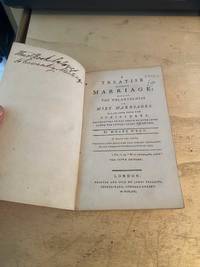
179053953James Phillips London 1790. Fifth Edition. Softcover. Very Good Condition. Size: 18mo 5 1/2 - 6 1/2". 46 pp. Binding firm with minor wear to spine. Previous owner's address in ink. Edges foxed and browned. Marbled paper covers. Quantity Available: 1. Shipped Weight: Under 250 grams. Category: Religion & Theology; 18th century; Sociology & Culture. Pictures of this item not already displayed here available upon request. Inventory No: 53953. . James Phillips paperback
17360001326MARLBOROUGH MASSACHUSETTS MASS MA 1736. On offer is a charming relic of Marlborough Massachusetts ephemera being a manuscript dated 1736 detailing the specifics of a new road in the town. "A way laid out beginning near the dwelling house of Jeremiah Barstow & so running along between the land of Col Thomas How & the land of Simon Gates & is bounded by said Gates land by boundry mark't trees & it is Eight rods wide until it comes to that which is called the Indian land & then running across the County road along by the house of Zachariah Maynard four rods wide & still extends four rod wide along between land of Daniel Rice & land of Eliazer Rice & along through the land of Thomas Martin down where the path now goeth. Down that which is called Sandy Hill & then it is tow rods wide & then turning & then running through the land of Joshua Rice through a corner of Rice's land and then through Daniel Rice's land & the land of Thomas Martin down to that which is called the new Bridge over Fort Meadow Crook. between the meadow of Daniel Rice and the Meadows of Simon Gates & it is two rod wide to the lot granted to Abraham How as the way is mark't on the west side by markt trees & then running on westerly end of said lot granted to Said How four rods wide & so running a long through the lot of Hezekiah Bush & so running along over Sto. Low Bridge markt with trees on the east side of sd way running along the way which runs along by the Dwelling house of Peter How near Alfabeth sp River." This was accepted by the town March 3d 1729: "A True Coppy Attest Moses sp WoodsTown Ca. Marlboro Feb 27 1736." The paper document measures 9 7/8 x 6 inches and overall is G. Autograph. Manuscript. Good. 8vo - over 7¾" - 9¾" tall. Paperback
1777h42069Amsterdam: Jacob ben Solomon Proops 1777. Hardcover. Very good. Small quarto 10.5 x 8.25 inches mid-20th century cloth 2 volumes bound in one book contents very good and clean bookplates and signature of Solomon Freehof an important leader in American Reform Judaism rabbi at Rodef Shalom in Pittsburgh. Edition of the 16th century commentary on the Pentateuch. In Hebrew. It was first published in Belvedere near Istanbul in 1593 and with indices in Venice in 1601. Early printings of this are very uncommon. Jacob ben Solomon Proops hardcover
179112073Salonika 1791. Hardcover. f. Folio 57 leaves. Rebound. Illustrated title page. Owner's inscription on title-page. Front and back boards scuffed. Spine worn. Front board starting. Some water damage to lower left front corner of volume but it does not affect text. There is more severe damage along the margin of first ten leaves however there is no text loss. In Hebrew. Fair condition. Ozar Hasefer P.675 item #417. hardcover
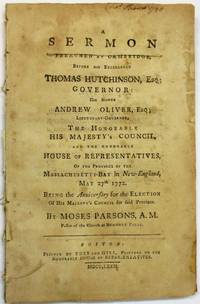
177236416Boston: Edes and Gill 1772. 43 1 blank pp but lacking the half title. Disbound light to moderate foxing. Good. Ownership signature "Chas. Stearns 1780" at head of title. <br /> <br /> A desirable pre-Revolutionary War sermon. Parsons locates God's hand in all events "either when we enjoy the advantages of good civil government or find that it is altered and become grievous." The British heritage of good civil government is now disturbed: "The scene is changed- Grievances are complain'd of- In Great Britain- In Ireland- In America- In this Province.- The day is become gloomy and dark and the waters are troubled." <br /> Even in England "A King may be misled by evil counsellors- He may be corrupted by bad ministers and give into those measures which are injurious to the subject." As God has brought us safely out of the "howling wilderness" He will do so today when "our liberties have been invaded and hostile measures made use of to bring us to submit to things which are grievous." <br /> FIRST EDITION. Evans 12502. ESTC W29233. Edes and Gill unknown
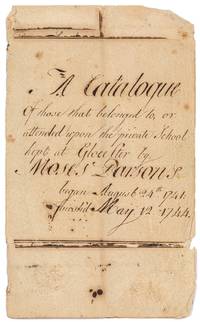
1741560322Gloucester Massachusetts 1741. Softcover. Very Good. Manuscript. 24mo. Three quarter leaves pinned inside two outer full leaves measuring about 3 ½†x 6â€. One quarter leaf is loose laid-in. The full front cover leaf titled in manuscript is trimmed above the title and has one horizontal cut below the title very good. The three-quarter leaves list the names of students 75 boys and 13 girls in ink on the rectos and versos. Born in Gloucester Massachusetts in 1716 Moses Parsons graduated from Harvard in 1736 and while pursuing his theological studies he taught a private school in his native town as noted in the catalogue from 1741-44. In 1744 he accepted a call to Byfield Parish where he was distinguished as a preacher until his death in 1783 having seen the Church through the Great Awakening led by George Whitefield and through the Revolutionary War. At his school Parsons taught a veritable Who’s Who of early Gloucester residents – individual and family names such as Winthrop Sargent whose son was a prominent patriot and Governor of the Mississippi Territory William Ellery Nathaniel Haraden whose son served as the Sailing Master of the U.S.S. Constitution and many others. In addition to his pastoral responsibilities at Byfield Parsons was instrumental in founding Governor Dummer Academy now known as The Governor’s Academy. During his tenure at his private school Parson’s calculates that he taught 75 boys and 28 girls quite a few of whom would go on to be immortalized by Gloucester historians John Babson and James Pringle. An important early manuscript documenting an overlooked piece of Gloucester’s local history.<br /> <br /> Reference: William Cutter. Genealogical and Personal Memoirs Relating to the Families of the State of Massachusetts. unknown
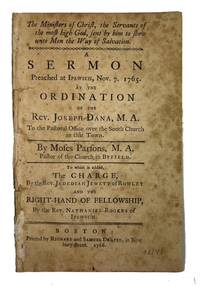
176692148Boston: Printed by Richard and Samuel Draper in Newbury-Street 1766. Paperback. Fair. 30p. Disbound removed from a bound volume. 19 cm. Substantial foxing. Last few leaves almost entirely detached. No separate wrapper present. Coloniral printing. Dana served as minister in Ipswich fror 62 years. Printed by Richard and Samuel Draper, in Newbury-Street paperback
176542130Boston: Printed by Richard and Samuel Draper in Newbury - street 1765. 36pp with the half title as issued. Disbound with recent stitching mild scattered spotting Good plus or Very Good. Clipped inscription at top margin of half title: "For the Revd Jonathan Parso--."<br /> <br /> The half title is "Mr. Parsons's Sermon at the Ordination of the Reverend Joseph Dana."<br /> Ministers says Parsons are God's agents "send by him to shew unto Men the Way of Salvation."<br /> Evans 10439. ESTC W26196. Printed by Richard and Samuel Draper, in Newbury - street unknown
171037844Frankfurt a. M. 1710. First edition. Hardcover. fair to g. Folio. 1 leaf 4 leaves 99 leaves 114 leaves 9 leaves 13 leaves 1 leaf. Contemporary brown leather with blind tooling along the border and spine as well as raised bands. Blue edges. Illustrated title page with image of a swan. Head and tail pieces. Commentary on the Talmud that elucidates contradictions within the text. Author makes use of gematriot based on his name. Text printed in double columns with talmudic text in regular script and author's comments in Rashi script. Source notes on side margins. Text in Hebrew. Significant peeling and scratching to leather boards. Bottom edge torn. Tail of spine mostly missing. Some misnumbering to leaves. Leaf 5 was bound after the fact. Name of previous owner on front endpaper. Heavy foxing to leaves. Overall in fair to good condition. hardcover
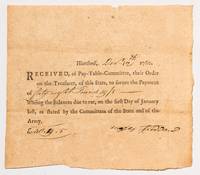
1780423857Hartford Connecticut 1780. Unbound. Near Fine. Approximately 7" x 6. 5" on laid paper with a deckled edge. Old folds near fine. Receipt of payment from the Pay-Table Committee of 48 pounds to Moses Stoddard Signed by Stoddard as received. Docketed as received on the verso. unknown